logo elektroda
logo elektroda
X
logo elektroda

De Dietrich - How do I record the switching on of my central heating cooker by connecting to LEDs?

Mariusz.33 3411 3
ADVERTISEMENT
Treść została przetłumaczona polish » english Zobacz oryginalną wersję tematu
  • #1 15821703
    Mariusz.33
    Level 9  
    I have a De Ditrich brand central heating + DHW furnace with a controller installed in a detached house. I would like to record the fact that it is switched on and off. As I plan to do this without too much reworking of the working solution, I came up with the idea of connecting to the LEDs on the panel that light up when the furnace is running.
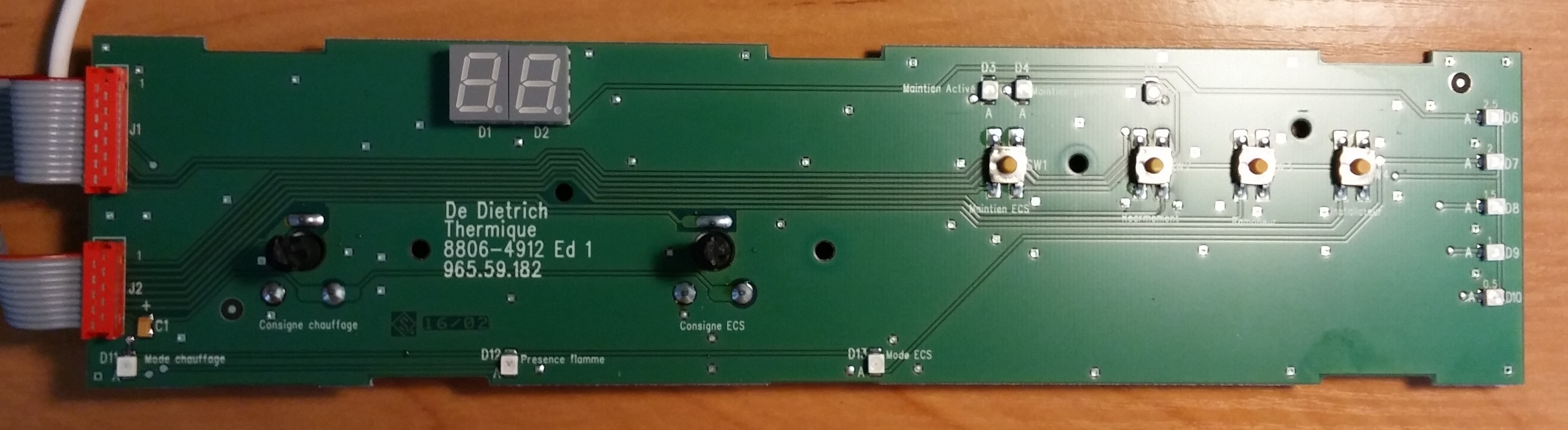
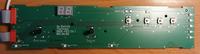
    I dismantled the panel, which looks like this:
    De Dietrich - How do I record the switching on of my central heating cooker by connecting to LEDs?

    The LEDs I am interested in are located at the bottom (3 pieces). From analysing the paths on the board, I worked out that these LEDs share a common ground (the path above them) - I soldered a cable there.
    I then soldered the 3 cables to the individual LEDs (from the bottom) at the A marking (I think it was like Anode). Testing the correct connection with a meter, the LEDs even lit up slightly, so the cables are conducting correctly.

    And now the strangest thing, which surpasses my knowledge of electronics:
    When I measured the voltage on the individual LEDs, the multimeter showed "-1.32V" when the LEDs were not lit and from "-0.6V - -1.0V" when they were lit. I was expecting about a 2V drop on each LED, not negative values. Furthermore, when lit, these voltages varied and were probably also dependent on the digital display (on top of the board).

    My request/question:
    - how to explain the above strange readings?
    - how else to detect the on/off of the cooker (without extensive interference with the original controller)? I rather skip registering temperature changes on the pipes because that's not a very accurate way.
  • ADVERTISEMENT
  • #2 15825100
    Mariusz.33
    Level 9  
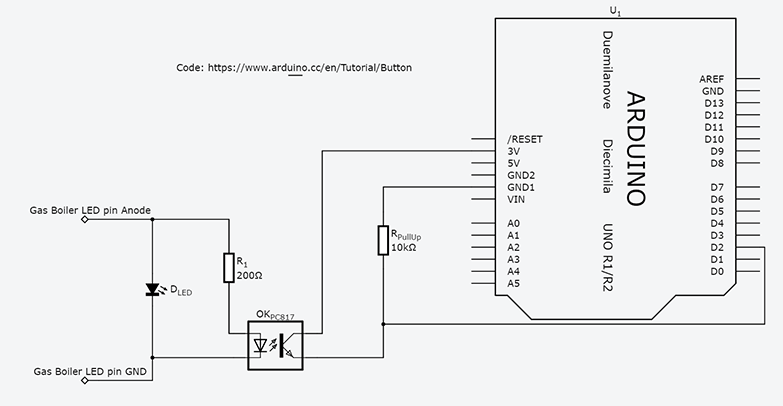
    Maybe it will be useful to someone: i was able to achieve the desired effect (on/off detection of the central heating boiler) by connecting to the LED indicating its operation. I used a PC817 optocoupler. Connection as in the diagram below:
    De Dietrich - How do I record the switching on of my central heating cooker by connecting to LEDs?
    Notes:
    - the Dled diode is one of the three light diodes in the boiler panel (for the others the connection is analogous);
    - the optocoupler has been connected in parallel to the diode, so that its current "spreads" over the diode and the optocoupler;
    - resistor R1 is needed to limit the current;
    - the connection to the microcontroller (here an Arduino UNO) acts as an on/off switch with a pull-up resistor. This can be handled, for example, with the standard example button for Arduino .

    I have tested the circuit and it works for me :) Of course I do not guarantee that it will work in every case.
    Please feel free to offer any comments and constructive criticism.
  • ADVERTISEMENT
  • #3 15832739
    enceladuse
    Level 13  
    It's a bit of a risky approach to mess around with the motherboard - you're more than likely to lose your warranty and the question is, will the cooker pass inspection? After all, it is a gas cooker that has to undergo periodic inspections (as does the entire gas installation). Insurers require such inspections.
    Coming back to the actual issue - the question is what kind of control console you have, because the diametic console from De Dietrich has a communication bus, which according to the descriptions on the French forum is MODBUS over RS485
    http://www.systemed.fr/forum-bricolage/de-dietrich-diematic-modbus-t34836.html


    There is also information on the DieDietrich website about the DIAMETIC BUS -> MODBUS OVER TCP adapter.

    Using such an interface, it is possible not only to read data from the furnace, but also to set its parameters.

    If you don't want to mess around with interfaces - a photoresistor superimposed on a diode on the panel seems safer - no interference with the electronics - no problems with inspection.
  • #4 15832833
    Mariusz.33
    Level 9  
    enceladuse wrote:

    A bit of a risky approach messing around with the motherboard - you're more than likely going to lose your warranty

    The cooker is already a dozen years old, so no such problem :) Actually it's not a motherboard just a module with a few buttons, LEDs and a simple display. I wanted to make it fairly non-invasive so as not to modify the operating parameters. But of course in case of warranty there could be a problem.

    enceladuse wrote:

    and the question is whether the cooker will pass inspection? After all, it is a gas cooker, which has to undergo periodic inspections (as does the entire gas installation). Insurers require such inspections.

    As far as I know, the insurer only requires a certificate from a chimney sweep and an electrician.

    enceladuse wrote:

    Back to the actual issue - The question is what kind of control console you have because the diametic console from De Dietrich has a communication bus, which according to the descriptions on the French forum is MODBUS over RS485
    http://www.systemed.fr/forum-bricolage/de-dietrich-diematic-modbus-t34836.html

    On the DieDietrich website there is also information about the DIAMETIC BUS -> MODBUS OVER TCP adapter.

    Using such an interface, it is possible not only to read data from the furnace, but also to set its parameters.

    The boiler is a City 3.24 and the controller is a SV-matic 321. The website mentioned above lists a different model. From what I once spoke to a service technician there are no such extras for my cooker.


    enceladuse wrote:

    If you don't want to mess about with interfaces - then a photoresistor superimposed on a diode on the panel seems safer - no interference with the electronics - no problems with inspection.

    I've thought about this, but not too much room to put the components in there (it's covered up by a flap).
ADVERTISEMENT