
logo elektroda
logo elektroda
X
logo elektroda

Wago - 8A relay in a smart home system with Siemens S7 PLC - is it enough?

PiotreKK007 2325 6
ADVERTISEMENT
Treść została przetłumaczona polish » english Zobacz oryginalną wersję tematu
  • #1 16123371
    PiotreKK007
    Level 10  
    Welcome.

    I'm trying to make a smart home prototype.
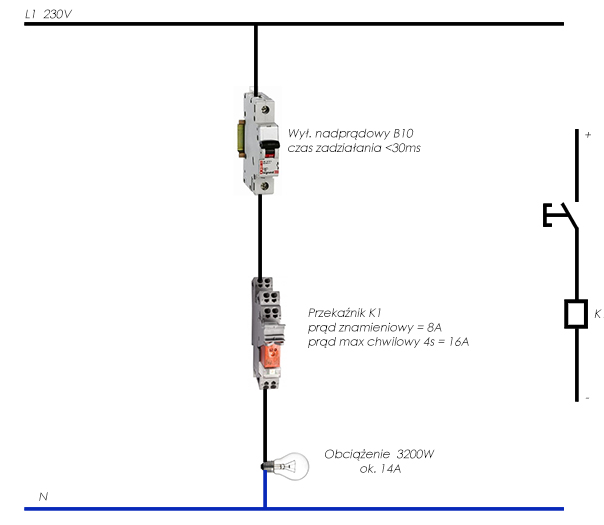
    I have a dilemma which is best (briefly) shown in this image.
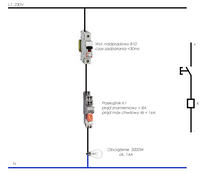
    Wago - 8A relay in a smart home system with Siemens S7 PLC - is it enough?

    Namely - I would like to use a Siemens S7 PLC to control relays to switch individual circuits. Lighting and some less loaded sockets.

    It is hard to find a relay with a higher load rating than 8A and having two connections at a good price.
    Is there a case for something like the picture? I.e. a relay with a smaller rating than the fuse in front of it?
    If the rated capacity is approx. 14A or even 9A, will the overcurrent circuit breaker trip first or will the relay burn out sooner?

    Maybe a silly question, but please answer.
    I hope the only solution is not to use 16A DC relays?
  • ADVERTISEMENT
  • #2 16123372
    3301
    Level 34  
    If you have a 10A neutral, the 14 will not flow for too long anyway, and the 9A will overheat the relay sooner or later, so it's probably better to have a spare right away.
    For a neutral, the tripping current is 1.45XIn and it should switch off the circuit within an hour.
    And why 16A DC?
  • ADVERTISEMENT
  • ADVERTISEMENT
  • #5 16132075
    PiotreKK007
    Level 10  
    3301 wrote:
    If you have a 10A neutral, then 14 will not flow for too long anyway, and the 9A will overheat the relay sooner or later, so it is probably better to have a reserve.
    For a neutral you have a tripping current of 1.45XIn and it should switch off the circuit within an hour.
    And why 16A DC?


    Ok, so the only sensible solution would be to use more expensive relays up to 16A.
    With that 1.45Xln I was already completely confused about what this was about, but I've done some reading and am getting something there.
    It was supposed to be 16A AC not DC:-)

    Added after 9 [minutes]:

    pafciowaw wrote:
    For large 1-phase loads it is better to use a modular contactor e.g.
    https://www.tim.pl/stycznik-modulowy-16a-1z-0r-24v-ac-ict-a9c22111#
    The relay by definition has only one insulation gap between the contacts (the contactor has two) so it will burn out quickly.


    Then I have another question.
    The contactor you gave in the link is a contactor with a max load of 16A.
    Here I found a Wago 788-354 relay whose max load is also 16A ( Link )

    If I want to switch sockets in the house protected by a B16 overcurrent fuse then, given that a relay comes out cheaper, would it be better to use a relay or the contactor you have shown?

    And then there is a similar question - if I use a contactor/relay up to 16A max followed by a B16 overcurrent fuse, will this work or will the relay/contactor burn out?

    Added after 1 [minute]:

    e2e4 wrote:
    Good afternoon.
    You might want to consider installing a solid state relay,
    maybe even a zero-crossing SSR.
    http://www.jmtcontrol.pl/Przekaznik-SSR-GD2544ZD3
    Nothing will tick, contacts will not burn out.

    Good luck,
    natenczas, e2e4.


    Cool stuff, but I'd rather stay with these relays, possibly contactors.
  • ADVERTISEMENT
  • #6 16132136
    retrofood
    VIP Meritorious for electroda.pl
    PiotreKK007 wrote:

    This brings me to another similar question - if I use a contactor/relay up to a maximum of 16A followed by a B16 overcurrent fuse, will this arrangement work or will the relay/contactor burn out?

    It doesn't matter.

    PiotreKK007 wrote:
    If I want to switch sockets in the house protected by a B16 overcurrent fuse then, given that a relay comes out cheaper, would it be better to use a relay or the contactor you have shown?

    A relay is only allowed to interrupt one pole (L). The contactor has gasification chambers so it can interrupt both L and N at the same time. In your case, interrupting N would be pointless, so you can use the second track to double the interrupts for better arc quenching. The contactor will therefore be more durable, but also louder.
    The decision is up to you.
  • #7 16134054
    ditomek
    Level 22  
    on allegro there are 30A relays for arduino for a dozen or so zlotys
ADVERTISEMENT