


logo elektroda
logo elektroda
X
logo elektroda

Sipeed M1s and M0sense - affordable AI modules based on BL808 and BL702

ghost666 2166 1

TL;DR

  • Sipeed launched the M1s AIoT module, the M0Sense TinyML board, and an M1s Dock with camera, display, audio and expansion connectors.
  • M1s uses Bouffalo Lab BL808 with a 64-bit C906, two additional RISC-V cores, BLAI-100 NPU, 768 KB SRAM, 64 MB PSRAM and 16 MB flash.
  • The BL808 adds Wi‑Fi, dual Bluetooth 5.x, Zigbee, 1080p H.264 decoding, MIPI CSI/DVP camera support, RGB LCD output, RMII Ethernet and USB 2.0 OTG HS.
  • M0Sense uses the BL702 at 144 MHz with 132 kB SRAM, 512 kB Flash, BLE, an IMU, a microphone and optional 0.96-inch display.
  • Drag-and-drop storage mode, Python scripts, SDKs, TinyMaix and MaixHub support the boards, while Indiegogo pricing starts at $19 and shipping adds $2–29.
Generated by the language model.
ADVERTISEMENT
This content has been translated flag-pl » flag-en View the original version here
📢 Listen (AI):
  • Sipeed M1s and M0sense - affordable AI modules based on BL808 and BL702
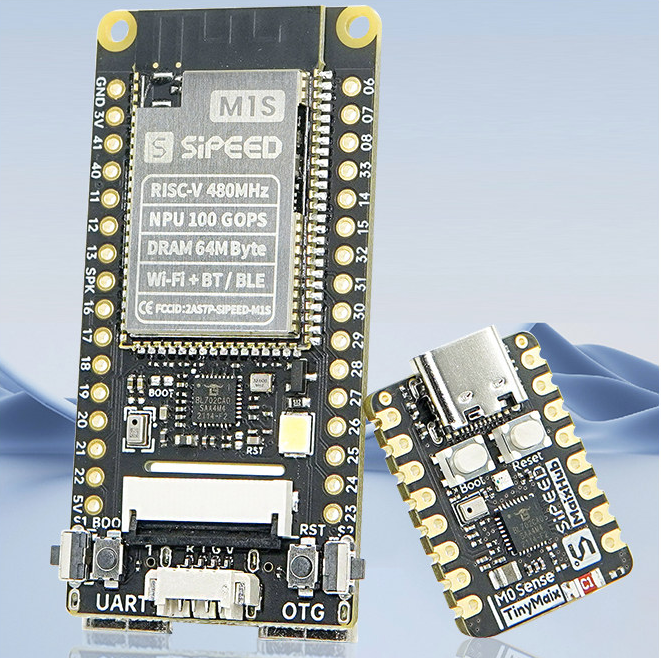
    Firm Sipeed has launched new M1s and M0Sense AI modules. Designed for AIoT applications, the M1s is based on a 32-bit/64-bit RISC-V core wireless SoC from Bouffalo Lab — BL808 with Wi-Fi, Bluetooth and 802.15.4 radio for Zigbee support. And a BLAI-100 module (Bouffalo Lab AI engine) — a neural network gas pedal for detection and/or recognition in video/audio footage. Sipeed M0Sense, on the other hand, is designed for TinyML-based applications with Bouffalo Lab's BL702 32-bit microcontroller, also offering WiFi, BLE and Zigbee connectivity.

    Sipeed M1s AIoT module

    Sipeed M1S is a new version of the Sipeed M1 unit introduced several years ago, based on the Kendryte K210 chip.

    Sipeed M1s and M0sense - affordable AI modules based on BL808 and BL702

    Specification of the Sipeed M1s module:

    * SoC — Bouffalo Lab BL808 with:
    — Alibaba T-head C906 — 64-bit RISC-V core (RV64GCV+) clocked at 480 MHz,
    — Alibaba T-head E907 — 32-bit RISC-V core (RV32GCP+) clocked at 320 MHz,
    — 32-bit RISC-V core (RV32EMC) clocked at 160 MHz,
    — RAM — 768 KB SRAM and 64 MB embedded PSRAM,
    — AI gas pedal — BLAI-100 NPU (Bouffalo Lab AI engine) for detection/recognition in video/audio, providing up to 100 GOPS with a rich set of options,
    — VPU – decoding of H.264 up to 1920 × 1080,
    — 2.4 GHz Wi-Fi 802.11 b/g/n,
    — dual Bluetooth 5.x (classic + BLE),
    — IEEE 802.15.4 transceiver for Zigbee.
    * Storage — 128 Mbit (16 MB) NOR Flash;
    * Outputs with the following interfaces:
    — Display — SPI, 8-bit parallel interface, RGB LCD,
    — Camera — MIPI CSI and DVP interfaces up to 1080p,
    — Audio — I²S and analog audio input/output,
    — Network — RMII Ethernet,
    — USB — USB 2.0 OTG HS,
    — low-speed peripheral interfaces — UART, I²C, SPI, SDIO, ADC/DAC.
    * Dimensions — 31 mm x 18 mm.

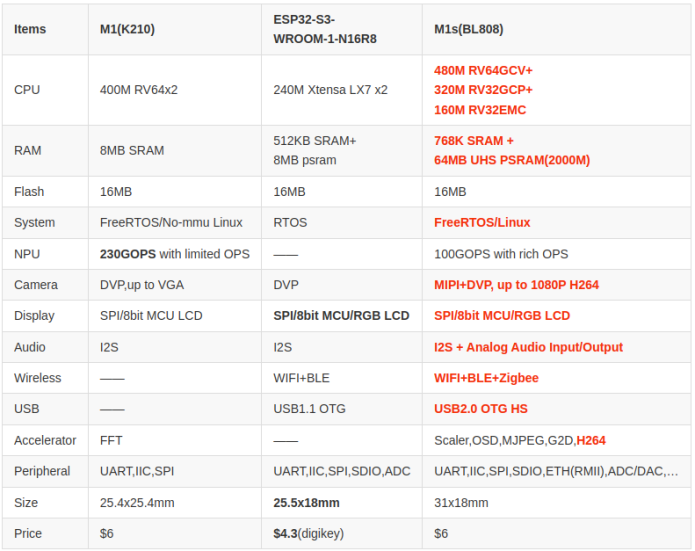
    It appears that the developers of the module had previously considered the ESP32-S3, but the BL808 SoC provides more processing power and RAM. The table below compares the Sipeed M1, M1S and ESP32-S3-WROOM-1-N16R8 modules. The only thing that seems inaccurate in it is that the ESP32-S3 does not support AI acceleration, as this is not true. This SoC does support acceleration for machine learning algorithms.
    Sipeed M1s and M0sense - affordable AI modules based on BL808 and BL702


    One advantage of the BL808 is that it can support Linux, and the chip includes an MMU, so there is no need to deal with typical uClinux issues.

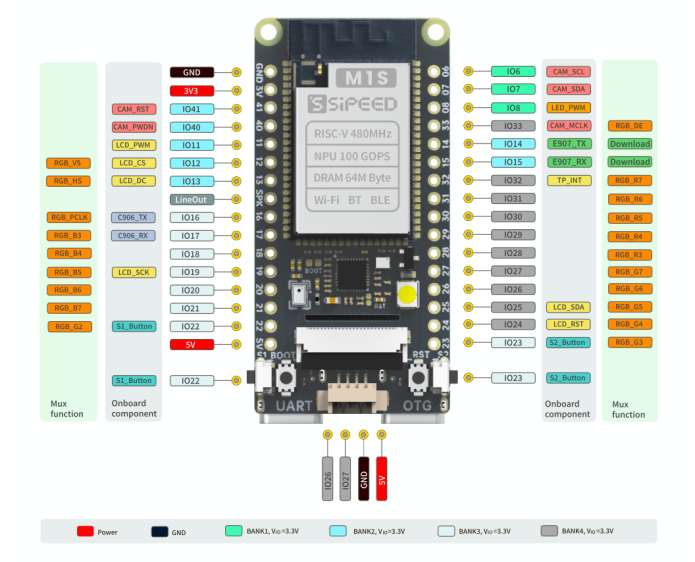
    Sipeed also offers the Sipeed M1s Dock with a camera and display to demonstrate most of the functions of the M1s module.

    Sipeed M1s and M0sense - affordable AI modules based on BL808 and BL702

    Specification Sipeed M1s Dock:

    * SoM — Sipeed M1s described above;
    * Storage — MicroSD card slot that also supports JTAG mode;
    * Display — 1.69-inch 280×240 resolution with capacitive touchscreen;
    * Camera — 2MP built-in camera with MIPI CSI interface and LED flash (OV2685 sensor);
    * Audio — MEMS analog microphone and line output;
    * USB — 1x USB Type C with built-in converter for two serial ports and 1x USB 2.0 Type-C OTG HS;
    * Expansion options:
    — two 16-pin input/output connectors suitable for contact boards,
    — 4-pin UART connector.
    * Debugging — optional TF2JTAG interface;
    * Miscellaneous — Reset, Boot and two user buttons;
    * Power supply — 5V via USB Type-C port;
    * Dimensions — 55 mm × 27 mm.

    Sipeed M1s and M0sense - affordable AI modules based on BL808 and BL702


    The company also offers a case for the Sipeed M1s Dock, as pictured with the microSD card and Sipeed M0Sense shown for scale.

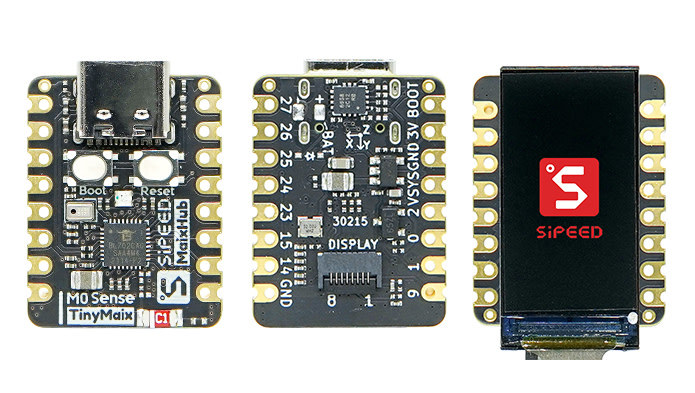
    The Sipeed M0Sense TinyML board
    Sipeed M1s and M0sense - affordable AI modules based on BL808 and BL702
    Sipeed M0Sense specifications:

    * Microcontroller — Bouffalo Lab BL702 — 32-bit RISC-V (RV32) clocked at 144 MHz with 132 kB SRAM, 512 kB Flash, Bluetooth Low Energy connectivity;
    * Display — optional 0.96 inch diagonal;
    * USB — USB Type-C port;
    * Sensor — built-in IMU and microphone;
    * Expansion capabilities — two 8-pin connectors (holes for goldpins and fields for soldering SMD module) with GPIO, I²C, UART, SPI;
    * Miscellaneous — RGB LEDs;
    * Power supply — 5 V via USB-C port;
    * Dimensions — 23 mm x 18 mm.
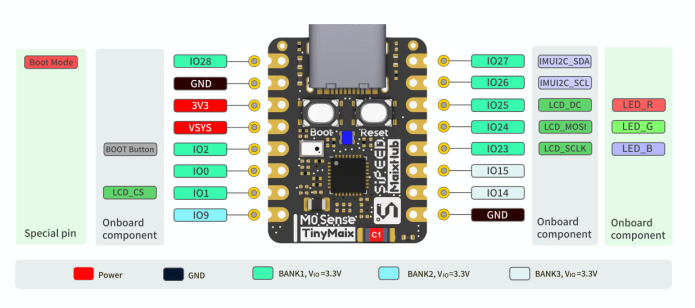
    Sipeed M1s and M0sense - affordable AI modules based on BL808 and BL702


    Software support


    There are many ways to program boards, such as. via „drag-and-drop” applications, as both M1s Dock and M0Sense can be seen by the computer as storage devices, here via a lightweight Python script and more complete and flexible, using the SDK of the chips. Examples of this approach are available in the company's repository on GitHub.

    Sipeed also offers two AIoT/TinyML solutions that work with new modules/boards and a range of third-party units:

    * TinyMaix — a Tiny inference neural network library specifically designed for microcontrollers with just 400 lines of core code and so far ported to more than 40 chips;
    * MaixHub — an online platform for training and sharing AI models.

    The best way to understand the capabilities of Sipeed M1s and M0Sense is to watch the video below, showing various demos ranging from MNIST handwritten digit recognition to face detection, posture capture, object classification and more. Prices and availability

    Sipeed unveiled the M1S and M0Sense modules as part of a campaign on Indiegogo with a flexible funding goal of $2155. Campaign contribution levels start at $19 for a set of five M0Sense boards and $22 for a complete Sipeed M1S Dock package with display, camera and enclosure. Shipping adds an additional $2-29 depending on the destination country. And it's also scheduled for the end of the month, right after the campaign ends. Alternatively, both rigs should appear on the AliExpress store later in November.

    Source: https://www.cnx-software.com/2022/11/14/sipeed-m1s-m0sense-low-cost-bl808-bl702-ai-modules/
    About Author
    ghost666
    Translator, editor
    Offline 
    ghost666 wrote 11961 posts with rating 10259, helped 157 times. Live in city Warszawa. Been with us since 2003 year.
  • ADVERTISEMENT
  • #2 20320952
    Anonymous
    Level 1  
📢 Listen (AI):

FAQ

TL;DR: Sipeed’s M1s pumps 100 GOPS AI at 480 MHz and bundles 64 MB PSRAM, “BL808 packs more processing power and RAM” [Elektroda, ghost666, post #20320756] Kits start at $22 on Indiegogo [CNX-Software, 2022].

Why it matters: Makers can now run Linux-class vision models on a thumb-sized module.

Quick Facts

• Triple-core BL808: 64-bit 480 MHz, 32-bit 320 MHz & 160 MHz [Elektroda, ghost666, post #20320756] • NPU: 100 GOPS + 1080p H.264 VPU [Elektroda, ghost666, post #20320756] • Memory: 768 kB SRAM + 64 MB PSRAM, 16 MB NOR flash [Elektroda, ghost666, post #20320756] • Dock: 1.69″ 280×240 touchscreen & 2 MP OV2685 camera [Elektroda, ghost666, post #20320756] • Crowdfunding price: $19/5× M0Sense, $22 M1s Dock; shipping $2–29 [CNX-Software, 2022]

What does the M1s improve over the older Kendryte K210-based M1?

M1s swaps the dual-core K210 for a triple-core BL808 that is 2× faster (480 MHz vs 400 MHz) and adds 64 MB embedded PSRAM, Wi-Fi, Bluetooth 5.x and Zigbee radios—features absent on the K210 module [Elektroda, ghost666, post #20320756]

Can the M1s run Linux out of the box?

Yes. The BL808 includes an MMU, so full Linux (not uClinux) boots from the 16 MB NOR flash; Sipeed’s demo image launches a BusyBox shell in under 10 s [Elektroda, ghost666, post #20320756]

How do I flash new firmware onto the M1s Dock?

  1. Hold the Boot button while connecting USB-C.
  2. Drag-and-drop the compiled *.bin file onto the new mass-storage drive.
  3. Press Reset; the board reboots running your code [Elektroda, ghost666, post #20320756]

Does the competing ESP32-S3 really lack AI hardware?

No. ESP32-S3 integrates vector extensions that speed small ML models, and it supports USB 2.0 FS OTG and up to 1 GB SPI flash [Elektroda, khoam, post #20320952]

How much external storage can I add to the Dock?

The microSD slot handles cards up to 32 GB FAT32 without extra drivers; larger exFAT cards need manual kernel configuration [CNX-Software, 2022].

What development tools are available?

Sipeed ships the BL808/702 SDK, a 400-line TinyMaix inference library, and MaixHub for model training and sharing [Elektroda, ghost666, post #20320756] “TinyMaix now runs on more than 40 chips” [CNX-Software, 2022].

Can I record or play audio on the Dock?

Yes. The board exposes I²S plus an analog MEMS microphone and line-out jack, supporting 48 kHz stereo streams [Elektroda, ghost666, post #20320756]

What are typical M0Sense use cases?

With BLE, IMU, mic and optional OLED, M0Sense excels at gesture recognition, keyword spotting and wearable data logging where its 132 kB RAM suffices [Elektroda, ghost666, post #20320756]

Any edge cases or limitations to beware of?

Large CNNs exceed M0Sense’s 132 kB RAM, and early BL808 Linux images crash when decoding 1080p at >30 fps—stick to 720p for stability [CNX-Software, 2022].
Generated by the language model.
ADVERTISEMENT