
logo elektroda
logo elektroda
X
logo elektroda

Enhancing OBK Status Page with WiFi Details for OpenBeken Devices

max4elektroda 3939 64
Best answers

Czy można rozszerzyć stronę statusu OpenBeken o szczegóły Wi‑Fi, takie jak aktualny BSSID, kanał i tryb PowerSave, oraz czy takie zmiany działają też na innych platformach?

Tak — sensownym kierunkiem było przeniesienie dodatkowych danych Wi‑Fi do JSON API (Tasmota-like) i ewentualnie pokazanie ich w Web App, zamiast rozbudowywać główną stronę OBK [#21588291][#21077881] W praktyce BSSID i kanał zostały już dodane do JSON statusu, a SSID uznano za zbędne, bo zwykle można je odczytać z konfiguracji; na głównej stronie pozostawiono tylko PowerSave jako bardziej ogólną informację [#21075738][#21602507][#21678334] Testy pokazały, że na wielu platformach działa to poprawnie: RTL8720D zwracał poprawny JSON z Wifi/BSSId/Channel, a później potwierdzono działanie także na BL602, LN882H, BK7231N, ESP32, W600, W800, BK7238, ECR6600, BK7231T, RTL8720CF i XR809 [#21602660][#21603311] Na XR najpierw był problem z BSSID, ale został poprawiony przez cache BSSID w bloku `safeMode == 0`, po czym uznano zmiany za bezpieczne do scalenia [#21603163][#21603218][#21603333] Dodatkowo zwrócono uwagę, że trzymanie tych danych w JSON/Web App pozwala uniknąć rozdmuchiwania strony statusu i zachowuje kompatybilność z urządzeniami, które można łatwo odzyskać przez UART, jeśli coś pójdzie nie tak [#21073333][#21076301]
Generated by the language model.
ADVERTISEMENT
  • #1 21073220
    max4elektroda
    Level 24  
    Posts: 746
    Help: 48
    Rate: 184

    When accessing an OpenBeken device without a serial log, I often miss some information.
    E.g. I have multiple access points and would like to see, to which my module is connected.
    Or: I would like to see if the device is using PowerSave and (with LN882H) which level.

    So I tried to add some WiFi hal functions, to make this accessible.

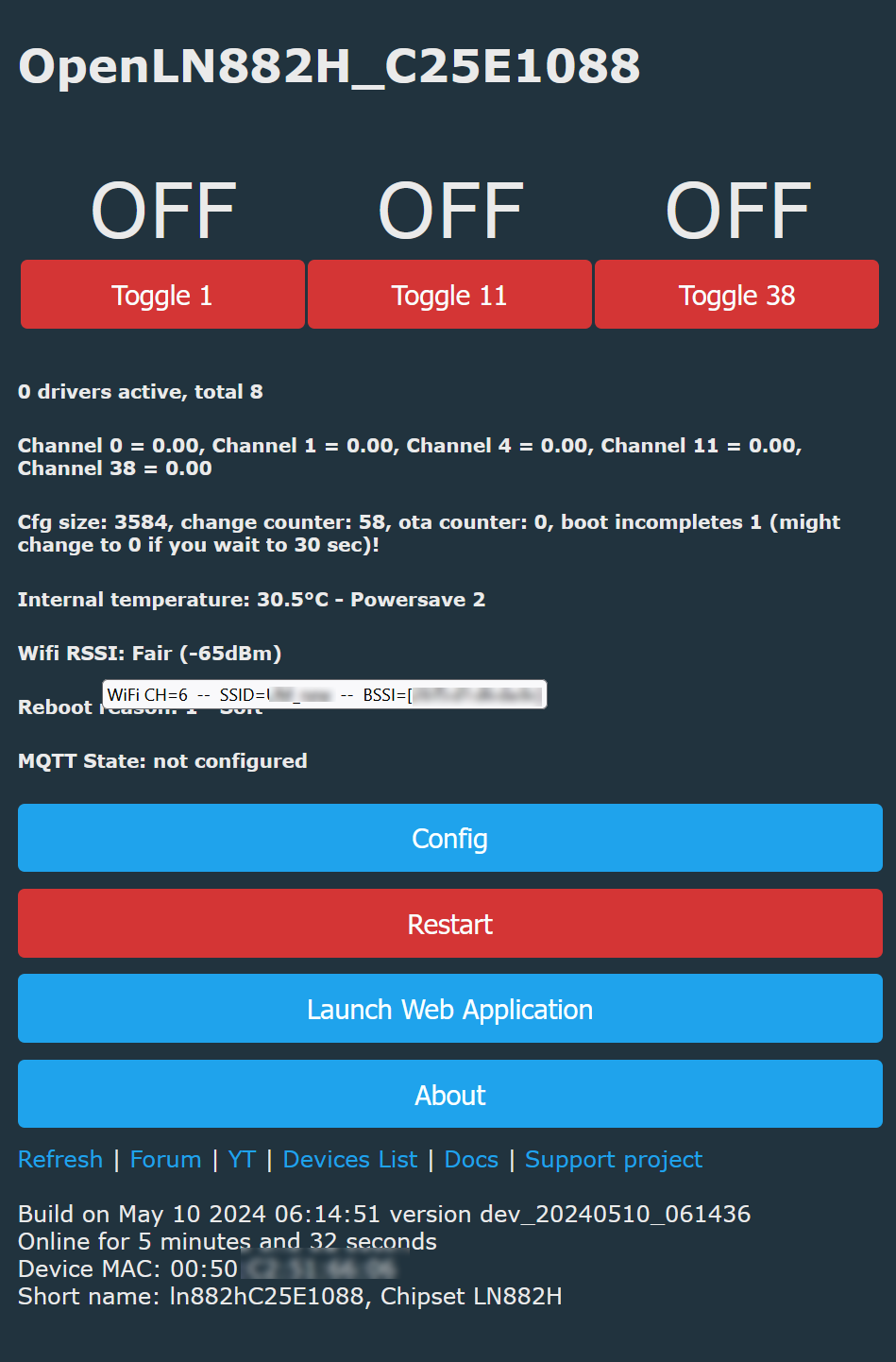
    On my LN882H it looks like this:
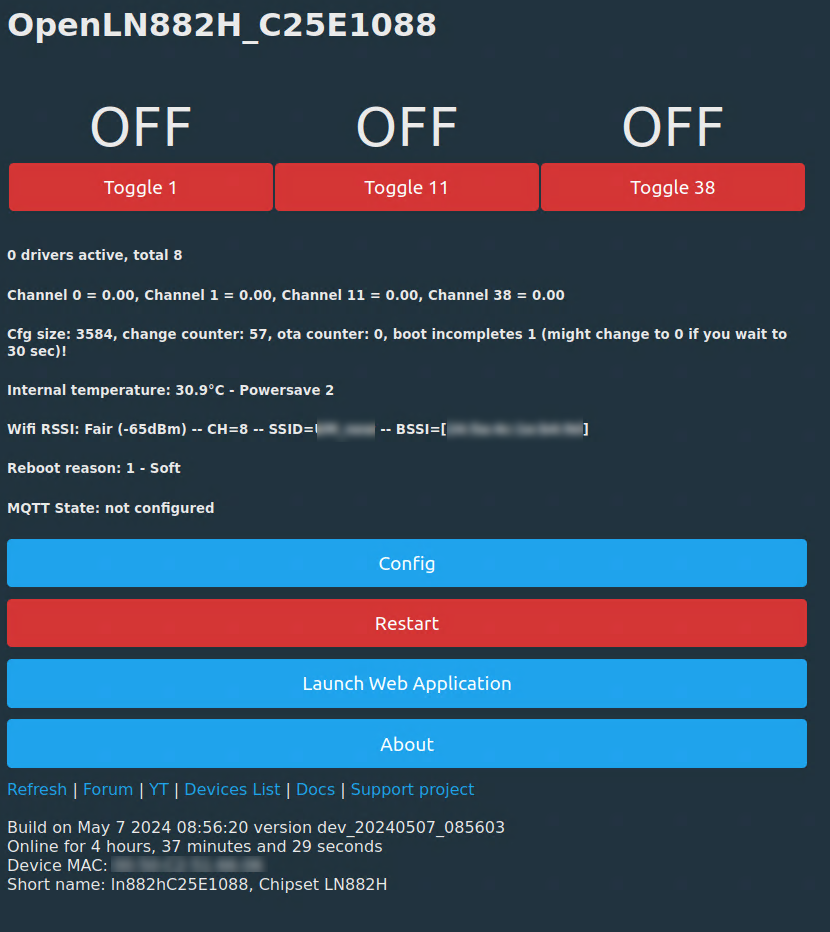
    User interface of the OpenBeken LN882H control panel.

    Since I only own LN882H modules, I would like some brave testers to try the images from this PR on other platforms.
    https://github.com/openshwprojects/OpenBK7231T_App/pull/1216

    Since I couldn't test them, I would suggest only to test on modules, which can be re-flashed easily (e.g via UART), if it might be inaccessible for an OTA update with this images...

    Thanks for any feedback.
  • ADVERTISEMENT
  • #2 21073333
    p.kaczmarek2
    Moderator Smart Home
    Posts: 14454
    Help: 650
    Rate: 12454
    @divadiow @DeDaMrAz wanna take a look?

    My first suggestion would be to put your code inside a conditional statement that checks for failed boots. This way you can make sure that you won't break devices even if your code has an error...

    Futhermore... hmmm I see you made a feature to put a WiFi info on the main page just to later censor it before putting it on forum....
    Maybe that's a sign that your feature should be enabled by a flag? Something like "show extra info"? So people can choose whether they show it or not?

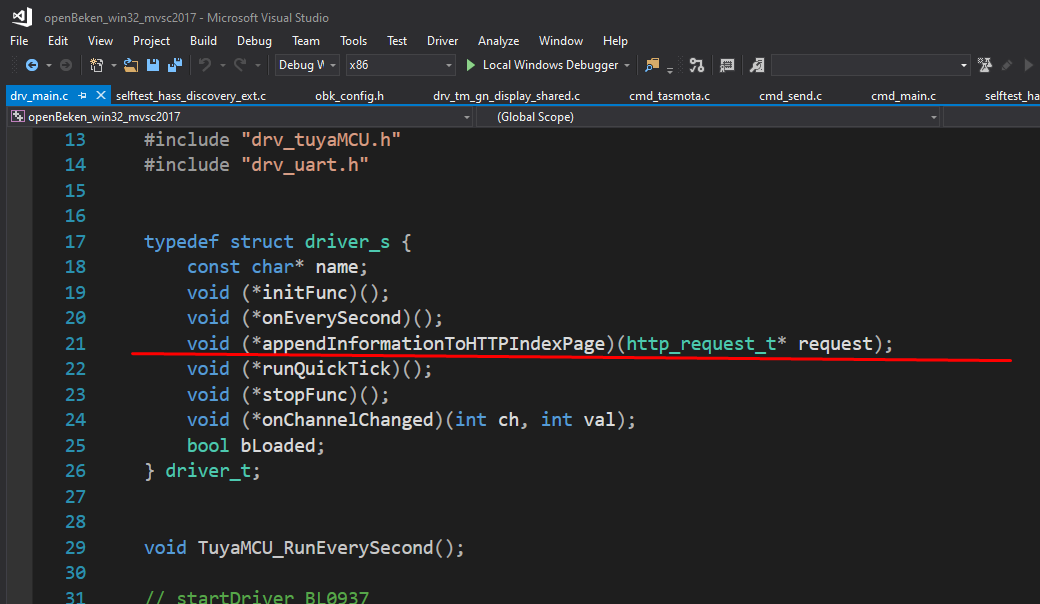
    Or maybe... maybe it could have been put in a driver? It would be even better than a flag...
    And then you would just use:
    View of Visual Studio screen showing C code.
    Helpful post? Buy me a coffee.
  • #3 21073436
    divadiow
    Level 38  
    Posts: 4891
    Help: 427
    Rate: 869
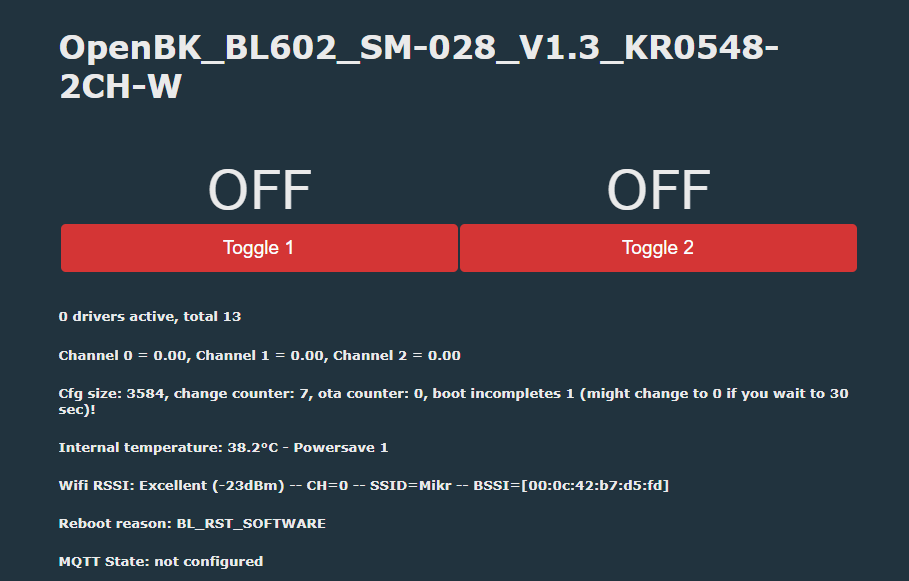
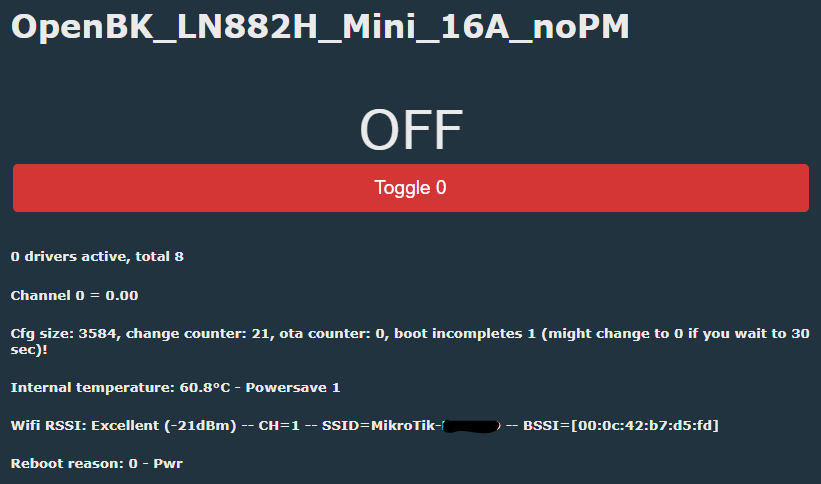
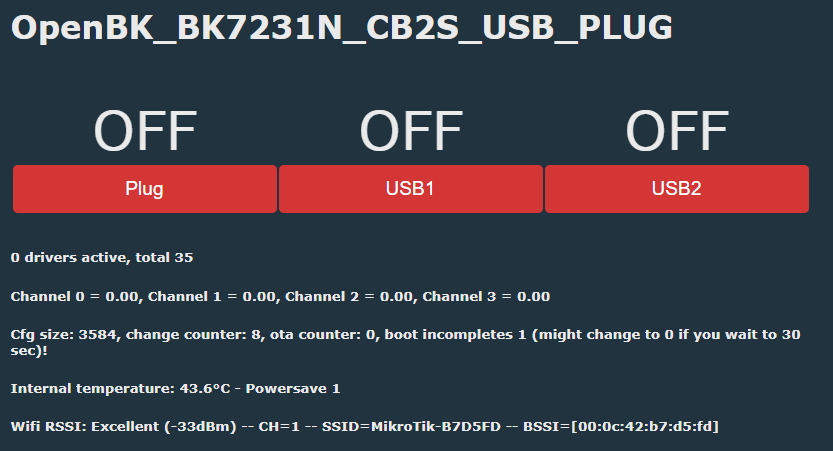
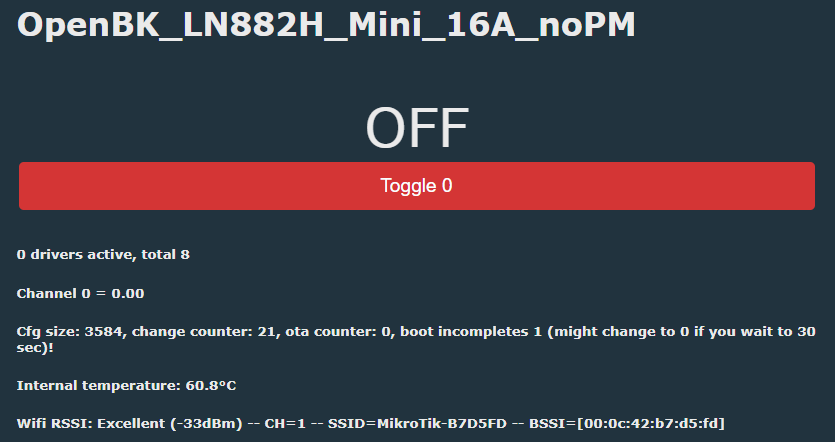
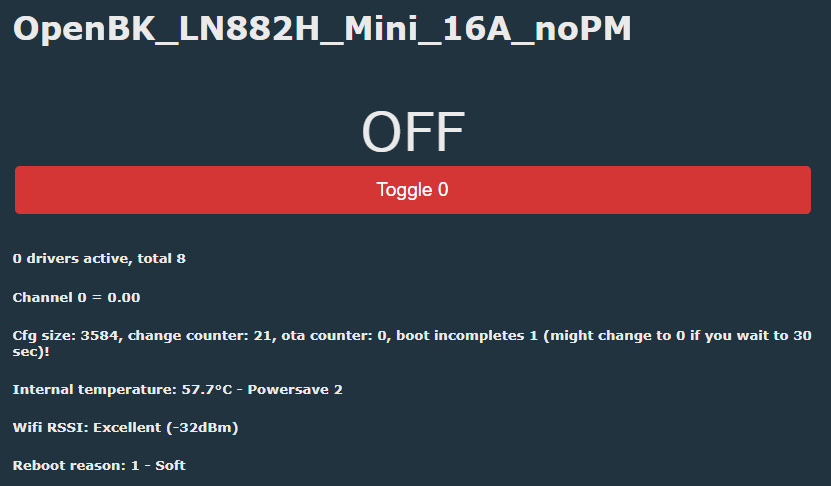
    Device interface with two Toggle buttons, both set to OFF. Screenshot of OpenBK LN882H Mini interface with Toggle 0 button.
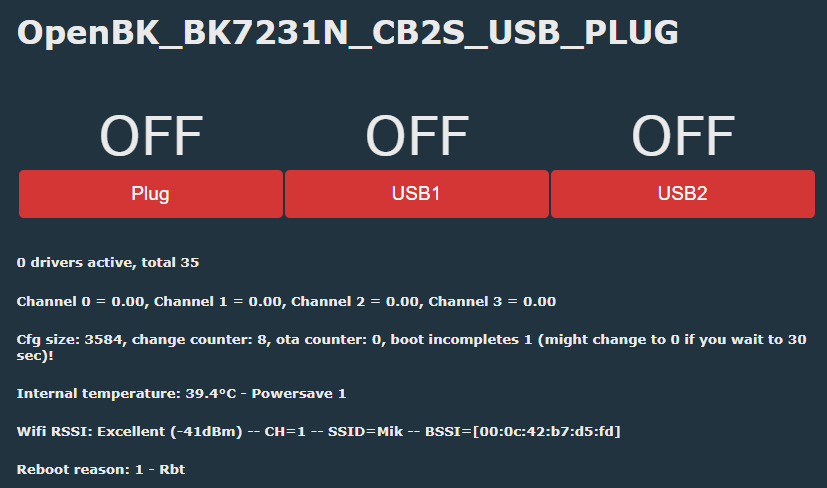
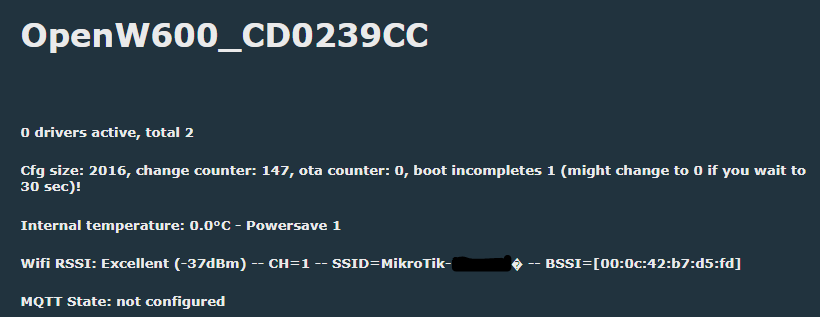
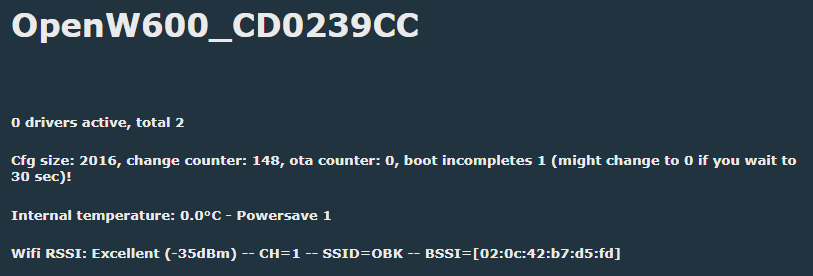
    Web interface of OpenBK_BK7231N_CB2S_USB_PLUG controller displaying device status information. Screenshot of the OpenW600 interface with configuration details.

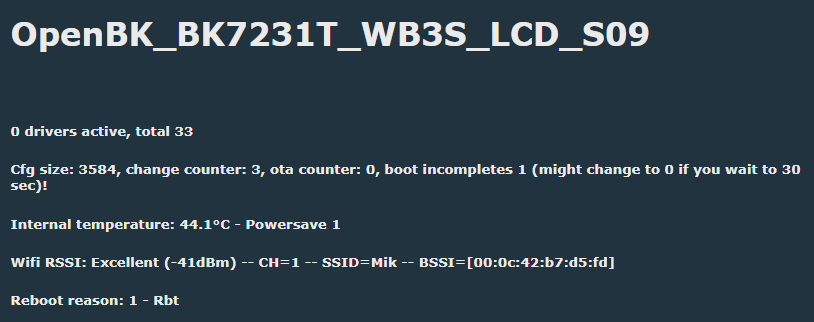
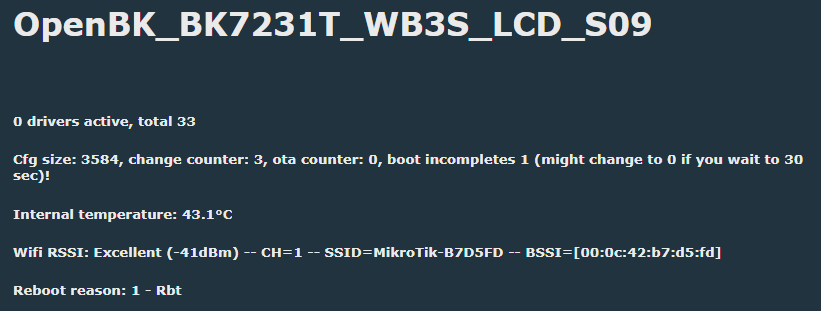
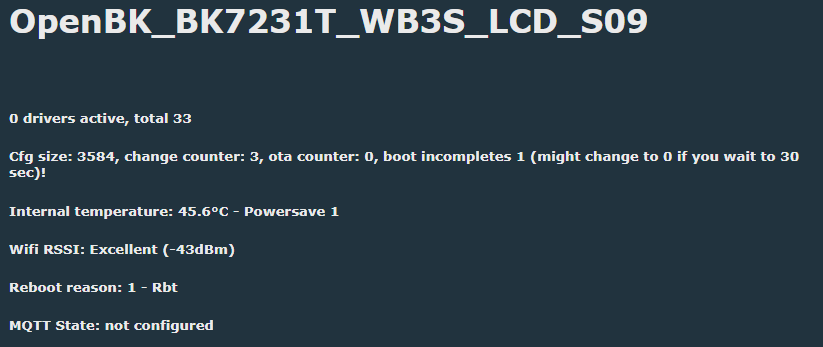
    Screen displaying system data of the OpenBK_BK7231T_WB3S_LCD_S09 device.

    all Build on May 7 2024 12:48:51 version 1216_merge_a66f326e5e17

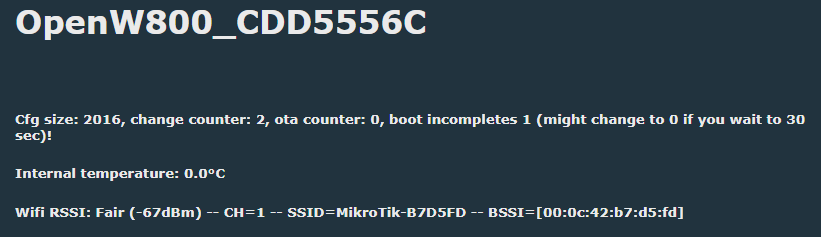
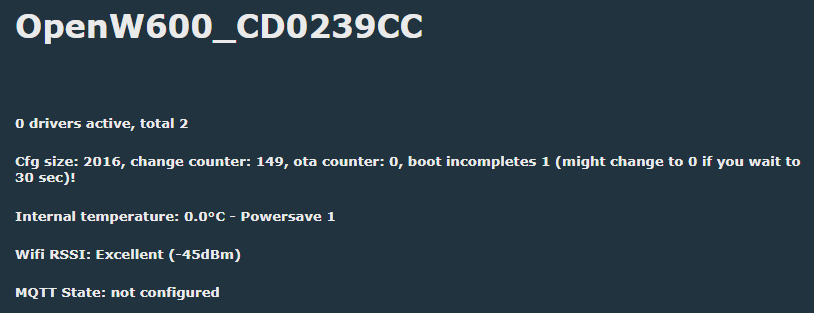
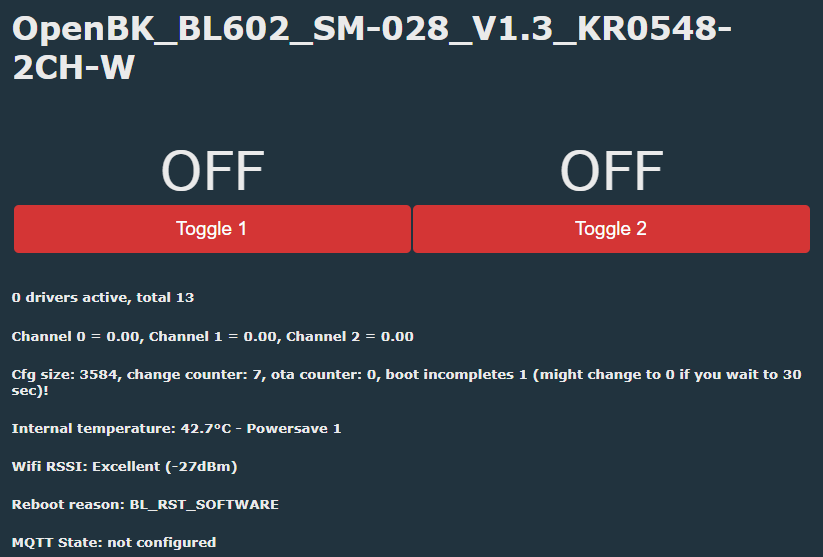
    all truncate SSID except LN882H and W600. W600 has invalid character at end but not if SSID is shorter

    Screenshot displaying diagnostic information for the OpenW600 device.
  • #4 21073559
    max4elektroda
    Level 24  
    Posts: 746
    Help: 48
    Rate: 184

    p.kaczmarek2 wrote:
    >>21073333
    Furthermore... hmmm I see you made a feature to put a WiFi info on the main page just to later censor it before putting it on forum....
    Maybe that's a sign that your feature should be enabled by a flag? Something like "show extra info"? So people can choose whether they show it or not?

    Yes, maybe I'm a bit paranoid, but I also censor MAC addresses, and they are on every status page, too ;-)

    This is for sure something to put into some conditional section, but actually I only wanted to hear, if it is working at all, so it makes no sense to suppress the output in this stage.

    I think putting it into a driver will just take too much space on the page - but that can be discussed, too.

    @divadiow : Great, that you took the risk.
    I'll take a look into this SSID issue - but even if it doesn't work - most people know what SSID they configured. Just the BSSID of the AP you are connected to is often some clicks away ;-)

    And: at least for my LN882H I had some times, where the displayed information was simply wrong. It showed a valid pair of channel and APs MAC, but it was in fact connected to another AP (could be verified by the (correct) rssi , which didn't match the shown AP (and by the serial log proving, it connected to another AP).
    There is something strange with LN882Hs wifi lib...

    Are the other ones showing correct values (channel and BSSID) in your case?
    Thanks for your support!
  • #5 21074987
    divadiow
    Level 38  
    Posts: 4891
    Help: 427
    Rate: 869
    max4elektroda wrote:
    Are the other ones showing correct values (channel and BSSID) in your case?


    BSSID is as expected for all. Regarding the channel, my Mikrotik doesn't seem to give me the frequency or channel for each client so I cannot say if they're all correct. The BL602 though says channel 0 which isn't a valid 2.4ghz channel?
  • ADVERTISEMENT
  • #6 21075738
    max4elektroda
    Level 24  
    Posts: 746
    Help: 48
    Rate: 184

    Thanks, I think I might just drop SSID (this is known and can be taken from the config - would only be interesting in case you have 2 SSIDs configured).
    Channel 0 is not valid, but usually given to configure startup with only SSID and an unknown channel.
    But maybe you can give the new Version a try (I used strcpy instead of memcpy here)?
  • Helpful post
    #7 21076301
    divadiow
    Level 38  
    Posts: 4891
    Help: 427
    Rate: 869
    Enhancing OBK Status Page with WiFi Details for OpenBeken Devices Enhancing OBK Status Page with WiFi Details for OpenBeken Devices Enhancing OBK Status Page with WiFi Details for OpenBeken Devices OpenBK interface screen with technical information and Toggle 0 button. Screenshot of the OpenBK interface with system information.

    Added after 1 [hours] 4 [minutes]:

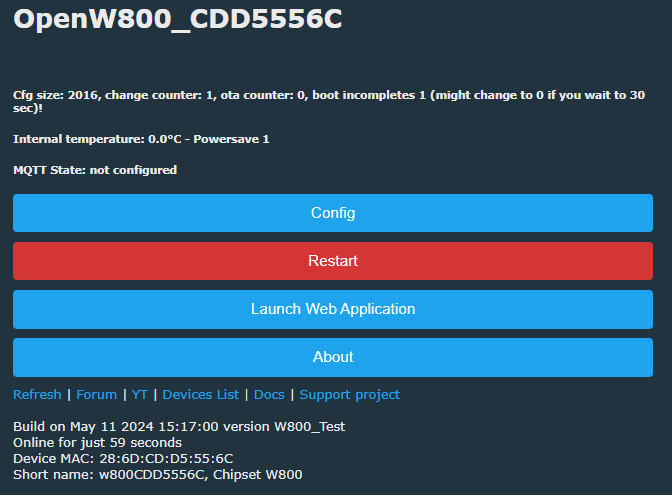
    and my first flash to a new W800

    Screen displaying information about OpenW800, configuration, and WiFi status.
  • #8 21076512
    miegapele
    Level 16  
    Posts: 173
    Help: 15
    Rate: 29

    I think it's too much detail already on the front page. I suggest moving all this except maybe power to some other debug page
  • #9 21076560
    divadiow
    Level 38  
    Posts: 4891
    Help: 427
    Rate: 869
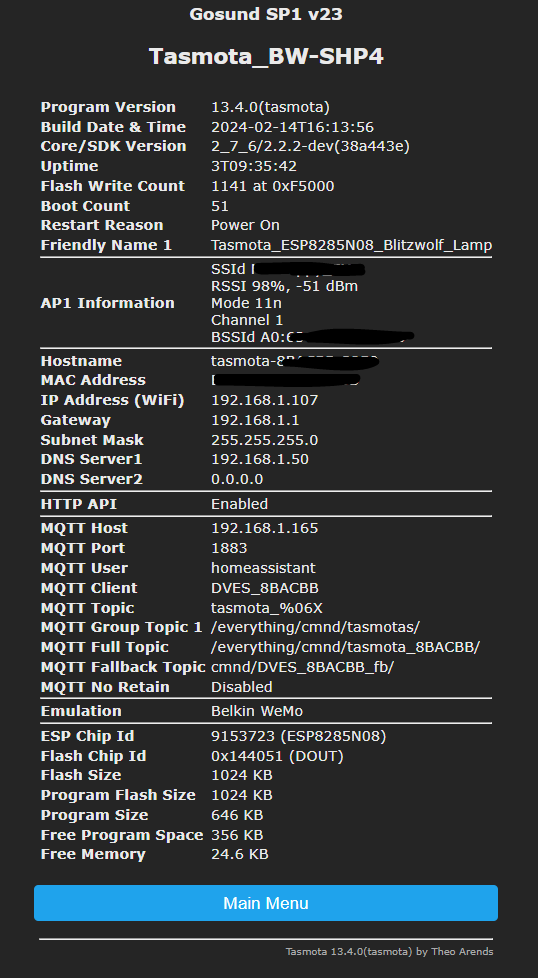
    something like Tasmota, complete with flash ID, size, chip detected

    Screenshot of Tasmota BW-SHP4 device settings on Gosund SP1.
  • #10 21076563
    max4elektroda
    Level 24  
    Posts: 746
    Help: 48
    Rate: 184

    Yes, that's a good point and I fully agree that BSSID, channel, and SSID are not of interest in most cases, and my suggestion would have been the same, only leaving PowerSave mode in regular status.
    On the other hand: I did put them in one line with existing information for every "appendInformationToHttpIndexPage" takes even more space.
    My first goal was to verify the function of the new functions and as far as I can see, it works o.k., only feedback for an XR802 is missing.
    For the other details I can think of a debug page, removing them fully from the GUI and introducing a command or, my actual idea, hiding it in a mouseover/tooltip.
    That will make it accessible on the main page (something I personally would like) but not visible hence not overloading this already loaded page.
    The drawback: It's not clear on the first look that there is some "hidden" information present.
    But maybe that is a general idea to streamline the main page and hide information like config size, reboot reason ...
    On a separate "detailed information" or "debug" page or in tooltips...

    Added after 51 [minutes]:

    Just a quick hack to show what I mean by information hidden in a "tooltip", if this is not clear (mouse pointer is over "WiFi" - not shown in screenshot):
    User interface page displaying network and device configuration details for OpenLN882H_C25E1088.
  • #11 21077839
    p.kaczmarek2
    Moderator Smart Home
    Posts: 14454
    Help: 650
    Rate: 12454
    We have users that still don't know we have Flags menu in Config, or don't know that we have Startup and then ask how to configure start value of relay, so I am not sure that a popup menu in "onmouseover" event is a good idea...

    Maybe we should just use existing API - the Tasmota STATUS command we have implemented - and just access it from the Web App, and show all info in the Web App? That way we don't even have to extend the binary size of obk, as the web app is on github:
    https://github.com/OpenBekenIOT/webapp/tree/gh-pages
    Helpful post? Buy me a coffee.
  • #12 21077862
    divadiow
    Level 38  
    Posts: 4891
    Help: 427
    Rate: 869
    p.kaczmarek2 wrote:
    We have users that still don't know we have Flags menu in Config, or don't know that we have Startup

    Yes. This is interesting. And partly why I started to add some basic links to my signature. It's quite overwhelming as a new user. I don't mind taking time to understand things but sometimes you need a little helping ramp into the whole world of something new.

    That's more of comment about OpenBeken in general though I guess rather than this new feature specifically.
  • #13 21077871
    max4elektroda
    Level 24  
    Posts: 746
    Help: 48
    Rate: 184

    Shame on me. I once reasoned, why there are so many "fake" entries in the json code (replying with hard coded values) and didn't take the first view there to see, that I only had to change the code there to answer with actual values.
    At least BSSID and Channel are present here, so this information doesn't need to be integrated to the GUI.
    And maybe PowerSave can be integrated in STATUS as well, in StatusSTS (as sleep mode or if it's possible to add other fields) or, for this might be interesting for more users, displaying the PowerSave value in the main Page is o.k.
  • #14 21077881
    p.kaczmarek2
    Moderator Smart Home
    Posts: 14454
    Help: 650
    Rate: 12454
    So maybe let's agree together on updating the JSON code for Tasmota and then doing your feature in the Web App, @max4elektroda ? I can help.

    Get Visual Code and use "Run with live server" plugin to get Web App running locally. Use the local index file with IP (change IP to point towards your device) for development.

    It's very easy, you get changes updated in realtime, no firmware flashing needed (as long as you are changing only the web app)
    Helpful post? Buy me a coffee.
  • ADVERTISEMENT
  • #15 21077930
    max4elektroda
    Level 24  
    Posts: 746
    Help: 48
    Rate: 184
    I'm not sure about the "feature", but my first step will be to integrate the results of the "new functions" in hal_wifi code to the corresponding status messages in the JSON code.
    Then we can discuss further, if/how this can be integrated in the app.
    I could also think of displaying the result of the status queries in the GUI, too.
    But first things first.

    Added after 11 [minutes]:

    p.kaczmarek2 wrote:
    a popup menu in "onmouseover" event
    Just to clarify: I didn't make that much of code, it's just a simple title="BSSID=..."
    which I like as a simple way for explanations, hints ...


    Added after 5 [hours] 31 [minutes]:

    Just a dumb question: Is the second SSID used in any case?
    On a quick search I didn't find any code which accessed it?!?
    I don't need to waste code for a function trying to retrieve the actual SSID in, if it can only be SSID1 ;-)
    Thanks!
  • ADVERTISEMENT
  • #16 21078302
    p.kaczmarek2
    Moderator Smart Home
    Posts: 14454
    Help: 650
    Rate: 12454
    Second SSID is unfinished, it's logic is TODO, you can help us with that if you have some time.

    Today I am optimizing pins page, it already went down from 90kB to 9kB.
    Helpful post? Buy me a coffee.
  • #17 21078334
    max4elektroda
    Level 24  
    Posts: 746
    Help: 48
    Rate: 184
    p.kaczmarek2 wrote:
    it already went down from 90kB to 9kB

    Good man ;-)

    O.k., then I think for now I can remove the code to retrieve SSID. Even if logic for a second SSID is there, it might be easier to use CFG_GetWiFiSSID()/CFG_GetWiFiSSID2() then.
    Just pushed the first changes to the PR (displaying only PowerSave mode on GUI [if it's configured]).
    BSSID and WiFi channel are in JSON status.

    I count on brave @divadiow for some tests again :-).
    @p.kaczmarek2 do you know someone who could test XR809 code?
    I tried to code "HAL_GetWifiStrength()" and "HAL_PrintNetworkInfo()" here, too, but can't test it...
  • #18 21078335
    divadiow
    Level 38  
    Posts: 4891
    Help: 427
    Rate: 869
    Yes. I'll be home again tomorrow to test all again. I'm looking to get an XR809 but that's probably a week away at least, so no help yet.

    Added after 2 [minutes]:

    Also assumes the water sensor I'm looking at still comes with XR809
  • #19 21078518
    p.kaczmarek2
    Moderator Smart Home
    Posts: 14454
    Help: 650
    Rate: 12454
    I have one or two XR809's somewhere, but I would need to look for them and I already have a queue of tasks waiting (including a lamp sent to me by @HalliHallo ), so I think I will attend to them first. There aren't much XR809 devices around, it seems to be the most rare platform.

    I hope that dual SSID logic would be implemented soon, but it will be tricky. We would need to agree on some kind of threshold when to switch, idk, when connection to first SSID fails for 20 seconds or something? And then what, stay on SSID2 until SSID2 diseappers?
    Helpful post? Buy me a coffee.
  • #20 21078571
    max4elektroda
    Level 24  
    Posts: 746
    Help: 48
    Rate: 184

    I fully agree - the actual coding should be much easier than the "logic" for it:

    Should you switch to SSID2 in any case if connection fails or only if SSID1 is not present?
    And especially the case you mentioned: What if SSID1 is temporarily out of order and is restored later?
    We would probably need to make a network scan, and that is only available on some platforms (it's some time ago, so I don't recall my efforts in detail, but I didn't manage to succeed on my LN882H).
    And: is the network scan possible during operation, or is the scan disruptive?
  • #21 21078591
    divadiow
    Level 38  
    Posts: 4891
    Help: 427
    Rate: 869
    And what will the behaviour be if SSID1 is up but the password entered is wrong or password is changed on router without updating OBK. Will it know to switch or will it just keep trying SSID1. Does it keep trying now or just once? I'm not home to check.
  • Helpful post
    #22 21079433
    divadiow
    Level 38  
    Posts: 4891
    Help: 427
    Rate: 869
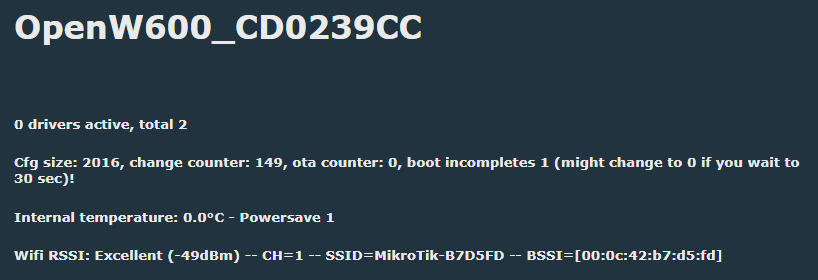
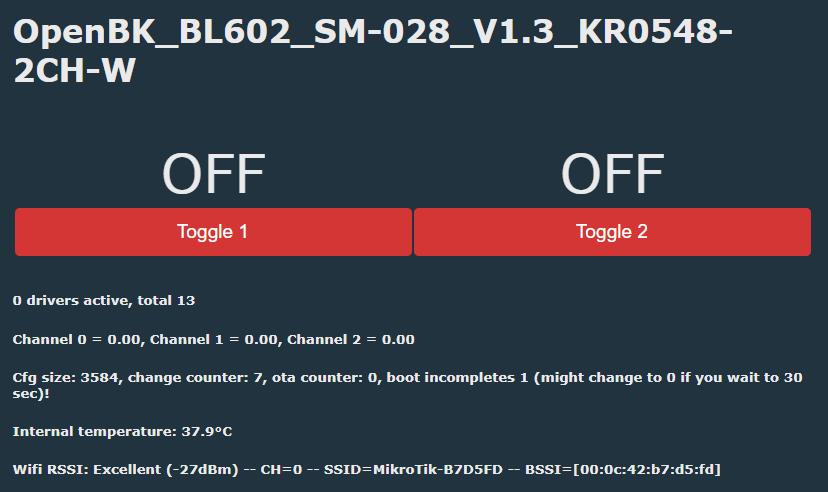
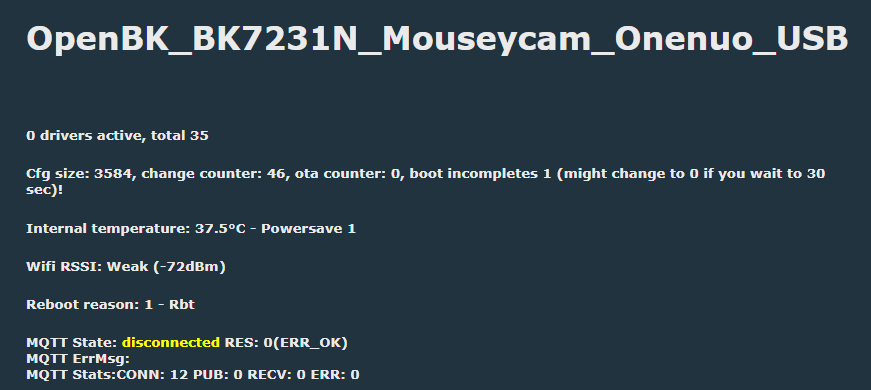
    Screenshot showing the status of OpenBK BK7231N Mouseycam Onenuo USB with a disconnected MQTT state. User interface of OpenBK showing network connection status information. Screenshot of the status panel for OpenW600_CD0239CC. Screenshot of the user interface for OpenBK_BL602_SM-028_V1.3_KR0548-2CH-W, showing Toggle 1 and Toggle 2 buttons in the OFF state. Screenshot of OpenBK interface displaying device status information. OpenW800 user interface displaying device status information and configuration buttons.

    all 1216_merge_0c97efa515cf

    Added after 17 [minutes]:

    divadiow wrote:
    Does it keep trying now or just once? I'm not home to check.

    yes. after changing ssid pw the W800 tries to connect approximately once every minute

    Code: Text
    Log in, to see the code
  • #23 21079493
    p.kaczmarek2
    Moderator Smart Home
    Posts: 14454
    Help: 650
    Rate: 12454
    What if you change SSID itself, and the target AP does not exist?

    The message you've shown originates from here:
    Screenshot of code in Visual Studio showing WiFi authentication error handling in the user_main.c file.
    Maybe we could put there a change of current SSID? In this conditional block?
    Helpful post? Buy me a coffee.
  • #24 21079523
    divadiow
    Level 38  
    Posts: 4891
    Help: 427
    Rate: 869
    p.kaczmarek2 wrote:
    What if you change SSID itself, and the target AP does not exist?

    it still does please wait connect net...... every minute
  • #25 21079532
    p.kaczmarek2
    Moderator Smart Home
    Posts: 14454
    Help: 650
    Rate: 12454
    "please wait connect net..." is not the message from the OBK, it's from the underlying SDK on that particular platform
    Helpful post? Buy me a coffee.
  • #26 21086916
    divadiow
    Level 38  
    Posts: 4891
    Help: 427
    Rate: 869
    divadiow wrote:
    Also assumes the water sensor I'm looking at still comes with XR809


    lame. bought 4 door sensor/water leak devices that looked like XR809 candidates. 3x CBUs and 1 CB3S :(
  • #27 21087039
    p.kaczmarek2
    Moderator Smart Home
    Posts: 14454
    Help: 650
    Rate: 12454
    Actually CBUs are great, they have P16 routed out. You can use them for WS2812B LEDs.
    Helpful post? Buy me a coffee.
  • #28 21087581
    divadiow
    Level 38  
    Posts: 4891
    Help: 427
    Rate: 869
    and the device chassis makes quite a neat little package for adding USB power and adapting for small footprint LED deployment I guess.
  • #29 21588288
    spleefer90
    Level 7  
    Posts: 17
    Help: 1
    Rate: 5
    > I see you made a feature to put a WiFi info on the main page just to later censor it before putting it on forum....
    > Maybe that's a sign that your feature should be enabled by a flag? Something like "show extra info"?

    Using either a MAC address of a device or an AP, an SSID or a BSSID, you can sometimes pin down a very precise physical location.

    The current status page already leaks the MAC in the name of the device and by giving the actual MAC, so if any censoring should happen, MACs should be included.

    There are even *public* databases that can be used for this.

    This thread was linked in the issue where I requested BSSID to be visible on the main page for debugging - https://github.com/openshwprojects/OpenBK7231T_App/issues/1683

    OP tried to censor the info, and still left out the MAC in the name of the device, and used a blurring alg which seems susceptible to being deciphered, so I'd agree with having a "Show extra/sensitive info" button.
  • #30 21588291
    p.kaczmarek2
    Moderator Smart Home
    Posts: 14454
    Help: 650
    Rate: 12454
    Very nice! My suggestion is to add all necessary info to JSON API (Tasmota-like) and then just use this API in the Web App
    Helpful post? Buy me a coffee.

Topic summary

✨ The discussion centers on enhancing the OpenBeken (OBK) status page to display detailed WiFi information for OpenBeken devices, particularly focusing on LN882H modules. The main goal is to show the connected access point's BSSID, WiFi channel, and PowerSave mode level without relying on serial logs. Initial implementations added WiFi HAL functions to the status page, but concerns arose about cluttering the main page and privacy risks from displaying sensitive data like MAC addresses and SSIDs. Suggestions include making the feature optional via a flag, moving detailed info to a debug page, or integrating it into the JSON API for use in the Web App, similar to Tasmota's approach. Testing on various platforms (W600, W800, XR802, XR809) revealed issues such as truncated SSIDs, invalid channel reporting (e.g., channel 0 on BL602), and inconsistent AP information. The dual SSID logic remains unfinished and complex due to connection failover scenarios and network scanning limitations. The community emphasizes cautious rollout on easily re-flashable devices and prefers exposing PowerSave mode on the main page while relegating other WiFi details to JSON status or tooltips. The discussion also highlights the need for better user guidance on OBK features and the potential to leverage existing APIs to avoid increasing firmware size.
Generated by the language model.

FAQ

TL;DR: After tests on 11 platforms, the thread shifted from “put WiFi info on the main page” to “expose it in JSON first.” This FAQ helps OpenBeken users show BSSID, channel, and PowerSave safely without risking hard-to-recover OTA failures or cluttering the default UI. [#21603311]

Why it matters: OpenBeken users need accurate WiFi diagnostics, but the thread shows that UI placement, platform quirks, and recovery safety matter as much as the raw data.

Approach What it shows Main advantage Main drawback
Main status page PowerSave or selected WiFi fields Fast, local, always visible Can overload the page
Separate debug page Full WiFi and hardware detail Cleaner main UI Extra navigation step
Web App using STATUS JSON Rich data, flexible layout, no reflashing for UI work Best long-term flexibility Some users do not want external Web App usage
LFS custom page / HTTP override Fully custom local UI Works locally on-device More setup and design work

Key insight: The thread’s strongest consensus is to move detailed WiFi data into the Tasmota-style JSON API first, then decide how the built-in page or Web App should present it.

Quick Facts

  • Early cross-platform testing reported SSID truncation on most tested targets, while LN882H and W600 were exceptions; W600 still showed an invalid trailing character on longer SSIDs. [#21073436]
  • One contributor reduced the pins page from 90 kB to 9 kB, showing that UI and payload size were active design constraints during the discussion. [#21078302]
  • A W800 with a wrong password retried WiFi association about once per minute and logged WIFI_STA_AUTH_FAILED - 3, which matters for any future dual-SSID failover logic. [#21079433]
  • A long-running LN882H clock test stayed up for 171 days, 10 hours and drifted by about 7 minutes, giving a concrete bound for uptime-based timekeeping accuracy. [#21602796]
  • Final merge confidence came after testing on 11 platforms: BL602, LN882H, BK7231N, ESP32, W600, W800, BK7238, ECR6600, BK7231T, RTL8720CF, and XR809. [#21603311]

How can I show WiFi details like BSSID, channel, SSID, and PowerSave mode on the OpenBeken status page?

You can add new WiFi HAL functions, expose their values, and then choose the UI surface carefully. The thread ended with a narrower GUI plan: keep PowerSave on the main page if configured, and move BSSID and channel into Tasmota-style STATUS JSON instead of crowding the default page. That approach kept the built-in page smaller while still exposing data to the Web App or custom pages. [#21078334]

Why does OpenBeken truncate or corrupt the SSID on some platforms like BL602, BK7231, or W600 while LN882H shows it correctly?

The thread points to platform-specific WiFi HAL handling, not a universal OpenBeken UI bug. A tester reported that all tested platforms truncated SSID except LN882H and W600, while W600 appended an invalid character unless the SSID was shorter. The proposed fix was to change string handling from memcpy to strcpy, and the author later considered dropping SSID display entirely because config already stores the known network name. [#21075738]

What is BSSID in WiFi, and why is it useful for debugging which access point an OpenBeken device is connected to?

"BSSID" is a WiFi network identifier that names the specific radio interface of one access point, unlike an SSID, which names the shared network. It matters when you run multiple APs with the same SSID and need to know which one the device actually joined. The thread’s original request came from exactly that use case, because the author wanted to identify the real AP without needing a serial log. [#21073220]

What is PowerSave mode in OpenBeken, and how can I tell which level an LN882H module is using?

PowerSave mode is a WiFi sleep setting, and LN882H was the platform that motivated exposing its level. The first post asked to show whether PowerSave was active and, on LN882H, which level was currently selected. Later discussion narrowed the GUI goal to showing only PowerSave on the main status page, while other WiFi details moved to STATUS JSON. [#21078334]

Where should extra WiFi details live in OpenBeken: on the main status page, on a separate debug page, or only in the Web App?

The thread leans toward STATUS JSON plus Web App, with only high-value items on the main page. Several users said BSSID, channel, and SSID add too much detail to the front page, while PowerSave may still deserve visible placement. Others proposed a debug page, tooltips, or a separate detailed-information view, but the strongest consensus favored JSON first and UI second. [#21077881]

How do I safely test an experimental OpenBeken firmware build with new WiFi HAL functions without risking an unrecoverable OTA brick?

Test only on hardware you can recover easily over UART. The original warning was explicit: use modules that can be reflashed if OTA becomes inaccessible. A safe workflow is: 1. Flash only devices with easy serial recovery. 2. Add failed-boot conditional protection before risky code. 3. Verify behavior on local hardware before wider rollout. That advice came before broad multi-platform testing started. [#21073333]

Why would an OpenBeken device report channel 0 or an incorrect BSSID, especially on BL602, LN882H, or XR platforms?

Those bad values came from platform-specific WiFi library behavior and incomplete HAL support. BL602 was seen reporting channel 0, which the author called invalid for 2.4 GHz but typical as a startup placeholder when only SSID is known. LN882H also sometimes showed a valid-looking channel and AP MAC while actually being connected elsewhere, based on RSSI and serial-log verification. XR later needed fixes before BSSID became correct. [#21073559]

How can I add BSSID and WiFi channel information to the Tasmota-style STATUS JSON in OpenBeken?

Add the values in the JSON status path instead of hardcoding placeholders. The discussion moved to json_interface.c, where missing fields like Heap, SleepMode, BSSID, and channel could be filled from real HAL data. By July 10, 2025, a pull request specifically added BSSID and channel to STATUS output, with later fixes for XR behavior before merge. [#21602507]

What is the Tasmota STATUS JSON API in OpenBeken, and how is it different from showing the same data directly on the built-in status page?

"Tasmota STATUS JSON API" is a device-side JSON interface that returns structured runtime data for tools and web clients, unlike the built-in status page, which renders fixed HTML directly on the module. In this thread, JSON became the preferred transport for BSSID, channel, and PowerSave because it avoids page clutter and lets the Web App render the same facts more flexibly. [#21077839]

How do I develop and test OpenBeken Web App changes locally with Visual Studio Code and Live Server instead of reflashing firmware every time?

Use the Web App locally and point it at your device IP. The thread gave a simple workflow: 1. Install Visual Studio Code. 2. Run the Web App with the “Run with Live Server” plugin. 3. Open the local index file and change the IP to your device. That lets you see Web App changes in real time without reflashing firmware, as long as you only modify the front end. [#21077881]

What is the current state of second SSID support in OpenBeken, and how is SSID1 versus SSID2 supposed to behave when the first network fails?

Second SSID support was unfinished during the thread. A maintainer stated clearly that the second SSID logic was still TODO, and the author then removed code that tried to retrieve the active SSID because it could only be SSID1 in practice. The suggested long-term path was to use configuration helpers for SSID1 and SSID2 once failover rules exist. [#21078302]

How should OpenBeken handle dual-SSID failover when the AP is missing, the password is wrong, or SSID1 comes back after a temporary outage?

The thread says the hard part is policy, not coding. Open questions included whether to switch only when SSID1 disappears, whether wrong-password failures should trigger SSID2, and when to switch back after SSID1 returns. Real testing showed W800 retried a bad password roughly every 1 minute, which gives a concrete timing reference for any future threshold-based failover design. [#21079433]

What troubleshooting steps help when XR809 or XR872 returns an empty BSSId or 'wlan info failed' in OpenBeken STATUS output?

Check the XR HAL path, then confirm the API return handling before blaming the UI. In the thread, XR872 initially returned an empty BSSId, XR809 later showed wlan info failed, and maintainers traced it to how wlan_sta_ap_info returned status. After fixes, XR809 on build 1689_merge_444d39530925 reported the expected BSSID correctly, proving the issue was implementation-specific. [#21603260]

OpenBeken main page vs Web App for advanced status information — which approach is better for local-only users who do not want cloud or external hosting?

For local-only users, both paths are valid, but the thread recommends improving local options instead of forcing the external Web App. One participant said many users do not want Web App or any online dependency at all. The proposed compromise was better local Web App documentation, plus cleanup of the built-in landing page so advanced data still works for offline users. [#21596150]

How can custom LFS index pages, HTTP override, REST API, or a future plugin store be used to build a cleaner OpenBeken UI with logs and richer device status?

They let you move UI complexity out of core firmware and into replaceable local pages. By July 2025, HTTP override could replace the default index page from LFS, keep the hardcoded state area, and add custom buttons or logs. A future plugin-store idea would download styles or pages into LFS automatically, while REST or STATUS JSON would provide the live data. [#21602377]
Generated by the language model.
ADVERTISEMENT