logo elektroda
logo elektroda
X
logo elektroda

Action LSC 3202086 Addressable LEDs flashing with OBK for control cloudfree like in Tasmota/Esphome

p.kaczmarek2 7275 17
ADVERTISEMENT
  • #1 21101486
    p.kaczmarek2
    Moderator Smart Home
    Posts: 14393
    Help: 650
    Rate: 12314
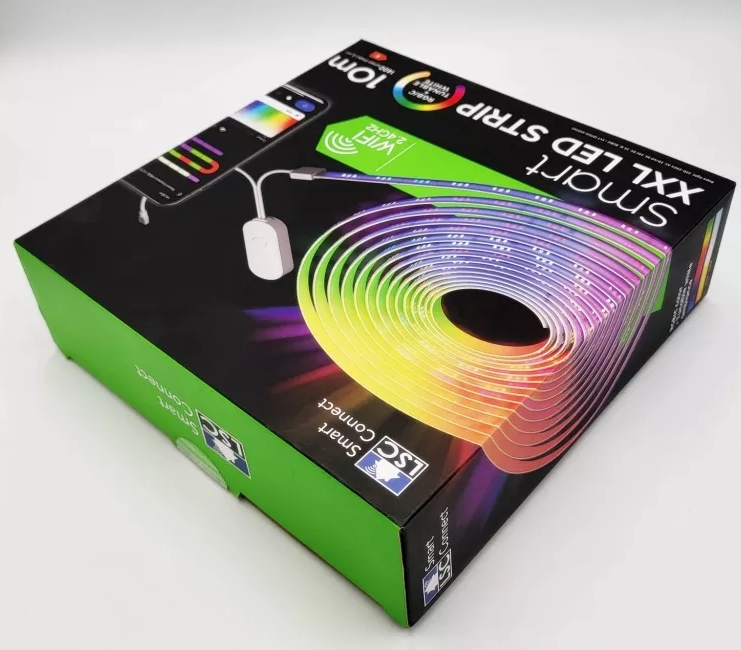
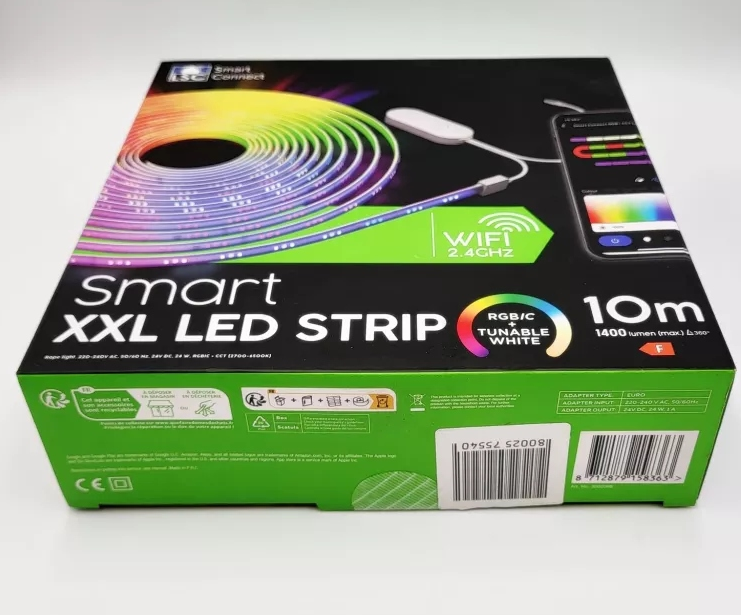
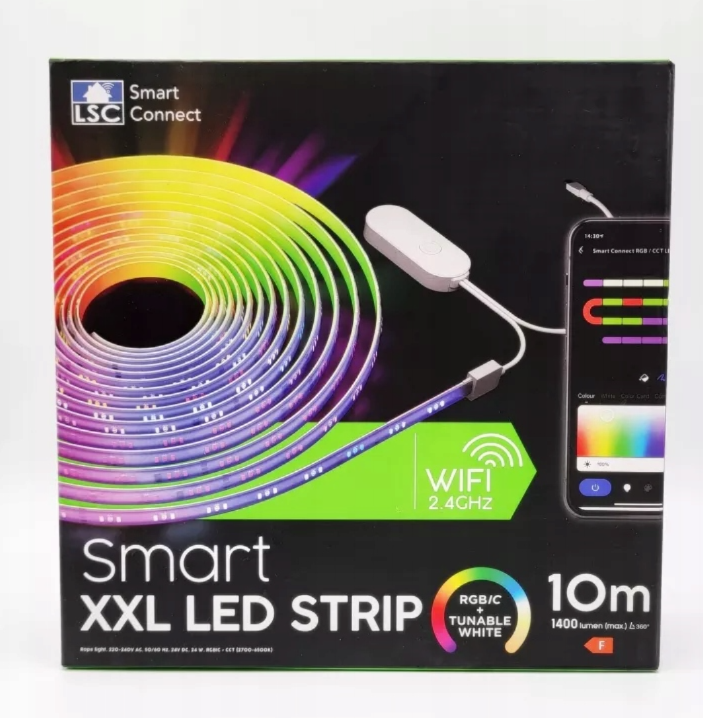
    Packaging of LSC Smart XXL LED Strip featuring a spiral LED light and mobile app.
    LSC 3202086 LSC Smart Connect XXL LED strip is a individually addressable (WS2812B-like) LED strip with extra two PWM channels (RGB + CW).
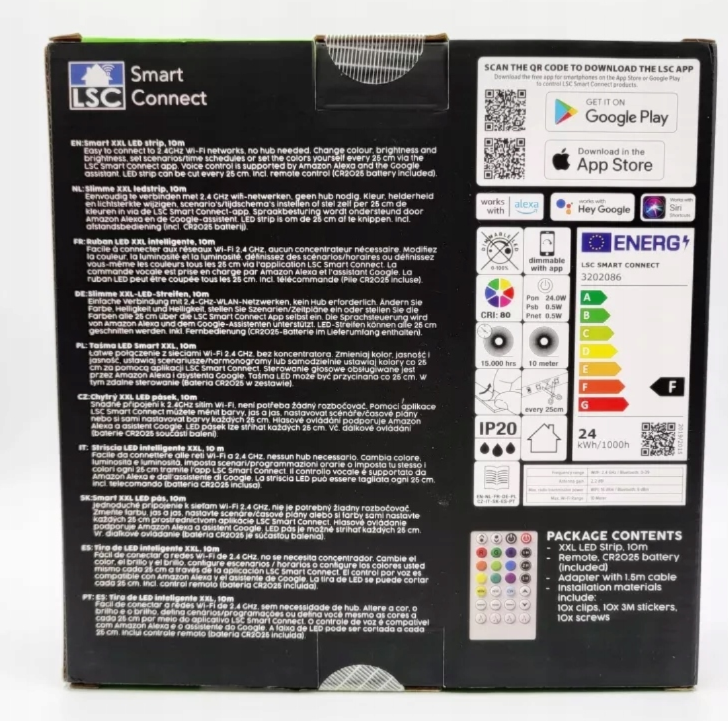
    LSC Smart Connect LED Strip packaging Packaging of LSC Smart Connect XXL 10m RGBIC + CCT LED Strip Packaging of the LSC Smart Connect XXL LED Strip with product information printed on it.
    It is using BK7231N module, so you can flash it with OBK: https://github.com/openshwprojects/OpenBK7231T_App
    You can check our flashing guides for more info on flashing Beken chips: https://www.youtube.com/playlist?list=PLzbXEc2ebpH0CZDbczAXT94BuSGrd_GoM

    ADVERTISEMENT


    Brandname: LSC
    Product description: LSC Smart Led Strip 1x10m RGBIC + CCT
    EAN Code: 8712879158363
    Product code: 3202086 (factory model number: LS-DCCT-IWD-B-24-10 / LS-DCCT-IW-DB-0.5)

    OBK Device template:
    Code: JSON
    Log in, to see the code

    Currently you also need to manually configure WS2812B-style LEDs, see related topics:
    OpenBeken WS2812B animations - new HTTP panel integration, PixelAnim driver
    The CW + RGB integration will be supported soon in next OBK releases, so it's possible that by the time you read it, it will work out of the box.

    Here is also device description as text:
    
    Device name seems to be 3202086 XXL LED Strip v1.0.18
    Device manufacturer seems to be LSC
    - LED Cool (Channel 4) on P9
    - LED Warm (Channel 5) on P24
    - WS2812B/SM16705B out on P17
    - Control Pin (TODO) on P6
    - Pair/Toggle All Pin on P7
    

    This should be enough to get you started with this device, more to come soon. Feel free to ask if you have any questions.
    Helpful post? Buy me a coffee.
  • ADVERTISEMENT
  • #2 21101992
    p.kaczmarek2
    Moderator Smart Home
    Posts: 14393
    Help: 650
    Rate: 12314
    UPDATE: RGB IC + CW PWMs tested and working in simulator:
    https://www.elektroda.com/rtvforum/topic4057187.html#21101720
    Simulation of configuring RGB IC LEDs with dual PWM on a computer screen. Simulator interface controlling RGB IC and PWM lighting with LED animations. LED lighting simulation with control settings.
    Helpful post? Buy me a coffee.
  • #3 21327507
    snakesrules94
    Level 8  
    Posts: 37
    Help: 3
    Rate: 4
    Hello there !
    Do you have success with this led strip ?
    I bought one yesterday, did a backup , extract config , but no way to get some light after flashing ...
    Here is my extract :

    
    {
       "Jsonver":"1.0.5",
       "brightmin":"10",
       "gmwb":"75",
       "title20":"0",
       "cdtime1":"60",
       "1err":"40",
       "cdtime3":"180",
       "cdtime2":"120",
       "totallen":"1000",
       "gmwg":"70",
       "knum":"1",
       "leaderr":"15",
       "wfcfg":"spcl_auto",
       "colormin":"10",
       "bitseq":"0",
       "pmemory":"1",
       "gmkb":"60",
       "pairt":"180",
       "cmod":"rgbcw",
       "slidemod":"2",
       "micpin":"23",
       "customcode":"00ff",
       "rstbr":"50",
       "ktime":"5",
       "0err":"70",
       "colormax":"100",
       "c_pin":"6",
       "module":"CBU",
       "ctrl_lv":"1",
       "rstmode":"2",
       "irpin":"26",
       "brightmax":"100",
       "sfunc":"1",
       "key_lv":"0",
       "wfct":"3",
       "pwmhz":"1000"
    }


    Device configuration, as extracted from Tuya: 
    - Microphone (TODO) on P23
    - LED Cool (Channel 4) on P6
    - IR Receiver is on P26
    - PWM Frequency 1000
    Device seems to be using CBU module, which is using BK7231N.
    And the Tuya section starts, as usual, at 2023424
    
  • ADVERTISEMENT
  • #4 21327560
    p.kaczmarek2
    Moderator Smart Home
    Posts: 14393
    Help: 650
    Rate: 12314
    So how did you configure the PixelAnim driver? What is your autoexec.bat?
    Helpful post? Buy me a coffee.
  • #5 21327607
    snakesrules94
    Level 8  
    Posts: 37
    Help: 3
    Rate: 4
    hello,
    i didn't start yet to have colour leds. I'm just trying right now to have cool/warm white working. I have no autoexec.bat right now.
    BTW, i've also tried the esphome/libretiny port for this led strip and i also have no light at all, no white, no colours.
  • #6 21327629
    p.kaczmarek2
    Moderator Smart Home
    Posts: 14393
    Help: 650
    Rate: 12314
    We need more information and you need to try the RGB. Maybe they have now alternate CW control, where second pin is used to control brightness. Try playing with GPIO Doctor on PWM pins. Make some detailed photos, what is connected where?
    Helpful post? Buy me a coffee.
  • ADVERTISEMENT
  • #7 21327635
    snakesrules94
    Level 8  
    Posts: 37
    Help: 3
    Rate: 4
    I think the game is over for now .. I don't have power any more to the board. I have 24V on input but the board is not powered, thinking something went wrong.
    The BK7231N is ok when powered directly from pin but not when powered from the 24V power supply.
  • #8 21327640
    p.kaczmarek2
    Moderator Smart Home
    Posts: 14393
    Help: 650
    Rate: 12314
    Maybe it's just a mechanical damage. Can you check where voltage reaches and where it doesn't? How the step down converter looks like?
    Helpful post? Buy me a coffee.
  • ADVERTISEMENT
  • #9 21336832
    Dratii
    Level 3  
    Posts: 4
    Rate: 1
    Hello, I can relate to the snakesrules94 posts.
    Code: Text
    Log in, to see the code

    and
    Code: JSON
    Log in, to see the code

    and I can't get any LED's to light up
  • #10 21336875
    p.kaczmarek2
    Moderator Smart Home
    Posts: 14393
    Help: 650
    Rate: 12314
    Can you share 2MB Tuya flash dump so I can try flashing it to my device and check the protocol on the scope?
    Helpful post? Buy me a coffee.
  • #11 21336881
    Dratii
    Level 3  
    Posts: 4
    Rate: 1
    Okay no problem, if I understand correctly it's the file that the BK7231Flasher took as a backup so here it is
    Attachments:
    • readResult_BK7231N_QIO_led_2024-07-12-09-16-30.bin (2 MB) You must be logged in to download this attachment.
  • #12 21336886
    p.kaczmarek2
    Moderator Smart Home
    Posts: 14393
    Help: 650
    Rate: 12314
    Thank you, can you also share some photos of the device inside?

    Have you tried to run PixelAnim driver, as in the first post?
    Related guide: https://www.elektroda.com/rtvforum/topic4057187.html
    Helpful post? Buy me a coffee.
  • #13 21336912
    Dratii
    Level 3  
    Posts: 4
    Rate: 1
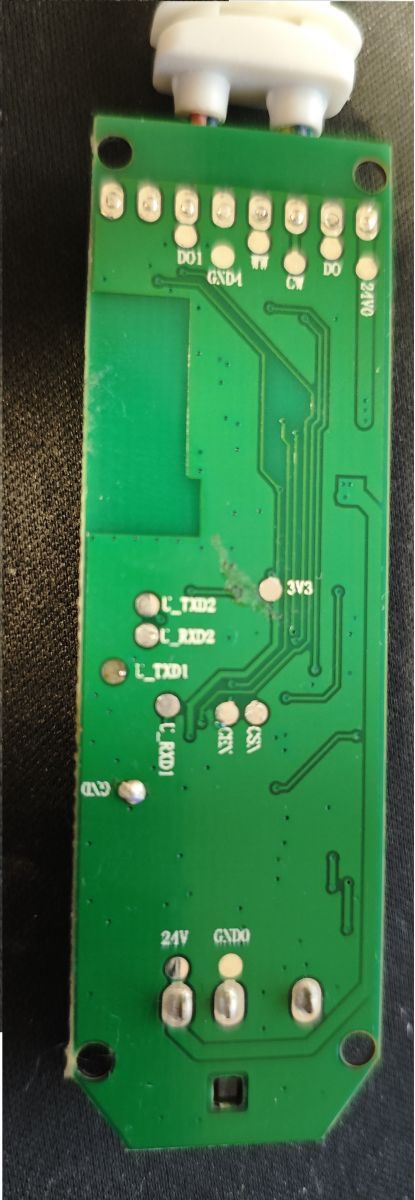
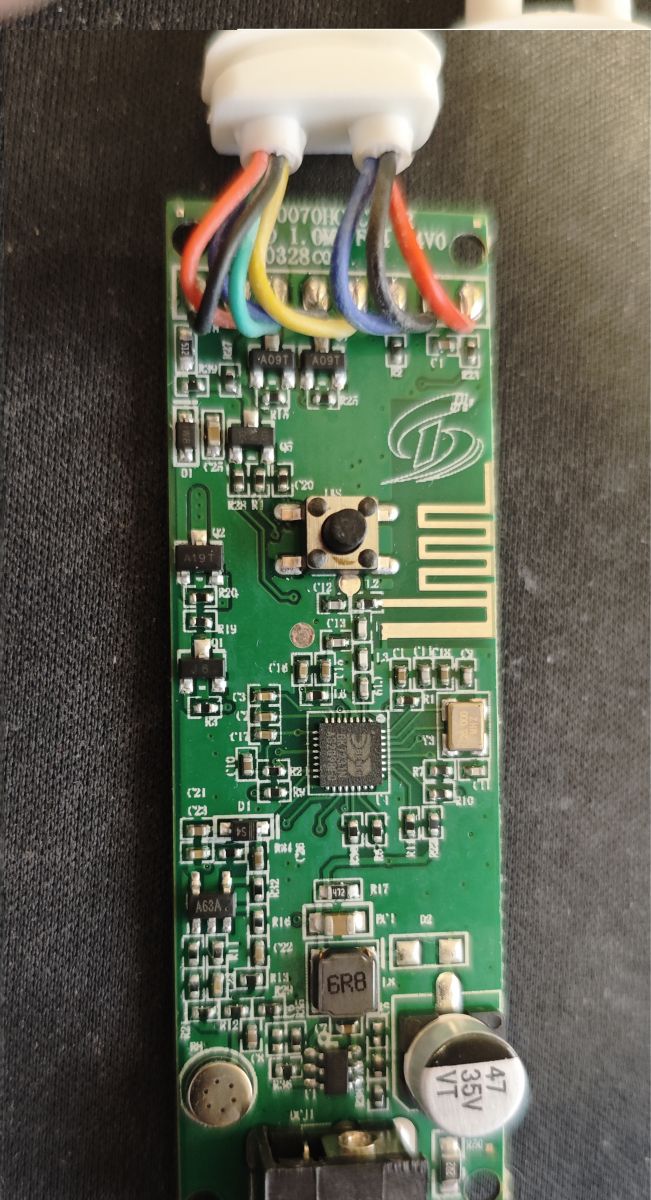
    Here are the photos of the insides:
    Image of a green circuit board with various connectors and pin labels. Electronic board with several colored wires connected at the top.


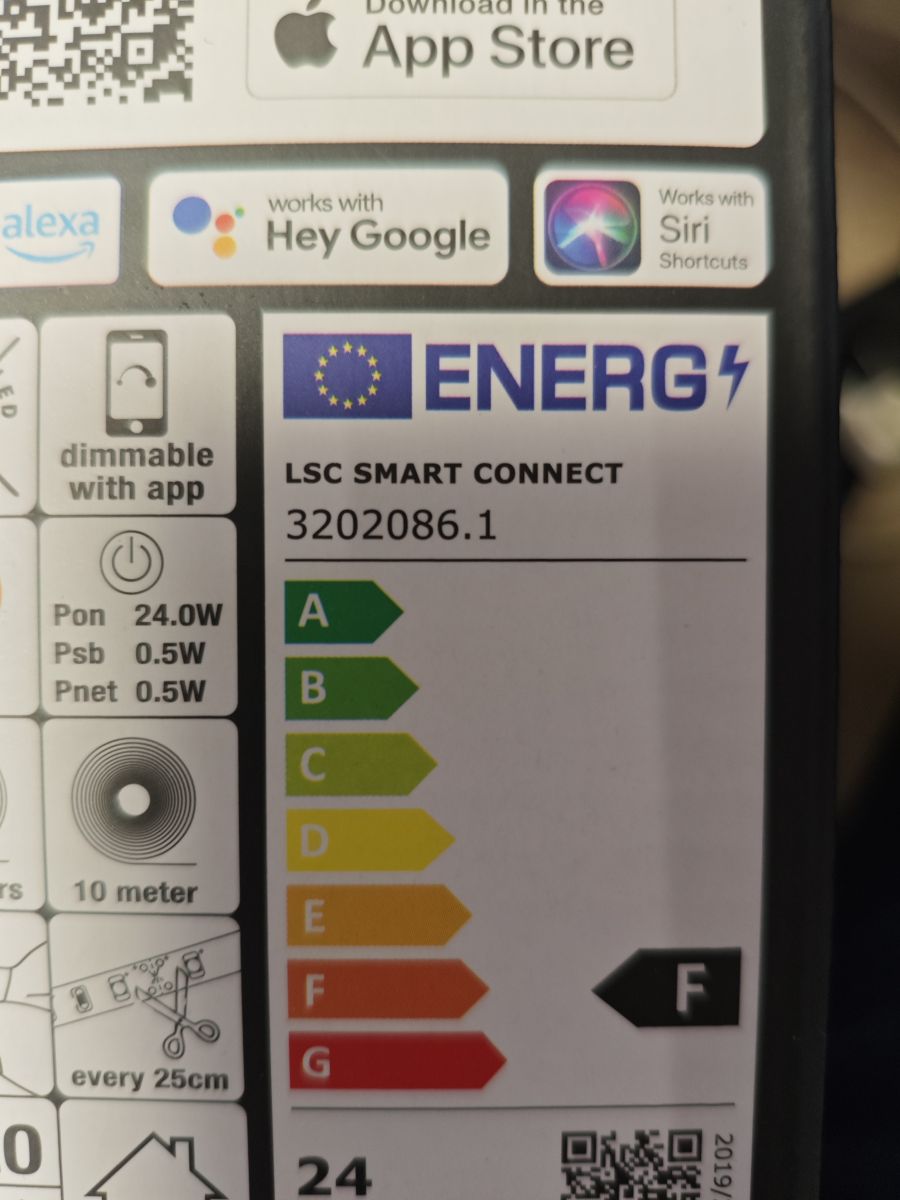
    and on the box there is .1 at the end of product code so i guess that means it's a new revision Energy label for LSC Smart Connect product with energy class F.
    I didn't run PixelAnim driver because I have no clue what pins are relating to rgb led's and/or CW
  • #14 21336982
    p.kaczmarek2
    Moderator Smart Home
    Posts: 14393
    Help: 650
    Rate: 12314
    We actually know which pin is used for LED RGBs, the ones that are per-pixel addressable. It's always P16, hardware SPI output. That's because hardware SPI is used to control the WS2812 LEDs.

    For a start, I'd suggest following PixelAnim/WS2812 topic (linked few posts above) and trying to get some RGB light.

    I would also check if 24V is present on LEDs, because some devices might have extra pin used to toggle power on and off for them, sometimes to dim them. Check it with multimeter.
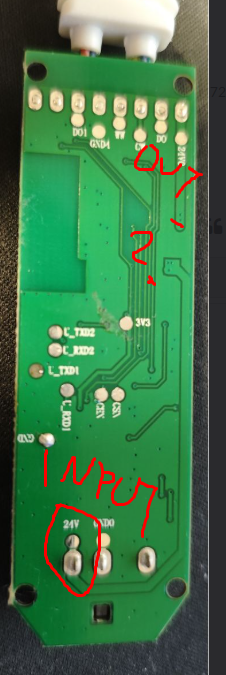
    Probably the transistor between 24 in and out is used:
    View of a circuit board with marked INPUT 24V locations and labels OUT and a question mark on other pins.
    If there is 0V at output of transistor, try setting each pin in GPIODoctor to 1 and observe which enables voltage for the strip. It will be probably one of PWM pins.
    Helpful post? Buy me a coffee.
  • #15 21337021
    Dratii
    Level 3  
    Posts: 4
    Rate: 1
    the 24V on the LED's is present but after using this RGB code in autoexec.bat form PixelAnim thread:
    Code: Text
    Log in, to see the code

    i didn't get any leds to light up and i tried toggling it on and off using the button in the home menu
  • #16 21337134
    divadiow
    Level 38  
    Posts: 4835
    Help: 420
    Rate: 852
    >>21336881

    Code: JSON
    Log in, to see the code


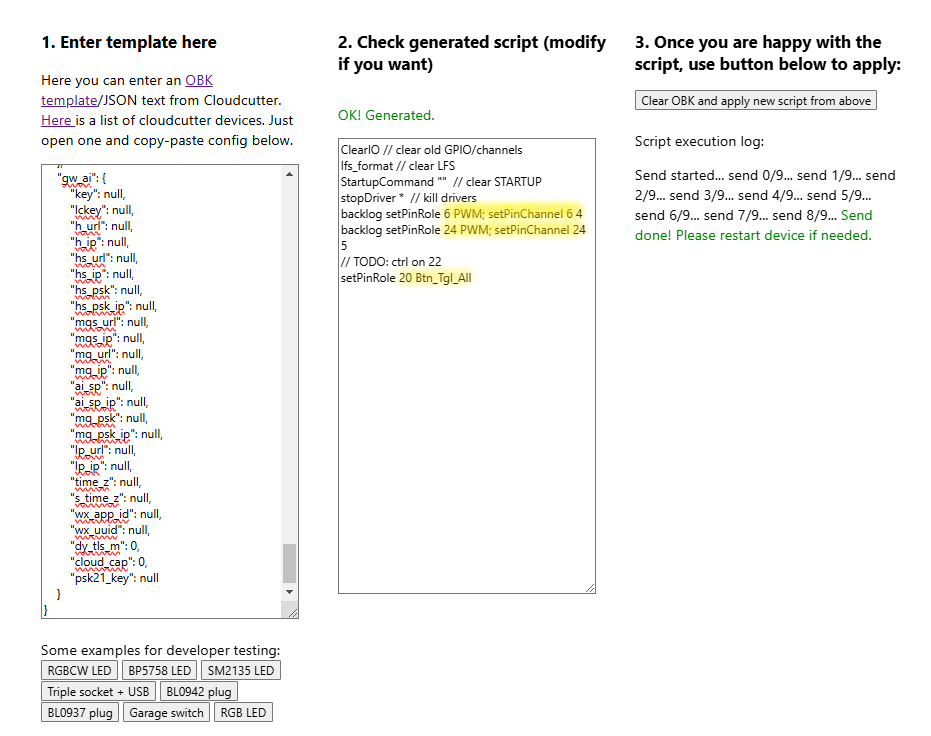
    which when put into the importer wholesale give you some bits:

    Comparison of JSON configuration with script code for a Tuya device.

    that doesn't match the EF extractor though, which you've already posted

    Code: Text
    Log in, to see the code


    I think a more complete template would be with this:

    Code: JSON
    Log in, to see the code


    still, your RGB should be working though I would have thought

    Added after 6 [minutes]:

    paired, the 3202086.1 is referred to as LSC Smart Led Strip 1x10m RGBIC + CCT by Tuya
  • #17 21358222
    xpeng
    Level 3  
    Posts: 3
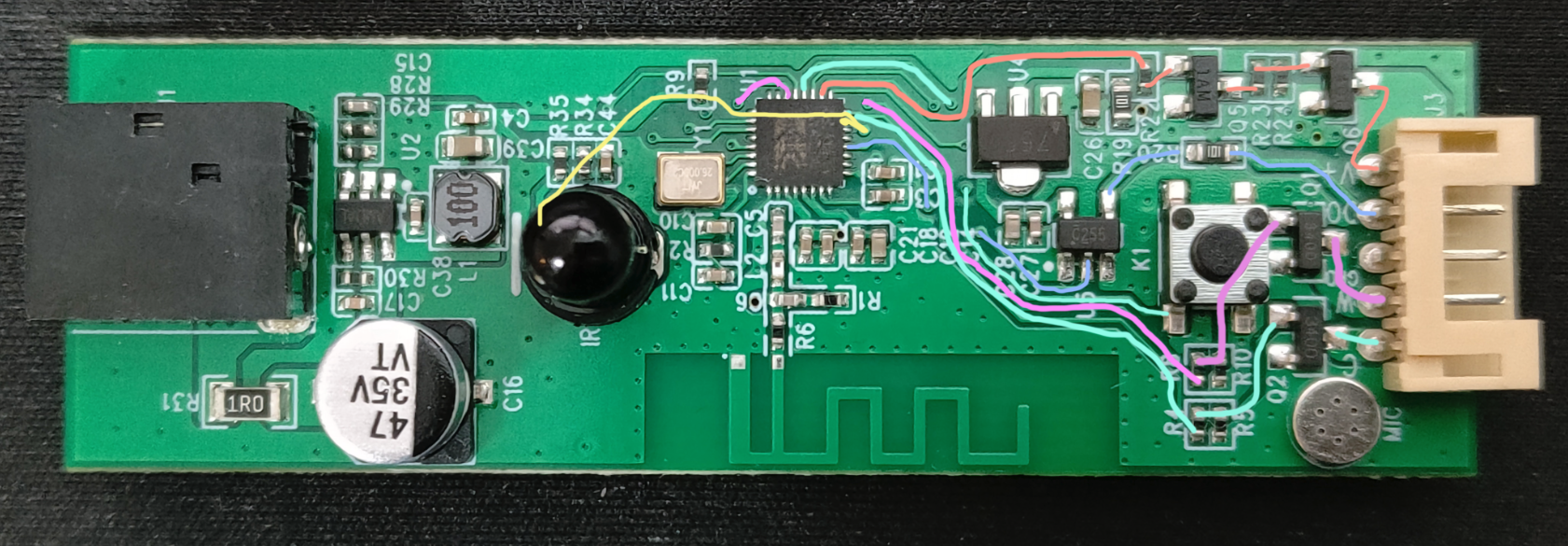
    For the people that have the revision of this product (3202086.2), here is my esphome config and the pinout that I figured out.

    
    light:
      - platform: cwww
        id: white_light
        name: "White Light"
        cold_white: output_cw
        warm_white: output_ww
        cold_white_color_temperature: 6500 K
        warm_white_color_temperature: 2700 K
        on_turn_on:
          - light.turn_off: color_light
    
      - platform: beken_spi_led_strip
        id: color_light
        name: "Color Light"
        pin: P16
        chipset: WS2812
        num_leds: 40
        rgb_order: RBG
        power_supply: led_power
        effects:
         - random:
         - pulse:
         - strobe:
         - flicker:
         - addressable_rainbow:
         - addressable_color_wipe:
         - addressable_scan:
         - addressable_twinkle:
         - addressable_random_twinkle:
         - addressable_fireworks:
         - addressable_flicker:
        on_turn_on:
          - light.turn_off: white_light
    
    output:
      - platform: libretiny_pwm
        id: output_cw
        pin: P9
        power_supply: led_power
      - platform: libretiny_pwm
        id: output_ww
        pin: P24
        power_supply: led_power
    
    power_supply:
        id: led_power
        pin: P6
    
    remote_receiver:
      pin:
        number: P26
        mode:
          input: true
          pullup: true
      dump: all
    
    binary_sensor:
      - platform: gpio
        pin:
          number: P7
          inverted: True
          mode:
            input: True
            pullup: True
        name: "Button"
        on_press:
          - light.toggle: white_light
    

    The power supply config needs a bit adjustment (need to add delay to the led when it starts)

    Electronic module with visible components and colored traces
  • #18 21362240
    matiserv4
    Level 1  
    Posts: 1
    For those who has LSC 3202086.1 (i belive it is the same as of @Dratii), i modified config for esphome based on @xpeng config
    Here is how it looks
    
    bk72xx:
      board: generic-bk7231n-qfn32-tuya
    
    light:
      - platform: cwww
        id: white_light
        name: "White Light"
        cold_white: output_cw
        warm_white: output_ww
        cold_white_color_temperature: 6500 K
        warm_white_color_temperature: 2700 K
        on_turn_on:
          - light.turn_off: color_light
    
      - platform: beken_spi_led_strip
        id: color_light
        name: "Color Light"
        pin: P16
        chipset: WS2812
        num_leds: 40
        rgb_order: RBG
        power_supply: led_power
        effects:
         - random:
         - pulse:
         - strobe:
         - flicker:
         - addressable_rainbow:
         - addressable_color_wipe:
         - addressable_scan:
         - addressable_twinkle:
         - addressable_random_twinkle:
         - addressable_fireworks:
         - addressable_flicker:
        on_turn_on:
          - light.turn_off: white_light
    
    output:
      - platform: libretiny_pwm
        id: output_cw
        pin: P6
        power_supply: led_power
      - platform: libretiny_pwm
        id: output_ww
        pin: P24
        power_supply: led_power
    
    power_supply:
        id: led_power
        pin: P22
    
    remote_receiver:
      pin:
        number: P26
        mode:
          input: true
          pullup: true
      dump: all
    
    binary_sensor:
      - platform: gpio
        pin:
          number: P20
          inverted: True
          mode:
            input: True
            pullup: True
        name: "Button"
        on_press:
          - light.toggle: white_light
    

Topic summary

✨ The discussion focuses on the LSC Smart Connect XXL LED strip (model 3202086), an individually addressable RGBIC + CCT LED strip based on the BK7231N chip, compatible with OpenBK7231T (OBK) firmware. Users share experiences flashing the device with OBK and ESPHome, aiming to achieve control similar to Tasmota/ESPHome for cloud-free operation. Key challenges include configuring the PixelAnim driver for WS2812B-like LEDs on hardware SPI pin P16, managing additional PWM channels for cold/warm white (CW) LEDs, and ensuring proper 24V power delivery through onboard step-down converters and transistor switches. Several users provide JSON device configurations extracted from Tuya firmware, highlighting pin assignments: microphone on P23, IR receiver on P26, CW LED on P6, and RGB LEDs on P16. Attempts to light the LEDs using PixelAnim and SM16703P drivers initially failed, prompting suggestions to verify power lines and PWM pin control via GPIO Doctor. Later contributions include ESPHome YAML configurations for both 3202086.1 and 3202086.2 revisions, demonstrating working setups with beken_spi_led_strip platform for RGB LEDs and libretiny_pwm outputs for CW channels, enabling various lighting effects and proper color temperature control. The thread also includes requests for Tuya flash dumps and internal device photos to aid in protocol analysis and hardware understanding.
Generated by the language model.

FAQ

TL;DR: 1x10m RGBIC+CCT LSC 3202086 runs BK7231N; “Currently you also need to manually configure WS2812B-style LEDs.” Flash OpenBeken, set WS2812/PixelAnim, and map CW PWM pins per revision. [Elektroda, p.kaczmarek2, post #21101486]

Why it matters: This helps DIYers flashing OBK/ESPHome go cloud-free, fix “no light” issues, and avoid revision-specific pin traps.

Quick Facts

What is the LSC 3202086 and can I flash OpenBeken for cloud-free control?

It’s an LSC Smart Led Strip 1x10m RGBIC + CCT using a BK7231N (CBU) Wi-Fi SoC. OpenBeken supports this chip. The strip has individually addressable RGB LEDs plus separate PWM channels for white. WS2812-style LEDs require manual setup in OBK’s PixelAnim panel. [Elektroda, p.kaczmarek2, post #21101486]

Which pin drives the addressable RGB LEDs on this controller?

P16 (hardware SPI MOSI) drives the per-pixel RGB data. As the maintainer notes, “It’s always P16, hardware SPI output.” Use this pin with SM16703P/WS2812 drivers in OpenBeken or beken_spi_led_strip in ESPHome. [Elektroda, p.kaczmarek2, post #21336982]

How many addressable LEDs should I configure?

Typical configuration for revision 3202086.1 sets LedNum to 40. If your effects look truncated or mirrored, adjust this count to match your strip length. The Tuya extract shows LedNum: 40 for that hardware. [Elektroda, divadiow, post #21337134]

What PWM frequency should I use for the CW/WW channels?

Use 1000 Hz PWM for the white channels. This value comes from the device’s Tuya configuration and works well with BK7231N-driven drivers. [Elektroda, divadiow, post #21337134]

What pins and ESPHome mapping work for LSC 3202086.1?

Use P16 for RGB data, CW on P6, WW on P24, and power/control on P22. IR receiver is P26 and the on-board button is P20. Example ESPHome sets num_leds: 40 and beken_spi_led_strip on P16. [Elektroda, matiserv4, post #21362240]

What pins and ESPHome mapping work for LSC 3202086.2?

Use P16 for RGB data, CW on P9, WW on P24, and power/control on P6. IR receiver is P26 and the button is P7. Example ESPHome uses num_leds: 40 with beken_spi_led_strip and power_supply on P6. [Elektroda, xpeng, post #21358222]

How do I enable RGB with PixelAnim in OpenBeken?

Run these commands (e.g., in autoexec):
  1. startDriver SM16703P
  2. SM16703P_Init 16
  3. startDriver PixelAnim Then set pixel count and toggle power in the UI. This initializes WS2812 via P16. [Elektroda, Dratii, post #21337021]

I flashed successfully, but nothing lights. How do I fix it?

Verify 24 V is present on the strip rails. Many boards gate LED power with a transistor, enabled by a control pin. Use GPIODoctor to set suspected PWM/control pins high and watch for 24 V at the strip and any glow. Then configure PixelAnim on P16 to confirm RGB output. [Elektroda, p.kaczmarek2, post #21336982]

What does the power/control pin do on these boards?

It enables the LED power path, often gating 24 V to the strip. Some designs also modulate brightness there. If LEDs stay dark, assert this pin before driving CW/WW or RGB. The control sits between 24 V input and LED output via a transistor. [Elektroda, p.kaczmarek2, post #21336982]

How can I find the correct CW/WW pins if they’re unknown?

Open GPIODoctor and toggle each PWM-capable pin while measuring LED power. “Try playing with GPIO Doctor on PWM pins.” Note which pin brings up 24 V or lights cold/warm channels, then map those to CW/WW. [Elektroda, p.kaczmarek2, post #21327629]

Does OpenBeken now support combined RGBIC + CW?

Development progressed: “RGB IC + CW PWMs” was tested and working in the simulator. If your build predates this, use manual PixelAnim plus PWM. Update to a recent OBK release for integrated control. [Elektroda, p.kaczmarek2, post #21101992]

I lost power from 24 V input after tinkering. What should I check?

Inspect for mechanical damage and trace voltage from the 24 V jack through the step-down converter. Measure where voltage stops. If the regulator or fuse path is open, repair it before further tests. Provide clear board photos to aid diagnosis. [Elektroda, p.kaczmarek2, post #21327640]

BK7231N runs on 3.3 V but the board stays dark on 24 V—what does this indicate?

This points to a failed 24 V power path or regulator stage. One user saw 24 V at input, yet the controller board was unpowered, while the BK7231N worked when powered directly. Inspect the input path and regulator. [Elektroda, snakesrules94, post #21327635]

Is there a starter OpenBeken template I can import?

Yes. A base OBK template was shared with button on P7 and PWM on P9 (CW) and P24 (WW). WS2812 requires manual configuration via PixelAnim. Use it as a starting point and adjust for your revision. [Elektroda, p.kaczmarek2, post #21101486]
Generated by the language model.
ADVERTISEMENT