logo elektroda
logo elektroda
X
logo elektroda

[Solved] Connecting two 12 V power supplies to one 12 V actuator - how do I do it?

szczudlo 609 15
ADVERTISEMENT
Treść została przetłumaczona polish » english Zobacz oryginalną wersję tematu
  • #1 21697189
    szczudlo
    Level 10  
    Hi, Good afternoon.
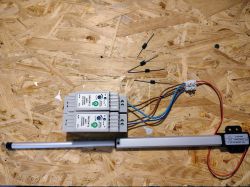
    Could you please direct me how to connect a 12 volt actuator to two 12 volt power supplies so that the control is based on the principle of actuating alternating power supplies with opposite polarity, via a 230 volt NO/NC relay. Someone told me that I should use rectifier diodes, unfortunately either this is the wrong hint or I am wiring these diodes wrong. Or should I use a completely different solution? In this connection as in the pictures the power supplies at the output make a short circuit, because the voltage from one powered supply seems to bridge on the other unpowered supply.... I'm not an electronics engineer, I don't know, I just want the actuator to close or open when it gets a signal from a temperature sensor that works with a 230V relay.


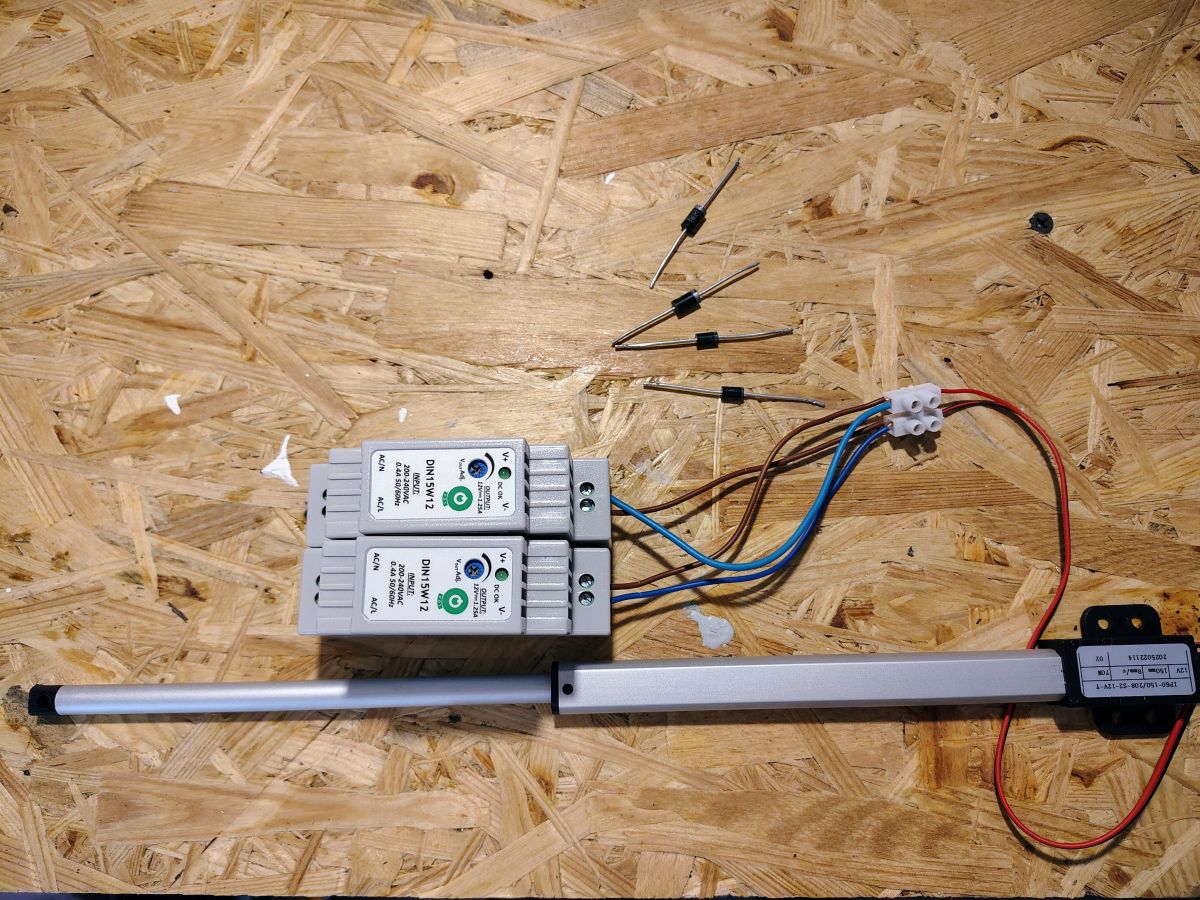
    Power supplies 12 V, 1.25 A.
    Rectifier diodes - 5 A sb5200 ssg25043.
    Actuator 12 V, current consumption unknown, but these power supplies will quietly power this actuator as I connect "makeshift".
    I don't necessarily have to use these power supplies, I can give them away, there may be another solution, as long as not some expensive one.
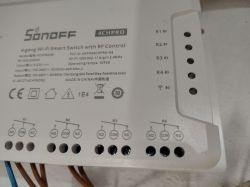
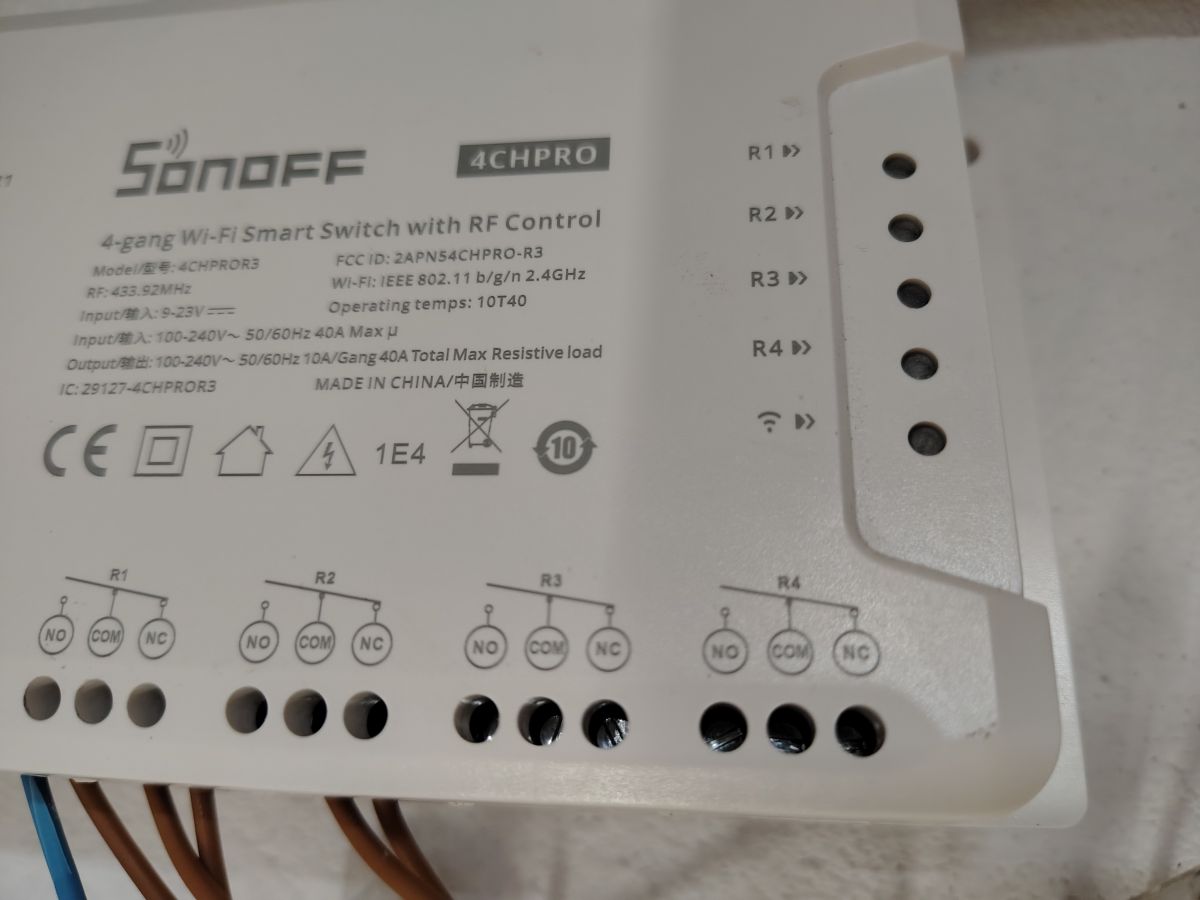
    Close-up of a Sonoff 4CHPRO R3 relay panel showing R1–R4 terminals with NO, COM, and NC labels
    Two 12V power supplies, linear actuator, and rectifier diodes on wooden surface. .
  • ADVERTISEMENT
  • Helpful post
    #2 21697214
    78db78
    Level 43  
    One power supply can be used why two?
  • #3 21697217
    szczudlo
    Level 10  
    78db78 wrote:
    You can use one power supply why two?

    That's why I'm asking how to wire it up - the less unnecessary hardware, the better. I'd like it to work properly, but I don't know how to figure out what to use.
  • Helpful post
    #4 21697226
    78db78
    Level 43  
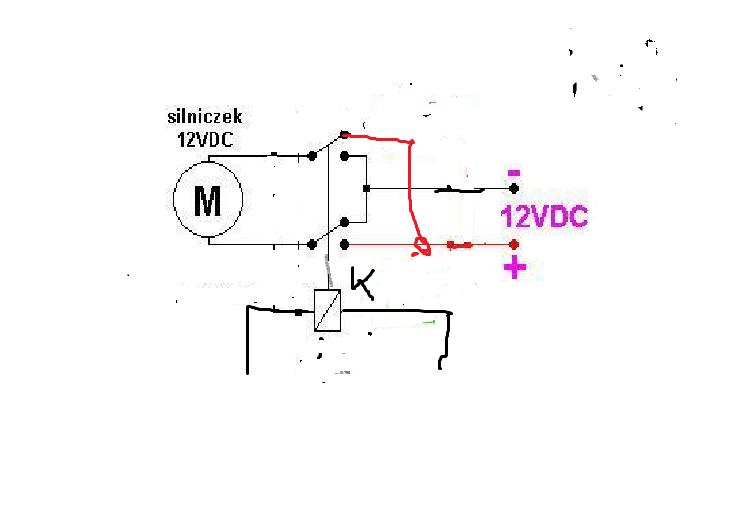
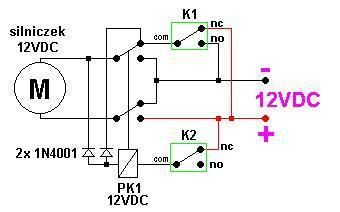
    Electrical diagram with relay K reversing rotation of 12VDC motor
    Applying voltage to relay K changes the direction of rotation.
  • #5 21697246
    szczudlo
    Level 10  
    Will you give some specific relay for this diagram, I don't really understand this diagram of yours.... Maybe if I saw the relay schematic it would make something clearer.

    But maybe I'll try to ask again, because to me it has to be straightforward to write.
    I have a 230 volt NO and NC relay supply, so under one terminal of the relay e.g. NO I connect the 12 volt supply which powers the actuator (e.g. closes it) and under the other terminal NC I connect the relay? Do I understand this correctly? Because what I mean is that when there is power on the 230 V NO relay, the 12 V actuator is supposed to close, and when there is 230 V NC power, the 12 V actuator is supposed to open. Sorry for such questions, but I'm new to this subject and I'd rather ask than do blind.
  • ADVERTISEMENT
  • Helpful post
    #6 21697269
    Staszek_Staszek
    Level 34  
    szczudlo wrote:
    Someone told me that I should use rectifier diodes,

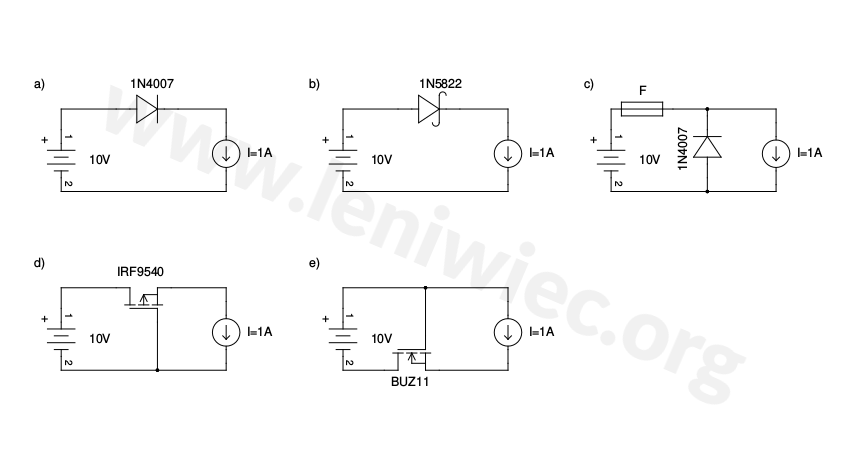
    If I don't know everything inside the power supply and the load is inductive, I use a diode on the output.
    Some kind of protection should be inside the power supply, but if I can't see what kind then maybe I'm duplicating it, a diode is not a fortune.

    Five circuit diagrams with diodes and transistors for 1A load at 10V
  • #7 21697283
    stachu_l
    Level 38  
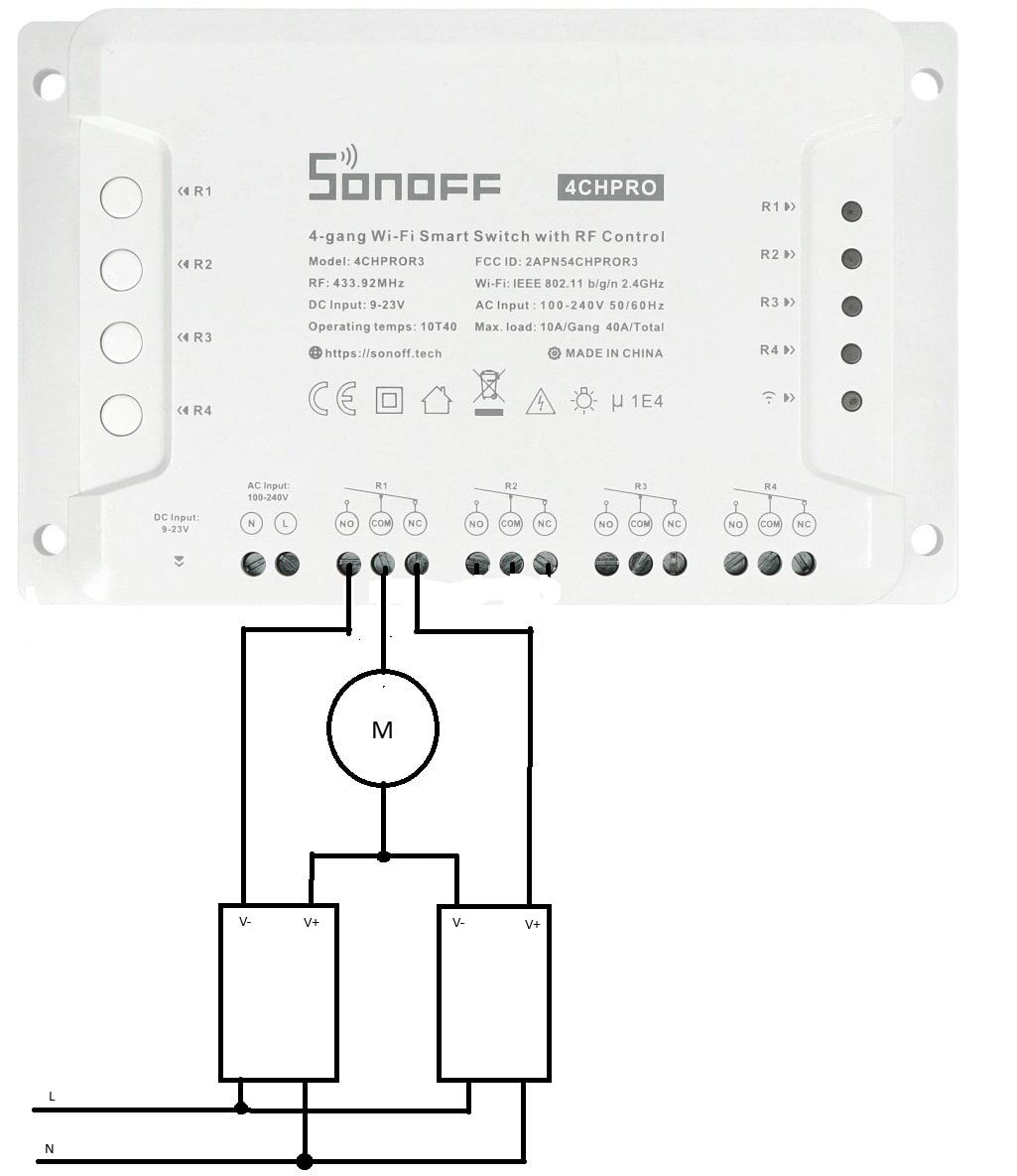
    This Sonoff module has 4 relays with NO-COM-NC switched contacts.
    Using two channels (e.g. 1 and 2), you can control the motor in two directions.
    Connect +12 V from the power supply to NO (1) and NO (2).
    Connect -12 V from the power supply to NC (1) and NC (2).
    Connect the motor to COM (1) and COM (2).

    Connecting two 12 V power supplies to one 12 V actuator - how do I do it?Przekaz...jpg Download(126.41 kB)

    If the motor draws less than 10 A, it should work, because that is the strength of the Sonoff contacts according to its technical data. The power supply draws less, so the motor will not draw more.
  • ADVERTISEMENT
  • #8 21697294
    szczudlo
    Level 10  
    stachu_l wrote:
    This Sonoff module has 4 relays with NO-COM-NC switched contacts.
    Using two channels (e.g. 1 and 2), you can control the motor in two directions.
    Connect +12 V from the power supply to NO (1) and NO (2).
    Connect -12 V from the power supply to NC (1) and NC (2).
    Connect the motor to COM (1) and COM (2).


    As the motor draws less than 10 A it should work, as this is the strength of the Sonoff contacts according to its technical data. The power supply gives less, so the motor will not draw more.


    I only have one free relay on this Sonoff model. The others are occupied.
  • ADVERTISEMENT
  • Helpful post
    #9 21697305
    stachu_l
    Level 38  
    szczudlo wrote:
    I only have one free relay on this sonoff model, the others are occupied.

    I'm sorry then, but how is the control of this motor supposed to work as you have one button/relay/channel control available?
    Is it supposed to work like e.g. a garage door - press - it moves one way and either gets to the end and stops, or a second press stops it somewhere along the way. Pressing again after stopping (regardless of which one) will start the door in the other direction.
    If this is how it is supposed to work, then you need to build or buy such a gate controller.
  • #10 21697318
    szczudlo
    Level 10  
    stachu_l wrote:
    szczudlo wrote:
    I only have one free relay on this sonoff model, the others are occupied.

    I'm sorry then, but how is the control of this motor supposed to work as you have one button/relay/channel control available?
    Is it supposed to work like e.g. a garage door - press - it moves one way and either gets to the end and stops, or a second press stops it somewhere along the way. Pressing again after stopping (regardless of which one) will start the door in the other direction.
    If this is how it is supposed to work, then you need to build or buy such a gate controller.


    There is a NO terminal and an NC terminal on the output of the relay. On the NC terminal is the phase to which I wanted to connect one 12 volt power supply and the actuator would then open until switched off by the limit switch. When a signal is received from the temperature sensor, the relay switches to the NO terminal, then there is a phase on the NO terminal and no phase on the NC, the second power supply fed from the NO terminal switches on with the opposite polarity. I've seen it that way, but the problem is behind the 12 volt power supplies where I bridge one cable from the actuator with the cables coming out of the power supplies, there it bites.
  • Helpful post
    #11 21697727
    78db78
    Level 43  
    Wiring diagram with 12VDC motor, relay PK1, and limit switches K1 and K2
    K1, K2 extremities.
  • Helpful post
    #12 21698444
    stachu_l
    Level 38  
    Let's perhaps establish this further:
    - an actuator powered by a single power supply operates normally, and the problem lies only in controlling the direction of rotation by changing the polarity of the power supply to the actuator,
    - the actuator has built-in limit switches and when it reaches the end it stops, without drawing power from the power supply (and without overheating the motor).

    If 2x YES, you can use one NO-COM-NC contact from the Sonoff to change direction, but leave two power supplies.
    This will be a circuit similar in principle of operation to the output of an acoustic amplifier supplied with a symmetrical voltage.

    szczudlo wrote:
    There is a phase on the NC terminal

    There will only be a phase on either the NC or NO terminal if you connect it to COM, and you don't have to do that. The Sonoff itself doesn't give phase there.

    In the proposed arrangement, we connect the power supplies permanently to 230 V AC, and connect their outputs in series - the V+ of one connects to the V- of the other. We connect one actuator wire to this point.
    We connect the V- of the first to the NO terminal of the Sonoff and the V+ of the second to the NC terminal. We connect the COM terminal to the second motor lead - end.

    Connecting two 12 V power supplies to one 12 V actuator - how do I do it?Przekazn..2.jpg Download(140.02 kB)
  • #13 21698576
    szczudlo
    Level 10  
    stachu_l wrote:
    This may yet be established:
    - an actuator powered by a single power supply operates normally, and the problem lies only in controlling the direction of rotation by changing the polarity of the power supply to the actuator,
    - the actuator has built-in limit switches and when it reaches the end it stops, without drawing power from the power supply (and without overheating the motor).

    If 2x YES, you can use one NO-COM-NC contact from the Sonoff to change direction, but leave two power supplies.
    This will be a circuit similar in principle of operation to the output of an acoustic amplifier supplied with a symmetrical voltage.

    szczudlo wrote:
    On the NC terminal there is a phase

    There will only be a phase on either the NC or NO terminal if you connect it to COM, and you don't have to do that. The Sonoff itself doesn't specify the phase there.

    In the proposed arrangement, we connect the power supplies permanently to 230 V AC, and connect their outputs in series - the V+ of one connects to the V- of the other. We connect one actuator wire to this point.
    We connect the V- of the first to the NO terminal of the Sonoff and the V+ of the second to the NC terminal. We connect the COM terminal to the second motor lead - end.


    This is quite an interesting solution, I will test it tomorrow and let you know how it works. Just won't there be a problem at the point where V- meets V+ from the different power supplies? Won't there be some kind of short circuit there?
  • Helpful post
    #14 21699125
    stachu_l
    Level 38  
    szczudlo wrote:
    Only, won't there be a problem at the point where V- meets V+ from different power supplies? Won't there be some kind of short circuit there?

    The power supplies do not have a PE connector and rather for user safety reasons have galvanic isolation of the I/O so their outputs are not internally connected and can be treated as separate voltage sources. If you can connect batteries in series (voltage two 12 V batteries to make 24 V) then these power supplies can also be connected in series. Until you short these second V+ and V- terminals there will be no short circuit. I assume that the Sonoff has a switched contact which never connects NC and NO together. If such a moment occurs when switching then there will be a momentary short circuit.
  • #15 21699240
    szczudlo
    Level 10  
    stachu_l wrote:
    szczudlo wrote:
    Only, won't there be a problem at the point where V- meets V from different power supplies? Won't there be some kind of short circuit there?

    The power supplies do not have a PE connector and rather for user safety reasons have galvanic isolation of I/O so their outputs are not internally connected and can be treated as separate voltage sources. If you can connect batteries in series (voltage two 12 V batteries to make 24 V) then these power supplies can also be connected in series. Until you short these second V and V- terminals there will be no short circuit. I assume that the Sonoff has a switched contact which never connects NC and NO together. If such a moment occurs when switching then there will be a momentary short circuit.


    Thanks a lot, you have helped to solve the problem. With the help of your schematic the actuator works as I expected. Thank you again.

    Added after 4 [hours] 53 [minutes]:

    Actuator already mounted in the target location, everything works perfectly controlled by two 12v power supplies connected according to the schematic sent by stachu_I big thanks Stach.
    Big thanks also to user Dioda52 who took his time in private messages, solved the problem in different ways.
    Thanks also to everyone else for their willingness to help.
    Topic to be closed, problem solved.
    Greetings
  • #16 21699836
    szczudlo
    Level 10  
    Problem solved. I connected everything according to this diagram:Circuit diagram connecting a motor to Sonoff 4CHPRO with two power modules
ADVERTISEMENT