


logo elektroda
logo elektroda
X
logo elektroda

[Solved] Bosch Thermostat II - inflated temperature, plan not working, what to set in the app?

marek_0116 369 10
ADVERTISEMENT
This content has been translated flag-pl » flag-en View the original version here
  • #1 21711627
    marek_0116
    Level 4  
    Hi I have this problem.
    I have bought a Bosch thermostat II head for the radiator in my flat. For this I bought a Bosch Smart Home Driver II controller and installed the Bosch Smart Home app.
    I have connected everything, theoretically it works.

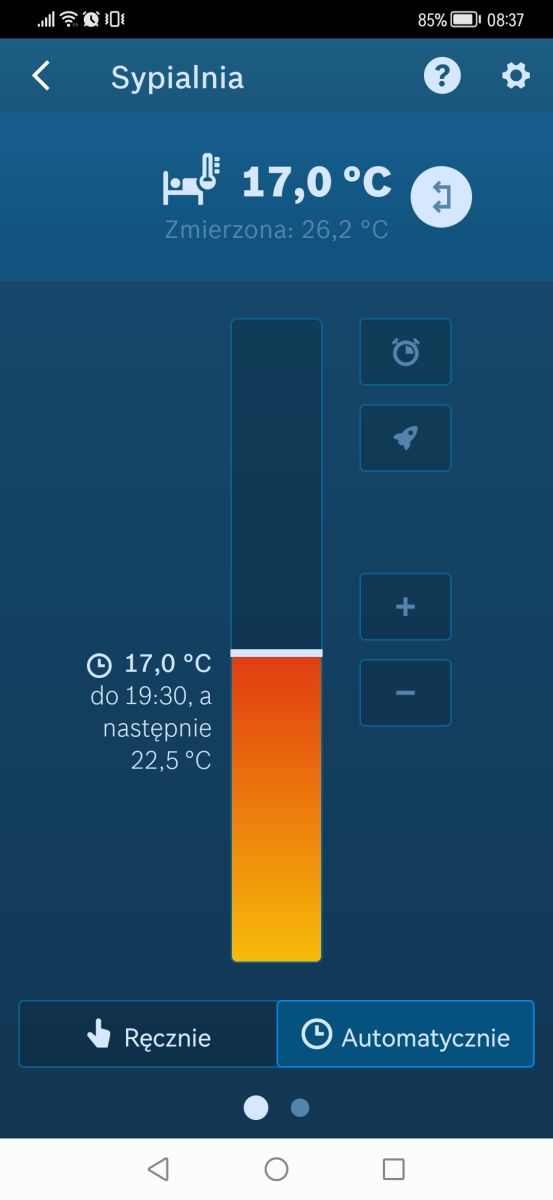
    The problem is that the head heats too much. I set myself a schedule. It is supposed to heat at 22.5 degrees at night and drop to 17 degrees during the day. However, the head maintains a temperature of around 26/26.2 degrees.
    Any suggestions as to what could be wrong?
    I have reset the head, done the calibration again and still the same. Bosch Smart Home screen shows measured temp 26.2°C and setpoint 17.0°C in bedroom .
  • ADVERTISEMENT
  • #2 21712214
    szamotel
    Level 18  
    If you close the head completely so that the heating is off, is the radiator warm or does it cool down? If the radiator is warm even though the head is closed, it means that there is a gap between the head bolt and the valve and some distance needs to be used.
  • ADVERTISEMENT
  • #3 21712224
    marek_0116
    Level 4  
    When I reduce the temperature to 5 degrees (that's the minimum) it still holds that 26 degrees.

    But in the app I have the option to pause heating, when I turn this on then the head closes completely and the radiator is cold. So it's unlikely to be the fault of play between the pin and the valve.
  • ADVERTISEMENT
  • #4 21712241
    szamotel
    Level 18  
    At 5 degrees the radiator should be closed, apparently the calibration was not done correctly. Maybe the radiator head pin pushes in with a lot of resistance and the Bosch head detects the resistance during calibration and the radiator valve is not completely closed. You can measure the stroke of the head after calibration (close - open) and compare with the stroke of the needle of the radiator valve.
  • #5 21712254
    marek_0116
    Level 4  
    It seems to me that if it detected too much resistance, it would throw an EO3 error (at least that's what it says in the instructions).

    As for the head pitch after calibration - I hadn't thought of that, I'll measure it and see what it looks like. Thanks for the hint
  • #6 21712290
    płetwa
    Level 32  
    Is the head covered by a curtain or drapes? I ask because the sensor is in the head and if you obscure that then there is no precision.
  • ADVERTISEMENT
  • #7 21712297
    marek_0116
    Level 4  
    It is not obscured.
    We could talk about precision if the difference was 1 or 2 degrees. Not that I set it to 17 degrees or 5 degrees and it heats up around 26 degrees 😂.
  • #8 21712303
    płetwa
    Level 32  
    Send a link to the instructions. I wonder if the adjustment is proportional or 0.1.
  • #9 21712305
    marek_0116
    Level 4  
    It seems to me that if it detected too much resistance it would throw an EO3 error (at least that's what it says in the instructions).

    As for the head pitch after calibration - I hadn't thought of that, I'll measure it and see how it looks. Thanks for the hint
  • #10 21712791
    szamotel
    Level 18  
    During calibration, the head works from resistance to resistance and so learns the working range. There can be an error if the firing pin stroke is too small.
  • #11 21715421
    marek_0116
    Level 4  
    I calibrated the head once again and so far it is working as it should.

Topic summary

A Bosch Thermostat II radiator head controlled via the Bosch Smart Home Driver II and app is overheating, maintaining around 26°C despite a programmed schedule to heat to 22.5°C at night and 17°C during the day. The radiator remains warm even when the thermostat is set to its minimum temperature (5°C), but turns cold when heating is paused via the app, indicating the valve closes properly in that mode. This suggests the issue is unlikely due to mechanical play between the thermostat pin and valve. Calibration was redone without improvement. It is proposed that the thermostat calibration may be incorrect due to excessive resistance on the valve pin, causing incomplete valve closure. Measuring the stroke length of the thermostat head after calibration and comparing it to the valve needle stroke is recommended to verify proper calibration. An EO3 error, which would indicate excessive resistance during calibration, was not reported.
Summary generated by the language model.
ADVERTISEMENT