logo elektroda
logo elektroda
X
logo elektroda

Identifying Erased Chipset on Unmarked Temperature Sensor from Pinout Analysis

tadeu1 774 13
ADVERTISEMENT
  • #1 21818838
    tadeu1
    Level 5  
    Posts: 80
    Help: 2
    Rate: 3
    Temperatura Sensor
    Help to discovery the Chipset

    Hey guys I receive 2 of them but the chineses they erase the chip info

    I have no ideia wich one is that
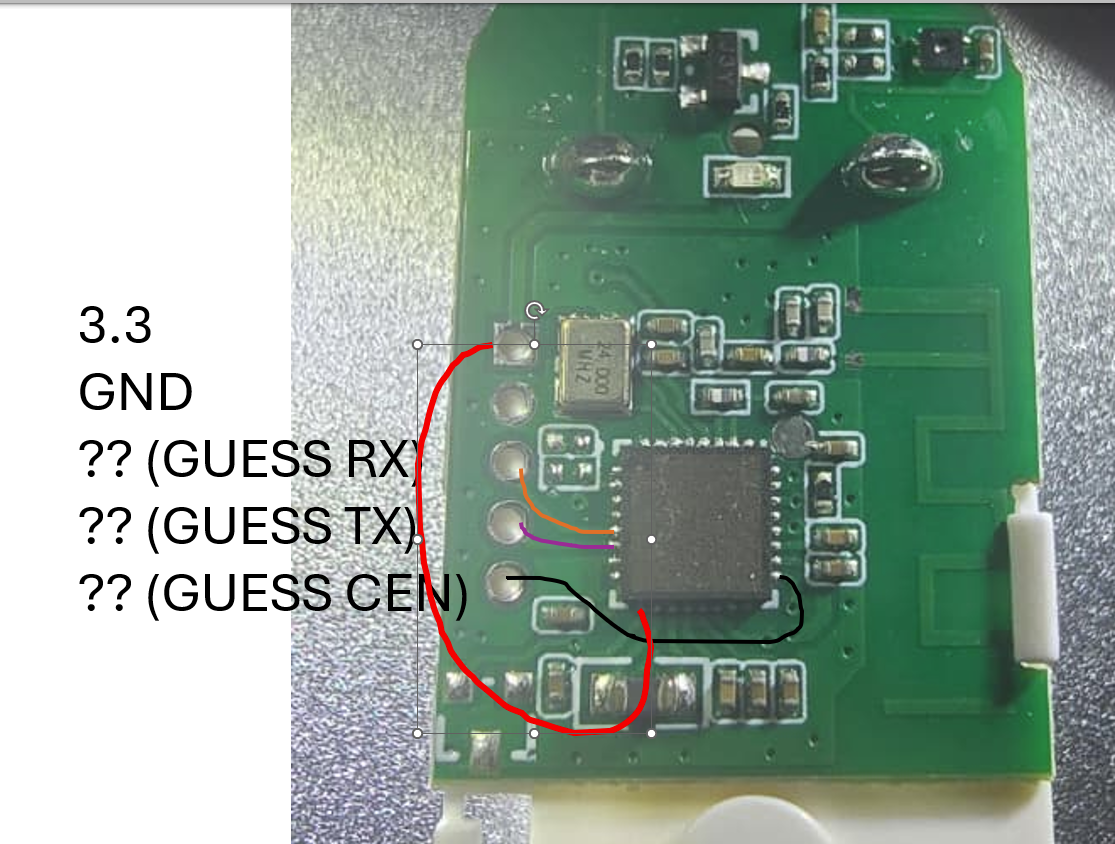
    I check the point with the pinout of the chip and I have it.
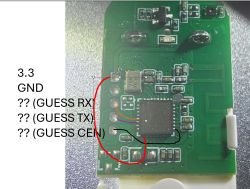


    PCB with labeled pins 3.3V, GND, guessed RX, TX, and CEN connections

    I cannot find ground at the chip, just on the battery
  • ADVERTISEMENT
  • #2 21818841
    p.kaczmarek2
    Moderator Smart Home
    Posts: 14416
    Help: 650
    Rate: 12371
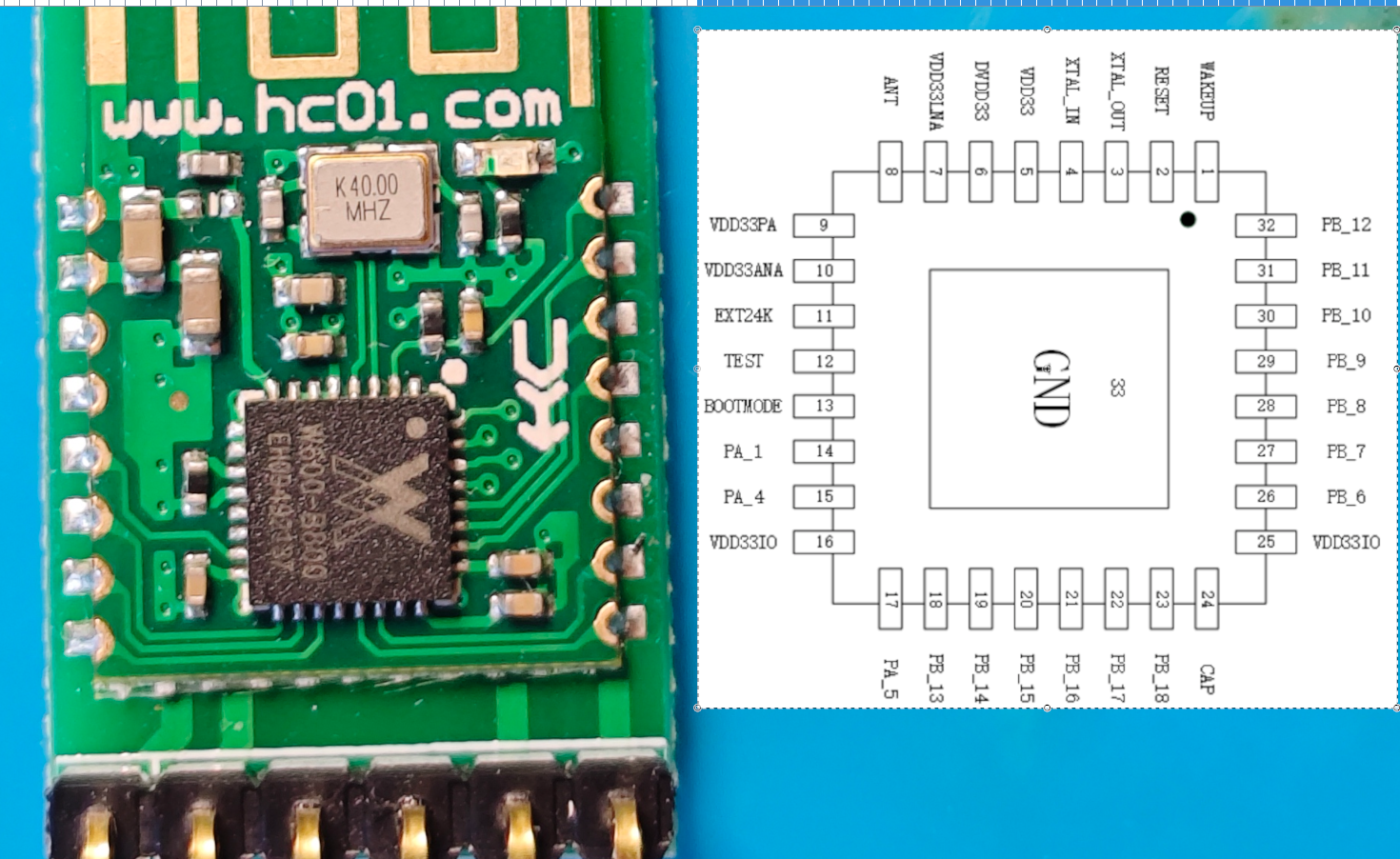
    Both Beken and ESP seems to have UART in the same pins row as crystal (oscillator), so probably it's not them... have you tried to receive anything from UART via USB to UART converter?

    This is also not T34, as T34 has built-in crystal.

    Also not W600, crystal does not match...
    Bluetooth module HC with Beken BK8000L chip and microcontroller pinout diagram


    I would suggest looking at crystal pins (XO, XI) and checking pinouts of known chips one by one
    Helpful post? Buy me a coffee.
  • #3 21818863
    DeDaMrAz
    Level 22  
    Posts: 600
    Help: 34
    Rate: 127
    I've just compared several chips in my possession and could not find a match, I'll need to do a better something for these boards as my effort on this is a fail :)

    @tadeu1

    Can you make a better picture, without the lines ab that reflection? preferably on a darker surface as not all the pins are visible?

    What I can say with certainty this is not TRS6260 or ECR6600, one potential candidate is W800 or BL602 but I need some better pictures to confirm (maybe multiple pictures would be best)
  • ADVERTISEMENT
  • #4 21818914
    tadeu1
    Level 5  
    Posts: 80
    Help: 2
    Rate: 3
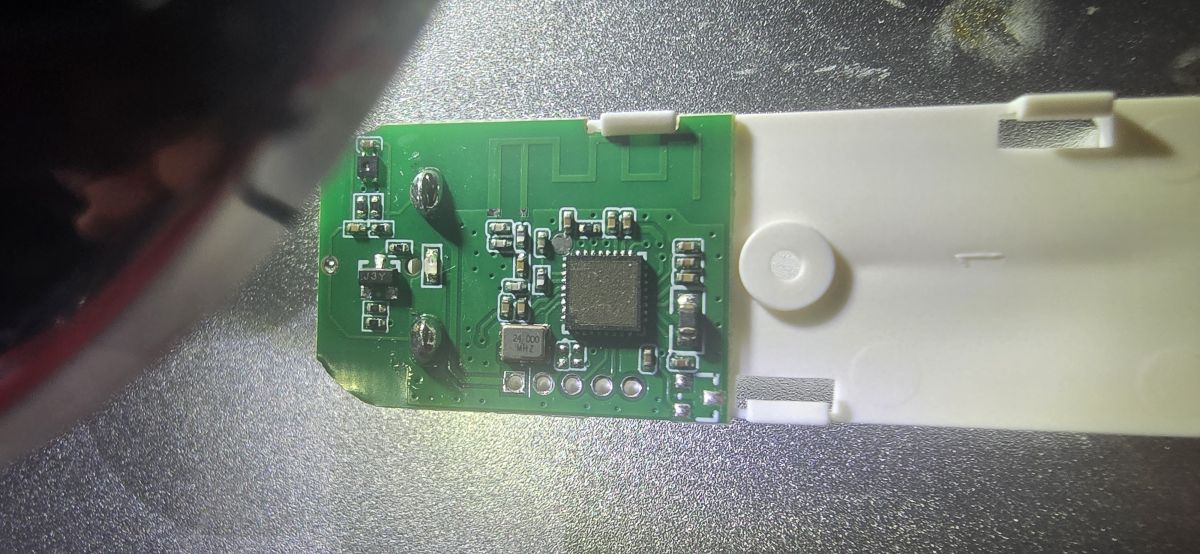
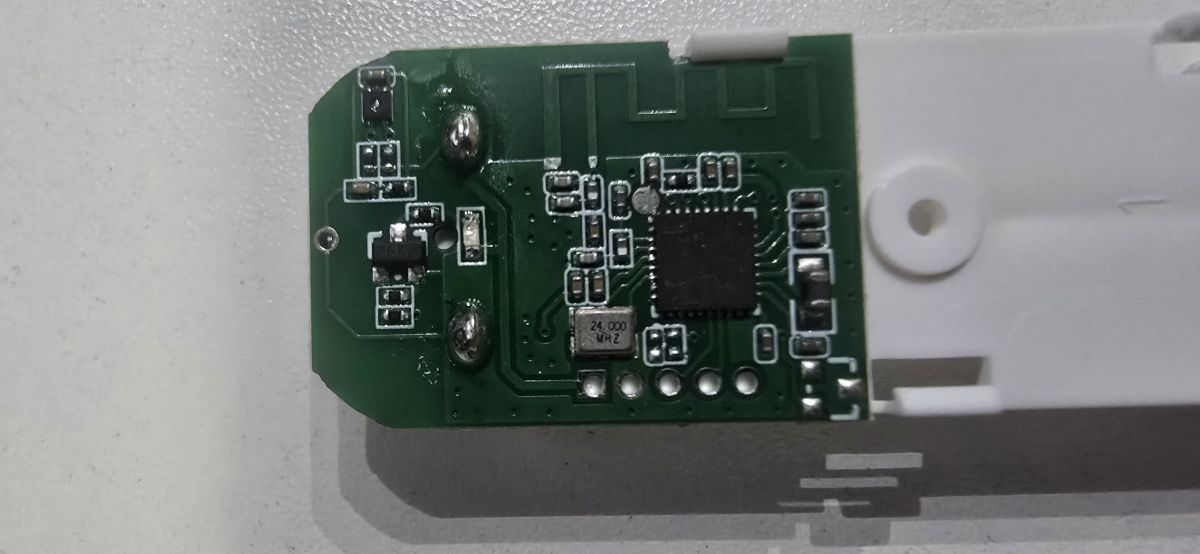
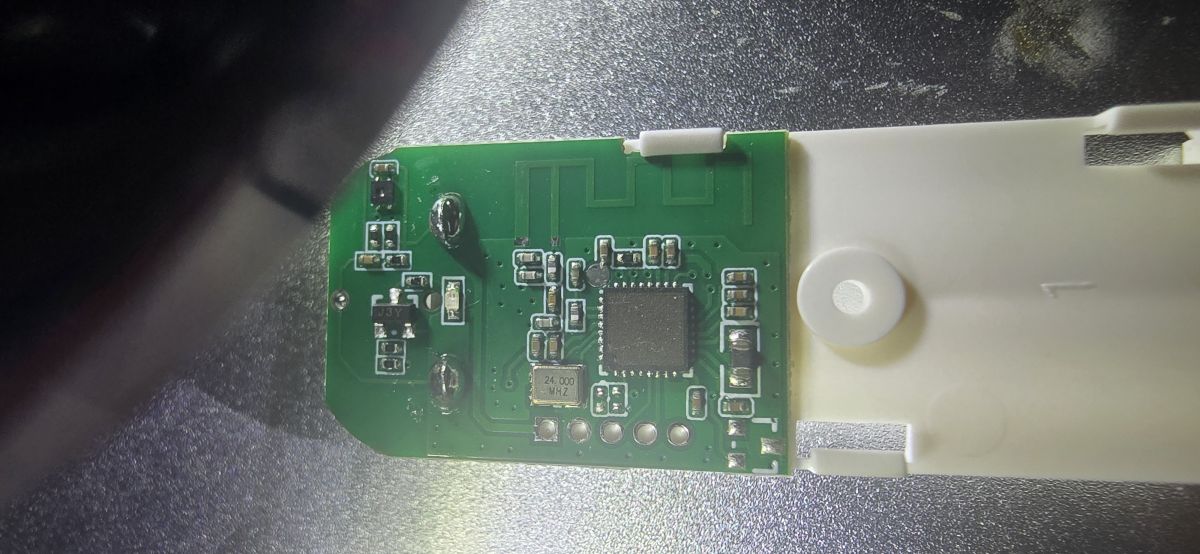
    Hey buddy, it's enough?
    I also try to use bl to read fw no success

    Close-up of a green PCB with an IC, antenna-like traces, and a white plastic housing Green PCB with an IC and SMD components mounted on a white plastic housing Close-up of a green PCB in a white housing with an IC and surface-mount components.
  • #5 21818922
    insmod
    Level 31  
    Posts: 1353
    Help: 160
    Rate: 425
    ESP8285?
  • #6 21819045
    p.kaczmarek2
    Moderator Smart Home
    Posts: 14416
    Help: 650
    Rate: 12371
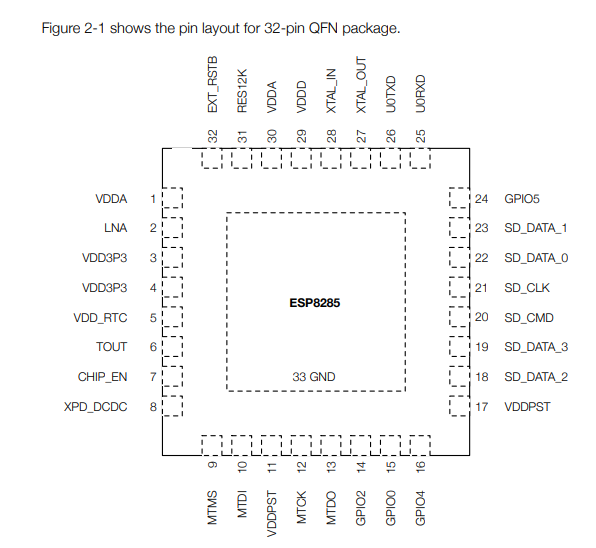
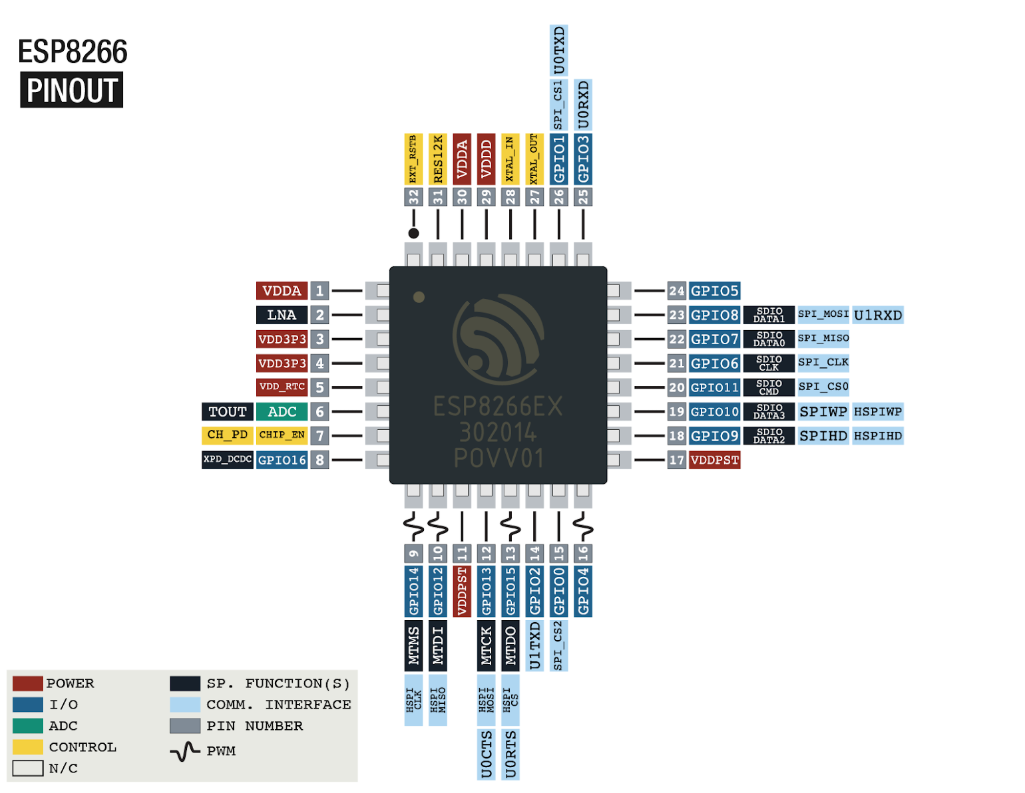
    ESP8285 has same pinout as ESP8266?
    ESP8285 QFN-32 pinout diagram with labeled pins and pin numbers around the package outline
    ESP8266EX pinout diagram with labeled functions and pin numbers
    XTAL does not match.

    Added after 19 [minutes]:

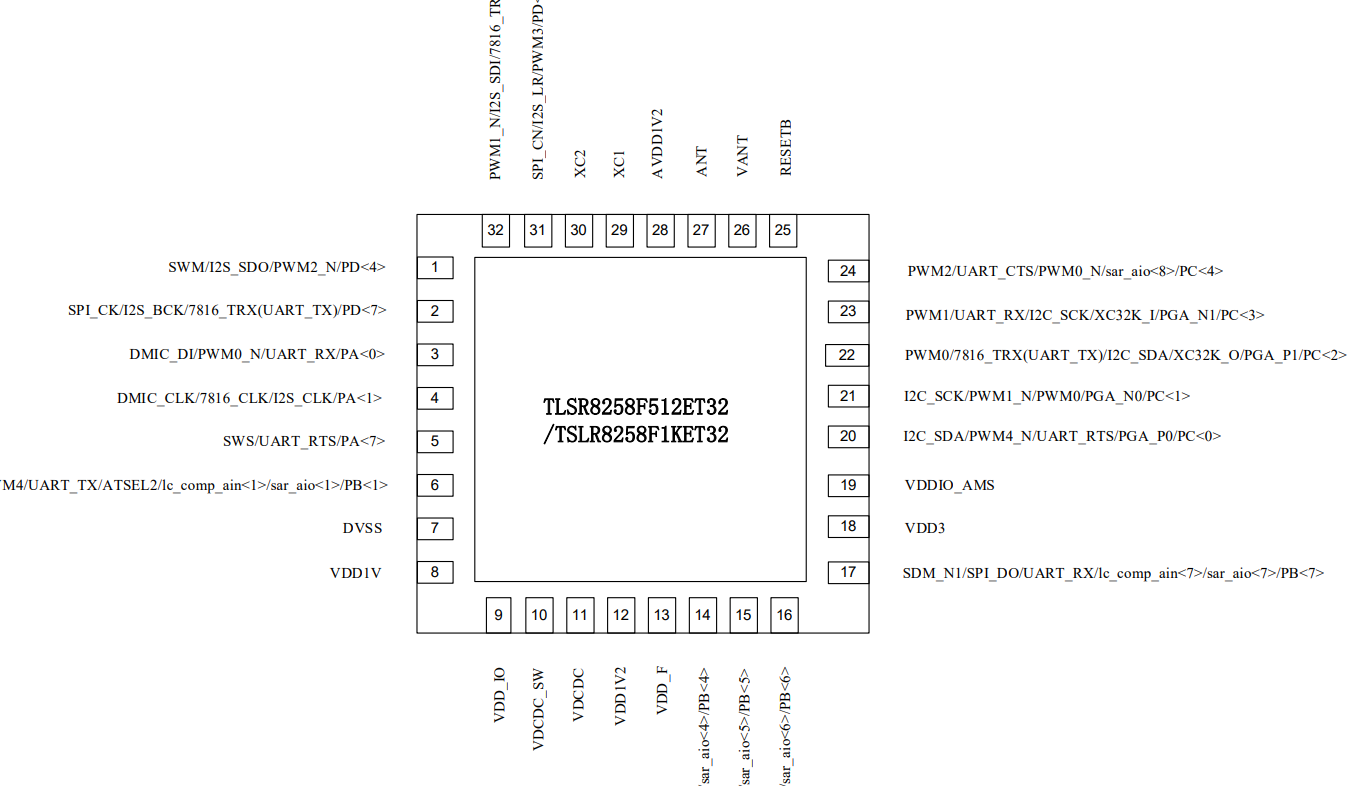
    Hey, ,maybe TLSR8258?
    Pinout diagram of TLSR8258F512ET32 microcontroller in 32-pin package.
    Helpful post? Buy me a coffee.
  • #7 21819091
    tadeu1
    Level 5  
    Posts: 80
    Help: 2
    Rate: 3
    Looks like the pin 1 it's close the cristal. I just wake up now. I'll check more pins to map it. Why this fck guys erase this cheap stuffs.
  • #8 21819134
    p.kaczmarek2
    Moderator Smart Home
    Posts: 14416
    Help: 650
    Rate: 12371
    There are two pins befor crystal, so TLSR8258 matches in that regard.
    Helpful post? Buy me a coffee.
  • ADVERTISEMENT
  • #9 21819138
    tadeu1
    Level 5  
    Posts: 80
    Help: 2
    Rate: 3
    Gosh I bought wifi, they send me zigbee. I just recheck aliexpress. It's wifi there, but you are true, came zigbee. Gosh. I need to start use zigbee
  • ADVERTISEMENT
  • #10 21819150
    p.kaczmarek2
    Moderator Smart Home
    Posts: 14416
    Help: 650
    Rate: 12371
    Oh, so it actually is TLSR8258? I guessed by accident, I saw it in this topic and felt it's similar:
    https://www.elektroda.com/rtvforum/topic4162375.html
    But that's actually very good! At least in my opinion. As I often say, I think Zigbee is better for battery-powered devices. It's easier to use and more energy efficient.
    For non-battery powered ones, I strongly prefer WiFi (it gives lots of possibilities, with OBK, we can even add extra sensors), but for battery powered devices, Zigbee is the way.
    Helpful post? Buy me a coffee.
  • #11 21819170
    DJ MHz
    Level 26  
    Posts: 1136
    Help: 36
    Rate: 241
    Laser burnt deep? Sometimes you can see it with a microscope, the layout just dampens or something
  • #12 21821654
    tadeu1
    Level 5  
    Posts: 80
    Help: 2
    Rate: 3
    >>21819150
    Yha I know, I have to start work with Zigbee for some devices.
    ;-(

    Added after 1 [minutes]:

    >>21819170

    I have one, but they did a good work uhahahua
  • #13 21821661
    p.kaczmarek2
    Moderator Smart Home
    Posts: 14416
    Help: 650
    Rate: 12371
    Do you have a Zigbee gateway? Like a CC2531
    Helpful post? Buy me a coffee.
  • #14 21821682
    tadeu1
    Level 5  
    Posts: 80
    Help: 2
    Rate: 3
    >>21821661 no, nothing. Im plaining to buy one next month

Topic summary

✨ The discussion focuses on identifying an unmarked temperature sensor chipset through pinout analysis. The user received two sensors with erased chip information and is attempting to determine the chipset by comparing pinouts and crystal oscillator connections. It was noted that common candidates like Beken and ESP chips are unlikely due to UART pin placement overlapping with the crystal oscillator pins. The T34 chipset is excluded because it includes a built-in crystal, which the sensor lacks. Similarly, the W600 model is dismissed as the crystal does not match its specifications. The recommendation is to examine the crystal oscillator pins (XO, XI) closely and systematically compare them with known chip pinouts to identify the sensor chipset. Additionally, the user could attempt UART communication via a USB to UART converter to gather more data.
Generated by the language model.

FAQ

TL;DR: Two sensor boards arrived with the chip label erased; experts note “Zigbee is better for battery-powered devices.” The pin layout near the crystal points to a TLSR8258 Zigbee MCU, not ESP/ Wi‑Fi. [Elektroda, p.kaczmarek2, post #21819150]

Why it matters: This FAQ helps you confirm the chipset, avoid misbought Wi‑Fi gear, and get Zigbee sensors working.

Quick-Facts

Quick Facts

What chip is this unmarked temperature sensor using?

Forum analysis points to Telink TLSR8258. The tell is two pins immediately before the crystal and non-ESP UART placement. Users compared ESP8266/8285/W600/T34 and ruled them out by crystal and pin-row mismatches. “Zigbee is better for battery-powered devices,” which aligns with the board’s behavior and photos. [Elektroda, p.kaczmarek2, post #21819134]

How can I identify an erased MCU from pinout and crystal?

Track the crystal pins (XO/XI), then map neighboring pins with continuity. Compare that cluster to common MCUs’ datasheets and known boards. Probe the suspected UART pair and check for boot messages using a USB‑UART dongle. How‑To: 1. Locate XO/XI by tracing to the crystal can. 2. Map the first four pins around XO/XI. 3. Test UART pairs at 74880–115200 bps. [Elektroda, p.kaczmarek2, post #21818841]

Is this board Wi‑Fi or Zigbee?

It shipped as Zigbee, despite a Wi‑Fi listing. The buyer rechecked the AliExpress page and confirmed the mismatch after identifying the TLSR8258‑like layout. Plan to pair it with a Zigbee coordinator rather than a Wi‑Fi firmware toolchain. [Elektroda, tadeu1, post #21819138]

Could it be ESP8285 or ESP8266?

No. The ESP8285 shares the ESP8266 pinout, and the oscillator/crystal placement on your board does not match that family. UART placement along the crystal row also diverges from typical ESP modules used in sensors. The crystal evidence rules out W600 and T34 too. [Elektroda, p.kaczmarek2, post #21819045]

Why does TLSR8258 fit the clues?

The photographed PCB shows two pins before the crystal, matching TLSR8258 reference layouts. That specific pin cluster is a strong signature. This board also behaved like a Zigbee node, supporting the Telink inference. Statistic: two pins precede the crystal can in the image. [Elektroda, p.kaczmarek2, post #21819134]

I tried reading firmware with a BL tool and got nothing. What now?

That failure aligns with a non‑ESP, Zigbee‑class MCU. BL tools for ESP or BK chips won’t speak Telink bootloaders. Shift to Zigbee workflows: pair the node, read clusters, and map attributes instead of flashing Wi‑Fi firmware. [Elektroda, tadeu1, post #21818914]

How do I connect this sensor to my smart home?

Use a Zigbee coordinator such as a CC2531 USB stick with Zigbee2MQTT or Home Assistant. Put the sensor in pairing mode, join it to your network, and expose temperature and battery clusters. Replace Wi‑Fi expectations with Zigbee device handling. [Elektroda, p.kaczmarek2, post #21821661]

Why do sellers erase chip markings?

Vendors sometimes laser‑burn IC tops to hide sourcing or deter cloning. If the burn is deep, a consumer microscope may not reveal remnants. “Sometimes you can see it with a microscope,” but not when the etch is aggressive. Edge case: nothing visible even under magnification. [Elektroda, DJ MHz, post #21819170]

What is Zigbee?

Zigbee is a low‑power, mesh networking protocol for home and IoT devices. It enables battery sensors to relay data efficiently through nearby nodes to a coordinator. Zigbee supports profiles for lighting, sensing, and energy management. It prioritizes low energy and reliability over raw bandwidth. “Zigbee”

What is Tuya?

Tuya provides an IoT platform used by many white‑label smart devices. It offers cloud services, mobile apps, and modules supporting Wi‑Fi, Zigbee, and Bluetooth. Many budget sensors are Tuya‑based, though protocols differ by model. “Tuya Smart”

What is Arduino Nano?

Arduino Nano is a compact microcontroller board for prototyping and education. It typically uses an ATmega328P or RP2040, provides USB programming, and breaks out digital and analog I/O. Makers choose it for breadboard‑friendly size and rich library support. “Arduino Nano”

What is CAN bus?

Controller Area Network (CAN) is a resilient serial bus for robust, real‑time communication. It’s used in vehicles and industrial systems for microcontrollers to exchange messages without a central host. Standardized by ISO 11898, it tolerates noisy environments. “CAN bus”

Can I still find ground on the chip package?

In this board, users found no accessible ground on the IC pads. Ground was only available at the battery negative. Use that point for stable reference when probing UART or crystal pads. Avoid lifting the QFN just to find ground. [Elektroda, tadeu1, post #21818838]

Is Zigbee really better for battery sensors than Wi‑Fi?

Experienced modders recommend Zigbee for coin‑cell devices due to lower energy draw and simpler sleep cycles. As one expert put it, “Zigbee is better for battery‑powered devices.” Use Wi‑Fi mainly for mains‑powered nodes with richer features. [Elektroda, p.kaczmarek2, post #21819150]

What should I buy next to get this working?

Get a Zigbee coordinator (e.g., CC2531 USB), then run Zigbee2MQTT or Home Assistant ZHA. Put the sensor in pairing mode near the coordinator, join it, and verify temperature updates. Skip ESP flashing tools for this unit. [Elektroda, p.kaczmarek2, post #21821661]

What is OpenBeken (OBK)?

OpenBeken is a community firmware used on many Wi‑Fi smart devices to add features and sensors. In this thread, OBK is noted as a flexible option for mains‑powered Wi‑Fi gear, not this Zigbee sensor. [Elektroda, p.kaczmarek2, post #21819150]
Generated by the language model.
ADVERTISEMENT