logo elektroda
logo elektroda
X
logo elektroda

Has anyone managed to make wireless coexistence work on any Tuya modules in OpenBK?

jitsirakowsk 462 14
ADVERTISEMENT
  • #1 21847888
    jitsirakowsk
    Level 7  
    Most Tuya modules have one antenna so there are tricks necessary to make both Bluetooth and WiFi work at the same time. Both N and T Beken (7231) chips have the hardware that is supposed to make it work (wireless arbiter, etc.) but I couldn't find any guides as to what a minimal setup would be. Our little group plans to teach a lab on BLE and reverse engineering this year and we were trying to make some basics to work before we throw it to our unsuspecting students :). Any help, hints are appreciated!

    Andy
  • ADVERTISEMENT
  • #2 21847982
    DeDaMrAz
    Level 22  
    I looked at that briefly when trying to do BT integration into ESP32, it can be done but at a cost... more on that to follow for sure. Maybe @insmod has more to say on the matter?
  • ADVERTISEMENT
  • ADVERTISEMENT
  • #4 21848253
    jitsirakowsk
    Level 7  
    >>21847988 Thanks! We were looking at BK7231 series chips (N and T). That SDK has functions for that as well, but it is not clear how to call them or what parameters to set, if any. There is a cost, sure (I am assuming both BLE and WiFi would have to slow down, and the dropped packet rate would go up, but for IoT devices this should be fine). Anyway, thanks again; if anyone knows more, we would appreciate it!

    Andy
  • #6 21853734
    jitsirakowsk
    Level 7  
    >>21850071 This looks really promising, but I am not sure what I am looking at. Am I right to assume that I can build this from the https://github.com/NonPIayerCharacter/OpenBK7231T_App fork? Do I need to specify BK7231N_ALT target? For some reason, none of us here can get the build system to work (I guess it is heavily Windows-biased, which none of us has access to here), so we have to remove most of the scripts first to get to the Makefile, which is why I am asking. Also, any chance this would work on the BK7231T version, since this is what we have for the students to play with? Anyway, thanks, looks great!
  • #7 21853742
    DeDaMrAz
    Level 22  
    @jitsirakowsk

    follow that thread I mentioned before, I got a local build system via docker ready that needs to be tested on Linux so you can build it quickly. BT is coexisting and some heavy development and testing is on the way but for now the initial goal is achieved - BT is running on N ( and I think T as well + other platforms as that is the goal of this project ) it works, coexists and with more improvements to follow. Feel free to give feedback and ask questions as this is a huge milestone for our project but we may use it is a different way than you intended it so feel free to engage and we will get it done.
  • #8 21853774
    insmod
    Level 31  
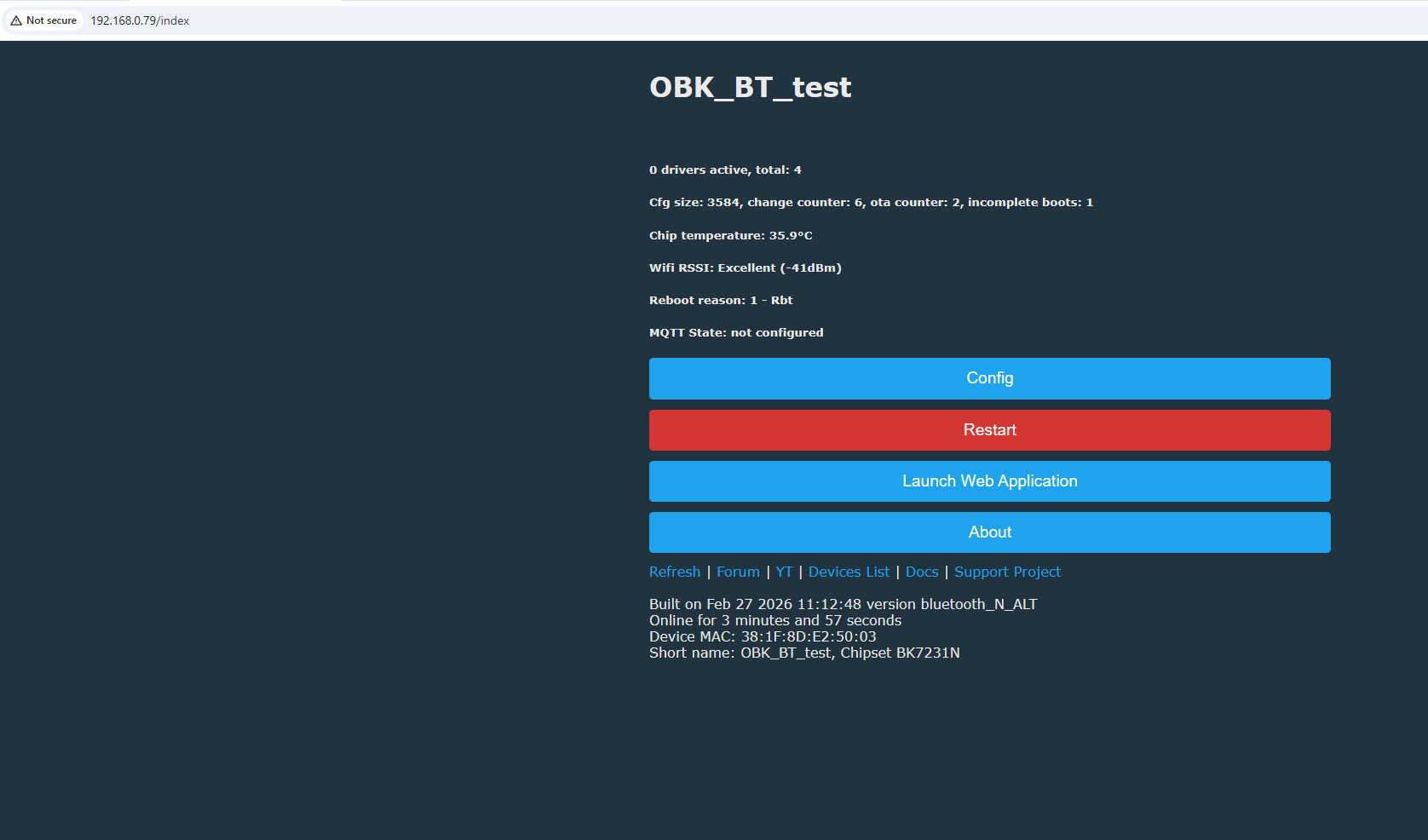
    What exactly is the problem with building?
    It's Linux only, the only things that are needed to build ALT are make and gcc (best is system arm-none-eabi gcc from ubuntu 22.04 (10.3))
    cd to cloned app repo and just type "make OpenBK7231N_ALT VARIANT=btproxy"

    Only scan is implemented, no active connections.
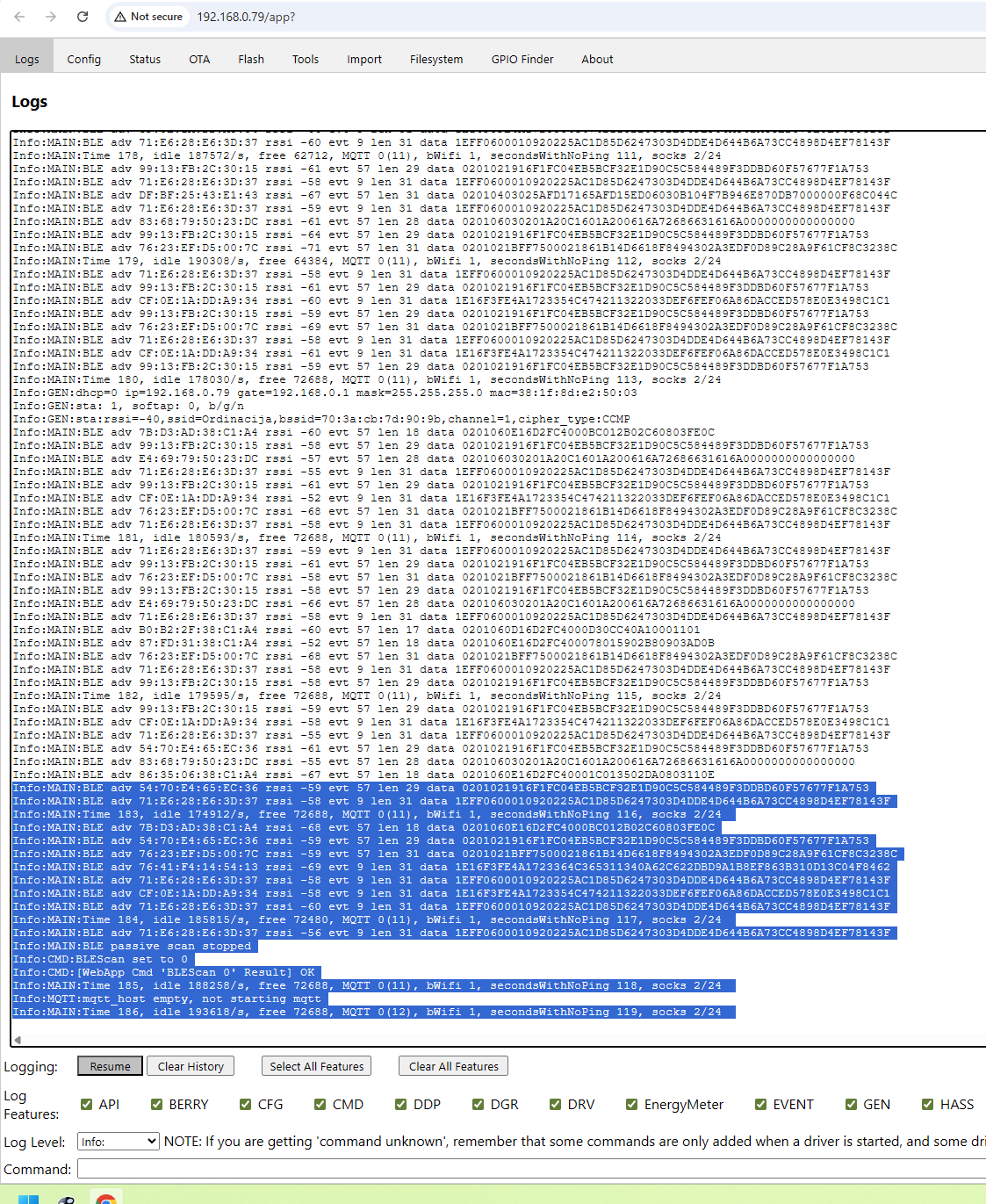
    Caught advertisements are then passed to Home Assistant via ESPHome API.
    Extended advertisements are not supported, as is LE Coded.

    BK7231T is not supported (it doesn't support ble 5.x library), only N and 7238. At least for now.

    @DeDaMrAz do you think it would be better to use nanopb library, instead of how it's done now?
  • #9 21853775
    DeDaMrAz
    Level 22  
    insmod wrote:
    do you think it would be better to use nanopb library, instead of how it's done now?


    I am still thinking about that, I have no clear idea how to and what for to use the BT on OBK - direction is lacking in my head. I have to dwell on it a bit more.
  • #10 21854100
    jitsirakowsk
    Level 7  
    >>21853774 Thanks for the tip, we will try this. We were using the shell commands from the root of the repo and they do not seem to work well (I guess bash vs zsh vs sh syntax comes into play), so every time we build we just strip the rest and leave the SDK and the main Makefile and build it this way. I am not sure why such a straightforward project has such a convoluted build system (on the other hand I appreciate the difficulty of supporting a dozen different platforms). Just a clarification: by the app repo, do you mean the platforms/OpenBK7231N directory? There are so many Makefiles floating around between the root and that, I am not sure where the target is. I can always grep for it, I guess...

    On the Bluetooth side, we do have the BLE running on T (actually, on N as well but I have not posted it yet), a sample project was posted in this forum. Primitive as it is, it does support advertisements as well as encrypted connections (all you need for the latter is to activate the SM); what we were lacking was the coexistence with WiFi. I am still not sure from looking at your code how it was done. There must be several parameters set up for it to work smoothly (like the delay for the radio reset). Is it all taken care of by the SDK? There is an rf_coex_.. struct somewhere, but all it does is set the policies, no relax times or anything. It must somehow interact with the scan window/interval settings (CEVA manuals for their stack mention some formulas), but where is it done?

    Also, you managed to set up active scanning as well. Did you check that it actually sends out scan requests and gets stuff back? There must be a callback that does this upon receiving the advertisement. Is it also done by the SDK code? I did not find it in your code, but I might have missed something. We always wrote the callback by hand (this is all active scanning is, really, just asking when you feel like it :)). We do have a bunch of eager students to write code though... :) Someone currently is working on the HID (over GATT for now) profile, I will tell her you got the coex working, see if she can make a 'wifi keyboard' this way.

    Great work!

    Andy
  • ADVERTISEMENT
  • #11 21854686
    insmod
    Level 31  
    No, i meant main app directory (OpenBK7231T_App)
    N and T default SDK are from Tuya, and use their makefile. I have problems with it as well on WSL1.
    OpenBK723xx_ALT builds fine, but like i said requires specific gcc.
    Callback is registered via ble_set_notice_cb
    Active scanning works fine, i get BTHome sensor name if it's enabled. Don't know if LE Coded works, it's disabled in SDK and i don't have any device that uses it. Also don't know if extended advertising works.
    Coex is achieved via window/interval settings, but it can miss some advertisements that way.

    RTL8720C/RTL8720D don't miss advs, they can work when scan window=interval

    Pls be aware that i almost know nothing about bluetooth. This is the first time i've done anything with it.
  • #12 21854690
    DeDaMrAz
    Level 22  
    insmod wrote:
    Pls be aware that i almost know nothing about bluetooth. This is the first time i've done anything with it.


    I want to second this as well, all this is highly experimental and hard WIP!
  • #13 21855295
    jitsirakowsk
    Level 7  
    >>21854686 Thank you for the info. I apologize for a stupid question but I am looking at the code in hal_bt_proxy_bk7231.c (is this the right place?) You said you registered the callback with ble_set_notice_cb so I see a call ble_set_notice_cb(hal_bt_gap_callback), but looking at what hal_bt_gap_callback does I only see the processing of the received advertising data. It does not launch any scan requests. The name of the device, the MAC, etc., would be sent in any advertising packet; there should be no need for active scan. So I wonder what active scan does for you and how the scan requests are sent. Is it done automatically by the stack? I do not have an N device on hand to check but are you getting any advertising info for which info->evt_type&0x7==3 (meaning it is a response to a scan request, not just a standard advertising PDU)?

    insmod wrote:
    Pls be aware that i almost know nothing about bluetooth. This is the first time i've done anything with it.


    This probably works in your favor more than you know :) We have a bunch of people quite familiar with BLE and they all have a deer-in-the-headlights look when they read Beken's (or, God forbid, Tuya's) BLE code. Thanks for all the help.

    Andy

    Added after 1 [hours]:

    >>21854686
    insmod wrote:
    Don't know if LE Coded works, it's disabled in SDK

    What do you mean by disabled in the SDK? The rf_init function sets the PHY params (in RADIOCNTL2 reg) and it even states in the comment that the PHY is set to support the Coded PHY. Am I looking at the wrong place? The T version, indeed, does not have support for the Coded PHY at all.
  • #14 21855646
    insmod
    Level 31  
    >>21855295
    Yes, hal_bt_proxy_bk7231.c is the correct file.
    hal_bt_gap_callback only processes advertisements, scan must be launched manually with BTStartScan command in OBK, which calls HAL_BTProxy_StartScan. Then scan will just continue until stopped.

    I don't think it's in my favor when i want to do more than just receive advertisements.
    I tried to implement active connections on RTL8720D, but it's a callback hell there. I barely understand what most functions there do.

    To enable scan on LE Coded channels, GAPM_SCAN_PROP_PHY_CODED_BIT must be added here:
    https://github.com/NonPIayerCharacter/beken_f...er/ble/ble_5_1/ble_pub/app/src/app_ble.c#L696
    And GAPM_SCAN_PROP_ACTIVE_CODED_BIT for active scan.

    T doesn't support coded because it doesn't support 5.0.
  • #15 21855763
    jitsirakowsk
    Level 7  
    >>21855646
    insmod wrote:
    hal_bt_gap_callback only processes advertisements, scan must be launched manually with BTStartScan command in OBK, which calls HAL_BTProxy_StartScan. Then scan will just continue until stopped.

    I see. What I meant was if you are doing active scan, you should be getting two responses for each scanned ad: one for the original AD PDU and one in response to your scan request (this was originally introduced to circumvent the 31 byte limit on the AD PDU). If you (or, rather, whoever you are scanning) are using extended advertisements, there is no need for active scan. So there must be a separate callback to launch scan requests. I guess the bits you mentioned are set so that the BLE cell would wait to hop to the next ad channel in order for you to send the scan request. I am just curious if somehow GAPM sends the request by itself, but I do not see where.

    insmod wrote:
    To enable scan on LE Coded channels, GAPM_SCAN_PROP_PHY_CODED_BIT must be added


    I cannot see anywhere in the library that setting this bit does anything. It is an enum, so the debugging info for the library should have a record of it (unless the Beken devs are truly evil), but I cannot see it anywhere in the disassembled sources. There are also a bunch of other _CODED settings; I wonder if they are supposed to be set as well.[

    quote="insmod,post=21855646"]it's a callback hell there.

    No kidding! I appreciate all your hard work on this. I am also curious why you decided to start with scanning (other than for detection purposes). Setting up connections for peripherals should be a bit easier (we have the code for T, at least and as soon as we get something to test the N code on, we should have that too). The hard work is setting up profiles and handling events, etc. For centrals (the scanning ones) you would have to implement discovery, pairing, etc. Just thinking about it makes me shiver...

    Andy

Topic summary

✨ The discussion addresses the challenge of enabling wireless coexistence between Bluetooth and WiFi on Tuya modules, which typically feature a single antenna. Both N and T Beken 7231 chips include hardware components such as a wireless arbiter designed to facilitate simultaneous operation of Bluetooth Low Energy (BLE) and WiFi. However, there is a lack of minimal setup guides or documented procedures to achieve effective coexistence on these platforms. One contributor referenced experience with Bluetooth integration on ESP32, noting it is feasible but involves trade-offs. The conversation seeks practical advice or hints to establish a baseline configuration for teaching BLE and reverse engineering using OpenBK firmware on Tuya modules.
Generated by the language model.

FAQ

TL;DR: Yes—BLE scanning can coexist with Wi‑Fi on BK7231N today; "Only scan is implemented" and BK7231T isn’t supported for BLE 5.x. Build the ALT target with GCC 10.3 and start scans via BTStartScan; data forwards to Home Assistant. [Elektroda, insmod, post #21853774]

Why it matters: This lets Tuya-based IoT devices listen for BLE sensors while staying online over Wi‑Fi, without extra radios or antennas.

Quick Facts

What is Tuya?

Tuya is an IoT platform provider that supplies Wi‑Fi/BLE modules and cloud services, enabling OEMs to build smart devices with a common SDK and app ecosystem. Many low‑cost bulbs, plugs, and sensors use Tuya modules with single shared RF front‑ends. [Elektroda, jitsirakowsk, post #21847888]

What is OpenBeken (OpenBK)?

OpenBeken is an open-source firmware and tools set for Tuya/Beken chips that replaces vendor firmware to add features, reduce cloud dependence, and enable custom integrations like BLE scanning with Wi‑Fi coexistence on BK7231N/7238 via the ALT build. [Elektroda, insmod, post #21853774]

What is Bluetooth LE active scanning?

Bluetooth LE active scanning is a discovery mode that sends a Scan Request to advertisers and receives an extra Scan Response, extending metadata beyond the 31‑byte advertising payload limit for legacy PDUs. It increases detail but requires timing budget. [Elektroda, jitsirakowsk, post #21855763]

What is BLE Packet Traffic Arbitration (PTA) on Beken?

BLE PTA is a coexistence mechanism in Beken SDKs that coordinates BLE and Wi‑Fi access to a shared RF chain, reducing collisions; in OpenBK ALT, coexistence is currently achieved via scan window/interval tuning while leveraging SDK controls. [Elektroda, insmod, post #21854686]

Does wireless coexistence (Wi‑Fi + BLE) work on BK7231 modules with OpenBK?

Yes. Users report BLE runs alongside Wi‑Fi on BK7231N in the ALT path; “BT is coexisting” and active development continues. It’s experimental but functioning for scanning today. [Elektroda, DeDaMrAz, post #21853742]

Which chips are supported for BLE 5.x features in OpenBK ALT?

Use BK7231N or BK7238. BK7231T is excluded because its default SDK path lacks the BLE 5.x library used by the btproxy variant. “Only N and 7238” are supported at this time. [Elektroda, insmod, post #21853774]

How do I build the BLE btproxy for BK7231N on Linux?

Build in the main app repo (OpenBK7231T_App): 1. Install arm-none-eabi-gcc 10.3 (Ubuntu 22.04). 2. Clone the app repo. 3. Run: make OpenBK7231N_ALT VARIANT=btproxy. This produces a firmware with BLE scan forwarding. [Elektroda, insmod, post #21853774]

Is Docker available for building on Linux?

Yes. A Docker-based local build system exists and needs Linux testing. The maintainer notes BLE is running and coexisting, with more improvements planned; community feedback is welcome. [Elektroda, DeDaMrAz, post #21853742]

How do I start BLE scanning in OpenBK and where is the callback?

Start with the BTStartScan console command, which calls HAL_BTProxy_StartScan. Advertisements trigger the notice callback registered via ble_set_notice_cb, processed in hal_bt_proxy_bk7231.c. Scanning continues until stopped. [Elektroda, insmod, post #21855646]

Is active scanning supported and does it actually send Scan Requests?

Active scanning works; users see BTHome names when enabled. The SDK manages timing; add proper properties for CODED if needed. Extended advertising support is currently unknown or off. [Elektroda, insmod, post #21854686]

How are BLE advertisements forwarded to Home Assistant?

The btproxy variant passes received advertisements to Home Assistant using the ESPHome API. This enables quick sensor presence and telemetry in HA without pairing or connections. [Elektroda, insmod, post #21853774]

How is coexistence achieved if there is only one antenna?

Coexistence is achieved by tuning BLE scan window and interval so Wi‑Fi retains airtime. The trade‑off is that some advertisements can be missed during contention periods. “It can miss some advertisements that way.” [Elektroda, insmod, post #21854686]

Can I enable LE Coded PHY scanning on BK7231N?

Yes. Add GAPM_SCAN_PROP_PHY_CODED_BIT (and GAPM_SCAN_PROP_ACTIVE_CODED_BIT for active scan) to the scan properties in app_ble.c. BK7231T lacks BLE 5.0 and cannot use Coded PHY. [Elektroda, insmod, post #21855646]

Are extended advertisements and LE Coded enabled by default?

No. Extended advertisements are not supported in the current btproxy path, and LE Coded is disabled unless you set the proper bits and rebuild. [Elektroda, insmod, post #21853774]

Why do I sometimes see two packets per device when scanning?

In active scanning, you receive the original advertisement plus a Scan Response, overcoming the legacy 31‑byte limit. Extended advertising reduces the need for active scans but isn’t enabled here. [Elektroda, jitsirakowsk, post #21855763]

What toolchain version should I use for reliable builds?

Use the system arm-none-eabi-gcc 10.3 from Ubuntu 22.04 for OpenBK7231N_ALT. Other versions can fail due to SDK makefile expectations. [Elektroda, insmod, post #21853774]
Generated by the language model.
ADVERTISEMENT