kulmar wrote: If we’re going to have a bit of fun, we might as well make the most of modern technology – the tape recording should be digital.
Philips has already made such attempts. However, DAT very quickly proved to be a flop; in theory, digital technology offers the potential for extremely high quality (for magnetic tape recording) quality, but the problem lies precisely with the tape itself – whilst in the case of analogue recording, momentary drops are not a problem (as at most you’ll hear a crackle or a minimal drop in quality), with digital recording it wasn’t quite so straightforward. No error correction schemes could remedy the problems arising from the nature of the tape itself. Whilst the CD is still doing quite well, DAT was essentially forgotten within a few years of its launch.
Jacekj wrote: Hello, I’d go for valve amplifiers.
What for? I suppose just to end up with higher electricity bills. A valve won’t improve the sound quality of a tape recorder. Modern silicon electronics already have such high specifications that, in this particular case, they’re ‘too good’ for magnetic recording anyway.
kulmar wrote: Ultimately, it’s the medium – that is, the tape – that determines these parameters.
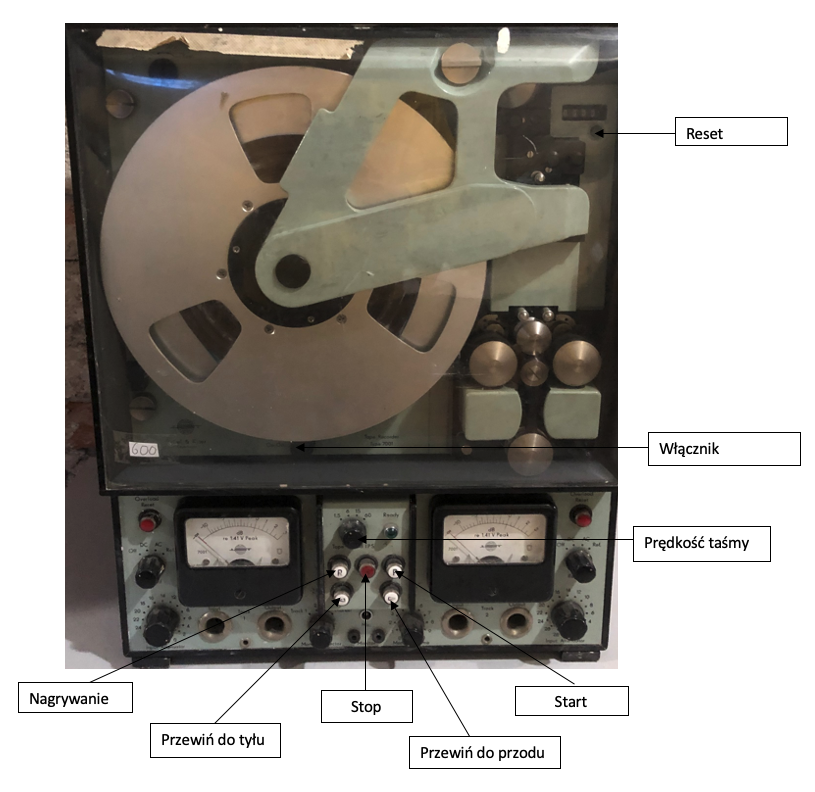
Yes and no. Whilst it is true that the tape has a significant impact on recording quality, noise level, bandwidth, etc., the influence of the mechanical aspects should not be underestimated; the precision of tape guidance, contact with the head faces, and irregularities in tape movement...
Despite its relatively simple operating principle, a tape recorder combines several extremely important fields – electronics, mechanics and … technology (the latter referring to tape manufacturing). You can have the best tape recorder in the world, but if the tape is poor, you will never achieve good sound quality. You can have the best tape, but if the electronics are faulty, you will not be able to achieve a good recording, let alone a good playback from the tape (even if recorded on a reference-quality tape recorder). Conversely, a minor fault with the pressure roller can compromise the quality to such an extent that a planned evening of music turns into a nightmare.One could list all these factors one by one and their impact on the sound, but there are so many that it would take up so much space that no one would have the patience to read through them all. And unfortunately, all these factors are crucial to achieving the ultimate goal: a sufficiently high-quality recording or playback. The best tape recorders cost a fortune (still do!) not because they’re big, heavy and look good, but because they have to meet all these requirements – and that, unfortunately, comes at a price.
And Nagra achieved its fame precisely because Mr Kudelski had the knowledge and the patience to see to every tiny detail and bring them to perfection.
andreyatakum wrote: The Chinese are already offering tape-transport mechanisms.
Indeed, but which ones? The two or three simplest and cheapest mechanical models, which were mass-produced right up until the last ‘dachshund’ (radio cassette player) rolled off the production line. A chassis made from sheet metal as thin as a tin can, plastic flywheels (at best with a sheet metal disc attached), a permanent magnet instead of an erase head.... Even with the greatest determination and the best of intentions, the best you could make of this would be a poor-quality ‘Walkman’.
andreyatakum wrote: There are more of these things gathering dust in readers’ cupboards and cellars than there are cassettes or records.
That’s right; unfortunately, cassette tape ages not only in terms of sound quality but also physically. I myself have at least about 600 cassettes (mostly branded ones)
and I know what I’m talking about – not to mention the findings from laboratory tests that were carried out back in the day. In theory, the tape retains its properties for a few to a dozen or so years at most; after that time, even when stored in its original packaging (sealed packs), it degrades, which affects its sensitivity, noise levels and overall quality. And to pre-empt the point that the Chinese are still producing cassettes – yes, they are, but they’re producing knock-offs. The recording quality on such tape, compared to a branded one (even one that’s been sitting around and has already deteriorated), is at best 20 per cent. The inherent noise is comparable to the recorded signal; the tape can start to delaminate even on the very first playback, and the tape itself can stretch.
Unfortunately, as I wrote, in a tape recorder it is important to maintain the best possible quality of each of its components – including the tape.