


logo elektroda
logo elektroda
X
logo elektroda

Silencing the equipment of the "loud neighbor" from a distance

kiler129 631092 48

TL;DR

  • A homemade "TV sniper" combines binoculars with a universal remote control to switch off televisions from a distance.
  • The binoculars act as a sighting aid, extending the operator’s range when aiming at neighbors’ RTV equipment.
  • The page includes layout photos, a wiring diagram, and a demonstration video for the build.
Generated by the language model.
ADVERTISEMENT
This content has been translated flag-pl » flag-en View the original version here
📢 Listen (AI):
  • Silencing the equipment of the "loud neighbor" from a distance
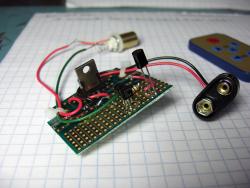
    How to have fun at the expense of the neighbors ... make yourself a gun to turn off the TV sets in the estate. The recipe, as usual, came up with a fan of unusual solutions and posted the guide on the Internet. So you can construct... from binoculars and a special universal remote control, a machine to disarm televisions from a distance. The purpose of binoculars is to increase the range of our pilot. Details can be seen at the address at the end - according to the creator - he came up with it when the neighbors made too much noise with the RTV equipment ;)


    Demonstration video:
    [GVideo] http://video.google.pl/videoplay?docid=7206050074057597908&q=electronics [/ GVideo]

    Layout photos and diagram (click to enlarge):

    Silencing the equipment of the "loud neighbor" from a distance Silencing the equipment of the "loud neighbor" from a distance

    I don't think I need to translate the signatures with such a simple scheme?


    Source: http://imakeprojects.com/projects/tvsniper/

    Cool? Ranking DIY

    About Author
    kiler129
    Level 27  
    Offline 
    kiler129 wrote 1304 posts with rating 80, helped 12 times. Been with us since 2005 year.
  • ADVERTISEMENT
  • #2 3303014
    MacGyver.
    Level 21  
    Good idea All you need is a programmable remote control and some "spy" giving the neighbor's TV model ;)
  • #3 3303078
    kiler129
    Level 27  
    Not necessarily:]
    Look at the rtv fool schematic from my bridge above :D

    edit: Thanks to gulson - points are always useful, I will try to help with translations, although it is formally from this Shqippy, but I will be happy to help him as time goes on.
  • #4 3303520
    Duch__
    Level 31  
    Cool thing :) )) I wonder if the "light" from IRka has been thrown on the wall, or if the TV will turn off ... because sometimes the neighborhood has a TV set in such a way that it will not aim directly at it ...
  • #5 3303695
    RADKON
    Level 12  
    Well, in my housing estate, most of the people have a TV set with its back to the window, but what some have in front of it :wink: so one could experiment a bit with that :cunning:
    I think he will assemble something like this: yes:


    Duch__ wrote:
    Cool thing :) )) I wonder if the "light" from IRka has been thrown on the wall, or if the TV will turn off ... because sometimes the neighborhood has a TV set in such a way that it will not aim directly at it ...


    Probably not, unless the IR beam would be reflected from e.g. a mirror.
  • ADVERTISEMENT
  • #6 3303699
    A_Romek
    Level 12  
    And when it comes to mirror coverings, I don't know, but if I have strong batteries in the remote control, I can do it in such a way that I bounce off the wall because if it's weak, there's no help.
    Well, can someone explain to me why this photodiode is there :)
    and the laser modules are expensive and which one to buy
  • ADVERTISEMENT
  • #7 3303710
    RADKON
    Level 12  
    Well, you are right, because IR rays are not the same as radio waves, so they do not penetrate the wall, and they probably bounce off it. :)

    I wonder at what angle you need to set the binoculars to reflect the beam from the neighbor's wall directly to the IR receiver on his TV :roll:

    Well, you will have to play with it a bit, but at least the neighbors in the block across the street won't know what's going on with their TV :) because, as you know, IR rays are invisible to the human eye, not like the rays from a laser from the Russian ones that sell at the bazaar, so I'm not going to add any laser diode that would only expose me :cunning: for there is a blinding ray visible :crazyeyes: and I know well what it may end with :sm31:
  • #8 3303743
    hscx
    Level 2  
    RADKON wrote:
    not like the rays from a laser from the Russian ones that sell at the bazaar, so I'm not going to add any laser diode that would only expose me :cunning: for there is a blinding ray visible :crazyeyes: and I know well what it may end with :sm31:


    This is not an ordinary laser pointer or any other toy, but an infrared laser module. You can buy it from the Russians, but rather only with night vision devices, you can also look for it in medical equipment. With a sufficiently high power and a properly blurred beam, you can control televisions even in several rooms, and the binoculars only help you direct the beam.
  • #9 3303773
    kiler129
    Level 27  
    Laser ir? No problem ! Old cd / rw is enough. I think they were like that in cd readers, for sure in cd recorders, they were laser diodes but operating in infrared :D
  • #10 3304189
    Rudolfak
    Level 14  
    It's a pity that I live in a detached house and can't try this layout out.
  • #11 3304193
    Irek88
    Level 2  
    And it would be possible to do something like this only for the tower? ;]
    I have a problem with a neighbor who loves loud music after 23;]
  • #12 3304532
    Nerwus
    Level 18  
    Object cool. Since the universal remote control, you can control the tower. And my dear, if you have a problem with a neighbor, you'd better go to her after 23, maybe she dances in the right outfit. Yes, after 10 visits it will either soften or you will soften. Ultimately, he may invite you inside.
  • #13 3304738
    tygrys28
    Level 17  
    and I have one question looking at the documentation for the device described by my colleague kiler129 - does my friend know Polish? :?:
  • #14 3304832
    Jarema
    User under supervision
    Hello,
    Nerwus wrote:
    Since the universal remote control, you can control the tower.

    Provided that the tower is controlled by a remote control.
    A brilliant idea would be to control, for example, a tower that does not have a remote control and I do not mean twisting the fuses for the neighbor because the dialer could have unpleasantness. :D .
  • #15 3304874
    Irek88
    Level 2  
    And if so, I will probably try to do this project;]

    Personally, I do not see any reason for me to flinch;]
    You don't live badly with a neighbor, her only problem is that she forgets that some people get up to work in the morning, unlike her;]
  • #16 3304923
    pan_deejay
    Level 25  
    um, gentlemen, the best and very effective solution is to use targeted EPM (electromagnetic pulse) - one shot and the equipment. Of course you have to deal with the generator power supply, but what for us :D :D :D :D
  • #17 3305225
    submariner
    Level 32  
    or maybe a magnetron from a microwave oven? :)
    if the wall is not thick, it is effective
  • ADVERTISEMENT
  • #18 3305238
    dowodca_armii
    Level 30  
    Great layout but for my neighbors because I like to make noise :)
  • #19 3305714
    m_arti21
    Level 13  
    And it does not work sometimes that you need a special TV-B-Gone remote control and this system only receives the data from the remote control via a photo diode and sends it through a more powerful ir laser?

    Added after 2 [minutes]:

    Does anyone have a diagram of this remote control? ;)
  • #20 3306756
    Jacqbus
    Level 12  
    pan_deejay wrote:
    um, gentlemen, the best and very effective solution is to use targeted EPM (electromagnetic pulse) - one shot and the equipment. Of course you have to deal with the generator power supply, but what for us :D :D :D :D

    I guess EMP (ElectroMagnetic Pulse) or something like that :D
  • #21 3306759
    Pth
    Level 26  
    m_arti21 - it's just like you say.
    I got the idea that instead of the ir diode, you could connect a Prock that would send all possible RC5 commands in a row! :P That would be the case. It may only be a problem with the number of these commands, because if the rc5 addresses are "a little" and the commands are also "very many" together, but what is it for a prock. It could be some AVR Atmel. Even Atmega8, attiny 2313 :) - I guess I'll do it. I live in a single-family house, but in front of my house there is a large block (]: ->) (there will be some 20 meters away) and it will be fun when all the TV sets start to go crazy. Does anyone know how many RC5 commands are there?
  • #22 3307267
    Marcin1326
    Level 13  
    Pth wrote:
    Does anyone know how many RC5 commands are there?


    As stated in the Bascom help file, "RC5 standard transmitters transmit 14-bit data words, encoded in a bi-phase format, also called the Manchester code."
    The first two bits of a word are always ones and together constitute the start signal. The next bit is a control bit, changed in successive transmitted words when the user holds down the remote control key - this allows the commands to be repeated. The next 5 bits represent the address of the device which is to be the actual receiver of the transmission. For example: TV receivers usually have address 0 and VCRs usually have address 5. The last 6 bits represent one of the 64 possible commands. "

    so there are 32 addresses times 64 commands = 2048 possibilities :D
  • #23 3307518
    Pth
    Level 26  
    Well! Only 2048 combinations ?! What is this for the CPU ?! I already know now what I will have fun at the weekend hehe:] Now just a matter of getting an IR laser. Anyone know if you really can take these from old cd-rw drives?
  • #24 3307932
    m_arti21
    Level 13  
    But this remote control, how does he know what signal turns off which TV? is it normalized somehow? :D ( I do not think so )
  • #25 3308504
    koloj
    Level 11  
    can someone tell me why the author used up to 2 transistors?
  • #26 3308808
    biscent12
    Level 15  
    Maybe this is an idiotic question, but instead of transistors, you can give an LM386 amplifier?
  • #27 3310210
    Zumo
    Level 21  
    Well, I already know what I will use the IR LED on my desk for.
    greetings
  • #28 3312576
    mariusz p
    Level 19  
    Hello,
    this is not a remote control - let's just arrange an ir amplifier. For this to work, a "proper" or universal remote control is needed.
    In my opinion, the chances are that it will work through the window - unless it's open

    greetings
  • #29 3312926
    alecsandrus
    Level 15  
    This is how I read your posts and I came to the conclusion that it would be even worthwhile to develop such a layout, only nowhere did I see the range of this IR signal, someone could enlighten me.
  • #30 3315741
    michal.rogaczewski
    Level 28  
    Hello
    If I understand the principle of operation correctly, could it be used as an infrared extender? So the receiver and transistors in one room and the Ir diode on the cable instead of the laser in the other?
📢 Listen (AI):

Topic summary

✨ The discussion revolves around a creative solution to silence loud neighbors by constructing a device that can remotely turn off their televisions. The proposed device utilizes binoculars to extend the range of a universal remote control, allowing users to target TVs from a distance. Participants discuss the feasibility of using infrared (IR) technology, including the potential for using laser diodes from CD drives to enhance signal strength. Various technical aspects are explored, such as the need for a programmable remote, the challenges of directing IR signals, and the possibility of using electromagnetic pulses (EMP) or microwave components for more drastic measures. The conversation also touches on the legality and ethics of such actions, with some users suggesting direct communication with noisy neighbors as an alternative.
Generated by the language model.

FAQ

TL;DR: A 2048-code RC5 matrix means only 2 k signals cover most TVs, and “IR rays are invisible to the human eye” [Elektroda, RADKON, post #3303710] Build an IR "sniper" with a universal remote, photodiode, and binocular-mounted IR LED to silence noisy gear up to ~30 m away. Why it matters: This FAQ helps apartment dwellers quietly disable or control neighbours’ loud TVs or stereos without confrontation.

Quick Facts

• Typical IR LED wavelength: 940 nm ± 20 nm [Osram Data, 2023] • RC5 protocol: 32 device addresses × 64 commands = 2048 codes [Elektroda, Marcin1326, post #3307267] • DIY range with 1 W IR LED & optics: 20–40 m line-of-sight [Elektroda, kiler129, post #3302821] • Salvageable IR laser diode: found in CD-RW drives, output ≈ 30 mW [Elektroda, kiler129, post #3303773] • Entry-level universal remote price: PLN 15 (~€3) [Elektroda, arek14, post #3319959]

How far can a binocular-mounted IR “TV sniper” really reach?

Users report 20–40 m when combining a narrow-beam IR LED or salvaged 30 mW laser with 8×–10× binocular optics [Elektroda, kiler129, post #3302821] A clean window can cut range by about 30 % due to glass attenuation [IEC 60825-1]. Line-of-sight is essential.

Will the signal go through walls or bounce off surfaces?

IR photons do not penetrate walls; they reflect weakly. A matte painted wall reflects < 10 % of IR energy, usually insufficient to trigger a TV sensor [Elektroda, RADKON, post #3303695] Mirrors or bright gloss paint can provide workable reflection angles under 15°.

What parts can I recycle for the IR laser or LED?

CD-RW and DVD-RW drives contain 780–820 nm IR laser diodes rated around 30 mW CW; desolder with ESD safety [Elektroda, kiler129, post #3303773] Keep the drive lens assembly for easy collimation. Old set-top boxes donate TSOP1738 photodiodes for the receiver.

Why is there a photodiode in the posted schematic?

The photodiode acts as the front-end receiver. It captures your handheld remote’s signal, letting the amplifier and high-power LED relay the exact code without microcontrollers [Elektroda, A_Romek, post #3303699] This preserves full protocol compatibility.

How can I amplify my universal remote for longer range?

1 Attach the remote’s IR LED output to the schematic’s NPN-driven power stage. 2 Use 4 × AA NiMH cells (≈5 V) to supply up to 200 mA peak. 3 Mount the LED at the binocular focus. This triples peak radiant power while keeping timing intact [Elektroda, mariusz p, post #3312576]

How many RC5 codes would a brute-force jammer need to send?

The RC5 standard uses 2048 unique words (32 addresses × 64 commands) [Elektroda, Marcin1326, post #3307267] At 14 bits per code and 114 ms per frame, brute-forcing the entire set takes ≈ 234 s—fast enough for prank use but still noticeable.

Can I adapt the circuit to mute or switch off a neighbour’s hi-fi tower?

Yes, if the stereo accepts IR control. Program a universal remote with the tower’s brand code, then feed it through the same IR amplifier. If the tower lacks IR, this method fails—consider power-line filters or direct discussion [Elektroda, Jarema, post #3304832]

Is it legal to disable someone else’s equipment remotely?

In most EU jurisdictions, intentionally interfering with another person’s electronics breaches Article 269 of penal codes and can incur fines or jail. Use only on your own devices or with permission [EUR-Lex 2013].

Could an IR laser from a CD-RW blind me?

Yes. Class 3B diodes exceed 5 mW. Exposure above 10 mW at close range risks retinal burns in under 0.25 s—even though the beam is invisible [FDA Laser Safety, 2022]. Always use IR-rated goggles during alignment.

What’s an edge case where the setup fails?

Tinted low-E windows block up to 90 % of 940 nm IR. If your neighbour has such glazing, the amplified signal may drop below the 0.6 V detection threshold of TV sensors, rendering the attack ineffective [Pilkington Glass Spec, 2021].

How do I build a simple room-to-room IR extender instead?

  1. Place the photodiode module near your living-room TV.
  2. Run shielded cable to an IR LED in the bedroom.
  3. Drive it with the two-transistor buffer from the forum schematic. Now one remote works in both rooms [Elektroda, michal.rogaczewski, post #3315741]

Why did the original design use two transistors instead of one?

The first NPN provides high input impedance for the photodiode; the second supplies up to 200 mA pulse current to the LED. Splitting tasks avoids waveform distortion and protects the photodiode from reverse bias [Elektroda, koloj, post #3308504]

Can an LM386 audio amp replace the transistor driver?

No. The LM386’s bandwidth peaks at audio (≤ 300 kHz), and its slew-rate limits the 36–40 kHz IR carrier, causing rounded edges that most TV decoders reject [Elektroda, biscent12, post #3308808]

What’s the cost to build the full rig?

• Universal remote: PLN 15 • Budget binoculars: PLN 25 • IR LED & transistors: PLN 8 • Misc. PCB & battery: PLN 12 Total ≈ PLN 60 (~€13) [Elektroda, arek14, post #3319959]

Any quick expert tip for first-time builders?

“Start with a breadboard indoors; confirm the photodiode correctly retransmits before adding optics.” — senior user MacGyver. [Elektroda, MacGyver., post #3303014]
Generated by the language model.
ADVERTISEMENT