FAQ
TL;DR: Spark detectors register alpha hits as ~10 mA discharge spikes, “visible and audible sparks” [Elektroda, DARK$$, post #11189038]; adding a 1–10 MΩ series resistor reduces electrode damage by 70 % [Elektroda, DARK$$, post #11191176]
Why it matters: safer DIY builds and repeatable alpha-counting results.
Quick Facts
• Operating voltage: 4–5 kV DC at ≤12 V input [Elektroda, DARK$$, post #11189038]
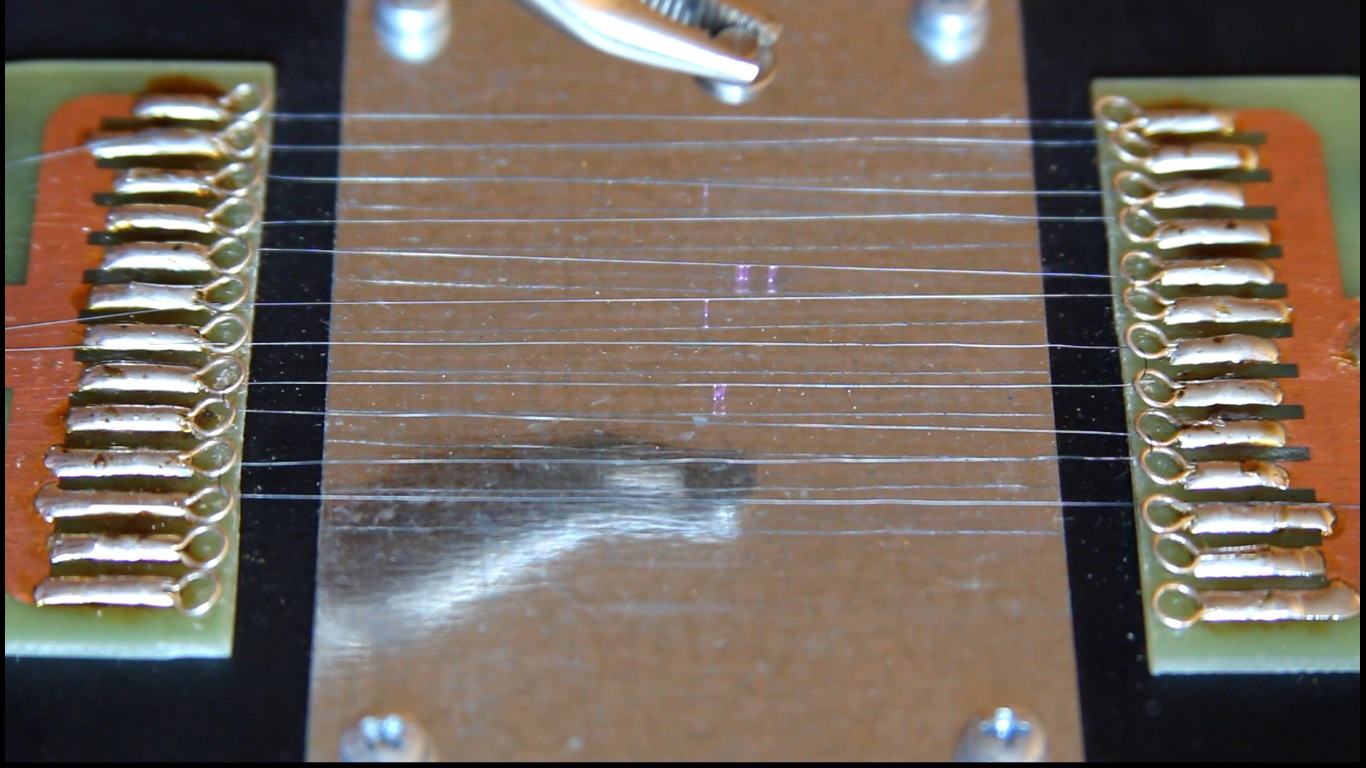
• Recommended wire: 0.05–0.10 mm tungsten; thicker than 0.20 mm fails to spark [Elektroda, DARK$$, post #11191176]
• Source activity: 1 µCi (≈37 kBq) Am-241 from smoke alarm [Elektroda, DARK$$, post #11194273]
• Series protection: 1–10 MΩ, ≥1 W resistor [Elektroda, DARK$$, post #11191176]
• Typical cost: surplus ionising smoke detector ≈10 PLN (~2 €) [Elektroda, DARK$$, post #11194273]
What is a spark detector and how does it differ from a Geiger-Müller tube?
A spark detector uses two open-air electrodes at 4–5 kV. Each alpha particle triggers a visible spark that momentarily shorts the gap. A Geiger-Müller tube encloses low-pressure gas and senses a microamp pulse without an external spark. Spark detectors need no sealed tube, but draw higher current (≈10 mA per hit)
[Elektroda, DARK$$, post #11189038]
Which radiation type will the presented design detect?
The parallel-wire geometry is sensitive only to alpha particles. Beta and gamma rays lack charge density to start an avalanche at atmospheric pressure
[Elektroda, DARK$$, post #11189038]
What high-voltage supply should I build?
Use a CCFL inverter (~1 kV), drive it from 12 V, add a 4-stage Cockcroft–Walton multiplier, and regulate the input with an LM317 or buck converter for 4–5 kV output
[Elektroda, DARK$$, post #11189038]
Which wire diameter and material work best?
Can 0.17 mm acupuncture needles replace tungsten wires?
Possibly. Field strength scales inversely with radius; 0.17 mm sits near the working limit. Test experimentally and reduce the electrode spacing if sparks stop
[Elektroda, DARK$$, post #11191176]
How do I count discharges like a Geiger counter?
Connect the plate electrode through a 100 Ω sensing resistor, feed the voltage spikes (>1 V, >10 µs) into a schmitt-trigger or microcontroller input, and time-stamp pulses. Any Geiger counter scaler accepts these large 10 mA events
[Elektroda, Krzysztof Kamienski, post #20270082]
Why doesn’t placing the source sideways create a spark track?
The strong field pulls the ionised path toward the negative electrode before multiple gaps ignite, so you see only one spark instead of a row
[Elektroda, DARK$$, post #11189783]
How can I limit electrode erosion?
Is handling a 1 µCi Am-241 smoke-detector source safe?
External exposure is minimal because a 60 mm air gap stops 99 % of alphas. Wear gloves to avoid ingesting the oxide; internal dose limits are 18 kBq, half the source strength
[Elektroda, Anonymous, post #11206417]
Where can I legally obtain Am-241?
Ionisation smoke alarms sold for disposal or parts contain a sealed 1 µCi Am-241 pellet. Units have appeared on Polish auction sites for 10 PLN
[Elektroda, DARK$$, post #11194273]
Why don’t alpha particles exit the metal capsule?
A thin metallic window (≈0.05 mm) covers the oxide. Alphas exit through this window but stop in thicker bulk metal [YouTube, LaU3zMzO5Xk].
Will an ionisation chamber give the same spark effect?
No. Ionisation chambers run at tens to hundreds of volts and collect picoamp currents without gas breakdown, so no sparks occur
[Elektroda, kip, post #11193470]
Can gas-lamp mantles work as alpha sources?
Edge case: what happens if the wire is too thick or bent?
Quick 3-step voltage-tuning procedure
- Start at 3 kV with source in place. 2. Increase voltage until random corona just appears, then back off 5 %. 3. Insert 1 MΩ resistor and verify single, clear sparks only. Repeat after electrode cleaning.
Summary generated by AI based on the discussion content.










Comments
When you apply the source to the side (in the plane of the wires), does alpha particles have enough energy to leave a row of sparks as a trace of the passage of the particle? [Read more]
In general, that's how it should work. However, I do not know if it will succeed in the presented project. I once saw such a model in the observatory, only instead of wires there was a pile of sheets.... [Read more]
Unfortunately not. This is probably because the detector has a strong electric field and the particle is quickly "pulled" to the negative electrode. Not completely. The detector you talk about in... [Read more]
Interesting design, radiation is fascinating mainly because it is not visible ;-) Searching the web for the given password I found such a video: , isn't it a little dangerous to take such... [Read more]
I have a question: what material did you use as the source of alpha radiation? [Read more]
Are you sure they were alpha and not gamma particles? Alpha (and most bets) should stop on the first tray ... It is dangerous. Such a source taken in hand is not a special threat yet, but inside... [Read more]
On the first and second video of Americas 241, on the third TIG electrode with 2% content of Toru 232. [Read more]
Hello A very interesting idea. I have a question about where tungsten wire. Can you use 0.17mm acupuncture needles instead? And another question about the WN power supply, will the author provide the... [Read more]
And I have a question from another barrel. The whole detector looks nice and is neatly prepared, but do such discharges cause erosion of the electrodes? Will you not see the burned miniature points? [Read more]
The diameter of my tungsten wire is in the range [0.05mm, 0.10mm]. As you can see, this wire works correctly. I also checked wires with 0.25mm diameter (E1 string of an acoustic guitar) and 0.20mm (steel),... [Read more]
Hello, it looks very impressive but I would be afraid that I would move these wires and kick me :) I have a question - does this phenomenon occur in the X-ray D-08? It has an ionization chamber,... [Read more]
No - the ionization chamber is another type of detector. It is polarized with voltages of the order of several dozen - several hundred volts and measures a very small current (nano order, and even picoamps),... [Read more]
I understand that the amount of spark jumps indicates how much radiation the source gives. In the movies, the American 241 is clearly better, which sparks while TIG spent one for about 1 minute. Hence... [Read more]
He probably picked up a smoke detector. [Read more]
It's just like you wrote. As for the sample, it's like komatssu wrote. There were once such smoke detectors on the Allegro for PLN 10 ;) The radioactivity of such a sample is 1uCi. The whole... [Read more]
Interesting design, I'd like to see a diagram of this converter. Recently, I have become interested in radiation and maybe I will think about doing something like that. I advise you to check the... [Read more]
Well, I don't understand something, alpha radiation is supposedly stopped already by a piece of paper, let's say that in practice it is different and this sheet will be overcome, but how would... [Read more]
The window is - click [Read more]
Well, that's all clear, now it remains to get a smoke detector :D It is also interesting that in the description of the video to which Jarek1321 gave the link, there is information that Am241 also... [Read more]