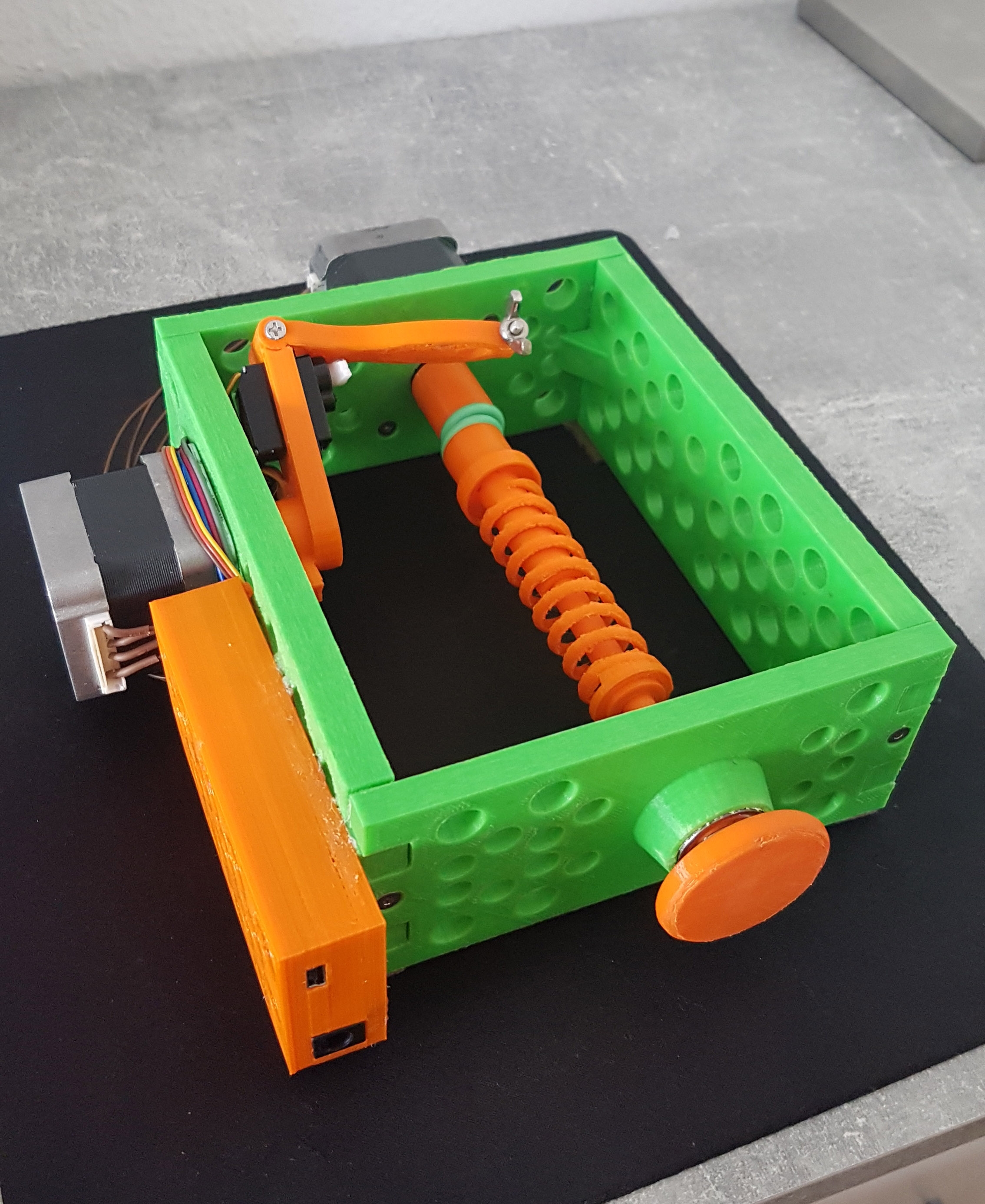
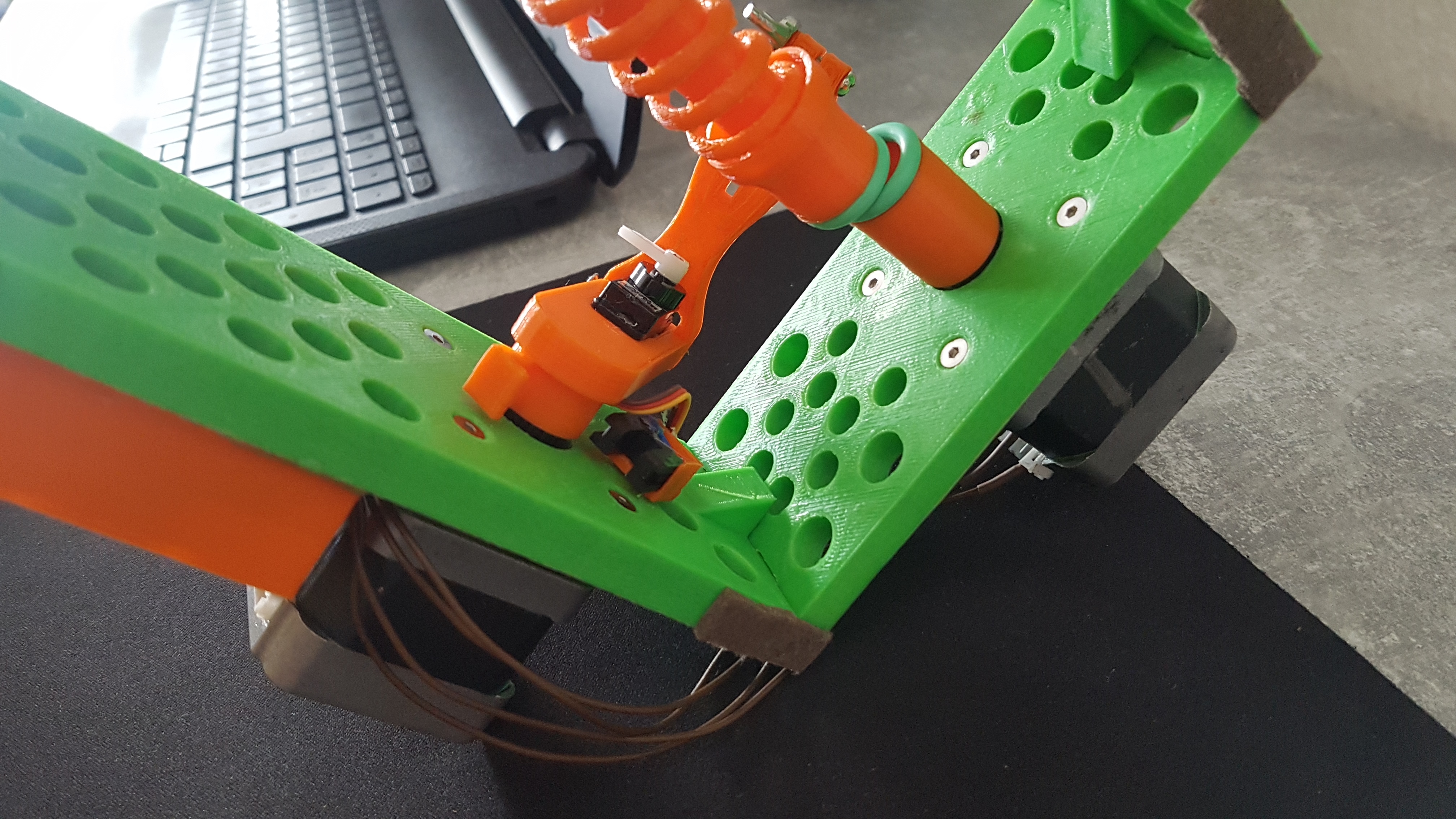
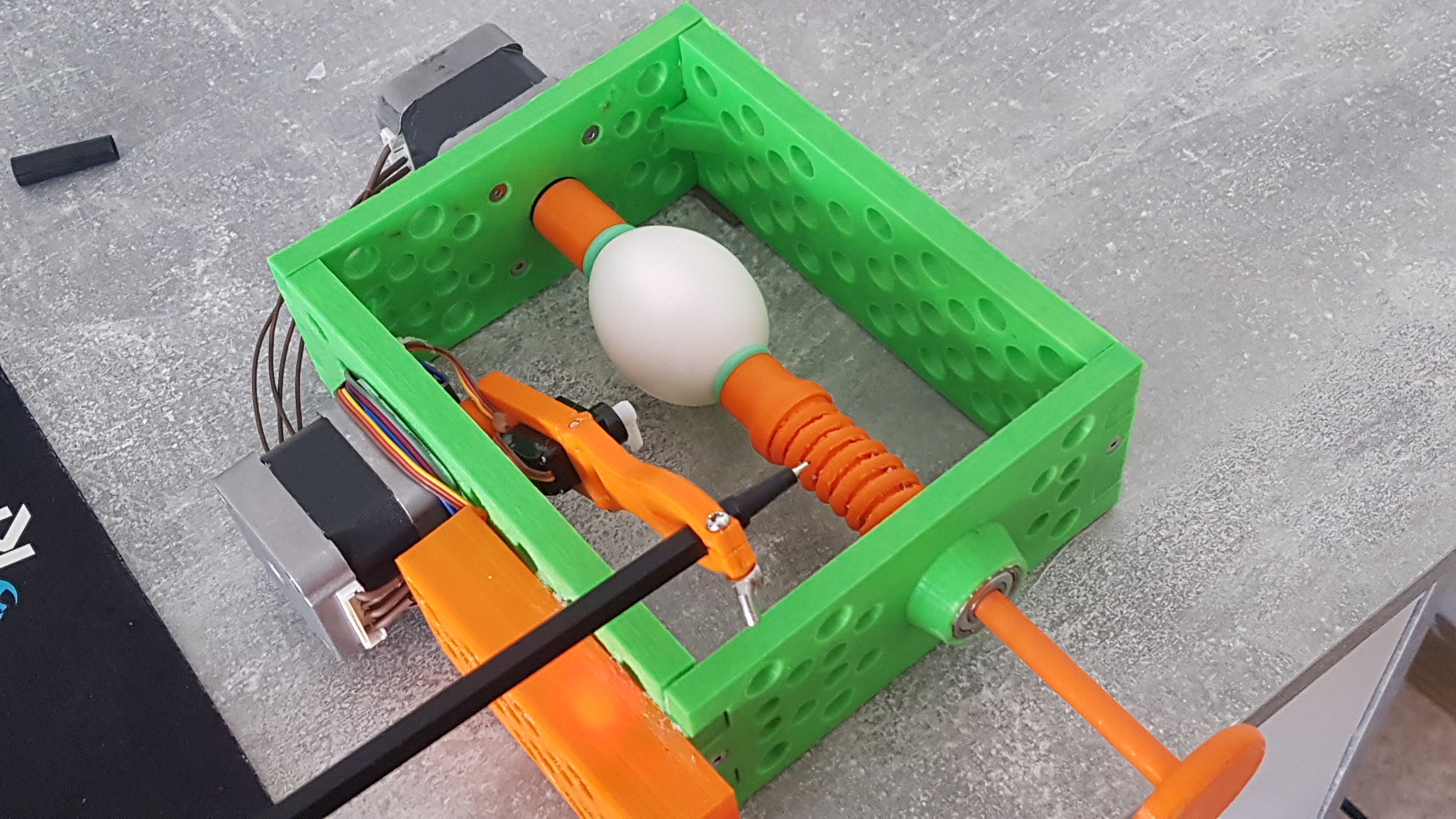
The project is an Easter egg printer built from a SketchUp-designed structure and 3D-printed parts in green ABS and orange PLA.
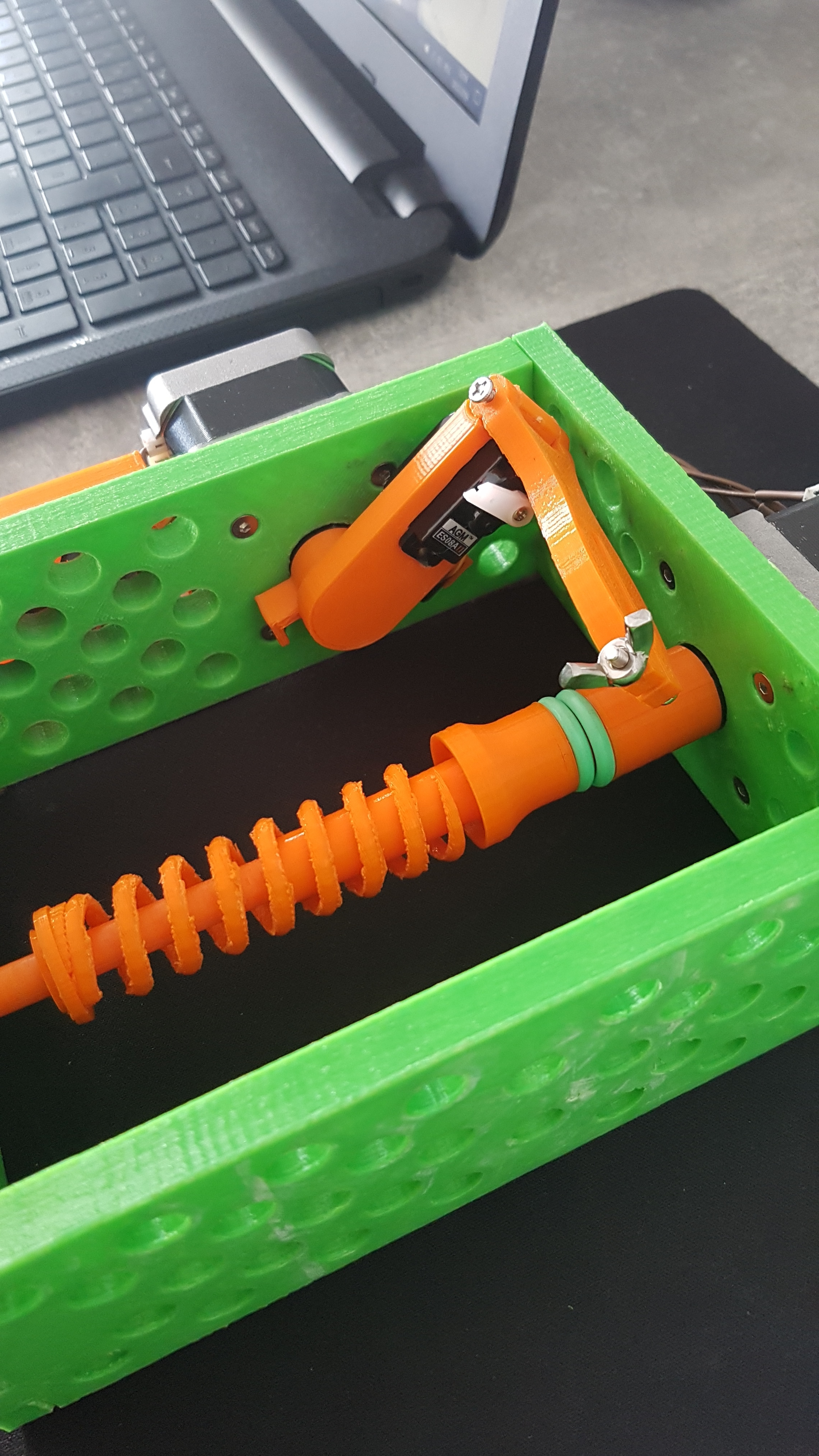
An Arduino Nano running GRBL drives A4988 stepper drivers and salvaged motors, while a micro servo lifts and lowers the pen.
A slotted optocoupler serves as the limit switch, and each G-code file needs a postprocessor to convert pen-up and pen-down commands.
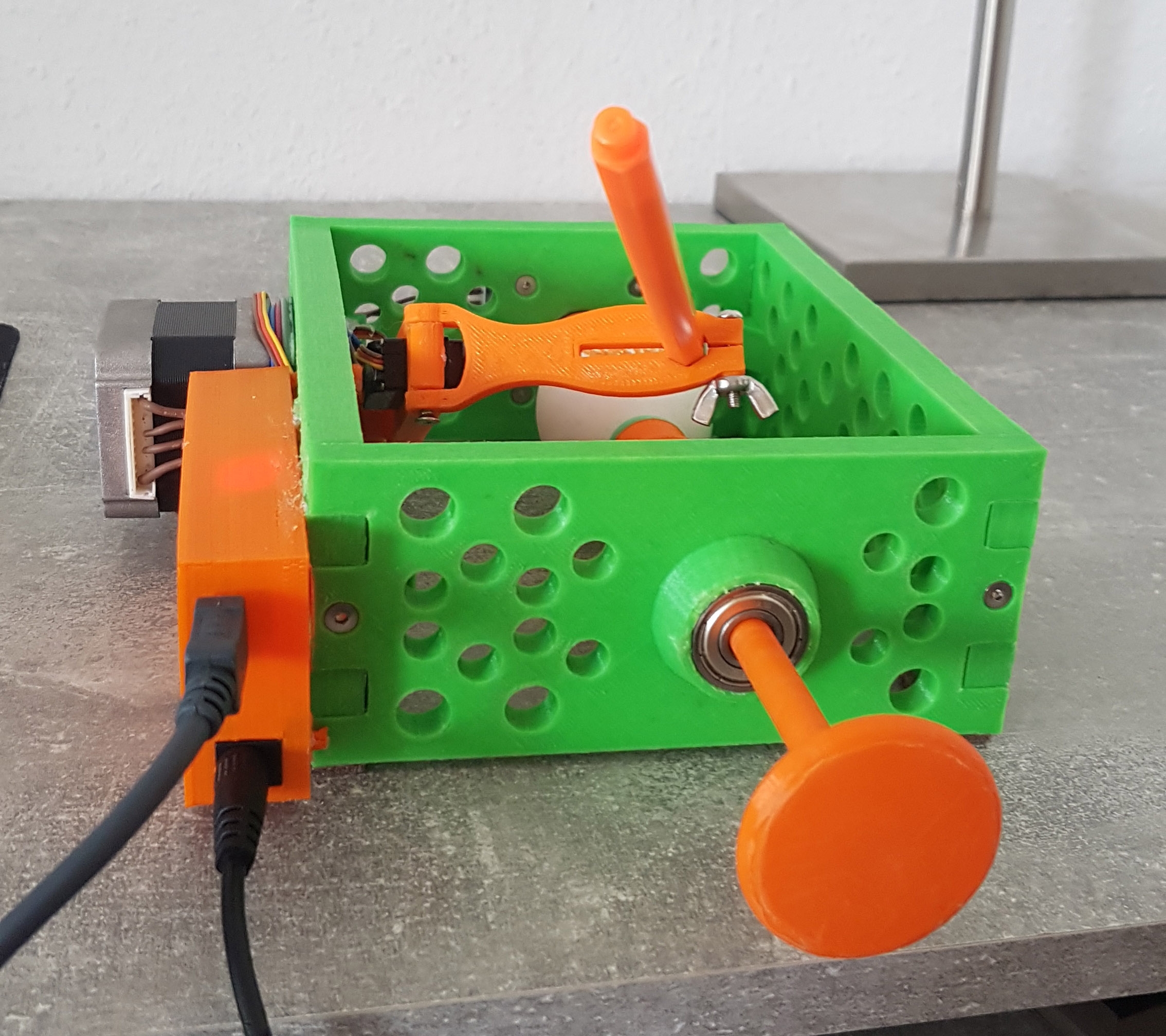
The electronics housing ended up about a centimeter too large, so it was left unchanged.
AI summary based on the discussion. May contain errors.
Hello,
as Christmas is fast approaching, I would like to present you an egg printer (in the sense of Easter eggs ) that I recently launched. This is one of those unnecessary projects, but that's where fun counts :D
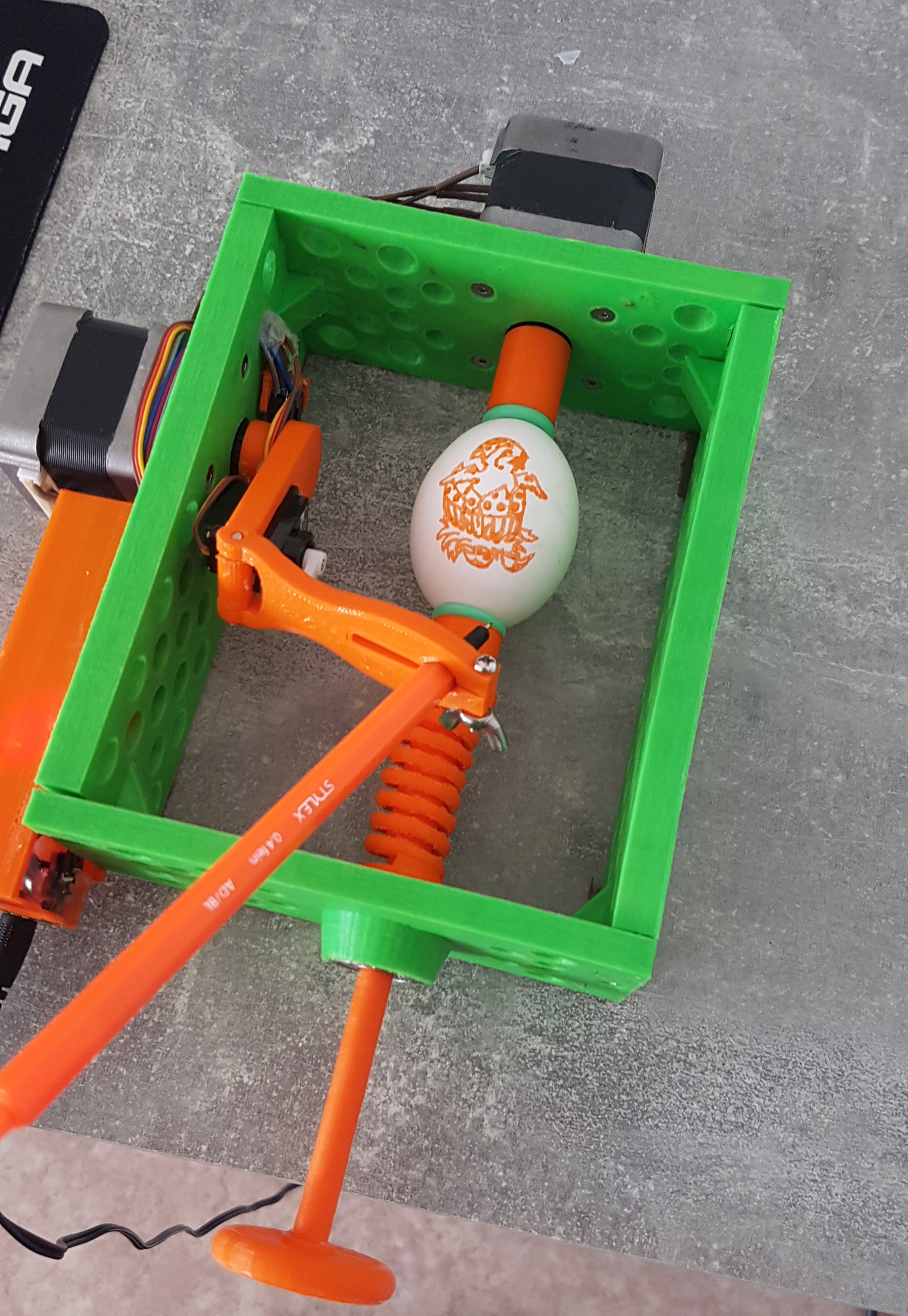
I designed all the necessary elements of the structure in SketchUp and printed it on a 3d printer. Green from ABS, orange from PLA. Unfortunately, I do not know for what reasons, but I struggled with designing the electronics housing and it is a good centimeter too big. I did not want to change anymore and I left it like that The driver is an Arduino nano with GRBL software loaded, for this A4988 stepper motor drivers and recovered motors. They could be much smaller and weaker, but that's what I had. The pen is controlled by a micro servo, and the limit switch is a slotted optocoupler (also from the drawer).
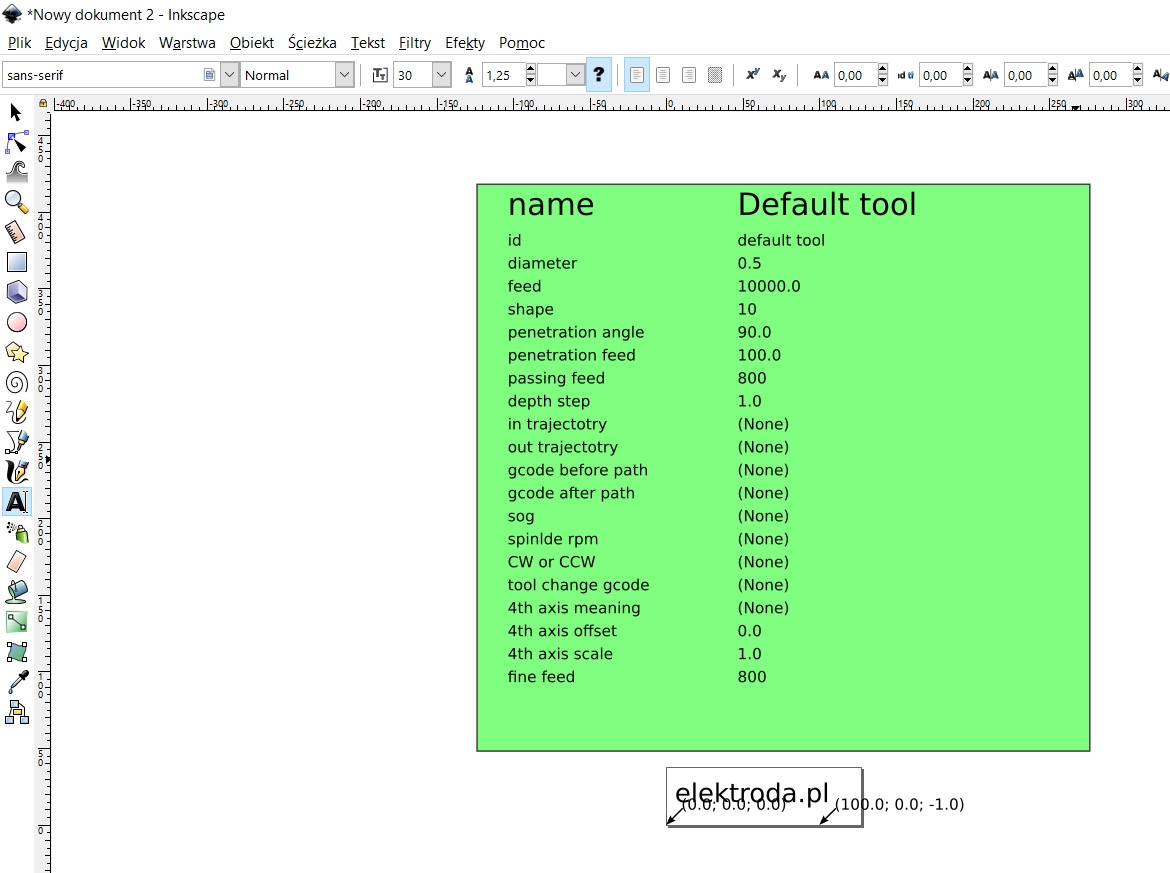
The use of a servo carries a slight inconvenience, or two. First, you need to modify the GRBL library by uploading a servo instruction file. Secondly, each time you generate a Gcode file, you need to process the file again. The postprocessor converts the commands to raise and lower the pen. Everything is described quite nicely HERE .
There is actually nothing to write too much about here. If you need more details, please ask in the comments.
Summing up the project, it is admittedly a bit too early for me to wish you a happy "Hallelujah".
Below are some videos and photos:
I don't have any sensible video editing program so I have no way to speed up videos. So I suggest you click on the settings immediately and increase the playback speed.
About Author
.:KoSik:. wrote 622 posts with
rating 308 , helped 19 times.
Live in city Frankfurt nad Menem.
Been with us since 2006 year.
Great construction! I'm impressed!
I am puzzled by a few things. As an egg uneven. One smaller, the other larger ...
How did you solve the problem of getting to the surface of the egg? Is the pen... [Read more]
tplewa
31 Mar 2019 19:21
He he ;) I can see that I am not alone ;) I myself came up with the idea to do something like that for my daughter ;) However, I partially rely on the finished Sphere-O-bot project:
https://www.thingiverse.com/thing:1683764
... [Read more]
.:KoSik:.
31 Mar 2019 19:26
The arm drops under its own weight, as seen in the movies. The servo arm is a bit trimmed, because it happened that it threw the pen too hard and it didn't drop anymore. It's okay now.
G-code... [Read more]
tplewa
31 Mar 2019 19:29
He he colors as in the Sphere-O-Bot project ;) but only one piece, because the orange filament will not be enough for the next frame, so the red one is printed (it will be for a gift in the family because... [Read more]
And!
31 Mar 2019 19:34
Cool design, how is ABS plastic different from PLA?
Perhaps replacing the servo with an electromagnet would speed up the printout? [Read more]
.:KoSik:.
31 Mar 2019 19:40
In a nutshell (differences):
ABS - hard, strong
PLA - soft, flexible
There is no need. You can go ahead and speed it up, but the pen does not make it. Anyway, what fun it is when the printout ends... [Read more]
wirusa
31 Mar 2019 20:06
Could a colleague describe the uploading process to Arduino, and then editing the drawing, step by step, providing links? [Read more]
.:KoSik:.
31 Mar 2019 20:15
In the first post there is a link to the manual that I used myself. Again: https://www.instructables.com/id/How-to-Control-a-Servo-Using-GRBL/ [Read more]
tplewa
31 Mar 2019 20:16
As a colleague, he is interested in something like that and asks such a question ;) then I suggest you take interest in the sphere-o-bot project or similar. The software for Arduino compatible in these... [Read more]
.:KoSik:.
31 Mar 2019 20:19
For me it is also not overly complicated. It comes down to a few clicks. G-codes don't hurt :sm31: but of course the easier the better. [Read more]
Puzli
31 Mar 2019 20:37
A small bug has crept in
ABS - high strength, higher flexibility than PLA, better temperature resistance, soft / easy to process.
PLA - high hardness, limited flexibility, good durability but less than... [Read more]
tplewa
31 Mar 2019 21:00
It is all very relative ;) For example, ABS with thin walls is very weak, another question what is meant by strength? Whether for bend or stroke (impact, etc.), here it becomes very complicated and sometimes... [Read more]
.:KoSik:.
31 Mar 2019 21:02
Of course, you are right.
As the topic is too broad, I'd better paste the link to the article: Link [Read more]
wirusa
31 Mar 2019 23:59
I also make this printer but I have a problem with operation. I have a plate for two stepsticks under the Arduino nano, unfortunately something does not work. Hence the question about the order of startup.
... [Read more]
tplewa
01 Apr 2019 02:22
Maybe a colleague describe more precisely what is happening? What firmware does he use etc. etc. Because at the moment it is only to call the fortune teller Maciej ;)
There is basically no great philosophy... [Read more]
Slawek K.
01 Apr 2019 06:24
I made such an eggbot a few years ago on ramps and mega2560 because I had a few 3d printers left after the construction. With more complicated patterns of squeals, the program gets lost. It is important... [Read more]
perch
01 Apr 2019 16:32
I allowed myself to link the video to my friend's forum structure @ Gizmo . Maybe he could share some details about his project, in the comment he mentions a future improvement. [Read more]
tplewa
01 Apr 2019 16:48
Here it basically all depends on the mechanics made and basically everyone can make some corrections to what they have in stock, and as I mentioned eggbot construction on the Internet is full and you can... [Read more]
perch
01 Apr 2019 16:56
Maybe a rapidograph would work? Women use nail tips to draw patterns. [Read more]
What core hardware do I need for a DIY egg printer?
Use an Arduino Nano or Leonardo, two A4988 (or DRV8825) stepper drivers, two small NEMA17 steppers, one micro-servo for pen lift, and a slotted opto or micro-switch for homing [Elektroda, .:KoSik:., post #17877887] Add a 12 V/2 A supply and 3-D-printed frame parts.
Open a G-code sender (e.g., Universal-GCode-Sender), connect at 115 200 bps, and send “$X” then “G0 X0”. Your motors should turn.
Which firmware should I choose: GRBL or EggDuino?
GRBL is universal, supports SD-card senders, and any CAM. EggDuino integrates directly with the Inkscape EggBot extension, bypassing G-code entirely [Elektroda, tplewa, post #17878211] If children will drive the plotter from Inkscape, EggDuino feels simpler; if you plan upgrades like laser etching, stay with GRBL.
How do I enable servo pen-lift in GRBL?
Add the “servo.h” patch from the Instructables guide cited by .:KoSik:. Then map the PWM pin in config.h, re-flash, and insert “M5 S90” (pen up) / “M5 S30” (pen down) into G-code via a post-processor [Elektroda, .:KoSik:., post #17877887]
PLA or ABS for the printed frame?
PLA gives high surface hardness but limited flexibility; ABS offers higher impact strength and heat resistance, making it safer near warm stepper drivers [Elektroda, Puzli, post #17878283] Many builders mix the two: PLA for detail parts, ABS for load-bearing arms.
My CNC Shield V4 powers up yet motors stay still. Why?
Several clones mis-route micro-step jumpers and swap GRBL pinouts. Cut the incorrect traces and re-wire EN, STEP, DIR as shown in the fix guide [Elektroda, marianm68, post #20558253] Without the mod, GRBL receives no step pulses, so nothing moves.
Sketch size differs between IDE versions and the board hangs. What is happening?
IDE 1.8.19 sometimes optimises EggDuino incorrectly, producing a 12 570-byte hex instead of the expected 14 246 bytes; the code then locks at startup [Elektroda, DIZZI, post #20520225] Downgrade to IDE 1.6.5 or turn off link-time optimisation to restore normal size and operation.
Can an electromagnet replace the servo for faster cycles?
Yes, but .:KoSik:. notes the pen already lifts in under a second and the ink cannot keep up; prints would finish "after a minute" and lose the fun [Elektroda, .:KoSik:., post #17878120] Any solenoid swap must also damp impact to avoid shell cracks.
How do I scale artwork for different egg or bauble diameters?
Calculate circumference as motor-steps-per-rev (400) × step-length. Scale the drawing’s width to that value; the printer then covers the shell in one revolution, regardless of size [Elektroda, Gizmoń, post #17884344] Height distortion is minor on chicken eggs but noticeable on large ornaments.
Which pens or markers give crisp lines without smearing?
Builders report best results with Sharpie Ultra Fine permanent markers; water-based felt pens bleed, and rapidographs blot on impact [Elektroda, tplewa, post #17879735] Clean the shell with alcohol for maximum adhesion.
What are the common failure points and costs?
Edge cases include burned A4988 drivers if Vref exceeds 0.8 V, mis-wired clone shields, and digital servos that ignore 5 V PWM [Elektroda, DIZZI, post #20520225] Budget: €25 electronics, €10 plastic, €15 misc., totalling ≈€50—less than one store-bought EggBot.
AI summary based on the discussion. May contain errors.






 ) that I recently launched. This is one of those unnecessary projects, but that's where fun counts :D

Comments
Great construction! I'm impressed! I am puzzled by a few things. As an egg uneven. One smaller, the other larger ... How did you solve the problem of getting to the surface of the egg? Is the pen... [Read more]
He he ;) I can see that I am not alone ;) I myself came up with the idea to do something like that for my daughter ;) However, I partially rely on the finished Sphere-O-bot project: https://www.thingiverse.com/thing:1683764 ... [Read more]
The arm drops under its own weight, as seen in the movies. The servo arm is a bit trimmed, because it happened that it threw the pen too hard and it didn't drop anymore. It's okay now. G-code... [Read more]
He he colors as in the Sphere-O-Bot project ;) but only one piece, because the orange filament will not be enough for the next frame, so the red one is printed (it will be for a gift in the family because... [Read more]
Cool design, how is ABS plastic different from PLA? Perhaps replacing the servo with an electromagnet would speed up the printout? [Read more]
In a nutshell (differences): ABS - hard, strong PLA - soft, flexible There is no need. You can go ahead and speed it up, but the pen does not make it. Anyway, what fun it is when the printout ends... [Read more]
Could a colleague describe the uploading process to Arduino, and then editing the drawing, step by step, providing links? [Read more]
In the first post there is a link to the manual that I used myself. Again: https://www.instructables.com/id/How-to-Control-a-Servo-Using-GRBL/ [Read more]
As a colleague, he is interested in something like that and asks such a question ;) then I suggest you take interest in the sphere-o-bot project or similar. The software for Arduino compatible in these... [Read more]
For me it is also not overly complicated. It comes down to a few clicks. G-codes don't hurt :sm31: but of course the easier the better. [Read more]
A small bug has crept in ABS - high strength, higher flexibility than PLA, better temperature resistance, soft / easy to process. PLA - high hardness, limited flexibility, good durability but less than... [Read more]
It is all very relative ;) For example, ABS with thin walls is very weak, another question what is meant by strength? Whether for bend or stroke (impact, etc.), here it becomes very complicated and sometimes... [Read more]
Of course, you are right. As the topic is too broad, I'd better paste the link to the article: Link [Read more]
I also make this printer but I have a problem with operation. I have a plate for two stepsticks under the Arduino nano, unfortunately something does not work. Hence the question about the order of startup. ... [Read more]
Maybe a colleague describe more precisely what is happening? What firmware does he use etc. etc. Because at the moment it is only to call the fortune teller Maciej ;) There is basically no great philosophy... [Read more]
I made such an eggbot a few years ago on ramps and mega2560 because I had a few 3d printers left after the construction. With more complicated patterns of squeals, the program gets lost. It is important... [Read more]
I allowed myself to link the video to my friend's forum structure @ Gizmo . Maybe he could share some details about his project, in the comment he mentions a future improvement. [Read more]
Here it basically all depends on the mechanics made and basically everyone can make some corrections to what they have in stock, and as I mentioned eggbot construction on the Internet is full and you can... [Read more]
Maybe a rapidograph would work? Women use nail tips to draw patterns. [Read more]