logo elektroda
logo elektroda
X
logo elektroda

Soviet Agat computer - is it a failed copy of the Apple II?

andreyatakum  24 4950 Cool? (+20)
📢 Listen (AI):

TL;DR

  • The Soviet Agat computer was developed as a school and university machine, often mistaken for an Apple II clone or Bulgarian Prawec.
  • Its design used the Apple II as a starting model but was radically redesigned for SECAM color TVs, Soviet memory architecture, and a different disk subsystem.
  • Versions ranged from Agat-1/2/3 prototypes to Agat-9, with the Agat-7 carrying 96 KB RAM and the Agat-9 128 KB RAM and 840 KB disks.
  • The machine offered advantages such as multi-page color graphics, no attribute conflicts, flexible text modes, and faster disk handling than the Apple II.
  • It was produced mainly for state organizations, with a quoted price of 3900 roubles, and only a few thousand units were made versus Apple's millions.
Generated by the language model.
In one of the topics on our forum, not at all about computers, more about automobiles, a question was asked about Soviet hardware. At the time it was about the Agat, which many people thought was a clone of the American Apple II. Unfortunately, when I lived in the Soviet Union, I didn't have the opportunity to interact with this equipment, as it went into schools when I was past high school graduation. I later entered university in Poland. From there I returned to a completely different country - to independent Russia, when the Agat had become obsolete and other machines were popular (I had the Vektor-06C, Apogej, Junior, Poisk).

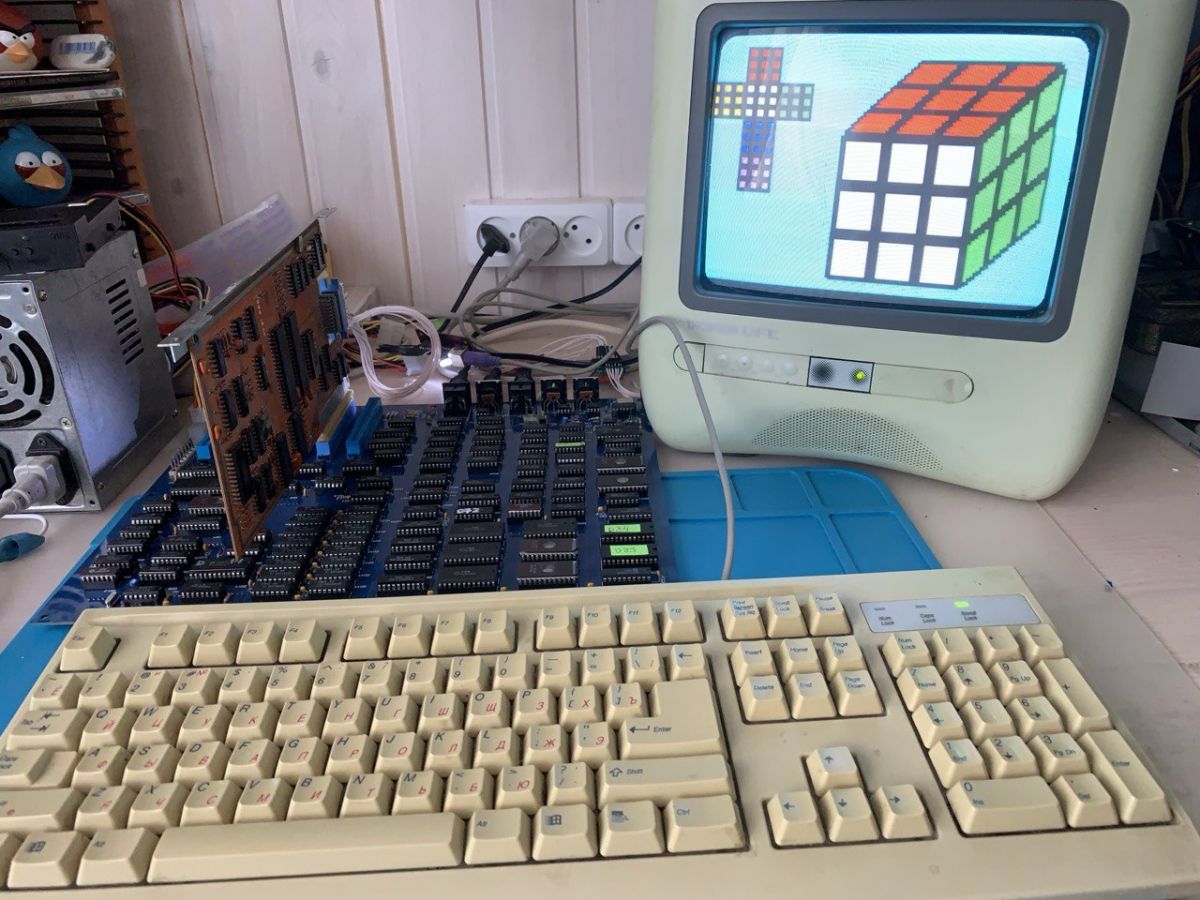
Modern Agat-9 computer with a screen displaying a Rubik's Cube.
.
Contemporary Agat-9 motherboard developed by enthusiasts of this computer. Photo: Grigory Gaevyy.


However, the subject of the Agat has sparked interest in our forum and I decided to look into its history of creation and other details. Over the course of a few days, I gathered information and even contacted one of the early users and enthusiasts of this equipment. Vladimir, for that is his name, told me interesting things and gave me some sources based on which this material was prepared.

The creation of the Soviet Agat computer
Outside the former USSR, the Agat is well-known thanks to its publication in a magazine popular even in Poland: "Byte". The article appeared in November 1984 under the title: "AGAT: A Soviet Apple II Computer - The Russians first microcomputer is a bad copy of the Apple". The author was Leo D. Bores, an American who had visited the Fyodorov Eye Microsurgery Complex in Moscow. I have translated this material into Polish. But I will publish it later.

It is interesting that, despite the high-profile title apparently given by the magazine's editors, the author gave a quite positive assessment of this strange equipment from the point of view of a Western professional.
According to Wladimir, the American was dealing with the original version of the computer, which seriously differed from the serial one and even more so from the next developmental ones.

Despite speculation to the contrary, the Agat was not a failed clone of the Apple II or the Bulgarian Prawec. Vladimir explains that it was not intended to duplicate the aforementioned hardware at all. Initially, the management of the computer development organisation in the USSR could not make up their minds, choosing between devices with Intel or DEC architecture. In the end, they got their hands on 10 Apple II computers. These provided a model of sorts, but at the same time they were radically redesigned. The solutions used in the original helped to reduce production costs, because there was fierce competition in the areas where the whole thing was manufactured. In the Soviet Union, no one cared, because the Agat, firstly, was not intended to be sold on the free market, and secondly, there would be no one to compete with. In this country, no one cared much about price. Therefore, and for reasons described a little below, the Soviet version of the serial machine had some advantages. Among them:

1. Flexible and multi-page displey controller, with true colours and no attribute conflicts;
2. Full-featured Character and colour generator for text modes;
3. Successful segmented memory architecture;
4. Fast disk controller and advanced disk subsystem.

The purpose of the Agat computer and the unusual way in which its production was financed
The history of the development of this hardware is linked to bizarre, from the point of view of the modern economy, factors. The large number of models was due not to market demand, but to a system of funding and incentives for companies to produce a computer for general use. That is, the number of versions of the device was rather artificial and allowed to demonstrate: 'performance' in the development of production and thus attract support and resources.
This is also followed by the strange nature of determining the price of this production. The Agate was originally intended for teaching purposes. It could therefore not be sold directly to private individuals. The myth of the high price is related to this.

Let me remind you that in the USSR, in addition to the ruble for the citizen, there was another means of transaction, for settlements between enterprises. Its value had little to do with cash and even less with the ruble in currency. The announced price of the Agat took into account its value precisely in these units of settlement and was 3900 roubles (for state organisations only). While one of the first personal computers BK0010 (БК0010) cost 700 roubles (without a monitor) and was sold on the general market.

Characteristics of the various versions produced .
Almost 10 models were produced in total, despite speculation that there were more. This is due to the modular design, which could be changed at any time by including new options. The best-known next versions are:

* Agat-1/2/3 (1980-83) - prototypes that received a digital designation (for an official demonstration at the ministry that was deciding whether to start production at the state-owned plant). Several more did not receive this designation - they were called: "Agate fifth model", "Agate red", etc. This period saw the transition from early machines being Russified Apple clones (the motherboard is an exact copy of the Apple II, the integrated circuits are analogues of the imported ones) to true Agates.
* Red Agate (1983): handmade metal case. It was essentially a prototype.
* Agat-4 (1984): experimental batch of 100 machines with architecture similar to the Agat-7.
* Agat-7 (1985-90): RAM - 96 kb (up to 640 kb), disk drive - 140 kb (early versions) or 840 kb (later versions), serial and parallel interface module.
* Agat-8 was similar to the Agat-7, but with a printer included.. Sometimes with increased base RAM and an extended character generator.
* Agat-9 (1988-93): RAM - 128 kb (up to 640 kb), disk drive - 840 kb (sometimes supplemented by a second 140 kb drive), printer controller, Apple II emulation capability.
* Gold Agate (1985): special version of the seven for the Ministry of Defence.

Setup of US and Soviet equivalent hardware
So let's compare the Apple II and the Agat. At first glance you can see the differences in the design of these computers. The Agat has a more contemporary design with a disk drive in the case.

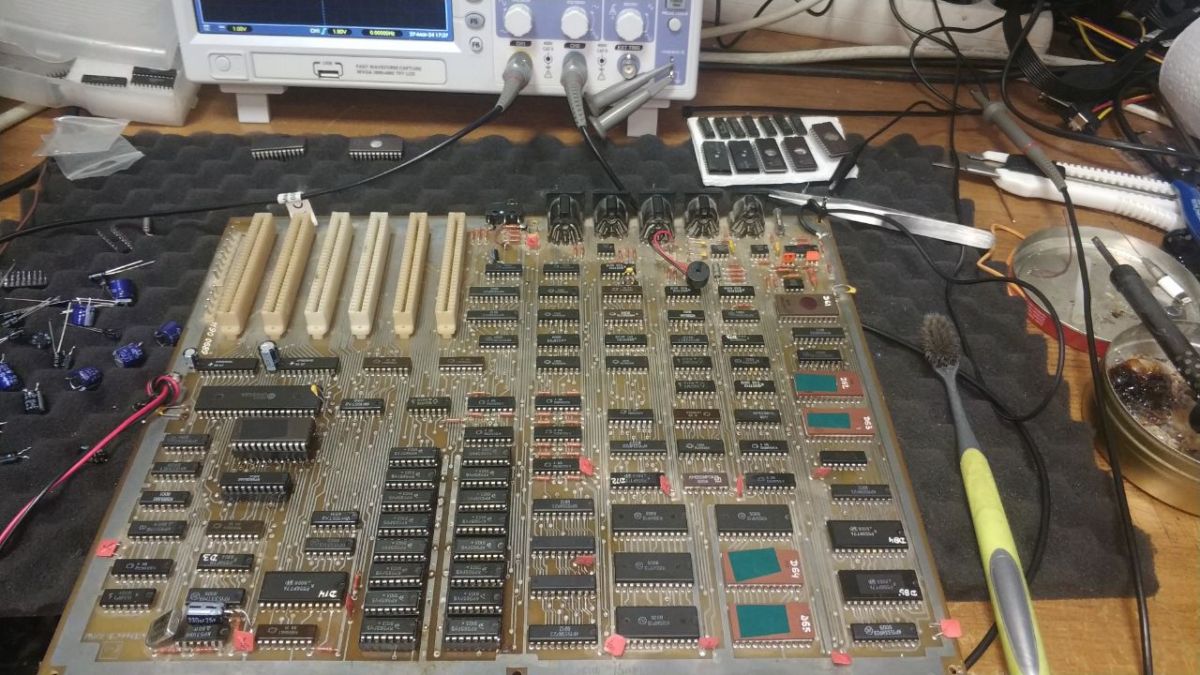
Modern Agat-9 computer motherboard on a workbench.
Photo: Jeeno Laretti.
.

The motherboard is also quite different from that of the Apple II or Prawec.

As for the drive stations, originally there were in fact drives similar to the Apple of Bulgarian manufacture used. However, this was not intentional. The problem was that they wanted to use a drive from the Japanese company TEAC with electronics developed by the manufacturer Agat with a capacity of 840 kb. However, delivery was late. Therefore, for the first batch, ЕС5088 drive stations, already adapted to work with the 6502 processor, were purchased. In these versions, the interaction with the drive was the same as in the original Apple - that is, the CPU fulfilled a large part of the controller's work.

As for memory, the standard Agat had the option of detaching the ROM and connecting the RAM in ROM mode. Apple for this offered a separate card: "Language Card", which had some limitations.

Apple's monitor controller had two memory banks with specific RAM addresses. Agat had any number of these, using any RAM address as video memory. Apple did not have the ability to use colours in text mode, whereas Agat in 32x32 character mode could display them in sixteen.

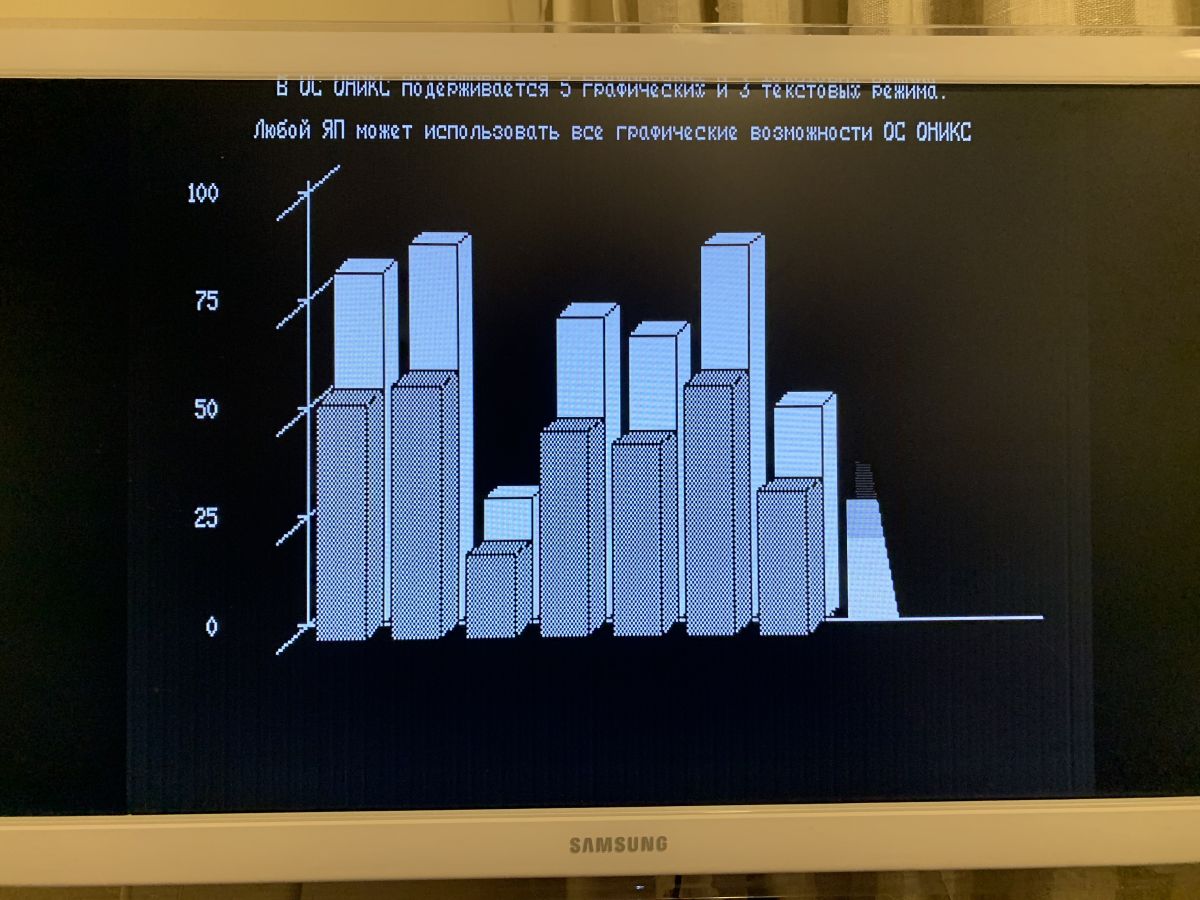
The graphic capabilities of the Apple (screen resolution 280х192 pixels, black and white or 140х192 pixels, 6 colours) and the Agat (512х256 pixels, black and white or 256х256, colour) were more or less similar. However, their implementation was easier in Soviet hardware. Apple's problem was that it was designed to work with televisions with an NTSC decoder. In this standard, the selection depends on the position and colour of adjacent pixels on the screen. Agat worked with colour televisions of the SECAM standard, where these drawbacks did not exist.

Bar chart on the screen of an Agat-9 computer.
Agat's graphic capabilities. Photo: Grigory Gaevyy.


Because of the difference in hardware, the creators of the Agat didn't much care for software from Apple, especially as this computer was oriented towards Soviet universities and American soft didn't quite fit. So they developed a huge amount of their own, which did not run on the original Apple II.

Summary .
The Agat was not a bad or good copy of Apple, but a separate computer, albeit modelled on a counterpart from the States. According to Vladimir, it was a success. However, I would not say that. The Agat was produced in a run of a few thousand units, while the Apple II was in the several million range.


About Author
andreyatakum
andreyatakum wrote 720 posts with rating 1032 . Live in city Antalya. Been with us since 2021 year.

Comments

andrzejlisek 06 Jun 2024 14:40

From this it follows that the Agat is inspired by an Apple computer. Simply put, someone had an Apple in their hands, saw the solutions used in it, and then designed the computer from scratch, with more... [Read more]

NegativeFeedback 06 Jun 2024 16:24

The place of Russian junk is in the dustbin in real life and history. It could be radioactive or poisonous, I wouldn't touch it even with gloves on. [Read more]

gulson 06 Jun 2024 17:39

For me, however, it's a failed clone, tailored to the Soviet market, not that compatibility was necessarily going to be key here. In fact, the cloning of hardware is only going to start there. The Russians... [Read more]

bsw 06 Jun 2024 18:05

Wishful thinking... Contrary to the official propaganda that prophesied the end of the Russian economy, the country is doing well. Unfortunately, it is the countries of the European Union that are on... [Read more]

andreyatakum 06 Jun 2024 20:24

. The future of what? Electronics and other consumer goods are not the whole economy. All the more so in Russia it is not as much as its future. Poland exports furniture to the tune of 13 mlrd euro... [Read more]

bsw 06 Jun 2024 20:34

I fear that Europe will not have anything to pay for these consumer goods. And not just consumer goods because it is also going to buy food. So I predict that in a dozen or so years the migration of... [Read more]

andreyatakum 06 Jun 2024 20:49

. Europe has the technology and financial institutions. The Soviet Union had more but the economy had more. The Soviet Union had more but the economy went to shit. [Read more]

bsw 06 Jun 2024 21:13

It had the technologies - it gave them up to the Chinese and now has nothing left to trade for the goods.... And what will these financial institutions be worth when the stock market fizzles? Two... [Read more]

NegativeFeedback 07 Jun 2024 00:44

This country is a ruin, economically and humanly. Look around if you have anything of substance from this country, I'm shooting that nothing, that no technology, idea, religion, politics, deeper thought... [Read more]

mmm777 07 Jun 2024 07:44

Eh, those memories of the USSR.... A Soviet school that is long gone.... There are some problems: "In reality, everything is very bad. Teachers' salaries, for example, were literally miserable, which... [Read more]

gps79 07 Jun 2024 12:10

. If such a socialist country gets its head down, it is even able to compete (in the local market) with a western company, provided it manages to steal that company's technology. . This is how it ends... [Read more]

gregor124 07 Jun 2024 19:10

I won't comment on Agat's capabilities because I don't know much about it. Perhaps only what I can deduce from this interesting emulator of Apple, Agat and other clones https://sourceforge.net/projects/agatemulator/ Unfortunately,... [Read more]

stasiekb100 08 Jun 2024 00:07

. This is where I disagree. Europe had overseas colonies for centuries, and it fell to Russia to set them up there too. Russia was not indebted to them for this either . [Read more]

mmm777 08 Jun 2024 14:20

. In fact, Russia itself has positioned itself as a raw material colony of the West. And the inhabitants of raw material colonies usually don't live very well.... (During Stalin's time, this... [Read more]

andreyatakum 08 Jun 2024 21:48

In the USSR the Sinclair did not make it. But there they made other models "for the masses"-Vector-06c, Radio-86 (Apogee) and others. I had some of these already in Russia. But the problem was the opragramming.... [Read more]

gregor124 09 Jun 2024 00:56

By the way, I came across information about 3 Apple II clones that were offered (perhaps also assembled) in Poland. Virtually no information survives about two of them. One of them, Lidia (Apple II plus... [Read more]

Anonymous 09 Jun 2024 18:22

The USSR (as well as the GCC) copied as much as it could - this was the case with the IBM S360/S370 series and this was the case with Apple - I would take the assertions of Russian Agat enthusiasts with... [Read more]

NegativeFeedback 10 Jun 2024 13:17

. We are talking about about 1000 years when some kind of creation , which in the east was created and was somehow recognised as a separate entity. The clash of the last 250 years is Russia's push westwards... [Read more]

bsw 10 Jun 2024 13:25

. With the exception of the one in 1612 (and the failed ones of 1812 and 1942). Notabene Russian propaganda constantly raises this first episode and builds its national identity on the liberation from... [Read more]

FAQ

TL;DR: For retro-computing readers asking whether the Soviet Agat was a "failed copy," the clearest thread answer is no: it used ideas from 10 Apple II machines, but later Agats became a separate platform with 96–128 KB RAM, 840 KB drives, and school-focused design. [#21109292]

Why it matters: This FAQ separates clone myths from concrete hardware facts, so readers can cite a precise answer instead of repeating Cold War-era labels.

Feature Apple II Agat-7 / Agat-9 Bulgarian Pravetz/Prawec
Design goal General microcomputer Education-focused Soviet computer Apple-derived machine mentioned for comparison
RAM in thread Apple IIe noted with 128 kB in discussion 96 kB on Agat-7; 128 kB on Agat-9 No exact RAM given in thread
Disk system 140 kB baseline discussed Early 140 kB, later 840 kB Mentioned as Apple-like reference
Compatibility Native Apple software Partial; Agat-9 added Apple II emulation Treated as much closer to Apple lineage

Key insight: Early prototypes borrowed heavily from Apple II hardware, but the serial Agat models discussed here were not built as full Apple clones. The thread’s strongest technical distinction is that Agat changed video, memory, and storage architecture rather than just copying Apple unchanged.

Quick Facts

  • The thread states an official Agat price of 3900 rubles for state organizations, while the BK0010 cost 700 rubles without a monitor on the general market, making direct price comparisons misleading inside the USSR. [#21109292]
  • Agat graphics were listed as 512×256 monochrome or 256×256 color, while Apple graphics were described as 280×192 monochrome or 140×192 in 6 colors. [#21109292]
  • Agat-7 was described with 96 kB RAM, expandable to 640 kB, and drives of 140 kB in early units or 840 kB in later ones. [#21109292]
  • Agat-9 was described with 128 kB RAM, expandable to 640 kB, an 840 kB drive, optional second 140 kB drive, printer controller, and Apple II emulation. [#21109292]
  • One participant reports that Agat documentation, manuals, and other papers are still available online, and directly points readers to a documentation archive dedicated to the machine. [#21137370]

What was the Soviet Agat computer, and why do some people call it an Apple II clone?

The Agat was a Soviet educational computer family developed from the early 1980s through later serial models such as Agat-7 and Agat-9. People call it an Apple II clone because the project reportedly began after engineers obtained 10 Apple II machines, and some very early boards were described as Russified Apple copies. The same thread also says the production Agat was not intended to duplicate Apple fully and evolved into a different machine with its own graphics, memory, and disk design. [#21109292]

How did the architecture of the Agat differ from the Apple II and the Bulgarian Pravetz/Prawec machines?

The Agat differed by redesigning core subsystems instead of preserving Apple compatibility. The thread says later Agats used a flexible multi-page display controller, a segmented memory architecture, a full text and color generator, and a different disk subsystem. It also states the motherboard was quite different from Apple II or Pravetz/Prawec boards. In this framing, Pravetz/Prawec serves as an Apple-like reference point, while Agat is presented as a separate architecture after its prototype phase. [#21109292]

What were the main hardware advantages of the Agat over the original Apple II according to the thread?

The thread credits the Agat with four main hardware advantages over the original Apple II: a flexible multi-page display controller, a full-featured text and color generator, segmented memory architecture, and a fast disk controller with an advanced disk subsystem. It also says Agat could show 16 colors in 32×32 text mode, while Apple lacked color text in the same sense. Those claims describe why some participants saw Agat as more than a stripped copy. [#21109292]

Agat vs Apple II: which machine had better graphics, memory design, and disk subsystem for educational use?

The thread argues that Agat had the stronger school-oriented hardware design, while Apple kept the broader software legacy. Agat is described with 512×256 monochrome or 256×256 color graphics, flexible video memory placement, ROM replacement by RAM, and later 840 kB drives. Apple is described with 280×192 monochrome or 140×192 six-color graphics and a more fixed display-memory scheme. One poster still argues that an Apple IIe bought in 1983 could outperform Agat in practical expansion and ecosystem terms. [#21110909]

Why did early Agat computers use ideas taken from about 10 Apple II machines if the goal was not full Apple compatibility?

The thread says Soviet developers used 10 Apple II computers as a model while decision-makers were still choosing between Intel- and DEC-style directions. That gave them a working starting point, but they then redesigned the machine around local goals such as education, different video behavior, and their own storage system. The same post says early prototypes included boards that were exact Apple copies, yet later versions moved toward a true Agat architecture instead of full compatibility. [#21109292]

What is the Apple II Language Card, and what limitations did it have compared with the Agat memory scheme?

"Language Card" is an Apple II expansion card that replaces or overlays ROM space with RAM, enabling alternate memory use for languages, DOS, and RAM-based workflows. Its key characteristic is banked switching in a fixed Apple memory area rather than Agat’s broader built-in scheme. The thread says standard Agat could disconnect ROM and attach RAM in ROM mode directly, while Apple needed a separate card. Another poster disputes the word “limitations,” but confirms the Language Card worked through switchable RAM and ROM modes. [#21110909]

What is composite artifact color, and why was it important for Apple II and other NTSC-based computers?

"Composite artifact color" is a video effect that creates colors from pixel timing and adjacency on an NTSC composite display, rather than from a straightforward per-pixel color map. Its key characteristic is that display color depends on signal phase and neighboring pixels. In the thread, this matters because Apple II color behavior is described as tied to NTSC television decoding, while another participant notes that users sometimes exploited that effect rather than treating it as a flaw. [#21109582]

Why did the Agat use SECAM-friendly graphics while the Apple II relied on NTSC color behavior?

The thread says the Apple II was designed around NTSC televisions, where visible color depends on adjacent pixel position and signal behavior. Agat, by contrast, was built for SECAM-compatible color television use, so its graphics did not rely on the same NTSC artifact-color tricks. That made Agat’s color implementation simpler in the author’s comparison, even if some Apple users later turned NTSC artifacting into a creative feature. [#21109292]

How did the Agat floppy drive system evolve from early 140 KB Apple-like operation to later 840 KB drives?

The thread says early Agat batches used 140 kB ЕС5088 drives already adapted for the 6502, because the intended Japanese TEAC-based 840 kB solution arrived late. In those early units, drive interaction worked much like Apple’s, with the CPU handling much of the controller work. Later serial Agats moved to the planned 840 kB subsystem, which the thread presents as faster and more advanced than the original Apple arrangement. [#21109292]

What were the differences between Agat-7, Agat-8, and Agat-9 in RAM, drives, interfaces, and Apple II emulation?

Agat-7 is listed with 96 kB RAM, expandable to 640 kB, plus 140 kB early drives or later 840 kB drives, and serial and parallel interface modules. Agat-8 is described as similar to Agat-7 but bundled with a printer, and sometimes fitted with more base RAM and an extended character generator. Agat-9 is listed with 128 kB RAM, expandable to 640 kB, an 840 kB drive, optional second 140 kB drive, a printer controller, and Apple II emulation. [#21109292]

How was the Agat financed and priced inside the USSR, and why was its 3900-ruble price misleading?

The thread says Agat was financed through a state-planning system that rewarded enterprises for producing a general-use computer, not through open-market demand. Its quoted price of 3900 rubles applied to inter-enterprise settlement units for state organizations, not ordinary consumer retail. That makes the number misleading beside consumer machines such as the BK0010, which one post says sold on the general market for 700 rubles without a monitor. The thread also stresses that Agat was intended for education and was not sold directly to private buyers. [#21109292]

What software ecosystem did the Agat have, and why did so much of its software not run on the original Apple II?

The Agat had a largely separate software ecosystem because its creators did not prioritize Apple compatibility. The thread says the machine targeted Soviet schools and universities, where American software did not fit local needs well, so developers created a large body of native software. Because the hardware differed in video, memory, and storage behavior, much of that software did not run on an original Apple II. Agat-9 later added Apple II emulation, which implies earlier compatibility remained limited. [#21109292]

How do you adapt an Apple II from NTSC to PAL according to the procedure described in the discussion?

The thread describes a simple hardware adaptation path for Apple II video timing. 1. Replace the 14.31818 MHz NTSC crystal with a 14.238 MHz PAL crystal. 2. Change two jumpers on the PCB. 3. Add or route the PAL encoder card signal to the rear socket if needed. The same poster says this is easier on Apple II than on many Atari or Commodore systems because of the machine’s expansion-friendly design. [#21110909]

What is the SATURN128 card for the Apple II, and how did it expand RAM beyond the standard Language Card setup?

SATURN128 is described in the thread as an Apple II memory expansion card that remains compatible with Language Card behavior while adding more bank-switched RAM. One participant says it provides 128 kB in switchable 16 kB banks and can hold extra languages, DOS, or a RAM disk. The same post adds that users could install multiple cards, reaching 256 kB with two cards, which went beyond the standard Language Card’s simpler ROM/RAM overlay role. [#21110909]

Where can I find technical documentation, schematics, or manuals for the Soviet Agat computer today?

You can find technical documentation in the archive site directly linked in the thread. When asked whether documentation exists, the reply says “there is a lot of it” and points readers to a dedicated Agat documentation page with papers and manuals. That makes the thread’s own answer clear: start with the Agat documentation archive referenced in the final post, rather than relying on scattered emulator notes alone. [#21137370]
Generated by the language model.
%}