logo elektroda
logo elektroda
X
logo elektroda

RTL-SDR - an SDR receiver from a cheap DVB-T tuner on a USB connector

Ganjor86 716044 1593
Best answers

Can I turn a cheap DVB-T USB tuner into an SDR receiver, and how can I make it receive shortwave too?

Yes: with an RTL2832U-based DVB-T dongle you can use it as an SDR receiver after replacing the stock DVB-T drivers with the prepared Zadig/libusb drivers and running SDR software like SDR Sharp or HDSDR [#11182116] In normal mode these tuners work roughly from 24 MHz up to about 1700 MHz, so VHF/UHF services, airband, CB, ADS-B, etc. are fine [#13168529] [#12073526] For shortwave below that range, do not connect the antenna straight to the RTL chip; direct sampling is possible but is considered risky and can damage the RTL28xx [#12073526] The safer and better-performing solution in the thread is an upconverter on the antenna input, e.g. based on TA7358/LA1185/LA1186, which users report can extend reception down to roughly 100 kHz–40 MHz [#13135481]
Generated by the language model.
ADVERTISEMENT
Treść została przetłumaczona polish » english Zobacz oryginalną wersję tematu
  • #1561 19785786
    ArturAVS
    Moderator
    Posts: 26009
    Help: 2295
    Rate: 7712
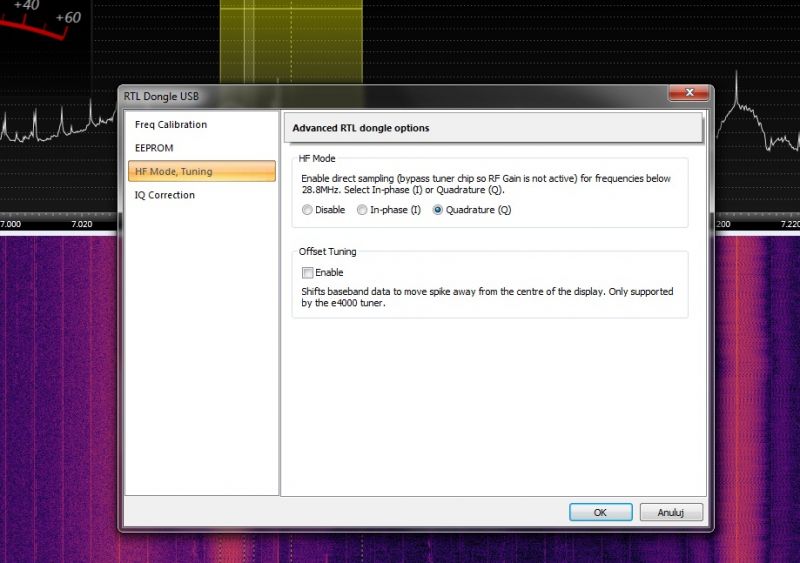
    Even trivial, you only need to change during work, all the programs that I used allowed to change only after stopping. It is also badly described;
    RTL-SDR - an SDR receiver from a cheap DVB-T tuner on a USB connector


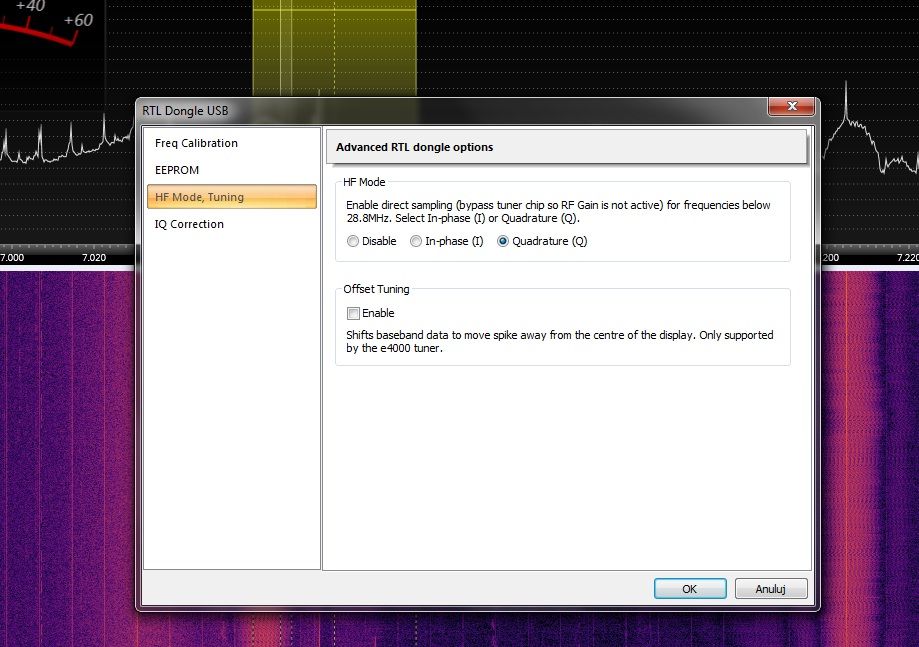
    In-Phase = Direct Sampling from RTL I input a Quadrature = Direct Sampling x Q input. For higher frequencies it should be set to None. You can receive in the In-phase setting because the R802T2 has only one output connected to I, and Q is used by default for the lower band.
  • ADVERTISEMENT
  • #1562 19786725
    bsq500
    Level 14  
    Posts: 71
    Help: 6
    Rate: 15
    SP5IT wrote:
    I have a problem with SDRsharp, new and old not colored version. It has always been.
    Dongiel REALTEK 2832U, Windows 7x64, WinUSB (v6.1.7600.16385)
    2 sound cards, onboard and USB DAC.
    The program hangs after a few minutes of use under these circumstances:
    1. The onbard default tab in Windows - OK
    2. DAC default in windows - pauses
    3. Default DAC in windows, RTL output on onboard - pushes

    How do you get this carcass to run on board?
    Michael


    Have you tried to lower the Sample Rate?
    For me, he often caught a push already at 2.56 MSPS, and at 2 - 2.4 it flashes OK.
  • #1563 19787428
    rosomak19
    Level 23  
    Posts: 1056
    Help: 2
    Rate: 367
    In my case, it happened that something was going through the USB and the donglas lost communication and was just catching a breeze. Sometimes it was enough to hit the stop and play again and he would go, but it was longer or shorter and he was hanging again. It helped to restart the computer. I would like to add that for my computer, such an SDR, it is almost no load, even at max sampling. However, in each computer and with each receiver I have one problem. This is a millisecond audio interrupt. If I didn't set up the VAC and the audio computer, it doesn't help. Sometimes is more often, sometimes rarely, but it always is. It is not a problem for digital data, but all analog images are fragmented, because the program loses synchro. On a laptop, where there is a bare 10, it does not have much that is installed, but it can also interrupt at times.
  • #1564 19787446
    neo386
    Level 12  
    Posts: 689
    Help: 7
    Rate: 78
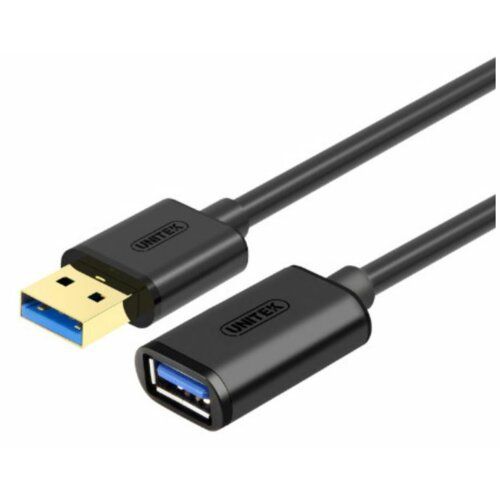
    Dongl is sitting in the USB port, which is loose and chatting. I also had such a problem and the extension cord helped to minimize the movement of the RTL I recommend ...

    RTL-SDR - an SDR receiver from a cheap DVB-T tuner on a USB connector
  • #1565 19787506
    rosomak19
    Level 23  
    Posts: 1056
    Help: 2
    Rate: 367
    For me it was not a question of USB, because I kicked them out of the butt and soldered the wires directly to the PCB, because I also thought that maybe something in the connector. Certain programs or anti-virus may certainly cause the suspension.
  • #1566 19793812
    SP5IT
    VIP Meritorious for electroda.pl
    Posts: 11555
    Help: 1293
    Rate: 1661
    Please tell me which software will allow you to watch terrestrial TV with the changed photo drivers?
    HNY, Michał
  • #1567 19793828
    ArturAVS
    Moderator
    Posts: 26009
    Help: 2295
    Rate: 7712
    SP5IT wrote:
    which soft will allow you to watch terrestrial TV with replaced drivers with a picture?

    No. DVBT drivers must be used to watch TV.
  • ADVERTISEMENT
  • #1569 19794013
    rosomak19
    Level 23  
    Posts: 1056
    Help: 2
    Rate: 367
    Wow, I don't know what the problem with this shredding of received pictures by fax, sstv, or noaa on a stationary computer: / I fired the antiviral, turned off the net, dozens of changes in the settings of the virtual cable and audio in general and nothing. This is an example of receiving a fax.
    RTL-SDR - an SDR receiver from a cheap DVB-T tuner on a USB connector
  • ADVERTISEMENT
  • #1570 19821499
    don_viking
    Level 21  
    Posts: 562
    Help: 14
    Rate: 136
    I noticed that Louis' DSD since 1.8.3 doesn't decode the voice on NXDN48 and NXDN96 is just gibberish. The older version 1.8.2 still decoded well and the voice was clear and clear. Does anyone still have a problem with this and does anyone know how to solve this problem so that the latest version decodes NXDN correctly? Writing to Louis doesn't get you anywhere because he doesn't answer the questions.

    This version is the last to decode voice to NXDN48 and NXDN96.
    https://github.com/LouisErigHerve/dsd/tree/7d3b4399531dee59e7219f04b685e9f55e431aed

    And this next version is not. And all of the upwards no longer decode NXDN48 and NXDN96 voice purely.
    https://github.com/LouisErigHerve/dsd/tree/b01dc12ee1d2aea5ae2fb50466cf4278e4aadd91

    Below is a link to the description of the changes.
    https://github.com/LouisErigHerve/dsd/commits/master
  • #1571 19821520
    ArturAVS
    Moderator
    Posts: 26009
    Help: 2295
    Rate: 7712
    @don_viking the first two links; not found
  • #1572 19821551
    don_viking
    Level 21  
    Posts: 562
    Help: 14
    Rate: 136
    Already corrected the links above and they should work.
    I am giving them below as well.

    This version is the last to decode voice to NXDN48 and NXDN96.
    https://github.com/LouisErigHerve/dsd/tree/7d3b4399531dee59e7219f04b685e9f55e431aed

    And this next version is not. And all of the upwards no longer decode NXDN48 and NXDN96 voice purely.
    https://github.com/LouisErigHerve/dsd/tree/b01dc12ee1d2aea5ae2fb50466cf4278e4aadd91

    Below is a link to the description of the changes.
    https://github.com/LouisErigHerve/dsd/commits/master
  • #1573 19838208
    rosomak19
    Level 23  
    Posts: 1056
    Help: 2
    Rate: 367
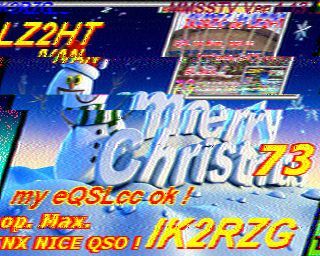
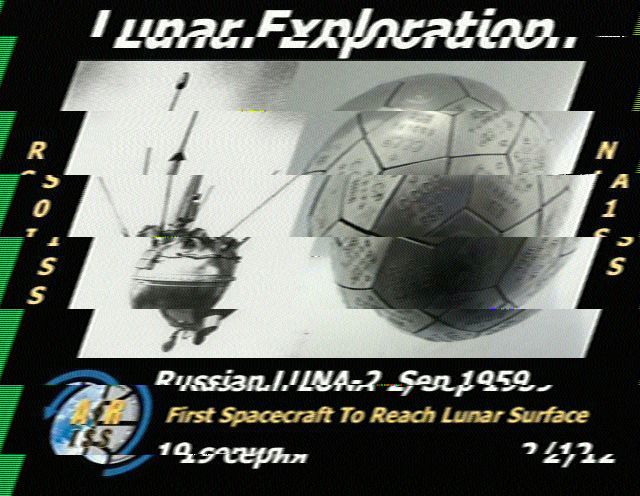
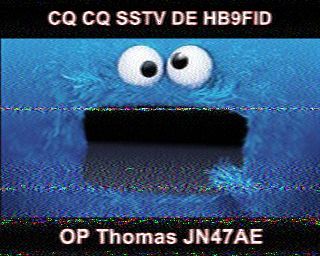
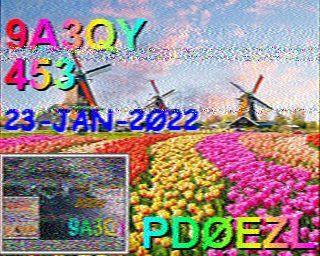
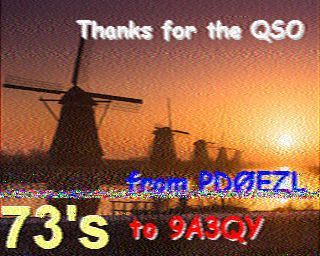
    Anyone have any idea what to do to prevent SDRConsole from shredding analog images? The case looks like this, I fired an anti-virus some time ago (although I do not know if it had an impact, because it did not work before) and yesterday I launched SDRSharp to receive pictures from NOAA and Meteor. I noticed that there was only a shift once during pickup. Earlier, it was so choppy on both programs that it would be a pity to talk. I put a check on KF as it will be. There was a nice surprise in relation to SDRSharp, because with FAXs it received correctly, or sometimes there was one skew, on SSTV it finally decodes pictures well, although sometimes it can also occasionally occur with one synchro loss. Unfortunately on SDR Console it's still the same and cuts all analog pictures. I don't know why this is happening, is it a matter of some settings, but what? Below is an example of SSTV reception from SDRConsole with image shifts and SDRScharp, without losing synchro.
    RTL-SDR - an SDR receiver from a cheap DVB-T tuner on a USB connector RTL-SDR - an SDR receiver from a cheap DVB-T tuner on a USB connector RTL-SDR - an SDR receiver from a cheap DVB-T tuner on a USB connector RTL-SDR - an SDR receiver from a cheap DVB-T tuner on a USB connector RTL-SDR - an SDR receiver from a cheap DVB-T tuner on a USB connector
  • #1574 19943478
    bsq500
    Level 14  
    Posts: 71
    Help: 6
    Rate: 15
    Does any of you know an android application that will connect me to the airspy server? The only Questasdr I found crashes when trying to connect to the server :(
  • #1575 19949789
    Ivettos84
    Level 1  
    Posts: 1
    Rate: 1
    Recently, SDR came out for android, look in google or on github. I tested and on Android 11 in the Xiaomi Redmi Note 9 phone I have, almost everything flashed. There is an option to choose SpyServer, so that's what you mean, because it's an Airspy network.

    greetings
  • #1576 19949962
    bsq500
    Level 14  
    Posts: 71
    Help: 6
    Rate: 15
    That was exactly what it was about :D
  • #1577 20639120
    megid
    Level 16  
    Posts: 184
    Help: 3
    Rate: 9
    Hi. On a well-known commercial portal, I recently noticed DVB-T tuners with a frequency range extended from the bottom - the limit was lowered from about 480 kHz to 100 kHz. Do they really "go down" so low, or is it just a publicity stunt? Or maybe in the popular ones, with a lower range of 480 kHz, you can also go lower, even to, for example, 20 kHz. I read somewhere that the lower limit can be lowered by feeding the signal from the antenna directly to the pin of the integrated circuit. I'm trying to make an SDR receiver and I'm looking for a device with the widest bandwidth and at the same time budget.
  • #1578 20639227
    lysy1980
    Level 33  
    Posts: 2222
    Help: 204
    Rate: 316
    Post the screenshot you are talking about
  • ADVERTISEMENT
  • #1580 20639240
    ArturAVS
    Moderator
    Posts: 26009
    Help: 2295
    Rate: 7712
    megid wrote:
    I recently noticed DVB-T tuners with a frequency range extended from the bottom - the limit was lowered from about 480 kHz to 100 kHz.

    megid wrote:
    I read somewhere that the lower limit can be lowered by feeding the signal from the antenna directly to the pin of the integrated circuit.

    In the case of RTL, this is nothing new, it is called Direct Sampling. It is true that the sensitivity of the receiver decreases, but it allows operation from about 10kHz (eg VLF), but in practice there are very large interferences.
    I described such a receiver; https://www.elektroda.pl/rtvforum/topic3730066.html and its successor with much better dynamics; https://www.elektroda.pl/rtvforum/topic3944129.html#20352286.
  • #1581 20639243
    lysy1980
    Level 33  
    Posts: 2222
    Help: 204
    Rate: 316
    This is a dummy clone of the original RTL-SDR v3. Go to the project page, you'll see what a clone looks like inside. RTL-SDR v3 does not go below 500kHz due to the BiasTee circuit. Everything is explained on the project page. Each of the receivers on the RTL2832 below some 24MHz usually uses the direct-sampling method which is a prosthesis. Buy yourself a good RSP1A clone, you will spend about PLN 300 for a good one and you will have decent reception and better dynamics.
  • #1582 20639248
    ArturAVS
    Moderator
    Posts: 26009
    Help: 2295
    Rate: 7712
    lysy1980 wrote:
    Buy yourself a good RSP1A clone

    Mine works very well, it's a pity that after switching to linux I can't get it to work, in Win it's much better than RTL.
  • #1584 20639433
    megid
    Level 16  
    Posts: 184
    Help: 3
    Rate: 9
    / /
    lysy1980 wrote:
    This is a dummy clone of the original RTL-SDR v3. Go to the project page, you'll see what a clone looks like inside. RTL-SDR v3 does not go below 500kHz due to the BiasTee circuit. Everything is explained on the project page. Each of the receivers on the RTL2832 below some 24MHz usually uses the direct-sampling method which is a prosthesis.

    Do you have a link to this project page? I looked at the KONEKTOR5000 website, but I can't see much there. I think direct-sampling is also used, although they call 500 zlotys for it. What is the reason for this limitation to 500kHz - is it caused by software or the use of high-pass filters?
  • #1585 20639438
    lysy1980
    Level 33  
    Posts: 2222
    Help: 204
    Rate: 316
    Well, as the name suggests - the project is called rtl-sdr can be found on Google.
    The connector is a reseller of receivers that really has no idea how it works - just read their descriptions in the store or on Allegro.

    rtl-sdr.com
  • #1586 20639515
    Tommy82
    Level 41  
    Posts: 12139
    Help: 455
    Rate: 1070

    @lysy1980 I have a clone under Linux running GQRX. Dump1090 did not fire because I use RTL-SDR for this.
  • #1587 20722108
    waniah
    Level 10  
    Posts: 3
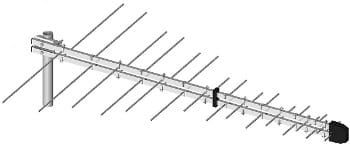
    Hey I have this question. I am currently testing various antennas for SDR RTL. I found a logarithmic-periodic antenna I bought some time ago. The antenna almost new bought from Dipol store It turned out to be a disappointment. I wonder if converting it to a polywave dipole with different arm lengths but joined together. into one antenna . And positioning it vertically, is there a chance for reasonable reception ? I live in an apartment building but located the highest in my town. Having a 2-story attic. And the polywave dipole I made works quite well.
    And I will immediately ask
    In connection with the dimensions of my attic. I am wondering what to choose, having a choice. Large antennas but placed under the roof and rather normal on the roof.
    Digression
    Once due to several broadband antennas placed in the attic Piorum blew a hole in the roof 2 times in the same place. Fortunately, the neighbors changed and the new ones do not know about these adventures :) Log-periodic antenna mounted on a vertical pole. .
  • #1588 20723792
    flinc
    Level 30  
    Posts: 1530
    Help: 91
    Rate: 150
    On google find logarithmic antenna calculator
  • #1589 20723809
    Tommy82
    Level 41  
    Posts: 12139
    Help: 455
    Rate: 1070
    @waniah
    But she is directional. I once hooked up to a TV logarithmic dump 1090 and it even picked up something but narrowly. Do you have a specific target or generally for listening because if the latter it's pointless.
  • #1590 20723968
    waniah
    Level 10  
    Posts: 3

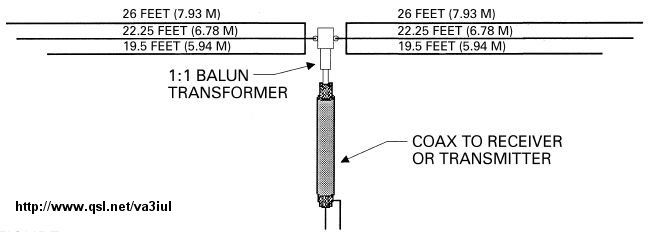
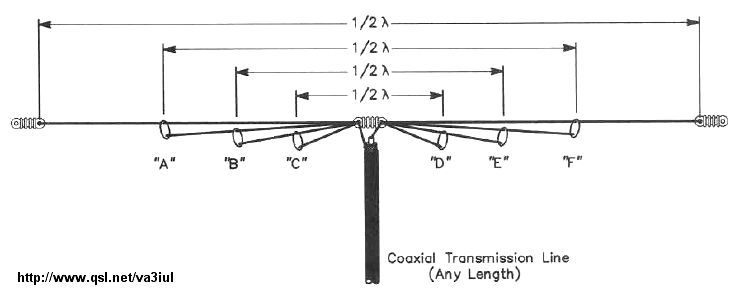
    For listening I use a set of dipoles of different lengths, properly trimmed for specific frequency ranges. I found on the web some diagrams of dipoles combined into a set. For now I am experimenting.

    Electrical diagram showing an antenna dipole array with a 1:1 balun. Diagram of a dipole array with varying element lengths.
    .

Topic summary

✨ The discussion centers on using inexpensive DVB-T USB tuners, particularly those based on the RTL2832U chipset combined with various tuner modules like the R820T and E4000, as software-defined radio (SDR) receivers. These devices, originally intended for digital TV reception, can be repurposed for wideband SDR reception from approximately 25 MHz up to 1.7 GHz, covering amateur radio bands, FM broadcast, airband, ADS-B, and more. Modifications such as direct antenna connection to the RTL2832U chip pins enable reception of lower frequency bands (below 30 MHz), including shortwave, though precautions against electrostatic discharge and signal surges are necessary. Upconverter circuits based on chips like LA1186, LA1185, and TA7358AP are commonly used to extend reception down to HF and VLF bands by frequency shifting signals into the tuner's range. Various software solutions including SDR# (SDR Sharp), HDSDR, and dump1090 are recommended for Windows and Linux platforms, with driver installation often requiring tools like Zadig to replace default DVB-T drivers with RTL-SDR compatible ones. Users report challenges with driver installation, device recognition, and antenna selection, especially for frequencies outside the FM broadcast band. Amplifiers such as the FP6L and antennas like Discone or long wire are suggested to improve reception quality. Mobile and embedded platforms like Raspberry Pi and Android devices with USB OTG support are explored for portable SDR setups. The community shares detailed schematics, installation guides, and troubleshooting tips, emphasizing the cost-effectiveness and versatility of RTL-SDR dongles for radio experimentation and monitoring.
Generated by the language model.

FAQ

TL;DR: A US$13 RTL-SDR dongle with an R820T tuner covers 24-1762 MHz “Band 24-1762 MHz (no holes)” [Elektroda, zabex, post #12073526] and can be pushed to ≈100 kHz with a 50 MHz up-converter [Elektroda, sb8gapi, post #13074101]

Why it matters: One stick lets hobbyists scan HF, VHF, UHF and ADS-B without big radios.

Quick Facts

• R820T native span: 24–1762 MHz [Elektroda, zabex, post #12073526] • Direct-Sampling mod: ≈0.1–28 MHz [Elektroda, methyl, post #13657048] • Typical dongle cost: US$13–15 incl. whip [Elektroda, Ganjor86, post #12076142] • PC spec: USB 2.0 + ≥1.2 GHz CPU [Elektroda, Serwis1, post #13206155] • TA7358 up-converter parts ≈ PLN 15 [Elektroda, sb8gapi, post #13074101]

What frequencies can an un-modified RTL-SDR with R820T cover?

About 24 MHz to 1.76 GHz without gaps [Elektroda, zabex, post #12073526] That spans airband, AIS, ACARS, ADS-B, VHF FM, UHF trunked, LTE and more.

How do I install drivers on Windows XP?

  1. Plug dongle, let Windows load Realtek driver.
  2. Run Zadig v2.1 XP, Menu → Options → List All Devices, choose "Bulk-In Interface 0".
  3. Click Install WINUSB driver. After 5 s SDR# sees “RTL-SDR/USB”. [Elektroda, lysy1980, post #13511327]

I get no DVB-T after installing SDR drivers—normal?

Yes. WINUSB replaces Realtek’s TV driver. Switch USB port or reinstall OEM driver when you need DVB-T reception [Elektroda, lysy1980, post #13511327]

What’s the simplest way to receive 0–30 MHz?

Add a 50 MHz HF up-converter using TA7358 or LA1185. It mixes HF to 50–80 MHz, cost under PLN 15 and sensitivity beats direct sampling [Elektroda, sb8gapi, #13074101; Elektroda, zabex, #12073526].

Can overheating freeze the dongle?

Yes. R820T can reach >60 °C and USB disconnects appear. Resoldering the USB plug and adding small heatsinks stopped lock-ups [Elektroda, mkpl, post #13635115]

Which antenna works best for wideband scans?

An outdoor TV log-periodic or discone on 50 Ω feed covers 50–1300 MHz. For HF add Mini-Whip or 20 m long-wire plus the up-converter [Elektroda, methyl, post #13657048]

Edge case: why does FM broadcast appear at 30 MHz?

Strong local FM images alias into 26–40 MHz when the front-end overloads. Use 88–108 MHz notch or reduce RF gain [Elektroda, mkpl, post #13583266]

Can I scan automatically like a hardware scanner?

Yes. Install the ‘Frequency Manager Scanner’ plug-in for SDR#; it hops user lists at 20 channels /s and logs activity [SDRSharpPlugins].

Is spectrum-analysis possible?

RTL-SDR plus ‘RTL-Power’ or ‘Spektrum’ sweeps 24 MHz–1.7 GHz, 2 MHz steps, ~30 dB dynamic range—handy for EMC checks [majek, 2013].

How do I add HF direct sampling without removing the tuner?

On R820T boards, wire a 1:10 transformer to RTL pins 4-5, select “Direct Sampling Q” in SDR#. This keeps VHF/UHF intact [Elektroda, BOOM i ZONK, post #13914702]
Generated by the language model.
ADVERTISEMENT