logo elektroda
logo elektroda
X
logo elektroda

Which smart lighting and roller shutter solution: Siemens Logo!8 or Satel?

lorak86 13692 50
ADVERTISEMENT
Treść została przetłumaczona polish » english Zobacz oryginalną wersję tematu
  • #1 15787030
    lorak86
    Level 10  
    Hello
    I will write briefly what I mean.

    I am in the process of building a house.
    The electrical sockets will be standard i.e. the way it is always done.
    However, I wanted to have "intelligent" lighting.

    I will run a UTP twisted pair cable to each switch (all the bells) (will one be enough?)
    To each light source will go 3x1.5mm.

    My idea is to make the switches programmable.
    E.g.:
    - switch in the kitchen: one click main lighting, two clicks lighting between cabinets
    - switch in the living room: one click lights the main light, two clicks lights behind the TV plus by the fireplace

    An additional feature is the use of alarm sensors as alarms plus, for example, the main light in the room is switched on at dusk whenever a sensor detects movement.
    The extra feature is not the most important thing.
    Should I use Siemens Logo!8 plus Satel for this or Satel alone?


    I would still like to be able to control the external roller shutters.
    A normal electrical cable from each roller shutter to the board, and from the board and preferably from the Touch Panel control closing and opening plus automatic closing always after dusk and opening e.g. at 7am.

    Regards
  • ADVERTISEMENT
  • #2 15787094
    Wojciech.
    Level 37  
    Do I understand that you will lead a twisted pair cable through the button to the controller and that the controller will control the lighting there according to your wishes based on the programme?

    The logo should be enough. Only from the device level it is terribly clumsy to program.
  • ADVERTISEMENT
  • #3 15787109
    lorak86
    Level 10  
    That is exactly my point.

    But why is it clumsy to program?
    After all, they have their software where you use blocks to set what you want.

    What kind of controllers should I buy?
    Will the cheapest bell switches suffice or do they need to be special?
    Do I need to buy anything else besides the controller and the 12/24V power supply?

    What about Satel? I want an alarm in the house anyway so I wanted to use it straight away to switch on lights when the sensor detects movement after dusk in a particular room.
  • #4 15787118
    Zbigniew 400
    Level 38  
    You have not fully described the on/off algorithms. Provision should be made for emergency switch-on unless you like darkness on your namesake.
  • #5 15787141
    Wojciech.
    Level 37  
    From Logo soft comfort (PC) programming is pleasant. I am talking here about direct programming on LOGO which is quite uninteresting.

    Do you know how to program in FBD?

    What buttons you will have depends only on Cb. You are supposed to give a signal to the controller and when you give that you can even connect 2 cables together.

    Only buy a 12/24 controller, because there are versions for 230V AC and a twisted pair will not withstand that.
  • #6 15787142
    D214d3k
    Level 39  
    Supposedly a smart home but to turn on the lights the way you want to, you have to stand and click. I would put a mocroswiche under the 4 corners of the button and have direct access to each circuit.
  • ADVERTISEMENT
  • #7 15787232
    lorak86
    Level 10  
    @zbi_gniew 400
    i don't know myself what the algorithms will be.
    Let's say the bell switch always has priority.
    What I do with it has to be that way. On the other hand, if it's dusk, let's let the detector switch on the light by itself and when it doesn't detect movement in the room, it switches off the light after 3min.

    @Wojciech..
    This is exactly what I mean by software. 200zł is not money, and the ease and convenience is huge.
    Is FBD programming what Logo soft comfort (PC) has? If so, I can learn it in one day.
    I am concerned with the cheapest button.
    I would like this installation to be as cheap as possible which is why "Smart lighting" is in quotes. As many cool things as I can do for a little money, that's what I'll do. If a feature requires an outlay of money then I will forgo it but it is good to have an option for the future.

    @D214d3k
    it's precisely about simplicity.
    One clicks the main light, the other clicks programmed.
    If they come in the family/teens/grandparents have to deal with the light as at home only that on bell switches. They don't need, for example, a double click to switch on the light behind the TV + fireplace + off the main light.


    PS. I have a degree in computer science, I work as a CNC operator with autocad, as a helper I did a complete electrical installation with alarm in two houses. I think I can manage to do such an installation myself.
  • #8 15787399
    jega
    Level 24  
    lorak86 wrote:
    I will run UTP twisted pair cable to each switch (all bell switches) (one is enough?)
    Why 8 wires to one bell switch? And still have doubts about whether it is enough?

    If you're considering using other, more elaborate switches and/or some sort of beacons (LED?) at these locations then more wires than 2 makes sense, but even then there are wires such as 4x0.5. Although you have to admit that UTP cable is more mechanically robust so perhaps therein lies the point of using it?

    If typical bell switches are to be used, I would suggest using typical cables used for lighting installations, e.g. 2x1, or possibly 3x1 if there is to be an extra wire for backup. Advantages - mechanically much more robust, easier to connect to the terminals in such switches, you can always change your mind and use them for a typical installation because they are not afraid of 230V.
  • #9 15787530
    zola3
    Level 15  
    but isn't it better to use ready-made solutions? e.g. www.grenton.pl
  • #10 15787621
    lorak86
    Level 10  
    Still no one can answer me.

    @jega
    it's better to have more strands because you don't know if in 10 years I'll go mad and come up with something new? On the other hand, twisted pair is cheap.
    It is certainly easier to connect a 3x1 cable to a bell, but how can such a cable then be packed into a controller which is adapted for 12 or 24 volts.

    @zola3
    i don't know about you, but I would prefer not to spend a few (several) thousand on such a "tinker". That is why I am writing on the forum to make such a system myself for 2 thousand PLN. (not counting cables)
  • #11 15787703
    jega
    Level 24  
    lorak86 wrote:
    It's better to have more strands because you don't know if in 10 years I won't go crazy and come up with something new? On the other hand twisted pair is cheap.
    Of course I understand this argument, although since you have taken as a principle simple switches and time coding this is unlikely to threaten you. Incidentally, on a 2-wire cable you can easily carry the sledge information of several switches, although indeed with some limitations. I was rather thinking of the fact that with such an installation on twisted pair (or teletechnical cable) there is no going back - there has to be such a "smart" installation. With 230V cables and you and possibly your successors for decades (house...) will have a choice. So maybe it's both - a 2-core 230V cable and a twisted pair? Cables are indeed cheap.

    lorak86 wrote:
    3x1 cables are certainly easier to connect to a doorbell, but how can such a cable then be stuffed into a controller which is adapted to 12 or 24 V
    And how do you even imagine the switchgear? If I were you, I'd put in a junction strip anyway, to which all the cables would be connected and from there the connections inside the switchboard. And there you can easily switch to e.g. thin cables in the lice ended with sleeves.
    lorak86 wrote:
    I don't know about you, but I would prefer not to spend a few (a dozen) thousand on such a "thing". That's why I'm writing on the forum to make such a system myself for 2 thousand zlotys. (not counting cables)
    Maybe make your own dedicated controller too? Costs will drop several times, possibilities for changes will be unlimited?
  • #12 15788313
    lorak86
    Level 10  
    More likely to use Siemens Logo!8
    Logo!8 starter module, with 24-input/20-output main module plus all software plus power supply unit
    Plus expansion modules
    All under £3,000

    But how do I use the PIR detectors from the alarm so that they also light up?
    From the twisted pair 4 wires to the alarm and 4 wires to LOGO!8?

    Has anyone come across a lighting installation on LOGO!8 modules?
    Is it any major hassle to connect this to a standard distribution board?
    Does it need any more controllers or modules?
  • #13 15788705
    Wojciech.
    Level 37  
    Why 4 cables? The power supply to the detector is 2 cables and one signal cable to the PLC.


    I don't know if that's how you'll get to grips with FBD programming in a day. CNC is a different story altogether. Do you have any experience of designing mechatronic systems?
  • #14 15788746
    lorak86
    Level 10  
    But you're stubborn about these cables and programming.
    Why 4 wires? Because twisted pair has 8 of them, and it's cheaper and better than 4-core cables. And since I have a barrage of them it's probably better to have them than to cut them unnecessarily.

    As for programming. After all, Logo!8 is programmed graphically. And FBD programming is a snap too.

    Tell me more about the situation with the connection of this device.

    Switch (bell)
    twisted pair to the board
    LOGO 8! 12/24RCE
    cable to fuse
    power supply
    cable from the board to the light source (chandelier)

    Something like this in simplified terms?
  • #15 15788769
    Wojciech.
    Level 37  
    Get yourself some sort of wiring diagram and then we'll think about it.

    Okay goodness with this programming :D If you have never had the pleasure of working with tangent logic(circuits hardwired differently tangent or ladder language) and the principle of creating graphcet type algorithms it can be hard. But goodness me, I'm not arguing.
  • ADVERTISEMENT
  • Helpful post
    #16 15788949
    pafciowaw
    Automation specialist
    And he insisted on Logo!...expensive!
    ARRAY APB - soft for free - downloadable from http://telmatik.pl/ programming in FBD; cable 50,-; PLC 14we/8output - 500,- ; further extensions at 315,- (again 14 I/O/8output).
    see my post #14 in the topic https://www.elektroda.pl/rtvforum/topic3180608.html
    but then twisted pair is out - it has too low breakdown voltage and must not be used on 230 Vac.
  • #17 15788983
    Wojciech.
    Level 37  
    pafciowaw wrote:
    No and insisted on Logo!...expensive!
    ARRAY APB - soft for free - downloadable from http://telmatik.pl/ programming in FBD; cable 50,-; PLC 14we/8output - 500,- ; further extensions at 315,- (again 14 I/O/8output).
    see my post #14 in the topic https://www.elektroda.pl/rtvforum/topic3180608.html
    but then twisted pair is out - it has too low breakdown voltage and must not be used on 230 Vac.


    Unless he chooses something from the specification for 12/24V DC
  • #18 15789060
    lorak86
    Level 10  
    @pafciowaw and this is exactly the hint I was hoping for.
    If this TELMATIK can do what I want then why take the more expensive LOGO!?

    Let me briefly describe my installation
    The basement (all mine):
    Main power supply, standard boiler room there, usual room lights and usual sockets (plus power socket)
    Standard outlet for house and garden lighting. If a twilight sensor would work then this lighting could be integrated into the system. On the other hand, it would be easier for me to plug in a simple detector from Allegro and not plug this into the whole system.

    GROUND FLOOR (division into two separate flats because the house is a two-generation house):
    1a. All standard sockets plus induction cable
    1b. Lighting completely on bells with STAR style cable distribution (to light sources 3x1.5mm but to bells twisted pair or 3x1.5mm?) I would like one switch to perform two functions - 1 click main light, 2 clicks local light (e.g. fireplace or kitchen cabinets). Control the lighting with PIR detectors from the alarm (after dusk let them turn on the light)
    1c. External blinds - 3 window blinds plus 1 patio blind - I would like to be able to control at each window plus automatically close after dusk and open at a set time
    1d. Intercom (preferably Videophone). Could be as a separate installation linked to 2d and the entrance to the property.

    2a. Sockets all standard plus cable for induction
    2b. Lighting standard
    2c. External blinds - 3 window blinds plus 1 patio blind - control at windows only
    2d. Intercom (preferably Videophone). Could be as a separate installation linked to 1d and the entrance to the property.

    FIRST FLOOR (all mine):
    Sockets all standard
    Lighting the same as on the GROUND FLOOR

    My comments:
    Maybe it would be worth running 3x,15mm and twisted pair to the SWITCHES (bells) at the same time? Yes for the future
    As for controlling the lights with motion detectors from the alarm, that's just a fiddly thing. I will run cables (just what kind) so that I can run such an option one day.
    If the system doesn't require it then they don't need any touch panels.
    Is one twilight detector enough? So that the system recognises when night and when day.
    I will be doing the installation next year so I have time to choose cables, equipment and learn.
    As for the number of inputs/outputs. I will try to adjust all the electrics to fit in as few as possible (it's about the cost of the modules).
  • #19 15789558
    piterek-23
    Level 33  
    I do such things on an AVR for 3zł - 6 inputs and 6 outputs + RS485 - several controllers throughout the house communicate with each other. I also use a Raspberry Pi and do the same thing with bell switches via SMS, browser from all over the world...
  • #20 15790840
    Anonymous
    Level 1  
  • #21 15790898
    Zbigniew 400
    Level 38  
    1b, what about switching off ?
  • Helpful post
    #22 15790950
    Wojciech.
    Level 37  
    Zbigniew 400 wrote:
    1b, what about switching off ?


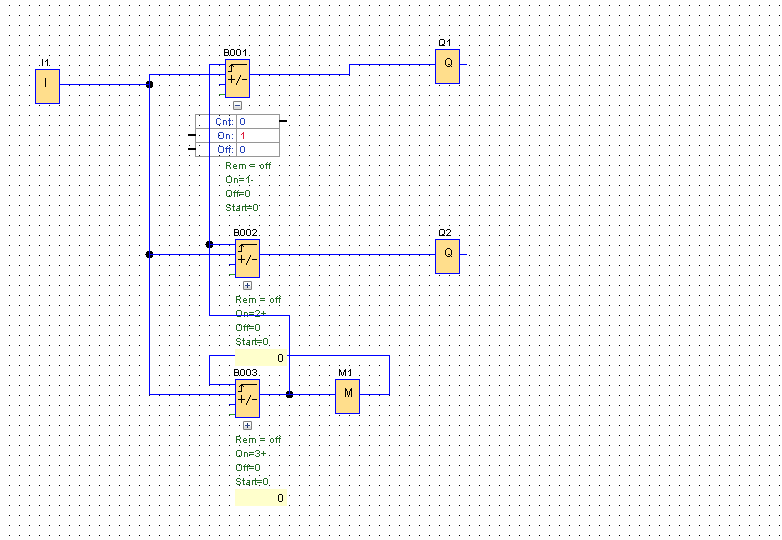
    hmm maybe a 3rd click that will reset the counters?

    That would be the easiest way to do it. Unless the author says something more.

    Which smart lighting and roller shutter solution: Siemens Logo!8 or Satel?
  • #23 15791070
    Zbigniew 400
    Level 38  
    How about both lights ?

    Added after 39 [seconds]:

    Totally confusing.
  • #24 15791081
    Wojciech.
    Level 37  
    After one press, Q1 lights up, after the second Q2(Q1 is switched on) and after 3 all counters are reset.
  • #25 15791143
    Zbigniew 400
    Level 38  
    And if you only want to light up Q2 ?
  • #26 15791169
    Wojciech.
    Level 37  
    And you are right. Because it wasn't a matter of 2 presses but 2 clicks. The matter gets a bit more complicated.

    Well, because in total the controller has to verify the 2 clicks and there should also be some error tolerance.
  • #27 15791214
    lorak86
    Level 10  
    @Wojciech.. thank you very much because you are terribly helpful.
    I will write how I think it would work.
    1 click turns the main light on, again 1 click turns the main light off
    2 clicks turns on side light, again 2 clicks turns off side light
    3 clicks (or holding for e.g. 2sec) turns everything off.

    Seems simple. Just a click changes the action. When ON it does OFF, when OFF it does ON. However, holding it down (or 3 clicks) always does OFF.

    But, gentlemen, this is bullshit. I will be programming such things myself at the finishing stage.

    How about cables?
    Run STAR to light sources with 3x1.5mm?
    Should I run STAR to the bell switches with 3x1.5mm or twisted pair , or maybe both wires?
  • Helpful post
    #28 15792428
    Szyszkownik Kilkujadek
    Level 37  
    And I (as a user for 3 years) recommend the Sterbox version with RS485 + wired alarm (e.g. Satel).

    You also input motion detectors on the control unit. Intrusion and standby from the control panel are all lights on or off respectively.

    For light points, I strongly recommend YDYp 4x1.5mm2. Then you have the possibility of connecting a luminaire with a graduated number of lit bulbs. Each point is connected to the control panel by a separate cable, i.e. a star installation.

    Single bell switches with the light logo. It is worth adding a piece of tape or a 12V LED panel (to illuminate the switch). To the switches a YTDY 10x0.5mm2 cable. Here also a star installation.
    You use the conductors of this YTDY like this: fixed (+), fixed (-), switch contact, backlight, and the rest in reserve (e.g. for temperature sensor, light sensor, IR receiver, IR transmitter as remote control).

    Plus a simple tablet as a control panel with weather and IP camera view.

    That's enough for a start.
    P.S.
    Give one twisted-pair cable to each room with a termination near the 230V sockets. Then you can easily connect a computer, central heating cooker, TV or WiFi AP.
  • #29 15792715
    lorak86
    Level 10  
    @BK_klp
    Tell me if I should have about 20 light sources. Plus 10 bell switches (two sources per switch). Plus control of 4 external roller shutters. Plus a twilight detector. Plus motion detectors in each room (probably 2 in the living room) so about 15 detectors
    How many inputs and outputs do I need to have in the Sterbox
    Plus how to solve the alarm. Should the wires go from the detectors straight to the Sterbox and from it to Satel?
    Is a YTDY 4x0.5mm2 cable sufficient for the detectors?
  • #30 15794135
    Szyszkownik Kilkujadek
    Level 37  
    Generally, the single largest Sterbox set is 28 ports. You can increase the number of inputs with a special extension so that from 3 you make 7. You can also give two sets, but then the costs are already considerable. Call them, tell them how many ports (inputs/outputs) you need and they will choose the optimal solution.
    Here we also come to the issue of why I suggest RS485. Well, in the AVT shop there are inexpensive modules for
    analogue (measurement) inputs,
    digital inputs (such as in Sterbox),
    oC type outputs (like in Sterbox),
    pWM outputs (to control LED strips),
    and with these modules you can cheaply have up to 50 ports.
    Motion detectors are all fed into Satel, and only from Satel are they fed into Sterbox inputs. Also give YTDY 10x0.5mm2 to the detectors. I know that 4 wires are enough, but it's worth having a spare. The price difference between 4-core and 10-core (for such an investment) is small.
    I, for example, am now getting ready to put an infrared receiver in the motion detector. This will allow me to use the unused few buttons on the TV remote control to control the light.
    Aha, important: Sterbox programming is not very accessible to the average consumer. You operate on logic elements like logic gates and flip-flops.
    P.S..
    How much work one has to do to be able to bullshit afterwards.
    P.S.2
    It's not laziness. It's convenience. :-]
ADVERTISEMENT