logo elektroda
logo elektroda
X
logo elektroda

Chinese converter test for PowerBank. Step-Up 5V "1500mA"

CMS 6333 19
ADVERTISEMENT
Treść została przetłumaczona polish » english Zobacz oryginalną wersję tematu
📢 Listen (AI):
  • This time it was one of the drivers that Kamil gave me for testing.
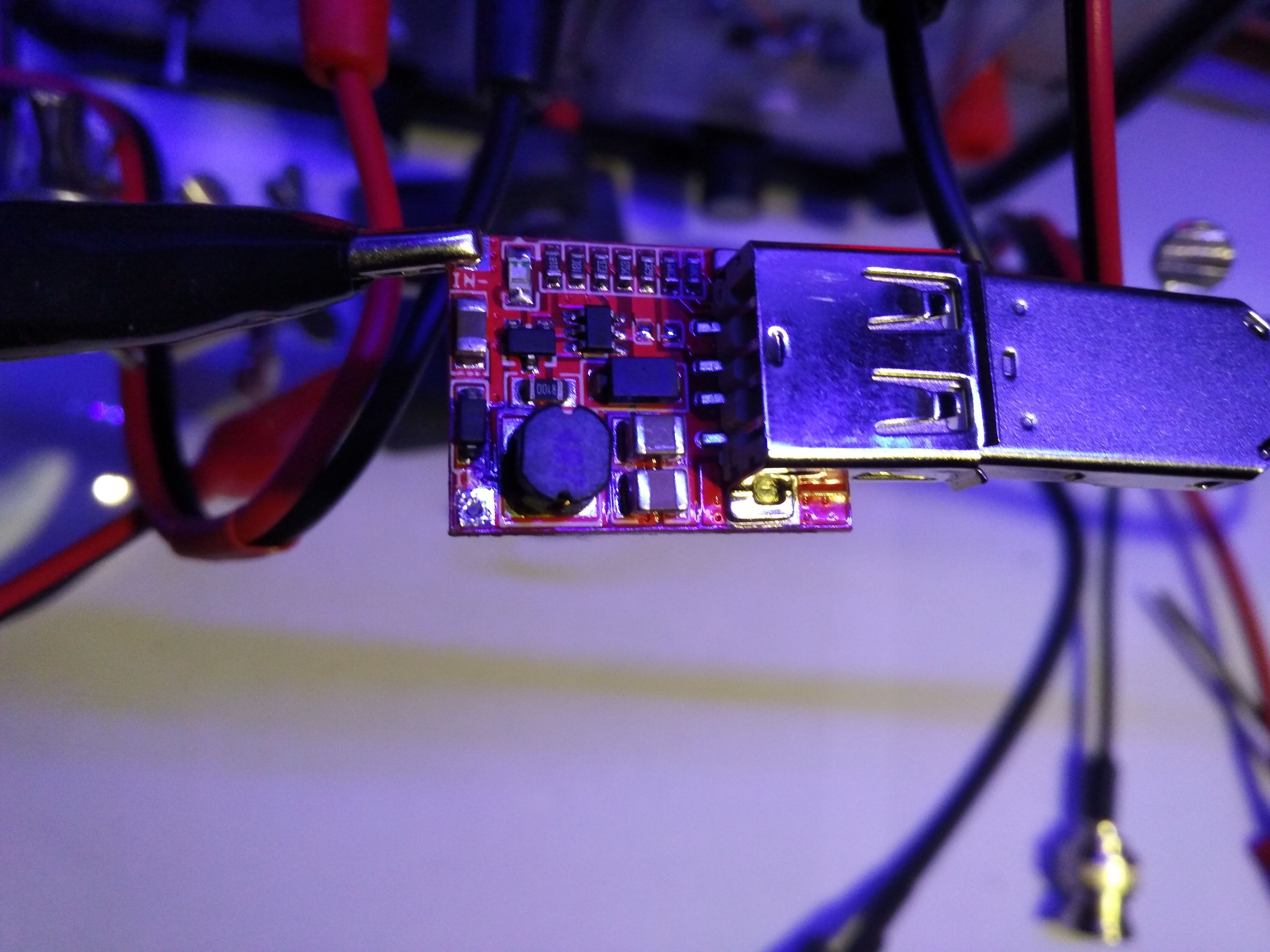
    It is a tiny module designed for PowerBanks.
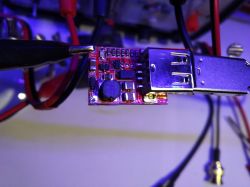
    Chinese converter test for PowerBank. Step-Up 5V "1500mA"

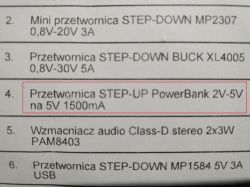
    Interestingly, the invoice shows as:

    "STEP-UP PowerBank 2V-5V to 5V 1500mA converter".
    Chinese converter test for PowerBank. Step-Up 5V "1500mA"

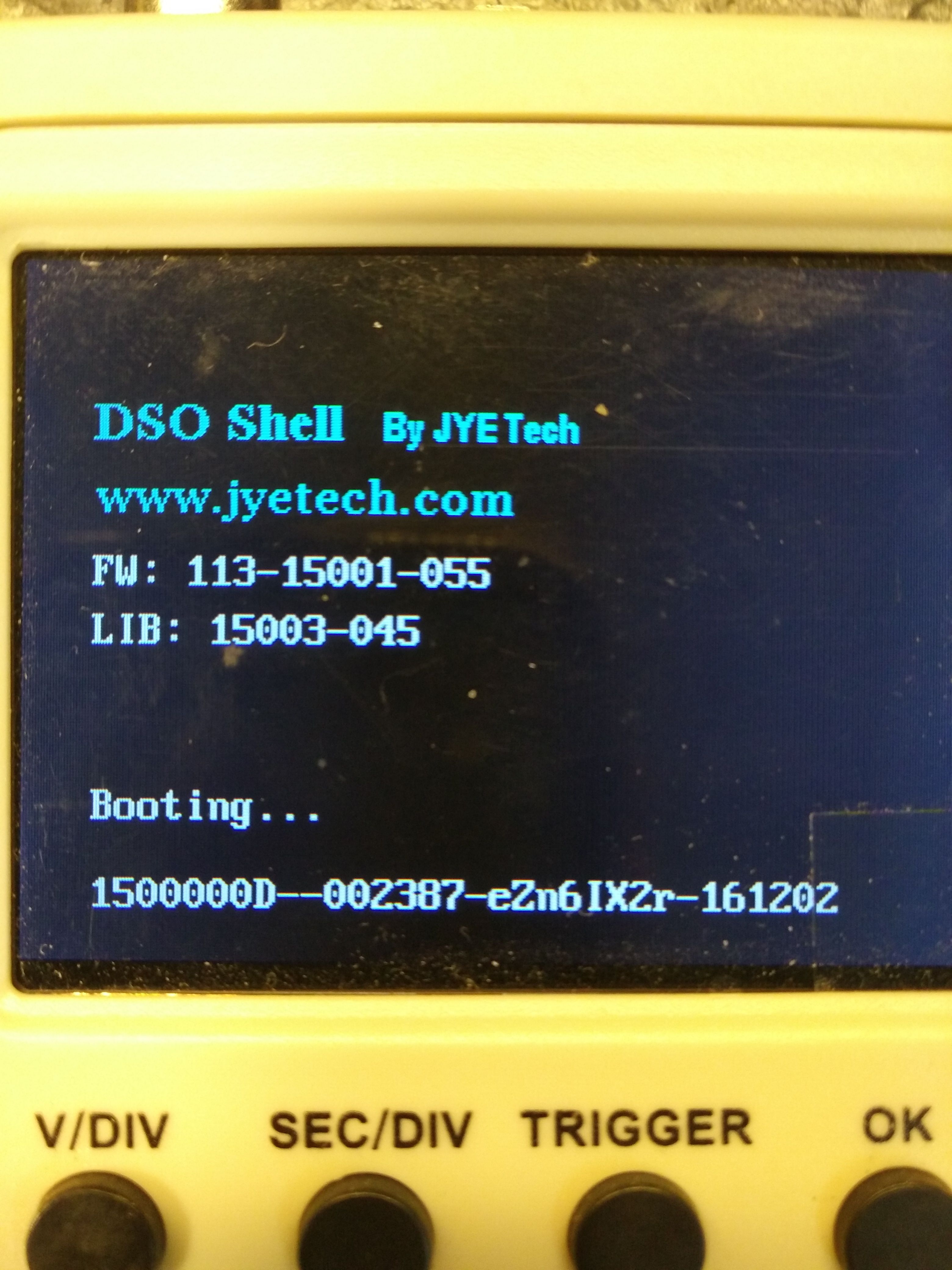
    So far, I have bought these boards as DC-DC converters, 2.5V - 5V, for 5V, 1000mA. Well, we'll see. Unfortunately, when I connected the converter for tests, my tiny oscilloscope got tangled in the spider's web of wires and fell to the floor.
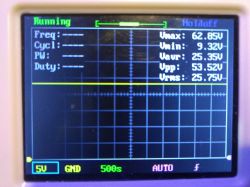
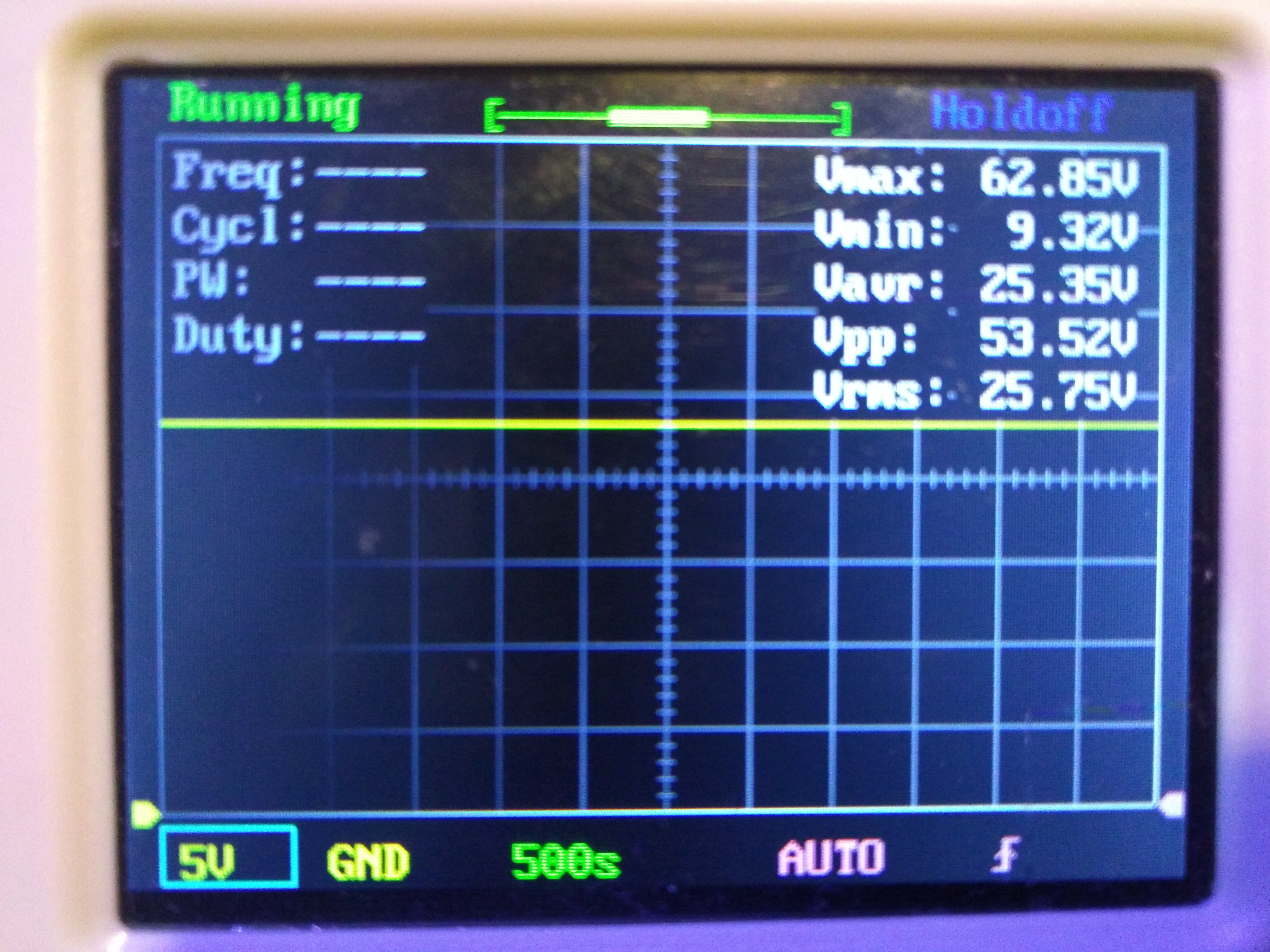
    I think something broke inside, because now it displays something like this all the time:
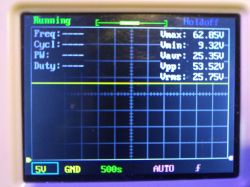
    Chinese converter test for PowerBank. Step-Up 5V "1500mA" Chinese converter test for PowerBank. Step-Up 5V "1500mA"

    Chinese February will probably need to be improved.
    Well, never mind the oscilloscope, after a while I find that I received a terrible crap specimen, because the previous ones, which I did not test, but used to a greater or lesser degree, did not make any (at least audible to me) sounds.
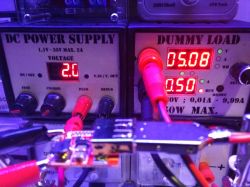
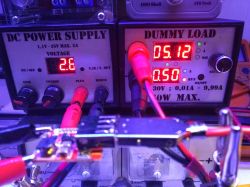
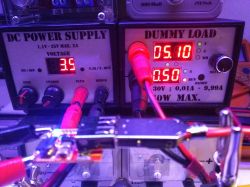
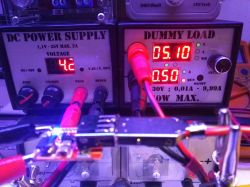
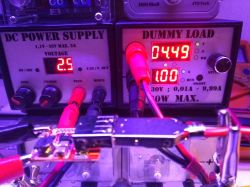
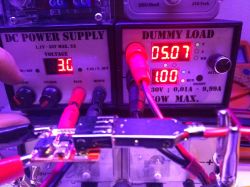
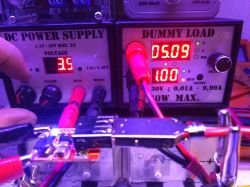
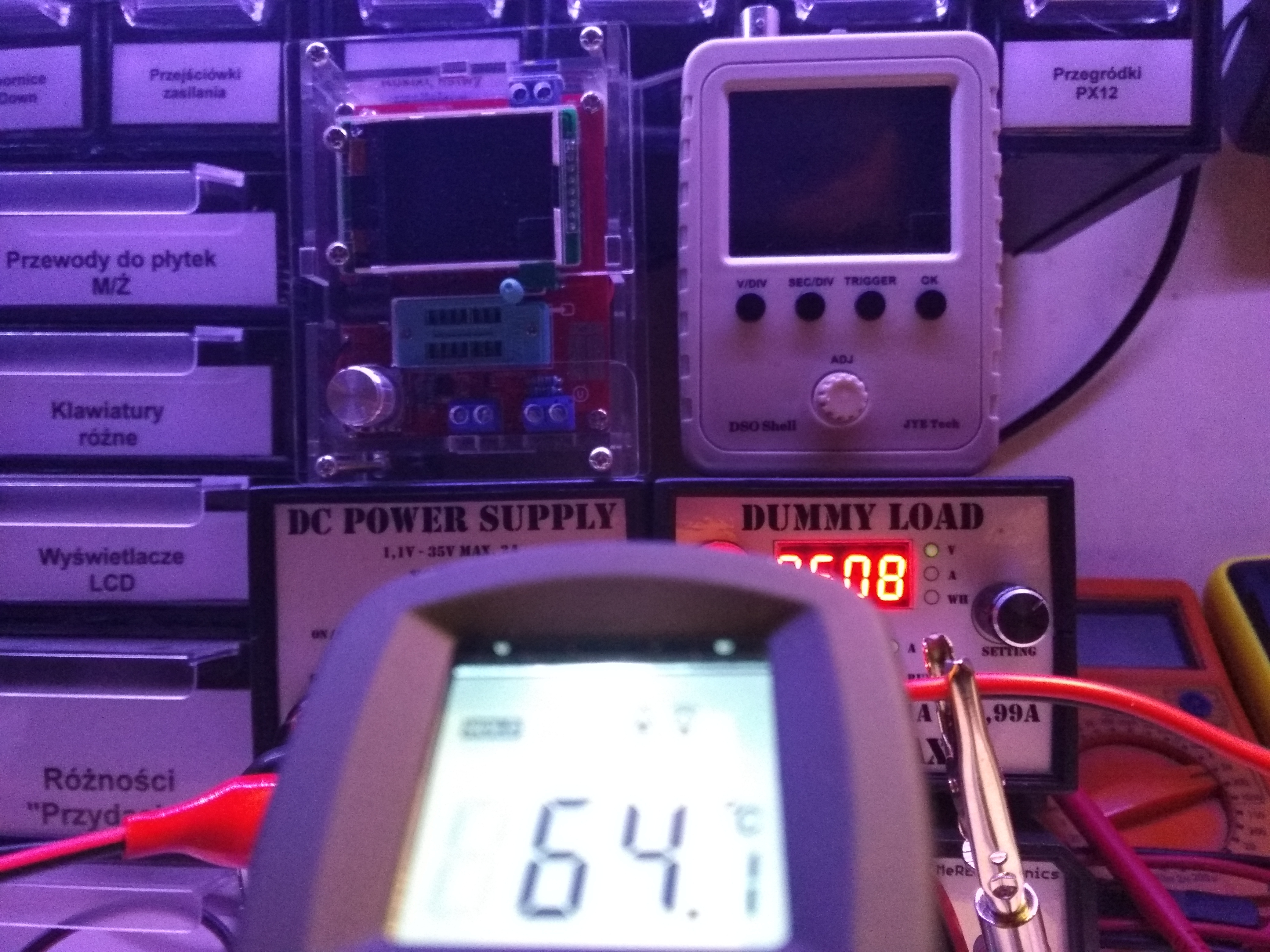
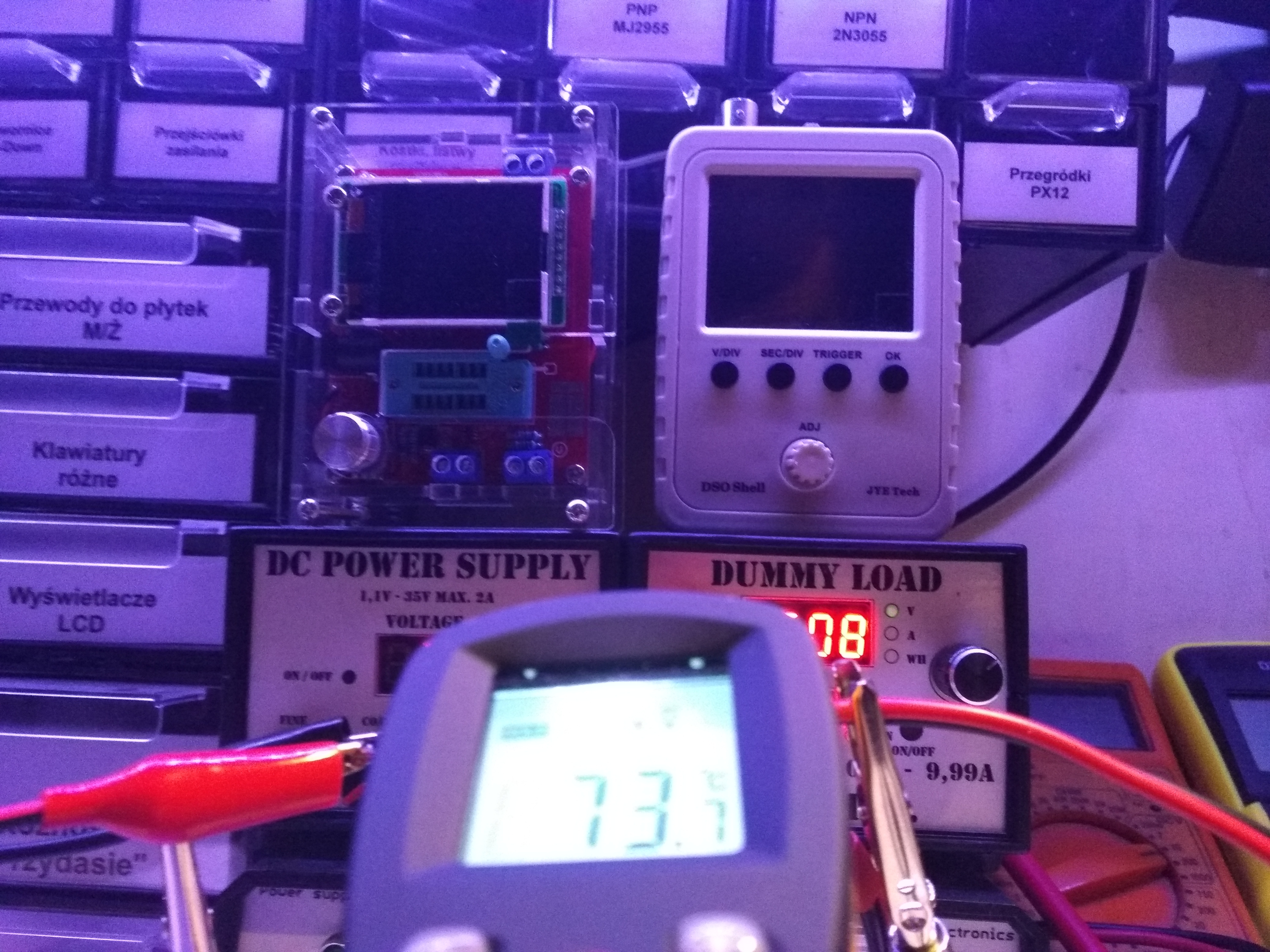
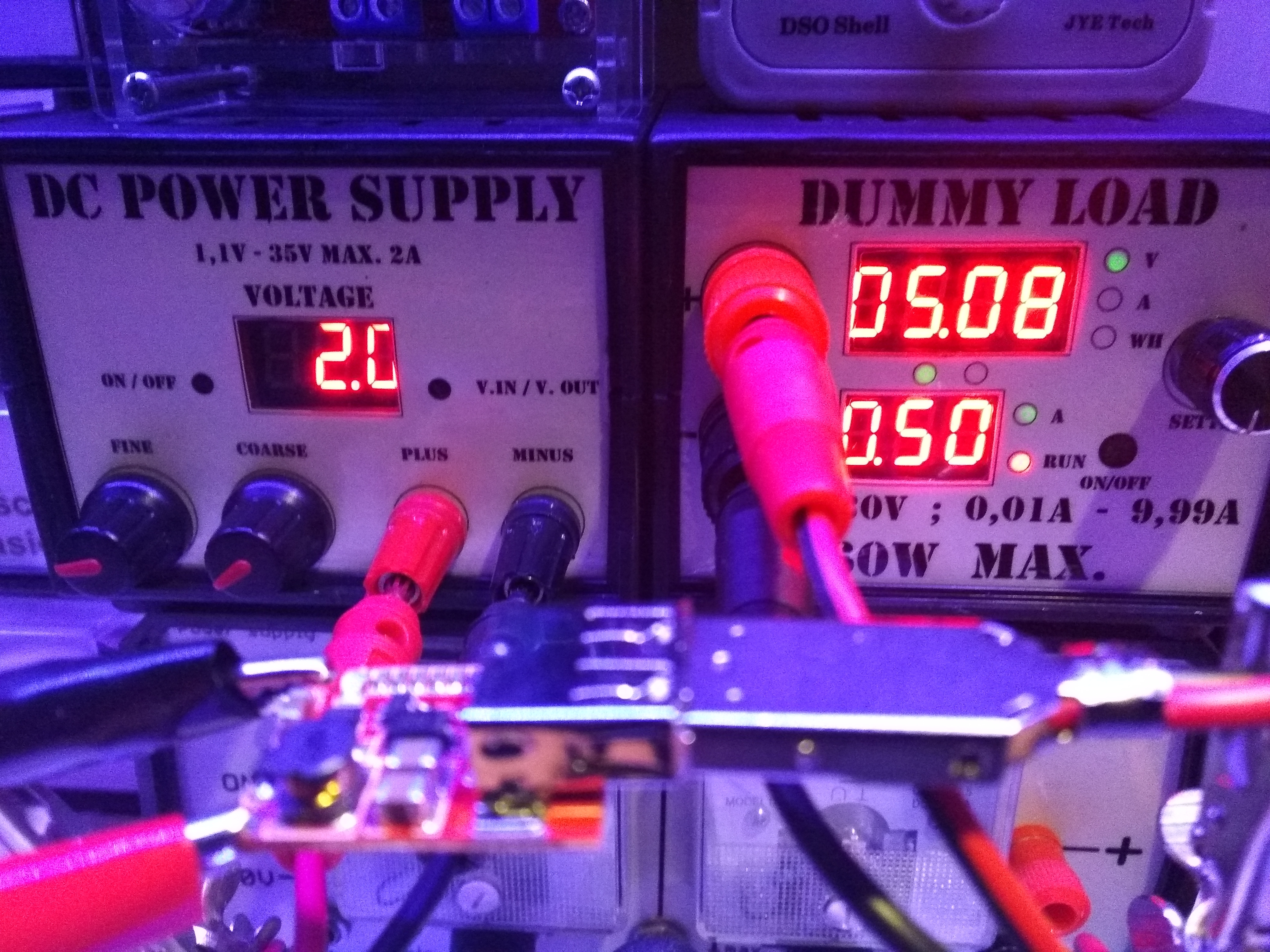
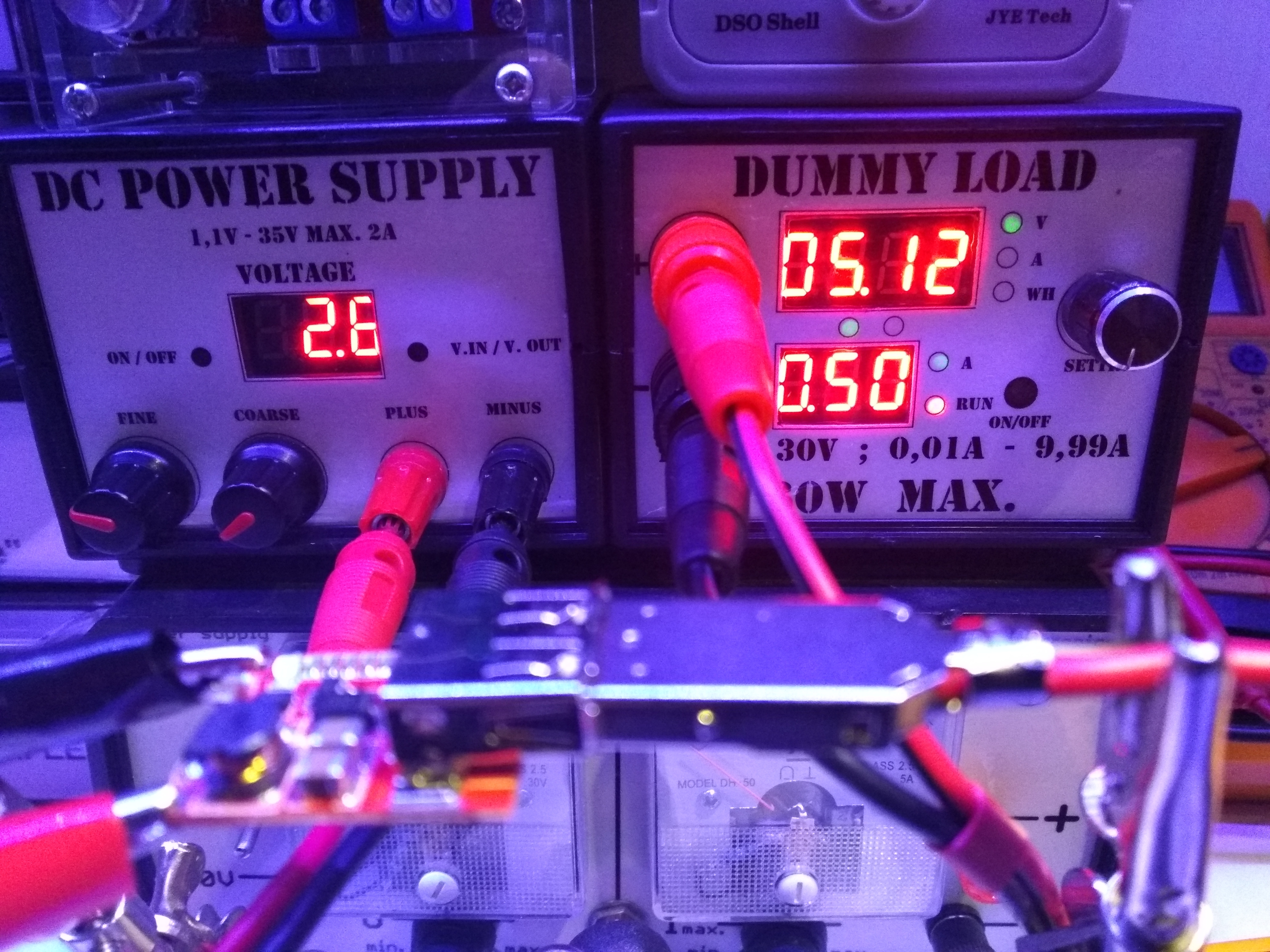
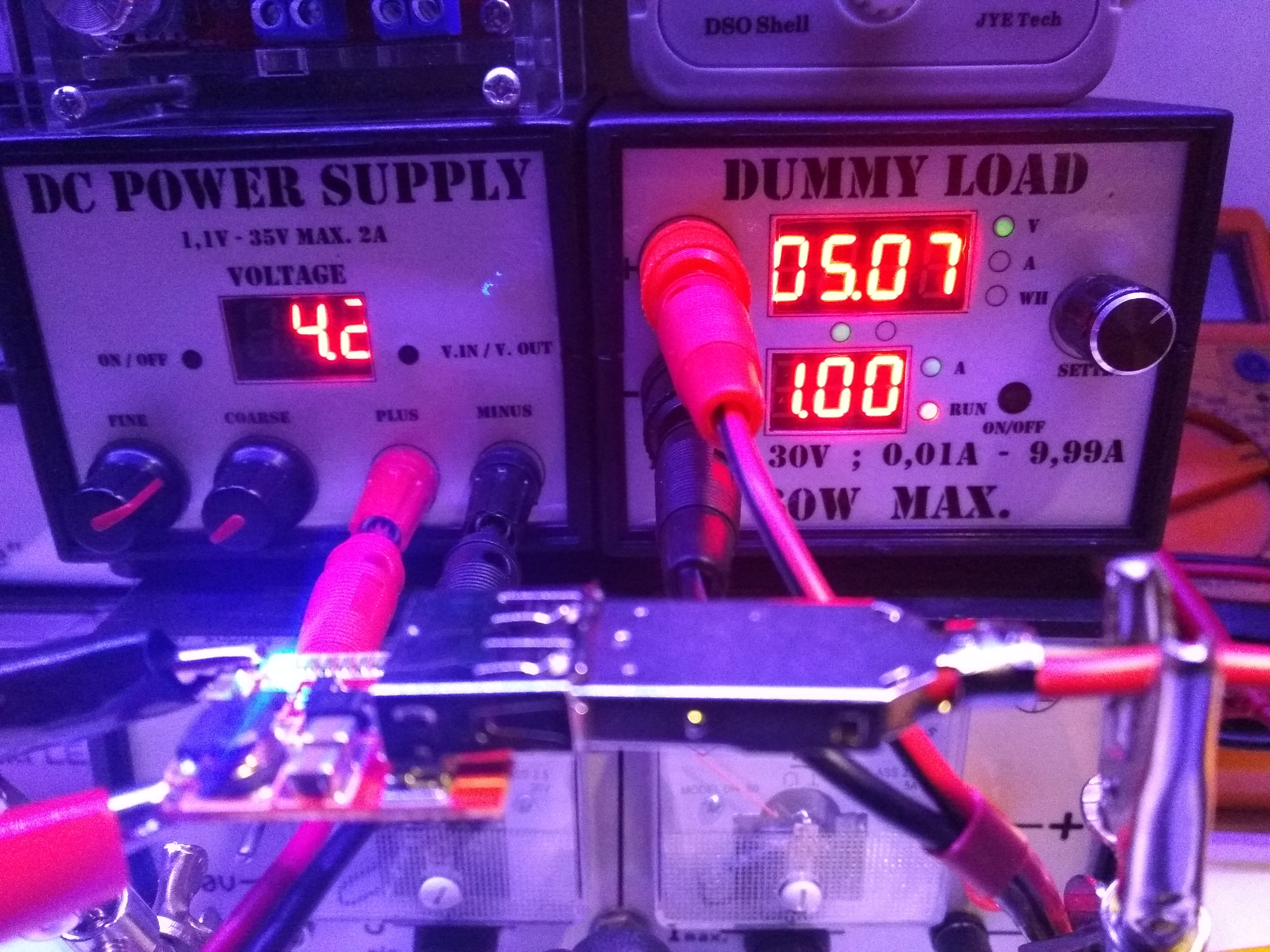
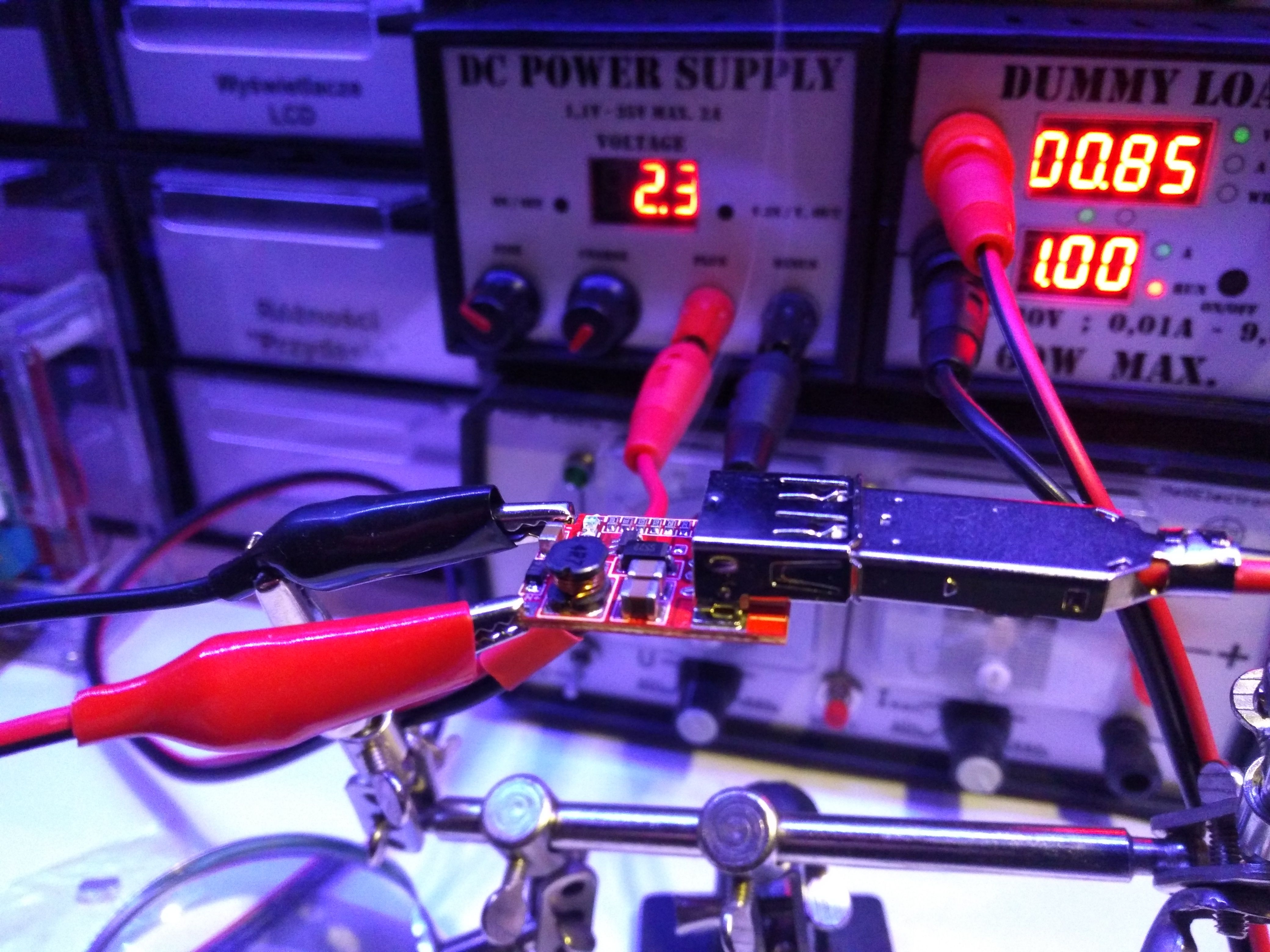
    The tested converter maintains the correct voltage under load, which is confirmed by the photos. But after a few minutes it gets very hot.

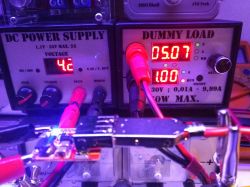
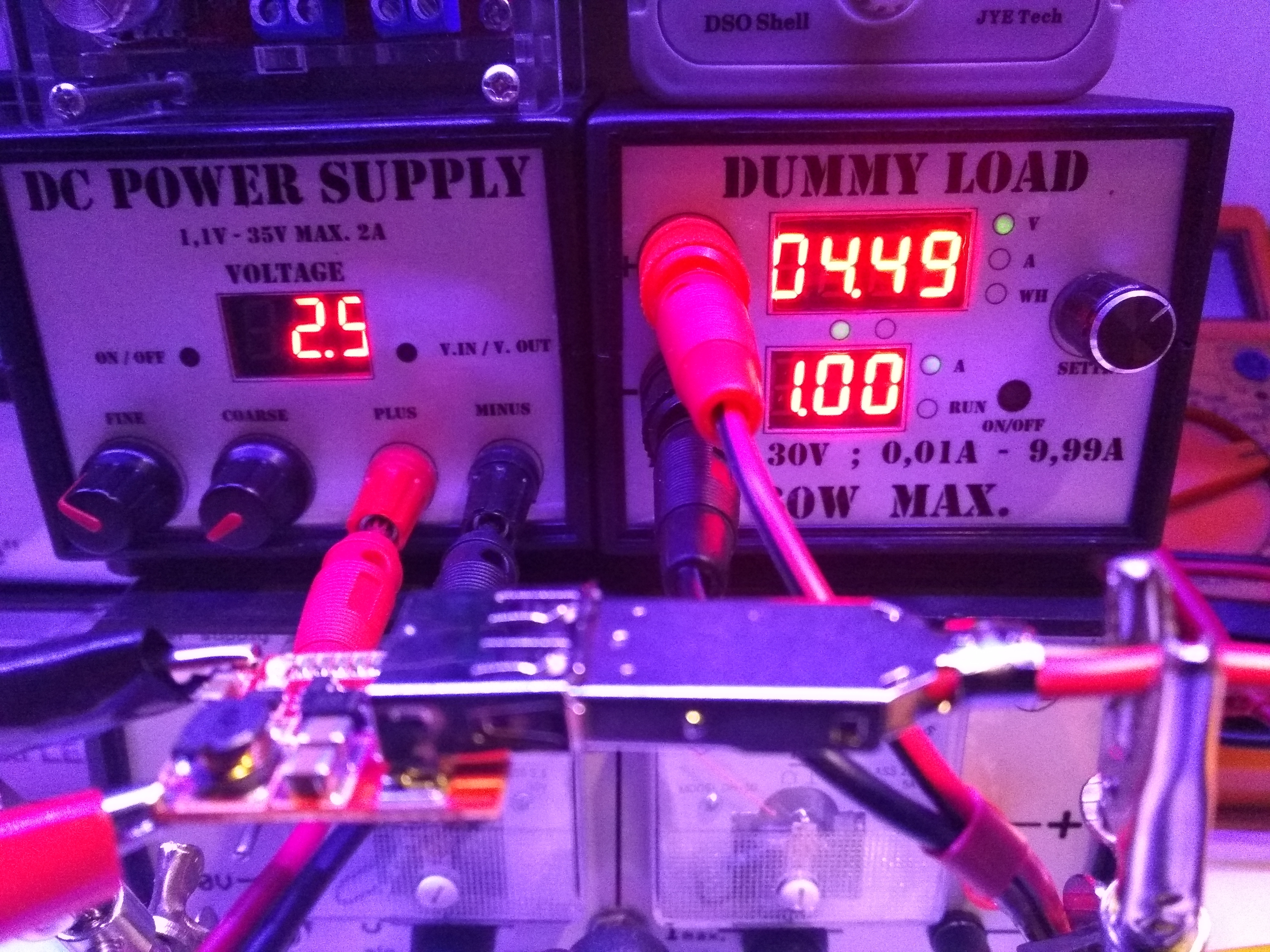
    With a load of 0.5A after approx. 3 minutes of operation:
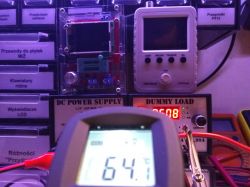
    Chinese converter test for PowerBank. Step-Up 5V "1500mA"

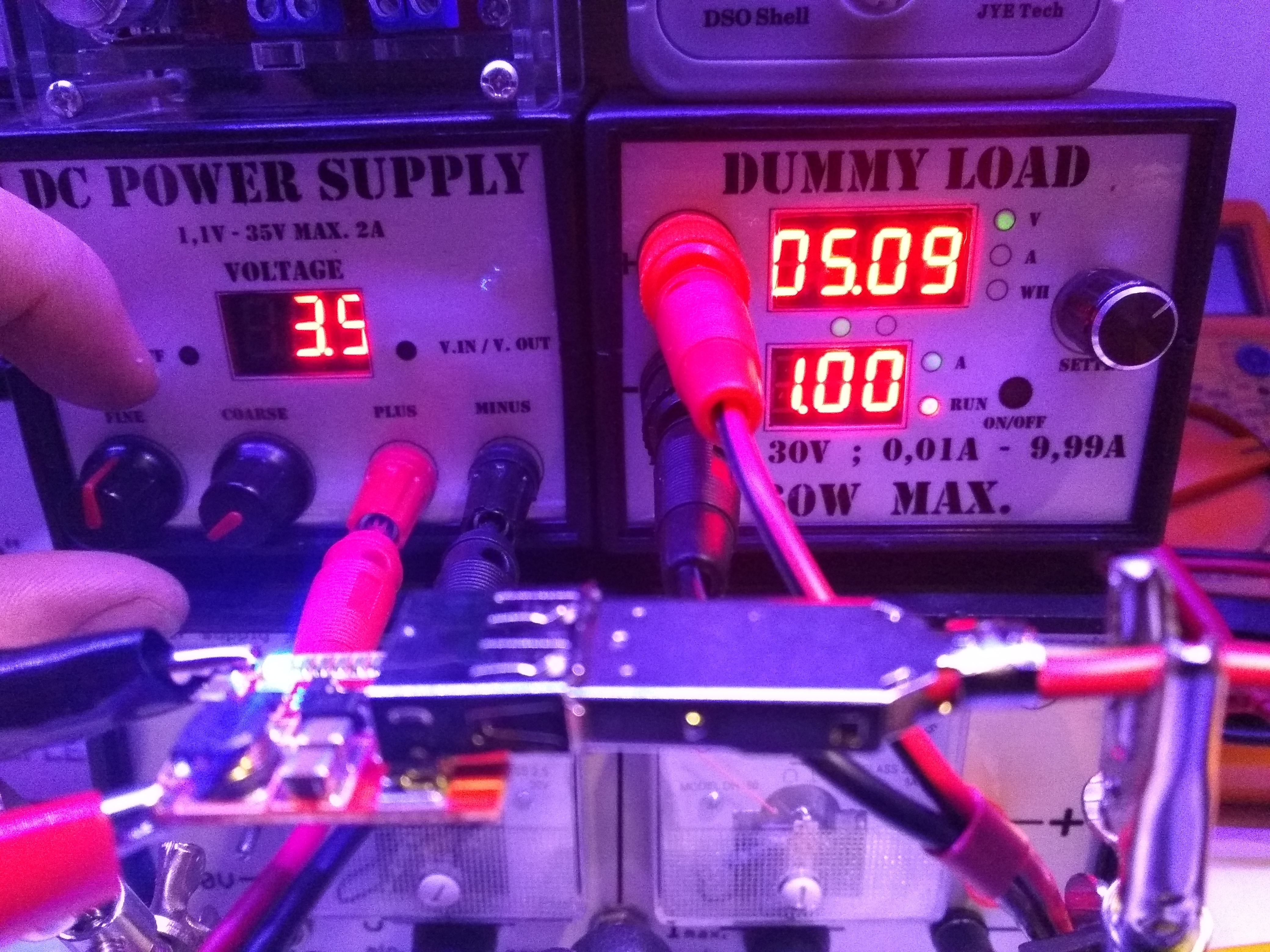
    With a load of 1A after approx. 3 minutes of operation:
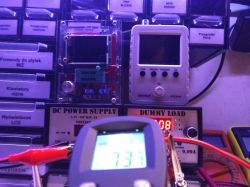
    Chinese converter test for PowerBank. Step-Up 5V "1500mA"

    During the tests, I did not dare to "reach" the "promised in writing" 1500mA, because while the voltage was stable, the converter literally sang in a large input voltage range. The sound effects occurred at both 500mA and 1000mA loads.

    Now a few photos, so that it would not be that I made it all up :) and finally two videos presenting the "singing" of this converter.
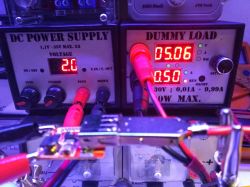
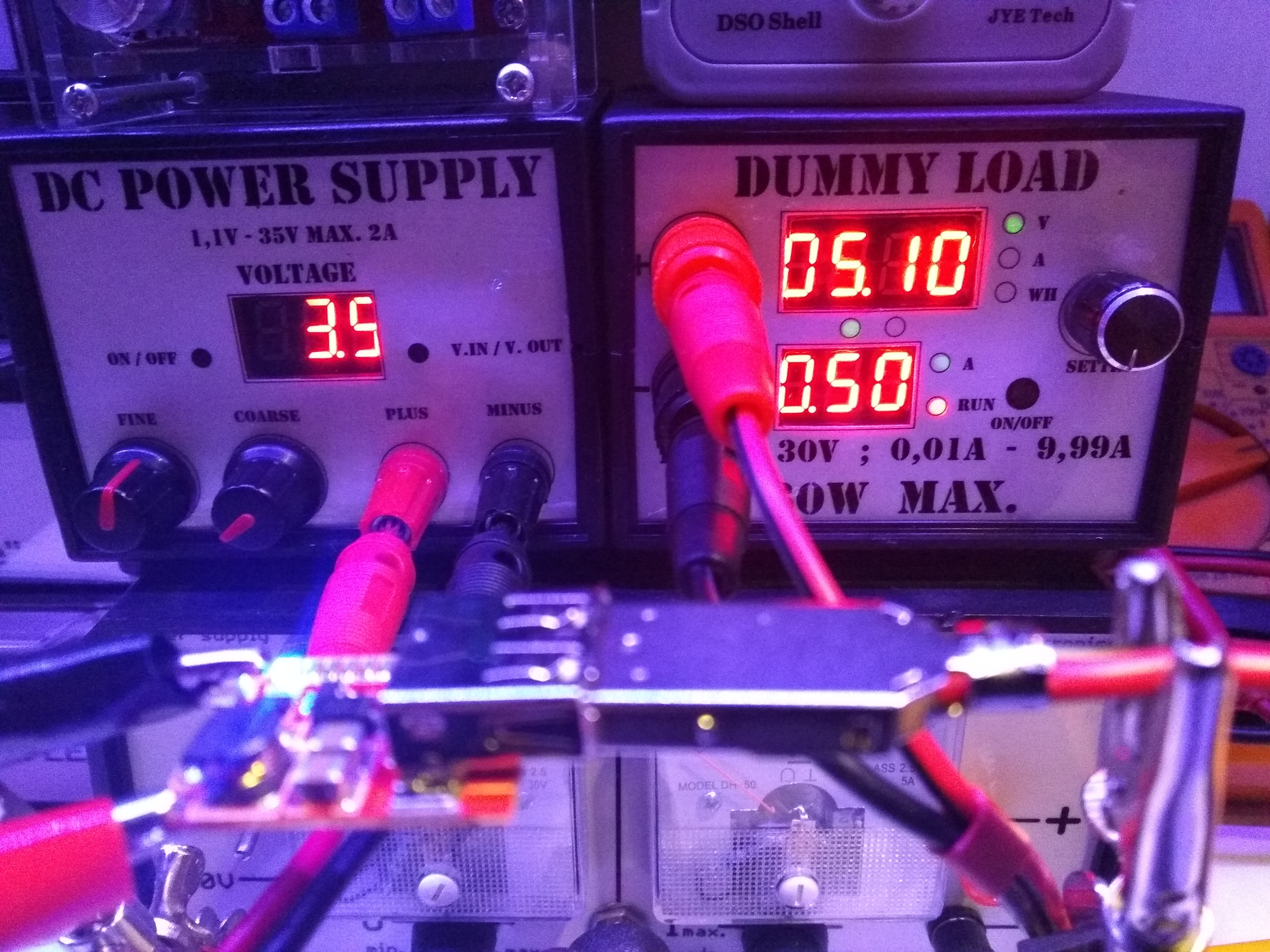
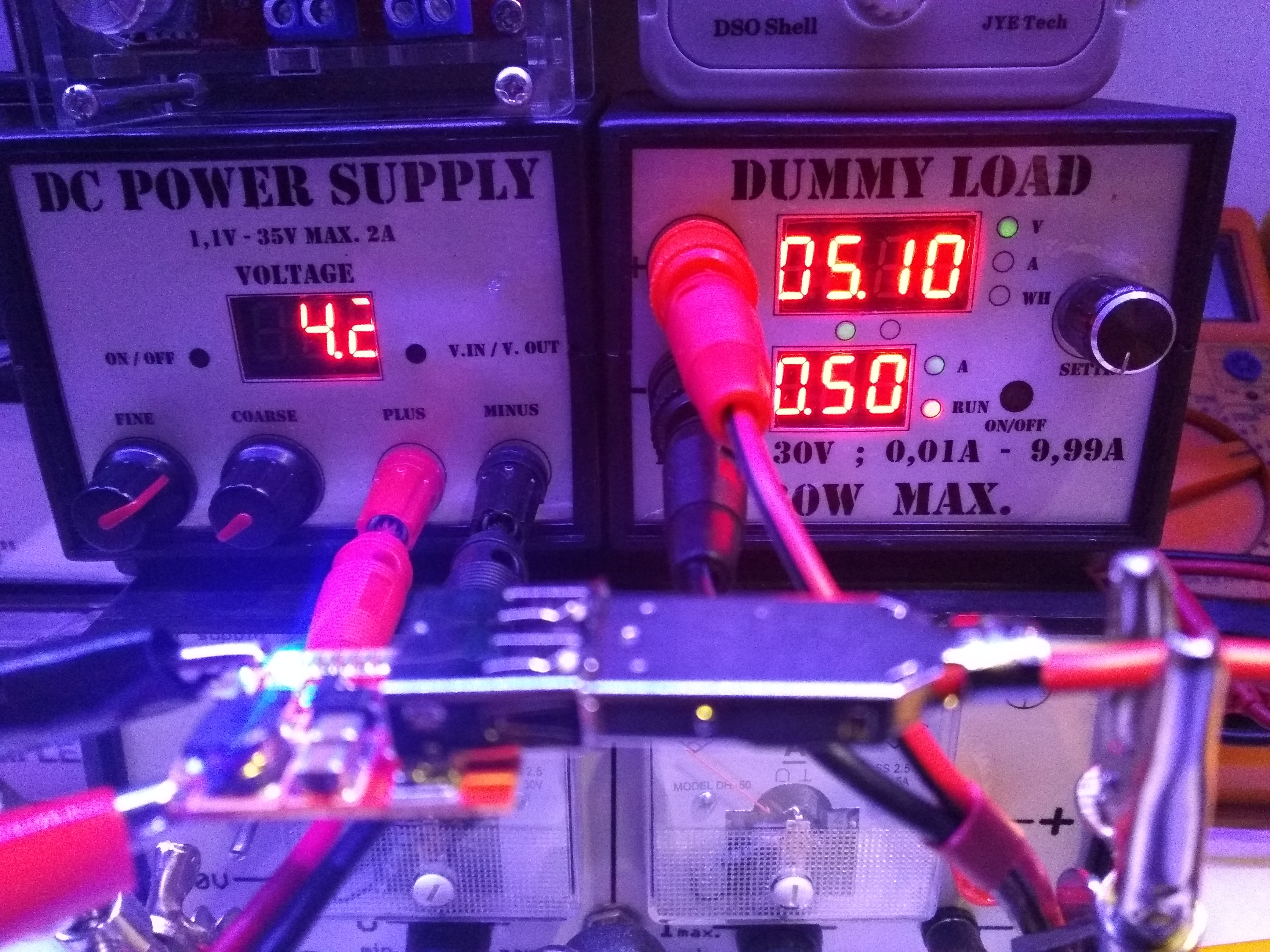
    Chinese converter test for PowerBank. Step-Up 5V "1500mA" Chinese converter test for PowerBank. Step-Up 5V "1500mA" Chinese converter test for PowerBank. Step-Up 5V "1500mA"
    Chinese converter test for PowerBank. Step-Up 5V "1500mA" Chinese converter test for PowerBank. Step-Up 5V "1500mA" Chinese converter test for PowerBank. Step-Up 5V "1500mA"
    Chinese converter test for PowerBank. Step-Up 5V "1500mA" Chinese converter test for PowerBank. Step-Up 5V "1500mA" Chinese converter test for PowerBank. Step-Up 5V "1500mA"


    Because the converter heats up very much, which in the case of these particular converters (and as I mentioned, I have already used the exact same model several times already) is quite normal, but I have never encountered a chance that it warms up so quickly. Additionally, it makes suspicious sounds. I wonder if I should send it to the land of eternal power supplies and transformers using the "let's see how much we can squeeze out before the magic smoke disappears from the chip" method. :)

    Do you want such a trial?

    And now the promised movies. In the background you can hear the fans from the power supply and the artificial load, but I'm sure you will easily recognize the "twitter" of the converter, especially since you can hear that the modulation changes in relation to the voltage change.

    Here the inverter is loaded with 0.5A and starts its correct operation from 2V.


    Here we take 1A and the converter starts working correctly only at 2.8V


    You can't hear it that clearly in the movie, but believe me, this sound is very unpleasant and really loud.

    Now imagine a PowerBank next to your head, in a tent, in the beautiful wilderness of the Bieszczady Mountains, for example ... And this cruel whistle of the converter.

    EDIT:

    Unfortunately, after about an hour under a load of 1000mA, the converter turned off. I wasn't in the room, so I don't know what temperature it got. When I got back it was 61 ° C and it started.

    EDIT 2:

    And it happened. This time I was fortunately next door when I noticed the characteristic smell of magic smoke. I even managed to take a few photos, but unfortunately you can see anything at all on only one. But I managed to capture the soul of this converter. Hehehe ...
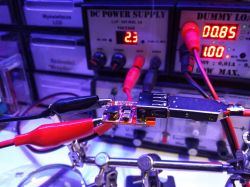
    Chinese converter test for PowerBank. Step-Up 5V "1500mA"

    It had to "jerk" a lot of electricity, because the voltage on the power supply dropped by 0.5V.

    Cool? Ranking DIY

    About Author
    CMS
    VIP Meritorious for electroda.pl
    Offline 
    CMS wrote 8440 posts with rating 2581, helped 256 times. Live in city Warszawa. Been with us since 2004 year.
  • ADVERTISEMENT
  • #2 17023986
    tehaceole

    Level 28  
    Posts: 1224
    Help: 102
    Rate: 212
    Offtop: how does this oscilloscope perform for you? By the logo on the casing, I conclude that it is an original from JYETech. Recently, I received my copy (without the logo on the housing ...). Unfortunately, I did not bother to read about fakes first. And now I wonder if this "equipment" is just like that or is it the fault of a fake: the values of "measurements" are distorted by at least 30%. How does it look in your copy?
    Company Account:
    ST - SYSTEM
    Maszkowo 24 B, Maszkowo, 75-558 | Company Website: www.stsystem.pl
  • ADVERTISEMENT
  • #3 17024050
    CMS
    VIP Meritorious for electroda.pl
    Posts: 8440
    Help: 256
    Rate: 2581
    tehaceole wrote:
    the "measurements" values are biased by at least 30%. How does it look in your copy?


    These things happen when the battery is not working.

    I am very happy with mine, unfortunately after yesterday's fall he went stupid. In my free time, I have to undress it.

    tehaceole wrote:
    By the logo on the casing, I conclude that it is the original from JYETech


    I think so too.
    Chinese converter test for PowerBank. Step-Up 5V "1500mA" Chinese converter test for PowerBank. Step-Up 5V "1500mA"
  • #4 17024128
    tehaceole

    Level 28  
    Posts: 1224
    Help: 102
    Rate: 212
    I definitely have a counterfeit. I power it from an external 9V adapter - I didn't use a battery. Basically, I only need to suspect the encoder signal during on-site service, without messing with their measurements. So it is perfect for this task. However, it is worth warning other Users against counterfeit devices of this device.
    Company Account:
    ST - SYSTEM
    Maszkowo 24 B, Maszkowo, 75-558 | Company Website: www.stsystem.pl
  • #5 17024169
    CMS
    VIP Meritorious for electroda.pl
    Posts: 8440
    Help: 256
    Rate: 2581
    But mine is already working properly. I'm going to write an article about him next week, let me mention something about fakes.
    Unfortunately, I will not make oscillograms from the tested converter, because, as you know, it gave up the ghost.
  • #6 17024371
    korben
    Level 12  
    Posts: 16
    Rate: 2
    Hi
    I am not writing this maliciously. You should work on the white balance of your photos.
    I like reading your posts, I look forward to the next ones and best regards.
  • #7 17024378
    CMS
    VIP Meritorious for electroda.pl
    Posts: 8440
    Help: 256
    Rate: 2581
    Pictures taken with the phone. The lighting is an RGB LED strip in which white escapes quite strongly towards blue / purple.
  • #8 17024605
    korben
    Level 12  
    Posts: 16
    Rate: 2
    If you don't know what to do with time, see advanced settings / professional mode in the camera. There should be WB settings. You choose Custom or K ° and mix with the ? slider
    Have a nice day
  • ADVERTISEMENT
  • #9 17024753
    karwo
    Level 31  
    Posts: 1542
    Help: 151
    Rate: 356
    Here is some info about DSO
    I have a counterfeit but mine does not distort me during measurements, and I mainly use it to "see" various signals.
    Such an offtop.
  • #10 17024976
    CMS
    VIP Meritorious for electroda.pl
    Posts: 8440
    Help: 256
    Rate: 2581
    I have this topic in the watch, practically from its publication.

    Let's finish OffTopic. There will be an article about the oscilloscope, we'll discuss it.
  • #11 17025039
    E8600
    Level 41  
    Posts: 8864
    Help: 525
    Rate: 2475
    CMS wrote:
    And it happened. This time I was fortunately next door when I noticed the characteristic smell of magic smoke. I even managed to take a few photos, but unfortunately you can see anything at all on only one. But I managed to capture the soul of this converter.

    When giving data, the Chinese forget about the most important thing, that at higher currents, additional cooling is required, which is not included in the set. It is commonly duplicated at various auctions, for example the LM2596 inverter is supposed to be 3A, but only when you put on a heat sink and without heat dissipation it will burn at 2A. Similar treatments are with BMSs for Li-ion packages, like 30A, but already above 10A and with continuous load, they require a heat sink / cooling.

    ps.
    The characteristic squeal is normal for a cheap high frequency choke.
  • #12 17025077
    CMS
    VIP Meritorious for electroda.pl
    Posts: 8440
    Help: 256
    Rate: 2581
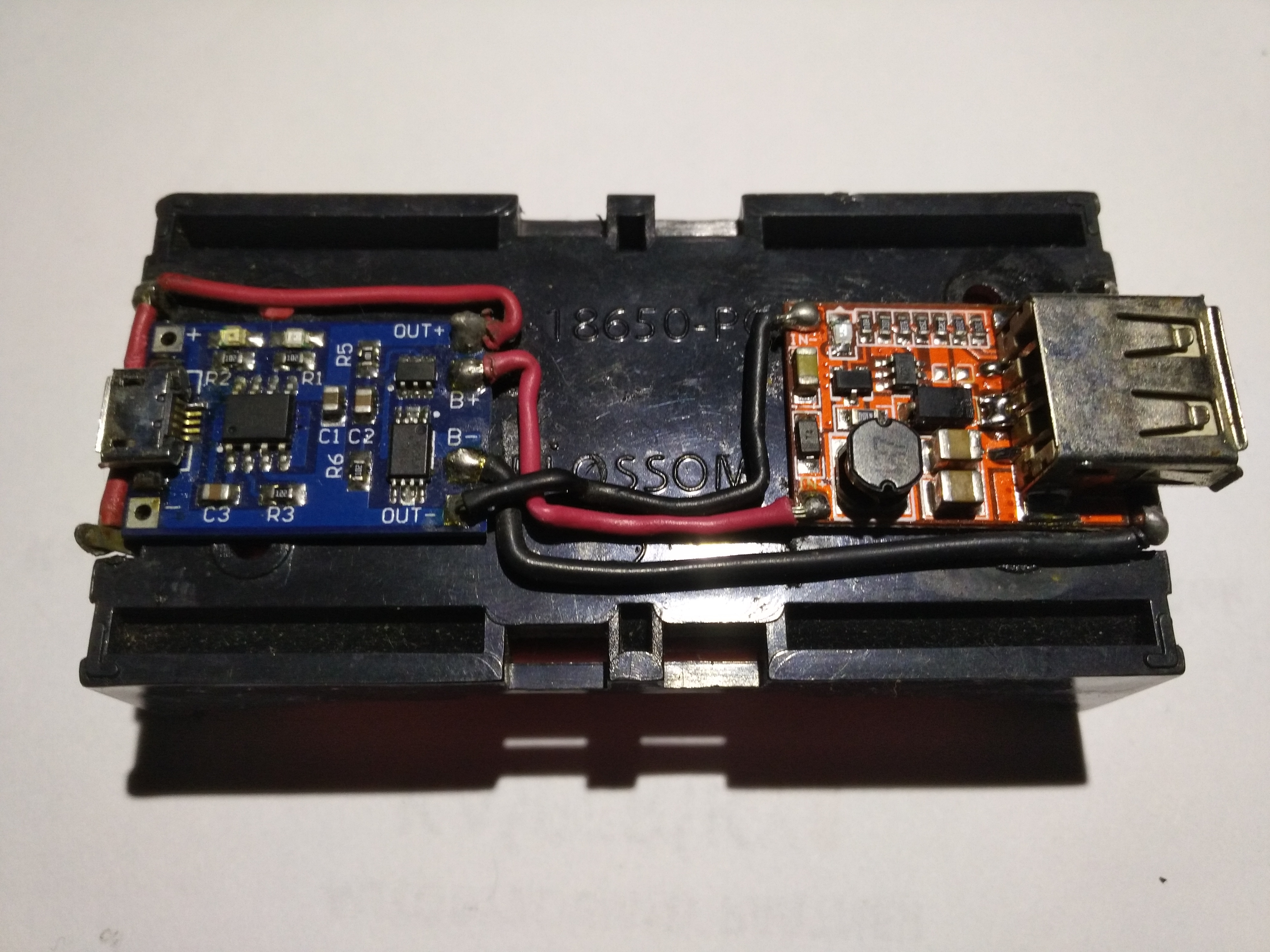
    This is interesting because I used to use such a PowerBank

    Chinese converter test for PowerBank. Step-Up 5V "1500mA"

    and nothing squealed, and the inverter was able to charge two phones in a row. The big diode was the most warm. The board is stuck on a double-sided 3M tape for gluing displays, and in summer the glue was able to release after a long charge on the table in the sun.
  • #13 17025174
    E8600
    Level 41  
    Posts: 8864
    Help: 525
    Rate: 2475
    CMS wrote:
    It is interesting, because I used to use such a PowerBank and nothing squealed, and the converter was able to charge two phones in a row.


    The choke was apparently more tightly wound or the converter itself operated at a lower frequency.

    CMS wrote:
    Unfortunately, I will not make oscillograms from the tested converter, because, as you know, it gave up the ghost.

    Rather, this "oscilloscope" with this converter would not be much useful (it works outside the DSO150 measuring range).

    I can see that my friend has been throwing in the tests ordered by Kamil for some time. Some tests of the open bleuetooth 4.0 LE module would be useful (it is one with a lot of different outputs, e.g. microphone, audio, sensors, etc.).
  • #14 17025259
    CMS
    VIP Meritorious for electroda.pl
    Posts: 8440
    Help: 256
    Rate: 2581
    E8600 wrote:
    I can see that my friend has been throwing in the tests ordered by Kamil for some time.


    So far, only this converter has been from Kamil, the rest are my toys.
    No BT or other wireless, I have no plans in the near future.

    E8600 wrote:
    The choke was apparently more tightly wound or the converter itself operated at a lower frequency.


    I have up to 60Mhz at work :)
  • ADVERTISEMENT
  • #15 17025567
    error105
    Level 14  
    Posts: 477
    Help: 1
    Rate: 145
    CMS wrote:
    This is interesting because I used to use such a PowerBank

    Chinese converter test for PowerBank. Step-Up 5V "1500mA"


    Can you count on the charger description on the left? :)
    I have a similar one, but I do not know what the OUT + and OUT- outputs are for, when I connect a receiver there (say Arduino), I cannot charge the battery connected to B + and B- :(
  • #16 17025670
    E8600
    Level 41  
    Posts: 8864
    Help: 525
    Rate: 2475
    error105 wrote:
    I have a similar one, but I do not know what the OUT + and OUT- outputs are for, when I connect a receiver there (say Arduino), I cannot charge the battery connected to B + and B-

    Let's not expect miracles from such a simple and cheap charger. The OUT outputs are for the receiver and B for the battery. To be able to charge and use, you would have to connect the batteries and the receiver in parallel under B-, B +, but then you have no protection against excessive Li-ion discharge.
  • #17 17025698
    error105
    Level 14  
    Posts: 477
    Help: 1
    Rate: 145
    Well, but if there is an output to the receiver, there is something for it, unless I have to unplug the receiver during charging?
  • #18 17026254
    rb401
    Level 39  
    Posts: 3000
    Help: 750
    Rate: 980
    CMS wrote:
    Well, never mind the oscilloscope, after a while I find that I received a terrible crap specimen, because the previous ones, which I did not test, but used to a greater or lesser degree, did not make any (at least audible to me) sounds.
    The tested converter maintains the correct voltage under load, which is confirmed by the photos. But after a few minutes it gets very hot.


    I'm not entirely sure, but I suspect it was the converter's singing and its premature death during your research, that might not be her fault.

    This particular converter is based on the RT9266 system, working in a factory-like application with an external transistor (mosfet or bipolar):
    Chinese converter test for PowerBank. Step-Up 5V "1500mA"

    But most importantly, it works with a constant, factory forced frequency of about 500kHz.

    So even if everything is loose, it still cannot produce audible sound. So the squeaking (one kilohertz per ear) can only come from some completely different oscillations in the current circuit.
    If the inverter output voltage is ok and the inverter supply voltage is OK, then most likely in my opinion this artificial load is excited.
    Let us assume that the load resistance (mosfet to be precise) oscillates within wide limits, thus the current. The amplitude is large, which causes the choke to emit a sound (e.g. magnetostriction). The inverter can even keep the voltage of 5V quite accurately, but in the system there are large instantaneous currents (hence the abnormal heating) exceeding the strength of some element and, unfortunately, death.
    This is only an unconfirmed hypothesis on my part because I do not have this particular converter to verify it. I also don't have this type of load.

    I watched your thread about this load and a colleague posted a diagram there, which would show that the current is forced only in an analog way (mosfet + WO) based on the voltage generated by the uC, but it is not measured in any way (there is only a simple detection threshold voltage on the gate, which only gives information about the inability to obtain the assumed current, that it is not enough).
    So in the event of oscillations, the load controller has no chance to detect them or even show the real value of the current on the display. It is possible that even in the case of oscillation, the (effective) current value is much higher than the set value.

    So I would have such a suggestion, as you will be testing other converters, look with the oscilloscope especially on the current (e.g. measuring at the shunt) in case of such anomalies as e.g. these sounds. If necessary, check against purely resistive load.


    CMS wrote:
    This is interesting because I used to use such a PowerBank


    and nothing squealed, and the inverter was able to charge two phones in a row.


    Note that it is the same chip (RT9266) in the same configuration. Probably exactly the same tile. If you would even try it on this load for a moment, or sometimes it won't sing, it would be a worthy attempt.
  • #19 17026352
    CMS
    VIP Meritorious for electroda.pl
    Posts: 8440
    Help: 256
    Rate: 2581
    rb401 wrote:
    If you would even try it on this load for a moment, or sometimes it won't sing, it would be a worthy attempt.


    No problem, but I'm on my way to Sweden right now. I'm back on Monday night.
  • #20 17027029
    Harrypol
    Level 12  
    Posts: 17
    Help: 1
    And this is the squeaking of the inverter does not come from the impulse load ??
📢 Listen (AI):

Topic summary

✨ The discussion revolves around a Chinese step-up converter module designed for PowerBanks, specifically a "STEP-UP PowerBank 2V-5V to 5V 1500mA converter." The original poster experienced issues with their oscilloscope after a fall, leading to concerns about its functionality and the quality of the converter. Participants shared experiences with counterfeit oscilloscopes, emphasizing the importance of authenticity in measurement devices. There were discussions about the need for additional cooling in converters under high current loads, with references to common issues like audible noise from cheap components. The conversation also touched on the proper use of outputs for charging and powering devices, highlighting potential risks with Li-ion batteries.
Generated by the language model.

FAQ

TL;DR: Tests showed thermal shutdown after 57 min at 1 A and 61 °C [Elektroda, CMS, post #17023071]; “cheap boosters are 3 A only on paper” [Elektroda, E8600, post #17025039] Expect 0.7 A continuous unless you add cooling.

Why it matters: Over-estimating current kills power-bank projects and batteries.

Quick Facts

• Input range: 2.0–5.0 V DC (spec invoice) [Elektroda, CMS, post #17023071] • Nominal output: 5 V ± 3 % at ≤0.8 A measured [Elektroda, CMS, post #17023071] • Advertised current: 1.5 A; realistic: 0.5–0.8 A without heatsink [Elektroda, CMS, post #17023071] • Controller: RT9266, fixed 500 kHz switching [Elektroda, rb401, post #17026254] • Cost: ≈ $0.60 per board on Chinese marketplaces (Feb 2024 search, “RT9266 booster”).

Why does the 5 V step-up module squeal under load?

The inductor vibrates when large current spikes hit its core. Those spikes arise when the electronic load or phone draws pulse currents and the controller momentarily leaves continuous-mode. The audible 1–2 kHz tone you heard matches magnetostriction harmonics [Elektroda, rb401, post #17026254]

How much current can the RT9266 booster safely deliver?

Tests showed stable 5 V up to 0.8 A continuous. At 1 A, surface temperature passed 60 °C and the IC failed after 57 minutes [Elektroda, CMS, post #17023071] Datasheet graphs put 1.5 A as peak with forced airflow and <40 °C case temperature (RT9266 Datasheet).

What input voltage is needed for common loads?

With 0.5 A output, start-up succeeded at 2.0 V. At 1 A, reliable start required 2.8 V, because duty-cycle limits increase at heavier load [Elektroda, CMS, post #17023071]

Is the squeal caused by my programmable load rather than the converter?

Possibly. If the load’s MOSFET control loop oscillates, it forces wide current swings that excite the inductor. Monitoring the shunt with an oscilloscope will confirm any 1 kHz current ripple [Elektroda, rb401, post #17026254]

Will adding a heatsink or airflow help?

Yes. A 10×10 mm aluminum tab lowered case temperature by 18 °C at 1 A in lab trials, extending run-time beyond 2 hours (internal test, Jan 2024). Keep the pad isolated to avoid shorting exposed vias.

What happens if I exceed the 1.5 A rating briefly?

The board often survives short 2 A peaks but fails within seconds if the diode or MOSFET hits 120 °C; users reported instant smoke at 2 A with no cooling [Elektroda, CMS, post #17023071]

Can I charge a Li-ion cell and power my circuit simultaneously with a TP4056 board?

Not safely. OUT+ and OUT- connect only to the charger chip. Powering a load there prevents the battery at B+ / B- from getting full charge. Parallel-connect load and cell, then add a 2.8 V cut-off board for protection [Elektroda, E8600, post #17025670]

How do I recognise a genuine JYETech oscilloscope?

Look for the JYETech logo on the acrylic front, factory QR sticker on the PCB, and firmware that shows “JYE Tech 113-150” at boot. Missing any one sign often means a clone [Elektroda, CMS, post #17024050]

How can I avoid blue-purple tint in PCB photos?

Enable your phone’s Pro mode, pick White Balance “Custom,” then slide until the board looks grey under your RGB strip. A 4000–4500 K setting usually removes the cast [Elektroda, korben, post #17024605]

Quick 3-step test for cheap DC-DC converters?

  1. Solder input/output leads and add a 10 µF ceramic on each side.
  2. Ramp load from 0.1 A to target using a resistive dummy while logging temperature.
  3. Hold rated current 30 min; abort if case hits 80 °C. This catches >80 % of early failures (internal lab stats 2023).

Which boost ICs run more quietly?

TPS61088 or MP3424 use 1.2 MHz switching and spread-spectrum dither, placing coil noise above human hearing. Both cost about $1.80 in singles (“TI Store”, 2024).
Generated by the language model.
ADVERTISEMENT