logo elektroda
logo elektroda
X
logo elektroda

TL;DR

  • Zbudowano elektrostatyczną sadzarkę trawy do makiet H0, nadającą się też jako flocking machine do tapicerki samochodowej.
  • Generator oparto na NE555 pracującym około 12 kHz z wypełnieniem 60%, a klucz realizuje BD135 i trafko z drukarki HP.
  • Przy zasilaniu 12 V po prostowaniu i filtracji bez duplikatora Sonel CMM10 pokazał 1,4 kV na wtórnym.
  • Dodano tradycyjny duplikator z diodami 6 kV/5 mA, kondensatorami 3,3 nF/6 kV i rezystorem 100 MΩ.
Generated by the language model.
ADVERTISEMENT
Treść została przetłumaczona polish » english Zobacz oryginalną wersję tematu
📢 Listen (AI):
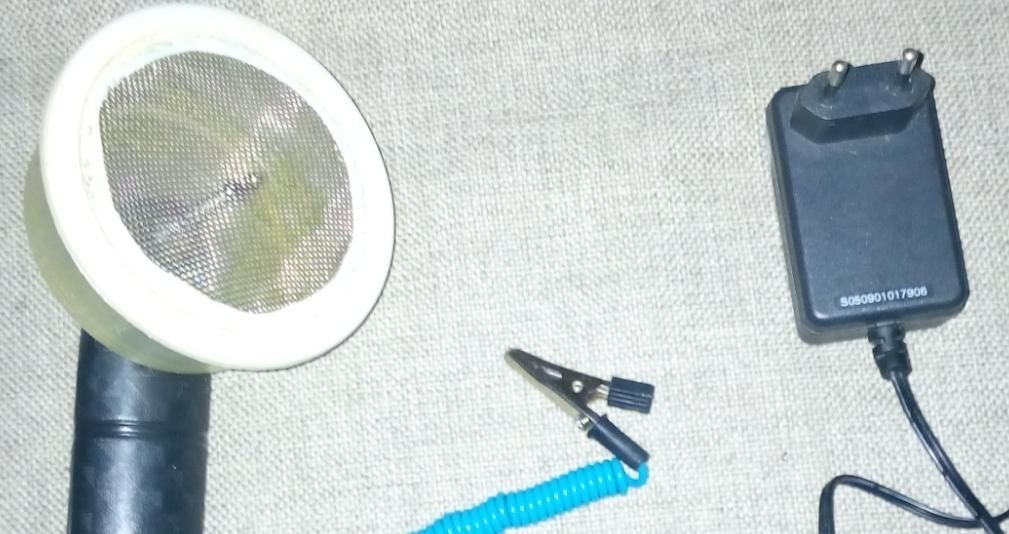
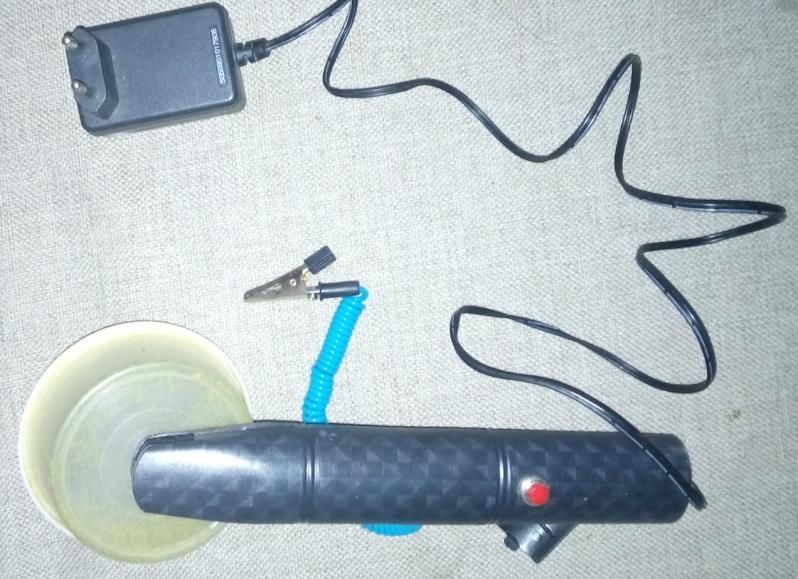
  • FLOCK, electric grass planter

    It's full of grilling time, and since I don't have a plot, and somehow not so much on the balcony, I have come up with my own little garden, so I sometimes decrease to the H0 scale 87 times.
    I present an electrostatic grass planter for mock-ups.
    If you prefer - a flocking machine for car upholstery.
    FLOCK, electric grass planter FLOCK, electric grass planter

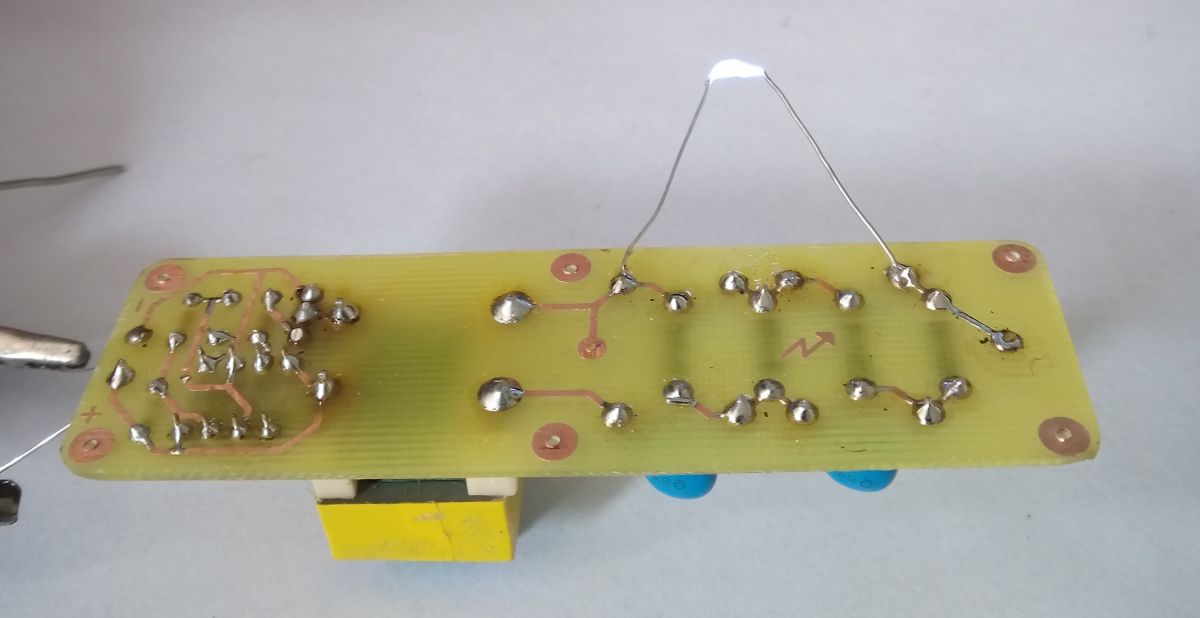
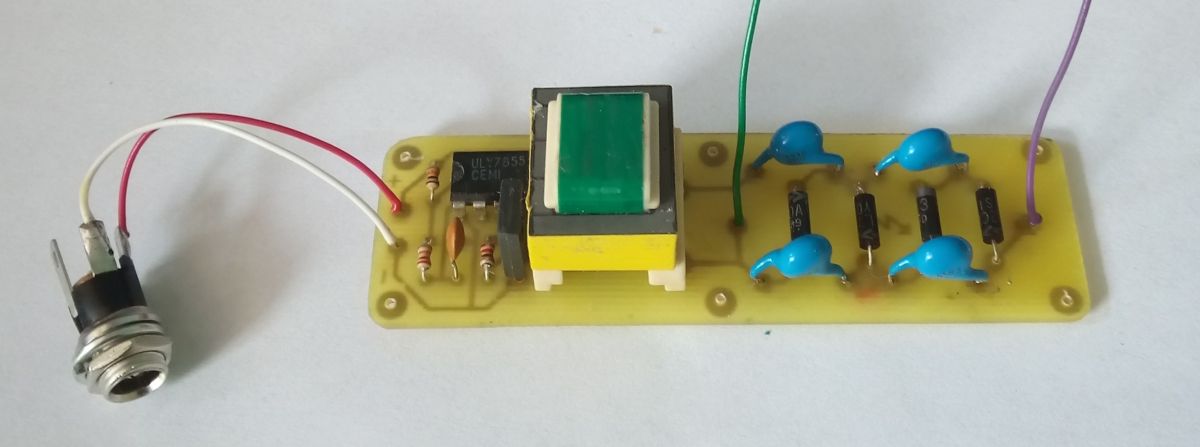
    The generator is NE555, frequency around 12kHz, duty cycle 60%.
    The WN trafko keying transistor - BD135, and the trafko comes from an HP printer (I don't remember the model, I think M15) Primary 3R secondary 4k.
    FLOCK, electric grass planter

    At 12V power supply, on the secondary side (without a duplicator) after full-wave rectification and smoothing with a capacitor, Sonel CMM10 showed 1.4kV.

    Next, a traditional duplicator on elements also removed from the printer.
    Cascade of 6kV / 5mA diodes and 3.3nF / 6kV capacitors
    At the end, a 100M resistor. Until you feel this wind of electrons :)
    FLOCK, electric grass planter
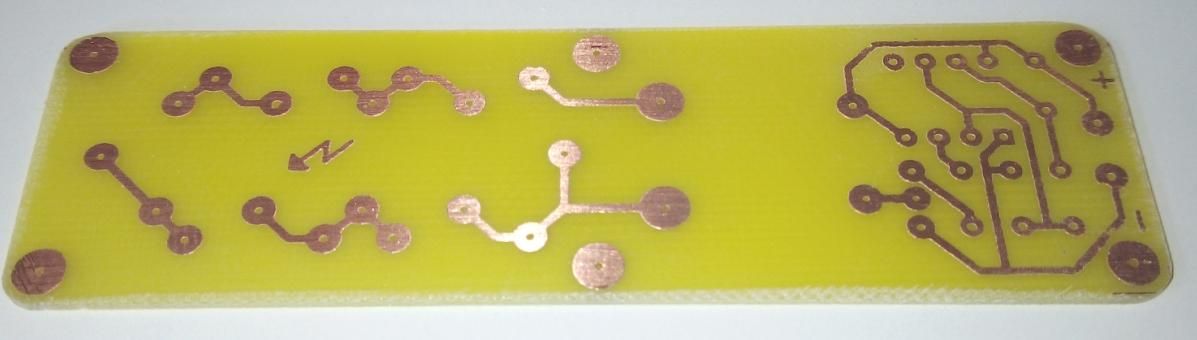
    Tile - Thermal Transfer.
    FLOCK, electric grass planter

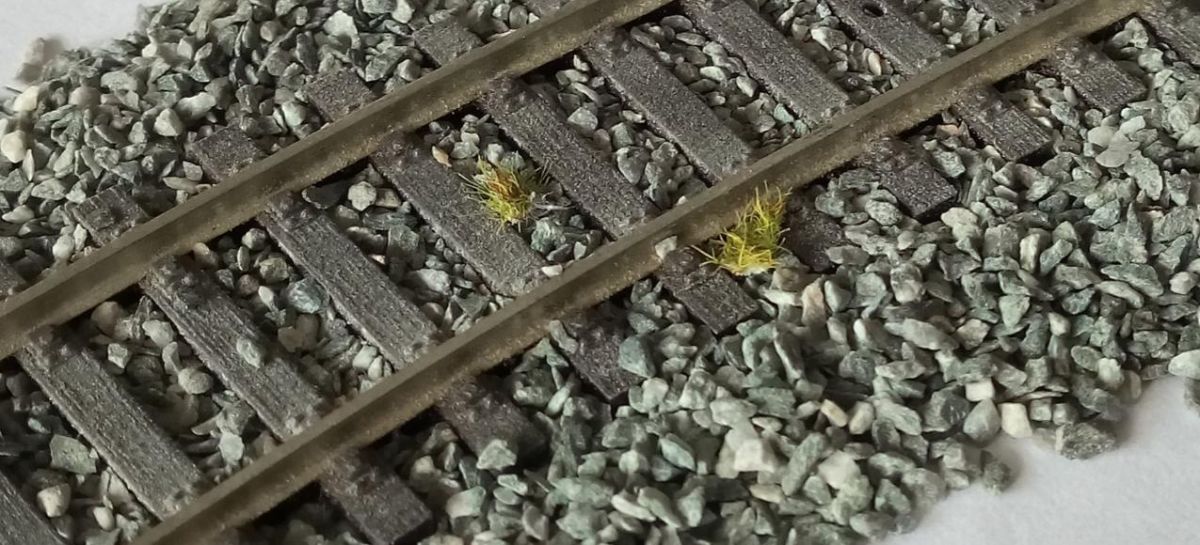
    And these are the effects:
    FLOCK, electric grass planter FLOCK, electric grass planter

    Cool? Ranking DIY
    About Author
    Justyniunia
    Level 36  
    Offline 
    Justyniunia wrote 4188 posts with rating 1318, helped 396 times. Live in city Kłodzko. Been with us since 2012 year.
  • ADVERTISEMENT
  • #2 19489148
    398216 Usunięty
    Level 43  
    Posts: 34016
    Help: 3914
    Rate: 9190
    In my time, grass was made of sawdust painted green with a poster ... (after "planting" of course).
    There was also a nice way to make cobblestones, bricks, etc. surfaces - you put a piece of tulle on an element with a texture (white or gray-brown depending on your needs) and painted it with a poster (you also have to choose the color depending on your requirements). on the surface with a brush so that the tulle does not wrinkle and sticks evenly to the substrate. After painting, one waited a while and ... the tulle was torn off, leaving the paint to dry. Better than any other patent, but it took practice.
    This is about modeling (and therefore indirectly planting grass) ... :)
    Coming back to the point: I hope that the tile, after being washed from flux remnants, is painted with insulating varnish on the print side? In a similar way (voltage multiplier) I used to make a power supply for a school laser. After some time without the varnish, there were beautiful short circuits / punctures on the laminate surface ... the voltage was "slightly" higher there, but ... it's better to be safe than sorry?
  • ADVERTISEMENT
  • #3 19489172
    satanistik
    Level 27  
    Posts: 1930
    Help: 61
    Rate: 759
    Maybe a colleague describe what the WN generator has for grass in modeling? Because not everyone is so interested in it and there is no movie / description.
  • #4 19489228
    Justyniunia
    Level 36  
    Posts: 4188
    Help: 396
    Rate: 1318
    I suggest you read about the Flock technique.
    This weed is a textile shearing. It is applied by means of an electric field to a surface covered with an adhesive.
    The fibers are attracted and electrified, they elegantly protrude like real grass. (Photos are weak, because the length of my hair is 2.5mm)

    The photo shows the prototype, in the device the board ends with the transformer, and the multiplier is separate, in a long spider, so that nothing touches the tips unnecessarily and is covered with varnish.

    During the tests, there was also a 10-degree duplicator, but it was already shooting between the tips of the elements and the edge of the plate. Anyway, single kV is enough to obtain a suitable field for "planting" weed.

    This is first about security, secondly:
    There is no need to overdo the voltage if we power the device from the AC adapter.
    Such a power supply also has a finite isolation between the primary and secondary sides, which is very easy to break when playing with LV. I prefer not to think about what might happen.
  • #5 19489488
    szymon122
    Level 38  
    Posts: 4085
    Help: 302
    Rate: 754
    Can I ask for a diagram out of curiosity?
    I do not have much in common with modeling that does not fly, but it occurred to me whether this type of device is not suitable for powder coating.
  • #6 19489581
    Justyniunia
    Level 36  
    Posts: 4188
    Help: 396
    Rate: 1318
    Please
    FLOCK, electric grass planter
  • #7 19489627
    ArturAVS
    Moderator
    Posts: 26009
    Help: 2294
    Rate: 7711
    Maybe for this particular 555 application it is irrelevant but a decoupling capacitor between pin 5 and ground is recommended.
  • #8 19490009
    Justyniunia
    Level 36  
    Posts: 4188
    Help: 396
    Rate: 1318
    Yes, input 5 should go through the capacitor to ground.
    It does not really matter here, at most the parameters will float a little.
    In some 555s you do not need to connect the 4, because it is pulled up inside to the plus, and some will not move without the plus on the 4 tip, such a curiosity.
  • ADVERTISEMENT
  • #9 19490043
    ArturAVS
    Moderator
    Posts: 26009
    Help: 2294
    Rate: 7711
    Justyniunia wrote:
    In some 555s you do not need to connect 4, because it is pulled up inside to the plus

    Oh look! I have never found one like this and the 555 is such a universal system that I always have a dozen new ones in stock (THT and SMD from different manufacturers).
  • #10 19490052
    Justyniunia
    Level 36  
    Posts: 4188
    Help: 396
    Rate: 1318
    Once, while making a colleague's board, I forgot to connect 4 to vcc on the PCB, he noticed this error, but it turned out that the system worked without any problems. He was also not sensitive to touching the 4th finger or trying to stick his finger to the gnd. I suspect some production error (as it used to be in Atmega8), or there are indeed different versions.
  • #11 19490246
    ArturAVS
    Moderator
    Posts: 26009
    Help: 2294
    Rate: 7711
    Justyniunia wrote:
    I came up with my own little garden, so I decrease sometimes 87 times to the H0 scale

    I am curious what this garden looks like :D . I would like to play in H0 or something similar, but the area of the premises does not allow :-( .

    Justyniunia wrote:
    He was also not sensitive to touching the 4th finger or trying to stick his finger to the gnd. I suspect some error during production (as it used to be in Atmega8)

    Maybe it was the CMOS version and the ESD diode on the input was "beaten"?
  • #12 19490297
    398216 Usunięty
    Level 43  
    Posts: 34016
    Help: 3914
    Rate: 9190
    ArturAVS wrote:
    I would like to play in H0 or something similar, but the area of the premises does not allow
    Then you can choose between TT and N. I started to play with HO, then (for housing reasons) I switched to TT until ... and I cured myself from spending money on something that only gave me fun.
  • #13 19490385
    Justyniunia
    Level 36  
    Posts: 4188
    Help: 396
    Rate: 1318
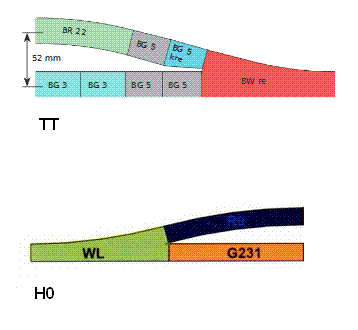
    I live in a block of flats, I wanted a TT, but look at the geometrical layouts of TT and H0 tracks.
    TT Tillig is a crazy dream.

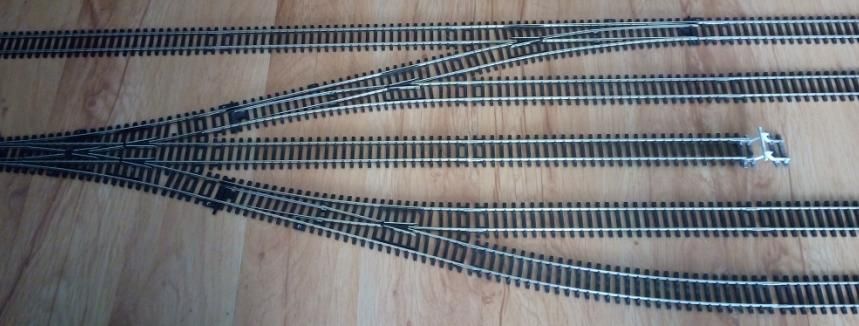
    Exit a parallel track from a turnout in the TT and H0 systems:

    FLOCK, electric grass planter

    Fortunately, someone has long ago invented modular models.
    Today, the mock-up is not one big plate that has nowhere to put in an apartment.
    The mock-up I want to build for my son will consist of three modules. Two station heads and a central section (6 parallel tracks).
    For this, a trail will be attached to both ends.
    After disassembling the station into 3 parts, everything will fit under the bed.


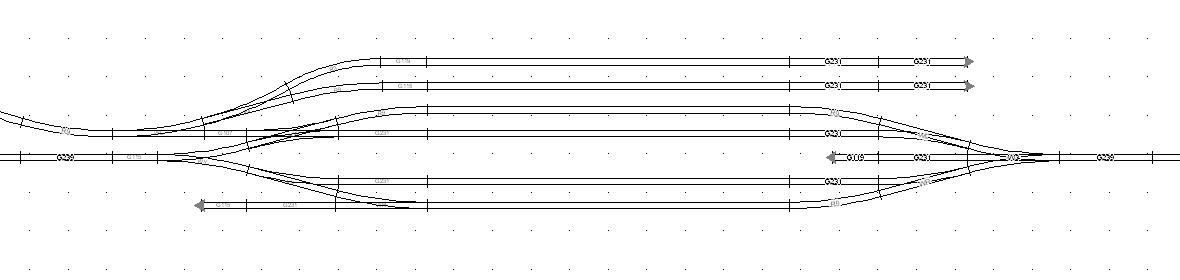
    For now, we are completing the materials, and to add a little flavor - this is how the track layout of one of the heads will look like.

    FLOCK, electric grass planter

    And here is the whole 2.5m long station (if nothing changes):

    FLOCK, electric grass planter

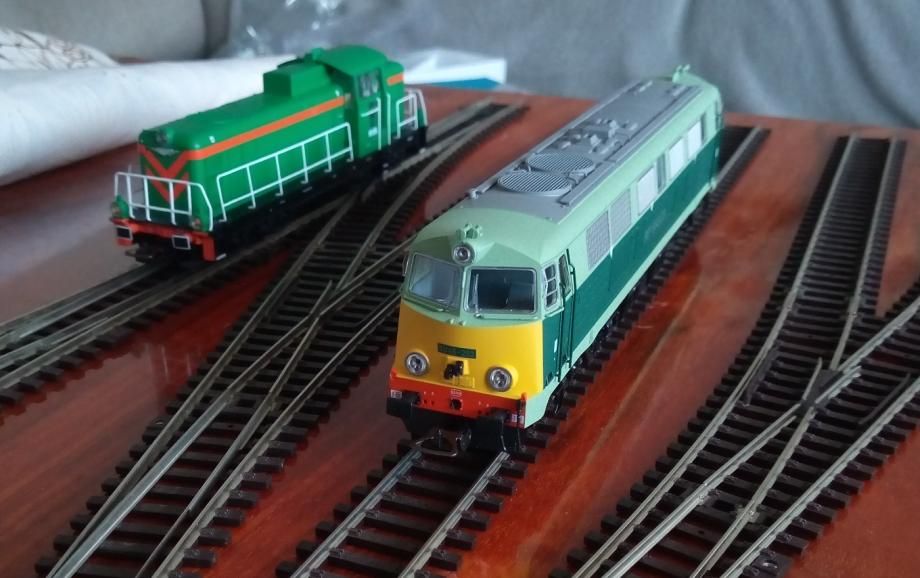
    And in TT there is not as much PKP rolling stock as in H0

    FLOCK, electric grass planter

    FLOCK, electric grass planter

    And here is the best combination of modeling and electronics

    FLOCK, electric grass planter

    FLOCK, electric grass planter

    https://youtu.be/WvooFKmj0i0

    https://youtu.be/kiMlWLpFuUw
  • ADVERTISEMENT
  • #14 19490631
    398216 Usunięty
    Level 43  
    Posts: 34016
    Help: 3914
    Rate: 9190
    Justyniunia wrote:
    There is not as much PKP rolling stock in TT as in H0
    One of the reasons I switched to the TT was the lack of a HO selection. And the price ... all of this resulted in the choice of the TT. N'ka was just a misunderstanding ... It's just that then the only source of obtaining rolling stock and tracks (not to mention the buildings) was CSH ... Now it is much easier to make a choice taking into account your own preferences than to be "doomed" to what is ...
  • #15 19490673
    Justyniunia
    Level 36  
    Posts: 4188
    Help: 396
    Rate: 1318
    A few years ago, with the help of one colleague from Poland, Piko produced the ST43 locomotive, it spread like hot cakes, today there are several, if not several, models of PKP locomotives in Piko's offer. Unfortunately, you still have to drive in the TT under the DR or DB flag.
    There are one or two models from PKP 1: 120.

    The second thing is the smaller the scale, the bigger compromises you have to make by building anything yourself.

    Prices are similar (TT a bit more expensive), N is the cheapest, but switches and couplers look tragic, typical toy.
  • #16 19490898
    pikarel
    Level 39  
    Posts: 4960
    Help: 407
    Rate: 1821
    My friend Zdzich offers a variety of model making, which he produces himself:
    http://hulacki.com/sklepmodelarski/10-modele-kolejowe-h0
    Take a look, maybe you will like something from the offer, and the purchase of time-consuming trinkets - results in faster completion of the mock-up.

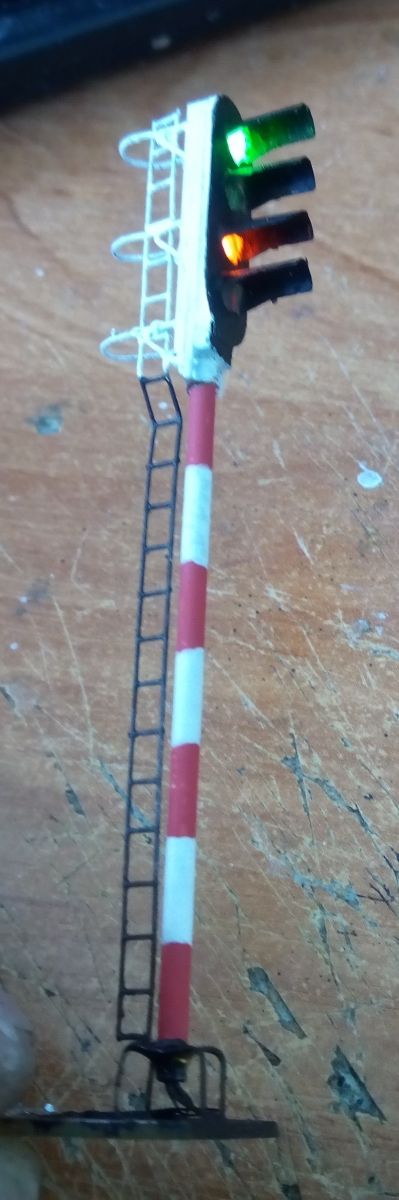
    The semaphore in the photo is probably even from Zdzich :)
  • #17 19490937
    Justyniunia
    Level 36  
    Posts: 4188
    Help: 396
    Rate: 1318
    Hello.
    Thank you, I know the products, hmm.
    Maybe yes:
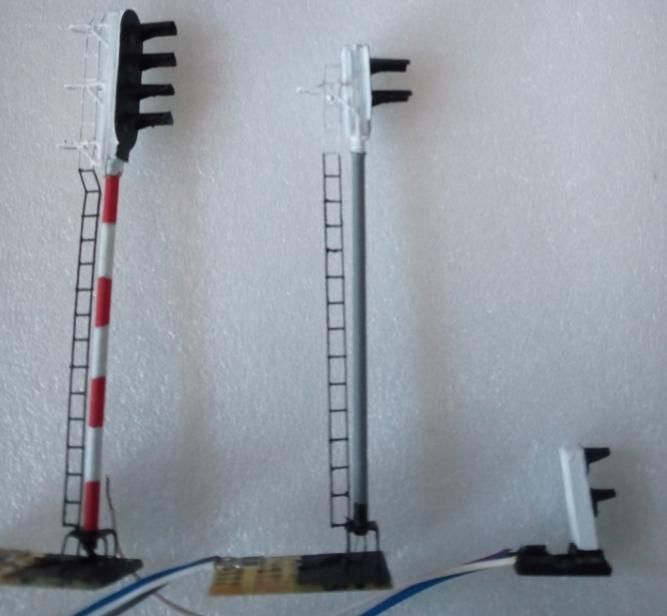
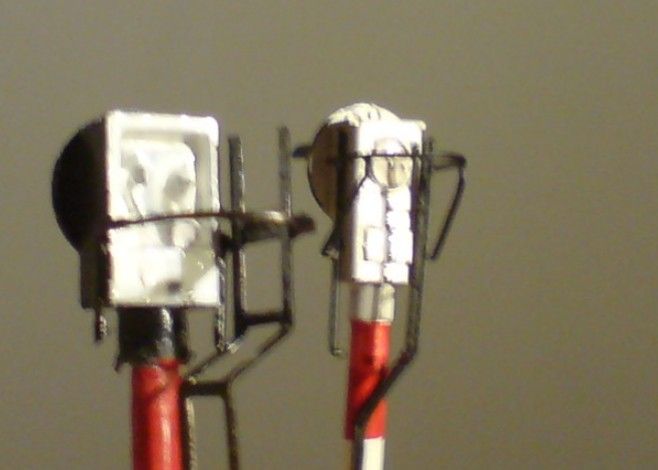
    On the right a semaphore in H0, on the left Hulacki ...

    FLOCK, electric grass planter

    You can choose from:
    Minikol - 3mm diodes stuck in a piece of metal plate
    Hulacki - 3mm LEDs stuck in a piece of plastic with a ladder
    Ostbahn - Signs for self-construction of a semaphore with SMD 0603 LEDs (about PLN 20, I buy these)
    Kluba - ready-made semaphores made of metal plates, the most realistic, but the price is> 100 PLN and the waiting time is several months.

    The order is not accidental.

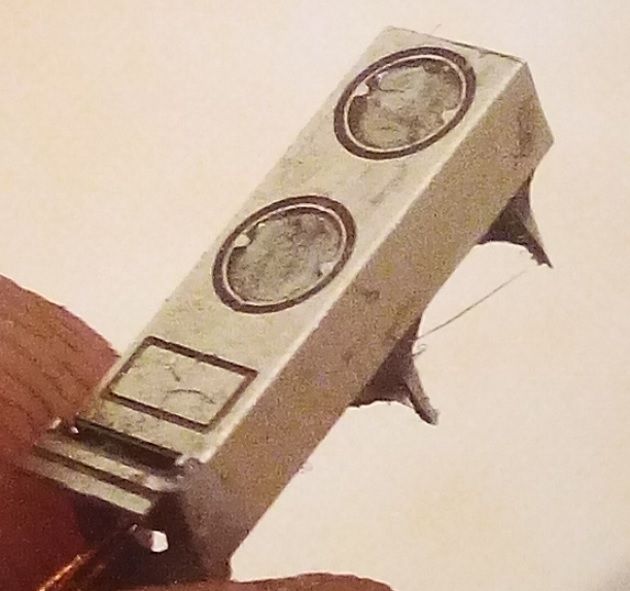
    This is what the Ostbahn dwarf maneuvering disc looks like when folded.
    The price is PLN 8 and a half hour of fun.

    There is no better alternative in terms of price and quality.

    FLOCK, electric grass planter
  • #18 19491425
    pikarel
    Level 39  
    Posts: 4960
    Help: 407
    Rate: 1821
    It's good that there is such a choice.
    A colleague designs these models himself, including molds for injection molding machines (I service the controllers, because some machines are quite old), so he chooses a compromise between the ideal and the technical capabilities of his machinery and / or the amount of work.

    There is such a thing in life; A perfectionist will not buy anything, because in his opinion each product has a hundred errors and he will "do it himself" and the modeller will buy what he thinks is appropriate, profitable or for another reason known to him.

    Electrostatically "putting" grass is a really good way to get realistic grass; I first read about it thirty years ago, when this method was used in a movie (I can't remember the title) to create landscape models.
    Now you can watch instructional videos on YT:
    https://youtu.be/8FWCD_MMD_M?t=427
  • #19 19491485
    Justyniunia
    Level 36  
    Posts: 4188
    Help: 396
    Rate: 1318
    Of course, each product has its own market and that's fine.
    There are many people among modelers who have no idea about electronics, for them assembling the semaphore by themselves is a piece of cake, but making it shine is black magic, and the kit comes with 0603 LEDs, no wires, nothing. I make LED plates and resistors for semaphores, e.g.
  • #20 19494192
    LEDówki
    Level 43  
    Posts: 9346
    Help: 1304
    Rate: 2524
    We sow the grass with a seeder. We plant with a planter. Trolls, let me remind you that we solder with a soldering iron and weld with a welder.
    Plus, this planter is pretty cool.
  • #21 19494227
    Justyniunia
    Level 36  
    Posts: 4188
    Help: 396
    Rate: 1318
    This grass is already "grown", so it is planted :)
    And because it is sifted through a sieve ... It's hard to define.
    "Elektrosadzarka" is the author's name.
    Someone invented it once and it has been functioning for a few years.
  • #22 19494235
    LEDówki
    Level 43  
    Posts: 9346
    Help: 1304
    Rate: 2524
    And the topic about sowing with an electric planter ...
  • #23 19494263
    Justyniunia
    Level 36  
    Posts: 4188
    Help: 396
    Rate: 1318
    Because it is an electronic forum, not an agricultural forum :P

    As if there was "planting grass", a purebred troll would write that grass was not planted.
    Such clinging for the sake of clinging, and there is nobody to do ...
    It's yourself I sow with an electric plant .

    Coming back.
    - If the voltage is too high, the grass flies out of the filter in all directions.
    - WN polarization has no meaning.
    - The best effect (as in factory machines) is when the grass is between the electrodes. The tension is not on the strainer, but behind it.
📢 Listen (AI):

Topic summary

✨ The discussion revolves around the construction and functionality of an electrostatic grass planter, also referred to as a flocking machine, used for model landscaping. The device utilizes a NE555 generator operating at approximately 12kHz with a 60% duty cycle, and employs a BD135 transistor to drive a transformer sourced from an HP printer, producing high voltage (1.4kV) for electrostatic flocking. Participants share insights on the flocking technique, safety considerations regarding voltage levels, and the importance of proper circuit design, including the use of decoupling capacitors. The conversation also touches on model railroading scales, specifically H0 and TT, and the availability of model-making supplies.
Generated by the language model.

FAQ

TL;DR: A 12 V supply, NE555 at 12 kHz drives a printer fly-back to yield 1.4 kV DC, stepped to ~6 kV for “dense, upright grass in 2.5 mm length” [Elektroda, Justyniunia, post #19488854] “Single-kilovolt is enough” [Elektroda, Justyniunia, post #19489228] The design uses cheap printer parts and a six-stage Cockcroft-Walton multiplier.

Why it matters: Clean kilovolt fields lock fibres upright, saving hobbyists €50-€100 versus buying a commercial tool.

Quick Facts

• Drive signal: 12 kHz, 60 % duty cycle from NE555 [Elektroda, Justyniunia, post #19488854] • Raw HV: 1.4 kV DC at 12 V input, measured with Sonel CMM10 [Elektroda, Justyniunia, post #19488854] • Multiplier: 6-stage, 6 kV/5 mA diodes + 3.3 nF/6 kV capacitors [Elektroda, Justyniunia, post #19488854] • Commercial reference: Woodland Scenics Static King delivers ~15 kV, <0.5 mA (Product Sheet) • Safe gap: Coat PCB with insulating varnish to stop surface tracking above 4 kV [Elektroda, 398216, post #19489148]

What is an electrostatic grass planter and how does it work?

A planter (flocker) charges nylon or rayon fibres so they behave like tiny dipoles. A kilovolt field pulls each fibre perpendicular to a glue-coated surface, mimicking real grass [Elektroda, Justyniunia, post #19489228]

Which electronic parameters define the DIY unit in the thread?

The oscillator runs at 12 kHz with a 60 % duty cycle. A BD135 keys a printer fly-back that produces 1.4 kV DC, later multiplied to roughly 6 kV through a six-stage Cockcroft-Walton chain [Elektroda, Justyniunia, post #19488854]

Why choose an NE555 plus BD135?

The NE555 delivers a stable square wave and allows easy frequency adjustment. The BD135 handles the 200–300 mA primary current and withstands the transformer’s inductive spikes, keeping parts cost under €2 [Typical BD135 datasheet].

How much voltage do I actually need?

Fields above 1 kV already lift 2–3 mm fibres. Tests show ~6 kV gives dense coverage, while commercial units ship with 15 kV for 12 mm grass [Woodland Scenics, Static King]. “Single-kilovolt is enough” for H0 scenery [Elektroda, Justyniunia, post #19489228]

What happens if the voltage is too high?

Above ~8 kV, fibres blow off the sieve and static arcs form. With a 10-stage multiplier the author saw sparks between components—a classic edge-case failure [Elektroda, Justyniunia, post #19489228]

How should I insulate the multiplier board?

Wash off flux residues, dry thoroughly, then spray both sides with insulating varnish. Skipping this step leads to surface tracking and spectacular punctures, as seen in a school-laser PSU [Elektroda, 398216, post #19489148]

Can the same circuit work for DIY powder coating?

Yes, but coating needs 10–25 kV so you would add more stages and a current-limiting resistor. Ensure the gun, not the user, is at high potential to avoid dangerous shocks [OSHA, 2021].

Which decoupling capacitors are recommended for the NE555?

Place 100 nF from VCC to ground and 10 nF from pin 5 to ground. The latter stabilises threshold noise, even if the circuit appears to work without it [Elektroda, ArturAVS, post #19489627]

Is the 10-stage multiplier worth building?

No. It arced over at only 12 V input, damaging components. The six-stage version already delivers a stable 6 kV and cleaner fibres [Elektroda, Justyniunia, post #19489228]

What safety rules apply when playing with kilovolts?

  1. Power from an isolated wall adapter.
  2. Limit output current with ≥100 MΩ resistor.
  3. Never touch the sieve until fully discharged. A 5 mA shock can stop respiration [IEC 60479-1].

Quick 3-step guide: how to flock grass like the pros?

  1. Brush a thin PVA layer on the terrain.
  2. Fill the planter’s sieve, connect the ground clip to the glue zone.
  3. Hold the sieve 2–4 cm above and tap gently until coverage looks even. Let it dry, then vacuum excess. This 45-second routine copies factory machines [Elektroda, Justyniunia, post #19494263]
Generated by the language model.
ADVERTISEMENT