logo elektroda
logo elektroda
X
logo elektroda

How do I check the operability of the ESP32 cam? No blinking diode when power is applied

sediv 2214 14
ADVERTISEMENT
Treść została przetłumaczona polish » english Zobacz oryginalną wersję tematu
  • #1 19495150
    sediv
    Level 10  
    Posts: 106
    Rate: 1
    I purchased an esp32 cam on Aliexpress .I wanted to upload the software via arduino but there is a problem communicating with the esp32.I have a question how can I check if my esp is working. Shouldn't the diode blink when connecting power to the esp because it just doesn't blink at my place?
  • ADVERTISEMENT
  • #2 19495254
    Anonymous
    Level 1  
  • ADVERTISEMENT
  • #3 19495294
    sediv
    Level 10  
    Posts: 106
    Rate: 1
    I am trying to do the same as in this guide


    .
    But it pops up that an error occurred while loading the sketch. The message "A fatal error occurred : Failed to connect to ESP32 : Timed out waiting for packet header.". I bought the ESP along with an additional board.
  • #4 19495501
    Anonymous
    Level 1  
  • #5 19495592
    sediv
    Level 10  
    Posts: 106
    Rate: 1
    I have purchased such a set https://pl.aliexpress.com/item/1005002830253996.html?spm=a2g0o.productlist.0.0.5bed3503Zbd6FD&algo_pvid=ecf02b98-a050-40d2-9a01-7b5d2722b1d0&algo_exp_id=ecf02b98-a050-40d2-9a01-7b5d2722b1d0-2 .I am trying to upload the software via the cp2102 converter.The converter works well because today I changed the software in the sonoff and there was no problem.
  • ADVERTISEMENT
  • #6 19495609
    Anonymous
    Level 1  
  • #7 19495613
    sediv
    Level 10  
    Posts: 106
    Rate: 1
    Yes, of course.
  • #8 19495615
    Anonymous
    Level 1  
  • #9 19495624
    sediv
    Level 10  
    Posts: 106
    Rate: 1
    This is how it is powered from the converter.
  • #10 19495690
    Anonymous
    Level 1  
  • #11 19495755
    sediv
    Level 10  
    Posts: 106
    Rate: 1
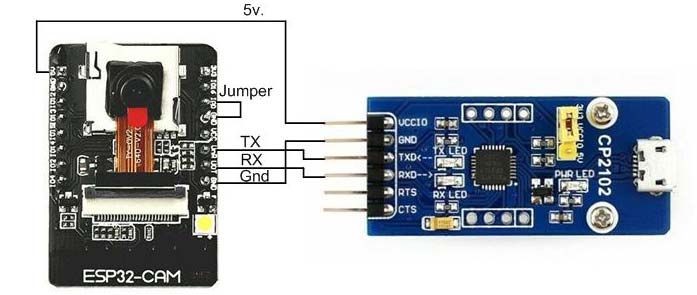
    I connected as above in the picture and there is the same error. I did not use the included converter because I used the instructions from youtube. Secondly my computer does not see this converter I think drivers are needed. I repeat the question, shouldn't the LED in the ESP32 at least blink when plugged in ?
  • #12 19495781
    Anonymous
    Level 1  
  • #13 19495959
    sediv
    Level 10  
    Posts: 106
    Rate: 1
    One thing cleared up the comp did not see this converter because I had the wrong usb cable. Now it goes to flash this esp a but after uploading it pops up bushes and underneath them that the detected camera is not supported and the camera probe failed with error 0x20004.I searched on the internet some help by switching the power supply from 3.3 to 5v others helped by adding // before #define CAMERA_MODEL_WROVER_KIT when I did that it was even worse .Also I have no idea where the error is.
  • ADVERTISEMENT
  • #14 19497082
    Anonymous
    Level 1  
  • #15 19497563
    sediv
    Level 10  
    Posts: 106
    Rate: 1
    Been combining all day and nothing. I uninstalled the Arduino then uploaded again and the problem was installing the esp32 board error
    java.lang.nullpointerexception. I installed the latest version I did as in the description from this link and a compilation error pops up for the dev module board . It pops up : Unused, shows path to libraries/wifi exit status 1.

Topic summary

✨ The discussion revolves around troubleshooting an ESP32-CAM purchased from Aliexpress, specifically addressing issues with uploading software via Arduino and the absence of LED blinking upon power application. The user encountered a "Failed to connect to ESP32: Timed out waiting for packet header" error, indicating potential connectivity problems. Suggestions included ensuring the correct wiring with a CP2102 USB/UART converter and pressing the BOOT/FLASH button before uploading. The LED behavior was clarified, noting it is connected to GPIO 33 and does not indicate power status. The user later resolved a driver issue with the converter but faced new errors related to camera support and compilation issues in the Arduino IDE.
Generated by the language model.

FAQ

TL;DR: ESP32‑CAM upload failures are often simple: 90% of “Failed to connect…” cases are wiring/boot‑mode issues—“90% of cases indicate connectivity problems.” Hold BOOT (IO0) low, reset, and retry at 115200 baud. [Elektroda, khoam, post #19495501] Why it matters: This FAQ helps makers quickly diagnose ESP32‑CAM power‑up, flashing, and camera errors so they can stream video fast.

Quick facts:

  • The onboard LED isn’t a power indicator; it’s tied to GPIO33 and only lights if firmware drives it. [Elektroda, khoam, post #19495781]
  • Bootloader mode requires GPIO0 low plus reset; it resolves most “timed out waiting for packet header” errors. [esptool Troubleshooting]
  • Use a stable 5V supply; many streaming issues vanish with a dedicated 5V/2A source. [ESP32‑CAM Video Streaming Web Server]
  • The kit’s USB‑UART often uses CH340; install the CH341SER driver if Windows doesn’t detect it. [CH341SER driver]
  • For Arduino IDE, select “AI Thinker ESP32‑CAM,” enable PSRAM, and use 115200 baud. [ESP32‑CAM Video Streaming Web Server]

Quick Facts

  • The onboard LED isn’t a power indicator; it’s tied to GPIO33 and only lights if firmware drives it. [Elektroda, khoam, post #19495781]
  • Bootloader mode requires GPIO0 low plus reset; it resolves most “timed out waiting for packet header” errors. [esptool Troubleshooting]
  • Use a stable 5V supply; many streaming issues vanish with a dedicated 5V/2A source. [ESP32‑CAM Video Streaming Web Server]
  • The kit’s USB‑UART often uses CH340; install the CH341SER driver if Windows doesn’t detect it. [CH341SER driver]
  • For Arduino IDE, select “AI Thinker ESP32‑CAM,” enable PSRAM, and use 115200 baud. [ESP32‑CAM Video Streaming Web Server]

Should the ESP32‑CAM LED blink when I power it?

No. That LED connects to GPIO33 and isn’t a power indicator. It only blinks if your firmware toggles it. “It is therefore not a voltage indicator.” If you see no blink, that doesn’t prove failure. Upload a blink sketch targeting GPIO33 to test it. [Elektroda, khoam, post #19495781]

How do I fix “Failed to connect to ESP32: Timed out waiting for packet header”?

Enter the bootloader by holding BOOT (GPIO0 low) and resetting EN. Verify TX↔RX, GND, and 5V wiring. Use 115200 upload speed and the correct COM port. Release BOOT after the tool starts connecting. This resolves most connection timeouts. [esptool Troubleshooting]

How do I wire a CP2102 to an ESP32‑CAM for flashing?

Connect 5V→5V, GND→GND, CP2102 TXD→U0R (RX), CP2102 RXD→U0T (TX). Pull IO0 to GND during upload to enter boot mode. After flashing, remove IO0‑GND and press RST/EN. Use a good USB data cable. [ESP32‑CAM Video Streaming Web Server]

Can I power the ESP32‑CAM from the adapter’s 3.3V pin?

Avoid it. Many USB‑UART 3.3V rails cannot supply the ESP32‑CAM’s peak current. Feed the board’s 5V pin from a stable source; 5V/2A is recommended for reliable streaming. This prevents brownouts and camera init failures. [ESP32‑CAM Video Streaming Web Server]

My PC doesn’t detect the included USB‑UART board. What driver do I need?

Most ESP32‑CAM kits ship with a CH340 USB‑UART. Install the CH341SER driver, then reconnect with a known good data cable. A new COM port should appear in Device Manager afterward. [CH341SER driver]

What camera model should I select in code?

For AI‑Thinker modules, set #define CAMERA_MODEL_AI_THINKER and comment out others. Enable PSRAM in the Arduino IDE board settings. Rebuild and upload again. Incorrect model definitions cause camera probe failures. [ESP32‑CAM Video Streaming Web Server]

I get “Camera init failed with error 0x20004” or “camera not supported.” How do I fix it?

Select the correct camera model in code, reseat the ribbon cable, and power from a solid 5V supply. Press RST after upload. If unstable, remove peripherals and try again. Wrong model or weak power often triggers 0x20004. [ESP32‑CAM Video Streaming Web Server]

Which Arduino IDE settings work best for ESP32‑CAM?

Choose Board: AI Thinker ESP32‑CAM. Set Upload Speed: 115200, Flash Mode: QIO, Partition Scheme: Huge APP, and PSRAM: Enabled. Open Serial Monitor at 115200 after reset. These settings match the common streaming example. [ESP32‑CAM Video Streaming Web Server]

Do I need to press BOOT to upload? How exactly?

Yes, unless your adapter auto‑toggles. How‑To:
  1. Hold BOOT (tie IO0 to GND).
  2. Tap RST/EN to reset.
  3. Start upload; release BOOT when “Connecting…” appears. Clones without BOOT require a manual IO0‑GND jumper. [esptool Troubleshooting]

Serial Monitor shows gibberish after flashing. What should I change?

Set Serial Monitor to 115200 baud and Newline mode. Press RST/EN to reboot the sketch. Mismatched baud causes unreadable characters. The example web server uses 115200 by default. [ESP32‑CAM Video Streaming Web Server]

Can I flash while the ESP32‑CAM is plugged into the kit’s converter/base board?

If you use an external CP2102, remove the ESP32‑CAM from the included converter. Two adapters on the same UART can conflict. Alternatively, use the kit’s converter alone with proper drivers. [Elektroda, khoam, post #19495690]

How do I clean‑install ESP32 board support in Arduino IDE?

Install “esp32 by Espressif Systems” via Boards Manager. If installation failed, close the IDE, delete the esp32 package folder, reopen the IDE, and reinstall. Then select the correct board and try compiling again. [Arduino‑ESP32 Installation]
Generated by the language model.
ADVERTISEMENT