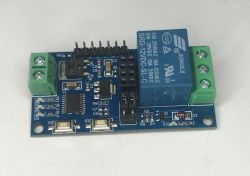
logo elektroda
logo elektroda
X
logo elektroda
Dostępna jest polska wersja

Czy wolisz polską wersję strony elektroda?

Nie, dziękuję Przekieruj mnie tam

[BK7231N - CBU] WD-01ADE Tuya water pump with WiFi - Unable to flash

drkbg 3852 16
ADVERTISEMENT
  • #1 20751807
    drkbg
    Level 4  

    1. So I am using CH340, connected RX, TX, 3v3, and GND.
    2. That blue diode stays solid for a second then goes blinking.
    3. I start the BK7231 GUI Simple Flasher.
    4. Choose the correct COM port, click on the flash firmware.
    5. I am asked to shorten GND and CEN.
    6. I shorten GND and CEN, and the blue diode goes off, goes solid on for a second, and then starts flashing again.
    7. The flasher still continues with prompting me to shorten CEN and GND.

    What am I doing wrong?
    I guess what happens with the diode means that I am succeeding in reboot?
    I also tried reversing TX and RX but no luck.

    Should I have the 3.3 external power supply also connected?
  • ADVERTISEMENT
  • #2 20751942
    p.kaczmarek2
    Moderator Smart Home
    Can you post a photo of the setup?
    drkbg wrote:

    5.I am asked to shorten GND and CEN

    It is better to do a power cycle then, disconnect and reconnect power ( reliable 3.3V), I do not even solder CEN
    Helpful post? Buy me a coffee.
  • #3 20752106
    drkbg
    Level 4  

    p.kaczmarek2 wrote:
    Can you post a photo of the setup?

    Will do later, as I already disconnected everything.

    p.kaczmarek2 wrote:

    It is better to do a power cycle then, disconnect and reconnect power (reliable 3.3V), I do not even solder CEN


    Does this mean that I should power the device via the power port to an external 3.3V additionally to 3.3V from the CH340?
  • #4 20752556
    p.kaczmarek2
    Moderator Smart Home
    I never power device directly from 3.3V of CH340. My CH340 dongle cannot provide enough current for programming to success. I always use external LDO, like AMS1117-3.3V.

    However, some people may have other USB to UART converters with better current capabilities.

    Have you seen our videos?
    https://www.youtube.com/@elektrodacom
    Helpful post? Buy me a coffee.
  • ADVERTISEMENT
  • #5 20752597
    drkbg
    Level 4  

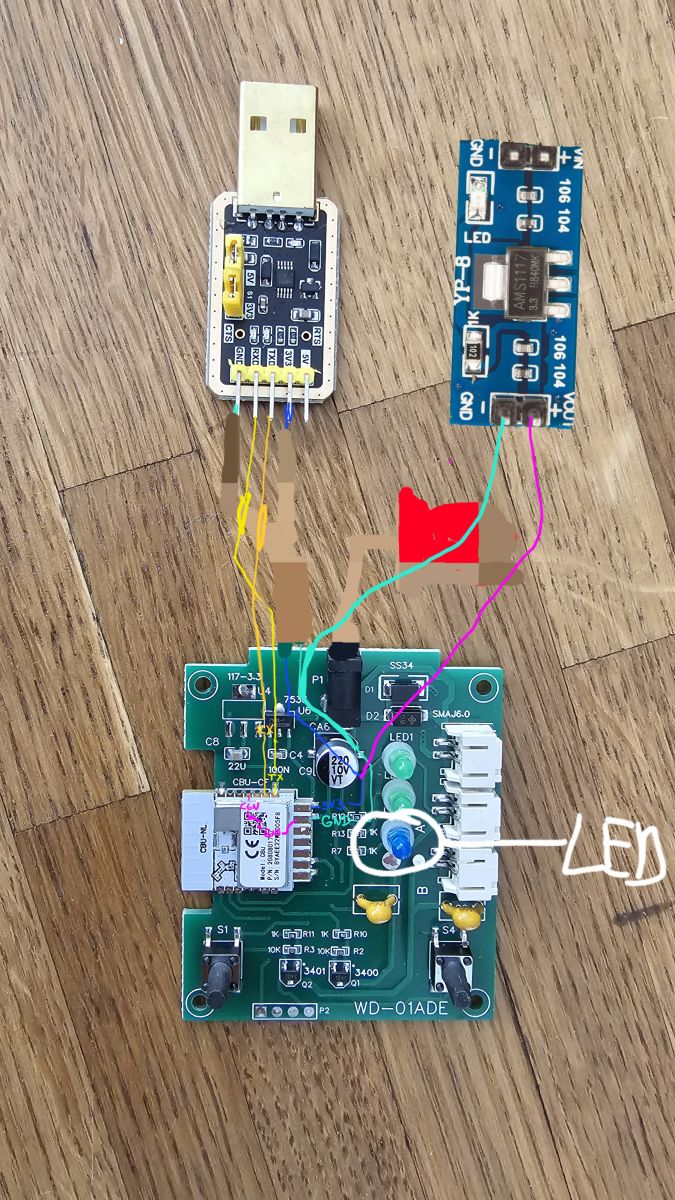
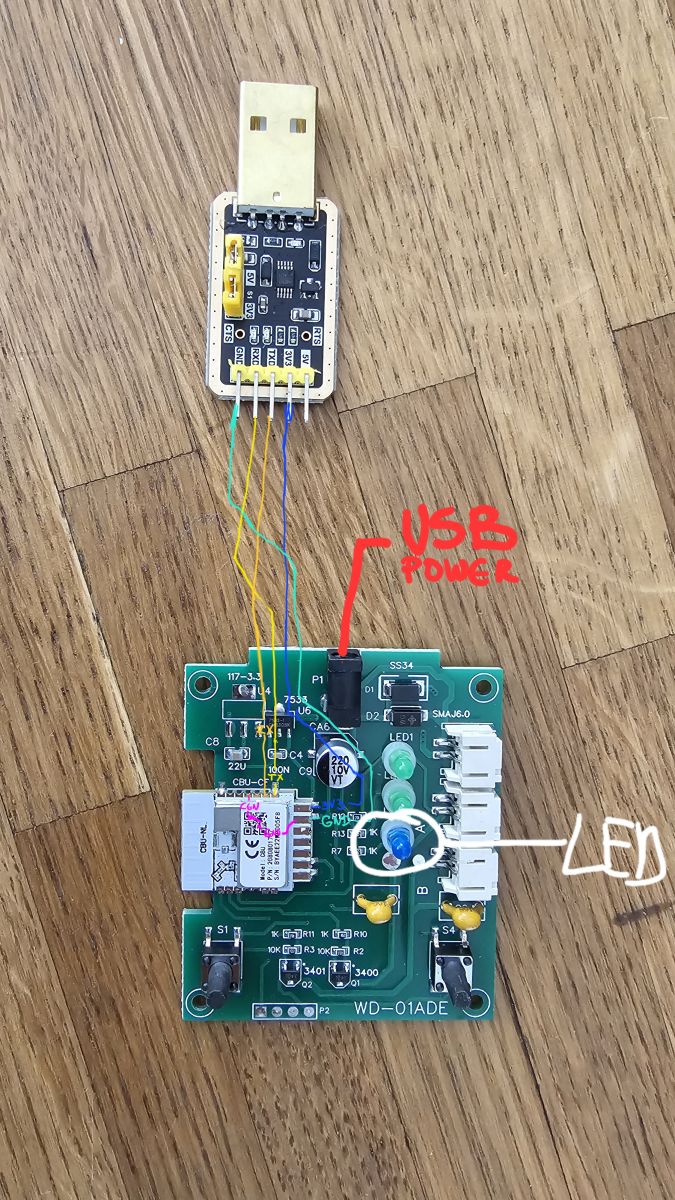
    The image shows a circuit board connected to a USB adapter using colored wires.

    My setup looks like this.

    So if I understand you correctly:
    1. I should not use the USB power connection during flashing.
    2. I should use something like AMS1117-3.3V to connect to the 3v3 and GND.

    At the end, it should look like this:

    Electronic connection setup using USB module, AMS1117, and PCB.
  • ADVERTISEMENT
  • Helpful post
    #6 20752646
    p.kaczmarek2
    Moderator Smart Home
    If this device has USB power, then the simplest way would be to:
    - connect GND, RX and TX from USB to UART converter
    - on USB to UART converter, connect VDD and 3.3V to select voltage levels 3.3V (at least on my USB to UART converter I need to do this, consult your own converter manual for more info)
    - connect power from USB as well
    - then, in flash tool, start flash, it will be doing "{getting bus" and waiting, while it waits, disconnect and connect power to the board, it should proceed with flashing

    The AMS1117-3.3V method is very universal, but if your board already has AMS1117-3.3V on board or any other 3.3V source, then you can just use that. Of course, it assumes that your board is not mains powered, because if it's mains powered and it has non-isolated power supply then you must never use this power supply while flashing, non-isolated power supplies ARE VERY DANGEROUS, you could fry your USB port
    Helpful post? Buy me a coffee.
  • #7 20755310
    drkbg
    Level 4  

    Thanks a lot for the guidance. Indeed, the following worked for me:

    - Connect CH340G: GND to GND, TX to RX and RX to TX
    - Connect CH340G to USB
    - Connect power of device to USB
    - Start flasher, select firmware
    - Click on backup and flash
    - Shorten CEN & GND for less than a sec
    - Flashing starts

    I had a problem with connecting to WiFi but found that toggling power 5-6 times will result in safe mode with AP turned on again.

    I use the autoexec from this thread.
    setChannelType 1 toggle
    setChannelLabel 1 "Pump A"
    setChannelType 2 toggle
    setChannelLabel 2 "Pump B"
    setStartValue 1 0
    setStartValue 2 0
    setPinRole 16 Rel
    setPinChannel 16 1
    setPinRole 14 Rel
    setPinChannel 14 2
    setPinRole 8 Btn_n
    setPinChannel 8 1
    setPinRole 7 Btn_n
    setPinChannel 7 2
    setPinRole 20 WifiLED


    For some reason, in Home Assistant only Pump A is shown as an entity connected to the Pump, but both appear as switches.

    Thanks a lot!
  • ADVERTISEMENT
  • #8 20755335
    p.kaczmarek2
    Moderator Smart Home
    Hey, can you also post YAML from Web App, so I can add this device to our teardowns list? Thanks!
    Helpful post? Buy me a coffee.
  • #9 20756133
    drkbg
    Level 4  

    Do you mean the template on the Config page of WebApp?
  • #10 20756421
    p.kaczmarek2
    Moderator Smart Home
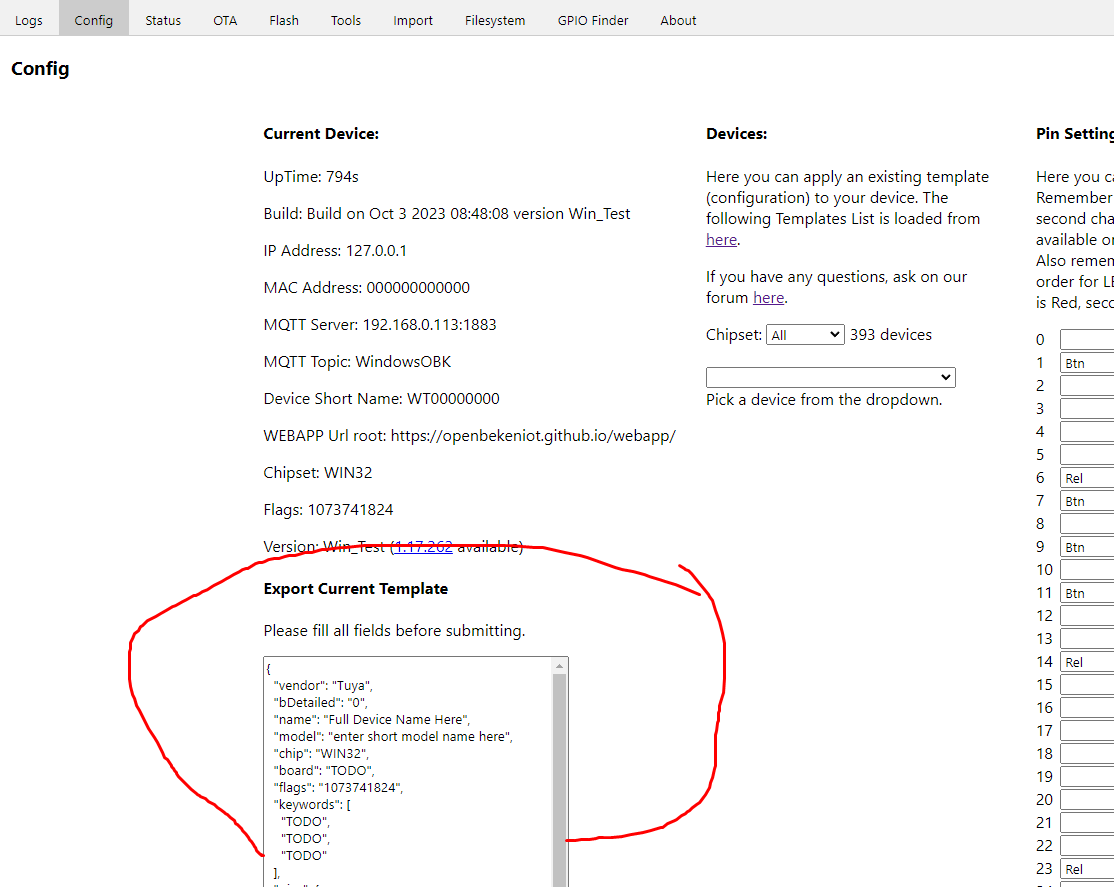
    Yes, that's what we use for devices list:
    Screenshot of a device configuration panel interface with a template export section.
    Helpful post? Buy me a coffee.
  • #11 20756665
    drkbg
    Level 4  
    There you go (I filled out some of the fields that were missing):

    {
      "vendor": "Tuya",
      "bDetailed": "0",
      "name": "WD-01ADE Tuya water pump with WiFi",
      "model": "WD-01ADE",
      "chip": "BK7231N",
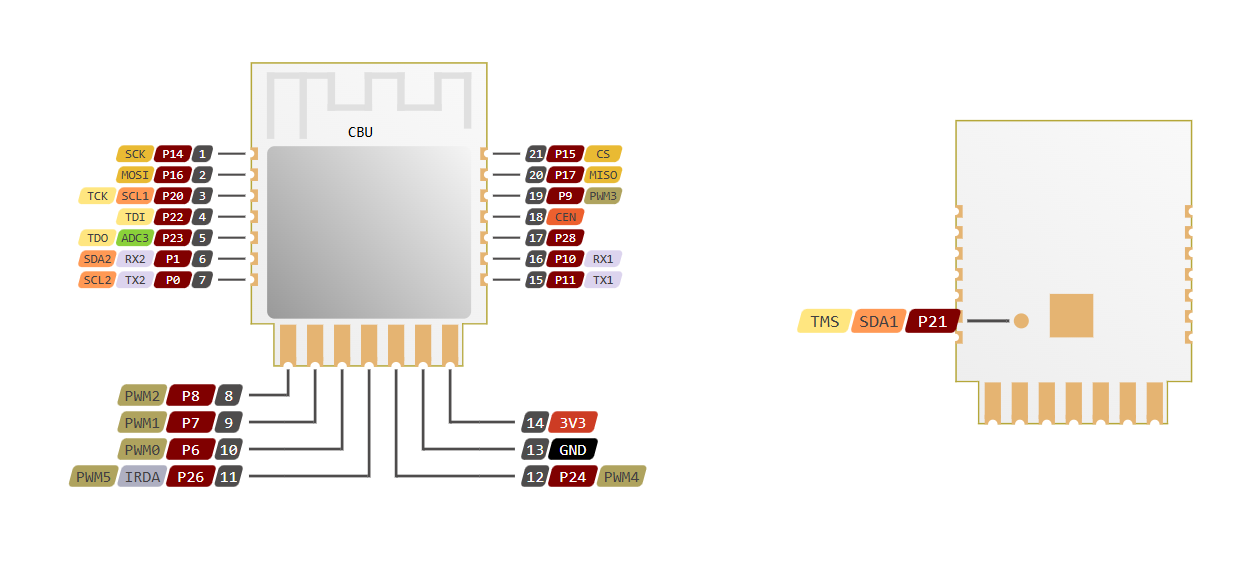
      "board": "CBU",
      "flags": "1024",
      "keywords": [
        "garden",
        "JOEKOL",
        "Irrigation"
      ],
      "pins": {
        "7": "Btn_n;2",
        "8": "Btn_n;1",
        "14": "Rel;2",
        "16": "Rel;1",
        "20": "WifiLED;0"
      },
      "command": "",
      "image": "https://obrazki.elektroda.pl/5341773600_1686167391.jpg",
      "wiki": "https://www.elektroda.com/rtvforum/topic3982582.html"
    }

    Not sure what the board is meant to be but most probably in that case the answer would be CBU-NL.

    I would suggest joining the two threads about this device https://www.elektroda.com/rtvforum/topic3982582.html and this one here.


    One more question about this device that I cannot find the answer in the forum:

    Buttons work, but you have to push them twice. I checked the logs (which are very talkative writing):
    
    Info:GEN:7 Button_OnLongPressHold
    Info:GEN:8 Button_OnLongPressHold
    Info:GEN:7 Button_OnLongPressHold
    Info:MAIN:Time 471, idle 183206/s, free 71880, MQTT 1(2), bWifi 1, secondsWithNoPing 1, socks 2/38 
    Info:GEN:8 Button_OnLongPressHold
    Info:GEN:7 Button_OnLongPressHold
    Info:GEN:8 Button_OnLongPressHold
    Info:GEN:7 Button_OnLongPressHold
    Info:GEN:8 Button_OnInitialPressDown
    Info:MAIN:Time 472, idle 198358/s, free 71880, MQTT 1(2), bWifi 1, secondsWithNoPing 1, socks 2/38 
    Info:GEN:7 Button_OnLongPressHold
    Info:GEN:7 Button_OnLongPressHold
    Info:GEN:8 Button_OnLongPressHoldStart
    Info:MAIN:Time 473, idle 190853/s, free 71880, MQTT 1(2), bWifi 1, secondsWithNoPing 1, socks 2/38 
    Info:GEN:7 Button_OnLongPressHold
    Info:GEN:8 Button_OnLongPressHold
    Info:GEN:7 Button_OnLongPressHold
    Info:GEN:8 Button_OnLongPressHold
    Info:MAIN:Time 474, idle 189577/s, free 71880, MQTT 1(2), bWifi 1, secondsWithNoPing 1, socks 2/38 
    Info:GEN:7 Button_OnLongPressHold
    Info:GEN:8 Button_OnLongPressHold
    Info:GEN:7 Button_OnLongPressHold
    Info:GEN:8 Button_OnLongPressHold
    Info:MAIN:Time 475, idle 191014/s, free 71880, MQTT 1(2), bWifi 1, secondsWithNoPing 1, socks 2/38 
    

    I believe the first push of the button is the
    Button_OnInitialPressDown
    and the second is
    Button_OnLongPressHoldStart

    1. Is it possible to use the Button_OnInitialPressDown event to start the pump?
    2. Why is this Button_OnLongPressHold constantly coming in the logs?
  • #12 20756732
    p.kaczmarek2
    Moderator Smart Home
    Why are you using Btn_n instead of Btn? Btn_n has inversed logic, and you most likely have just normal Buttons, so code thinks that Button is pressed all the time when it's not pressed in reality, that's why you get Button_OnLongPressHold spam..
    Helpful post? Buy me a coffee.
  • #13 20756809
    drkbg
    Level 4  

    That is a good question. Andy41 also asked the same one in the other thread.

    I guess this happens when you just copy paste stuff from the internet :)

    Will try without the _n and report.
  • #14 20756838
    p.kaczmarek2
    Moderator Smart Home
    So you haven't used our automatic GPIO extraction?


    Helpful post? Buy me a coffee.
  • #15 20757004
    drkbg
    Level 4  
    The one above doesn't work very well for me:

    When I use the "Extract Config from Tuya Binary" I get the following JSON:

    
    {
    	"abi": "0",
    	"id": "null",
    	"swv": "1.1.8",
    	"bv": "40.00",
    	"pv": "2.2",
    	"lpv": "3.4",
    	"pk": "key4rj5r4pv5wgwp",
    	"firmk": "null",
    	"cadv": "1.0.5",
    	"cdv": "1.0.0",
    	"dev_swv": "1.1.8",
    	"s_id": "null",
    	"dtp": "0",
    	"sync": "0",
    	"attr_num": "1",
    	"mst_tp_0": "9",
    	"mst_ver_0": "1.1.8",
    	"mst_md5_0": "null",
    	"mst_tp_1": "0",
    	"mst_ver_1": "null",
    	"mst_md5_1": "null",
    	"mst_tp_2": "0",
    	"mst_ver_2": "null",
    	"mst_md5_2": "null",
    	"mst_tp_3": "0",
    	"mst_ver_3": "null",
    	"mst_md5_3": "null }0EAtls_ca_cnt0)!Agw_wsm{nc_tp",
    	"ssid": "null",
    	"passwd": "null",
    	"md": "0",
    	"random": "0",
    	"wfb64": "1",
    	"stat": "0",
    	"token": "null",
    	"region": "null",
    	"reg_key": "null",
    	"dns_prio": "03Awf_start_md3uuid",
    	"psk_key": "blabla",
    	"auth_key": "blabla",
    	"ap_s{nc_tp": "1",
    	"ap_ssid": "SmartLife",
    	"ap_passwd": "null",
    	"country_code": "CN",
    	"bt_mac": "null",
    	"bt_hid": "null",
    	"prod_test": "false",
    	"fac_pin": "blabla",
    	"lckey": "null",
    	"h_url": "null",
    	"h_ip": "null",
    	"hs_url": "null",
    	"hs_ip": "null",
    	"hs_psk": "null",
    	"hs_psk_ip": "null",
    	"mqs_url": "null",
    	"mqs_ip": "null",
    	"mq_url": "null",
    	"mq_ip": "null",
    	"ai_sp": "null",
    	"ai_sp_ip": "null",
    	"mq_psk": "null",
    	"mq_psk_ip": "null",
    	"lp_url": "null",
    	"lp_ip": "null",
    	"time_z": "null",
    	"s_time_z": "null",
    	"wx_app_id": "null",
    	"wx_uuid": "null",
    	"dy_tls_m": "0",
    	"cloud_cap": "0",
    	"psk21_key": "null }eA000004sa7s[{type",
    	"mode": "rw",
    	"property": "{type",
    	"{type": "obj",
    	"{mode": "rw",
    	"type": "raw}",
    	"max": "86400",
    	"scale": "0",
    	"step": "1",
    	"maxlen": "255}",
    	"index": "0}{nc_tp",
    	"cnt": "0}EGAastro_timer{timestamp"
    }


    and the following text description:

    
    Sorry, no meaningful pins data found. This device may be TuyaMCU or a custom one with no Tuya config data.
    No module information found.
    And the Tuya section starts at UNCOMMON POSITION 0


    This results in following generated script in the WebApp:

    
    ClearIO // clear old GPIO/channels
    lfs_format // clear LFS
    StartupCommand ""  // clear STARTUP
    stopDriver *  // kill drivers


    I am pretty sure this is not what is expected.. so what is wrong?
  • #16 20757008
    p.kaczmarek2
    Moderator Smart Home
    Ah okay, this device is a custom one which has a hardcoded behaviour, there are no pins in JSON
    Helpful post? Buy me a coffee.

Topic summary

✨ The discussion revolves around flashing firmware onto the WD-01ADE Tuya water pump, which utilizes the BK7231N chip. The user encounters issues during the flashing process, specifically with the blue diode's behavior and the requirement to shorten GND and CEN. Responses suggest using an external power supply, such as an AMS1117-3.3V, instead of relying solely on the CH340's 3.3V output, as the latter may not provide sufficient current. The successful flashing procedure involves connecting the CH340G to the device, powering it via USB, and properly managing the GND and CEN connections. Additionally, the user shares their configuration for Home Assistant, noting issues with button logic that may stem from using incorrect GPIO settings.

FAQ

TL;DR: Wire CH340 at 3.3V, start the BK7231 flasher, then power‑cycle or briefly “Shorten CEN & GND”; 5–6 power toggles can restore AP safe mode. “Flashing starts” after that sequence. [Elektroda, drkbg, post #20755310]

Why it matters: This FAQ helps DIYers reliably flash WD-01ADE BK7231N pumps, avoid power pitfalls, and fix button/HA quirks.

Quick Facts

How do I flash the WD-01ADE (BK7231N CBU) with a CH340, step by step?

  • Wire GND, CH340 TX→module RX, CH340 RX→module TX; set converter to 3.3V logic.
  • Start the BK7231 GUI flasher and begin flashing; it will wait for the device.
  • While it waits, disconnect and reconnect power to the board to enter bootloader. This method removes the need to use CEN during flashing. [Elektroda, p.kaczmarek2, post #20752646]

Should I power the board from the CH340’s 3.3V pin?

No. Many CH340 dongles cannot supply enough current for a reliable flash. Use a separate 3.3V LDO regulator. “I never power device directly from 3.3V of CH340.” This improves stability and avoids brownouts during boot. [Elektroda, p.kaczmarek2, post #20752556]

Can I power the pump through its USB port while flashing?

Yes, if it’s a low‑voltage, isolated supply on the board. Connect only RX, TX, and GND from the UART and select 3.3V logic. Do not use a non‑isolated mains supply while flashing; it can damage the USB port. [Elektroda, p.kaczmarek2, post #20752646]

The flasher keeps asking me to short CEN to GND. How do I fix it?

Enter bootloader by power‑cycling instead. Start the flash, then disconnect and reconnect power. Ensure a reliable 3.3V source. You usually don’t need to wire CEN. “It is better to do a power cycle then.” [Elektroda, p.kaczmarek2, post #20751942]

Which UART pads should I use on this WD-01ADE board?

Use the TX1 and RX1 pads on the right side of the board. Some units won’t flash from the labeled programming pads. That pad choice was the key to a successful flash. [Elektroda, nifegovi, post #21625119]

My buttons require two presses and logs show Button_OnLongPressHold—what’s wrong?

You set buttons as Btn_n (active‑low) on a normal active‑high input. Switch pin roles to Btn, not Btn_n. “Btn_n has inversed logic.” This stops the long‑press spam and restores single‑press toggling. [Elektroda, p.kaczmarek2, post #20756732]

How do I map relays and the Wi‑Fi LED to GPIOs on WD-01ADE?

Use these roles: P16 as Relay channel 1 (Pump A), P14 as Relay channel 2 (Pump B), P20 as WifiLED. For buttons, P8 is Button channel 1 and P7 is Button channel 2. Label channels and set both ChannelType values to toggle. [Elektroda, drkbg, post #20756665]

Home Assistant shows only Pump A as the main entity—how can I control both pumps?

Users report only one primary device entity, but both pumps appear as switch entities. Control both via the two discovered switches. Ensure both channels are configured as toggle and labeled clearly for HA. [Elektroda, drkbg, post #20755310]

Wi‑Fi AP disappeared after flashing—how do I enter safe mode?

Power toggle the device 5–6 times to trigger safe mode. The access point will re‑enable for configuration. This recovery is handy after network misconfiguration or failed onboarding. [Elektroda, drkbg, post #20755310]

Why does “Extract Config from Tuya Binary” show no meaningful pins?

This device uses a custom, hardcoded behavior. The Tuya JSON lacks pin definitions, so the extractor can’t generate GPIO config. Configure pins manually in the WebApp. [Elektroda, p.kaczmarek2, post #20757008]

Do I need to cross RX and TX when wiring the CH340?

Yes. Connect CH340 TX to module RX, and CH340 RX to module TX. Also wire common GND. This cross‑connection is required for UART communication. [Elektroda, drkbg, post #20755310]

What LED behavior should I expect while resetting into flash mode?

Users report a blue LED that goes off, then solid for a second, then blinks. This indicates resets and boot attempts during the process. Continue until the flasher connects and starts. [Elektroda, drkbg, post #20751807]

Can I flash without soldering the CEN pin?

Yes. Use the power‑cycle method instead of pulling CEN low. “I do not even solder CEN.” Start the flash, then cycle power to enter the bootloader. [Elektroda, p.kaczmarek2, post #20751942]

What logic level should my USB‑to‑UART converter use?

Use 3.3V logic. On some adapters, link VDD to the 3.3V pin to select the correct level. Then connect RX, TX, and GND only. This prevents level‑mismatch issues during flashing. [Elektroda, p.kaczmarek2, post #20752646]
ADVERTISEMENT