logo elektroda
logo elektroda
X
logo elektroda
Dostępna jest polska wersja

Czy wolisz polską wersję strony elektroda?

Nie, dziękuję Przekieruj mnie tam

Configuring LSC Smart Outdoor Flood Light with OpenBeken: Managing BK7231N Chipset and RGBWW LEDs

vanderploegbas 6003 12
ADVERTISEMENT
  • #1 20797839
    vanderploegbas
    Level 2  

    Hi! In the last months, I've flashed numerous devices with OpenBeken, all with great success. Unfortunately, there is one problem I keep running into for some of them.

    In this example, I'll talk about the LSC Smart Outdoor Flood Light, sold at Action shops across Europe.
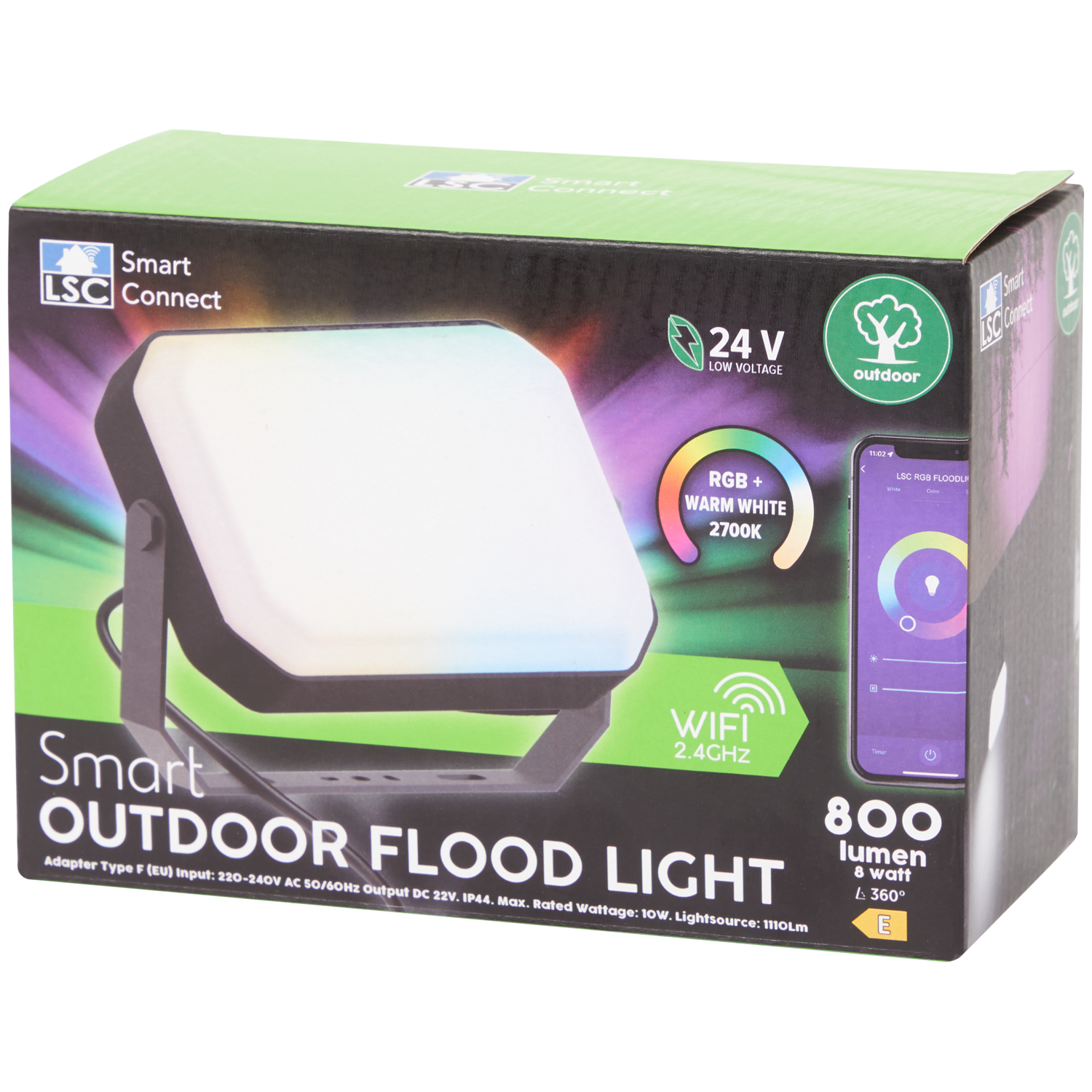
    Packaging of LSC smart outdoor flood light featuring RGB+Warm White.

    The light – which has the BK7231N chipset - was easy to flash using Tuya Cloudcutter.

    It features RGB and Warm White LEDs (RGBWW). And this is where my issue lies.

    I can't find a correct way to configure the light in OpenBeken.

    The LEDs are connected like this:


    RED = Pin 26 (PWM)
    GREEN = Pin 24 (PWM)
    BLUE = Pin 6 (PWM)
    WARM WHITE = Pin 7 (PWM)

    In this case, the Warm White is just a fixed color temperature, which is dimmable.

    The RGB configuration works flawlessly, but there seems to be no way to control the Warm White channel separately.

    I know about Flag 24, but that's not the way I expect the light to work. I don't want to create a cool white emulation. Instead, I expect the Warm White light to be controllable without the RGB lights.

    In short: no color temperature, just brightness control.

    Is there any way to get this done?

    I appreciate all the help I can get!
  • ADVERTISEMENT
  • #2 20801016
    p.kaczmarek2
    Moderator Smart Home
    I see, this must be the one of the rare cases where RGB + W mode is required. I will try to look into it. I must admit that I have flashed many, many devices with OBK but haven't encountered that kind of lamp yet.
    Helpful post? Buy me a coffee.
  • #3 20801028
    vanderploegbas
    Level 2  

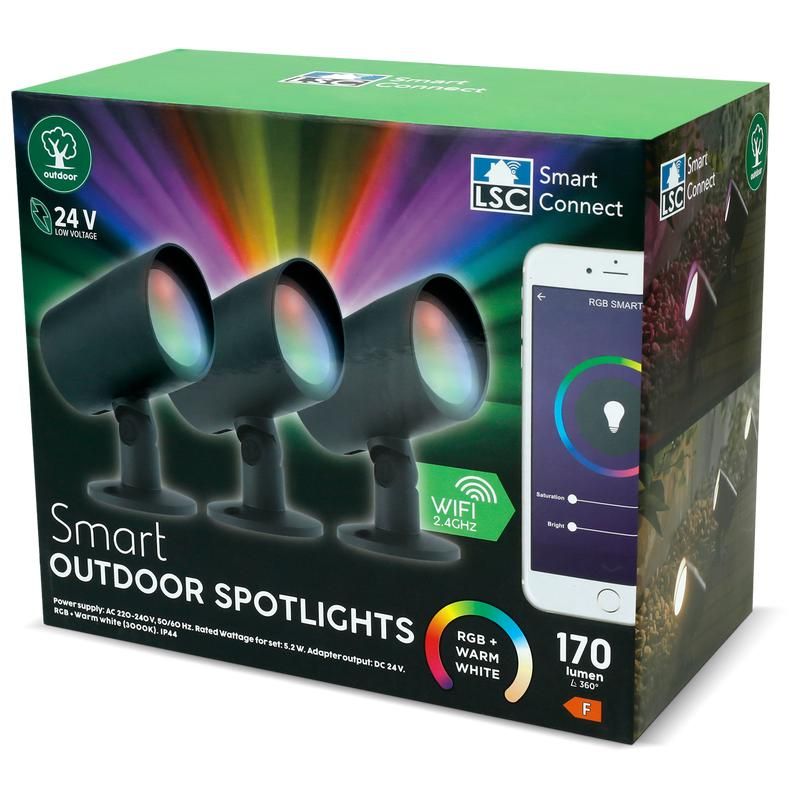
    I encountered the same with the LSC Smart Connect Outdoor Spotlights. They have the same LED configuration (RGB + Warm White).

    Colorful outdoor spotlights LSC Smart Connect on packaging.
  • ADVERTISEMENT
  • #4 20801045
    p.kaczmarek2
    Moderator Smart Home
    By the way, have you tried to just set a fifth PWM as a dummy? And then use it as RGBCW device but keep using one temperature mode?
    Helpful post? Buy me a coffee.
  • ADVERTISEMENT
  • #5 20801070
    vanderploegbas
    Level 2  

    Out of all the configuration combinations that I've tested, I didn't try that.

    That is indeed giving me the ability to control the warm white LEDs. The LED Temperature Slider now lets me control the brightness level of the white light. Thanks! 😄

    It would be nice to have a correct slider though. Also for integration in Home Assistant.
  • #6 20828895
    alfakenzo
    Level 9  

    @p.kaczmarek2, can you please add this device to the list for better support in the templates? Thanks.
  • #7 20828909
    p.kaczmarek2
    Moderator Smart Home
    I can make an entry but I don't even have a model number, do you have one, @alfakenzo ?
    or a config extracted that way https://www.youtube.com/watch?v=WunlqIMAdgw&ab_channel=Elektrodacom
    Helpful post? Buy me a coffee.
  • ADVERTISEMENT
  • Helpful post
    #8 20830326
    alfakenzo
    Level 9  
    Yes, I have all you need. LSC Smart Connect 3200719 Outdoor Flood Light RGB+WW.
    The JSON
    Code: JSON
    Log in, to see the code


    and the Template I use and it works.

    Code: JSON
    Log in, to see the code
  • #9 20967079
    HumbleDeer
    Level 4  

    I have this light apart.

    Disassembly was destructive in nature, so I don't recommend opening it up unless you have other plans (like I do).

    The exact module used is the CB2L, the same one as in the outdoor spotlights formerly mentioned. I took those apart a year or so ago and posted a teardown on here.

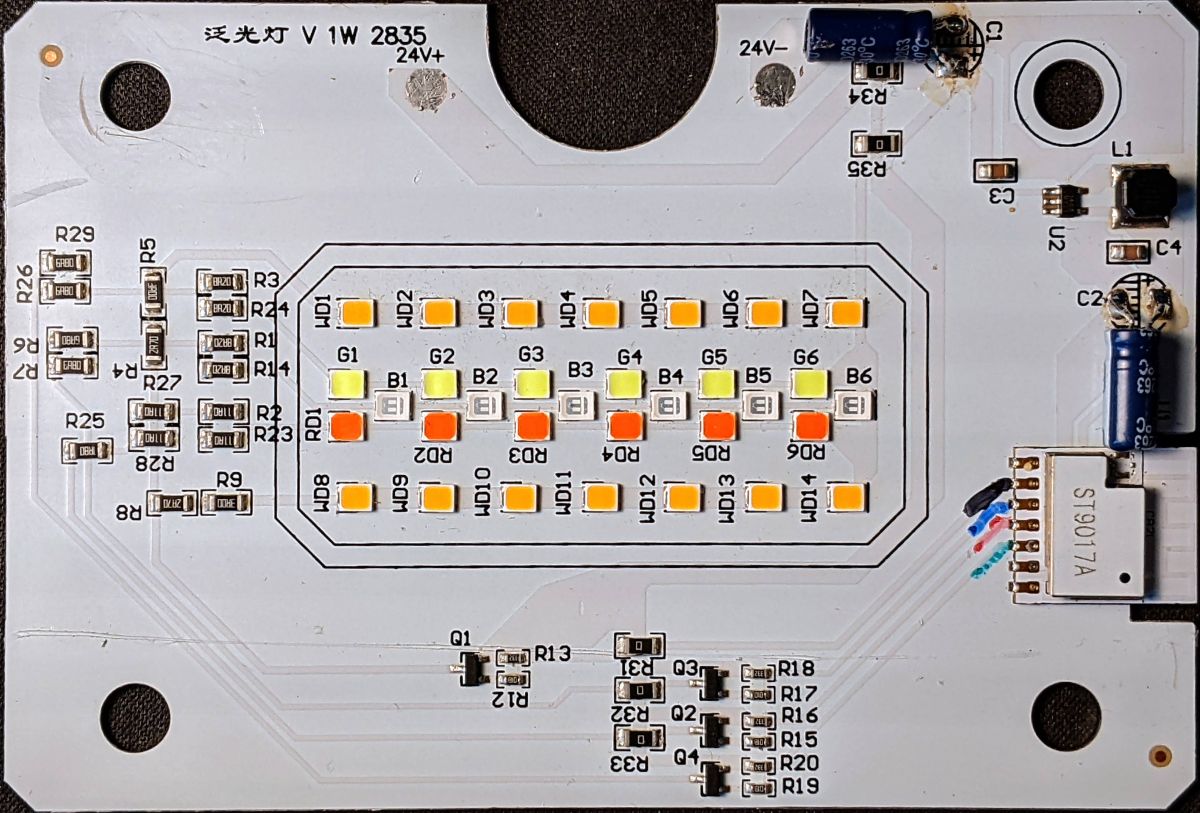
    Component-wise:
    - CB2L module, flat on its back
    - local step-down regulator for the logic control
    - 24V input
    - 2835 LED's
    - AO3400 N-channel MOSFETs
    - LED's:
    - Warm white: 2 parallel strings of 7 in series
    - Red: 6 in series
    - Green: 6 in series
    - Blue: 6 in series
    - PWM lines:
    - Warm white: PWM1 (P7)
    - Red: PWM5 (P26)
    - Green: PWM4 (P24)
    - Blue: PWM0 (P6)

    Circuit board with a light module, LEDs, and electronic components.
  • #10 21322721
    voske15
    Level 2  
    Hi all!

    I picked up a few lights at Action a few weeks back, and they flashed easily. But I had some issues getting the light to register correctly in Home Assistant using the template from the teardowns database. (No light was created, only the telemetry.) It seems that enabling flag 24 to emulate a cool white channel does the trick, but this requires a slightly different channel order.

    So, the final template that works for me is:
    Code: JSON
    Log in, to see the code

    Hope it helps someone!
  • #11 21323170
    divadiow
    Level 38  
    >>21322721

    did you Cloudcutter flash? If not and you managed to take a backup of the Tuya factory firmware, please feel free to post it.
  • #12 21323822
    voske15
    Level 2  
    I flashed it using Cloudcutter indeed (what an amazing tool by the way), so no firmware backup sadly.
  • #13 21328990
    Rendition4994
    Level 1  
    This thread already contains some great info. I'm trying to convert it to ESPHOME but having some trouble. I'm using the config below but am only getting a ON/OFF button and a brightness slider for (remarkably) cool white. No colors and no warm white. Am I missing something here?

    The light does work as expected in HomeAssistant tho. Just not in the ESPHOME interface.

    
      ...
      platform: bk72xx
      board: generic-bk7231n-qfn32-tuya
    packages:
      device_base: !include common/template_common_base.yaml
    wifi:
      use_address: 192.168.1.212
    output:
      - platform: libretiny_pwm
        id: output_red
        pin: P26
      - platform: libretiny_pwm
        id: output_green
        pin: P24
      - platform: libretiny_pwm
        id: output_blue
        pin: P6
      - platform: libretiny_pwm
        id: output_cold
        pin: P7
    light:
      - platform: rgbw
        id: light_rgbw
        name: Light
        red: output_red
        green: output_green
        blue: output_blue
        white: output_cold

Topic summary

✨ The discussion focuses on configuring the LSC Smart Outdoor Flood Light, which uses the BK7231N chipset and features RGBWW (RGB plus Warm White) LEDs, with OpenBeken firmware. The main challenge is controlling the Warm White LED channel separately from the RGB channels. The LED pins are assigned as Red (Pin 26 PWM), Green (Pin 24 PWM), Blue (Pin 6 PWM), and Warm White (Pin 7 PWM). While RGB control works well, Warm White control is problematic. A workaround involves setting a fifth PWM channel as a dummy and configuring the device as an RGBCW type, enabling brightness control of the Warm White LED via the temperature slider, though this is not an ideal solution for Home Assistant integration. The device model is identified as LSC Smart Connect 3200719 Outdoor Flood Light with a CB2L board module. The light uses AO3400 N-channel MOSFETs and 2835 LEDs arranged in series strings for each color channel. A working OpenBeken template with adjusted flags and pin assignments was shared, improving device recognition and control in Home Assistant. Attempts to port the configuration to ESPHome revealed limitations, with only cool white and basic on/off controls available, lacking full RGB and Warm White functionality.

FAQ

TL;DR: “LSC Smart Connect 3200719 Outdoor Flood Light RGB+WW” uses 1 kHz PWM on BK7231N; load the shared OpenBeken template to map RGB+WW and expose controls in Home Assistant. [Elektroda, alfakenzo, post #20830326]

Why it matters: This helps Action/LSC owners fix warm-white control and HA discovery without guesswork.

Quick Facts

How do I get separate Warm White brightness control in OpenBeken?

Use the RGBCW layout with a dummy PWM. Then the temperature slider controls the Warm White channel’s brightness. How-To: 1) Map R, G, B, and WW to their PWM pins. 2) Assign an unused PWM as a dummy fifth channel. 3) Set device type to RGBCW and use the temperature slider for WW. This avoids fake cold-white mixing while giving WW dimming. [Elektroda, p.kaczmarek2, post #20801045]

Does the RGBCW + dummy PWM method actually work on this LSC floodlight?

Yes. A user confirmed WW brightness is controllable this way. “The LED Temperature Slider now lets me control the brightness level of the white light.” This provides separate WW control without enabling color-temperature mixing. It also simplifies basic HA control before adding advanced flags. You can keep RGB off and use WW only. [Elektroda, vanderploegbas, post #20801070]

What are the correct BK7231N/CB2L pin mappings for RGB+WW?

Use these PWM lines on the CB2L: Red = P26, Green = P24, Blue = P6, Warm White = P7. These correspond to RGB channels plus a fixed warm-white channel. The board drives each LED string through AO3400 MOSFETs. Confirm wiring before flashing. If colors seem swapped, revisit mapping. [Elektroda, HumbleDeer, post #20967079]

Home Assistant didn’t create a light entity—what template and flags fix this?

Enable Flag 24 (CW emulation) and reorder channels as in the working template. Pins: 6→PWM2, 7→PWM4, 24→PWM1, 26→PWM0, with board CB2L and flags 16778240. This made HA create the light entity for multiple users. Adjust only if your wiring differs. Reboot after applying the template. [Elektroda, voske15, post #21322721]

What does OpenBeken Flag 24 do here, and when should I use it?

Flag 24 emulates a cool-white channel, which helps HA detect a light entity when only a warm-white LED exists. Use it if HA shows telemetry but no light. The shared template includes a compatible channel order to pair with Flag 24. Remove it if you prefer manual WW-only control. [Elektroda, voske15, post #21322721]

What’s inside the LSC 3200719 floodlight (module, power, LEDs)?

It uses a CB2L Wi-Fi module (BK7231N), a local step-down for logic, and 24 V input. LEDs are 2835 packages: Warm White in two parallel strings of seven, and RGB strings of six each. Drivers use AO3400 N-MOSFETs. PWM lines: WW=P7, R=P26, G=P24, B=P6. [Elektroda, HumbleDeer, post #20967079]

Is disassembly safe, or will I damage the unit?

Opening the enclosure is risky. “Disassembly was destructive in nature, so I don’t recommend opening it up.” Unless you plan repairs or deep mods, configure the device over-the-air. Use Cloudcutter or OTA tools to avoid mechanical damage and lost waterproofing. [Elektroda, HumbleDeer, post #20967079]

What PWM frequency does the stock Tuya profile use?

The posted Tuya configuration shows a 1,000 Hz PWM setting. This frequency balances flicker reduction and driver response for outdoor lighting. You can keep 1 kHz in OpenBeken for consistent dimming. Adjust only if you observe audible noise or banding in cameras. [Elektroda, alfakenzo, post #20830326]

Can I flash it with Tuya Cloudcutter, and can I back up firmware first?

Yes, users flashed this light with Cloudcutter successfully. However, Cloudcutter does not produce a firmware backup during the exploit. If you need a backup, you must use a different method before Cloudcutter. Plan ahead to avoid losing the factory image. [Elektroda, voske15, post #21323822]

Is there an official OpenBeken template for this light?

A community member shared the full Tuya JSON and a working OpenBeken template for LSC 3200719. It includes vendor, model, chip, pins, and flags. Use it as a baseline and adjust only if your PCB revision differs. Contribute your variant back to templates. [Elektroda, alfakenzo, post #20830326]

ESPHome shows only an ON/OFF and brightness slider—no colors. How do I fix that?

Your ESPHome device UI may expose limited controls, while Home Assistant shows full RGBW. Map outputs to P26, P24, P6, and P7, and use an rgbw light with white on P7. Verify color control from Home Assistant, which already works for users. [Elektroda, Rendition4994, post #21328990]

How do I share or extract the Tuya JSON config for better support?

You can extract and post the Tuya JSON, which helps template authors add official support. The thread references an extraction method and requests for model numbers. Sharing your JSON and photos accelerates template inclusion and troubleshooting. [Elektroda, p.kaczmarek2, post #20828909]
ADVERTISEMENT