logo elektroda
logo elektroda
X
logo elektroda

What interesting things are you building on ESP8266 ESP32 - ESPHome? (many links inside)

gulson 8703 19

TL;DR

  • A roundup of HN community ESP8266, ESP32, and ESPHome builds, from smart-home automation and sensors to displays, audio, robotics, and niche one-off gadgets.
  • Projects use Home Assistant, MQTT, BLE, NTP, LoRa, IR/RF, e-ink, relays, stepper motors, and accelerometers to control lights, blinds, doors, appliances, and monitoring dashboards.
  • Concrete examples include an 8-channel Lilygo ESP32 relay system, an NDIR SCD30 CO2 sensor, a 24 GHz radar presence detector, and a battery-powered gate sensor with 7 months operating time.
  • Many builds are already working in daily use, such as multi-room audio, boiler and HVAC controllers, fridge and laundry alerts, and an AV-cabinet cooling robot.
  • The thread also shows how hobbyists extend old systems and off-the-shelf modules, with several projects linked to blogs, GitHub repos, videos, and commercial boards.
Generated by the language model.
ADVERTISEMENT
Treść została przetłumaczona polish » english Zobacz oryginalną wersję tematu
📢 Listen (AI):
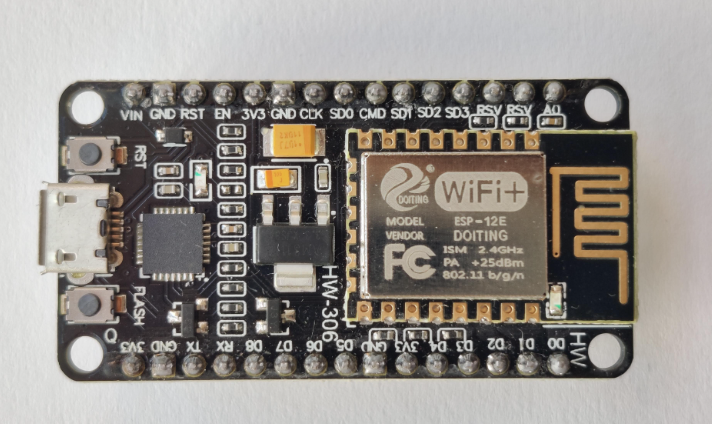
  • ESP8266 microcontroller on a white background
    Two days ago a days ago, an interesting discussion thread appeared on hacker news, on what users are building using the ESP8266 with ESPHome software. Let's try to summarise the discussion. And what are our users build with ESP8266 or ESP32? :) Promote your project or idea here! :)

    Snapcast client
    The project is to create a Snapcast client to synchronise audio playback across multiple rooms.
    Link to project


    NTP Stratum- server.1
    NTP server with time taken from GPS, displaying the time with extreme precision.
    Link to project

    HUB75 boards
    Boards displaying the status of public transport.
    Link to project


    Sign "On Air"
    Sign, which turns on or off when a user joins an online meeting.
    Link to project

    Decorative sign "Fire"
    Decorative sign imitating a pixelated fire.
    Link to project

    Kindle controlled lamp
    Kindle controlled night light, using MQTT.
    Link to blog

    HDMI switch and blind controller [/b]
    A simple HDMI switch and system to control blinds throughout the home.
    Link to blog

    Minecraft player counter
    A counter that allows you to check at a glance, how many players are online on a Minecraft server.
    Design of a small 'flat' to be a companion for children staying in hospital. Family and friends can control the lighting, giving the child a sense of closeness.
    Link to project photo
    Link to project photo (colours)

    Christmas house
    Christmas house with miniature character inside, realistic fireplace and television.
    Link to video

    Presence/motion/light/temperature sensors
    Sensors for home automation including IR transmitter for TV/AC control.
    Link to project

    E-ink display with calendar
    E- ink display showing user's calendar.
    Link to blog

    Projection of images in air
    Method to create images in air for long exposure photography.
    Link to blog

    Button to order food
    Button, which delivers food when pressed.
    Link to blog

    Bubble-creating drone Drone, Which releases soap bubbles.
    Link to video

    A toy bus Toy bus showing time until arrival of real bus
    Toy bus showing time of arrival of next bus.
    Link to blog

    Turnable mobile phone Turnable dial mobile phone.
    Link to video

    An alarm clock with weather forecast An alarm clock, which shows the weather so the user knows if it is worth getting up for tennis.
    Link to the blog

    E-newspaper with GPT
    E-newspaper powered by GPT and ESP32.
    Link to project image

    Automatic balcony irrigation system
    The user built a balcony irrigation system using an 8-channelchannel ESP32 relay system from Lilygo, connected to mini submersible pumps. MiFlora sensors were integrated via BLE to monitor plant health. Minimum soil moisture and pump run time configuration was 'set up' by hosting configuration files on Pastebin. A management interface is being developed this year with an M5 Atom running MicroPython with a web-based GUI to configure the sensors, visualise sensor data with graphs and send notifications to the phone via NTFY. The author is considering releasing the project as open-source.
    Lilygo 8x ESP32 relay system
    Mini submersible pumps
    M5 Atom MicroPython

    Tiny door-opening robot
    Someone has built a small robot, that opens the door when the AV cabinet becomes too hot. The robot is equipped with a temperature sensor, two fans and a linear actuator, and has a small web-based user interface to manually turn the cooling on/off. The system has been in operation for several years.

    Controller for a wood gas boiler
    Another user has built a controller for their wood gas boiler that allows them to start a fire and leave the house without having to return to set the 'off' temperature. The controller also solves the problem of hysteresis, where once the fuel in the boiler is burnt out, the system shuts down due to cold air cooling the sensor enough to cause a shutdown and then a restart, which is annoying and inefficient.
    The wireless part is optional, but is used to draw a temperature curve, allowing you to determine the best time to reload the fuel if necessary.
    Boiler controller

    Gateway for low-cost BLE sensors and data transfer to InfluxDB
    User built his own gateway for low-cost BLE sensors, sending data directly to InfluxDB.
    BLE gateway to InfluxDB

    Monitoring and automation of solar charge controllers
    Someone monitors and automates their solar charge controllers, battery management systems and inverter using 3 separate ESP32 boards. The project is not considered the pride of the author and relies mainly on the work of others.
    Energy monitoring ESPhome

    Dawn clock and time-lapse video creation device
    First contact with ESPHome allowed the reactivation of a dawn clock project with adjustable colour temperature (for waking up with blue light) and the ability to play any MP3 files as an alarm. The user has also created an ESP32 device for creating time-lapse movies that plugs into the remote trigger port on a DSLR camera, configurable via Home Assistant, of course. Another project on the list is an environmental sensor and room curtain opener, using an ESP8266 and an RS-232-controlled servo module.

    Remote control for a radio antenna rotator Built a remote control for a radio antenna rotator.
    Remote control for antenna rotator

    ESP32 with accelerometer in a small 3D printed box Another project is an ESP32 with accelerometer in a small 3D printed box. Two such kits have been attached to the washing machine and dryer, which detect the start and end of the cycle and send notifications via Home Assistant. The tablet in the kitchen also receives notifications and emits a special sound when the laundry is finished.

    Freakwan project
    User provided a link to his Freakwan project, which seems interesting and is reminiscent of Meshtastic, but the design of the protocol is better rated by another user.
    Freakwan project

    FM synthesizer with two operators and MIDI input Someone built an Arduino project, that monitored one room on an SD card while on holiday to know if the heating could be lowered while away. The results were inconclusive. Another project tried to work out where a mouse was entering another room from, using infrared distance sensors. It was not possible to catch anything. What did work was to build an FM synthesiser with two operators, MIDI input and audio output. The project was completed with satisfaction, without developing it to a version with 4 or 6 operators, potentiometers and buttons.

    Home location system The user plans to create a home location system for tracking items such as wallet or keys using multiple ESP32 or Raspberry Pi receivers to triangulate the position of Bluetooth beacons. He is also considering a project Sensor Light Switches which would integrate sensors such as presence, noise, pressure, temperature etc. with traditional light switches.

    Fridge door monitoring system The user has created a fridge door monitoring system for a garage that is not frequently used and has no alarm when the door is open. The ESP8266 monitors two reed switches and sends the status to the Home Assistant. The components were 3D printed.

    A CO2 sensor that activates a fan Another user built a CO2 sensor that activates a fan in an office when CO2 levels exceed 700ppm. The project used an NDIR CO2 sensor, specifically the SCD30 , which requires frequent calibration.

    Intelligent desk One user has created a 'smart' desk that can be controlled by Home Assistant. The project is available at: Home Assistant Community .

    Wandering Hourly Clock The user has built a wandering hourly clock controlled by a stepper motor and ESP32, which synchronises time using NTP. The project has been enhanced with time zones and DST support via a web interface. Software changes have been added to the project, which is available here: Printables .

    Weather dashboard Another project is a weather dashboard made on an M5Paper device from M5Stack with an E-ink touchscreen display. The project is available at: Speechcode .

    Controller for Stock Ticker Machine
    The controller for Stock Ticker Machine is based on ESP (probably ESP8266). The project can be found here: Secret Batcave . In addition, ESPhome was used to measure the temperature in the fish pond using a simple circuit on a prototype board with a Dallas One Wire sensor, available here: ESPhome .


    Integrating an inactive home alarm system with Home Assistant
    User integrated an inactive home alarm system with Home Assistant, enabling monitoring of everything from fire alarms to motion detectors, doors and windows, using a repository on GitHub. This solution allows old security systems to be upgraded.
    Repository on GitHub

    DIY projects using rp-pico 1) Wattmeter for a small solar installation, which sends a UDP packet every few seconds, recorded in a JSON log and then processed by DuckDB.
    2) A small WiFi pico-w temperature sensor that transmits data to the Raspberry Pi Zero controlling the boiler.
    3) An 'Ok to wake' light for the son's clock that changes colour at 6:30am to signal that he can already wake his parents.

    Thread about controlling the boiler
    Code in Rust on GitHub
    The "Ok to wake" project
    "Ok to wake" - a An alarm clock for your daughter Another user created a similar "Ok to wake" project for his daughter.
    Project page

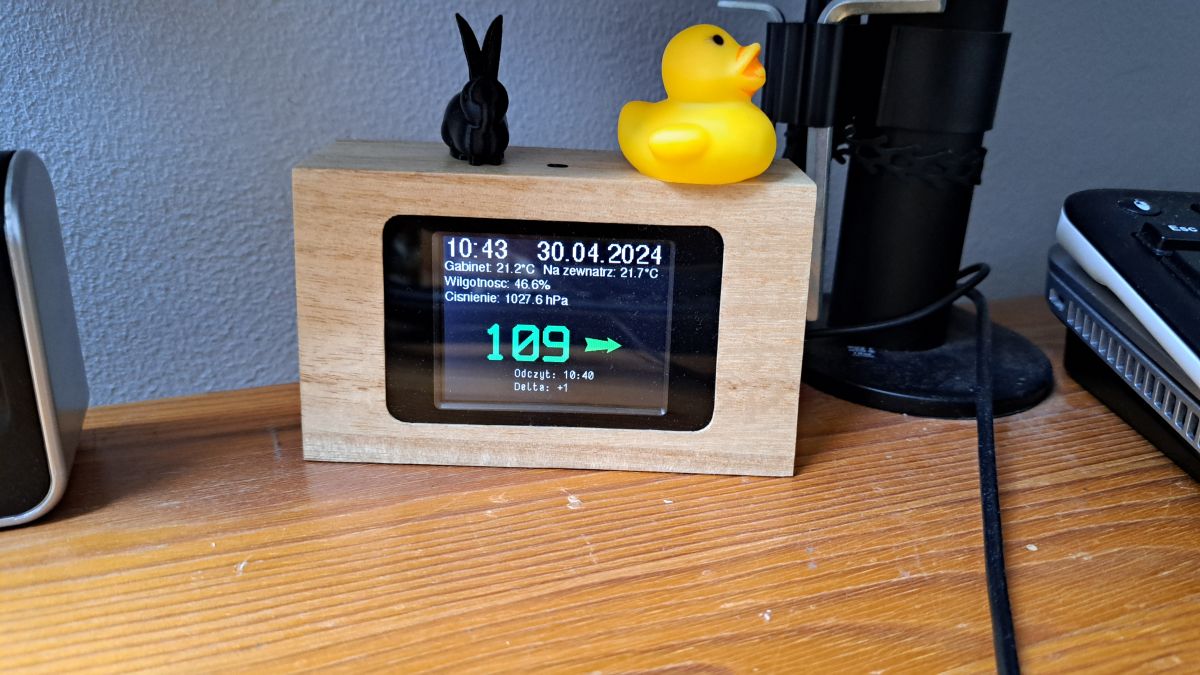
    Temperature/humidity/atmospheric pressure sensor
    Sensor design with ESPHome compatibility, with built-in functionality.
    Product on Tindie
    Description of the project
    Tracking contacts in times of pandemic The user has created a contact tracking device using ESP32, which records encounters between people via Bluetooth.
    Repository on GitHub
    Applications of ESP32 with Home Assistant -. Projector and projector screen integration
    - Universal home remote control
    - Motion sensors and accent lighting
    - Laser maze for kids
    - Bluetooth based room detection experiments

    Notification of remote control turned off in heating
    Design of thermoprobe with ESP8266, which sends notifications to Telegram chat when it detects the remote control going off in the heating.

    Pac-Man as an indicator for Uptime Kuma
    Conversion of a Pac-Man light figure into a beacon for an instance of Uptime Kuma.
    Repository on GitHub .

    Tracking 3D printing and full body trackers for VR User built 3D printing tracking system and body trackers for virtual reality.

    Humorous design of a jar that informs you of your status
    Design of a jar that rings a given phone number to inform you of your status.

    Bluetooth repeaters, alternative SwitchBot and more
    Designs of Bluetooth signal repeaters, alternative SwitchBot, WiFi bell, cameras and motion sensors.

    Integration of ESP8266 with QMK keypad
    Integration of ESP8266 with QMK keypad, enabling action triggering in Home Assistant.
    QMK keyboard
    Bee Motion sensor ESP32-.S3

    Glowy box - Internet reliability indicator Design of an Internet reliability indicator in the form of an LED series box.
    Mitsubishi heat pump control
    WiFi controller for hot tub
    Design of controller for hot tub, customised for control via WiFi.
    Repository on GitHub
    Using ESPHome for home control
    Projects for garage door control, entrance gate and various home appliances.

    Pacman machine add-ons and other
    Siri-controlled Pacman machine add-ons and other projects.

    Using community projects Using off-the-shelf community projects to improve home functionality.

    Hub for control of adjustable bed
    Project to enable control of adjustable bed from Home Assistant.
    Description of the project
    Product on Tindie
    Battery door lock and video intercom with fingerprint reader
    Design of battery door lock and video intercom with display and fingerprint reader.
    Door lock
    Video intercom

    Synchronised multi-room speakers
    Design of synchronised multi-room speakers using squeezelite and LMS.
    Presentation of the project


    The old Light adjustment phone The user has transformed an old dial phone into a light brightness adjustment device.

    Paintball sight and other prototypes
    Prototype of a Wacky Wheels-style buggy racing sight, using a pressure sensor.

    Power sensor in front of the kettle
    Design of a power sensor that notifies you when the tea is finished brewing.

    Automating the HVAC system Design of a device to automate the HVAC system and distribute fragrance throughout the house.

    Simple temperature sensor
    Simple temperature sensor that runs on AAA batteries and transmits data via WiFi.
    Repository on GitHub

    WallLED clock that synchronizes time via NTP
    Design of LED wall-clock, which synchronises time via NTP.
    Repository on GitHub

    Workshop air compressor monitor
    Design of air compressor monitor with remote monitoring and control function.

    Water meter monitoring and other applications in the home
    Using ESP to monitor the water meter and read various values from the heat pump in the home.

    Monitoring screen for PC and other
    Design of a screen to monitor the performance of PC components and a desktop clock.

    Weather station and functionality development
    Build your own weather station and add new features.

    Payment for arcade and pinball games over WiFi
    Prototype device for payment for arcade and pinball games over WiFi.

    AI Chat Thing
    AI Chat Thing project with OpenAI API integration.
    Presentation of the project
    Battery-powered gate sensor

    Simple gate sensor running on CR123A batteries, with 7 months operating time.
    Description of the project

    . Air conditioning controller and train information display
    Design of air conditioning controller and train information display.
    Library of IR codes Fine-physics management. Management of physical access to the local Fablab
    Assist in managing access to the local Fablab using the ESP8266 series and esp-rfid.
    Repository on GitHub
    Light controller. Plant light controller and other projects
    Project light controller for indoor plants and other projects.

    Bluetooth controlled reflow oven
    Design of Bluetooth controlled reflow oven.
    Instructions on Instructables
    Relay with online monitoring capability Design of device with remote monitoring capability.
    Product page


    Remote monitoring platform with ESP32 + LoRa Design of remote monitoring platform using ESP32 and LoRa.
    Repository on GitHub
    Monitoring status. GitHub status monitoring and network-controlled antenna controller

    Projects for GitHub status monitoring and network-controlled antenna controller.

    Web interface for IR remote controls
    Project web interface for IR remote controls.
    Instructions on Instructables

    Weather and task list on LED display
    Design of LED display with weather forecast and task list.
    Description of the project

    Tomato clock on ESP8266 Tomato clock project using ESP8266.
    Repository on GitHub

    Precision presence detection using 24 GHz radar
    Project presence detection using 24 GHz radar.

    Firmware update and remote control for coffee machine
    Project firmware update and remote control for coffee machine.
    Project description

    E Ink Todo list and more
    E Ink display design for task list management with Todoist.
    Description of the project

    . Programmable LED garland controlled by MicroPython Design of LED garland controlled by MicroPython.

    Controlling VP without IR remote control
    Project allowing VP control without IR remote control.

    Automation of window blinds
    Project to automate window blinds depending on time of day and sunlight.

    Network of home sensors on ESP8266
    Network of sensors collecting data from different parts of the house and sending it to Raspberry Pi.

    A ultrasonic nebula for hydroponics
    Design of an ultrasonic nebula for hydroponics.

    Intelligent kettle with HTTP code "418 I'm a teapot"
    Modification of a smart kettle using ESP32 that responds with HTTP code "418 I'm a teapot".
    Description of the project
    Cooker hood automation Design of light and fan automation in a cooker hood.
    Project description

    Hub IR/RF KC868-.AG in every room Use IR/RF hubs KC868-AG to control air conditioners and other appliances.
    Product on AliExpress
    WLED and QuinLED controllers
    Using WLED and QuinLED controllers to control LED strips.
    WLED page
    QuinLED page

    ESP32 for attendance tracking
    Using ESP32 for indoor attendance tracking.
    The ESPresense website
    Repository on GitHub

    Automatic opening and closing of the chicken coop door
    Design of an automatic system for opening and closing the chicken coop door using ESP8266.


    Source:
    https://news.ycombinator.com/item?id=40181000

    Summary created and translated by GPT-4 Turbo language model.

    Cool? Ranking DIY

    About Author
    gulson
    System Administrator
    Offline 
    gulson wrote 29236 posts with rating 5984, helped 148 times. Live in city Kielce. Been with us since 2001 year.
  • ADVERTISEMENT
  • #2 21065311
    pavyan
    Level 20  
    Posts: 320
    Help: 33
    Rate: 135
    I'll add something interesting that's not on the list above - TouchDRO with ESP32 in the lead role; I'm just getting on with building the contraption, with trepidation, as I've never dealt with microprocessor DIY before :-) But it's not expensive, so there won't be much of a loss if I mess up.
    TouchDRO is an advanced remote four-axis digital readout, with tachometer and sensor, working wirelessly with a tablet.
    Links to the author's website: https://www.touchdro.com/ and older: https://www.yuriystoys.com/ (this is an earlier version on the TI MSP430 microcontroller).
    In fact, I don't know if I can link to this, as it is partly a commercial project (interested parties who have nothing to do with electronics can buy a finished copy) - but the author also offers a DIY kit, makes the software freely available, and a description with schematics and tips, so you can copy the project yourself. The Android app is available free of charge in the Google shop.
    If my post somehow goes beyond the scope of the topic, it is to be deleted - but that would be a pity, because the thing is of great interest.
  • ADVERTISEMENT
  • #3 21065321
    gulson
    System Administrator
    Posts: 29236
    Help: 148
    Rate: 5984
    Awesome, you're going hard right away, where are you going to use it? If you do construct something, please post some pics to DIY :) .
  • #4 21065379
    ro-x
    Level 14  
    Posts: 192
    Rate: 129
    Such a watch. The contraption is also a remote display for data from the Home Assistant and the current blood glucose reading from the glucose sensor (I have type one diabetes). All on ESPeasy. I've already built it a few months ago and I'm getting together to put up a post about it here, but somehow time is still lacking.... Clock and display for Home Assistant data and glucose reading. .
  • #5 21065419
    pavyan
    Level 20  
    Posts: 320
    Help: 33
    Rate: 135
    gulson wrote:
    Super, you're acting sharp right away, where are you going to use it?

    Thanks for the appreciation (very much in stock), but e.g. :-) - I will be helped by a colleague who understands this very well.
    And I want to use in an old tool milling machine, I will try with capacitive scales - their accuracy of 0.01mm is completely sufficient for me - I already have one, the other two I may buy.
    I'm doing it more for sport, because in principle a typical, "normal", miniature display is enough for me; I got into it, because the construction of the heart of the device (processor with BT+input interface) looks quite simple, the money to lose is small, and I have a 10" tablet.
    The worst thing is that I have a few "analogue" projects buried, and I'm starting the next one.... and a "digital" one at that :-) .
  • #6 21065433
    gulson
    System Administrator
    Posts: 29236
    Help: 148
    Rate: 5984
    ro-x wrote:
    I built it already a few months ago and I'm getting together to post here about it, but somehow time is still lacking...
    Find some time please, I'm sure I'll reciprocate a little with a small gift. I believe that diabetes is a disease of the present age. Diabetes has already started in me as well, but exercise, a change in diet and I think I've postponed the disease by 10 years.

    pavyan wrote:
    The worst thing is that I have several "analogue" projects buried, and I'm taking on another one.... and it's a "digital" one at that"

    Super, if you're into DIY https://www.elektroda.pl/rtvforum/posting.php?mode=newtopic&f=85 no worries.
  • #7 21066259
    skwiro
    Level 14  
    Posts: 91
    Help: 3
    Rate: 42
    Interesting, but no links to parts.
  • #8 21066261
    gulson
    System Administrator
    Posts: 29236
    Help: 148
    Rate: 5984
    Not everywhere have the authors of the ideas shared links to the finished project or made it public, or are only planning a prototype.
  • ADVERTISEMENT
  • #9 21078923
    ascigacz
    Level 12  
    Posts: 29
    Help: 1
    Rate: 7
    At the place where I work there have been furnace failures (for process purposes) from time to time, usually at night.
    The next day some people were off (that's sarcasm - just the furnace screwed up....).
    Sometimes the factor was human, and sometimes the controller failed because there was a power cut and the furnace controller failed.
    The solution was to monitor the status of the furnace - but how? There is no way to interact with the cooker....
    -ESP-32CAM-
    Every now and then it sends a photo of the cooker panel to the server and then, especially for important customer orders, I have a chance to check if everything is ok with the cooker.
    The module turns on the backlight diode, takes a photo and sends it to the server, which I can see (my boss too).
    Design just written "on my knee" from examples and nothing to brag about...
    For this module, special attention should be paid to the correct power supply and its filtration because Wi-Fi can crash this module.

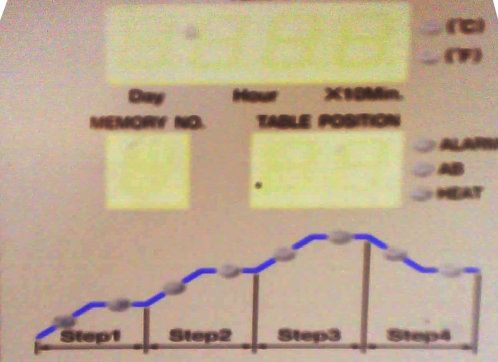
    Photo of an oven control panel with process step graph.

    Greetings!
  • #10 21079180
    gulson
    System Administrator
    Posts: 29236
    Help: 148
    Rate: 5984
    Very interesting idea! If anything, post to DIY electrodes with photos and description and I'll send a gift. Thanks for sharing the solution.
  • #11 21085191
    jarekgol
    Level 40  
    Posts: 5113
    Help: 641
    Rate: 1133
    ascigacz wrote:
    monitoring the condition of the furnace - but how?
    And add your own temperature sensor? I had a rubber vulcanising oven in my care, apart from the heaters it still held pressure. It was given a UPS for the control itself so that it did not drop pressure and spoil the goods during short outages.
    Just out of curiosity, is it possible to get better sharpness on such a camera, or is it a matter of some strong compression?
    ascigacz wrote:
    just written "on the knee" with examples and nothing to brag about...
    How it works and sends is what it is :) .
  • ADVERTISEMENT
  • #12 21086211
    ascigacz
    Level 12  
    Posts: 29
    Help: 1
    Rate: 7
    I have inserted this photo, of a section of the panel, the current state of the cooker and getting rid of the perspective in Gimp. The camera is mounted from the top and the image must be rotated 90°. The cooker was off... The quality is good enough to see what's on display. And since everything is there, I didn't have to connect anything else, but you can, because it's an Arduino and ESP...

    Program in Arduino, does only the following:
    -establishes connection to Wi-Fi network "rigidly",
    -initialises library,
    then every minute in a loop:
    -turns on LED,
    -takes photo,
    -turns off LED,
    -sends to server - primitively via FTP

    And that's all.

    Then I can see this photo on the server from outside - usually on my mobile phone - I have a shortcut on the screen.

    The program is so primitive that I'm really ashamed to brag about it...
    I used examples of ESP32-CAM
    Even there is its own server for video, but I preferred not to share anything externally.
    For such a large cooker, maybe it is better to install an ip-Wifi camera from commercial solutions...?
    Greetings!
  • #13 21086539
    metalMANiu
    Level 21  
    Posts: 619
    Help: 11
    Rate: 241
    ascigacz wrote:
    For such a large cooker, it might be better to install an ip-Wifi camera from a commercial solution...?
    This sounds more reasonable, but on the other hand you have to make sure that the network traffic is not going through the manufacturer's servers. I for one completely lost control of two cameras (5-6 years old) after updating the app on my phone. Newer cameras are still supported, but who knows for how long.
  • #14 21088922
    Duch__
    Level 31  
    Posts: 2338
    Help: 33
    Rate: 1597
    At my house I have a module on an esp-01 which measures the temperature at 16 points using a DS18b20. Via UDP it sends the measurements to the YUNSHAN module which is the main thermostat. The thermostat does the calculations and turns on the furnace (via a NO contact) and sends information to several further modules responsible for opening the actuators on the radiators in the house. In other words, I can set the individual temperature in each room from the browser.


    Another nodemcu module via rs485 communicates with the EVER MPPT module responsible for charging the battery in the garage for lighting. Charging from PV.

    In the case of the thermostat and PV, I have the results visualised on THINGSPEAK.
  • #15 21088965
    metalMANiu
    Level 21  
    Posts: 619
    Help: 11
    Rate: 241
    Duch__ wrote:
    I have a module on the esp-01 that measures temperature at 16 points using a DS18b20.
    Do you use two wires for this?
  • #16 21089040
    Duch__
    Level 31  
    Posts: 2338
    Help: 33
    Rate: 1597
    In my case on three wires, but two can also be used. Prerequisite: original DS18b20 sensors. On fakes it is unlikely to work.
  • #17 21089136
    jarekgol
    Level 40  
    Posts: 5113
    Help: 641
    Rate: 1133
    Gentlemen, and I have this question, as I have done very little on ESP, but I have an ESP-WROOM-32 and I wanted to use an ADC converter on this, but in a non-blocking way. From what I used to look for, in the old version of the Arduino environment there were functions to test the flag if the converter had already finished, but then these functions disappeared and it stopped compiling. I tried to get through HAL, but I was outgrown. Any hints? I haven't tried downgrading the Arduino yet as I got a bit discouraged.
    On an AVR or STM/ARM without HAL I can do such things on interrupts or polling without any problems.
  • #18 21089571
    xury
    Automation specialist
    Posts: 7071
    Help: 876
    Rate: 1486
    Use the RTOS on the ESP32. Set yourself shuffles every time you want and that's it.
  • #20 21091555
    andreyatakum
    Level 15  
    Posts: 717
    Rate: 1028
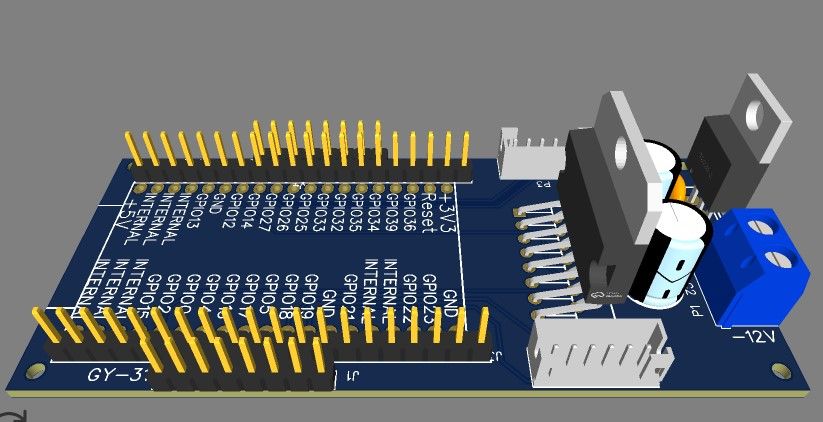
    Yesterday I received an order to develop a schematic and PCB for a device based on ESP8266 for controlling a 16x16 dot display. After completion I will ask the customer if I can publish the files here.

    Added after 5 [hours] 48 [minutes]:

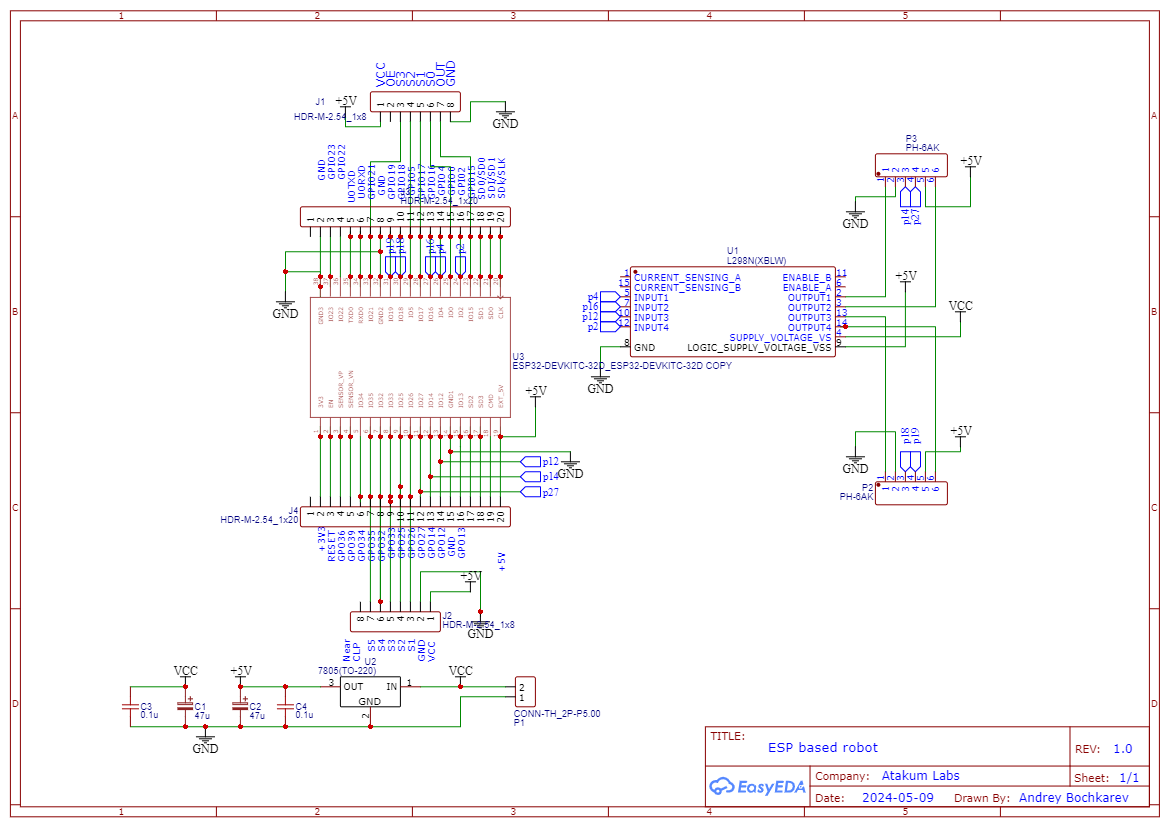
    I also developed a robot based on ESP32 for the order.
    It has a colour sensor and a skip on board.


    Electrical schematic of a robot based on ESP32.
    Electrical schematic of a robot based on ESP32.


    The image shows a PCB design with ESP8266 featuring pins and connectors.
    .
  • 📢 Listen (AI):

    Topic summary

    ✨ The discussion revolves around various projects built using the ESP8266 and ESP32 microcontrollers with ESPHome software. Participants share their innovative applications, including a Snapcast client for synchronized audio playback, an NTP server utilizing GPS for precise timekeeping, HUB75 boards for public transport status display, and a decorative "On Air" sign for online meetings. Other notable projects include a Kindle-controlled lamp, a remote display for Home Assistant data, and a temperature monitoring system using DS18B20 sensors. Users also discuss challenges and solutions related to power supply and network stability for their devices. Additionally, there are inquiries about using ADC converters with ESP32 and suggestions for implementing RTOS for non-blocking operations.
    Generated by the language model.

    FAQ

    TL;DR: This FAQ distills 15 practical ESP8266/ESP32 builds, and one builder says, "The quality is good enough" for reading a furnace display. It helps makers choose between ESPHome, ESPeasy, Arduino, and MicroPython for cameras, thermostats, sensors, and Home Assistant control without reading the full forum thread. [#21086211]

    Why it matters: The thread shows that low-cost ESP boards solve real monitoring, control, and automation problems, from 16-point heating control to industrial oven checks.

    Approach What it monitors Hardware noted in thread Best fit Main limitation
    ESP32-CAM photo monitor Existing control panel display ESP32-CAM, LED, Wi-Fi Non-invasive status checks Needs stable, filtered power
    Dedicated sensor node Temperature or state directly ESP-01, DS18B20, relay logic Precise automation Requires electrical integration
    Commercial IP Wi-Fi camera Full visual scene Vendor camera + app Fast deployment Cloud/privacy and support risk

    Key insight: The most robust ESP projects reuse what already exists: read the panel with a camera when you cannot interface electrically, or add simple sensors when direct measurements matter more than images. [#21086211]

    Quick Facts

    • One thermostat build measures temperature at 16 points with DS18B20 sensors on an ESP-01, then sends readings by UDP to a central controller and visualizes results in ThingSpeak. [#21088922]
    • A TouchDRO build targets an old milling machine and uses a wireless 4-axis readout with a 10-inch tablet; the builder considers 0.01 mm capacitive scales fully sufficient. [#21065419]
    • One office ventilation project switches a fan when CO2 exceeds 700 ppm and uses an NDIR SCD30 sensor, with frequent calibration noted as necessary. [#21064947]
    • A battery-powered gate sensor ran for 7 months on CR123A cells, showing that low-duty ESP monitoring can be practical without mains power. [#21064947]

    1. What is TouchDRO, and how does an ESP32-based wireless 4-axis digital readout work with a tablet on a milling machine?

    TouchDRO is a wireless digital readout for machine tools that sends axis data to a tablet. "TouchDRO" is a digital readout system that reads machine-position sensors, sends the measurements wirelessly, and shows them on an Android tablet, adding multi-axis display without a traditional DRO head. In the thread, the planned build uses ESP32, supports 4 axes, and is intended for an old tool milling machine. The builder already has one capacitive scale and says 0.01 mm accuracy is sufficient. [#21065419]

    2. What is Freakwan, and how is it different from Meshtastic for ESP32-based messaging projects?

    Freakwan is presented as an ESP32 messaging project similar in spirit to Meshtastic, but with a better-rated protocol design. "Freakwan" is a messaging project that runs on ESP32-class hardware, focuses on wireless text-style communication, and was described in the thread as Meshtastic-like but better regarded for protocol design. The thread does not provide a feature matrix, radio details, or benchmarks, so the safe takeaway is conceptual: same problem space, different protocol choices. [#21064947]

    3. How can I build an ESP32-CAM system that photographs a furnace or oven control panel every minute and uploads the image to a server over Wi-Fi?

    Use a minimal ESP32-CAM loop that connects to Wi-Fi, lights the onboard LED, captures one frame, and uploads it once per minute. 1. Initialize Wi-Fi and the camera library with fixed network credentials. 2. In the loop, turn on the LED, take the photo, then turn the LED off. 3. Upload the image to a server, in this case via simple FTP, and view it remotely from a phone shortcut. The reported installation checks a furnace panel at night without wiring into the controller. [#21086211]

    4. Why does ESP32-CAM often become unstable or crash on Wi-Fi, and what kind of power supply filtering helps?

    ESP32-CAM becomes unstable when its supply sags or carries noise during Wi-Fi activity. The builder explicitly warns that Wi‑Fi can crash the module and says special attention must go to correct power supply and filtering. The thread does not name exact capacitor values, so the actionable conclusion is to use a stable supply with good filtering and avoid marginal wiring, especially when the LED and camera run during transmission. [#21078923]

    5. What image quality can I realistically expect from ESP32-CAM for reading a machine display, and how can I improve sharpness or reduce compression artifacts?

    You can realistically expect image quality that is good enough to read a machine display, not archival-quality inspection images. The working example reads the furnace panel after cropping a section, correcting perspective in Gimp, and rotating the image by 90 degrees because the camera is top-mounted. That tells you image processing matters as much as raw capture. If compression artifacts bother you, tighten the framing and process only the display area instead of the whole panel. [#21086211]

    6. How do you connect 16 DS18B20 sensors to an ESP-01 for multi-room temperature monitoring, and when should you use two wires versus three?

    You can place 16 DS18B20 sensors on one ESP-01-based monitoring node and send their readings to a central thermostat. The thread’s working system uses 3 wires and measures 16 points before sending data by UDP. Two-wire mode can also work, but the poster gives one clear condition: use original DS18B20 sensors. For a practical multi-room system, choose 3-wire wiring first and reserve 2-wire mode for simpler or better-controlled installations. [#21089040]

    7. Why do counterfeit DS18B20 sensors cause problems on long 1-Wire buses, and how can I tell if my sensors are genuine?

    Counterfeit DS18B20 sensors cause trouble because the thread reports that two-wire operation is unlikely to work on fakes. That is a concrete reliability warning for longer or more demanding 1-Wire buses. The practical test in this discussion is simple: if your sensors fail in 2-wire mode while originals work, suspect clones. The poster states the prerequisite plainly: original DS18B20 parts are needed if you want dependable two-wire operation. [#21089040]

    8. How can I send temperature data from ESP8266 or ESP-01 modules over UDP to a central thermostat and then visualize the results in ThingSpeak?

    Use a distributed setup: one ESP-01 gathers temperatures, sends them by UDP, and a central thermostat decides when to heat. In the thread, the thermostat receives 16 DS18B20 readings, performs the calculations, switches the furnace through a normally open contact, and also commands radiator actuators in different rooms. The same poster visualizes both thermostat and photovoltaic data in ThingSpeak, so the architecture is sensor node, UDP transport, control node, then cloud graphing. [#21088922]

    9. What is ESPeasy, and how can it be used to build a watch-style remote display for Home Assistant data and blood glucose readings?

    ESPeasy is used here as the firmware layer behind a custom wearable-style display. "ESPeasy" is firmware for ESP modules that connects sensors, displays, and automation data with minimal custom coding, emphasizing quick setup and practical integration with systems such as Home Assistant. In the thread, a builder made a watch-like device that acts as a remote display for Home Assistant data and current blood glucose readings from a glucose sensor. The project was already built a few months before posting. [#21065379]

    10. How do I make non-blocking ADC measurements on an ESP-WROOM-32 in Arduino, and what changed between older and newer Arduino-ESP32 versions?

    Use FreeRTOS-style task scheduling on ESP32 when Arduino-level non-blocking ADC calls are missing. The questioner says older Arduino environment versions had functions to test whether conversion had finished, but those functions later disappeared and the code stopped compiling. A reply recommends using the ESP32 RTOS and running timed tasks instead of waiting in a blocking loop. That avoids the portability problem caused by changed Arduino-ESP32 APIs. [#21089571]

    11. Which approach is better for monitoring industrial equipment status: an ESP32-CAM watching the control panel, a dedicated temperature sensor, or a commercial IP Wi-Fi camera?

    The best approach depends on access, but the thread favors the least invasive method that still answers the question. ESP32-CAM worked when there was no way to interact with the furnace controller, because it simply photographed the panel every minute. A dedicated temperature sensor is better when a measured variable directly represents machine state. A commercial IP Wi‑Fi camera may suit a large oven, but only if you accept its support and privacy tradeoffs. [#21086211]

    12. What are the privacy and long-term support tradeoffs between DIY ESP32 monitoring cameras and manufacturer-cloud IP cameras?

    DIY ESP32 monitoring keeps control local, while many IP cameras trade simplicity for dependence on vendor apps and servers. One poster says they completely lost control of two cameras that were 5–6 years old after a phone app update, while newer models remained supported only for now. That is the key long-term risk. The privacy risk is also explicit: with commercial cameras, network traffic may pass through the manufacturer’s servers unless you verify otherwise. [#21086539]

    13. How can I use FreeRTOS on ESP32 to schedule periodic tasks like sensor reads or ADC sampling without blocking the rest of the program?

    Use FreeRTOS tasks and schedule them at fixed intervals instead of polling in a tight loop. The advice in the thread is blunt: use the RTOS on ESP32 and set your intervals as needed. In practice, that means one task can sample ADC or sensors every set period while other tasks handle Wi‑Fi, UI, or control logic. This approach fits periodic jobs such as one-minute image capture or repeated sensor reads without blocking the whole sketch. [#21089571]

    14. What is the easiest way to integrate ESP8266 or ESP32 projects with Home Assistant for notifications, dashboards, and automation?

    The easiest path is to expose simple states or sensor values and let Home Assistant handle automations and alerts. The thread lists many examples: washing-machine and dryer end-of-cycle notifications, old alarm-system integration, desk control, garage and gate control, and room-presence experiments. One builder even routes laundry-finished alerts to a kitchen tablet with a special sound. That pattern is simple and repeatable: send clean events, then build dashboards and notifications in Home Assistant. [#21064947]

    15. How do ESP8266, ESP32, ESPHome, and MicroPython compare when choosing a platform for home automation, sensors, and custom control projects?

    Choose ESP8266 for simple low-cost nodes, ESP32 for heavier multitasking and peripherals, ESPHome for fast Home Assistant integration, and MicroPython for custom interactive control. The thread shows ESP8266 in gate sensors, thermostats, and fridge-door monitoring; ESP32 in cameras, relays, robots, and BLE gateways; ESPHome in energy and home-control projects; and MicroPython in a balcony irrigation interface on an M5 Atom. For broad home automation, ESPHome is fastest. For unusual logic or UI work, ESP32 plus Arduino or MicroPython is stronger. [#21064947]
    Generated by the language model.
    ADVERTISEMENT