logo elektroda
logo elektroda
X
logo elektroda

Avatto Tuya S16 PRO Wifi + RF Teardown and Internal Components Analysis

yarix2 4929 20
Best answers

How do I configure the Tuya SH-4 module in the Avatto S16 Pro so the device’s RF functions work with open firmware?

You can make the S16 Pro’s IR and RF functions work in ESPHome by using the open-source `tuya_rf` component from `olivluca/tuya_rf` together with a recent dev build of LibreTiny, rather than trying to treat SH-4 like a simple sensor module [#21226707] The working pin setup reported was GPIO07 for IR transmit, GPIO08 for IR receive, P9 for the blue status LED, and P23 for the reset button with an external pull-down; the RF part was handled by `tuya_rf` with raw dump support [#21227105] The SH-4 is not a SHT40 humidity sensor, and divadiow noted it appears to be the same Tuya SH-4 RF module used in another device variant [#21225784] Under the RF shield, the chip is likely a CMT2300A, and its configuration from Tuya firmware appears to be what enables the 433 MHz remote support [#21225794] Tuya RF settings may involve OOK/FSK/GFSK modulation, but for practical use the thread’s solution was to port or reuse the existing `tuya_rf` implementation in ESPHome/LibreTiny [#21495639]
Generated by the language model.
ADVERTISEMENT
  • #1 21225618
    yarix2
    Level 6  
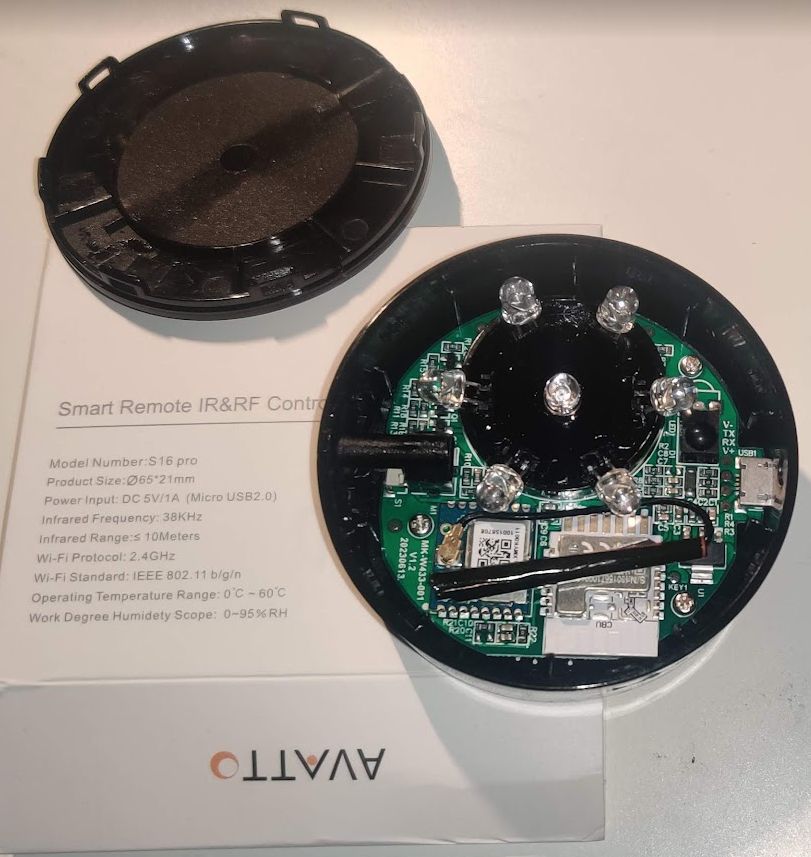
    This post is about smart IR+RF from AVATTO (Aliexpress link)

    SPECIFICATION
    --Mode:S16 PRO
    --Product size: Ø65*21mm
    --Power input: DC 5V/1A (Micro USB2.0)
    --Infrared Frequency:38KHz
    --Infrared Range: ≤10Meters
    --Wi-Fi Protocol:2.4GHz
    --Wi-Fi Standard: IEEE 802.11 b/g/n
    --Operating Temperature Range:0℃-60℃
    --Work Degree Humidity Scope:0-95%RH
    --RF: 433/315Mhz

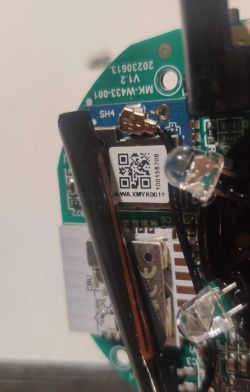
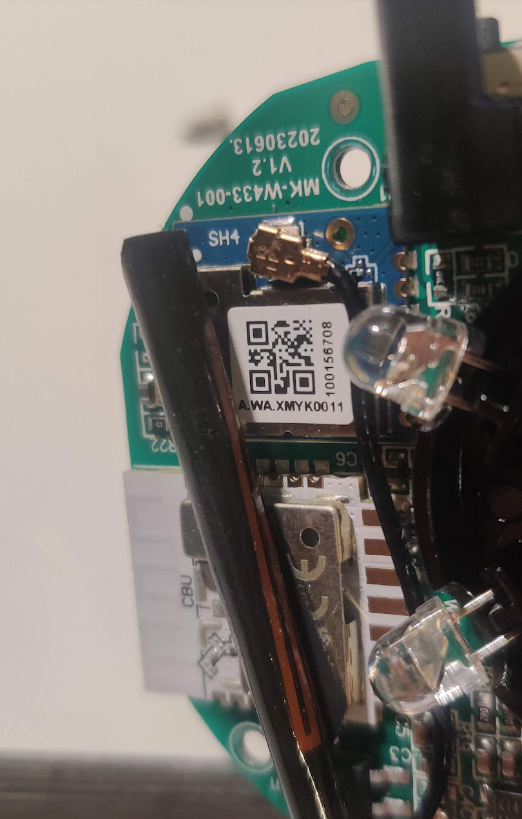
    Opening the device is by sharp tool from the top circle, no screws, just clips. 
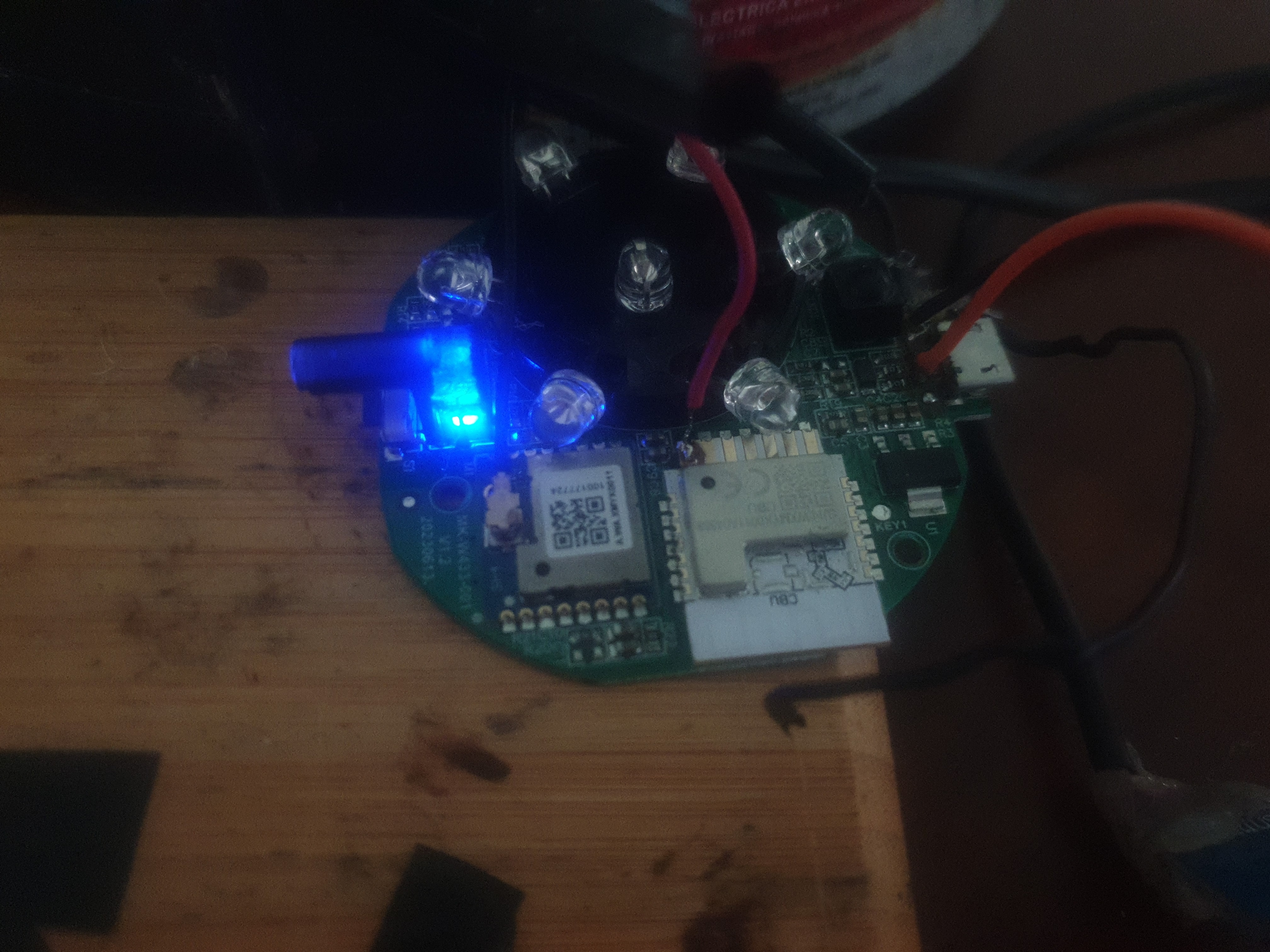
    The board contains CBU and RF module (SH-4) from Tuya.

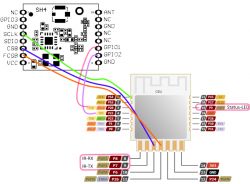
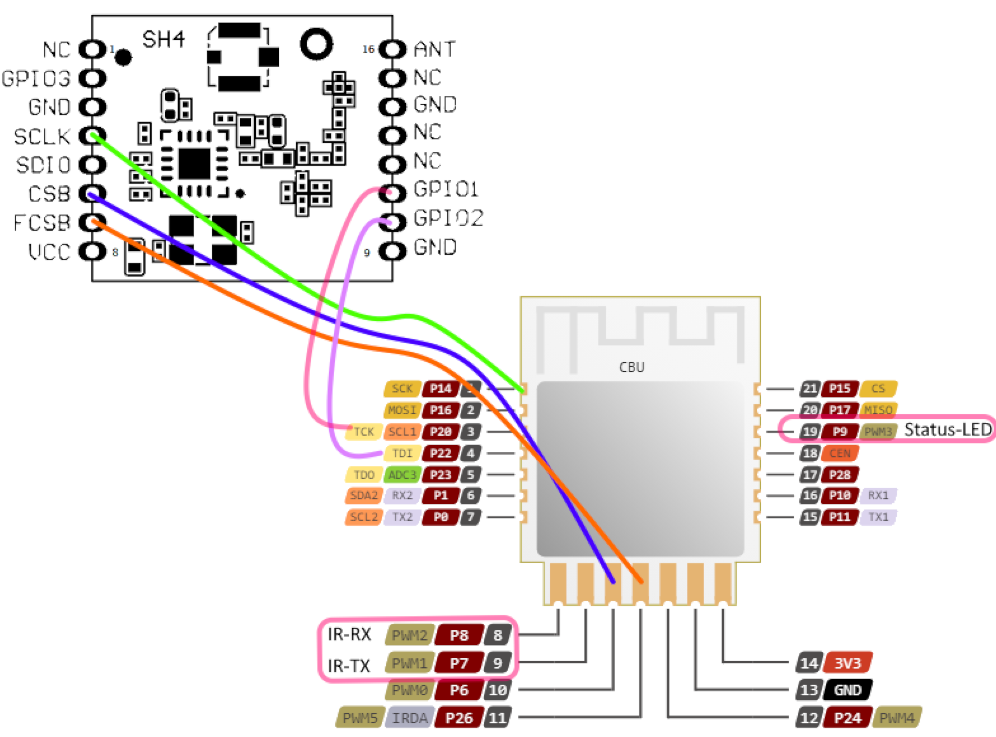
    Sadly, I didn't download the original firmware, so I had to manually trace the connections between the RF module SH4 and the CBU module.
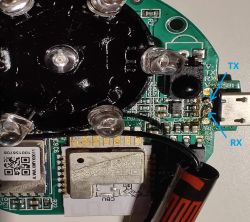
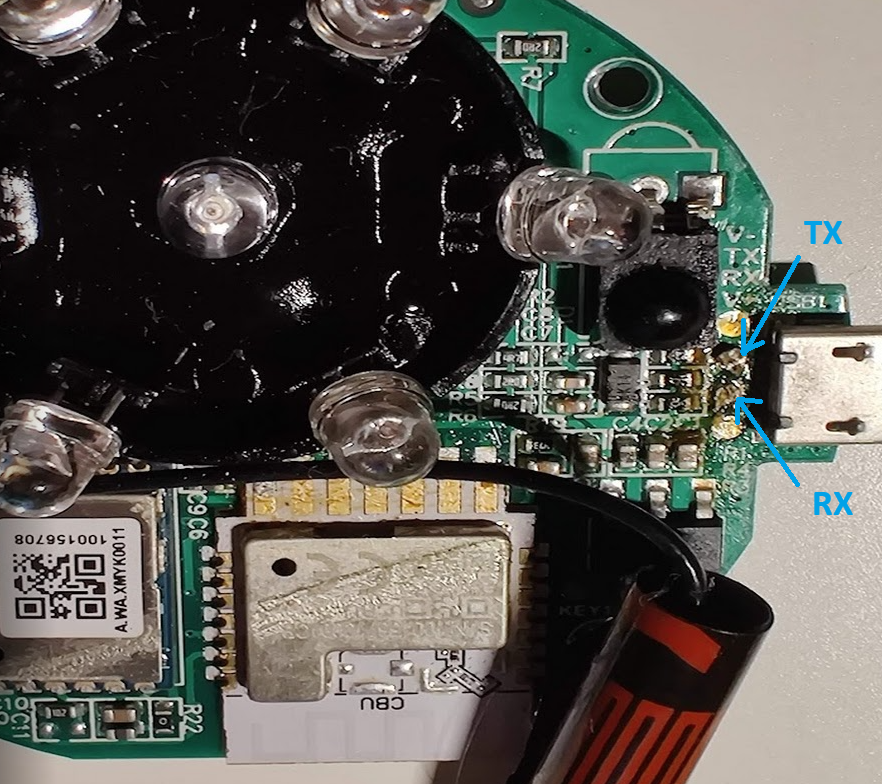
    On the front side, you could see 4 pads for -V, TX, RX, V+. I used the TX+RX, while the VCC i soldered directly to CBU (it was hard to solder 3 wires to the pads). 
    The back side of the board does not contain anything interesting.
    I only missed the small reset button, which i couldn't find its connection to CBU.
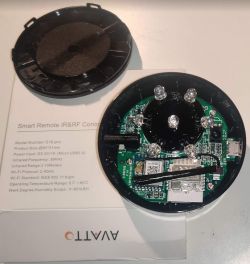
    Opened AVATTO S16 PRO IR+RF remote with visible PCB and electronic components. Close-up of a circuit board module with electronic components. Close-up of the smart IR+RF device S16 PRO circuit board with TX and RX labels.
    Wiring (tested with multimeter)Wiring diagram for SH4 and CBU modules.

    I can confirm that the IR is working like my previous module BK7231N - Universal IR Remote Contorl.

    GPIO settings
    GPIO-CBUFunctionSH-4 pinComment
    GPIO 07IR - Tx transmitterconfirmed working
    GPIO 08IR - Rx receiverconfirmed working
    GPIO 09Status LED (blue led)confirmed working
    
    P6CSB
    P14SCLK
    P20GPIO01
    P22GPIO02 
    P26FCSB 


    i don't know how to set the SH-4 
  • ADVERTISEMENT
  • #2 21225719
    p.kaczmarek2
    Moderator Smart Home
    Thanks for sharing! SH-4 may be SHT40 I guess? I think we have driver for that, @divadiow may know more. I didn't test it myself. It was submitted by one of our contributors.

    See ioRoles:
    https://github.com/openshwprojects/OpenBK7231T_App/blob/main/docs/ioRoles.md
    SHT3X_DAT and SHT3X_CLK maybe?
    Helpful post? Buy me a coffee.
  • #3 21225784
    divadiow
    Level 38  
    I don't think the Tuya SH4 module is related to the Sensirion SHT40 temperature/humidity sensor.
    https://developer.tuya.com/en/docs/iot/sh4-module-datasheet?id=Ka04qyuydvubw

    I've not seen the SH4 module before, but I have seen this device on Ali Express wondering if it was worth buying for a look. I have no idea how the factory firmware interfaces with it or how OBK could either. It's a shame you didn't get the factory firmware. Also, I wonder what's under the RF shield on the SH4. I may have to get one now ;)

    Added after 7 [minutes]:

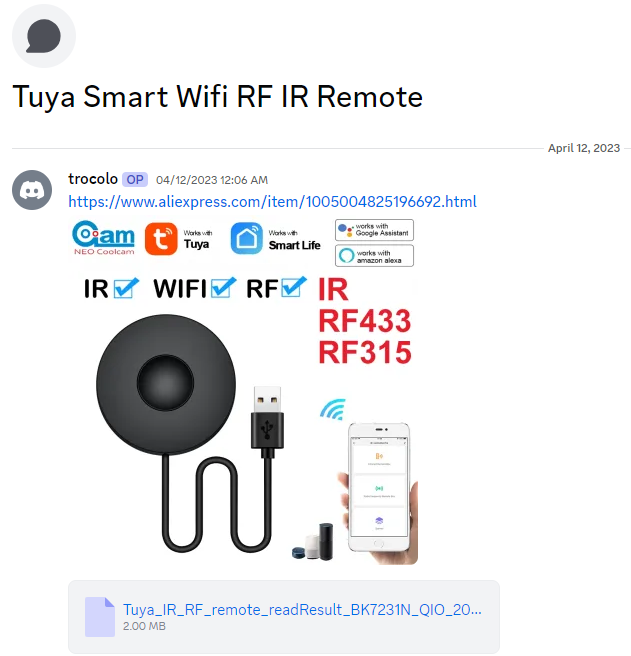
    I have found this elsewhere though that contains an SH4 module and pin assignments stated by the user match the Avatto. Looks like the same device in a slightly different chassis. Backup attached.

    Image of a Tuya Smart WiFi RF IR remote with a USB cable, smartphone screen, and logos of compatible apps.

    Code: Text
    Log in, to see the code
    Attachments:
    • Tuya_IR_RF_remote_readResult_BK7231N_QIO_2023-11-4--23-47-37.bin (2 MB) You must be logged in to download this attachment.
  • #4 21225794
    divadiow
    Level 38  
    @yarix2 did you happen to get the boot log or note the software version of factory firmware, if you paired to app?

    I've just noticed SH4 is in here https://www.elektroda.com/rtvforum/topic3975921.html

    the boot log for the firmware I posted (which may be different the one your device came with!) is

    Code: Text
    Log in, to see the code


    where we see mention of the CMT2300A_notFound. So I guess that's what's under the RF shield

    Added after 39 [minutes]:

    https://www.elektroda.com/rtvforum/find.php?q...513%2C517%2C507%2C428%2C518&search_cat=43
  • #5 21226141
    yarix2
    Level 6  
    I never logged in to Tuya or paired with original firmware. Thanks to you guys, I got used to buying a device and immediately flashing it :)

    Have a look at this repo https://github.com/olivluca/tuya_rf it seems to add support in ESPHome.
  • #6 21226423
    divadiow
    Level 38  
    Cool. I see that mentioned on the other thread too. I wonder if it could be used in OBK. Maybe @olivluca can say.
  • ADVERTISEMENT
  • #7 21226707
    yarix2
    Level 6  
    Eventually, I was able to make the device work in ESPHome (sorry...). i have both IR and RF control 🥳
    I had to use @olivluca component and the latest dev version of LibreTiny (as of writing this post, it's version 1.7.0) which contains a fix that @olivluca contributed there too.

    Bottom line, there is open source solution to work with CBU and SH4 from Tuya! Now, it's just a matter of priorities and effort until it will show up in OpenBeken (and officially supported in ESPHome).

    thank you all!

    BTW - here are codes i used for my RF fan (it might help someone else here):

    
    all-off:
    Received Raw: 7813, -245, 750, -781, 249, -235, 765, -250, 784, -246, 750, -250, 781, -219, 816, -245, 757, -243, 821, -210, 749, -250, 781, -787, 213, -281, 749, -790, 210, -781, 250, -788, 211, -281, 750, -781, 218, -281, 781, -789, 211, -249, 781,-219, 781, -781, 249, -789, 211, -250, 781, -218, 781, -781, 250, -250, 781, -781, 218, -787, 244, -250, 750, -249
    
    fan-on-off:
    Received Raw: 7790, -269, 750, -780, 219, -250, 781, -251, 756, -273, 750, -249, 750, -281, 749, -250, 755, -276, 750, -250, 780, -250, 750, -789, 241, -250, 750, -781, 250, -781, 218, -785, 246, -250, 764, -766, 250, -250, 750, -788, 242, -812, 188,-281, 780, -781, 219, -753, 278, -218, 783, -779, 250, -749, 251, -780, 250, -218, 781, -250, 781, -250, 787, -774
    
    light-on-off:
    Received Raw: 7758, -278, 751, -782, 219, -250, 785, -247, 750, -282, 750, -251, 750, -282, 758, -242, 751, -281, 751, -250, 750, -282, 758, -774, 250, -250, 751, -782, 250, -761, 271, -750, 322, -179, 750, -782, 219, -301, 769, -775, 219, -250, 782,-782, 219, -218, 789, -275, 750, -219, 813, -219, 781, -219, 785, -779, 250, -782, 219, -281, 751, -250, 755, -277
    
    Speed 1:
    Received Raw: 7789, -247, 750, -783, 253, -215, 782, -281, 751, -218, 788, -277, 754, -246, 753, -278, 750, -251, 750, -281, 759, -242, 750, -782, 250, -250, 751, -783, 249, -781, 219, -782, 250, -250, 782, -750, 250, -251, 781, -751, 250, -782, 250,-250, 788, -213, 781, -251, 781, -219, 782, -250, 790, -773, 219, -782, 250, -219, 782, -785, 247, -782, 219, -253
    
    Speed 2:
    Received Raw: 7784, -249, 748, -781, 250, -250, 785, -215, 782, -250, 781, -219, 781, -277, 728, -245, 781, -250, 750, -250, 781, -282, 753, -747, 250, -250, 781, -750, 250, -814, 217, -750, 282, -218, 782, -750, 282, -218, 784, -778, 250, -782, 218,-250, 782, -222, 778, -781, 250, -250, 753, -778, 250, -253, 747, -250, 782, -250, 750, -281, 753, -247, 750, -282
    
    Speed 6:
    Received Raw: 7753, -278, 781, -755, 246, -250, 781, -219, 781, -250, 750, -250, 793, -238, 750, -250, 750, -281, 784, -216, 785, -247, 781, -781, 188, -281, 784, -751, 246, -782, 250, -796, 204, -250, 781, -782, 218, -250, 782, -781, 219, -250, 781,-784, 216, -781, 343, -157, 781, -250, 755, -778, 245, -255, 782, -750, 219, -782, 285, -747, 250, -751, 281, -219
    
    1h:
    Received Raw: 7808, -1792, 219, -250, 781, -250, 750, -250, 785, -247, 750, -250, 782, -250, 750, -250, 789, -242, 750, -250, 782, -781, 219, -250, 789, -774, 250, -750, 250, -781, 250, -219, 789, -774, 250, -219, 781, -781, 250, -253, 787, -242, 750,-250, 781, -782, 218, -254, 783, -245, 750, -816, 215, -782, 219, -784, 247, -781, 219, -782, 250, -781
    
    2h:
    Received Raw: 7754, -311, 755, -775, 218, -282, 750, -219, 781, -280, 756, -214, 782, -281, 750, -277, 723, -282, 750, -250, 750, -281, 751, -781, 219, -282, 749, -782, 218, -782, 250, -804, 211, -273, 743, -782, 250, -250, 781, -750, 250, -257, 775,-750, 250, -250, 750, -250, 782, -750, 281, -750, 250, -250, 782, -218, 782, -253, 778, -784, 216, -250, 782, -780
    4h:
    Received Raw: 7798, -234, 750, -782, 250, -250, 781, -250, 750, -250, 751, -281, 781, -219, 750, -282, 750, -250, 755, -276, 750, -250, 751, -781, 250, -250, 789, -742, 282, -750, 250, -781, 259, -210, 789, -774, 219, -250, 781, -781, 219, -795, 237,-781, 250, -219, 781, -320, 711, -787, 215, -792, 244, -247, 747, -782, 250, -786, 214, -781, 251, -250, 786, -245
    
  • ADVERTISEMENT
  • #8 21226777
    ferbulous
    Level 18  
    @yarix2 do you mind sharing your full config? So rf receiver and transmitter works now?
  • #9 21227105
    yarix2
    Level 6  
    >>21226777
    sure - here is my ESPHome for that device:

    
    external_components:
      - source:
          type: git
          url: https://github.com/olivluca/tuya_rf
          ref: master
        components: [ tuya_rf  ]
    
    ##
    esphome:
      name: cbu
      friendly_name: cbu-wifi-rf
    
    bk72xx:
      board: cbu
      framework:
        version: latest
       
    wifi:
      ssid: !secret wifi_ssid
      password: !secret wifi_password
      
    web_server:
      version: 3
      
    #status led
    output:
      platform: gpio
      id: status
      pin: P9
    
    #reset button, it has an external pull-down in my board
    binary_sensor:
      - platform: gpio
        id: reset_button
        pin: P23
    
    #rf transmitter and receiver
    tuya_rf:
      id: rf
      receiver_disabled: true
      dump: raw
    
      - pin:
          number: GPIO08
          inverted: true
          mode:
            input: true
            pullup: true
        tolerance: 55%
        dump: all
        id: ir_receiver
       
    remote_transmitter:
      - id: ir_transmit
        pin: GPIO07
        carrier_duty_percent: 50%
       
    ## Example IR for A.C.
    climate:
      - platform: climate_ir_lg
        name: "lg-ac"
        id: parents_ac_climate
        transmitter_id: ir_transmit
        receiver_id: ir_receiver
    
    ## some buttons for RF.   
    button:
      - platform: template
        name: turn off receiver
        web_server_sorting_weight: 1010
        on_press:
           - tuya_rf.turn_off_receiver:
      - platform: template
        name: turn on receiver
        web_server_sorting_weight: 1020
        on_press:
           - tuya_rf.turn_on_receiver:
      - platform: template
        name: allOff
        web_server_sorting_weight:  10
        on_press:
           - output.turn_on: status
           - remote_transmitter.transmit_raw:
              transmitter_id: rf
              repeat:
                times: 7
                wait_time: 0s
              code: [7813, -245, 750, -781, 249, -235, 765, -250, 784, -246, 750, -250, 781, -219, 816, -245, 757, -243, 821, -210, 749, -250, 781, -787, 213, -281, 749, -790, 210, -781, 250, -788, 211, -281, 750, -781, 218, -281, 781, -789, 211, -249, 781,-219, 781, -781, 249, -789, 211, -250, 781, -218, 781, -781, 250, -250, 781, -781, 218, -787, 244, -250, 750, -249]
           - output.turn_off: status
    
  • #10 21241147
    olivluca
    Level 7  
    >>21226423 sorry for not replying earlier, I saw the alert just now.
    Yes, as I said in the other thread I couldn't wrap my head around OpenBeken, and even under ESPHome the code is kinda ugly (I didn't feel like to rewrite all the SH4 code), but I think a developer knowing OpenBeken could use it to port the component.
  • #11 21241174
    divadiow
    Level 38  
    cool, thanks for responding. can you recall what about the OpenBeken setup you got stuck on? I'm probably not much help but others who may see this thread might chime in.
  • #12 21241186
    olivluca
    Level 7  
    >>21241174 it's not about the setup, but about the structure of the software and I'm too old and too lazy to study it :-D
  • ADVERTISEMENT
  • #14 21495503
    kingdomcitytaker
    Level 2  
    I see that the Avatto Tuya S16 pro comes with universal RF remote control.. I'm looking forward to using this device to control the gate using wifi.. I'm wondering whether this device supports ASK, FSK, PSK or all the above modulation? Apparently my gate remote is using rolling code modulation..
    Can anyone share some insight about this device capability in the RF sector?
    Many thanks in advance.. 🙏😊
  • #15 21495639
    olivluca
    Level 7  
    >>21495503
    the cm2300A supports a bunch of modulations, the problem is you have to create a parameters file (.h) using the "cmostek rfpdk" configuration program (I don't remember where I got it), then send these parameters to the chip in your code.
    Since I couldn't make heads or tails of the cmostek rfpdk(*) I simply captured on the i2c bus the parameters sent to the chip with the tuya firmware, which is the "right" configuration for 433MHz remotes. I found on github several projects that use a different configuration, e.g. to receive data from tire pressure sensors.
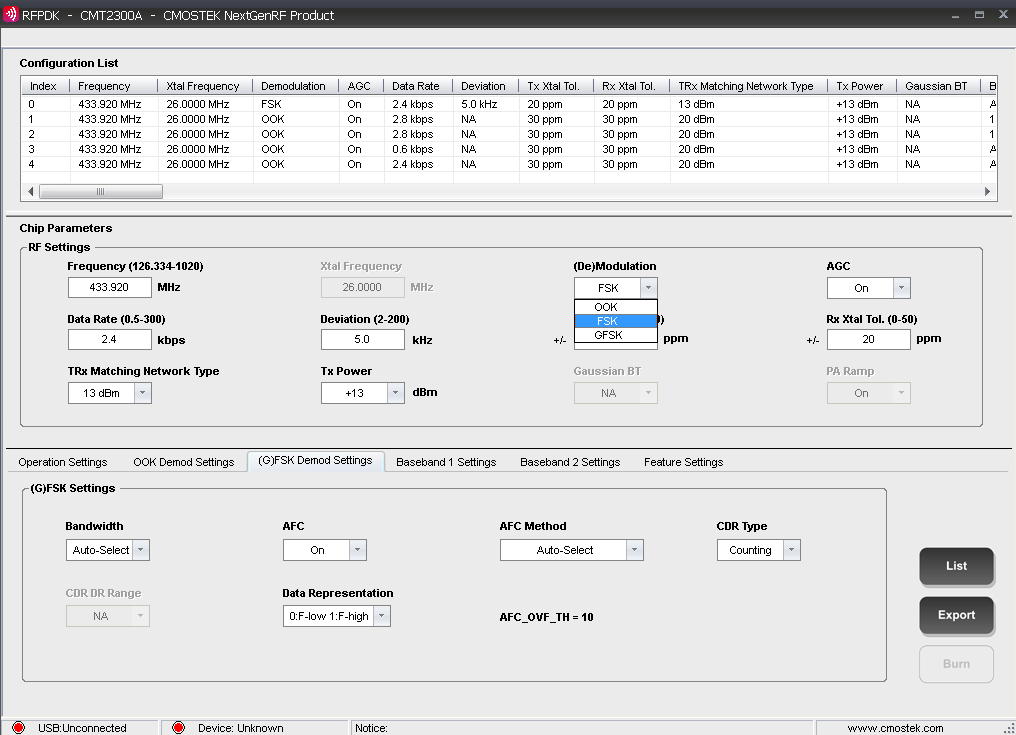
    From the "cmostek rfpdk" tool I see that it supports OOK, FSK and GFSK modulation (whatever that means).
    User interface of RFPDK software for CMT2300A device with configuration settings.

    (*) actually I couldn't find a set of parameters that generated the same configuration I captured.
  • #16 21495643
    kingdomcitytaker
    Level 2  
    Thanks for the brief but rather intuitive insight.. so in a nutshell it is able to imitate & clone FSK signals...
    That's all I need to hear...
    I'm not tech savvy when it comes to injecting packets or mods.. hopefully it'll just work out of the box...
    I got my fingers crossed 🤞
  • #17 21495659
    olivluca
    Level 7  
    >>21495643
    I'm not sure if you want to use tuya firmware or my implementation for libretiny/esphome, but in any case it will only work if the modulation used is the same as a "normal" 433MHz remote.
    Even then, if you use tuya firmware I highly doubt you can learn the remote if it's using rolling codes, but what do I know?
    Even with my implementation the codes to be sent are fixed in the yaml, though I think that with some lamba magic you could generate codes on the fly.
  • #18 21495678
    kingdomcitytaker
    Level 2  
    I really have no idea what you are talking about.. since I'm not well versed in RF modulation & its jargons... Even to me.. ASK, FSK & PSK.. only means it has different kind of coding or frequency shifting modulation.. if you ask me.. unlike wifi.. which is pretty much defined & straightforward... 11-13 channels in the a/b/g/n 2.4 GHz bands.. & some other more channels in the 5 & 6 GHz bands.. each with its own security standards.. like WPS, WPA, PSK.. and such... I couldn't keep up as a general end user...

    As for amateur radio band they also have the ASK, FSK, FMRS.. and other shits as well.. too advanced for my meager brain to keep up...
    It's just simply too complicated for an average Joe..
    But I appreciate your rather comprehensive explanation, since I'm just another John.. I'd simply ask if anyone has any success replicating/ cloning their autogate remote(s) with this device? Especially the ones notoriously more advanced security such as rolling modes remotes...as generally used in modern garage/ gate opener?
  • #19 21495691
    olivluca
    Level 7  
    >>21495678
    Oh, I'm probably even less versed than you in RF, but my understanding is that the modulation is just a way to send bits over the air, so you not only have to match the modulation but also have to match the sequence of bits.
    For a normal remote it's quite easy, since the bits for each key are always the same you can listen, learn them and then transmit them at will.
    A rolling code remote will send a different set of bits each time you press the same key, so you have to know the algorithm and be able to generate the bits on the fly.
    Again, this is just my understanding which could be totally wrong.
  • #20 21733992
    juleswit
    Level 2  
    Hello,
    I just bought an Avatto Tuya S16Pro. Hope my question is in the good forum. I'm not familiar with ESPHome (first time), but I did a lot of ESP32 ESP8266.
    So I would like to save the factory bin or if it not possible at least have a communication with UART USB. Unfortunately I can't get anything working. I do the following command:
    bk7231tools chip_info -d /dev/ttyUSB0
    bk7231tools installed through pip install, and Arduino IDE monitor shows connection on /dev/ttyUSB0. I always get timeout errors, I "play" with CEN pin as seen on many videos (I keep it with my finger), but after one afternoon, still have no success to just get chip info. Also tried ltchiptool without luck.
    I attached picture of my wiring, and I have a dedicated 3.3 V adaptor connected to CBU pin.
    Any thought how to get it work ?
    Attachments:
    • Avatto Tuya S16 PRO Wifi + RF Teardown and Internal Components Analysis IMG_20251028_175206.jpg (2.24 MB) You must be logged in to download this attachment.
  • #21 21734997
    juleswit
    Level 2  
    Hello

    I will reply if somebody wants to install the great ESPHome on the device S16 Pro, and, like me, is not familiar.

    ! Nothing to open/solder!

    1) Go to tuya-cloudcutter: https://github.com/tuya-cloudcutter/tuya-cloudcutter/blob/main/INSTRUCTIONS.md
    Follow instructions...
    Select By manufacturer/device name THEN Tuya generic THEN tuya-generic-ir-rf-universal-remote-controller-v2.0.15 (you should check if your device is 2.0.15 by connecting Tuya Smart Life app and connecting your device and checking its version).
    Process takes 2 restarts in slow blinking mode. Afterwards, your device will be visible from your router and port 6668 is opened on the avatto IP.
    [size=12]My logs ended by those lines:
    Device should be successfully onboarded on WiFi AP! Please allow up to 2 minutes for the device to connect to your specified network.
    Device MAC address: f8:17:xxxxxxx
    Device Id: HyPOK0PXXXXXX
    Local Key: whjEPgXXXXXX
    [/size]


    2) Upgrade to firmware of olivluca (https://github.com/olivluca/tuya_rf).
    a) First compile by typing:
    esphome run tuya.yaml
    It will create the firmware.bin in /tuya_rf-master/.esphome/build/tuya/.pioenvs/tuya/firmware.bin. Copy the firmware.bin to tuya-cloudcutter/custom-firmware/avattos16pro.bin
    b) Upgrade the firmware through cloudcutter:
    sudo ./tuya-cloudcutter.sh -p tuya-generic-ir-rf-universal-remote-controller-v2.0.15 -f avattos16pro.bin (it will take again 2 restarts with slow blinking).
    My logs ended with:
    Processing endpoint /v2/url_config
    Processing endpoint tuya.device.active
    Processing endpoint tuya.device.dynamic.config.get
    Processing endpoint tuya.device.upgrade.get
    Processing endpoint tuya.device.upgrade.status.update
    Processing endpoint /files/avattos16pro.bin-bk7231n-extracted.ug.bin
    Firmware update progress: 30%
    Firmware update progress: 60%
    Firmware update progress: 88%
    [Firmware Upload] /files/avattos16pro.bin-bk7231n-extracted.ug.bin send complete, request range: bytes=0-534031/534032
    Firmware update progress: 98%
    Firmware file has been sent and MQTT reported a progress of nearly complete. Waiting 15 seconds to ensure flashing completes.
    Flashing should be complete. It takes about 15 seconds for the device to reboot and verify the flash was valid.
    Please wait about 30 seconds then look for signs of activity from the firmware you supplied (either watch for AP mode or check if it joined your network).
    Device MAC address: f8XXXXX


    I didn't have any problems doing the steps. I did step 1) of cloudcutter about 4 times because I wasn't waiting long enough to see the avatto IP on my router. So just be patient, and the first time will be OK...
    Attachments:
    • avattos16pro.bin (2.65 MB) You must be logged in to download this attachment.

Topic summary

✨ The Avatto Tuya S16 PRO is a compact smart IR and RF device featuring a CBU module and a Tuya SH4 RF module operating at 433/315 MHz with 2.4 GHz Wi-Fi (IEEE 802.11 b/g/n). The device is opened via clips without screws, revealing pads for -V, TX, RX, and V+ connections on the front side. The SH4 module is distinct from Sensirion SHT40 sensors and includes an RF shield. Factory firmware was not backed up, requiring manual tracing of connections. Open-source support for the CBU and SH4 modules exists, notably through the tuya_rf component in ESPHome and LibreTiny firmware, enabling IR and RF control. Configuration examples and ESPHome YAML files were shared, including RF codes for fan control. The device’s RF chip (cm2300A) supports multiple modulations such as OOK, FSK, and GFSK, but rolling code remotes may not be clonable with factory firmware. Modulation matching and bit sequence replication are critical for RF remote emulation. OpenBeken integration is possible but requires developer effort due to software complexity. The device is suitable for Wi-Fi gate control, though advanced rolling code modulation presents challenges for cloning.
Generated by the language model.

FAQ

TL;DR: Avatto S16 PRO offers 38 kHz IR and 433/315 MHz RF; “I can confirm that the IR is working.” It uses Tuya CBU + SH‑4 with mapped IR/LED pins; this FAQ helps tinkerers integrate, flash, and troubleshoot. [Elektroda, yarix2, post #21225618]

Why it matters: It lets you bridge Wi‑Fi to legacy IR/RF gear while avoiding common RF pitfalls.

Quick Facts

What are the key specs and radios on the Avatto Tuya S16 PRO?

Mode S16 PRO. Size Ø65×21 mm. Power DC 5V/1A via Micro‑USB. Wi‑Fi 2.4 GHz IEEE 802.11 b/g/n. RF at 433/315 MHz. IR carrier 38 kHz with ≤10 m range. Operating temperature 0–60 °C. Humidity 0–95% RH. These match the teardown’s printed specification block. [Elektroda, yarix2, post #21225618]

How do I open the S16 PRO without breaking it?

Pry from the top circle using a thin, sharp tool. Work around the edge to release the clips. There are no screws, only plastic clips. Take care not to mar the shell or damage the PCB near the edge. [Elektroda, yarix2, post #21225618]

Which GPIOs handle IR send/receive and the status LED?

Community mapping shows IR Emit on P7, IR Receive on P8, and the status LED on P9. Quote: “IR Emit is P7; IR Receive is P8; ‘wfst_pin’ (status LED?) is P9.” This aligns with other backups of the same device. [Elektroda, divadiow, post #21225784]

How can I run this device under ESPHome right now?

Use LibreTiny with ESPHome and add the external tuya_rf component. Define IR transmit on GPIO07, IR receive on GPIO08, and status LED on P9. A working YAML shows IR climate control and RF transmit buttons. The example also maps a reset button on P23. [Elektroda, yarix2, post #21227105]

Is the Tuya SH‑4 module actually a Sensirion SHT40 sensor?

No. SH‑4 is a Tuya RF module, unrelated to the Sensirion SHT40 temperature/humidity sensor. Quote: “I don’t think the Tuya SH4 module is related to the Sensirion SHT40.” Use SH‑4 for RF, not sensing. [Elektroda, divadiow, post #21225784]

What RF chip and modulations does SH‑4 support?

SH‑4 drives a CMT2300A transceiver. The vendor tool indicates OOK, FSK, and GFSK support. You must generate a parameter header using Cmostek RFPDK and push it to the chip in firmware. One implementation instead captured Tuya’s I²C parameters. [Elektroda, olivluca, post #21495639]

Can the S16 PRO clone rolling‑code gate or garage remotes?

Not out of the box. Rolling codes change every press, so learning a single frame fails. Tuya’s app and the shared ESPHome component use fixed codes. Quote: Tuya firmware likely can’t learn rolling codes. [Elektroda, olivluca, post #21495659]

I see “CMT2300A_notFound” in logs. What does that indicate?

The factory boot log prints “CMT2300A_notFound” when the RF chip isn’t detected. It suggests a missing or miswired SH‑4/CMT2300A path. Without a detected transceiver, RF receive and transmit will not operate. Check power and bus lines to SH‑4. [Elektroda, divadiow, post #21225794]

Which RF bands and Wi‑Fi standards are supported?

RF operates at 433 MHz and 315 MHz. Wi‑Fi uses 2.4 GHz on IEEE 802.11 b/g/n. These are specified on the unit and confirmed in the teardown notes. [Elektroda, yarix2, post #21225618]

Where are the UART pads for flashing, and how did you power it?

Front pads are labeled −V, TX, RX, V+. TX and RX work for UART access. The author soldered VCC directly to the CBU because the pads were tight. Expect 5 V on USB input and 3.3 V logic on UART. [Elektroda, yarix2, post #21225618]

Is OpenBeken support available, or can it be added?

OpenBeken lacks a SH‑4 driver today, but the ESPHome code exists. Quote: “a developer knowing OpenBeken could use it to port the component.” The structure differs, but a port is feasible with contributors. [Elektroda, olivluca, post #21241147]

How do I learn and replay RF codes for a fan in ESPHome?

Use tuya_rf to dump raw frames, then replay with transmit_raw. Example YAML shows repeated sends for reliability. Three steps:
  1. Add external_components for tuya_rf and compile.
  2. Enable tuya_rf dump raw and press your remote.
  3. Create a button that transmit_raw repeats your captured code. This enabled full RF fan control. [Elektroda, yarix2, post #21226707]

Which pin is the reset button on this board revision?

One working configuration maps the reset button to P23. It notes the button has an external pull‑down. Define it as a GPIO binary_sensor on P23 in ESPHome. [Elektroda, yarix2, post #21227105]

What are the factory IR and LED assignments seen at boot?

Boot logs show ir_send=7, ir_recv=8, and wfst_pin=9. The log also lists led_num=9 and other config keys. This confirms the common P7/P8/P9 mapping used in custom firmware. [Elektroda, divadiow, post #21225794]
Generated by the language model.
ADVERTISEMENT