logo elektroda
logo elektroda
X
logo elektroda

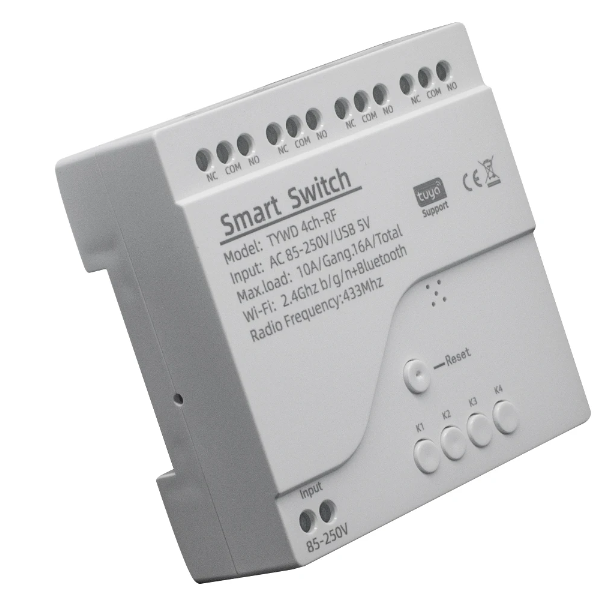
[BK7231N / CB3S] Tuya Smart Life Garage Door Motor Receiver 4CH Switch Controller WiFi Switch

lionboy 7671 30
ADVERTISEMENT
  • Helpful post
    #1 20860235
    lionboy
    Level 10  
    Posts: 69
    Help: 1
    Rate: 4
    Tuya smart switch with four buttons and display
    Hello,
    Here is Tuya JSON config for this device:
    Code: JSON
    Log in, to see the code

    As exported by https://github.com/openshwprojects/BK7231GUIFlashTool :
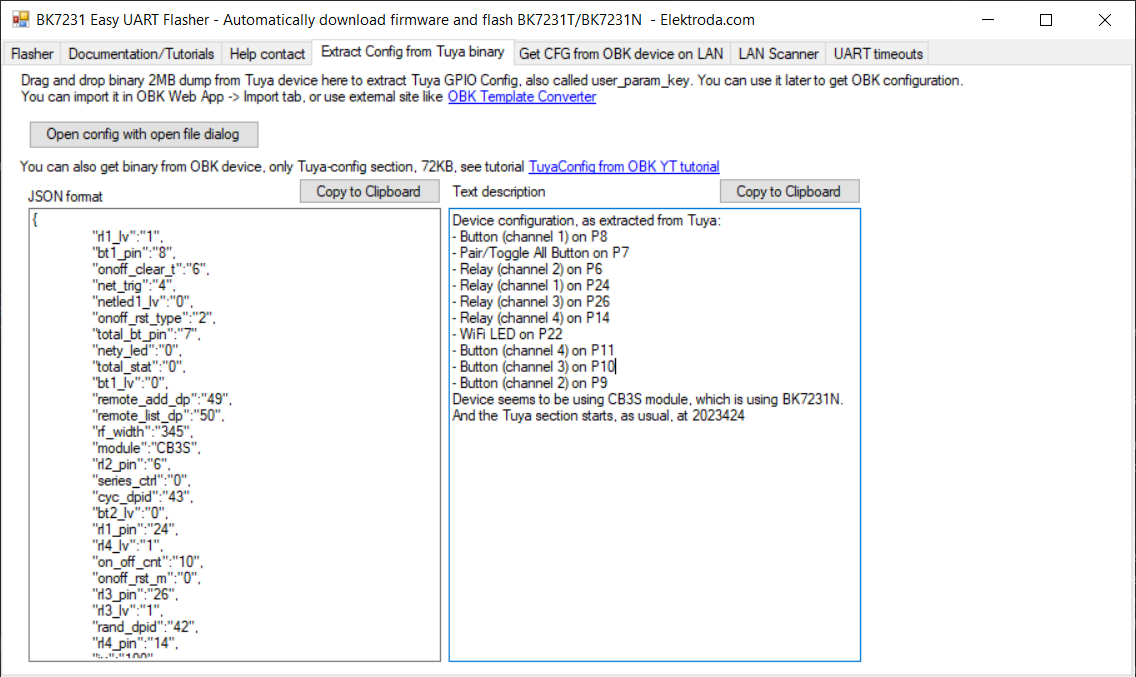
    User interface of a device configuration tool showing Tuya JSON code.
    Text description:
    
    Device configuration, as extracted from Tuya: 
    - Button (channel 1) on P8
    - Pair/Toggle All Button on P7
    - Relay (channel 2) on P6
    - Relay (channel 1) on P24
    - Relay (channel 3) on P26
    - Relay (channel 4) on P14
    - WiFi LED on P22
    - Button (channel 4) on P11
    - Button (channel 3) on P10
    - Button (channel 2) on P9
    Device seems to be using CB3S module, which is using BK7231N.
    And the Tuya section starts, as usual, at 2023424
    

    OBK template:
    Code: JSON
    Log in, to see the code


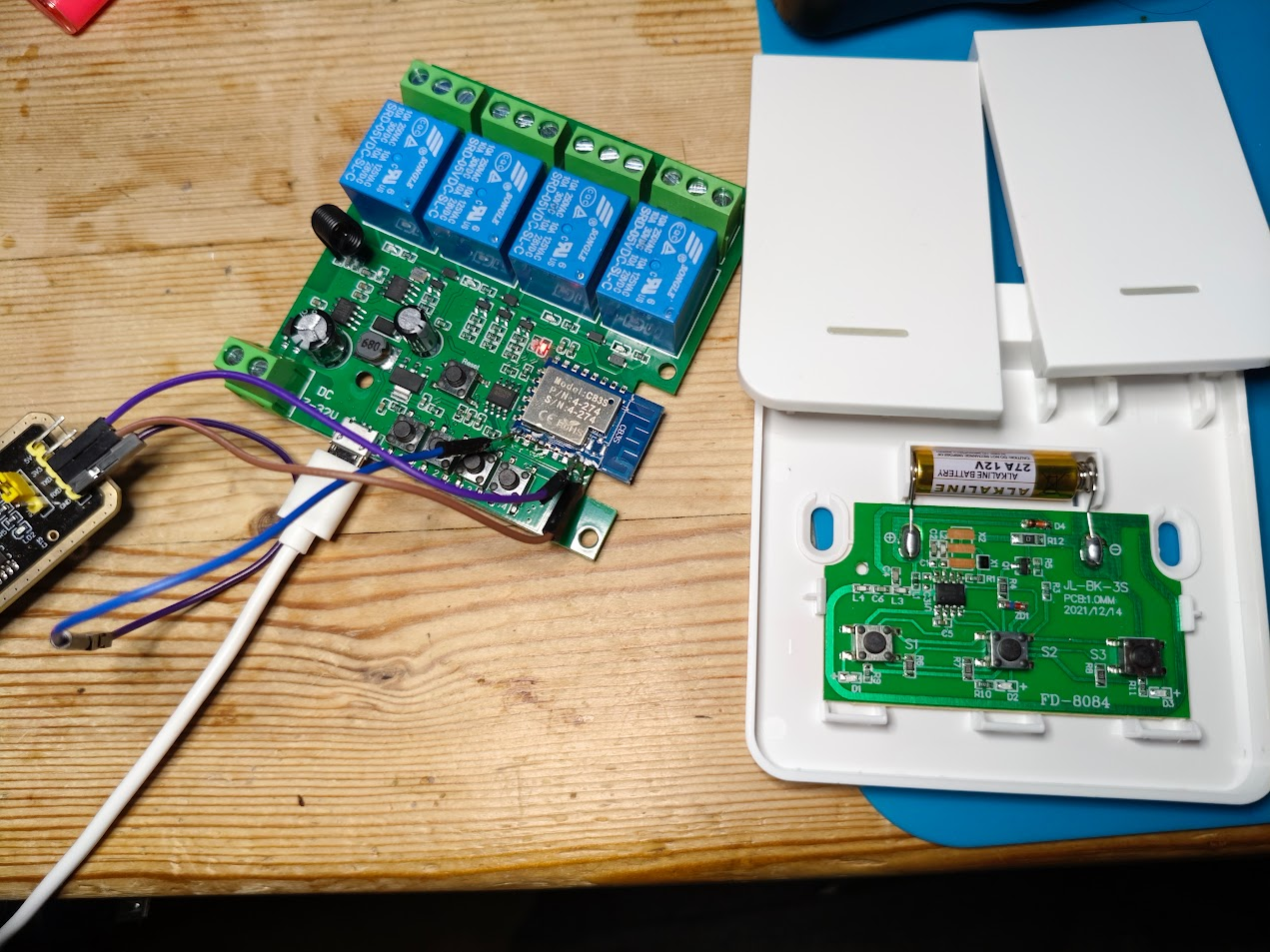
    After desoldering the CB3S chip from the board, I successfully put ESPHome on this Relay Board:
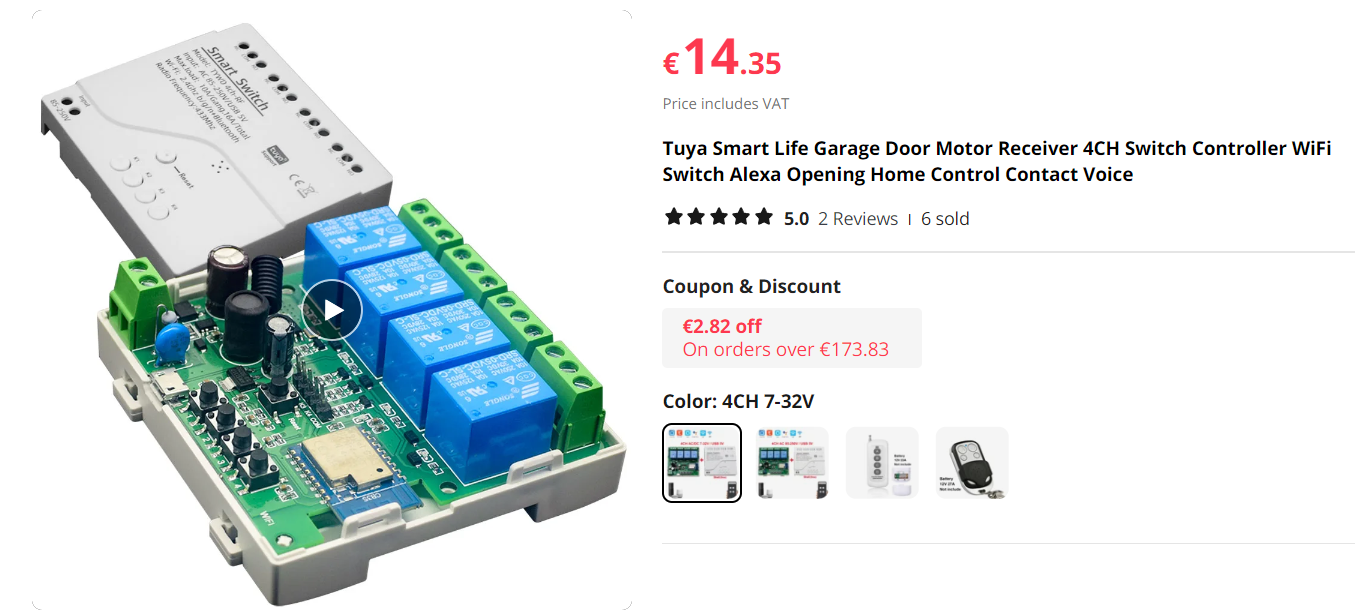
    Tuya Smart Life, garage door control receiver with visible circuit board.
    https://vi.aliexpress.com/item/10050053866410...1RO%21728730991%21&curPageLogUid=ruZlMkOZGwQc

    I will leave here a 2 MB bin extracted and templates if anyone wants to put it on their board:

    ADVERTISEMENT


    GPIO for EspHome:
    
    sensor:
      - platform: uptime
        name: Uptime
    
    binary_sensor:
      - platform: gpio
        id: binary_switch_1
        pin:
          number: P8
          inverted: true
          mode: INPUT_PULLUP
        on_press:
          then:
            - switch.toggle: switch_1
      - platform: gpio
        id: binary_switch_2
        pin:
          number: P9
          inverted: true
          mode: INPUT_PULLUP
        on_press:
          then:
            - switch.toggle: switch_2
      - platform: gpio
        id: binary_switch_3
        pin:
          number: P10
          inverted: true
          mode: INPUT_PULLUP
        on_press:
          then:
            - switch.toggle: switch_3
      - platform: gpio
        id: binary_switch_4
        pin:
          number: P11
          inverted: true
          mode: INPUT_PULLUP
        on_press:
          then:
            - switch.toggle: switch_4
      - platform: gpio
        id: binary_switch_all
        pin:
          number: P7
          inverted: true
          mode: INPUT_PULLUP
        on_press:
          then:
            - switch.toggle: switch_1
            - switch.toggle: switch_2
            - switch.toggle: switch_3
            - switch.toggle: switch_4
    
    switch:
      - platform: gpio
        id: switch_1
        name: Open Gate
        pin: P24
      - platform: gpio
        id: switch_2
        name: Close Gate
        pin: P6
      - platform: gpio
        id: switch_3
        name: Stop Gate
        pin: P26
      - platform: gpio
        id: switch_4
        name: Gate SbS
        pin: P14
    
    status_led:
      pin:
        number: P22
        inverted: true


    I forgot to take some pictures of the board.

    Thanks
    Attachments:
    • ltchiptool_bk72xx_2023-12-13_20-28-32.bin (2 MB) You must be logged in to download this attachment.
  • ADVERTISEMENT
  • Helpful post
    #2 20860808
    p.kaczmarek2
    Moderator Smart Home
    Posts: 14580
    Help: 654
    Rate: 12604
    Thank you for sharing. I've added the images from the shop offer in case that it expire and futhermore extended description a bit. The device should be soon live on our teardowns list.

    I will also correct code/quote tags in a moment (we use code for codes, because our translation system would translate quotes and thus break the code...)
    Helpful post? Buy me a coffee.
  • #3 20903211
    lionboy
    Level 10  
    Posts: 69
    Help: 1
    Rate: 4

    I have a question:

    Does anyone know how to set up RF using this code?

    
    {
    	"rl1_lv": "1",
    	"bt1_pin": "8",
    	"onoff_clear_t": "6",
    	"net_trig": "4",
    	"netled1_lv": "0",
    	"onoff_rst_type": "2",
    	"total_bt_pin": "7",
    	"nety_led": "0",
    	"total_stat": "0",
    	"bt1_lv": "0",
    	"remote_add_dp": "49",
    	"remote_list_dp": "50",
    	"rf_width": "345",
    	"module": "CB3S",
    	"rl2_pin": "6",
    	"series_ctrl": "0",
    	"cyc_dpid": "43",
    	"bt2_lv": "0",
    	"rl1_pin": "24",
    	"rl4_lv": "1",
    	"on_off_cnt": "10",
    	"onoff_rst_m": "0",
    	"rl3_pin": "26",
    	"rl3_lv": "1",
    	"rand_dpid": "42",
    	"rl4_pin": "14",
    	"jv": "100",
    	"bt3_lv": "0",
    	"reset_t": "5",
    	"netled1_pin": "22",
    	"rl2_lv": "1",
    	"net_type": "0",
    	"bt4_pin": "11",
    	"inch_dp": "44",
    	"bt3_pin": "10",
    	"ch_cddpid1": "9",
    	"remote_io": "20",
    	"init_conf": "38",
    	"bt4_lv": "0",
    	"zero_select": "0",
    	"onoff_type": "2",
    	"bt2_pin": "9",
    	"ch_cddpid4": "12",
    	"ch_cddpid2": "10",
    	"ch_cddpid3": "11",
    	"total_bt_lv": "0",
    	"remote_select": "1",
    	"ch_num": "4",
    	"ch_dpid3": "3",
    	"ch_dpid4": "4",
    	"netn_led": "0",
    	"ch_dpid1": "1",
    	"ch_dpid2": "2",
    	"crc": "109",
    	"}@Agw_diAinch_time_keyv": "40.00",
    	"pv": "2.2",
    	"lpv": "3.4",
    	"pk": "keyjnuy4s3kre7m7",
    	"firmk": "keyjnuy4s3kre7m7",
    	"cadv": "rl",
    	"lp_ip": "18.193.97.90",
    	"time_z": "+02",
    	"s_time_z": "[[1711846800",
    	"wx_app_id": "null",
    	"wx_uuid": "null",
    	"dy_tls_m": "2",
    	"cloud_cap": "1025",
    	"psk21_key": "null "
    }


    Thanks
  • #4 20903214
    p.kaczmarek2
    Moderator Smart Home
    Posts: 14580
    Help: 654
    Rate: 12604
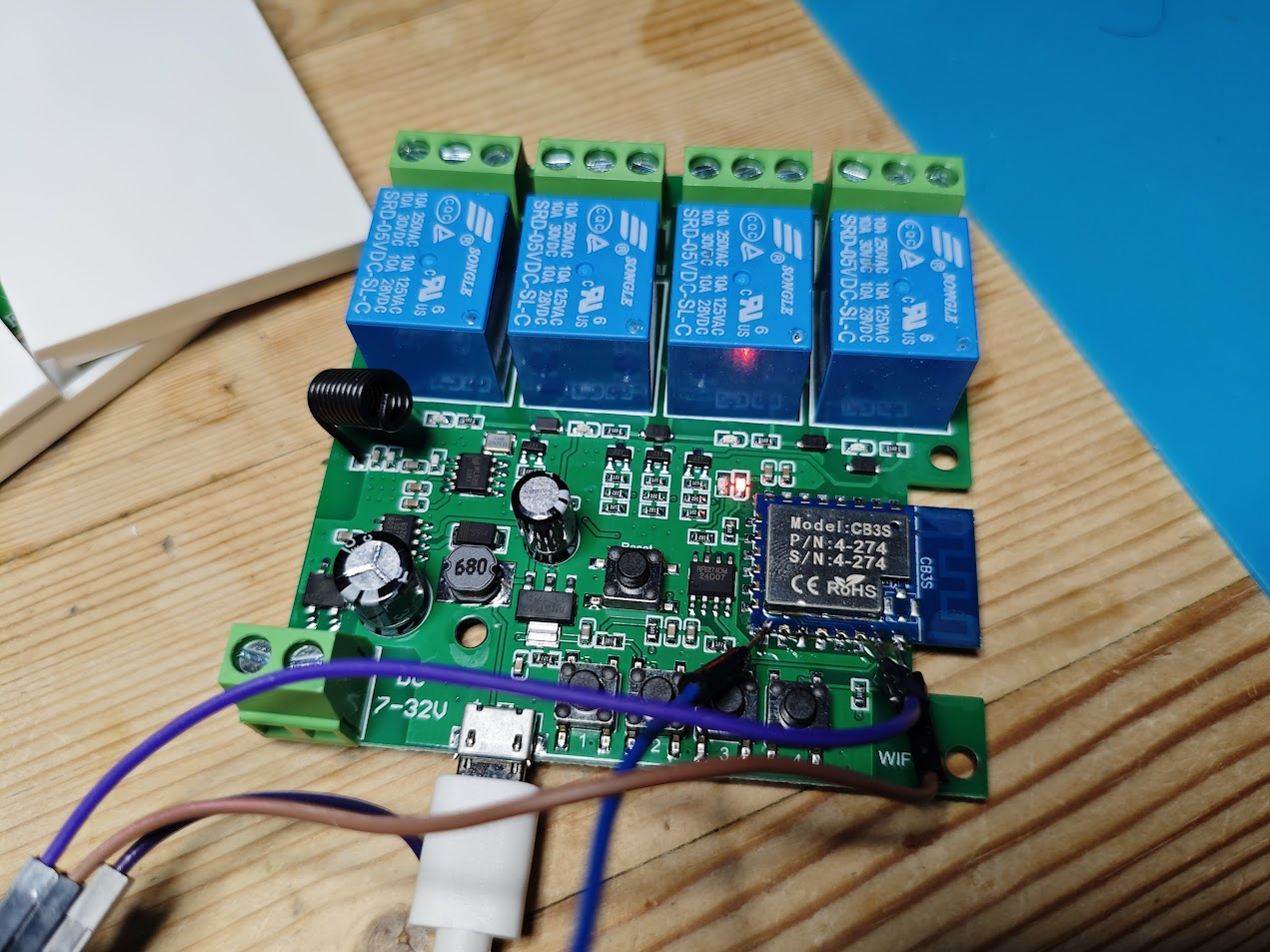
    Can you check which GPIO is connected to RF receiver? How does the board looks like from the close up?
    Helpful post? Buy me a coffee.
  • #5 20903224
    lionboy
    Level 10  
    Posts: 69
    Help: 1
    Rate: 4

    I need to take from my gate again and make some pictures but I have another one with Zigbee. Do you think I can figure it out from that or do I need this with CB3S? They are the same, only one is with Zigbee and another with CB3S.

    Added after 4 [minutes]:


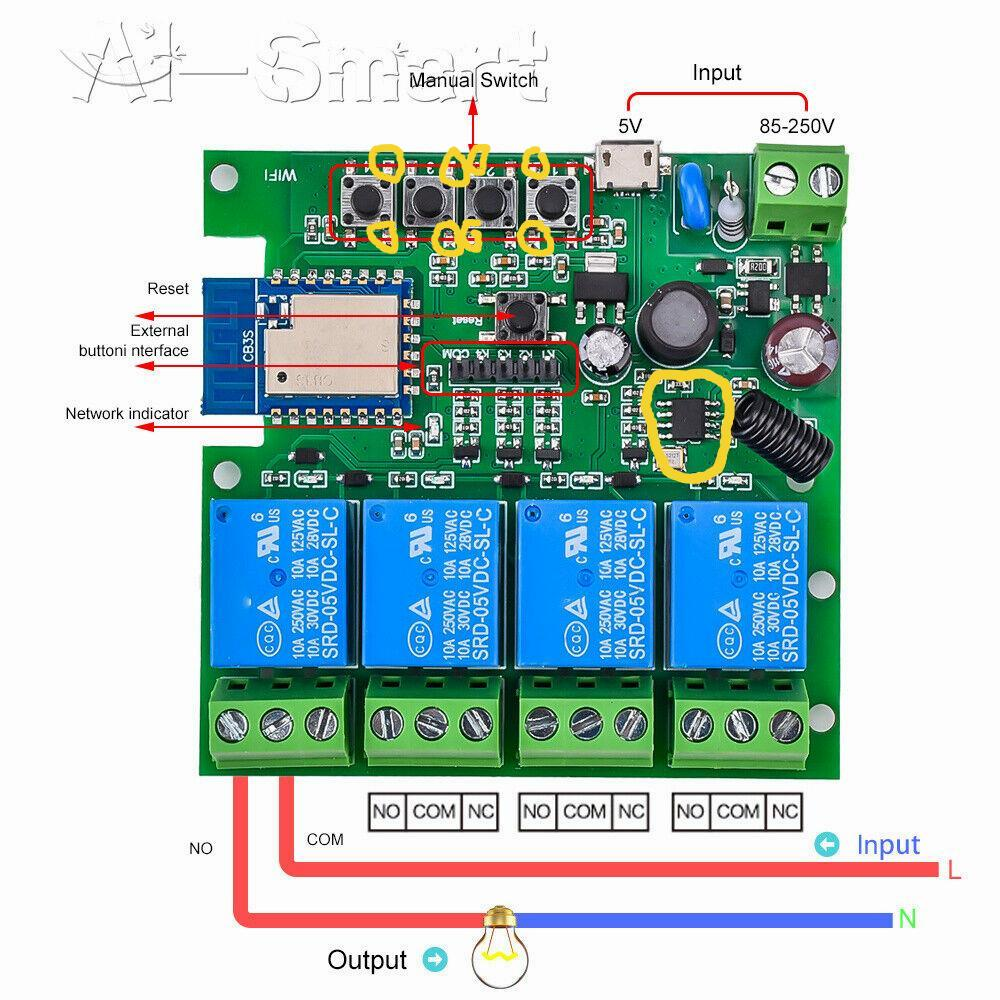
    Electronic module with labeled components and indicators.

    I found these pictures on the net. I don't know if they are okay.
  • #6 20903254
    p.kaczmarek2
    Moderator Smart Home
    Posts: 14580
    Help: 654
    Rate: 12604
    But is RF receiver connected to CB3S via single pin, or is it integrated into buttons driver?

    RF receiver integrated into buttons controller (another SOIC chip) does not require any drivers on OBK side, it should work out of the box
    Helpful post? Buy me a coffee.
  • ADVERTISEMENT
  • #7 20903375
    lionboy
    Level 10  
    Posts: 69
    Help: 1
    Rate: 4
    I don't know how I can figure out if there is another chip for RF or not.


    Added after 1 [hours] 49 [minutes]:

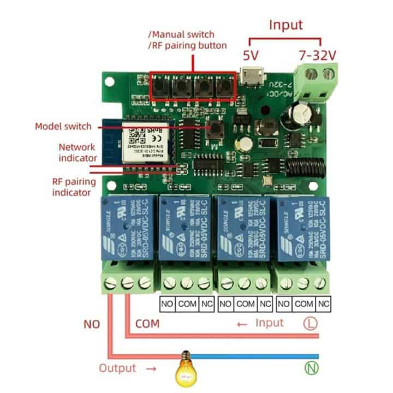
    On the chip near antena is this write: 590R 2326 i don't know what is this and didn't find on google something related to this

    Schematic image of an electronic board with labeled components such as buttons, network indicator, and antenna.

    Pin with ywllow i saw have a beep with Antenna
  • #8 21120483
    Nordlicht77
    Level 9  
    Posts: 67
    Hi
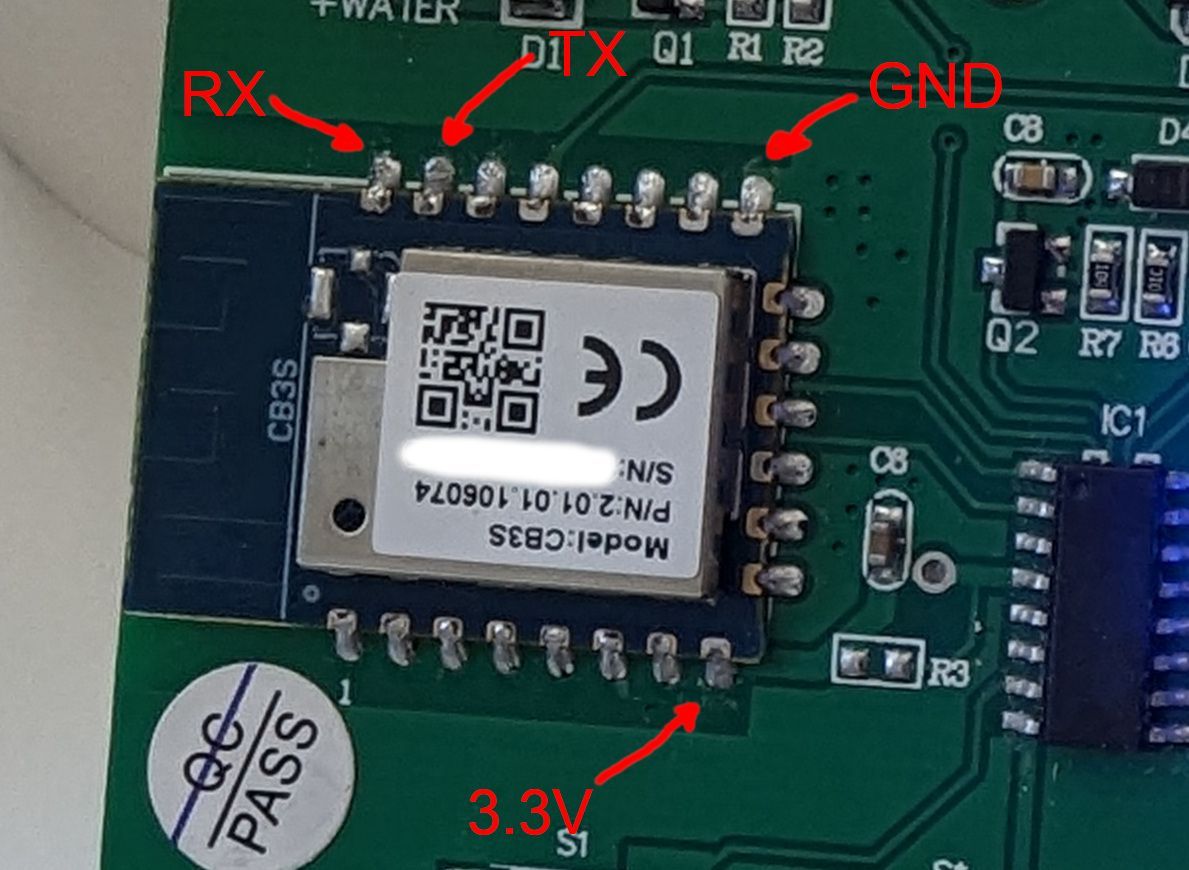
    I can't get a connection to the device
    Which flashers did it do it with?
    Which pins did you use?
    I still have to add something extra

    I have it like this in this picture
    Electronic module on a board with labeled RX, TX, GND, and 3.3V pins

    greet
    Martin
  • #9 21120653
    p.kaczmarek2
    Moderator Smart Home
    Posts: 14580
    Help: 654
    Rate: 12604
    CB3S can be easily flashed with:
    https://github.com/openshwprojects/BK7231GUIFlashTool
    But you need to be able to do a power cycle.
    See tutorials: https://www.youtube.com/playlist?list=PLzbXEc2ebpH0CZDbczAXT94BuSGrd_GoM
    Helpful post? Buy me a coffee.
  • #10 21120843
    Nordlicht77
    Level 9  
    Posts: 67
    so I must

    GND -> GND
    3V -> ADC3
    RX -> TX
    TX -> RX
    CEN -> GND kurz

    additionally

    AMS1117
    left GND -> GND(1)
    right 5V -> IN(3)

    Do I have to do the cutting, if so where?
  • #11 21120964
    p.kaczmarek2
    Moderator Smart Home
    Posts: 14580
    Help: 654
    Rate: 12604
    What is AD3?

    You don't need CEN.

    I would do:
    - RX to TX
    - TX to RX
    - GND to GND
    - connect 5V from USB to board USB port
    Then:
    1. start flash read
    2. disconnect 5V and reconnect it to reset/get bus
    3.flashing should start
    Helpful post? Buy me a coffee.
  • #12 21121269
    Nordlicht77
    Level 9  
    Posts: 67
    Sorry meant power supply pin (3.3V)

    Doesn't work now
    GND -> GND (FTDI232)
    RX -> TX (FTDI232)
    TX -> RX (FTDI232)
    and USB port on board to USB

    And as described, the USB was disconnected and reconnected
  • #13 21121303
    p.kaczmarek2
    Moderator Smart Home
    Posts: 14580
    Help: 654
    Rate: 12604
    So the main question is now - is RX/TX connected anywhere else on your board?

    Check with multimeter.
    Helpful post? Buy me a coffee.
  • #14 21121365
    Nordlicht77
    Level 9  
    Posts: 67
    like in the picture above
    I've never done anything like this with a multimeter
  • #15 21121370
    p.kaczmarek2
    Moderator Smart Home
    Posts: 14580
    Help: 654
    Rate: 12604
    So detach all power, and then set multimeter in the continuity test mode. It should beep when you short the probes. Then, put one probe on RX, and test all other points on PCB for continuity (for beep).

    Alternatively, you can just look at the PCB, are there vias/traces on the other side of the board, under the WiFI module?
    Helpful post? Buy me a coffee.
  • #16 21121448
    Nordlicht77
    Level 9  
    Posts: 67
    I can't find the multimeter right now
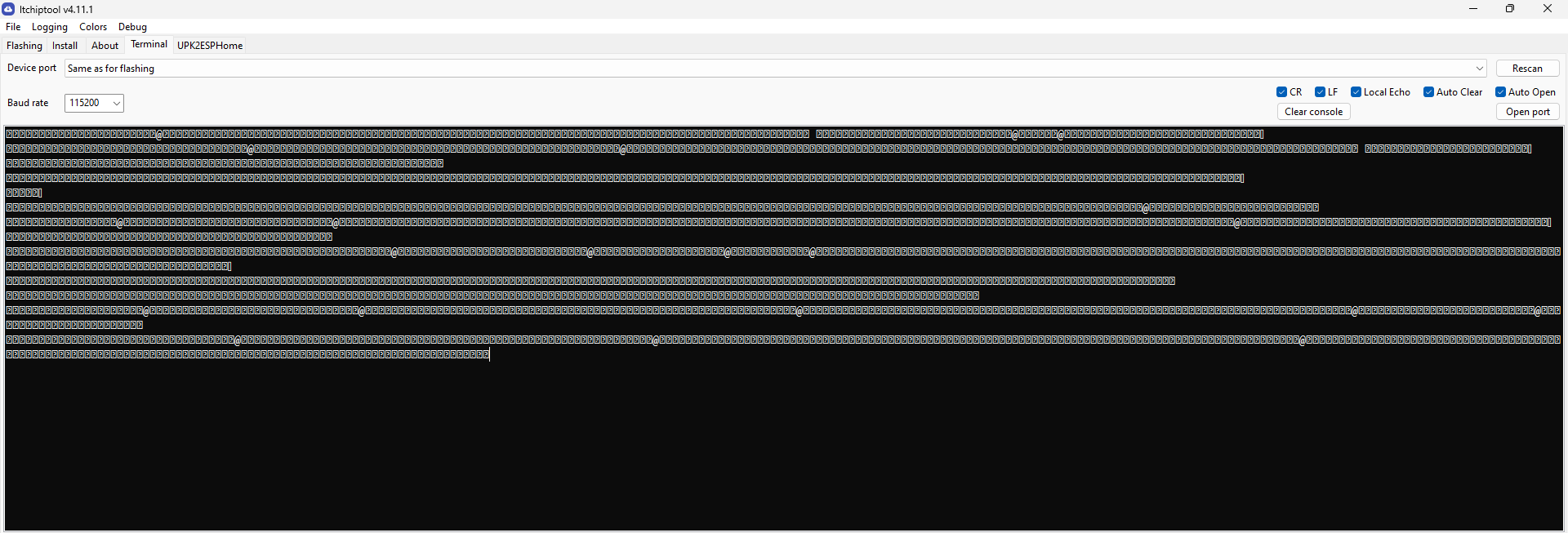
    With the program ltchiptool-v4.11.1 I get such an output at different baud rates
    Screenshot of ltchiptool v4.11.1 with unintelligible console output.
    Not a clear one like with the automatic feeder
    Which FTDI232 are you missing? I have read that it is not ideal for this
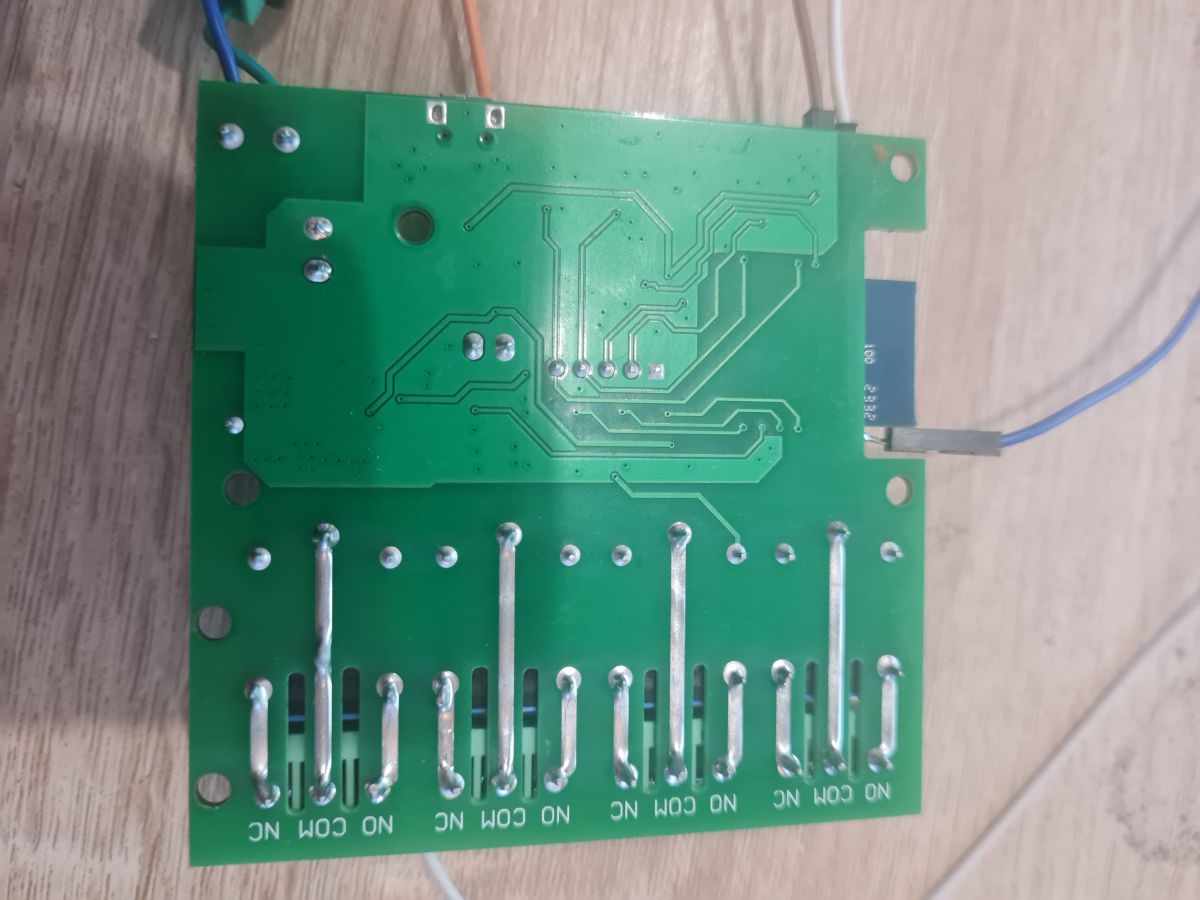
    The board looks like this from below
    Printed circuit board seen from below, showing traces and solder points.
  • ADVERTISEMENT
  • #17 21121988
    Nordlicht77
    Level 9  
    Posts: 67
    Hi
    I have now found the multimeter and completely unplugged it from the FTDI232
    there are no sounds
  • #18 21122408
    p.kaczmarek2
    Moderator Smart Home
    Posts: 14580
    Help: 654
    Rate: 12604
    Have you flashed any other Beken devices already?
    Helpful post? Buy me a coffee.
  • #20 21122594
    p.kaczmarek2
    Moderator Smart Home
    Posts: 14580
    Help: 654
    Rate: 12604
    Well, so if the 3.3V reset method does not work for you, then maybe you can try the CEN approach? Have you read about that? Basically, instead of reconnecting the power, you short CEN to ground for 0.25 s...
    Helpful post? Buy me a coffee.
  • #22 21140406
    p.kaczmarek2
    Moderator Smart Home
    Posts: 14580
    Help: 654
    Rate: 12604
    Device from the first post has been added to our database, sorry for the delay, commit:
    https://github.com/OpenBekenIOT/webapp/commit/f9dd8dc42a4043f1df5207cccf0b1f8ef2099012
    It should be soon live at:
    https://openbekeniot.github.io/webapp/devicesList.html
    I have used mode name: TYWD 4CH-RF
    Helpful post? Buy me a coffee.
  • #23 21144422
    divadiow
    Level 38  
    Posts: 5027
    Help: 438
    Rate: 891
    if there was still any doubt, I have the 7-32V/5V USB version of the naked board of this and the RF operates independently. Mine is now running OBK and it still pairs with this 3-button RF switch I got with a different device.

    Printed circuit board with electronic components and power supply on a wooden surface.
    PCB with four blue relays and a CB3S Wi-Fi module.

    bootlog and dump from mine

    Code: Text
    Log in, to see the code
    Attachments:
    • readResult_BK7231N_QIO_2024-05-7-16-40-36.bin (2 MB) You must be logged in to download this attachment.
  • #25 21448020
    rainerrmn
    Level 4  
    Posts: 4
    There is another name for a similar module: TYWB-4ch rf and TYWD-4ch rf. The difference between these modules is the supply voltage(AC-mains or low voltage-DC).
    The Beken CB3s, the rf SYN590, the 4 relays and buttons, the gpios used and all this are the same with these modules.

    So you can merge the information from the other thread:
    https://www.elektroda.com/rtvforum/topic3989878.html
  • ADVERTISEMENT
  • #26 21583893
    lcapriotti
    Level 1  
    Posts: 1
    my goal is to put ESPHome FW on the device (TYWB 4ch-RF, running fw 1.3.10 so tuyacloudclutter is not an option).
    I see two different processes: de-solder the cb3s (Post #1) and in-place flashing (Post #23); second being easier of course, so why de-solder it entirely?
  • #27 21757257
    Tilator
    Level 12  
    Posts: 130
    Help: 2
    Rate: 13
    I got one of these too. It's only 230V version. I attach backup and original FW settings json here:

    Code: JSON
    Log in, to see the code
    Attachments:
    • readResult_BK7231N_QIO_4c_2025-20-11-18-05-12.bin (2 MB) You must be logged in to download this attachment.
  • #29 21892981
    p.kaczmarek2
    Moderator Smart Home
    Posts: 14580
    Help: 654
    Rate: 12604
    Helpful post? Buy me a coffee.
  • #30 21895851
    Krazilek
    Level 2  
    Posts: 2
    lionboy wrote:


    Electronic module with labeled components and indicators.


    I have the same board with WB3S.
    The RF keychain is recorded, but the relay is not triggered.
    I can't figure out how to reset it or make it work.

    [BK7231N / CB3S] Tuya Smart Life Garage Door Motor Receiver 4CH Switch Controller WiFi Switch


    AlCube-ISP Check MCU log:
    Checking target MCU ... MCU type: STC15W204SCurrent 
    H/W Option: . Current system clock source is internal IRC oscillator . Current frequency: 11.069MHz . Wakeup Timer frequency: 35.975KHz . 
    Do not detect the level of P3.2 and P3.3 next download . 
    Power-on reset, use the extra power-on delay . RESET pin behaves as IO pin . Reset while detect a Low-Voltage . 
    Thresh voltage level of the built-in LVD : 2.69 V . Inhibit EEPROM operation under Low-Voltage . CPU-Core supply level : 2.74 V . 
    Hardware do not enable Watch-Dog-Timer . Watch-Dog-Timer pre-scalar : 256 . Watch-Dog-Timer stop count in idle mode . Program can modify the Watch-Dog-Timer scalar . Do not erase user EEPROM area at next download . Do not control 485 at next download . Do not check user password next download . 
    TXD is independent IO . TXD pin as quasi-bidirectional mode after reset . 
    P1.0 output HIGH level after reset . Reference voltage: 1254 mV (Range: 1150~1320mV) 
    MCU type: STC15W204S Complete !


    Silence in the terminal

    readResult...-30-19.bin (2 MB)You must be logged in to download this attachment.

    Need help, pls

Topic summary

✨ The discussion centers on the Tuya Smart Life Garage Door Motor Receiver 4CH Switch Controller based on the BK7231N chipset and CB3S module. The original poster shared a Tuya JSON configuration for the device and sought guidance on setting up the RF functionality. Participants examined the device's hardware, including GPIO pin assignments, the presence of an RF receiver chip (notably a SYN590 or similar), and the integration of RF with button controllers. Photos of the PCB and chip markings were analyzed to identify RF components and pin mappings, with TX and RX pins identified as GPIO 16 and 15 respectively. Flashing the CB3S module was discussed, including wiring for FTDI232 adapters, power cycling methods, and the use of tools like BK7231GUIFlashTool and ltchiptool. Challenges in establishing a serial connection and flashing firmware were addressed, with suggestions to test continuity on RX/TX lines and alternative reset methods using the CEN pin. The device was eventually added to an open-source database under the name TYWD 4CH-RF. Variants of the module, such as TYWB-4ch RF and TYWD-4ch RF, differ mainly in power supply type (AC mains vs. low voltage DC) but share the same core components and firmware. The possibility of replacing the original firmware with ESPHome was raised, with in-place flashing preferred over desoldering the CB3S chip. Overall, the thread provides detailed technical insights into hardware identification, firmware flashing, and RF setup for Tuya-based 4-channel garage door controllers using the BK7231N/CB3S platform.
Generated by the language model.

FAQ

TL;DR: This FAQ maps 10 GPIO assignments for the 4-relay CB3S board, and an experienced contributor confirmed RF can be “independent.” It helps Tuya TYWB-4CH-RF/TYWD-4CH-RF owners flash BK7231N safely, reuse the board with ESPHome or OpenBeken, and understand why RF may still work after firmware changes. [#21144422]

Why it matters: This thread answers the practical blockers that stop these 4-channel garage or gate controllers from being flashed, mapped, and reused reliably.

Variant Supply input Wi-Fi module RF behavior from thread Notes
TYWD-4CH-RF Low-voltage DC CB3S / BK7231N RF reported independent on some boards OpenBeken database name: TYWD 4CH-RF
TYWB-4CH-RF AC mains / 230 V version mentioned CB3S or WB3S Same relay/button GPIO layout reported Cloudcutter firmware worked on one WB3S case
7-32V / 5V USB naked board 7-32 V DC or 5 V USB CB3S / BK7231N RF still paired after OBK install Same basic hardware family

Key insight: The most important finding is that the RF section is often handled by a separate chip, not by the CB3S itself. That is why RF can keep working after OpenBeken is installed, and why JSON fields like remote_io do not automatically give you usable RF control in custom firmware. [#21144422]

Quick Facts

  • The exported Tuya config maps 4 relays, 4 channel buttons, 1 toggle-all button, and 1 Wi-Fi LED: relay pins P24, P6, P26, P14; button pins P8-P11; toggle-all on P7; Wi-Fi LED on P22. [#20860235]
  • The original dump shows rf_width set to 345, remote_io to 20, and remote_select reported as 1 in one config, while another device dump later showed remote_select as 0. [#21125280]
  • The Tuya firmware boot log identifies BK7231N firmware 1.3.10, Tuya IoT SDK 2.3.3, and build date 2022-12-07 15:29:01 for a matching board family. [#21144422]
  • One flashing method used in-place wiring with RX, TX, and GND plus board USB power, then a power reconnect to enter the boot path; no CEN line was required in that recommended sequence. [#21120964]

How do I set up RF on this Tuya 4-channel garage door controller using the exported JSON config with fields like remote_io, remote_select, and rf_width?

You usually do not set up RF from that JSON alone. The thread later confirmed the RF section can operate independently, and one matching board kept pairing with a 3-button RF remote after OpenBeken was installed. The boot log from that board also printed remote rf433 not enable, which shows the Tuya JSON fields were not enough to enable usable RF in custom firmware by themselves. In practice, first identify whether the RF receiver is on a separate chip or directly wired to the Wi-Fi module. [#21144422]

What are the correct GPIO pin mappings for the Tuya Smart Life Garage Door Motor Receiver 4CH Switch Controller with a CB3S/BK7231N module?

The mapped pins are P24 relay 1, P6 relay 2, P26 relay 3, P14 relay 4, P8 button 1, P9 button 2, P10 button 3, P11 button 4, P7 toggle-all, and P22 Wi-Fi LED. The same post also states the module is CB3S, which uses BK7231N. That gives you 10 usable assignments before any RF work. [#20860235]

What's the step-by-step process to flash a CB3S module in place with BK7231GUIFlashTool without desoldering it from the board?

Use the in-place serial method with a timed power reset. 1. Connect RX to TX, TX to RX, and GND to GND, then power the board from its USB input. 2. Start a flash read or flash operation in BK7231GUIFlashTool. 3. Disconnect 5 V and reconnect it to reset the board into the expected boot state. The contributor said this sequence should start flashing without removing the CB3S module. [#21120964]

Why would someone desolder the CB3S and replace it for ESPHome instead of doing in-place flashing on the original BK7231N board?

They may desolder because they want native ESPHome on a different module, not just a reflashed BK7231N. The first post says the CB3S was removed from the board, then ESPHome was installed and the board was reused with explicit GPIO definitions for four gate actions. That approach also bypasses any board-level serial access problem that can block in-place flashing. [#20860235]

Which pins should be connected to an FTDI adapter when flashing this BK7231N CB3S garage door board, and how should the power-cycle reset be done?

Connect FTDI RX to board TX, FTDI TX to board RX, and GND to GND. Then power the board separately through its USB port with 5 V, start the flash read, and briefly disconnect and reconnect that 5 V power. The same contributor explicitly said CEN was not needed in his preferred method. [#21120964]

Why does BK7231GUIFlashTool or ltchiptool fail to connect to a CB3S board even when RX, TX, and GND seem to be wired correctly?

Connection often fails because the board never enters the right boot state or because RX/TX are loaded by other circuitry. The thread narrowed the main question to whether the serial lines were connected anywhere else on the PCB. When the normal 3.3 V reset method fails, the suggested fallback was a short CEN-to-GND pulse of about 0.25 s. [#21122594]

How can I check with a multimeter whether the RX and TX lines on this Tuya CB3S board are connected to anything else that could block flashing?

Use continuity mode with all power removed. 1. Unplug the FTDI and all board power. 2. Set the meter to continuity mode and confirm it beeps when probes touch. 3. Put one probe on RX, then probe nearby pads, vias, and traces for a beep; repeat for TX. A beep means that line reaches another point that could interfere with flashing. [#21121370]

What is a CB3S module, and how does it relate to the BK7231N chip in Tuya relay boards?

“CB3S” is a Tuya Wi-Fi module that carries the BK7231N system chip, providing wireless control and GPIOs for relay boards. In this thread, the extracted configuration and template both identify the board as CB3S-based, and the description states directly that CB3S uses BK7231N. That is why BK7231 flashing tools apply to this hardware family. [#20860235]

What is the SYN590R RF receiver chip, and how is it used in TYWB-4CH-RF or TYWD-4CH-RF relay controllers?

“SYN590R” is a 433 MHz RF receiver IC that accepts remote-control signals and passes decoded events into the relay controller path, often as a separate hardware block. In this thread family, a contributor identified TYWB-4CH-RF and TYWD-4CH-RF as sharing the same Beken CB3S, the same RF SYN590, and the same relay and button GPIO layout. [#21448020]

How do I configure this 4-channel relay board in ESPHome using the reported pins for relays, buttons, toggle-all, and WiFi LED?

Map four GPIO switches for relays and five GPIO binary sensors for buttons. The shared ESPHome example used P24, P6, P26, and P14 for relays; P8, P9, P10, and P11 for per-channel buttons; P7 for toggle-all; and P22 as an inverted status LED. The sample names were Open Gate, Close Gate, Stop Gate, and Gate SbS. [#20860235]

When RF still works after installing OpenBeken, how can I tell whether the RF receiver is handled independently by another chip instead of by the CB3S firmware?

If RF still pairs and triggers after OpenBeken replaces the original firmware, the RF path is likely independent. One contributor reported exactly that on the 7-32 V or 5 V USB version: OpenBeken was running, yet a 3-button RF switch still paired and worked. Another contributor had already explained that an RF receiver integrated into another SOIC controller would need no OBK-side driver. [#21144422]

TYWB-4CH-RF vs TYWD-4CH-RF: what are the real differences besides AC mains versus low-voltage DC power input?

The thread says the main practical difference is the input power section. A later post states TYWB-4CH-RF and TYWD-4CH-RF use the same Beken CB3S, the same RF SYN590, the same four relays and buttons, and the same GPIO usage. That means firmware mapping and RF hardware assumptions transfer across both names much more than the power-input label suggests. [#21448020]

Where can I find the OpenBeken device template or database entry for this board, and what device name was used for it?

You can find it in the OpenBeken webapp device database entry added from this thread. The contributor posted the commit that added the board and said the model name used there was TYWD 4CH-RF. He also pointed readers to the webapp device list where it would appear after publication. [#21140406]

How do the 230V AC version and the 7-32V or 5V USB version of this Tuya 4-channel RF relay compare in GPIO layout, RF hardware, and firmware settings?

They appear very close in control hardware, despite different power inputs. The 230 V version shared a JSON with relays on P24, P6, P26, and P14, buttons on P8-P11, Wi-Fi LED on P22, and RF fields such as remote_io:20 and rf_width:345. The 7-32 V or 5 V USB board was reported to keep independent RF working after OpenBeken, which supports the same-hardware-family view. [#21757257]

What should I do if the RF keychain pairs successfully on a WB3S version of the board but the relay never triggers afterward?

Try known-working firmware for that exact board family before changing hardware. In the thread, a WB3S owner with the same symptom reported success after flashing the Tuya Generic TYWB-4CH-RF 4 Channel Relay firmware package, and then confirmed the M button switched three relay operating modes. That is the clearest fix reported for the pair-without-trigger case. [#21896563]
Generated by the language model.
ADVERTISEMENT