logo elektroda
logo elektroda
X
logo elektroda

How do I install the latest macOS on an old computer, laptop? OpenCore Legacy Patcher

p.kaczmarek2 22035 67

TL;DR

  • OpenCore Legacy Patcher is used to install macOS Sequoia on a 2014 Mac mini that would otherwise be limited to an older macOS version.
  • The upgrade creates a bootable installer on a 32GB USB stick, boots through OpenCore, and then installs the system plus a Post-Install Root Patch.
  • The patcher is described as supporting Macs back to 2008, and the example machine has 8GB of RAM.
  • The install works, but booting without the flash drive required installing OpenCore to the SSD’s first partition as well.
Generated by the language model.
ADVERTISEMENT
Treść została przetłumaczona polish » english Zobacz oryginalną wersję tematu
📢 Listen (AI):
  • #31 21385913
    p.kaczmarek2
    Moderator Smart Home
    Posts: 14465
    Help: 650
    Rate: 12478
    It depends on which step you are stuck on, you need to keep track of the steps you are doing yourself. It's hard to tell so remotely when you don't know what the other person has already done, but I had to manually enter boot after completing the copy to the flash drive:
    Instructions for installing OpenCore on a Mac using a USB drive and selecting a partition for booting. .
    What stage are you at now? Is the new Mac just on the flash drive, or is it already on the computer but not booting?
    Helpful post? Buy me a coffee.
  • ADVERTISEMENT
  • #32 21386051
    wetter1966
    Level 7  
    Posts: 37
    Rate: 1
    Good morning
    once the validation has finished and there is a rebot option, restart the process
    I follow the rules
    I press rebot and the option to restart pops up.
    after the reboot, when the screen is still black, I hold down the option and nothing
    it reverts back to the former system, i.e. big sur 11

    I have even removed the oclp
    and installed everything from scratch

    they will continue to match
    for mr coffee
    I also drink punishment
    and to work
  • #33 21386107
    p.kaczmarek2
    Moderator Smart Home
    Posts: 14465
    Help: 650
    Rate: 12478
    So there is a new mac loaded on the flash drive, but you can't get into that boot menu with the selection where you have to choose to boot from the flash drive?
    Helpful post? Buy me a coffee.
  • #34 21386110
    wetter1966
    Level 7  
    Posts: 37
    Rate: 1
    I am now in the creating stage


    but as you wrote I cannot enter the menu where to save the new os sequoia I am trying to continue I have sent you the video

    Added after 26 [minutes]:

    or maybe at the wrong moment I press
    Option???
    because I do it so that when it is
    restarted, the main screen disappears and I immediately hold option
    until it reappears
    but the old os appears
    big sur
    what is the reason for what I have to do
    can i just press and not hold and when exactly????

    Added after 3 [hours] 33 [minutes]: .

    the sequoia is probably on usb
    but I got to this main menu only there are 3 times oclp and there is no sequoia
    for the 5th time trying again from the beginning
    if you were here it would be great
    and you live far away in Germany????

    Added after 31 [minutes]:

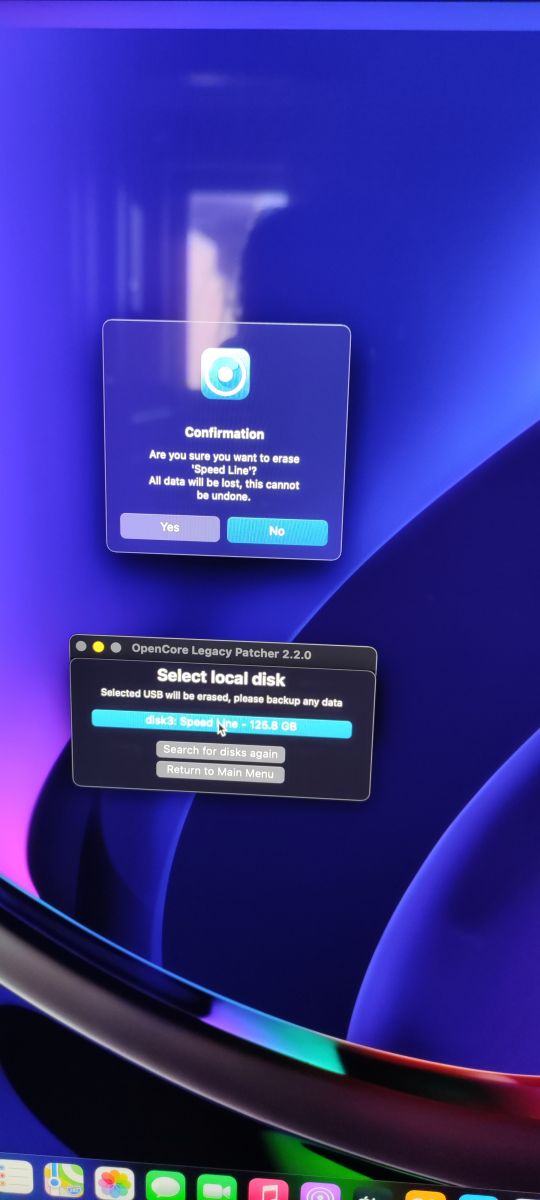
    cofirmation is shown
    when i press yes it removes the USA
    when I press no it has no effect
    Computer screen with data deletion confirmation on USB.
  • #35 21386552
    p.kaczmarek2
    Moderator Smart Home
    Posts: 14465
    Help: 650
    Rate: 12478
    Unfortunately, I am not from Germany.
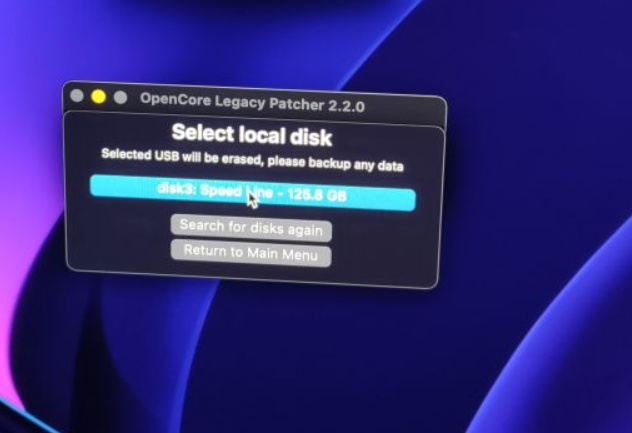
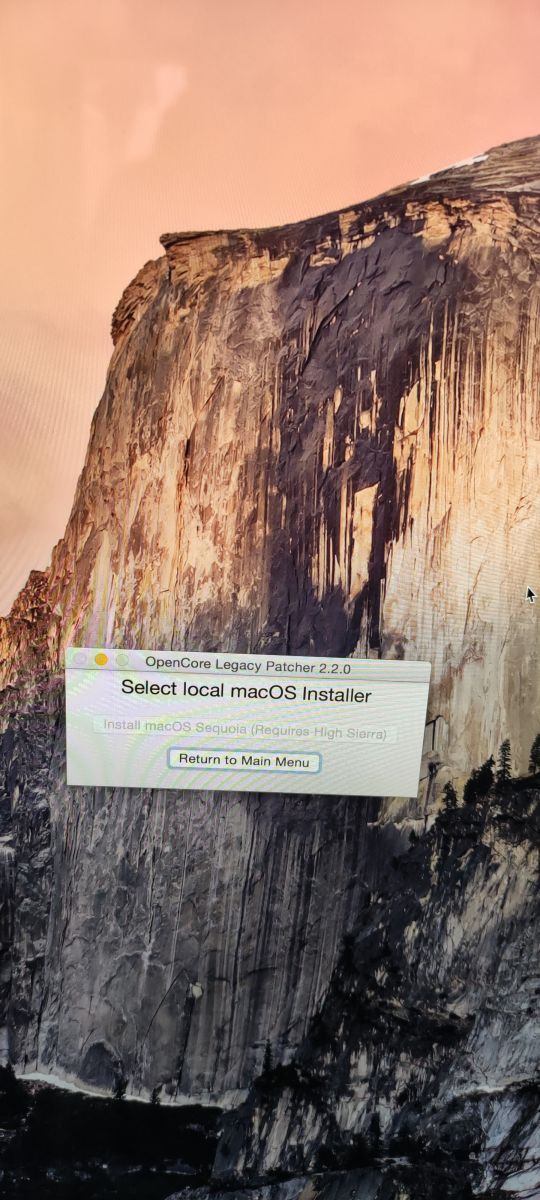
    This photo:
    OpenCore Legacy Patcher 2.2.0 program window with local disk selection. .
    It looks as if you want to upload the OpenCore Legacy patcher to the USB again, even though it only shows some 120GB media there - better not to move it, or you'll delete your files.

    If you have already uploaded the OpenCore Legacy Patcher to the USB stick, do not upload it again to the USB stick. You now need to switch off the computer completely with the USB stick plugged in at all times, then press Option on startup, or check here:
    https://support.apple.com/pl-pl/102603
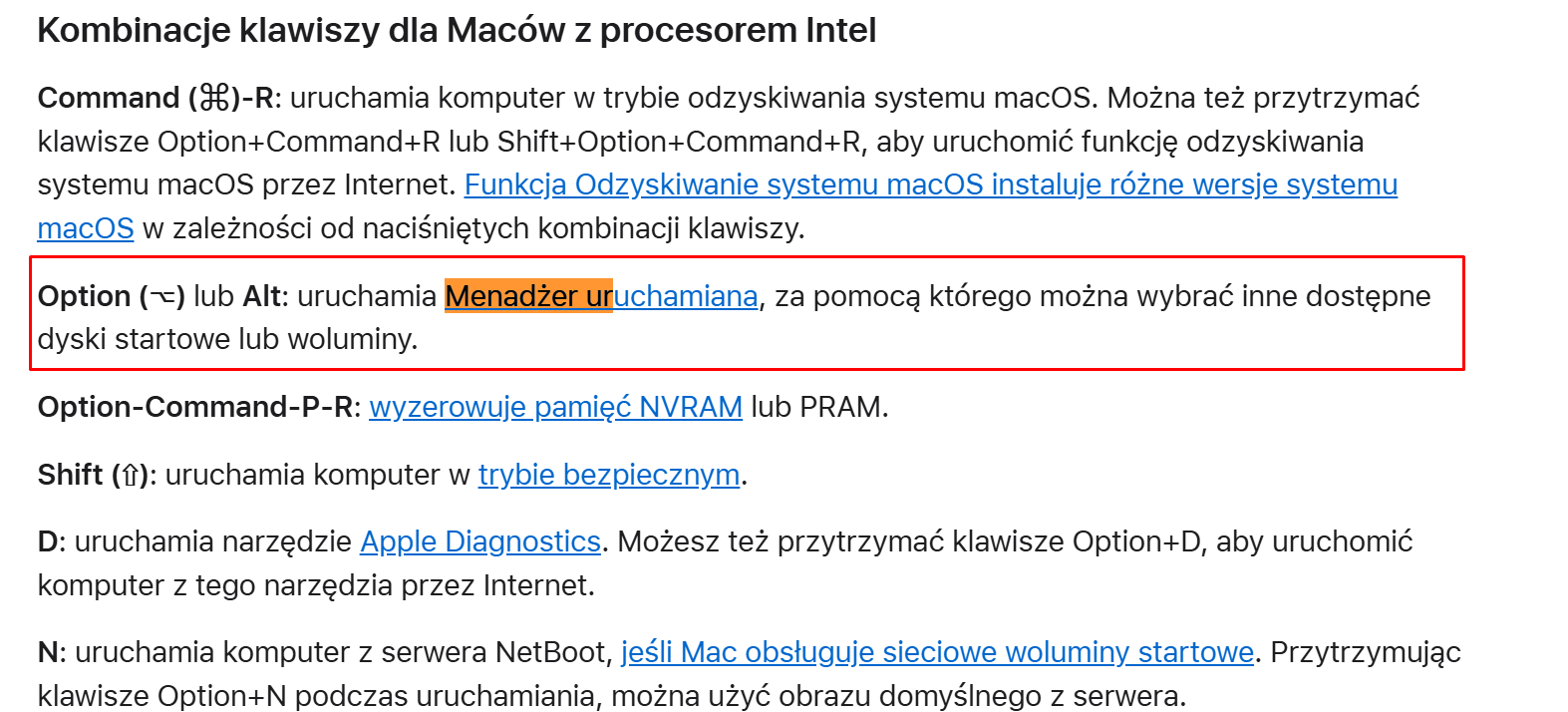
    Screenshot from this page for your convenience:
    Screenshot of instructions for key combinations for Macs with Intel processors. .
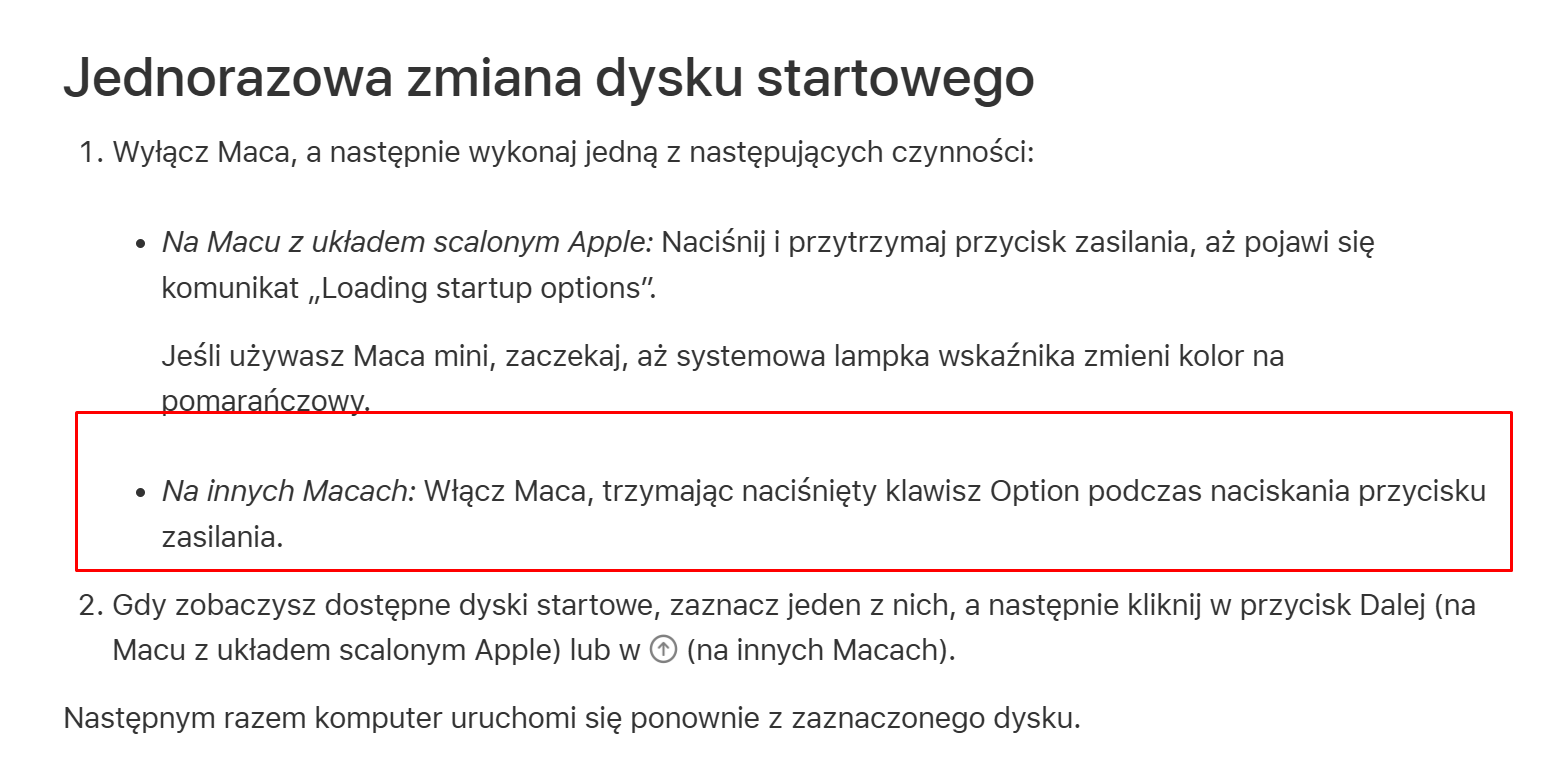
    Here you have a more detailed description of this process of entering the boot disk selection:
    https://support.apple.com/pl-pl/guide/mac-help/mchlp1034/mac
    Instructions for a one-time change of the startup disk on a Mac with detailed steps for different models.


    PS: As you are doing this process for the first time, I'll remind you again - if you have any important documents on your computer, copy them somewhere to keep them safe, e.g. to a PERSONAL memory stick, to the cloud, to email, etc., before experimenting further.
    Helpful post? Buy me a coffee.
  • #36 21386571
    wetter1966
    Level 7  
    Posts: 37
    Rate: 1
    it didn't work I reached the menu, selected oclp then os sequoia and a circle with a diagonal line appeared and I wanted to select os sequoia, it didn't work
    the patcher kept asking big sur
    but if i have it on usb maybe it can be copied to imac or something because i'm so nervous already ....... no swearing allowed here i know
    oh jeez shock

    Added after 1 [hour] 36 [minutes]:

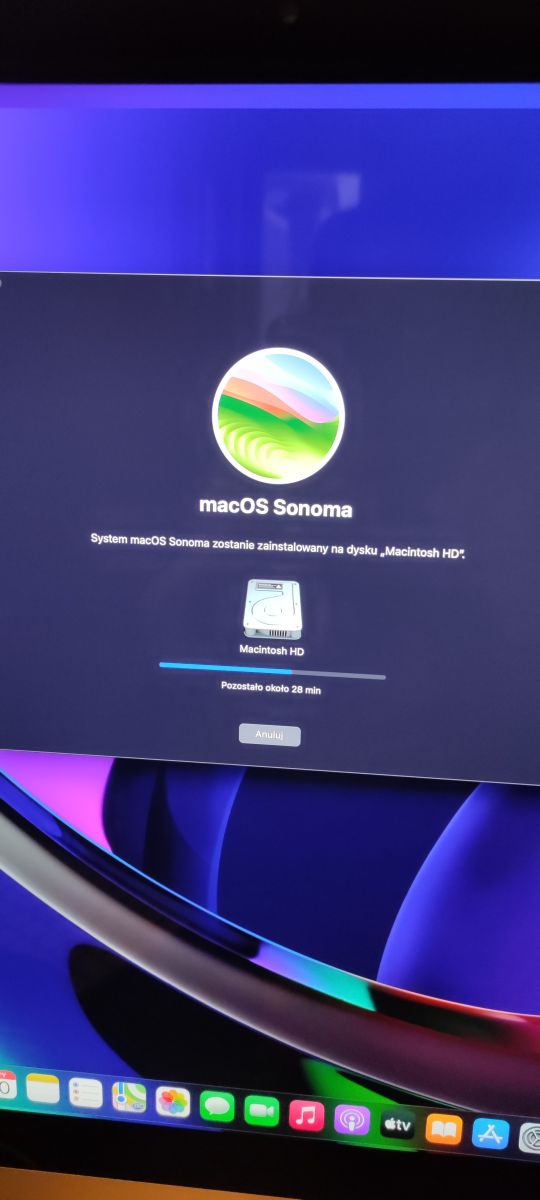
    why didn't you say that the new axle could be in FINDER
    Screen of macOS Sonoma installation on Macintosh HD. .
  • ADVERTISEMENT
  • #37 21388184
    maurycy123
    Conditionally unlocked
    Posts: 3090
    Help: 225
    Rate: 732
    And the 2011 Mac mini has a new system ;-) I still need to invest in an SSD because, on the HDD it's a bit muddy. The installation itself took a few hours. But it works and that is the most important thing.
  • #38 21388187
    wetter1966
    Level 7  
    Posts: 37
    Rate: 1
    so last night I installed SEQUOIA 15.2
    BUT SOMETHING IS WRONG it delays opening the application
    on startup I have sequoia 2 times why

    Added after 5 [minutes]:

    there is an os installed on HD Mackintosh
    how to transfer this new os on SSD????
    this iMac has the new os sequoia 15.2

    27" Retina 5k,2014

    Added after 43 [minutes]:

    my imac Retina 5k 27 inch year 2014 has 2 HDD separated and SSD separated
    IS New system installed on HDD Macintosh but it muddles terribly
    SSD is fast how do I do it to combine both into one SSD so as not to delete the system help me gentlemen?????
    please clear pictures and instructions
    best regards Danusia
  • #39 21388934
    wetter1966
    Level 7  
    Posts: 37
    Rate: 1
    Hello
    how to download oclp applications and this Program
    Open core legacy patcher and from kad
    on os Yosemite 10
    on imac 27 inch,retina 5k,2014 please can someone give me the site
    but Safari does not work for me and neither does Google
    please help

    Danusia

    Added after 11 [hours] 37 [minutes]: .

    there is someone here??????
    please help
    I beg you
  • #40 21390796
    wetter1966
    Level 7  
    Posts: 37
    Rate: 1
    Hello, can anyone help me? I have
    such a Problem I have installed Yosemite 10.10.5 on imac 27" 2014 I have downloaded the OCLP application I have USB on and I can not download any new system
    installation progress
    downloading mac OK 15.2 goes to the end, nothing else will work
    I will send a picture of help Gentlemen, why maybe on Yosemite can not???
    but Wien that it can
    Safari does not work
    iMac screen with Yosemite 10.10.5 showing OpenCore Legacy Patcher 0.2.2.0 window.
  • #41 21399699
    wetter1966
    Level 7  
    Posts: 37
    Rate: 1
    i can't install sequoia on imac 27 2014
    I have downloaded OCLP apps too And nothing is on the USB and now on the iMac the Progress line is stagnant what should I do can anyone help me step by step????
    gentlemen know how to beg
    Danusia

    Added after 16 [minutes]:

    there's someone out there?????

    Added after 7 [minutes]:

    when it gets almost to the end of the sequoia installation it stops at the "quotes" stage
    19 minutes left and it stands like this for a couple of hours
    I have a USB with sequoia uploaded by Oclp all the time and I can not fully install on imac 27 inch Regina 5k 2014 help me please
  • ADVERTISEMENT
  • #42 21432571
    wetter1966
    Level 7  
    Posts: 37
    Rate: 1
    part i have such a problem i want to download sequoia
    on an IMac 27 inch,year 2014
    Currently I have os Big Sur installed,but after downloading OCLP and connecting the Pen Driver I reached the option Creating Installer mac os Sequoia,which displays me "Validating Installer Integrity
    Unfortunately this process has been going on for 6 hours now and I always get an error at the end!
    Why what should I do????can someone help me?????
    kind regards
    Danuta
  • #43 21538115
    kupiecpl
    Level 11  
    Posts: 74
    Rate: 13
    I have a Macbook Pro 15 inch from late 2013. I wanted to upgrade the system from Big Sur 11 to Monterrey 12. (I only have a 16 GB flash drive).
    I did everything as you described but in the end I can't write the boot data to the hard drive. After rebooting and pressing option only the hard drive is shown and not the efi partition. I have to reboot the Macbook each time with the pendrive inserted. Please help.
  • #44 21547543
    kupiecpl
    Level 11  
    Posts: 74
    Rate: 13
    >>21538115 >>21538115 Problem solved, I installed Clover Configurator which allows you to mount EFI partitions and then edit them with Finder. From the ssd disk0s1 partition I deleted all directories (with files) and from the usb disk0s2 partition I copied everything, i.e. the EFI directory and the SYSTEM directory to the disk0s1 partition. I then ejected the flash drive and rebooted + Alt. The boot to ssd showed up and everything works without the pendrive.
    EFI partitions can also be mounted from a terminal but then they are read only, nothing can be written.
  • #45 21551351
    wetter1966
    Level 7  
    Posts: 37
    Rate: 1
    When installing the open core legacy patcher it says restart but what man press Which key on imac 27 zool Retina 5k
  • #46 21551404
    kupiecpl
    Level 11  
    Posts: 74
    Rate: 13
    ALT key
  • #47 21552394
    wetter1966
    Level 7  
    Posts: 37
    Rate: 1
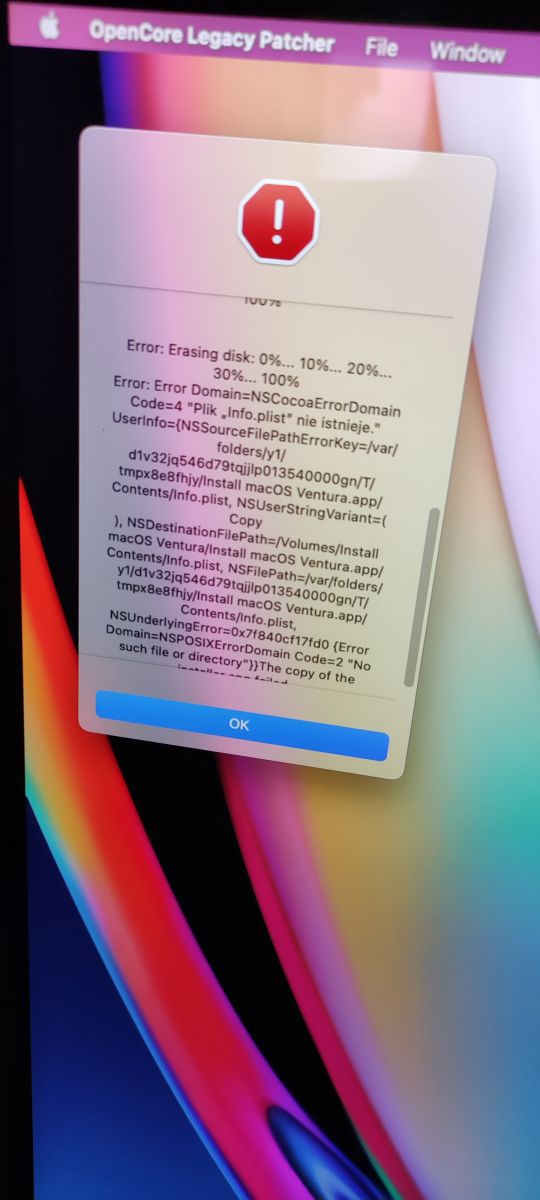
    Error message during macOS Ventura installation using OpenCore Legacy Patcher on a colorful background. Good morning
    Please help
    I can not download os Ventura on imac 27 inch 2014

    Man installed oclp
    Pen drive 120 GB
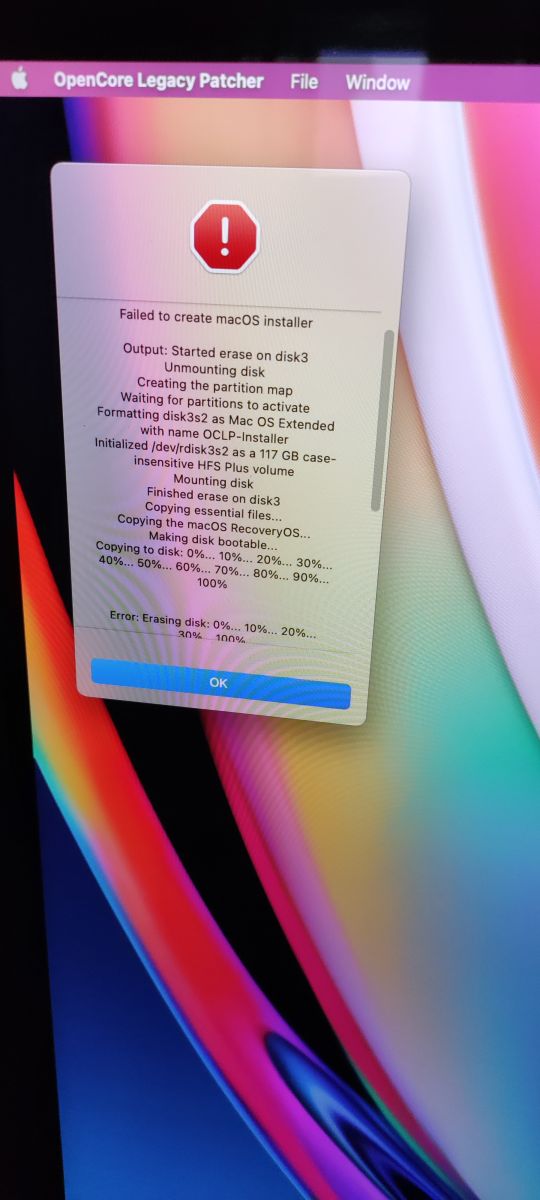
    I keep getting a message in English

    Error message on a computer screen during an attempt to create a macOS installer using OpenCore Legacy Patcher.

    What should I do please tell me step by step or I will call you ONLY I do not know YOUR NUMBER

    Danusia
  • #48 21552477
    kupiecpl
    Level 11  
    Posts: 74
    Rate: 13
    If I were you, I wouldn't use that 120GB usb but some new, smaller one. Ventura will probably fit on a 16GB usb. Format this usb to FAT and then start the installation again.
  • #49 21554167
    dana1111
    Level 1  
    Posts: 1
    I downloaded it and the Amiga is running smoothly.
    But why Sequoia freaks out after installation
    Doesn't work
  • #50 21636942
    tomaszgutowski79
    Level 2  
    Posts: 4
    Hi, I'm new here so welcome everyone. I'm a new MacBook owner, which I bought with my daughter in mind (internet, school, netfilx, etc). I got a MacBook that was already old but in very good condition, so I decided to buy it, but I was acting a bit foggy so the aftermath is this post :) .

    I decided on a MacBook Air (13-inch, Mid 2013) and everything was ok until it turned out that it no longer supported most apps i.e. WhatsApp, Chromium, FB and you have to do it all via Safari. I poked around a bit and found that there is such a thing as OpenCore Patcher so I breathed a sigh of relief when I saw that it was .... so simple :)

    Well simple it was until I downloaded what I thought was the right file .... I chose the most up-to-date one, macOS Sequoia. And that was it, because it turned out that my Mac doesn't support it and that it's not ... so easy :( That you have to download the right file for my model, etc. etc. etc. And everything turned out to be impossible for me (plus my ... English).

    I have a question for you: Is it really possible to "tweak" my MacBook Air (13-inch, Mid 2013) to the point where I can freely install such applications and not only do it via Safari? If so, can one of you tell me what file I need to download to make it work on my computer?

    Thank you very much for your help, if this is not the right topic for the Forum then I apologise. Have a good weekend.
  • #51 21636957
    kupiecpl
    Level 11  
    Posts: 74
    Rate: 13
    I too have a 2013 Macbook and didn't throw myself at Sequoia but installed the lowest still supported system which is 12 Monterrey. Everything works as I described in the posts above.
  • ADVERTISEMENT
  • #52 21641318
    tomik67
    Level 12  
    Posts: 111
    Rate: 11
    I also installed Monterrey without risking to jump straight to the latest release, now I have an update suggestion every now and then.
    Is it now possible to update the system automatically or in this case only via the OpenCore Legacy Patcher ?.
  • #53 21641415
    kupiecpl
    Level 11  
    Posts: 74
    Rate: 13
    I too get offers of upgrades but they are not Monterrey upgrades just a switch to Sequoia. I ignore them all. I upgraded my system from Big Sur to Monterrey because the antivirus from Play that I get with my cable does not support systems below 12.
    If that antivirus changes again I will upgrade to 13.
  • #54 21641465
    Damian_Max
    Level 21  
    Posts: 393
    Help: 40
    Rate: 96
    kupiecpl wrote:
    I also get upgrade suggestions but they are not Monterrey upgrades only upgrades to Sequoia.
    .
    Updates for Monterrey (without upgrading to Sequoia), you probably have under some three dots.

    tomik67 wrote:
    It is now possible to update the system automatically or in this case only via OpenCore Legacy Patcher ?.
    .
    Hm... in the FAQ https://dortania.github.io/OpenCore-Legacy-Patcher/FAQ.html#can-i-use-ota-updates
    says you can:
    Quote:
    Can I use OTA updates? .
    You can. However it is extremely recommended to use USB drive for major OS upgrades (such as 13 -> 14) to avoid larger issues from potentially occurring.
    General updates are usually fine, though it is always a good idea to wait a few days to see whether patches break and have to be fixed.

    (where OTA = Short for O ver T he A ir, refers to native OS updates via System Preferences like a supported Mac)

    Although it's worth updating the OpenCore Legacy Patcher beforehand, and somewhere I think it was written that after a system update it's worth clicking something there too.
  • #55 21642064
    tomik67
    Level 12  
    Posts: 111
    Rate: 11
    In that case, it's safer to go with USB though, and as always with such big changes I make a Clonezilla image of the drive just in case something goes wrong.
    Link
  • #56 21649162
    tomik67
    Level 12  
    Posts: 111
    Rate: 11
    Damian_Max wrote:
    Updates for Monterrey (without upgrading to Sequoia), you probably have under some three dots.
    .
    I decided to upgrade Monterrey to the higher version of Monterrey suggested by the system, the upgrade stalled after two 1/3 reboots and the system does not boot, it stops at the same place when loading.
    Is there any way to crash boot macOS ?
  • #57 21649876
    Damian_Max
    Level 21  
    Posts: 393
    Help: 40
    Rate: 96
    You can run macOS in safe mode: https://support.apple.com/pl-pl/guide/mac-help/mh21245/mac
    ^^ I haven't done this, I used to boot in revocery mode (maybe it's the same thing; I don't know)
    to enter recovery mode, you reboot and immediately hold Command + R, there are then a few options → from the options you can select something to view files.
    You may need to reinstall macOS from a flash drive in this situation, but I'm not sure :/.
  • #58 21650486
    tomik67
    Level 12  
    Posts: 111
    Rate: 11
    I tried to reinstall macOS from the same USB but it refuses to cooperate claiming that it won't install the older system on the newer one.
  • #59 21650942
    tomaszgutowski79
    Level 2  
    Posts: 4
    >>21636957 >>21636942 .

    Hi, in case anyone needs it I found a good YouTube video that shows how to do this step by step. Despite my poor English and general knowledge of Appla it all went smoothly, although it took quite a while.
    Link: https://www.youtube.com/watch?v=u8ST8HUaL9w

    Good luck!
  • #60 21693182
    Mechanik2019
    Level 6  
    Posts: 21
    Rate: 4
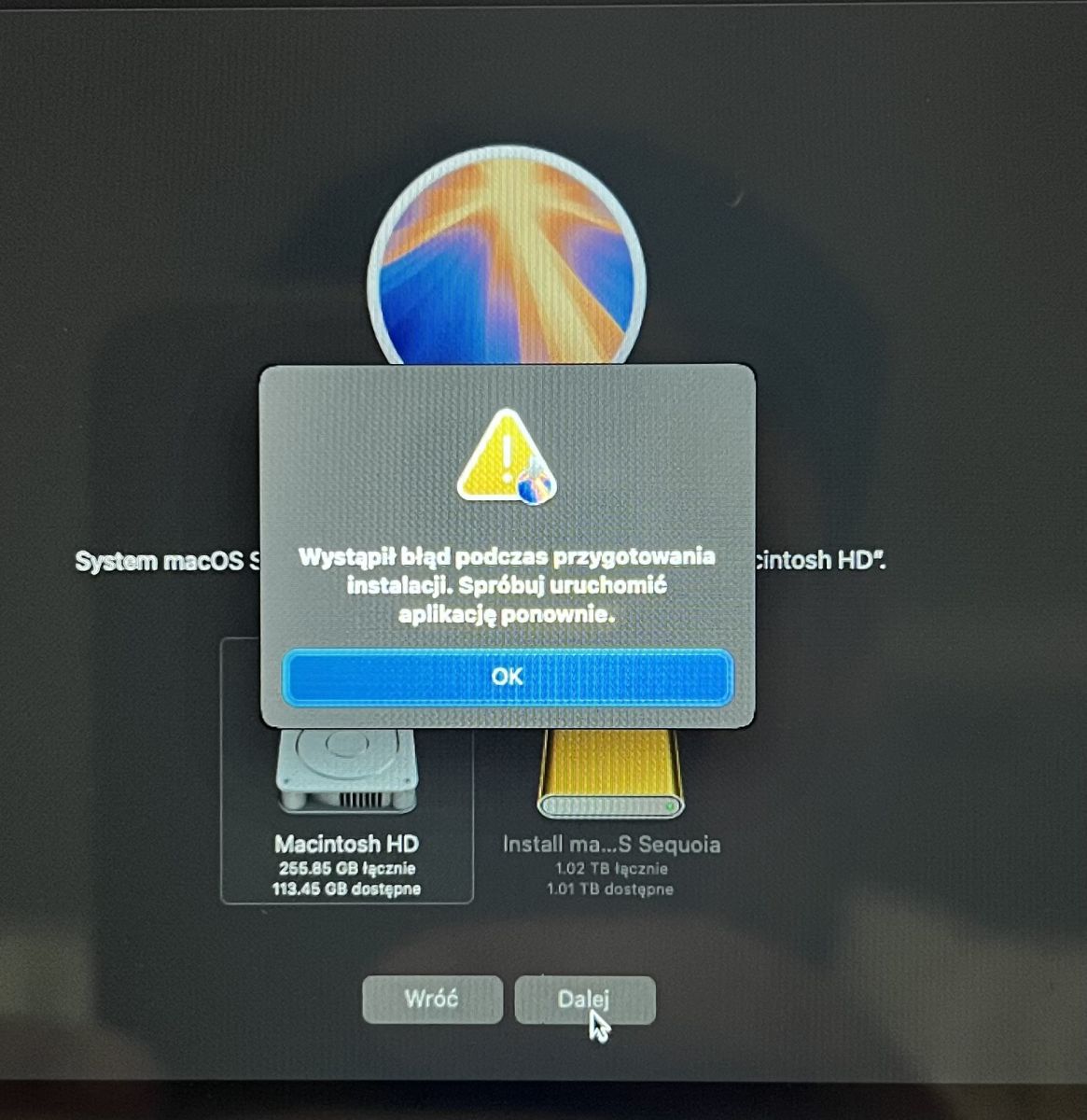
    How do I install the latest macOS on an old computer, laptop? OpenCore Legacy Patcher .

    Colleagues please help.
    I am stuck on an error as above.
📢 Listen (AI):

Topic summary

✨ The discussion centers on installing the latest macOS versions (Ventura, Sonoma, Sequoia) on older Apple hardware using OpenCore Legacy Patcher (OCLP). Users seek guidance on upgrading Macs that no longer receive official updates, particularly models like the 2014 iMac 27" Retina 5K and Mac Mini A1347 EMC 2840 2014. The process typically requires a USB flash drive (recommended minimum 32GB, though smaller sizes like 16GB may suffice for Ventura) to create a bootable installer. Challenges include hardware compatibility issues such as non-functional built-in keyboards and trackpads during installation, requiring external USB input devices initially, and post-installation problems like Wi-Fi connectivity, AirDrop failures, and slower performance due to lack of hardware acceleration or driver support. Users report difficulties entering the boot menu (holding Option key at startup) to select the USB installer, and some experience installation stalls or errors during validation or copying stages. Solutions involve preparing the USB installer on the same or another Mac, ensuring correct EFI partition setup (sometimes using Clover Configurator to mount and copy EFI files), and following detailed step-by-step instructions from OCLP documentation or community guides. Some users inquire about installing without USB, but the consensus is that USB media is necessary for the process. Upgrading RAM to at least 8GB is recommended for smoother operation post-upgrade. The patcher supports Intel-based Macs, despite Apple's transition to Apple Silicon (M1/M3). SSD upgrades prior to macOS installation improve performance. The community emphasizes backing up data before proceeding and patience during long installation phases. Overall, OCLP enables extending the usable life of older Macs by installing unsupported macOS versions, albeit with some manual troubleshooting and hardware limitations.
Generated by the language model.

FAQ

TL;DR: A 32 GB USB stick is enough for the basic workflow, and one user reported that “Sequoia runs smoothly and efficiently” on a 2014 Mac mini after OpenCore Legacy Patcher, root patching, and copying OpenCore to the internal drive. This FAQ is for owners of older Intel Macs who want newer macOS when Apple no longer offers the upgrade. [#21268544]

Why it matters: OpenCore Legacy Patcher can extend the usable life of Intel Macs from around 2010–2015, but stability depends on RAM, storage speed, and a correct post-install process.

Option Reported hardware from thread Main benefit Main drawback
Monterey 2013 MacBook, 2015 MacBook Pro Better balance of speed and app support Fewer newest macOS features
Sequoia 2010 iMac, 2011 Mac mini, 2014 Mac mini New browser and current app compatibility More glitches, slower on weak hardware
Lightweight Linux 2012 MacBook Air, 4 GB RAM Best responsiveness on very weak hardware Loses native macOS workflow

Key insight: The install is only half the job. Most failures in the thread came after reboot, when users skipped boot selection, root patches, or copying OpenCore from USB to the internal EFI.

Quick Facts

  • The starter guide used a USB flash drive of at least 32 GB, and the author recommends 8 GB RAM as the comfort floor after upgrading. [#21268544]
  • Creating the installer can take 30 minutes or more; another user saw the validation stage run for 6 hours before ending with an error. [#21322506]
  • Real-world success reports covered a MacBook 13-inch 2010 with 16 GB RAM, a 2010 iMac, a 2011 Mac mini, and a 2014 Mac mini. [#21388184]
  • Storage speed matters: a user with a 2011 Mac mini said the new system worked, but on an HDD it felt sluggish and an SSD was the next upgrade. [#21388184]
  • On very weak hardware, 4 GB RAM was the practical limit in the thread: a 2012 MacBook Air with 4 GB stayed laggy even after trying different macOS versions. [#21874107]

How do I install macOS Sequoia, Sonoma, or Ventura on an old Intel Mac using OpenCore Legacy Patcher step by step?

Use a USB installer, then boot through OpenCore and finish with post-install patches. 1. Format a 32 GB or larger USB drive, download OCLP, choose Create macOS Installer, and write the selected macOS to the USB. 2. Let OCLP install OpenCore to the USB’s first partition, restart, and hold Option/Alt to boot the OpenCore USB. 3. Install macOS to the internal drive, log in, run Post-Install Root Patch, then install OpenCore to the internal drive so the Mac boots without the USB. [#21268544]

What is OpenCore Legacy Patcher and how does it let unsupported Macs run newer versions of macOS?

"OpenCore Legacy Patcher" is an unofficial open-source patcher that boots newer macOS releases on unsupported Macs, adding the boot and post-install fixes older Apple hardware needs. In the thread, it was used to install newer macOS on Intel Macs as old as 2010 and was described as supporting hardware back to 2008. It works by creating a patched installer, booting through OpenCore, and then applying missing patches after installation. [#21268544]

What is a Post-Install Root Patch in OpenCore Legacy Patcher, and when do I need to apply it?

A Post-Install Root Patch is the final patching step you apply after macOS first boots. "Post-Install Root Patch" is a system-level patch step that restores missing hardware support after installation, especially for graphics, USB, and other dropped legacy components. In the thread, the author had a working desktop only after running it, and another user needed re-patching after an update broke brightness and keyboard backlight. Apply it after first login and again after some updates if hardware features disappear. [#21702383]

Why won’t my Mac boot without the USB installer after I finish installing macOS with OCLP, and how do I copy OpenCore to the internal drive?

Your Mac keeps needing the USB because OpenCore is still installed only on the USB’s EFI partition. The thread’s fix was to install OpenCore again, but this time choose the internal drive’s first partition instead of the USB. One user also solved it manually by mounting EFI, deleting the old contents on the SSD EFI, and copying the EFI and SYSTEM folders from the USB EFI to the internal EFI. After that, rebooting without the pendrive worked. [#21547543]

Which disk should I choose in OpenCore Legacy Patcher when creating the installer: the USB flash drive or the internal SSD/HDD?

Choose the USB flash drive when creating the installer. That step writes the installer and OpenCore to removable media, and it erases data on that USB. The internal SSD or HDD is chosen later, during macOS installation, as the target system disk. In the thread, the author explicitly selected the flash drive for installer creation and only later selected the internal drive inside the macOS installer. [#21268544]

Why does the macOS installer creation or validation stage in OCLP take so long, and what should I do if it seems stuck for 30 minutes or more?

Long waits are normal, and several users reported that this stage can look frozen. One poster said creating the installer took 30 minutes or more, and the original guide also notes long waits during copying and validation. If it still shows progress, wait longer and do not interrupt it. If it ends in an error after hours, reformat the USB, try a different flash drive, and restart the process from the installer-creation step. [#21432571]

What should I do if holding Option or Alt during restart does not open the Mac boot picker and the system keeps booting back into Big Sur or the old macOS?

Shut the Mac down fully, leave the USB inserted, then power on and hold Option/Alt immediately from startup. In the thread, users who pressed too late dropped back into Big Sur instead of the boot picker. If you still return to the old system, verify that OpenCore was actually written to the USB and do not re-run the install onto the wrong disk, because one user nearly selected a 120 GB internal disk by mistake. [#21386552]

How can I fix the Apple mouse and keyboard setup screen on a 2010 MacBook when the built-in keyboard and trackpad stop working during OCLP installation?

Connect an external USB keyboard and mouse, ideally through a USB 2.0 hub, to finish installation. A user with a MacBook 13-inch 2010 hit the Apple keyboard and mouse setup screen because the built-in keyboard and trackpad stopped working. Another poster explained that support for those legacy internal devices needed patching after install, so the temporary workaround was external input devices during setup. [#21318510]

Why does AirDrop stop working after installing a newer macOS on an unsupported iMac with OpenCore Legacy Patcher?

AirDrop can stop working because some legacy wireless features remain imperfect after patching. In the thread, a user with an iMac 5K 27-inch 2015 reported that everything worked except AirDrop, with no confirmed fix posted afterward. Treat AirDrop as a known compatibility risk on unsupported Macs, even when the core system, browser, and daily apps work. [#21318066]

How do OTA updates work on a Mac patched with OpenCore Legacy Patcher, and when is a USB update safer than updating through System Settings?

OTA updates can work, but USB is safer for major version jumps. One poster quoted the OCLP FAQ saying normal updates are usually fine, while big upgrades such as 13 → 14 are strongly recommended over USB. The same reply also advised updating OCLP first and checking patches after the update. Use System Settings for smaller maintenance updates, but use a USB installer when moving to a new major macOS generation. [#21641465]

Monterey vs Sequoia on an older MacBook Air or MacBook Pro — which version is the better balance of app compatibility and performance?

Monterey was the better balance in this thread for many 2013-era Macs. Users with a 2013 MacBook and a 2013 MacBook Air chose Monterey 12 because it restored app support without the heavier feel reported on Sequoia. Sequoia did work on stronger machines like a 2014 Mac mini or a 2012 MacBook Pro with 16 GB RAM, but a 2012 MacBook Air with 4 GB RAM stayed laggy. Choose Monterey first for weaker Intel Macs, especially with 4 GB or slower CPUs. [#21636957]

How can I recover an OCLP-patched Mac that gets stuck after a Monterey update, loses root patches, or only boots in Safe Mode?

Boot in Safe Mode first, then repair the broken root patch state. 1. Hold Shift during boot to force Safe Mode. 2. Disable or clear pending updates if they block root patching. 3. Reapply the root patch in OCLP. In the thread, a Monterey update stalled after repeated reboots, then the Mac booted only in Safe Mode at a tiny resolution. After clearing pending updates and re-patching root, normal boot, brightness control, and keyboard backlight returned. [#21702383]

What causes the prohibition symbol or circle with a diagonal line when trying to boot the OCLP USB installer, and how do I fix it?

That symbol means the selected boot path is not valid for the next stage. In the thread, one user chose OpenCore, then tried to launch Sequoia and got the prohibition sign instead of the installer. The practical fix was to verify the USB was built correctly, boot from the proper OpenCore entry, and avoid reinstalling OCLP onto the wrong disk. If the installer is visible in Finder but not booting, rebuild the USB and repeat the boot-selection step carefully. [#21386571]

How do I create the macOS installer USB for OpenCore Legacy Patcher on one Mac and use it to reinstall or upgrade a different Mac?

The thread suggests this is workable, but it was not fully verified there. One poster prepared everything on the same macmini7,1 and then questioned whether another Mac could build the USB for a different target Mac. Another user reasoned that the installer itself should be universal and then prepared a drive remotely for a 2010 iMac. Practical takeaway: you can prepare on one Mac, but confirm the target model’s compatibility before you rely on that USB. [#21303789]

What are the practical performance limits of running Sequoia on older Macs with 4 GB RAM versus 8 GB or 16 GB, and when is lightweight Linux a better option?

The thread sets a clear floor: 4 GB RAM is too little for comfortable Sequoia use, while 8 GB is the practical minimum and 16 GB is much safer. The original guide says 8 GB should keep upgraded Macs comfortable, and multiple success reports used 16 GB. By contrast, a 2012 MacBook Air with 4 GB RAM stayed too laggy even for normal browsing. When a 4 GB Mac still feels choppy after downgrading to Monterey, lightweight Linux becomes the better option. [#21875213]
Generated by the language model.
ADVERTISEMENT