
logo elektroda
logo elektroda
X
logo elektroda

[Problem} Selection of Tuya Zigbee modules for 1 gang 2 way 86x86 switches - how to connect?

electro4 297 7
ADVERTISEMENT
This content has been translated flag-pl » flag-en View the original version here
  • #1 21828709
    electro4
    Level 11  
    Hi everyone.

    For the house I am currently building, I will be looking to install light and roller shutter switches bought on AliExpress. The kind under an 86x86 square box.
    For this, I wanted to buy simple Tuya modules that I will hook up to a Zigbee gateway.

    And this is where the problems begin. I don't know how to hook it up, which modules to choose.

    1) The switches I want to buy are 1 gang, 2 way. It sounds weird because it's like it's supposed to be a staircase switch, but they're all like that on AliExpress, no 1 way. I attach a photo.
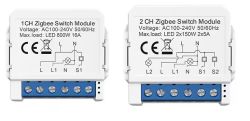
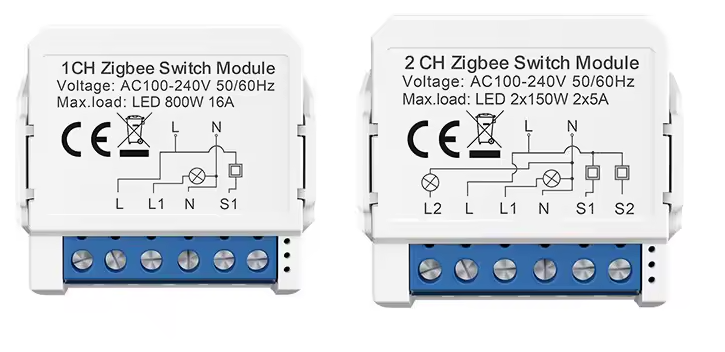
    2) The module itself. I have a choice of 1 to 4 way, I was just looking at the dimmer version, but the wiring layout looks the same. I attach a photo.

    I'm not familiar with it and don't know how to wire it up. According to the picture, a simple matter:
    L and N from the switchboard.
    L1 and N to the bulb (the neutral wire from the distribution board goes to both the module and the bulb, right?)
    S1 to the switch.

    And this is where I seem to have a conundrum. It appears that only one wire goes to the switch? How is this supposed to work?


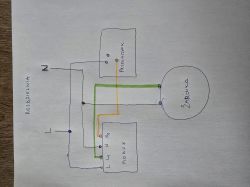
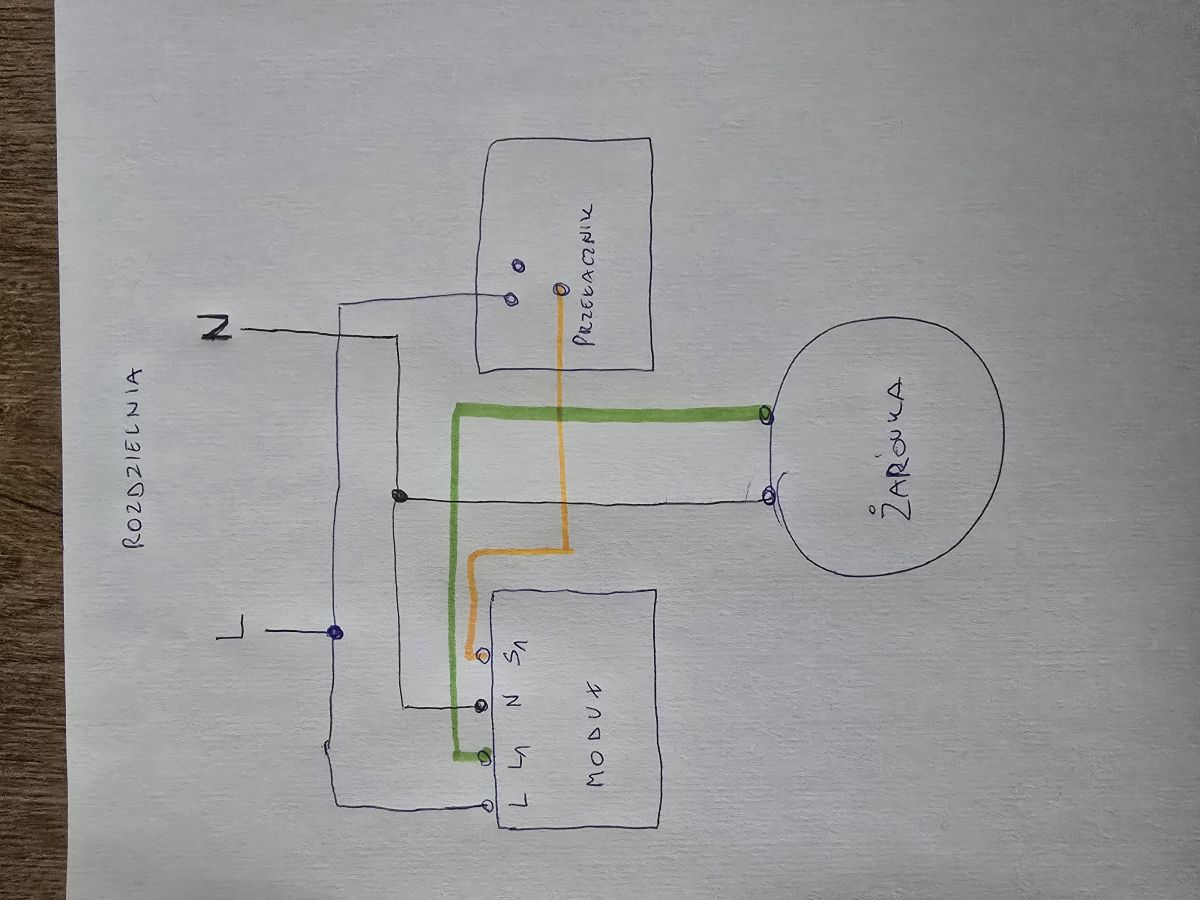
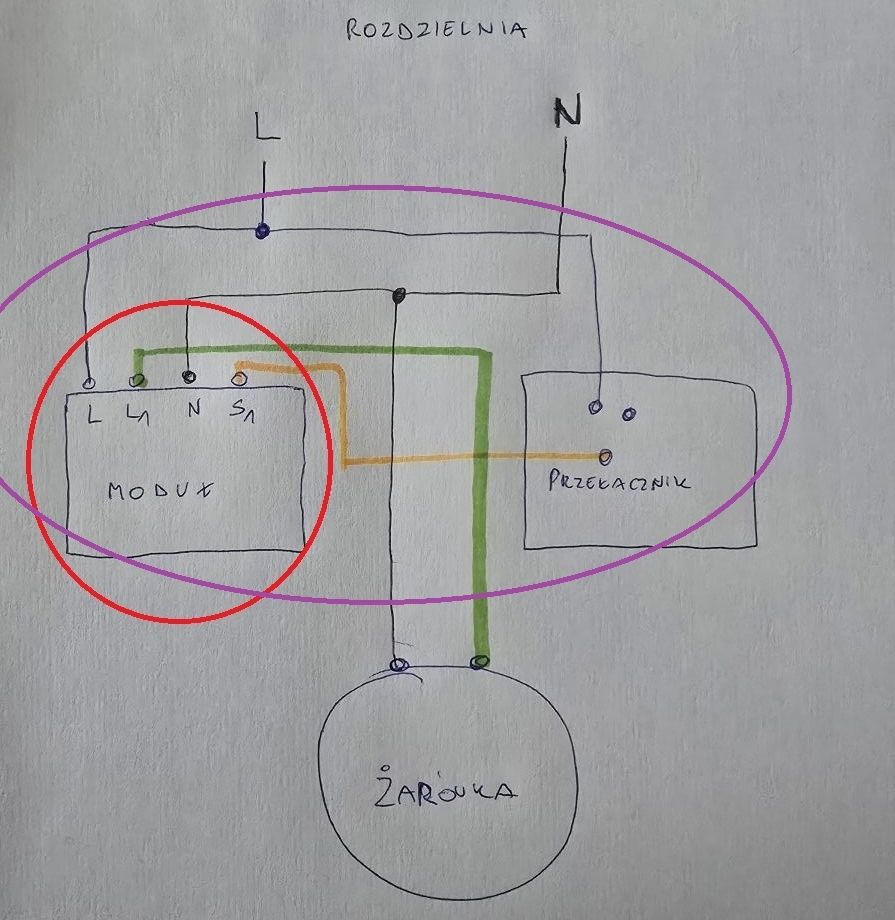
    [Edit] I've added a drawing of how I see it. I don't know how correct this is. Especially if the light switch has an output for 3 cables, from what I saw in the auction pictures. Is it enough for me to connect under two?


    I know this is probably obvious to many, but unfortunately for me. I would therefore be very grateful for any info;)

    Gold toggle switches on square 86x86 mm mounting panels Zigbee switch modules, 1-channel and 2-channel versions with wiring diagrams
    Hand-drawn wiring diagram showing Tuya module, switch, and light bulb connections
  • ADVERTISEMENT
  • Helpful post
    #2 21828724
    elktrod
    Level 40  
    electro4 wrote:
    And here I think I have a conundrum. it comes out that only one cable goes to the switch? How is that supposed to work?
    You have everything well drawn, and the cable to the switch may go one but there must be and are two wires.... When the switch is a two-way switch and has three contacts it can still be used in a normal non-switched circuit as it has two positions of which one connects two contacts and in the next position it disconnects the same contacts, simply, even if you don't understand it, you will connect two contacts in the switch, choosing those on which the circuit will work properly e.g. by trial and error... And if you want the circuit to be connected upwards and disconnected downwards, if it doesn't suit you, turn the whole switch by 180 degrees and it will be OK...
    I only have a request that you use the term "wire" when it is a single wire and the term "cable" when it is a set of at least two wires and more and your vocabulary will be correct and in future every electrician will understand it as every other electrician should...
    electro4 wrote:
    I only need to connect under two?
    Yes, you only need to connect under the correct two and "clockwise" you have three possibilities with three contacts and if the first attempt fails then the second attempt will be the correct one no matter if left or right you will put one of the wires or both at once....
    electro4 wrote:
    And this is where the problems begin. I don't know how to connect it, which modules to choose.
    Well, yes, when you have stairs you have to buy staircase switches and these are the three-contact switches and the one-key bistable switches are usually staircase switches, and how many to buy you need to know the building plan and possibly also electrical engineering because you don't know how many floors up and how many down etc. etc.. And stair switches are used not only for stairs but also in long corridors or in two entrances to one and the same room in order to light a lamp or lamps from both sides of the room and if one lamp is a single path and if two lamps are switched, it is a double path and that is why they are called (way) - paths or circuits....
    PS. A photo with the number of levers without photos of the contacts and without description tells us nothing about the type of switch and how the lever works....
  • ADVERTISEMENT
  • #3 21828895
    electro4
    Level 11  
    >>21828724

    Thanks very much for your reply.
    Oki. I will take the naming issue to heart ;)

    Generally there will be single switches everywhere. Only on the stairs can you think of a staircase switch. Corridors are short and small, so a single will suffice. The only thing left is the issue of roller shutters and the modules for them and their connection. I still have to figure that out.

    For the time being, as you say, I'll buy a gate, one module and maybe two switches for a trial (then I'll test the staircase connection).
  • ADVERTISEMENT
  • #4 21829260
    elktrod
    Level 40  
    Note that the modules you plan to buy require a minimum of two supply wires "L" and "N". And now there is the question of where you want to place them, if traditionally in the switch box then the question is whether you have the "N" in addition to the "L" there or not, because if not, then you have to provide it or place the modules in the switchboard or in the ceiling if there is space for them and change the concept of cable routing, that is, then draw yourself an installation diagram and not a general one as in your first post to understand what the next conundrum is....
    I have drawn you an imaginary box around the module, and also around the module including the switch because it would fit behind the switch to put the module in a deep box and counting around the perimeter you must have a minimum of 4 wires in the box leading to the required places and usually in such boxes made in the past there is / was only 3?
    Hand-drawn wiring diagram: distribution board, module L/L1/N/S1, switch and bulb connected by wires
    Just shy of mentioning what in the introduction of this post....
  • #5 21829826
    electro4
    Level 11  
    >>21829260

    You've knocked me off track a bit.

    I thought there were only 3 wires going from the switchboard: phase, neutral and earth.
    According to what I understand, I split the L phase from the switchgear into two wires in the box. One goes to the module to L and the other to the light switch.
    The N from the switchboard I also split into two wires in the box, with one going to the N in the module and the other to the light bulb.

    This now leaves a loose s1 in the module, which I connect to the switch. And L1, which I pull to the bulb.

    So in theory two wires from the switchboard are enough. And I can connect this third earthing wire to the lamp if I have a metal housing.

    Please correct me if I am wrong.
  • Helpful post
    #6 21829859
    elktrod
    Level 40  
    So you have assumed that the module is to be in the box together with the switch as I understand it?
    All good reasoning and well drawn.
    Now it's just a question of how many wires you have in the box in real life and where do they run?
    If they provide you with what you have assumed and what you have written and drawn, then OK.
    When the modules and connectors arrive, you'll be able to practice and understand.
    What I meant was the first situation where in the junction box you have only 3 wires led in the old way, i.e. phase from the distribution board and only two outlets (two phases) to the chandelier to two branches (light points) of the chandelier in the ceiling and nothing more, i.e. "N" is not in the junction box because it is only in the ceiling:
    https://www.elektroda.pl/rtvforum/topic3685941.html#18645524
    electro4 wrote:
    I thought there were only 3 wires going from the switchboard: phase, neutral and earth.
    And this is what I didn't know what you were thinking and is it actually as you think and as I quoted above? Study which wires from where and to where, train the connections and you will find out and understand?
  • ADVERTISEMENT
  • #7 21830079
    electro4
    Level 11  
    >>21829859

    The wiring is not yet in place. Right now there is the shell closed, without the installations. Dad, i.e. the site manager, will only be laying them in a month ;D
    I only orient myself in terms of smart, so that I know what, how and with what is to be connected. Because as much as Dad embraces the classic version, smart no longer does. And that's why I need to know what goes with what, so that I can communicate with him later, so that there is no muck ;)

    I wanted to have everything in a modern system over cables, but when I started counting the costs, for my needs like lights with dimming, electric blinds and possibly a video intercom. It doesn't make sense to push for expensive systems.


    Now for a trial I have ordered a zigbee tuya gateway with moes, two moes dimmers, 2 1-gang 2-way switches. I will practice on an installation in a flat in a block of flats :D
  • #8 21832198
    elktrod
    Level 40  
    So in general now for SMART devices there is a need to ensure that where they occur they are provided with a fixed "L" phase as well as a fixed "N" neutral wire.... There are also increasing themes that a wire is missing when it comes to implementing what was in the plan, see here: https://www.elektroda.pl/rtvforum/topic4164124.html#21831671. With LED lighting there are also sometimes difficult to control LED glows even after switching off due to low current consumption and generation of potentials in neighbouring wires and in the most difficult cases switching on and off both wires "L" and "N" with a two-pole switch only helps.... Well, I'm only signalling, but you're in a better situation anyway, because all these situations can now be foreseen and accordingly you can always lay two more wires, plus deeper or more spacious boxes to accommodate the modules and these two additional wires e.g. for correspondence in stair lighting.... The costs will be negligible compared to having to redo the wiring if one is missing.... Of course, someone will write that a staircase installation can be realised on two wires with momentary pushbuttons, and that is true, but you have to decide on any system, whatever it may be, much earlier and consistently stick to your plans, not change them every now and then.... Sometimes someone asks me to design or make an installation fulfilling the conditions of many systems, I refuse at once, because it becomes uneconomical to lay a twisted-pair cable from a junction box to a junction box in a loop through the whole house, as it used to be fashionable, for low-voltage control, because today the same thing is taken care of by radio communication with or without Wi-Fi, for example, and the number of wires in one junction box would become unacceptable, and for what purpose, if ultimately there will not be several systems at once anyway.....
ADVERTISEMENT