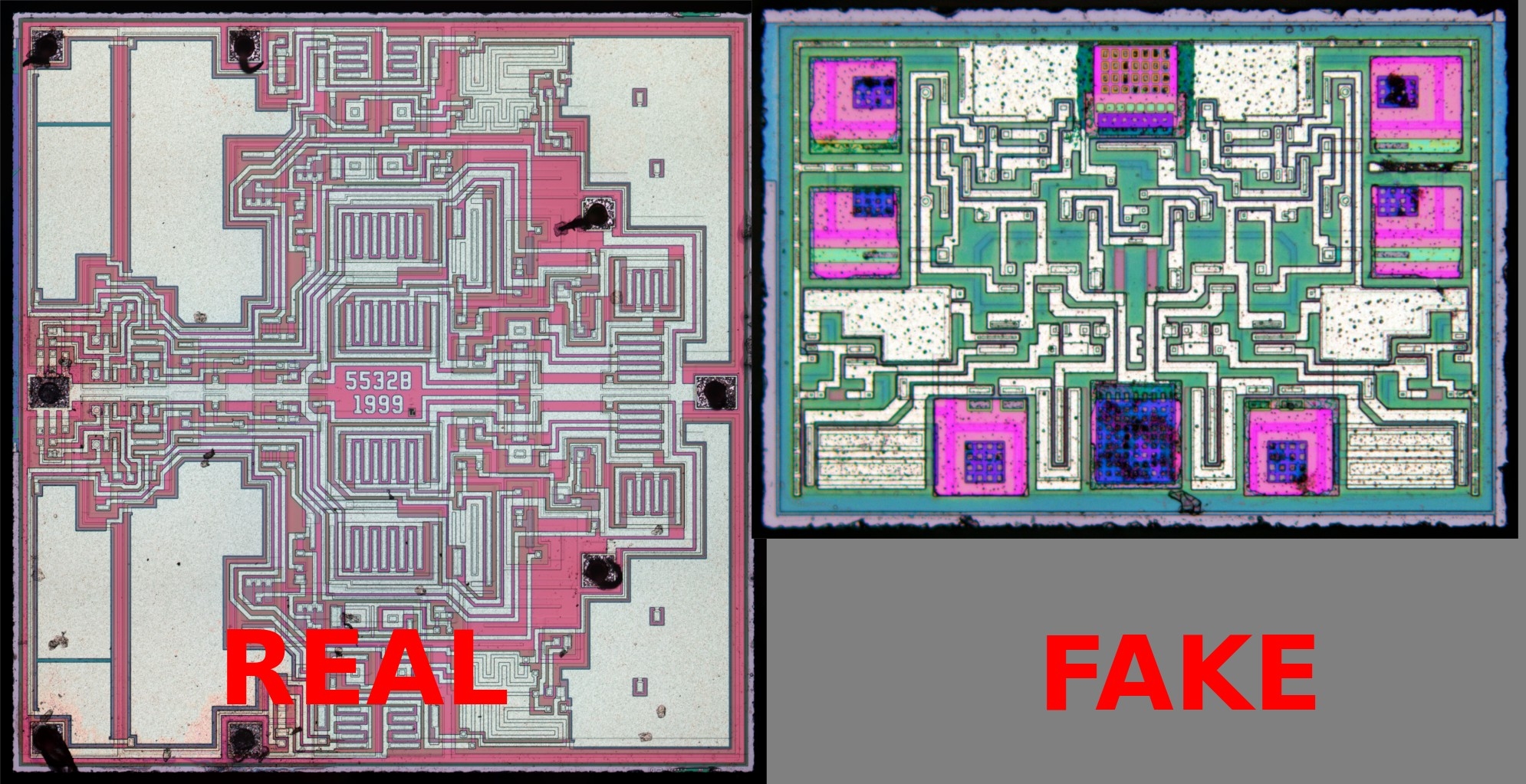
Comparing an original Texas Instruments NE5532 op-amp with a counterfeit bought on eBay, plus a Philips NE5532A die as a reference.
The chips were decapped with acid and their internal matrices and bond connections were inspected side by side.
The fake came from an eBay lot of 100 pieces for PLN 20 and showed a rise rate of about 1.25V/µS instead of 9V/µS.
The counterfeit has a smaller die and missing connections, suggesting only the minimum circuitry needed for basic op-amp operation.
AI summary based on the discussion. May contain errors.
The NE5532 is a popular operational amplifier used, among others, in audio systems, as a preamplifier, mixer or generator. This popular chip is often counterfeited, which can make a big difference in signal processing in your audio equipment. In particular, if someone is an audiophile and uses special gold plugs or a power cable for several thousand zlotys. As you can see, the only thing that can be recommended is that the preamplifier uses a counterfeit of the popular operational amplifier ;)
Jokes aside, the problem of counterfeit electronic components is huge. In our forum, we run a topic called fakes , which has now grown to 41 pages.
The blog team zeptobars.com dealing as a hobby with opening and, more precisely, dissolving the casings of integrated circuits with acid, opened the original NE5532 chip by Texas Instruments and bought a counterfeit from the famous eBay offer of 100 pieces for PLN 20. The effect is terrifying, the counterfeit not only has a smaller matrix, but also lacks many connections, you can say that only the basic things have been kept so that the system can work as an operational amplifier. On the forums, they noticed that the system is definitely much slower, the rate of rise is ~1.25V/µS, instead of 9V/µS.
Interestingly, they also opened the Philips NE5532A production system and the matrix was very similar to the original, it can be said that the parameters in this case will be preserved.
It seems to me that if someone is an audiophile and already has what you mention, he also replaced the opamps with more audiophile ones.
Counterfeits are a big bane of our times, sometimes it's really... [Read more]
krzysssztof
13 Oct 2017 20:03
There is a simple method for counterfeit integrated circuits - buy from reliable sources. It's just that the costs then increase several times ... [Read more]
MiernikZKauflanda
13 Oct 2017 20:08
How would they do it? Audiophiles have no idea about the theory of electronics, let alone the practice of soldering. Well, unless someone would set up a special "factory" engaged in such activities :D [Read more]
Włodzimierz Wojtiuk
13 Oct 2017 20:17
I'm afraid that with them it's like in the past with drug addicts (perfect knowledge of the necessary piece of chemistry), and here this one procedure is manageable. [Read more]
pawelr98
13 Oct 2017 20:52
I had one NE5532 that when connected to the circuit just got hot as hell.
Inserted in its place LM833 (identical pinout and similar parameters) worked correctly.
It was supposed to act as a W.CZ comparator.
... [Read more]
tytka
13 Oct 2017 21:14
Oh buddy, I'm afraid you'd be very surprised if you started digging into the subject.
Sure, there is a group of those who can't change anything in their equipment themselves (and maybe they... [Read more]
Anonymous
14 Oct 2017 00:02
One may ask, why did you concoct the comparator with the 5532 instead of using an integrated comparator for it? [Read more]
pawelr98
14 Oct 2017 02:00
One comparator and one buffer (that is, an amplifier with a gain of 1) were needed in the circuit.
In the original scheme there was just a W.CZ operational amplifier.
As it was impossible to buy it... [Read more]
rosak
14 Oct 2017 06:45
But you know what you pay for. For hobby applications, I do not see the slightest sense of buying in China. Prices in wholesalers, i.e. DigiKey, Mouser, RS, etc. are slightly higher than in the Far East... [Read more]
And!
14 Oct 2017 10:24
Both integrated circuits and simpler (not necessarily cheaper) elements such as transistors are counterfeited.
Apparently, there are also "empty" systems inside, only the type of housing / number of pins... [Read more]
wada
15 Oct 2017 02:31
Why a fake now?
After all, so many famous companies boast that they are making newer and newer systems in the technology of smaller and smaller nanometers, and that they are supposedly much better... [Read more]
Jaro
16 Oct 2017 12:23
Or rather, some users are fakes who can't read the documentation. :?: :D
And what the hell to open, digest in acid, etc ... It is enough to be able to read the documentation, and not to sow... [Read more]
wada
16 Oct 2017 13:21
Well, you're not bad at it... The cream of society sits in Dallas and they produce high-end elements, and not all of them either, because they have more modern factories in China and Taiwan. image... [Read more]
gulson
16 Oct 2017 13:33
The problem is that fakes do not meet the parameters specified in the documentation, someone even measured it: https://www.eevblog.com/forum/reviews/chinese-fake-op-amps/
Unless they have their documentation,... [Read more]
wada
16 Oct 2017 13:46
I've already written once :!:
And Texas Instruments itself has several datasheets - because it produces them in different factories
It's a pity that you can't see the nonsense you provide... [Read more]
Sas_AS
16 Oct 2017 14:35
You most likely have an older operating system that is no longer supported by the manufacturer ;) Use a different browser, e.g. mozilla firefox or use http:// instead of https:// in the link address
... [Read more]
Jaro
16 Oct 2017 15:05
"And in addition, the larger the chip, the greater the capacity, and the noise floor."
Sorry, but this is complete nonsense, because there are definitely more factors here than just the size of the structure.
... [Read more]
Mikroprocesorowiec
18 Oct 2017 13:57
Sockets for circuits in audiophile equipment? That's a crime :-) [Read more]
MiernikZKauflanda
20 Oct 2017 19:16
Why do you think so? Your equipment - your business. [Read more]
Why it matters: One bad 60-cent chip can ruin an entire audio path.
Quick Facts
• Genuine TI NE5532 slew-rate: Typical 9 V/µs [TI Datasheet].
• Counterfeit sample slew-rate: 1.25 V/µs [Elektroda, gulson, post #16754695]
• Short-circuit output current spec: 70 mA [TI Datasheet].
• DigiKey price (100 pcs): USD 0.55 each [DigiKey, 2023].
• Est. 15 % of online ICs are counterfeit [ECN, 2013].
What is the NE5532 and why is it so common in audio gear?
The NE5532 is a dual low-noise bipolar operational amplifier with a 10 MHz gain-bandwidth product and low total harmonic distortion (≈0.0005 %) [TI Datasheet]. Its pin-compatible layout and stable unity-gain operation make it a drop-in choice for mixers, phono stages and DAC filters [Elektroda, gulson, post #16754695]
How can I spot a counterfeit NE5532 without dissolving the package?
Inspect laser marking: genuine TI codes show crisp sans-serif font and date/lot traceability [TI Marking Guide].
Measure slew rate with a square-wave test; values below 5 V/µs suggest a fake [Zeptobars, 2017].
What electrical symptoms do fake chips show in circuits?
Forum users reported rapid overheating, oscillation and total silence in preamps [Elektroda, pawelr98, post #16755584] Measured parts had slew rates 1.25 V/µs and input noise > 10 nV/√Hz, both far outside TI specs [Zeptobars, 2017]. One engineer noted, “the system is definitely much slower” [Elektroda, gulson, post #16754695]
Does the lower slew rate really matter for audio?
Yes. A 1.25 V/µs op-amp cannot cleanly reproduce a 20 kHz, 10 Vpp signal; it needs ≥ 1.26 V/µs just for the fundamental. Headroom for harmonics is gone, leading to slew-induced distortion [Self, 2012]. Genuine parts at 9 V/µs give over 7× margin.
Where should I buy genuine NE5532 devices?
Authorized distributors such as DigiKey, Mouser, RS and Farnell buy directly from TI; they also offer traceable lot numbers and moisture-sensitive packaging [Elektroda, rosak, post #16756083] Buying this way adds only about USD 0.25 per unit compared with grey-market e-stores.
Are Philips or ON-Semi NE5532A versions trustworthy?
Tests on a vintage Philips NE5532A showed a die almost identical to TI’s and met datasheet specs [Zeptobars, 2017]. ON-Semi devices carry the same minimum slew-rate and noise guarantees in their own datasheet; they are legitimate second-source parts [ON Datasheet].
Can I replace a failed NE5532 with an LM833 or another op-amp?
Yes—pinout matches and small-signal specs are close [Elektroda, pawelr98, post #16755584] Ensure supply voltage ≤ 15 V and verify unity-gain stability; some drop-ins (e.g., OPA2134) need compensation. Always retest bias currents because filter response can shift [TI App Note SBOA022].
Is using IC sockets in high-end audio really a "crime"?
Gold-plated machined sockets add ≈0.02 Ω contact resistance and < 0.1 pF stray capacitance—negligible for audio frequencies [Pomona Spec, 2019]. They allow op-amp rolling and simplify counterfeit detection. However, poor tin-leaf sockets can corrode and introduce crackle noise [Elektroda, Mikroprocesorowiec, post #16764323]
Why not use a dedicated comparator instead of the NE5532 for RF work?
Comparators guarantee nanosecond propagation but many lack linear output stages. pawelr98 needed both a buffer and a comparator; a single dual op-amp saved board space [Elektroda, pawelr98, post #16756059] For 5 MHz signals, choose op-amps with ≥ 20 MHz GBW or fast comparators like LMV7219.
How big is the counterfeit semiconductor problem?
Industry studies estimate 15 % of electronic components sold online are fake, costing OEMs USD 7.5 billion annually [ECN, 2013]. The U.S. defence sector recorded over 1,800 counterfeit incidents in one decade “GAO Report”.
Does a smaller die always mean newer, better technology?
No. Smaller dies can lower cost but may sacrifice output transistor area; genuine TI parts reserve silicon for 70 mA short-circuit current [TI Datasheet]. Zeptobars images show fake dies with undersized output devices that likely current-limit at ≈30 mA [Zeptobars, 2017].
How do I perform a 3-step bench test for authenticity?
Apply ±15 V and load each output with 600 Ω; confirm current ≥ 20 mA without clipping.
Feed a 20 kHz, 10 Vpp sine; measure THD. Genuine parts stay below 0.002 %.
Switch to a 10 kHz square wave and record slew rate; accept ≥ 7 V/µs [TI App Note SBOA066].
What happens if a fake NE5532 is used at RF frequencies?
Users reported the chip latches, overheats above 60 °C and draws > 40 mA supply when driven at 5 MHz [Elektroda, pawelr98, post #16755584] This failure can cascade, damaging preceding mixer stages. Genuine parts remain stable up to their 10 MHz gain-bandwidth limit.
Are there open-source boards to test op-amps quickly?
Yes. Projects like the “MiniBench Op-Amp Tester” provide PCB files and Python scripts for automated slew-rate, noise and offset checks; they cost about USD 25 in parts and run on a Raspberry Pi [GitHub, 2022].
AI summary based on the discussion. May contain errors.








Comments
It seems to me that if someone is an audiophile and already has what you mention, he also replaced the opamps with more audiophile ones. Counterfeits are a big bane of our times, sometimes it's really... [Read more]
There is a simple method for counterfeit integrated circuits - buy from reliable sources. It's just that the costs then increase several times ... [Read more]
How would they do it? Audiophiles have no idea about the theory of electronics, let alone the practice of soldering. Well, unless someone would set up a special "factory" engaged in such activities :D [Read more]
I'm afraid that with them it's like in the past with drug addicts (perfect knowledge of the necessary piece of chemistry), and here this one procedure is manageable. [Read more]
I had one NE5532 that when connected to the circuit just got hot as hell. Inserted in its place LM833 (identical pinout and similar parameters) worked correctly. It was supposed to act as a W.CZ comparator. ... [Read more]
Oh buddy, I'm afraid you'd be very surprised if you started digging into the subject. Sure, there is a group of those who can't change anything in their equipment themselves (and maybe they... [Read more]
One may ask, why did you concoct the comparator with the 5532 instead of using an integrated comparator for it? [Read more]
One comparator and one buffer (that is, an amplifier with a gain of 1) were needed in the circuit. In the original scheme there was just a W.CZ operational amplifier. As it was impossible to buy it... [Read more]
But you know what you pay for. For hobby applications, I do not see the slightest sense of buying in China. Prices in wholesalers, i.e. DigiKey, Mouser, RS, etc. are slightly higher than in the Far East... [Read more]
Both integrated circuits and simpler (not necessarily cheaper) elements such as transistors are counterfeited. Apparently, there are also "empty" systems inside, only the type of housing / number of pins... [Read more]
Why a fake now? After all, so many famous companies boast that they are making newer and newer systems in the technology of smaller and smaller nanometers, and that they are supposedly much better... [Read more]
Or rather, some users are fakes who can't read the documentation. :?: :D And what the hell to open, digest in acid, etc ... It is enough to be able to read the documentation, and not to sow... [Read more]
Well, you're not bad at it... The cream of society sits in Dallas and they produce high-end elements, and not all of them either, because they have more modern factories in China and Taiwan. image... [Read more]
The problem is that fakes do not meet the parameters specified in the documentation, someone even measured it: https://www.eevblog.com/forum/reviews/chinese-fake-op-amps/ Unless they have their documentation,... [Read more]
I've already written once :!: And Texas Instruments itself has several datasheets - because it produces them in different factories It's a pity that you can't see the nonsense you provide... [Read more]
You most likely have an older operating system that is no longer supported by the manufacturer ;) Use a different browser, e.g. mozilla firefox or use http:// instead of https:// in the link address ... [Read more]
"And in addition, the larger the chip, the greater the capacity, and the noise floor." Sorry, but this is complete nonsense, because there are definitely more factors here than just the size of the structure. ... [Read more]
Sockets for circuits in audiophile equipment? That's a crime :-) [Read more]
Why do you think so? Your equipment - your business. [Read more]