logo elektroda
logo elektroda
X
logo elektroda

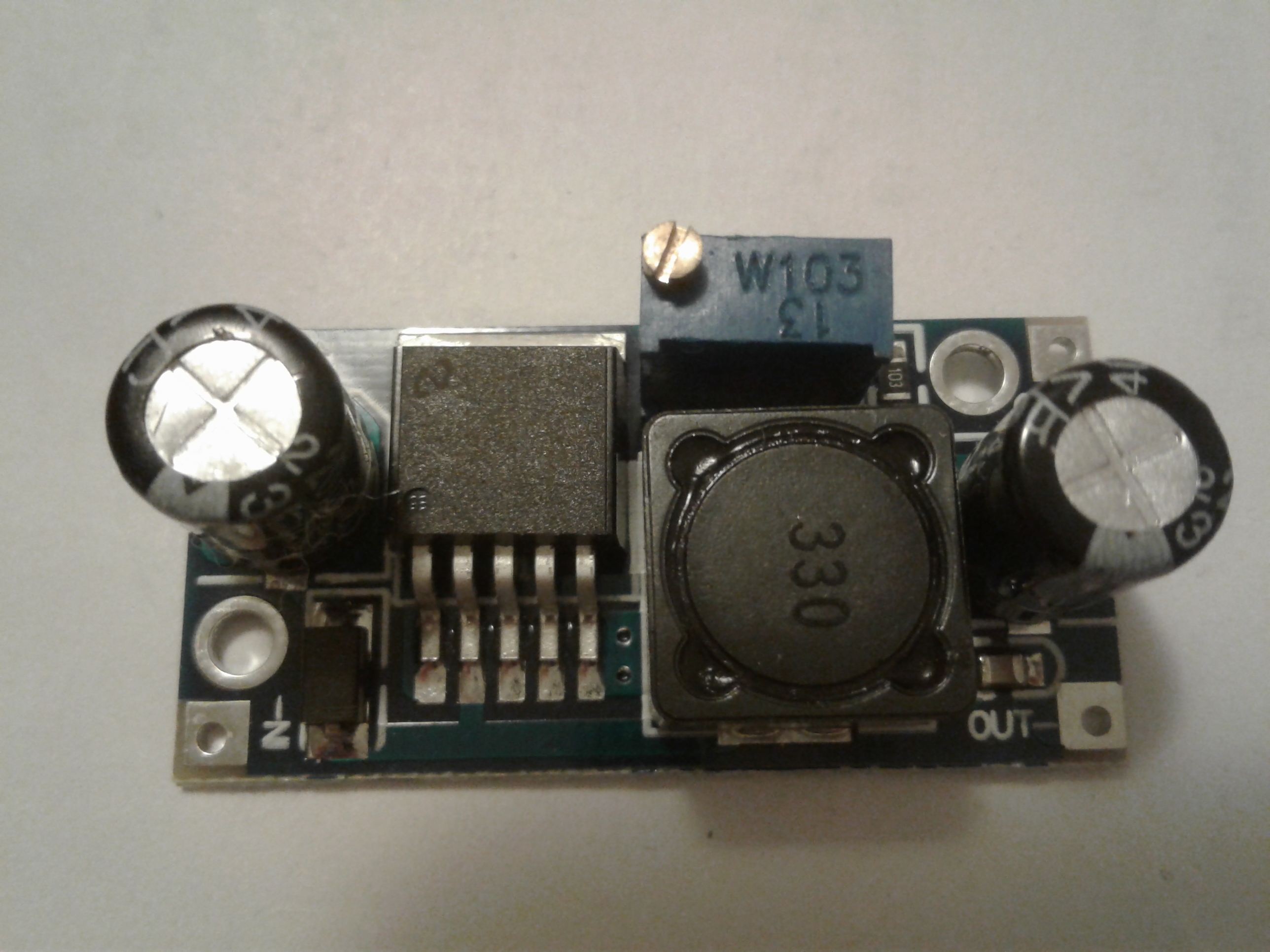
Description of the step down converter based on LM2596S DC-DC step down 3.2-35V

grala1  12 8322 Cool? (+15)
📢 Listen (AI):

TL;DR

  • LM2596S-ADJ step-down converter module regulates output from 3.2 to 35 V and is sold as a low-cost DC-DC buck board.
  • A potentiometer sets the output voltage, and the board measures 44 x 20 x 13 mm; the 35 V input limit comes from the 35 V input capacitor.
  • Tests used an artificial load at 12, 15 and 24 V input with 5 V and 12 V outputs to measure input/output current, power, and efficiency.
  • Measured efficiency did not exceed 85% in the results, with the best case at 15 V in and 12 V out and the worst at 24 V in and 5 V out.
  • At 24 V / 5 V and 2.5 A, the converter reached about 48 °C after 30 minutes, and it was not always possible to load it to 3 A while keeping the output voltage stable.
Generated by the language model.
Hello.
Below I present a description of the step-down converter based on the LM2596S-ADJ chip.
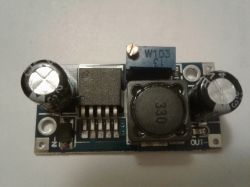
The prices of the converter start on Aliexpress from less than $ 0.60 with shipping, prices with shipping on Polish auction portals start from about PLN 7.
The maximum input voltage for the converter is 35 V (the converter IC itself can withstand a higher voltage, but the limitation here is the electrolytic capacitor at the input, which here has 35 V - you can find converters with a 50 V capacitor).
The output voltage is regulated by a potentiometer in the range from 3.2 to 35 V, efficiency up to approx. 3 A.
Converter dimensions: 44 x 20 x 13 mm
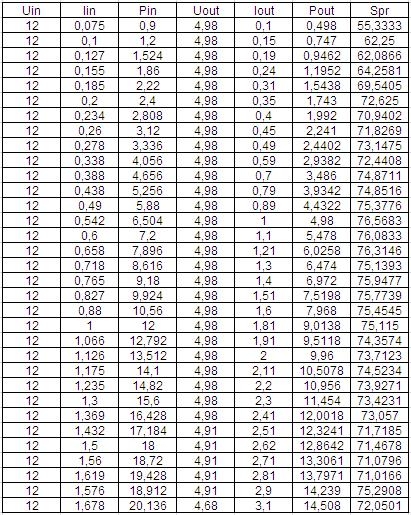
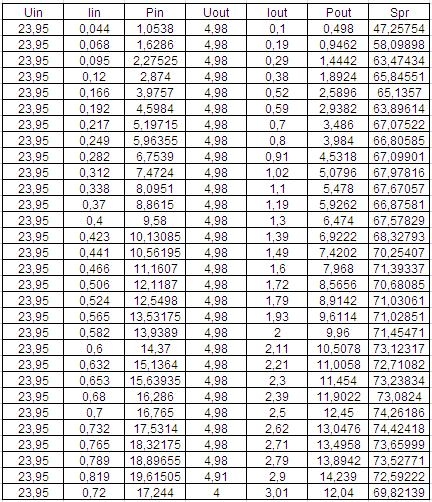
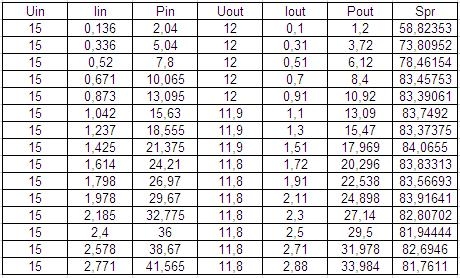
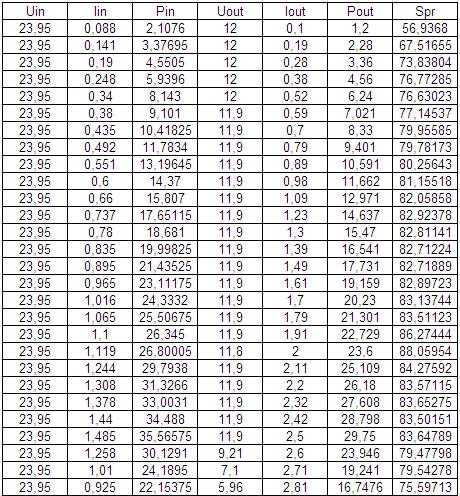
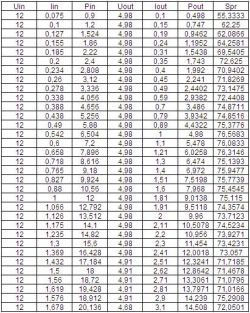
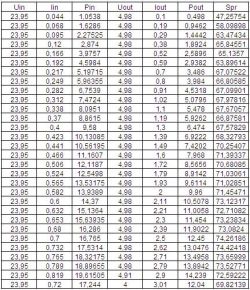
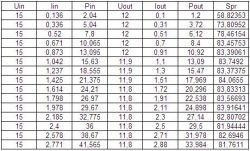
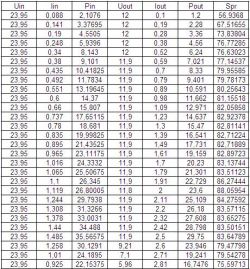
The converter was tested with an artificial load for input voltages of 12, 15 and 24 V and for output voltages of 12 and 5 V. During the tests, voltages and currents on the input and output sides of the converter were measured, power and efficiency were calculated.
Below I present the measurement results.
Input voltage 12V, output voltage 5V:
Input voltage 24V, output voltage 5V:
Input voltage 15V, output voltage 12V:
Input voltage 24V, output voltage 12V:
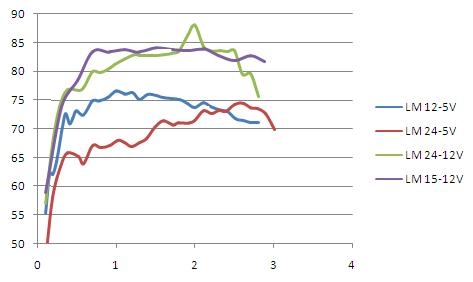
The diagram below shows the efficiency of the converter depending on the current consumed from the converter. We have shown the efficiency for 4 different variants.
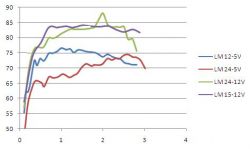
As you can see from the diagram, the efficiency of the converter is not a constant value and it can be seen here that the highest efficiency of this converter is at 15 V input voltage and 12 V output voltage, and the lowest at 24 V input voltage and 5 V output voltage.
It can also be seen that the efficiency also varies with the load on the inverter.
As you can see, the efficiency of this converter does not exceed 85%, where many sellers give even greater value in their descriptions.
The graph shows that for the input voltage of 24 V and output voltage of 12 V at approx. 2 A, the efficiency is approx. 88% - I did not notice it during the measurements, but I would consider this value as an error when reading the value from the artificial load display or an error when entering the value to Excel - it only came out when creating the chart.
It can also be seen from the measurements that it is not always possible to load the converter with 3 A and expect that it will hold the voltage at the output.
I also tested the converter temperature for the configuration where the efficiency was the worst - 24 V / 5 V. With a consumption of 2.5 A in this configuration, the converter temperature after 30 minutes was approx. 48 ° C.
Below is a link to the description of a converter based on the same circuit, but with built-in voltage measurement on the input and output sides.
https://www.elektroda.pl/rtvforum/topic3420290.html#16964656

About Author
grala1 wrote 9811 posts with rating 5028 , helped 1495 times. Live in city Kalisz. Been with us since 2006 year.

Comments

ditomek 16 Jan 2018 10:52

Good job. The parameters will definitely be useful because the device is really popular. And as with the quality of the components and the ability of the inverter to work continuously. I would like... [Read more]

Pelos 16 Jan 2018 12:34

The question is, is it the original LM National ... :) [Read more]

macgyver96 16 Jan 2018 12:55

Good job. The only thing missing is the oscillograms under various loads, unfortunately I experienced that this converter is terribly messy at the output and with sensitive systems you need to take care... [Read more]

lukiiiii 16 Jan 2018 13:20

Do not reverse connect the wires (plus and minus) because the LM2596S explodes. :) [Read more]

Anonymous 16 Jan 2018 18:49

For me, this converter has been working for half a year 24/7 in the 17V to 12V configuration. Loaded about 1-1.5A. No problems so far. [Read more]

zygmuntf 29 Jan 2018 18:49

@lukiiiii: What voltage is at the output of the damaged converter with the LM2596 chip? Has anyone "managed" to burn this chip so that Uout ? Uin; if so, under what circumstances? The post by @ grala1... [Read more]

lukaszd82 29 Jan 2018 19:03

I have built 3 power supplies on the LM2596-5 and they run for 2 years 24/7 without any problems. The systems consume about 1.5A and the power supply is 12V. In addition, the systems (along with the rest... [Read more]

CMS 30 Jan 2018 16:35

All wise books "tell" what happens when the circuit works properly and as intended. There is no one that says something about how a broken system behaves, because it cannot be defined. Answering the... [Read more]

zygmuntf 31 Jan 2018 14:14

Agree that this cannot be read in books. Sometimes, however, a practitioner who has burned several (teen) systems, or even a manufacturer's representative can tell a lot. Once, in the second of these... [Read more]

CMS 31 Jan 2018 17:38

So you can see how much electricity can flow temporarily. That's why I mentioned the example above. Though I've only burned three so far. [Read more]

lukiiiii 06 Feb 2018 15:35

I didn't measure it because I was a bit shocked. probably 0 or Uin. [Read more]

jakobs84 16 Mar 2018 22:56

Hello How to achieve these 2.8kA? :P 28V and 2.5A Vin after a while Vin = Vout and pufff after the circuit, is it "a lot of Amps"? Is no load ?? best regards [Read more]

FAQ

TL;DR: Lab tests show LM2596S modules hit 82–84 % efficiency at 15 V→12 V, not the 90 % claimed [Elektroda, grala1, post #16964655] “...this converter is terribly messy at the output” [Elektroda, macgyver96, post #16965257]

Why it matters: real-world numbers prevent fried loads.

Quick Facts

• Price per board: US $0.60–$1.00 shipped [Elektroda, grala1, post #16964655] • Safe Vin max: 35 V (limited by 35 V electrolytic) [Elektroda, grala1, post #16964655] • Vout trim range: 3.2–35 V via multiturn pot [Elektroda, grala1, post #16964655] • Rated Iout: 3 A peak, ~2 A practical [Elektroda, grala1, post #16964655] • Board size: 44 × 20 × 13 mm [Elektroda, grala1, post #16964655] • Typical efficiency: 70–84 % under 0.5–2 A loads [Elektroda, grala1, post #16964655]

1. What input-voltage range is safe for the standard LM2596S buck module?

Stay between 4.5 V and 35 V. The IC tolerates 40 V, but the onboard 35 V capacitor limits real safety to 35 V [Elektroda, grala1, post #16964655] [TI, 2016].

2. How do I set the output voltage?

Turn the blue multiturn potentiometer clockwise to raise Vout, counter-clockwise to lower it. Measure with a multimeter while adjusting. The range spans about 3.2 V up to nearly the input voltage minus 1 V [Elektroda, grala1, post #16964655]

3. What efficiency can I expect at common conversions?

Expect 82–84 % at 15 V→12 V, about 78 % at 12 V→5 V, and near 70 % at 24 V→5 V, all measured at 1.5–2 A load [Elektroda, grala1, post #16964655]

4. Can the board really supply 3 A continuously?

Not reliably. Tests show voltage sag above roughly 2 A, and some units cannot hold regulation at 3 A [Elektroda, grala1, post #16964655] Keep continuous load ≤2 A for stability.

5. How hot will it get under heavy load?

In the worst-case 24 V→5 V, 2.5 A test, the board reached 48 °C after 30 minutes in still air [Elektroda, grala1, post #16964655] Add airflow or a heatsink for higher currents.

6. What happens if I reverse input polarity?

The LM2596S often fails explosively when Vin is reversed. "Do not reverse connect the wires" warns a user who destroyed a board [Elektroda, lukiiiii, post #16965319] Add a series diode or fuse for protection.

7. Could a failed converter put full Vin on the output?

Yes. Damaged chips can short internally, passing full input voltage and high current to the load [Elektroda, CMS, post #17000118] Plan downstream over-voltage protection.

8. Is the IC genuine or a clone?

Modules from low-cost marketplaces often use unbranded or cloned chips, so performance varies. One poster asks if "it is the original LM National" [Elektroda, Pelos, post #16965222] Buy from reputable suppliers for mission-critical gear.

9. How noisy is the output and how can I clean it?

Oscilloscope checks show significant ripple and spikes. "This converter is terribly messy at the output" warns a user [Elektroda, macgyver96, post #16965257] Add π-filter, low-ESR capacitors, or an LC output filter to reduce noise.

11. How can I quickly test module efficiency myself?

  1. Feed a stable Vin within spec.
  2. Measure Vin, Iin, Vout, Iout with multimeters.
  3. Calculate η = (Vout×Iout)/(Vin×Iin). Repeat at several currents. A table and chart reveal real efficiency [How-To derived from tests, grala1 #16964655].

12. Any edge-case tips for automotive or battery setups?

Add a TVS diode at Vin to clamp load dumps, a Schottky at input to block reverse polarity, and set Vout at least 1 V below Vin minimum to keep regulation during cranks [Automotive EMI Guide].
Generated by the language model.
%}