A TEF6686-based AM/FM tuner module is controlled from a computer and can output analog audio L+R or MPX depending on configuration.
An ATmega328 bridge translates I2C commands for the tuner into UART, and xdr-gtk provides PC control.
The module costs about PLN 100 and offers adjustable de-emphasis, filter settings, great sensitivity, and selectivity.
Remote operation uses a Raspberry Pi and a sound card with line-in, letting the tuner run over the Internet from a separate installation.
Generated by the language model.
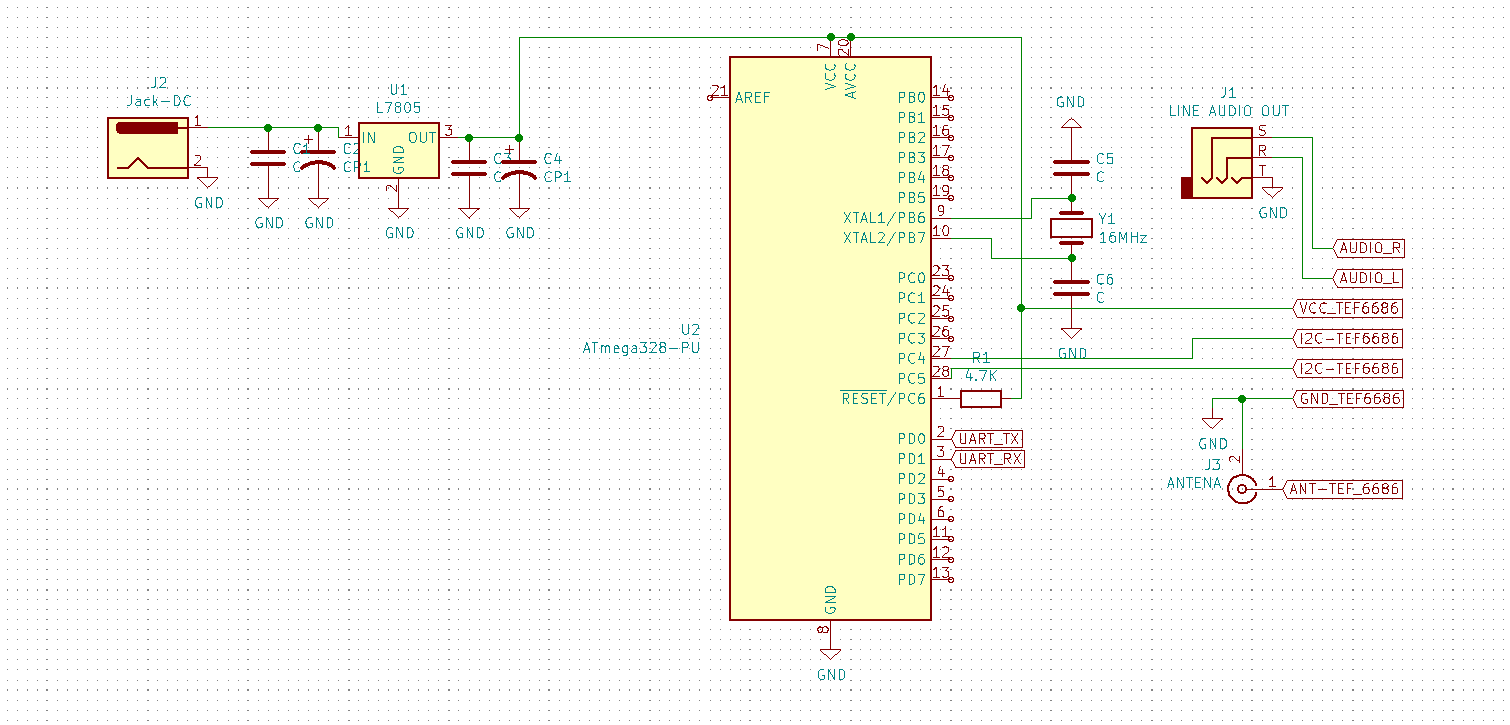
Recently, you can buy interesting AM / FM tuner modules on the TEF6686 chip. Such a module costs about PLN 100 and is sold as an FM head for car radios. It has amazing possibilities, great sensitivity and selectivity, adjustable de-emphasis and filter. The module is already output analog audio L + R, or MPX, depending on the configuration. The device consists of a microcontroller atmega328 with a program that translates the i2c communication with the tuner and issues via uart. You can use the xdr-gtk program to control, I think that a lot will be explained by the movie on which I make a rather slow band-scan, in the background an open page maps.fmdx.pl where you can quickly and easily verify what and where it comes from.
The antenna used in the film is a dipole installed in the V polarization on the roof of a four-story block, more precisely on a pipe from the former azart installation, plus a 40 m cable.
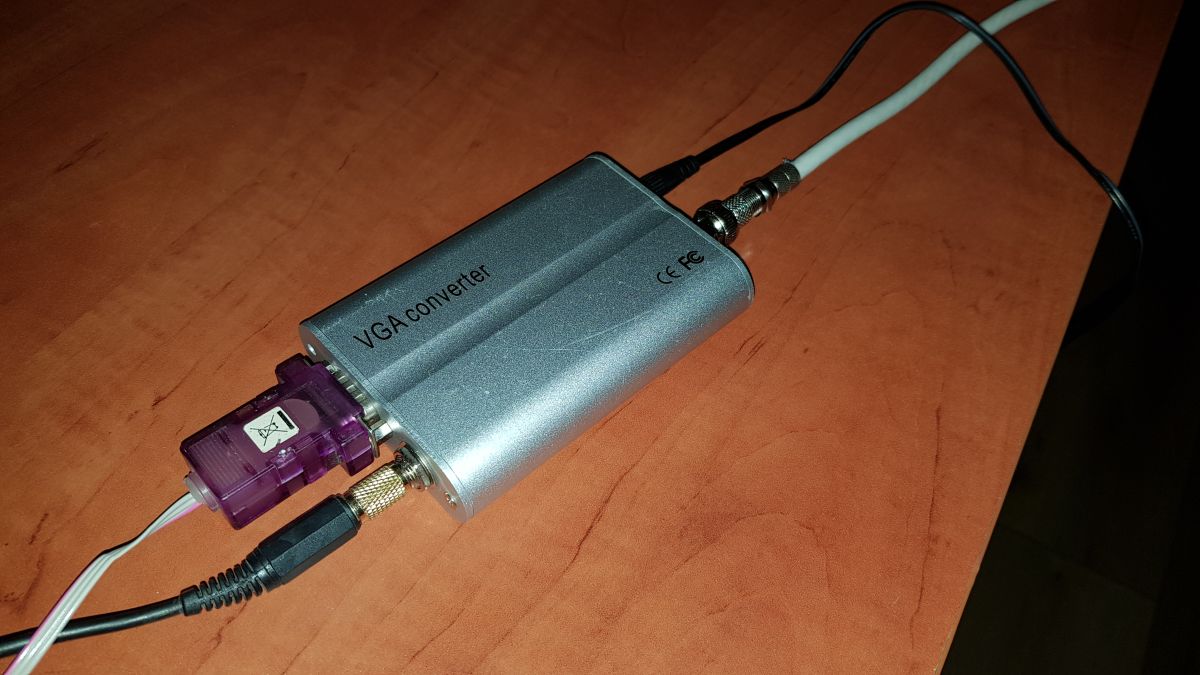
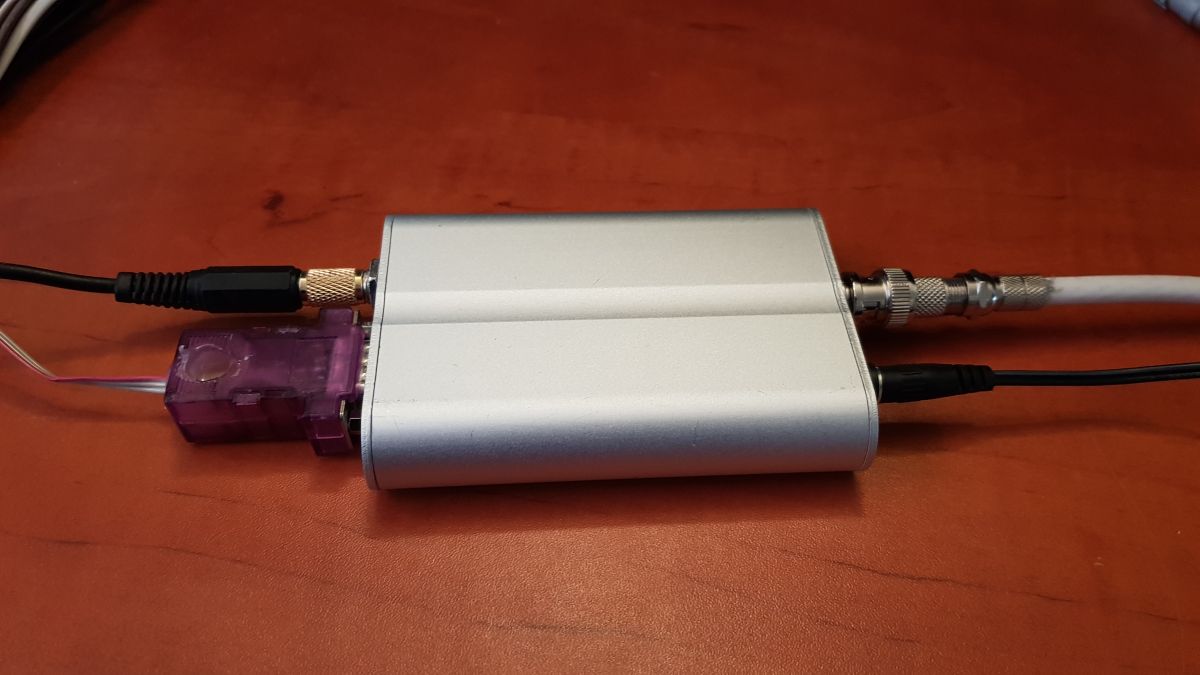
The housing comes from an old, damaged vga-composite converter and the holes for the sockets fit perfectly.
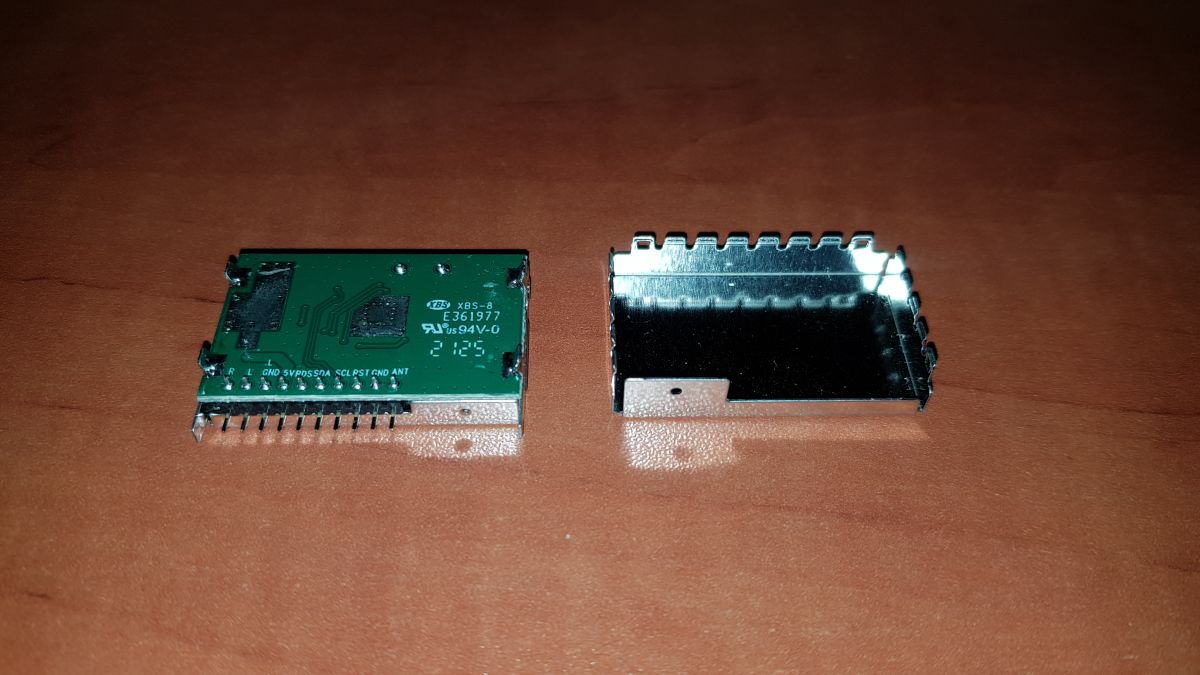
The tuner itself looks like this:
Wiring diagram:
There is also the possibility of remote operation of the tuner, you will additionally need a raspberry pi and a sound card with a line-in connector, then the tuner itself can be installed in a convenient location and used without delay via the Internet. I have such an installation on a 70 m chimney, the xdr itself is publicly displayed so everyone can have fun. The necessary programs are here: http://dktr.pl/XDR There is foobar2000 configured to have as little audio delay as possible and an item with stream address added. There is also the xdr-gtk program, to connect you need to enter the hostname dktr.pl and the password 12345 and you can shoot.
Attachments:
fmdx.7z(12.14 KB)
You must be logged in to download this attachment.
About Author
dktr wrote 935 posts with
rating 721 , helped 45 times.
Live in city Ostróda.
Been with us since 2003 year.
Since you presented your solution in another thread, such a tuner has come to me.
The cost is PLN 67 + PLN 15 per shipment.
The module will now wait for its turn, perhaps for the end of the world, and... [Read more]
Nepto
15 Oct 2021 18:53
Nice! Where exactly did you buy this tuner module? Could you upload a more detailed photo of the module's board? [Read more]
dktr
15 Oct 2021 19:26
Aliexpress or other Chinese store and enter tef6686.
Pictures, I also unsoldered the screen.
https://obrazki.elektroda.pl/8293397300_1634318746_thumb.jpg
https://obrazki.elektroda.pl/86351... [Read more]
Nepto
15 Oct 2021 20:32
Thanks a lot for the photo! It's actually interesting, in the TEF6686 datasheet from NXP they say that the housing is HVQFN32 and here you can see if it had feet. [Read more]
dktr
15 Oct 2021 20:37
The leg is not there, it's tin. Interestingly, the manufacturer of the module saved on ESD protection, which is probably why more is sold ;) [Read more]
simw
15 Oct 2021 20:37
At first glance, detailed documentation is hard to find, even on the NXP website.
However, finally you can find more complete documentation for both the module and the tuner itself.
All necessary files... [Read more]
BOOM i ZONK
16 Oct 2021 11:41
There is some documentation available:
https://usermanual.wiki/Document/UserManualTEF6686.297261401/view [Read more]
excray
16 Oct 2021 14:21
I prefer to buy a complete tuner with an amplifier, control and display for 1/3 of this:
https://www.aliexpress.com/item/32816122408.html
on some Chinese invention, which has such sensational sensitivity... [Read more]
dktr
16 Oct 2021 16:33
This Chinese invention is QN8035 and there is no driveway to the TEF6686 chip from this thread. A completely different league of tuners. [Read more]
excray
16 Oct 2021 17:21
As for the quality of the FM stereo signal, it is too good. Anyway, in the era of DAB and streaming music, such tuners are like a cassette tape.
By the way, I compared several parameters such as sensitivity,... [Read more]
dktr
16 Oct 2021 18:08
I tested tuners made on the qn8035, si4703, tea5767 chips on the same antenna. Only tef6686 can handle, for example, the reception of radio 7 at -94dB at 88.0, where on 88.1 I have + PLUS + with the signal... [Read more]
sq3evp
20 Oct 2021 15:43
How is the sensitivity of TEF6686 compared to others? There are a lot of descriptions on the Internet, but I did not find a strict comparison of parameters and subjective assessment "by ear". [Read more]
dktr
20 Oct 2021 16:46
It all depends on the level of interference. With the antenna input shorted, the signal indicator shows -120 dBm. In my location, three shielded cat6 twisted pairs go to the roof along with the coaxial... [Read more]
sq3evp
20 Oct 2021 18:44
These are nice results. From what you write, the audio quality is not great, but the selectivity is better?
I wonder how it would perform on something better than an ordinary dipole. [Read more]
William Bonawentura
01 Nov 2021 07:42
How about AM reception? Can you upload our 225kHz recording? [Read more]
dktr
01 Nov 2021 09:49
On AM it is surprisingly good, in the middle of the city, the antenna is a dipole 88-108 with a balun, so not quite for this band. [Read more]
William Bonawentura
01 Nov 2021 17:45
Thank you very much. You've just found a "word-music" broadcast :D
I will ask 2 more questions.
1) Do I think that as a PC driver - a module, an Arduino board should be suitable?
2) In the case... [Read more]
dktr
01 Nov 2021 19:24
Atmega328 (arduino) is there to translate commands from uart and pass them via i2c to the tuner. If you compile on rpi then there is a chance to run everything without atmega - it might be useful, but... [Read more]
delta221
29 Nov 2021 14:48
In the Netherlands Sjef has made a TEF V2 and also V1 tuner for AM and FM, all info is here: search : pe5pvb
I can not post now a link, there are also lot of video's see on Youtube:
TEF V2 reciever... [Read more]
FAQ
TL;DR: With a –120 dBm noise floor, "TEF6686 is a completely different league" [Elektroda, dktr, #19665625; #19659203]. Update firmware, add 3.3 V pull-ups, and XDR-GTK or Wi-Fi control unlocks DX-grade AM/FM up to 300 km. Why it matters: a €20 board can rival vintage hi-fi tuners when set up correctly.
Search “TEF6686 radio module” on AliExpress or similar Chinese marketplaces; prices range from PLN 67 to PLN 100 plus shipping [Elektroda, simw, #19656257; dktr, #19658014].
2. Which microcontroller works best for control?
An ATmega328 (Arduino Uno/Nano) is enough; it translates UART ↔ I²C commands. Any board exposing 3.3 V-safe I²C lines will work [Elektroda, dktr, post #20252114]
3. How do I wire the module to an Arduino?
Connect SDA/SCL through 10 kΩ pull-ups to 3.3 V. 2. Tie module 3.3 V and GND to Arduino 3.3 V/GND. 3. Link audio L/R to an amplifier or PC line-in. Follow the schematic in the first post [Elektroda, dktr, post #19656231]
4. XDR-GTK shows “Waiting for tuner” – what’s wrong?
Older firmware (≤v1.18) uses different serial commands. Flash Sjef’s v2.20 firmware via USB, then select the correct COM port at 115 200 bps [Elektroda, henryk2f, post #21586701]
5. My signal meter steps 1 dB at a time.
Decimal resolution appears only in firmware ≥v2.0. Update the ATmega code from the FM-DX-Tuner repo to restore 0.1 dB steps [Elektroda, dktr, post #20251213]
6. The frequencies are offset by ~18 MHz. How do I fix this?
If your board has a 4 MHz crystal, set TUNER_TEF668X_REF_CLOCK to 4000000 in ConfigTEF668X.hpp and recompile; the spectrum then aligns correctly [Elektroda, bup00124545, post #21075906]
7. Can I hear audio through XDR-GTK alone?
No. XDR-GTK only sends control commands. Route L/R outputs to an amp or enable “Listen to this device” on the PC line-in mixer for monitoring [Elektroda, dktr, #20246285; lechoo, #20247886].
8. How sensitive is TEF6686 compared with QN8035 or TEA5767?
Tests show stereo locks at –91 dBm, RDS at –75 dBm, beating QN8035 and TEA5767 which fail under –65 dBm adjacent-channel conditions [Elektroda, dktr, #19659365; #19665625].
9. Does it really handle AM longwave and medium-wave?
Yes. Even with an FM dipole it received 225 kHz LW and city-noise MW signals; adding a proper loop improves clarity [Elektroda, dktr, post #19684703]
10. How can I use the tuner over Wi-Fi?
Install xdr-gtk on a Raspberry Pi, forward UART via TCP, and stream audio with foobar2000; public demo at dktr.pl shows <1 s latency [Elektroda, dktr, post #19656231]
11. Nothing shows without an antenna—is that normal?
Yes. With input shorted, meter rests near –120 dBm. Attach a tuned FM antenna to see stations; an unmatched wire yields negative gain [Elektroda, dktr, #19665625; #20772781].
12. TPA3255 amp makes the tuner “go stupid.” What can I do?
Digital amps radiate HF noise via the audio cable. Add ferrite beads on the minijack, keep grounds short, or use an optical isolator; after filtering, the tuner regains stability [Elektroda, bendix101, post #21585259]
13. Can I lower USB noise entirely?
Power the Arduino+TEF from a battery bank and replace USB with an HC-05 Bluetooth serial link; level-shift HC-05 RX to 3.3 V using 1 kΩ+2.2 kΩ divider [Elektroda, bup00124545, post #21075906]







Comments
Since you presented your solution in another thread, such a tuner has come to me. The cost is PLN 67 + PLN 15 per shipment. The module will now wait for its turn, perhaps for the end of the world, and... [Read more]
Nice! Where exactly did you buy this tuner module? Could you upload a more detailed photo of the module's board? [Read more]
Aliexpress or other Chinese store and enter tef6686. Pictures, I also unsoldered the screen. https://obrazki.elektroda.pl/8293397300_1634318746_thumb.jpg https://obrazki.elektroda.pl/86351... [Read more]
Thanks a lot for the photo! It's actually interesting, in the TEF6686 datasheet from NXP they say that the housing is HVQFN32 and here you can see if it had feet. [Read more]
The leg is not there, it's tin. Interestingly, the manufacturer of the module saved on ESD protection, which is probably why more is sold ;) [Read more]
At first glance, detailed documentation is hard to find, even on the NXP website. However, finally you can find more complete documentation for both the module and the tuner itself. All necessary files... [Read more]
There is some documentation available: https://usermanual.wiki/Document/UserManualTEF6686.297261401/view [Read more]
I prefer to buy a complete tuner with an amplifier, control and display for 1/3 of this: https://www.aliexpress.com/item/32816122408.html on some Chinese invention, which has such sensational sensitivity... [Read more]
This Chinese invention is QN8035 and there is no driveway to the TEF6686 chip from this thread. A completely different league of tuners. [Read more]
As for the quality of the FM stereo signal, it is too good. Anyway, in the era of DAB and streaming music, such tuners are like a cassette tape. By the way, I compared several parameters such as sensitivity,... [Read more]
I tested tuners made on the qn8035, si4703, tea5767 chips on the same antenna. Only tef6686 can handle, for example, the reception of radio 7 at -94dB at 88.0, where on 88.1 I have + PLUS + with the signal... [Read more]
How is the sensitivity of TEF6686 compared to others? There are a lot of descriptions on the Internet, but I did not find a strict comparison of parameters and subjective assessment "by ear". [Read more]
It all depends on the level of interference. With the antenna input shorted, the signal indicator shows -120 dBm. In my location, three shielded cat6 twisted pairs go to the roof along with the coaxial... [Read more]
These are nice results. From what you write, the audio quality is not great, but the selectivity is better? I wonder how it would perform on something better than an ordinary dipole. [Read more]
How about AM reception? Can you upload our 225kHz recording? [Read more]
On AM it is surprisingly good, in the middle of the city, the antenna is a dipole 88-108 with a balun, so not quite for this band. [Read more]
Thank you very much. You've just found a "word-music" broadcast :D I will ask 2 more questions. 1) Do I think that as a PC driver - a module, an Arduino board should be suitable? 2) In the case... [Read more]
Atmega328 (arduino) is there to translate commands from uart and pass them via i2c to the tuner. If you compile on rpi then there is a chance to run everything without atmega - it might be useful, but... [Read more]
In the Netherlands Sjef has made a TEF V2 and also V1 tuner for AM and FM, all info is here: search : pe5pvb I can not post now a link, there are also lot of video's see on Youtube: TEF V2 reciever... [Read more]