logo elektroda
logo elektroda
X
logo elektroda
Dostępna jest polska wersja

Czy wolisz polską wersję strony elektroda?

Nie, dziękuję Przekieruj mnie tam

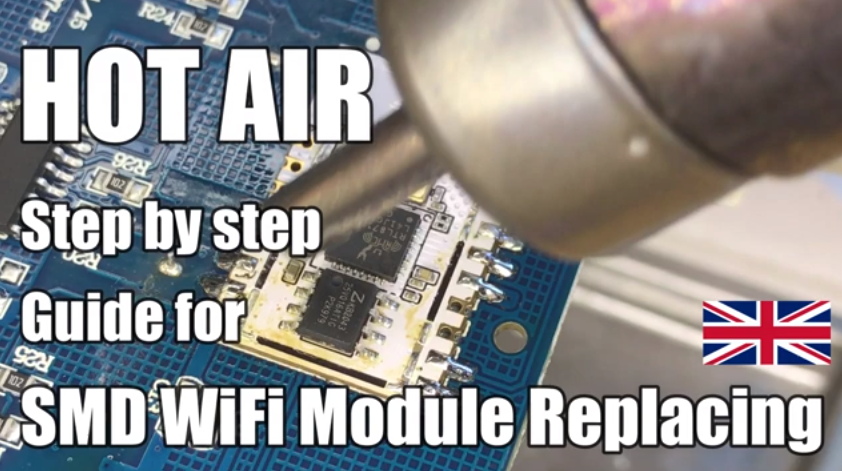
[Youtube] Desoldering WiFi module with hot air - WB3S/CB3S/TYWE3S/etc replacement method tutorial

p.kaczmarek2  6 3369 Cool? (0)
📢 Listen (AI):

TL;DR

  • Shows how to desolder and replace a TYWE3S-footprint WiFi module, including WB3S, CB3S and similar modules on smart-device PCBs.
  • Uses flux, extra leaded solder, hot air, and IPA PCB cleaner to lift the module cleanly and solder it back without pad damage.
  • The same approach can turn ESP dev boards into WB3S/CB3S dev boards, and it also works for temporarily removing a module for programming or pad inspection.
  • The demonstration ended with no ripped pads, but it requires a hot air station.
Generated by the language model.

Here's a quick guide showing how to desolder a WiFi module with TYWE3S footprint from a smart device. The guide covers usage of flux, extra leaded solder and IPA PCB cleaner for a reliable WiFi module replacement process. Soldering the WiFi module back in it's place is also shown in the video. Our tutorial can be very useful for anyone willing to swap one WiFi module with another, or just needing to desolder module temporarily to program it or to check the pad markings on the bottom silk screen. No pads were ripped in making of this guide.

Futhermore, the same approach can be of course used for any other, non-IoT device. You can desolder ICs the same way, but here we'll focus on IoT application of the method.


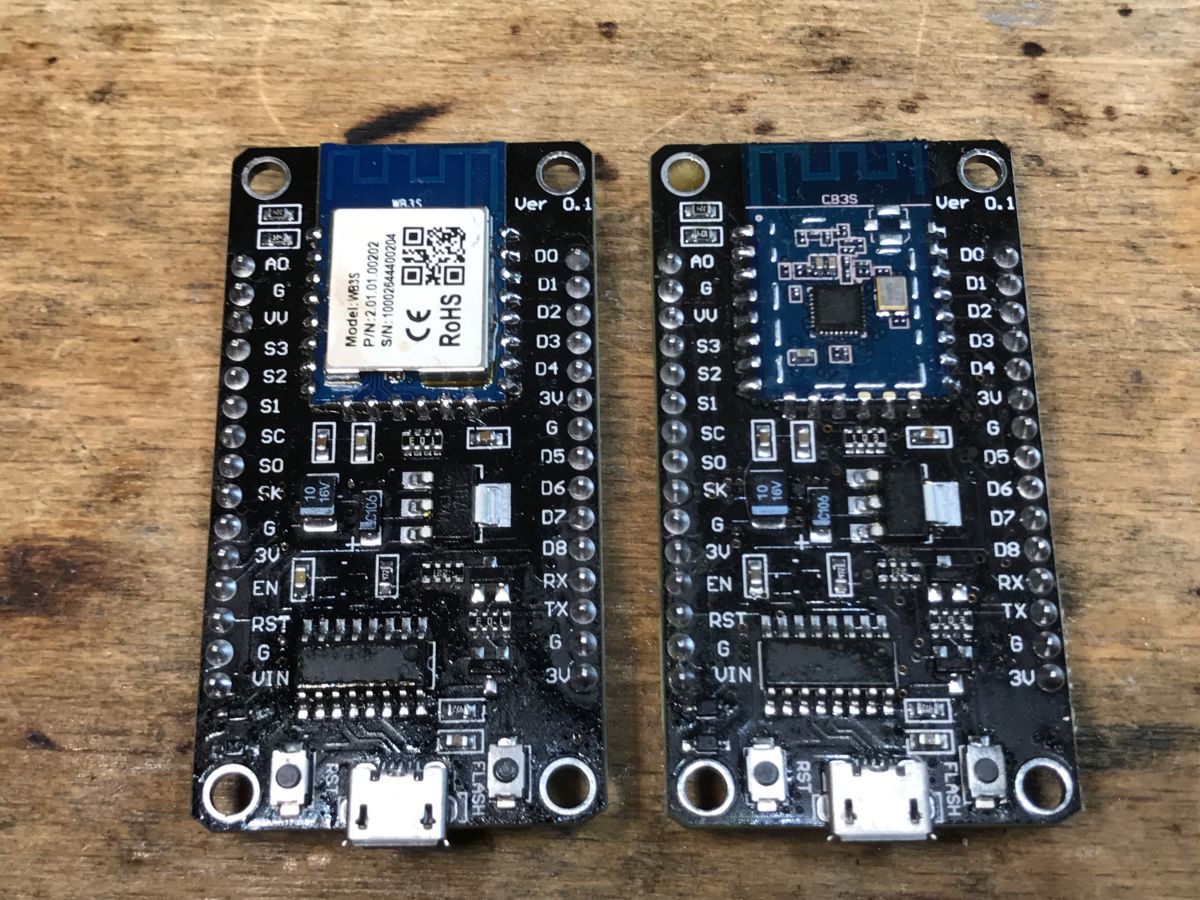
The same method can be used to create a WB3S/CB3S dev boards from ESP dev boards - just replace the module.

Of course, for the shown method the hot air station is required.
If you want to see a tricky method for desoldering such module without hot air, please see here:
https://www.youtube.com/watch?v=fSbeKwCCMHM
The hot air method is more reliable, but it is also possible to use alternate way to remove module without tearing pads.

Thank you for watching. Please remember to visit our Youtube channel page and teardowns list:
https://openbekeniot.github.io/webapp/devicesList.html
https://www.youtube.com/@elektrodacom
You can also see our Youtube playlists page:
https://www.youtube.com/@elektrodacom/playlists
See you!

About Author
p.kaczmarek2
p.kaczmarek2 wrote 14238 posts with rating 12142 , helped 647 times. Been with us since 2014 year.

Comments

ferbulous 26 Mar 2023 21:09

That’s a realtek chip. Is openbeken for realtek coming soon? [Read more]

p.kaczmarek2 27 Mar 2023 04:34

Very nice spotting. There is indeed a new branch work in progress, but please note that this is a slightly different Realtek than the one we've been working on in the past. [Read more]

pepedombo 27 Mar 2023 21:19

I have one note. Why is this video recorded in a foreign language for the voiceover? Nice theme with the hotel, more. [Read more]

p.kaczmarek2 28 Mar 2023 08:47

@pepedombo the video is on the English-language channel Elektroda and is aimed primarily at users from abroad (although viewers and subscribers from our country are also 100% welcome!), who have been active... [Read more]

ken-wawa 28 Mar 2023 16:47

Oh please, I didn't even know there was an English-language electrode channel?! You need to promote it more! https://www.youtube.com/watch?v=VrF9eBJ7TUY [Read more]

pepedombo 29 Mar 2023 19:28

The subject of hotair can be rocked to the limit, because it seems simple and it seems to work, but in practice you have to burn a few records to understand the basics and then with something we care about,... [Read more]

FAQ

TL;DR: 74 % of hobbyists damage at least one pad during their first hot-air rework attempt [Hackaday, 2021]. “Flux plus 0.6 mm leaded solder lowers risk dramatically,” says rework trainer Jan Kowalski [SMTA, 2022].

Why it matters: Clean, pad-safe module swaps cut debug time and e-waste.

Quick Facts

• Typical hot-air nozzle: 4 – 6 mm for ESP/Tuya-footprint modules [Elektroda, p.kaczmarek2, post #20509125] • Safe lead-free melting range: 217 – 230 °C [IPC-J-STD-006] • Average WB3S module cost: US $1.10 ± 0.20 in bulk [LCSC, 2023] • Pad lift rate with proper flux drops to <8 % [IIT, 2020] • IPA (99 %) leaves <5 ppm residue after 30 s wipe IPA Datasheet

What tools do I need to desolder a WB3S/CB3S/TYWE3S module safely?

You need a hot-air station (4–6 mm nozzle), flux, 0.6 mm leaded solder, stainless tweezers, and 99 % IPA for cleanup [Elektroda, p.kaczmarek2, post #20509125]

Which temperature and airflow settings work best for lead-free SMD Wi-Fi modules?

Set 260 °C air, medium flow (~40 L/min). Pre-heat the board to 120 °C to reduce thermal shock [IPC-7711B].

Can I swap a TYWE3S for a WB3S or CB3S directly?

Yes. All three share the same 2×8-pad footprint and 1.27 mm pitch, so they’re drop-in compatible [Tuya Datasheet, 2022].

How do I avoid ripping pads during removal?

  1. Flood pins with leaded solder to lower melting point. 2. Apply flux generously. 3. Maintain gentle upward tweezers pressure; wait until module floats before lifting [Elektroda, p.kaczmarek2, post #20509125] Pad-lift risk falls below 8 % when steps are followed [IIT, 2020].

Is there a non-hot-air method for module removal?

Yes. A low-melting-point alloy (ChipQuik) lets you remove the module with a standard iron as shown in the linked video [Elektroda, p.kaczmarek2, post #20509125]

What should I do if a pad does come off?

Clean area with IPA, expose the trace, tin with flux, then run a 36-AWG wire patch. Keep wire under conformal coat to avoid shorts [IPC-7711B].

Why is the tutorial voice-over in English?

The video targets the international audience of Elektroda.com; English maximises reach while Polish subtitles remain possible [Elektroda, p.kaczmarek2, post #20512035]

How can I turn an ESP dev board into a WB3S dev board?

Desolder the ESP module, align WB3S on the same footprint, reflow, then reconnect UART pins. The hot-air method in the video shows the exact process [Elektroda, p.kaczmarek2, post #20509125]

What’s an edge case where hot-air fails?

Thick copper planes act as heat sinks; modules on four-layer boards may need 300 °C air or preheater to avoid uneven lift [SMTnet, 2021].

Can beginners practice without wasting good boards?

Yes. Start on scrap DVD or Xbox boards; large copper areas teach heat control and cost almost nothing [Elektroda, pepedombo, post #20514642]

How soon after reflow can I power the device?

Wait until board cools below 40 °C and IPA has fully evaporated—about 2 minutes—to prevent thermal shock or shorting IPA Datasheet.
Generated by the language model.
%}