logo elektroda
logo elektroda
X
logo elektroda

Alternative/new GPIO pinout of TYWE3S/ESP8285 WiFi module, Tasmota

p.kaczmarek2 5748 5

TL;DR

  • A TYWE3S WiFi module in the Appio 9605 light switch uses a non-standard GPIO pinout that does not match Tuya documentation.
  • Inspection showed it is an ESP8285 with built-in memory, not the usual ESP8266 plus SPI flash, and the UART pins sit in different locations.
  • The module has 2MB built-in memory, and the alternative wiring for RX, TX, and GPIO0 allowed flashing Tasmota.
  • Standard flashing failed, but Tasmota uploaded successfully after using the alternative pinout; the new and old TYWE3S versions are hard to distinguish externally.
Generated by the language model.
ADVERTISEMENT
Treść została przetłumaczona polish » english Zobacz oryginalną wersję tematu
📢 Listen (AI):
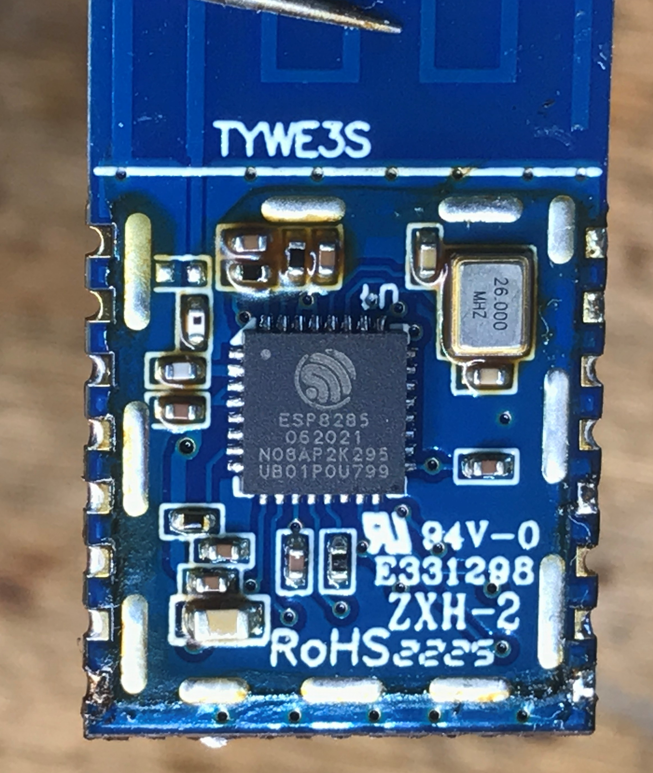
  • TYWE3S module with an ESP8285 chip.
    Recently, while uploading Tasmota to another series of WiFi-controlled light switches, I came across something that really surprised me. It was a TYWE3S module with non-standard pinouts that did not match the Tuya documentation. Here I will provide its RX, TX and GPIO0 location and information on how to change its input in such a case.

    I found the module in the Appio 9605 light switch, but from what I saw, it is repeated in the entire Appio series. It may also be found in other products.
    Seemingly, it's an ordinary TYWE3S:
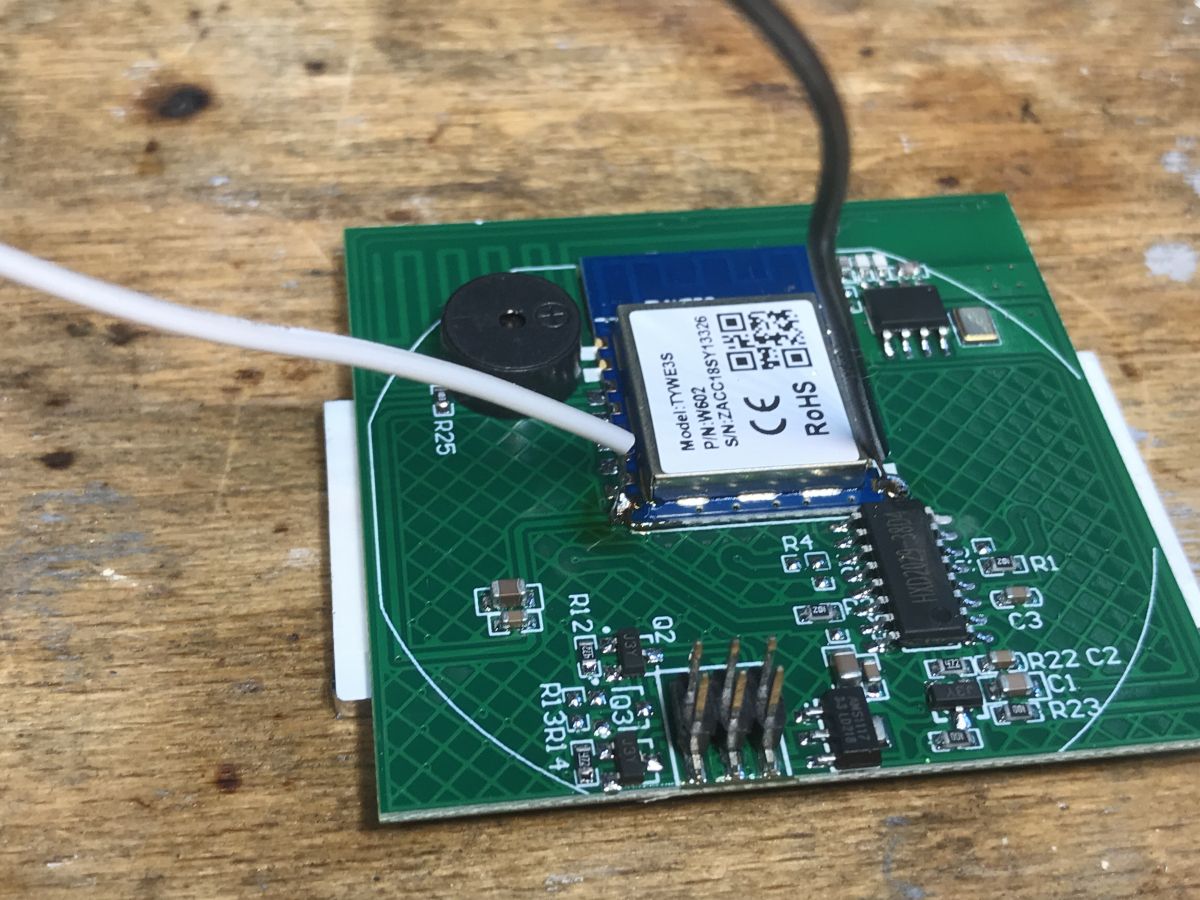
    TYWE3S module soldered onto a PCB with connected wires for firmware flashing.
    But standard flashing is not successful at all. For this reason, I desoldered it with hot-air:
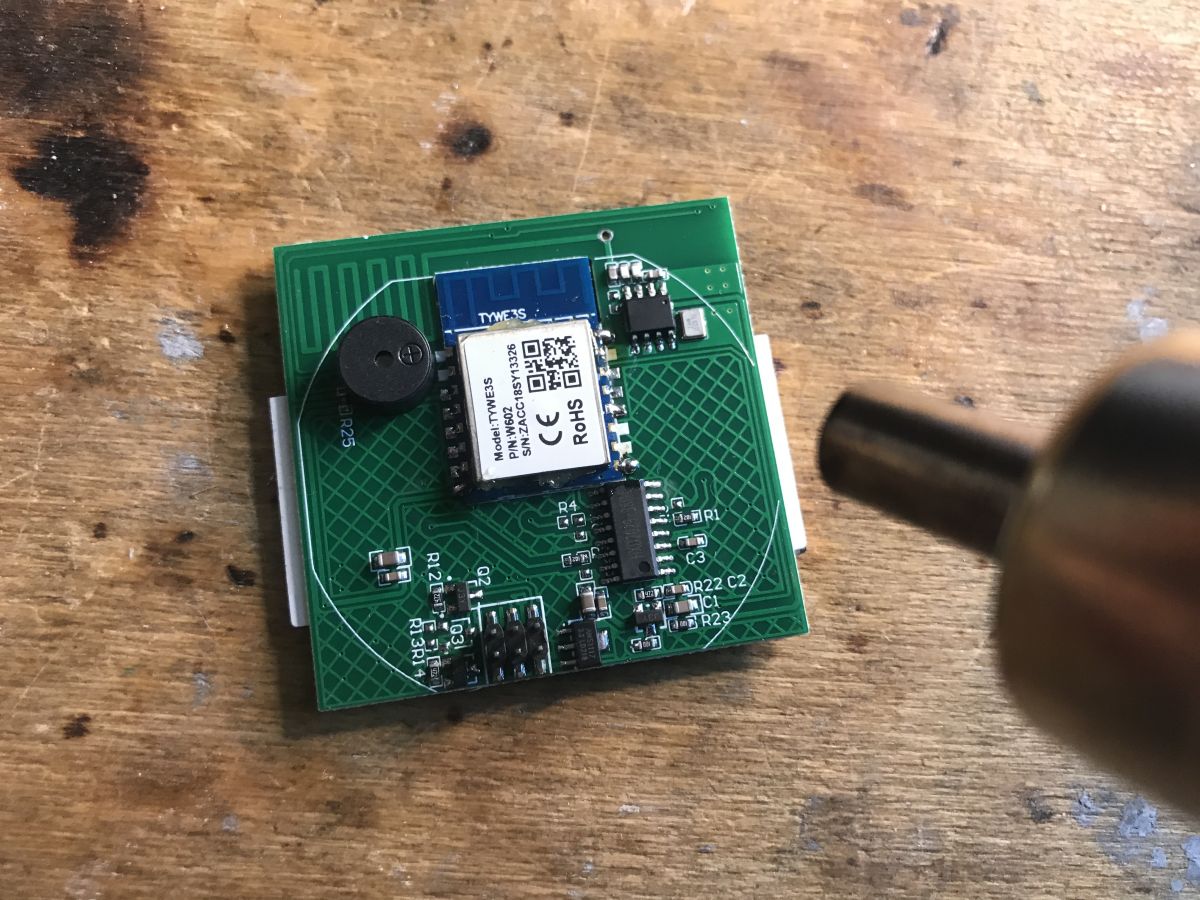
    TYWE3S module on a circuit board next to a hot-air tool.
    I also removed the screen and started analyzing:
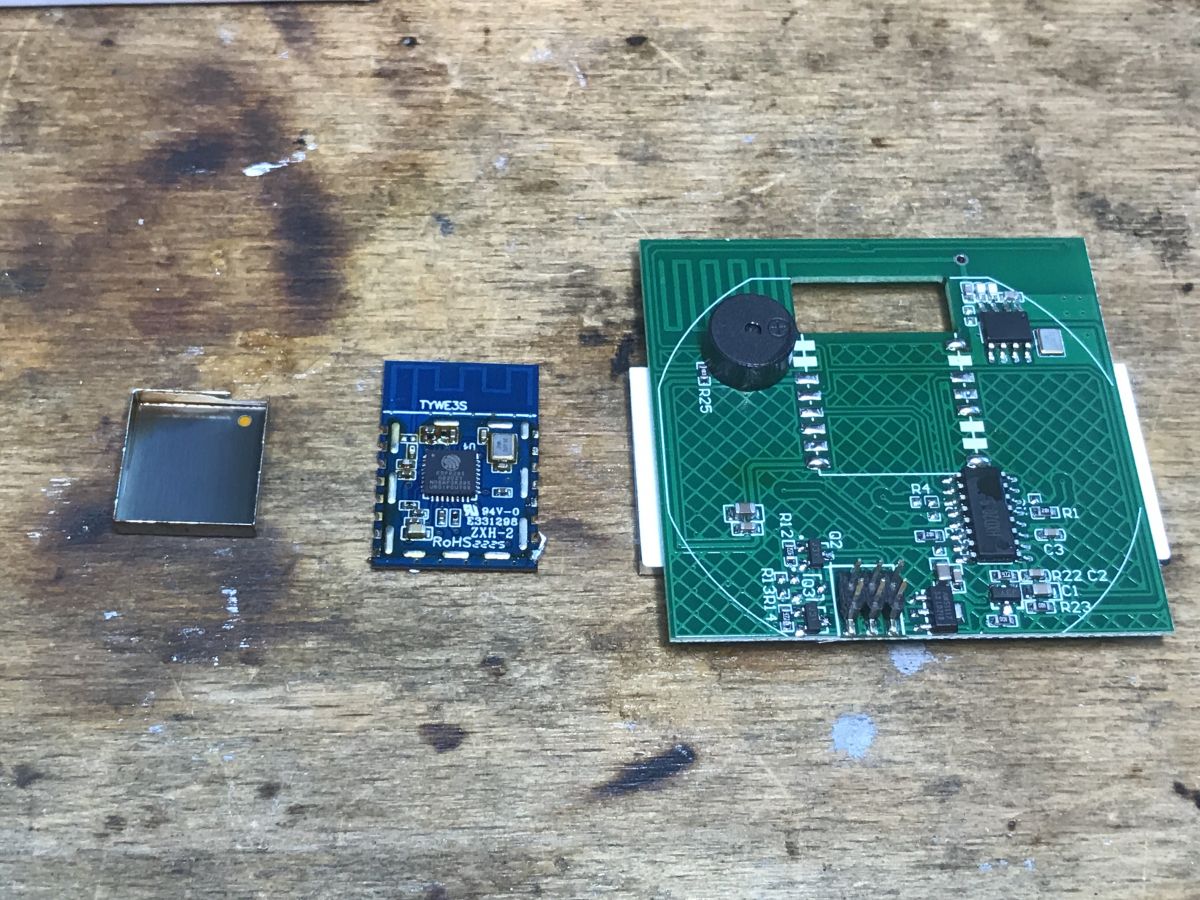
    TYWE3S module with open shield next to a circuit board.
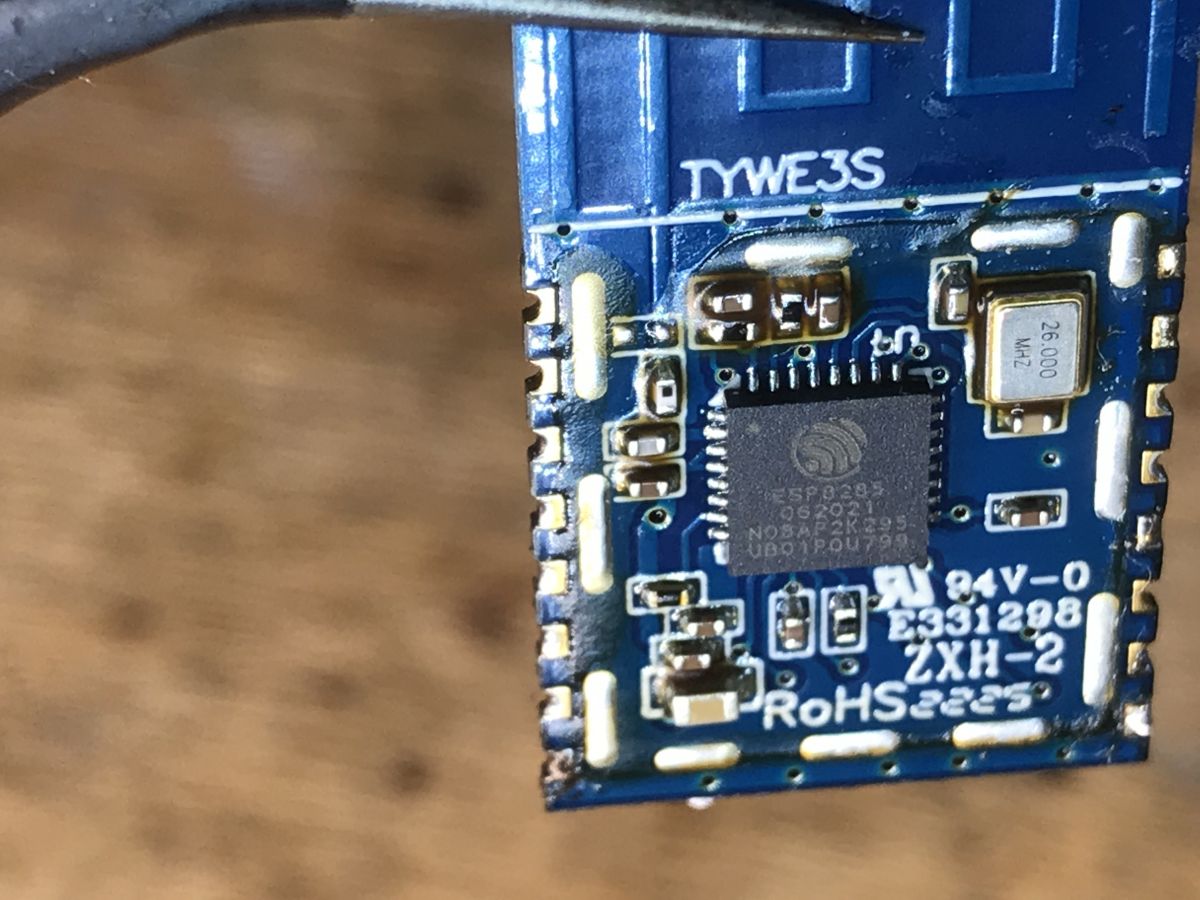
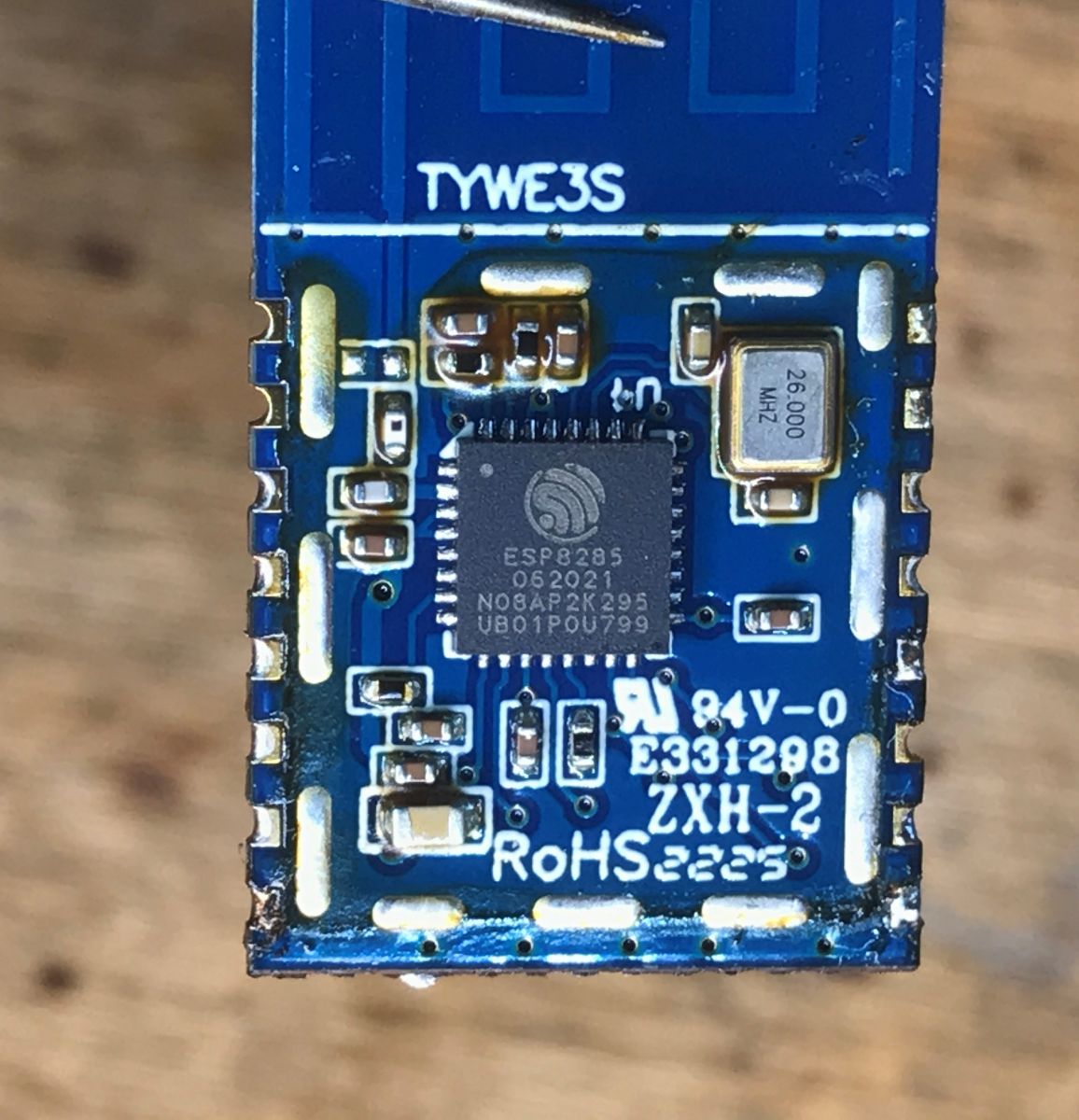
    There is no ESP8266 + SPI Flash set inside, only ESP8285 with built-in 2MB memory.
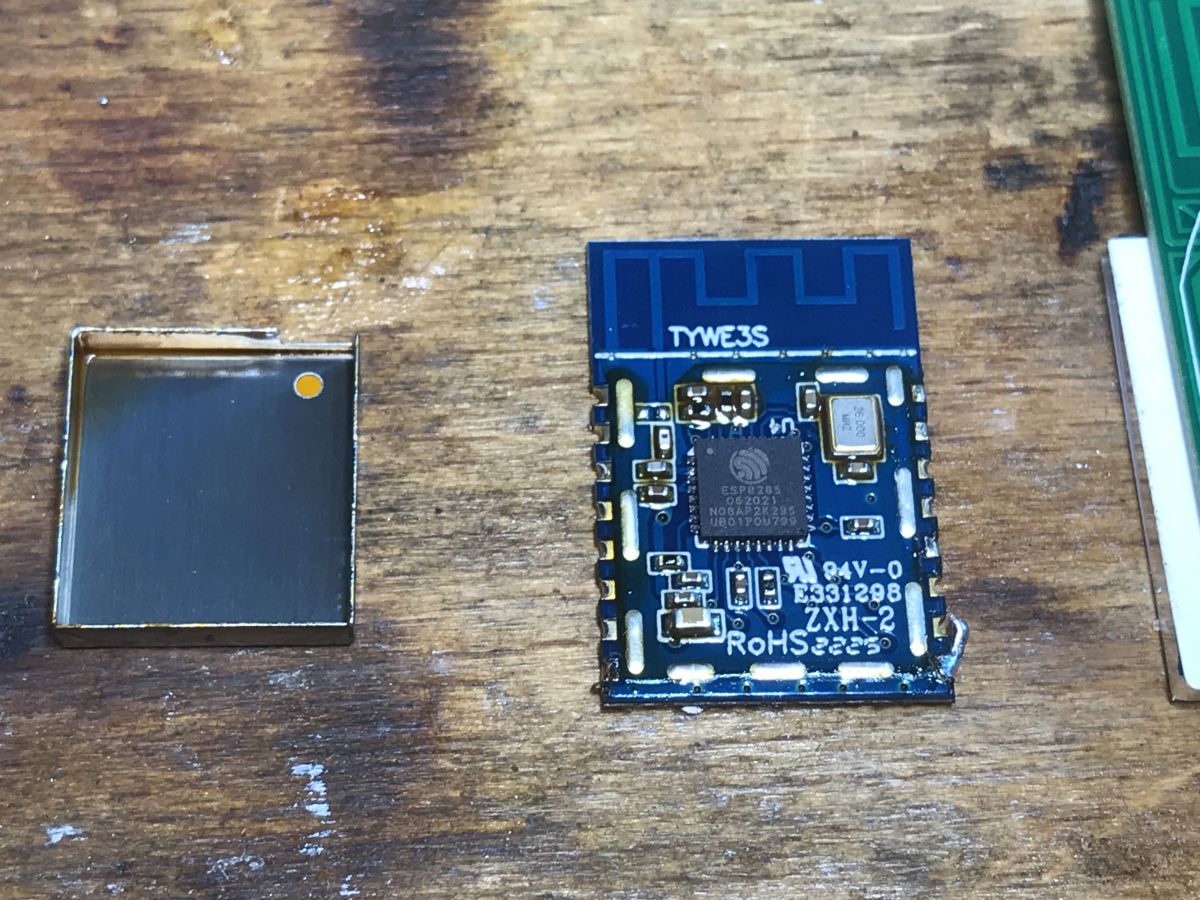
    TYWE3S module with ESP8285 chip visible after removing the shield.
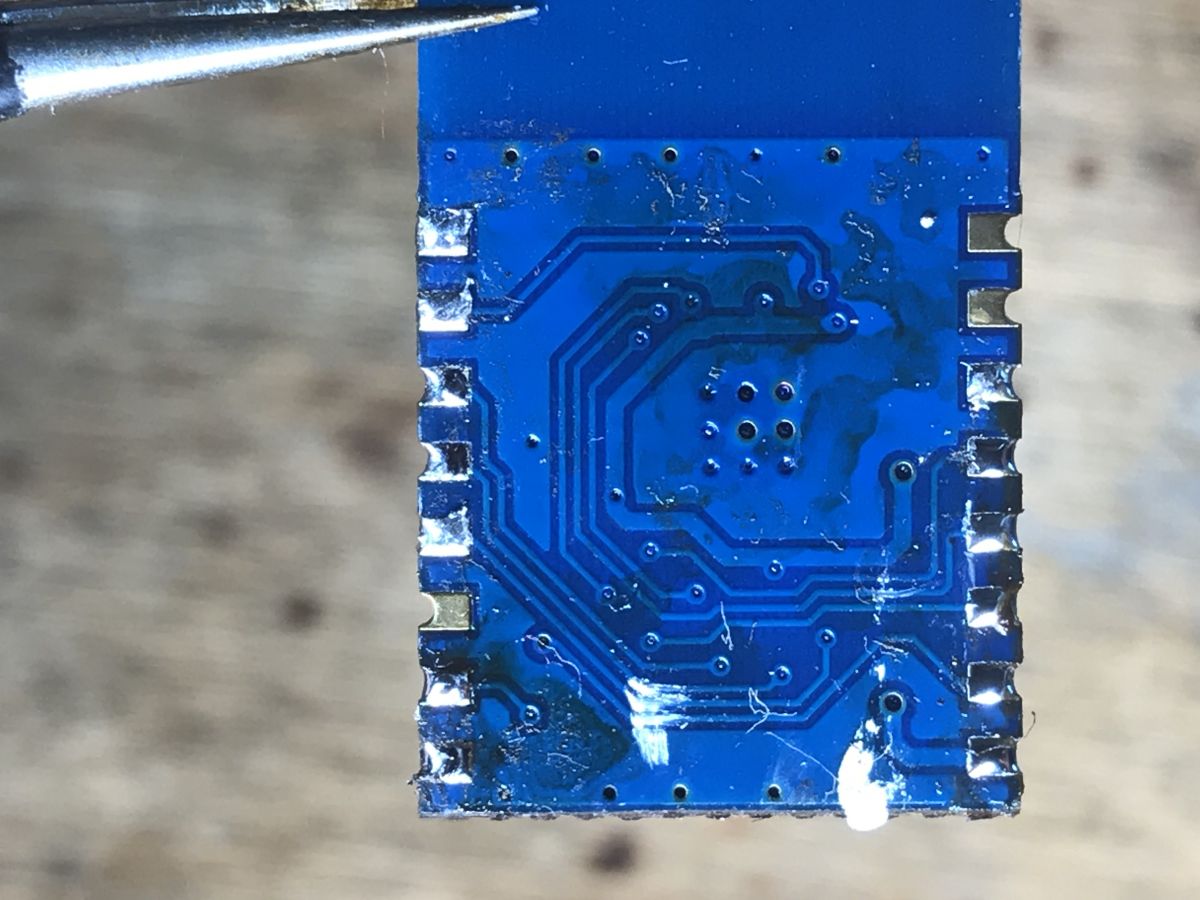
    This TYWE3S has no GPIO information on the description layer:
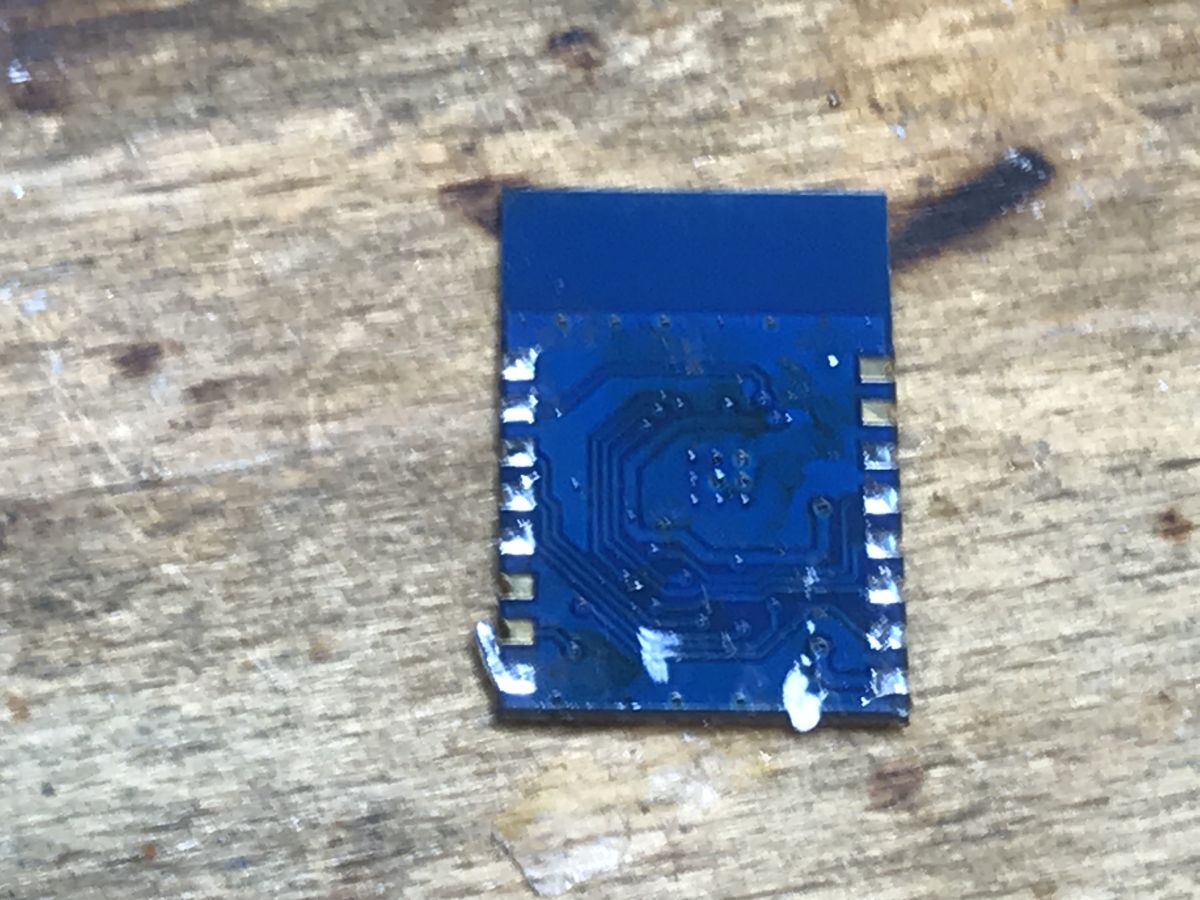
    TYWE3S module with non-standard pinout. View of the TYWE3S module with non-standard pinouts.
    TYWE3S module with exposed ESP8285 chip. Close-up of the TYWE3S module with ESP8285 chip.
    I was about to analyze the PCB carefully to see what goes where, but I found mentions of this module on the Internet:
    https://github.com/arendst/Tasmota/discussions/16500
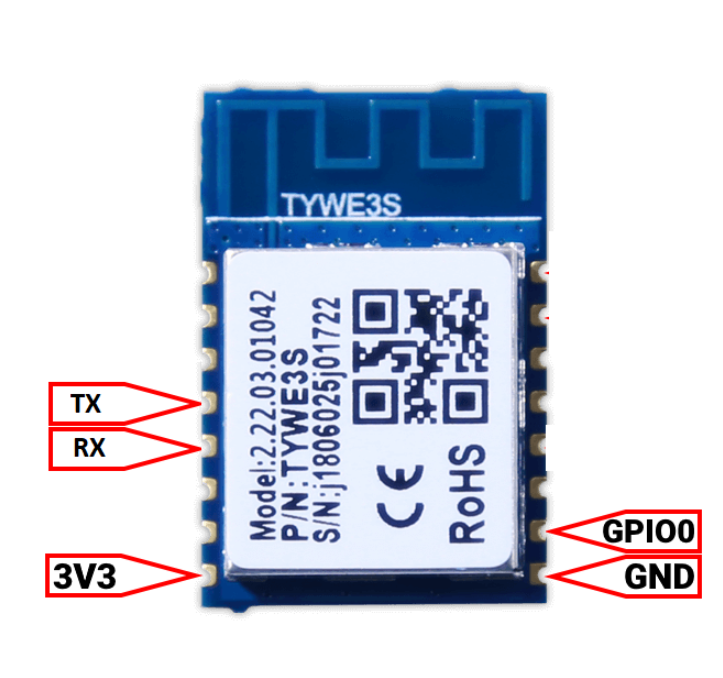
    TYWE3S WiFi module with marked pins: RX, TX, GPIO0, GND, and 3V3.
    After soldering the wires according to the alternative pinout, I managed to upload Tasmota:
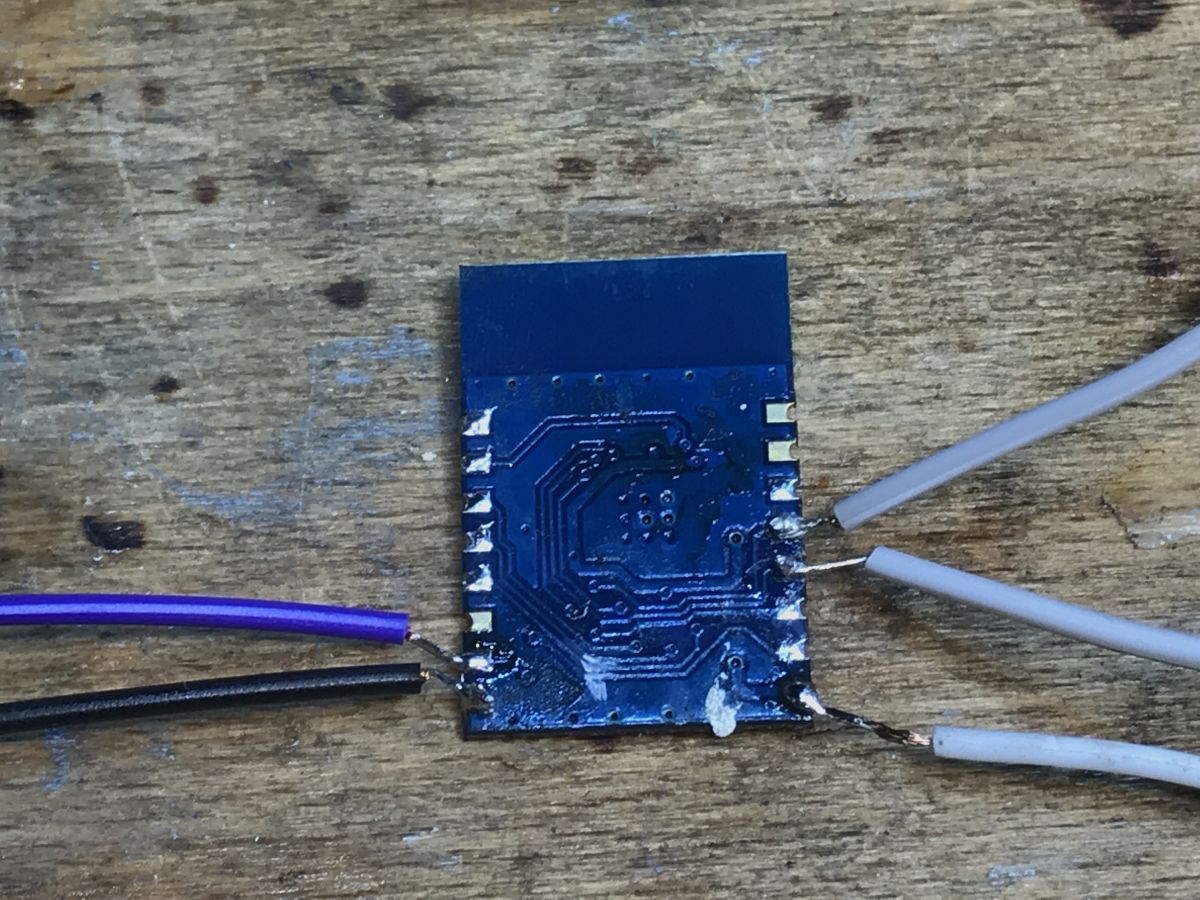
    TYWE3S module with soldered wires on a wooden surface
    I flashed according to: https://www.elektroda.pl/rtvforum/topic3990951.html
    Then I soldered the module into place.
    The module can probably be flashed into the system just like the old TYWE3S (as long as the UART port is not occupied, e.g. by TuyaMCU), but at the moment I don't know how to determine from the outside whether the encountered TYWE3S is "new" or "old"...

    Summary
    This module is described as TYWE3S but has pinouts that are incompatible with it. I guess only the ground and power supply are in the same place, but I didn't check other GPIOs either, because it's faster to just set 4 relays on the Tasmota and test the GPIO options one by one than to write it down. It can be distinguished from the old TYWE3S only by the fact that there is one ESP8285 under the screen, not ESP8286 + memory chip.
    For reference, I will remind you of the pinouts of the old TYWE3S:
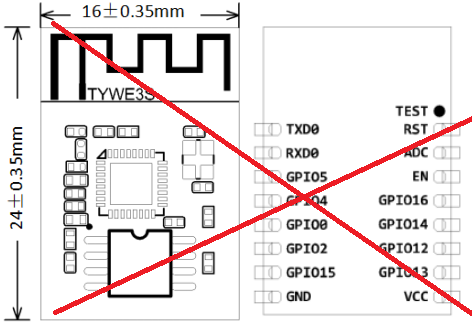
    Diagram of TYWE3S module with crossed-out pin specification.
    I really don't know how this could have happened and what was the motivation for such a pin swap, especially since all "newer" modules such as WB3S or CB3S have pinouts compatible with the old TYWE3S (even the UART location is the same), and here the UART is in a different place, but at least VDD/GND has not been changed, so there is probably no risk of damaging this module...
    To sum up, I warn you - if you are unable to upload the firmware to TYWE3S, check if you have the version described in this topic.

    Cool? Ranking DIY
    Helpful post? Buy me a coffee.
    About Author
    p.kaczmarek2
    Moderator Smart Home
    Offline 
    p.kaczmarek2 wrote 14394 posts with rating 12315, helped 650 times. Been with us since 2014 year.
  • ADVERTISEMENT
  • #2 20837223
    KarolJuszkiewicz
    Level 12  
    Posts: 183
    Help: 6
    Rate: 12
    Board Language: polish
    So this is a WiFi switch?!
  • ADVERTISEMENT
  • #3 20837253
    p.kaczmarek2
    Moderator Smart Home
    Posts: 14394
    Help: 650
    Rate: 12315
    TYWE3S is a WiFi module based on ESP8266 (or, as you can see, ESP8285), used in many Tuya products. Its documentation can be found here:
    https://developer.tuya.com/en/docs/iot/wifie3smodule?id=K9605ua1cx9tv
    In addition, there are also similar modules, such as TYWE2S, also for ESP, and modules on other systems, but compatible with pinouts (more or less), such as CB3S or WB3S.

    These types of modules can be found in various types of WiFi-controlled devices, for example in WiFi switches, or thermostats, or smart sockets (usually TYWE2S/CB2S/WB2S), and so on. Even in Blitzwolf's "smart fryer" (whatever it is) I saw TYWE3S.

    All this is interesting because such products can then be changed from a WiFi module to some open source software in order to free the device from the cloud and modify it at will.

    The full list of IoT devices we describe can be found in the link below:
    https://openbekeniot.github.io/webapp/devicesList.html
    The search engine supports searching by name, keyword and module name (enter "TYWE3S", select ESP and search)
    Helpful post? Buy me a coffee.
  • ADVERTISEMENT
  • #4 20845831
    KarolJuszkiewicz
    Level 12  
    Posts: 183
    Help: 6
    Rate: 12
    Board Language: polish
    And what can you do with such a module? Since he surprised you
  • ADVERTISEMENT
  • #5 20845841
    p.kaczmarek2
    Moderator Smart Home
    Posts: 14394
    Help: 650
    Rate: 12315
    But are you asking about the WiFi module itself or the switch?

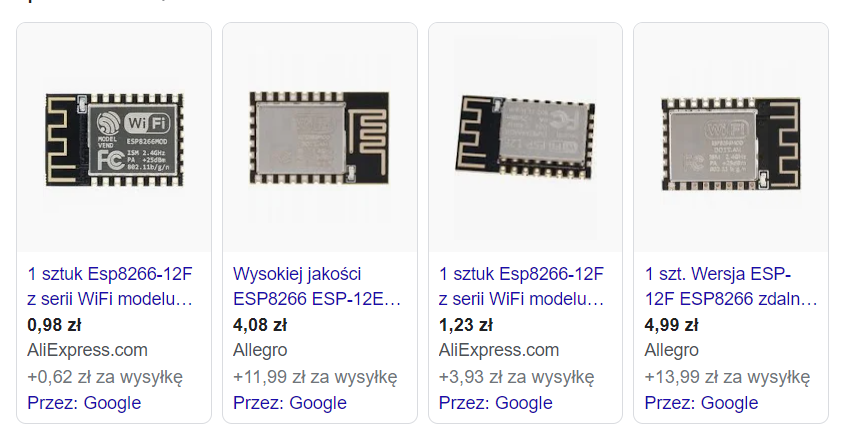
    TYWE3S is a module very similar to ESP12. Of course, you can also buy it as a module only, without an IoT device:
    Image of four ESP8266-12F WiFi modules with price offers.
    In the normal, popular version, TYWE3S has pinouts compatible with ESP12, but in this topic I am describing its alternative version, where the pinouts are completely mixed up (except ground and power supply).

    You can implement many interesting projects on ESP12, e.g.:
    Clock on ESP12 and MAX7219 display - tutorial - part 1, ArduinoOTA, basics
    Helpful post? Buy me a coffee.
  • #6 20845849
    KarolJuszkiewicz
    Level 12  
    Posts: 183
    Help: 6
    Rate: 12
    Board Language: polish
    p.kaczmarek2 wrote:
    But are you asking about the WiFi module itself or the switch?

    I'm asking about the module itself because I'm thinking about making a WiFi camera (I'll create a topic about it later).
📢 Listen (AI):

FAQ

TL;DR: ESP8285 packs 2 MB on-die flash and in the “new” TYWE3S 100 % of standard UART pins shift location; “pinouts are incompatible” claims expert p.kaczmarek2 [Elektroda, p.kaczmarek2, post #20835466] Why it matters: wrong pads mean no firmware upload and stalled projects.

Quick Facts

• Core: ESP8285 with 2 MB flash, ~20 % PCB area saved vs. ESP8266+SPI chip [Espressif DS, 2023]. • Supply: 3.0–3.6 V DC, 500 mA peak during Wi-Fi TX (datasheet). • Alternative UART: RX→GPIO4, TX→GPIO5, GPIO0→RXD0 [Elektroda, p.kaczmarek2, post #20835466] • Legacy TYWE3S uses ESP8266 + external 1/4 MB SPI flash [Tuya Docs, 2023]. • Retail price as loose module: €2–€4 (Nov 2023 market scan).

Is TYWE3S a Wi-Fi switch or just a module?

TYWE3S is a self-contained Wi-Fi module based on ESP8266 or ESP8285; manufacturers embed it in products like smart switches, thermostats and fryers [Elektroda, p.kaczmarek2, post #20837253]

What surprised users about the ‘new’ TYWE3S?

The module keeps the name but swaps every GPIO except VDD and GND, so the usual RX/TX/GPIO0 pads do not work for flashing [Elektroda, p.kaczmarek2, post #20835466]

How can I quickly flash Tasmota onto the alternative TYWE3S?

Follow this 3-step method:
  1. Solder wires: RX→GPIO4, TX→GPIO5, GPIO0→RXD0, 3.3 V and GND unchanged.
  2. Hold GPIO0 low, apply power, start esptool at 74880 bps.
  3. Upload Tasmota binary, verify, then resolder the module [Elektroda, p.kaczmarek2, post #20835466]

What tools do I need to desolder and re-flash the module?

Use a 300 °C hot-air station for safe removal, fine-gauge enameled wire for temporary connections, and a 3.3 V USB-UART bridge capable of 500 mA bursts [Elektroda, p.kaczmarek2, post #20835466]

Can mis-wiring damage the module?

Ground and VDD stay on the same pads, so reversed UART lines usually fail safely; however, feeding 5 V will destroy the ESP8285 in under one second [Espressif DS, 2023].

What practical projects suit this module alone?

Treat it like an ESP12: build clocks, smart relays, or a low-res Wi-Fi camera by adding an OV2640 camera and running ESP32-CAM-style firmware, though RAM constraints limit resolution to 160×120 frames [‘ESP-Cam-On-8266’ repo, 2022].

What baud rate should I expect on boot?

The bootloader prints at 74880 bps by default, the same as standard ESP8266/85 chips [Espressif DS, 2023].

Is there a visual way to spot the alternative version before desoldering?

Yes. Lift the RF shield and look: a single ESP8285 die appears where the old version shows separate ESP8266 + flash ICs [Elektroda, p.kaczmarek2, post #20835466]

What’s the failure rate when people flash using legacy pads?

Community reports show a 100 % failure to enter flashing mode when wires follow the old map on this variant [Elektroda, Discussion 16500].

Could flashing in-circuit still work?

It can if the UART pins are free—that’s rare because many boards wire those pads to an MCU like TuyaMCU. Desoldering avoids that roadblock [Elektroda, p.kaczmarek2, post #20835466]

Any licensing issues with using Tasmota?

Tasmota is MIT-licensed, so commercial and personal use require only preservation of the license notice [Tasmota License].
Generated by the language model.
ADVERTISEMENT