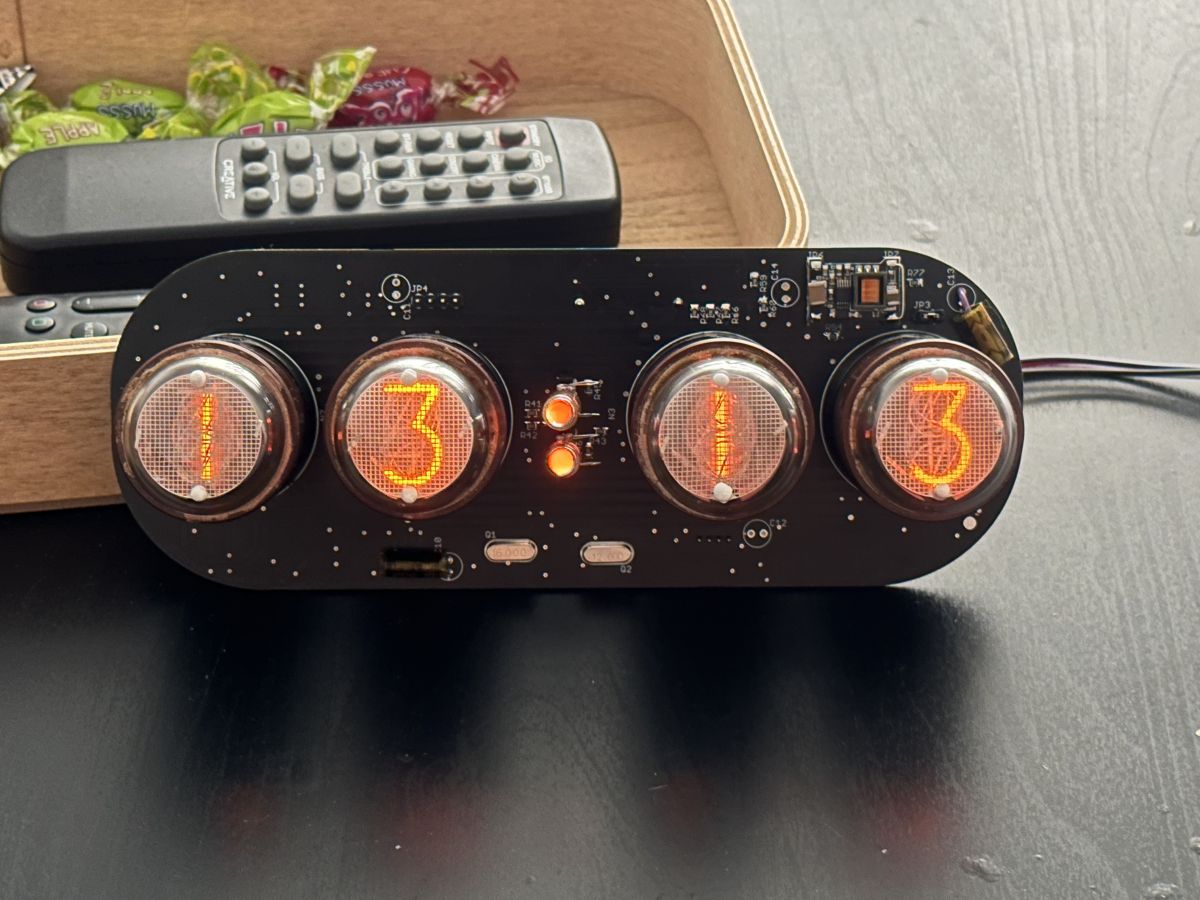
A finished NIXIE watch uses IN-1 and INS-1 tubes as a home decoration.
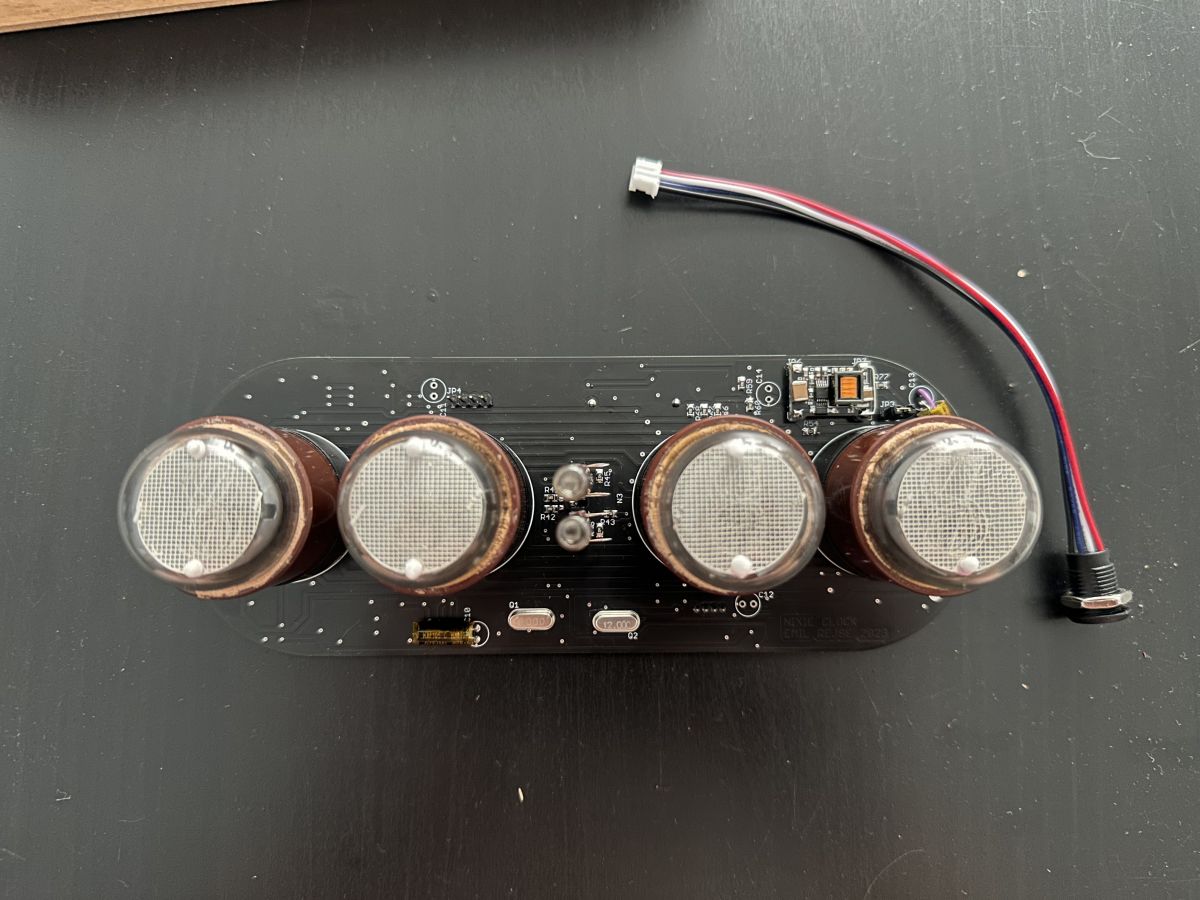
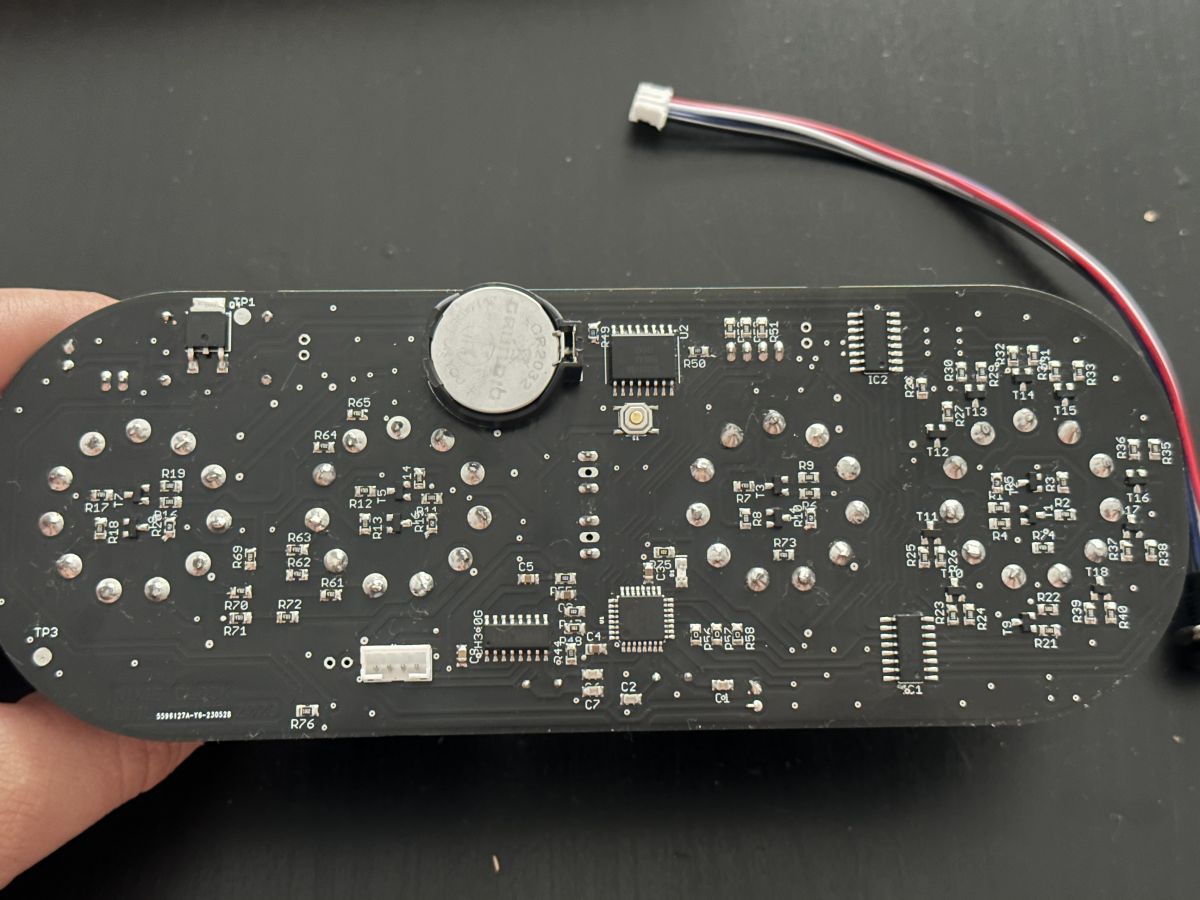
Compact surface-mount electronics center on a DS3231 RTC and an ATmega328 implemented as an integrated Arduino UNO with CH340G and USB-C power/programming.
Two 74HC595 shift registers drive the tubes through MMBTA42 and MMBTA92 transistors, and a ready-made converter provides 170 V.
The colon acts as the second hand, and the PCB shape was designed to fit a watch case.
Three free Arduino I/O ports remain for future additions like buttons or an alarm buzzer, but the woodwork is still ahead.
AI summary based on the discussion. May contain errors.
Hello forum users, I present the finished design of a watch based on IN-1 + INS-1 tubes
The project assumed the greatest possible compactness of the control electronics while using the most common elements.
So I decided on a surface mount project, using the DS3231 as a real time clock, the watch code is contained in the ATmega328 present on the PCB as an integrated Arduino UNO, hence the presence of the CH340G on board and the possibility of programming at any time via the USB C port, which also serves as power. The tubes are controlled by two multiplexing 74HC595 registers connected to MMBTA42 and MMBTA92 transistors. The 170 V boost converter is a ready-made system purchased from our friends from the east. On the board, in the possible need for development, there are 3 free Arduino ports that can be used as inputs/outputs (buttons, alarm clock buzzer, etc.) The colon, of course, serves as the second hand. The shape of the printed circuit board was created with the intention of making a watch case, but the woodwork is still ahead of me. :)
What do you think? I'm interested in your opinions.
About Author
emil134679 wrote 156 posts with
rating 90 .
Been with us since 2010 year.
Those lamps that make for colons, what markings do they have/where did you buy them? [Read more]
emil134679
29 Jul 2023 13:20
INS-1, where you get it, you buy it there, I used to buy tubes a long time ago. [Read more]
vodiczka
29 Jul 2023 13:31
The project was successful, but since it will be in a wooden housing, compactness was probably not that important.
Personally, I would choose a clock on vertical lamps, similar to this one, but with an... [Read more]
madart
29 Jul 2023 13:33
Such a pretty tile that it's a shame to hide it. :)
How is the time set? Because it's the only inconvenience when we still have the summer/winter time change. DS3231 has a very small deviation.... [Read more]
vodiczka
29 Jul 2023 14:01
That's right, you can make a transparent casing or (if the heat exchange allows) pour a transparent resin. [Read more]
kris8888
29 Jul 2023 18:30
No lamp replacement? The technical data indicate that the guaranteed lifetime for the IN-1 is only 1000 h. [Read more]
madart
29 Jul 2023 18:54
One has LC-516 link . I changed the tubes a few times so that the cathodes would detoxify and once two transistors died together with the CD4028
The advantage of the multiplex is that the lamps do... [Read more]
emil134679
29 Jul 2023 22:36
It was important because the housing is neither deep nor wide, more or less I see it as if you wrapped the presented circuit around, leaving the tube lenses outside the housing. The colleague above showed... [Read more]
vodiczka
30 Jul 2023 10:25
My taste is probably due to the fact that I first had contact with displays on vertical lamps and I remained faithful to them. [Read more]
chemik_16
30 Jul 2023 12:26
Do you have any experience with a high voltage converter controlled directly from the uC?
At one time I wanted to make a simple PWM controlled one MOSFET transistor and a transformer from fluorescent... [Read more]
excray
30 Jul 2023 12:44
The new Atmel uCs are great for this.
https://sm6vfz.wordpress.com/2020/12/11/boost-regulator-with-attiny/
In practice, it can be even simpler - ATTINY212:
TCA0.SINGLE.PER = 4; // 30us period,... [Read more]
KarolJuszkiewicz
21 Mar 2024 21:43
Great project (if there was a rating, of course there would be ⭐⭐⭐⭐⭐), I could do it myself. Is it possible for you to send the board design, diagram and code? [Read more]
emil134679
28 Oct 2024 14:10
@karoljuszkiewicz I don't look on the electrode too often but yes, a matter of agreement. I still have the boards as well as the code and the tutorial left because I already had a few customers for the... [Read more]
vbiFFoarFe
03 Dec 2024 07:32
I love the compact design and how you integrated the Arduino and other components so seamlessly. It's got a cool retro vibe with those IN-1 + INS-1 tubes. I’ve been fascinated by NIXIE tubes for a while... [Read more]
FAQ
TL;DR: This DIY Nixie watch runs a 170 V tube supply and leaves 3 free I/O pins; it even “reports as UNO,” so makers can power and reprogram it over USB-C. It helps builders who want a compact IN-1 + INS-1 display clock and need practical answers on RTC accuracy, multiplexing, enclosure choice, and serviceability. [#20673189]
Why it matters: This thread shows how to make a very compact Nixie-style desk clock without giving up Arduino compatibility, RTC stability, or future expansion.
Enclosure option
Main advantage
Main drawback
Best fit from the thread
Wooden case
Matches desk decor and the author's plan
Hides the attractive PCB
Best for a finished home decoration
Transparent case
Shows off the PCB and tubes
May clash with room style
Best if display electronics are part of the aesthetic
Resin-potted design
Maximum visual neatness
Heat from the boost stage makes it risky
Worst fit for this specific build
Key insight: The strongest idea in the thread is not the tubes alone, but the integration: ATmega328, DS3231, USB-C power/programming, and a ready-made 170 V module on one compact PCB. That combination makes the project small, maintainable, and easy to evolve. [#20671443]
Quick Facts
The board integrates an ATmega328, DS3231, CH340G, and USB-C so the clock can be powered and reprogrammed without extra controller hardware. [#20671443]
The tube supply uses a ready-made 170 V boost converter, while the display is driven through two 74HC595 registers and MMBTA42/MMBTA92 transistors. [#20671443]
The design leaves 3 free Arduino I/O pins for future add-ons such as buttons or a buzzer, which directly improves serviceability and feature growth. [#20671443]
Reported lamp life in discussion spans from a nominal 1000 h concern for IN-1 tubes to real projects still running after 14 years, especially with multiplexed operation. [#20672828]
One user reports a multiplex advantage of roughly 1/6 duty cycle for a 6-lamp clock, reducing continuous on-time and helping tube longevity in practice. [#20672863]
How was the Nixie watch built around IN-1 and INS-1 tubes while keeping the electronics as compact as possible?
It was built as a surface-mount design that combines the ATmega328, DS3231 RTC, CH340G USB interface, and tube drivers on one PCB. The board presents itself as an integrated Arduino UNO, so the same USB-C port handles both power and programming. A ready-made 170 V boost module avoids a larger custom high-voltage section, which also helps reduce board area. [#20671443]
What is the INS-1 tube, and how is it used as a colon or seconds indicator in a Nixie clock?
The INS-1 is a small neon indicator tube that serves as a simple status or timing lamp, with a compact shape that suits colon dots in a clock display. In this build, two INS-1 lamps form the colon, and the author states that the colon works as the seconds indicator. [#20671443]
What is the DS3231, and why is it a good real-time clock choice for a DIY Nixie watch?
The DS3231 is a real-time clock chip that keeps calendar time independently of the main microcontroller, with low drift that makes it suitable for long-running clocks. In the thread, it was chosen as the RTC, and another user explicitly notes that the DS3231 has very small deviation, which is why it fits a DIY Nixie watch well. [#20672494]
How do the 74HC595 shift registers with MMBTA42 and MMBTA92 transistors control IN-1 Nixie tubes in a multiplexed design?
They let a low-voltage controller manage multiple high-voltage digits with fewer MCU pins. The board uses two 74HC595 shift registers connected to MMBTA42 and MMBTA92 transistors, then multiplexes the tubes so the controller updates selected digits in sequence instead of driving every cathode directly. [#20671443]
Where can you find INS-1 tubes today, and what are good substitutes if they are hard to source?
The thread gives only one concrete sourcing answer: buy INS-1 tubes wherever you can still find them. The author says he bought his tubes a long time ago and does not name a current seller, so the discussion offers no verified substitute part number for INS-1 in this project. [#20672476]
How do you set or correct the time on a Nixie clock that uses a DS3231 and an ATmega328 programmed through Arduino IDE over USB-C?
You correct the time by reconnecting the clock over USB-C and uploading updated code to the ATmega328. The author's method is simple:
Connect the clock to a computer through USB-C.
Open the project in Arduino IDE.
Upload code that updates the DS3231 RTC.
He says this takes about 10 seconds and is acceptable for seasonal time changes. [#20673189]
What are the pros and cons of adding +, -, and OK buttons for manual time setting instead of updating the RTC from a computer?
Buttons make the clock self-contained, but USB updating keeps the hardware simpler. The author says the PCB exposes 3 free I/O pins on headers, so adding "+", "-", and "OK" inputs is feasible. The trade-off is extra code and front-panel design versus a 10-second USB connection when daylight-saving time changes. [#20673189]
Why would someone choose a ready-made 170 V boost converter for a Nixie watch instead of designing the high-voltage supply from scratch?
A ready-made 170 V module saves space, reduces design effort, and speeds assembly. The author wanted maximum compactness while using common parts, so he bought the high-voltage converter as a finished unit instead of devoting PCB area and debugging time to a custom supply. That choice also kept the rest of the board focused on control electronics. [#20671443]
How do you safely power Nixie tubes from a 170 V boost converter in a small desktop clock enclosure?
You keep the high-voltage stage isolated, avoid heat-trapping potting methods, and choose an enclosure with some thermal margin. The thread gives one clear warning: the whole clock stays cool, but the step-up converter does emit heat, so the author rejects resin encapsulation. In a small desk enclosure, that means planning airflow and access instead of sealing the supply inside solid resin. [#20673189]
What experience do people have with building a high-voltage converter controlled directly from a microcontroller PWM for Nixie clocks?
The thread shows interest in it, but not a finished Nixie-clock implementation from the project author. One participant says he once wanted a simple PWM-controlled converter using one MOSFET and a transformer taken from fluorescent monitor lamps, mainly because brightness control would then be straightforward. That establishes the idea as viable hobby practice, not a documented part of this build. [#20673563]
How do newer Atmel microcontrollers like the ATTINY212 compare with a separate boost-converter module for generating Nixie tube high voltage?
Newer Atmel parts can integrate boost-control logic, while a separate module is faster to deploy. One contributor says the newer Atmel microcontrollers are "great for this" and gives an ATTINY212 example with a 30 µs period, 120 µH inductor, 12 V target, and 0.8 A current figure. By contrast, this clock uses an off-the-shelf 170 V module for simplicity and compact integration. [#20673590]
Why can multiplexing increase Nixie tube lifetime, and how much difference does a 1/6 duty cycle make in practice?
Multiplexing can extend life because each lamp is on only part of the time instead of continuously. One user explains that in a 6-lamp clock the tubes conduct for about 1/6 of the time, and he thinks this helps longevity. That matters because another post raises a nominal IN-1 lifetime concern of only 1000 h, so reduced duty directly addresses wear. [#20672863]
What causes Nixie clock driver parts like transistors or a CD4028 to fail over long-term use, and how can you prevent it?
Long runtime and stressed driver stages can eventually kill switching parts, especially in older clocks. A user reports that in one clock two transistors died together with a CD4028, while the same clock also needed tube swapping to clean the cathodes. The practical prevention lesson is to reduce thermal and electrical stress, keep the high-voltage section reliable, and expect maintenance over multi-year use. [#20672863]
Which enclosure works better for a compact Nixie desk clock: a wooden case, a transparent case, or a resin-potted design?
A wooden case fits this project best, a transparent case best displays the PCB, and resin potting is the worst option here. The author designed the PCB shape with a case in mind and says transparent housing would not match his desk. He also rejects resin because the step-up converter produces some heat, even though the rest of the clock does not noticeably warm up. [#20673189]
How can you get the PCB design, schematic, code, or even a DIY kit version of this IN-1 + INS-1 Nixie watch project?
You need to contact the project author and arrange it directly. In a later follow-up, the author says he still has the boards, code, and remaining tutorial material, and adds that he has already had a few customers for a DIY kit version. That means the design files and kit access were available by private agreement as of October 28, 2024. [#21280047]
AI summary based on the discussion. May contain errors.








Comments
Those lamps that make for colons, what markings do they have/where did you buy them? [Read more]
INS-1, where you get it, you buy it there, I used to buy tubes a long time ago. [Read more]
The project was successful, but since it will be in a wooden housing, compactness was probably not that important. Personally, I would choose a clock on vertical lamps, similar to this one, but with an... [Read more]
Such a pretty tile that it's a shame to hide it. :) How is the time set? Because it's the only inconvenience when we still have the summer/winter time change. DS3231 has a very small deviation.... [Read more]
That's right, you can make a transparent casing or (if the heat exchange allows) pour a transparent resin. [Read more]
No lamp replacement? The technical data indicate that the guaranteed lifetime for the IN-1 is only 1000 h. [Read more]
One has LC-516 link . I changed the tubes a few times so that the cathodes would detoxify and once two transistors died together with the CD4028 The advantage of the multiplex is that the lamps do... [Read more]
It was important because the housing is neither deep nor wide, more or less I see it as if you wrapped the presented circuit around, leaving the tube lenses outside the housing. The colleague above showed... [Read more]
My taste is probably due to the fact that I first had contact with displays on vertical lamps and I remained faithful to them. [Read more]
Do you have any experience with a high voltage converter controlled directly from the uC? At one time I wanted to make a simple PWM controlled one MOSFET transistor and a transformer from fluorescent... [Read more]
The new Atmel uCs are great for this. https://sm6vfz.wordpress.com/2020/12/11/boost-regulator-with-attiny/ In practice, it can be even simpler - ATTINY212: TCA0.SINGLE.PER = 4; // 30us period,... [Read more]
Great project (if there was a rating, of course there would be ⭐⭐⭐⭐⭐), I could do it myself. Is it possible for you to send the board design, diagram and code? [Read more]
@karoljuszkiewicz I don't look on the electrode too often but yes, a matter of agreement. I still have the boards as well as the code and the tutorial left because I already had a few customers for the... [Read more]
I love the compact design and how you integrated the Arduino and other components so seamlessly. It's got a cool retro vibe with those IN-1 + INS-1 tubes. I’ve been fascinated by NIXIE tubes for a while... [Read more]