

logo elektroda
logo elektroda
X
logo elektroda

TL;DR

  • Questions how much internet bandwidth is actually enough for everyday home use, and whether 300 Mb/s, 600 Mb/s, or even 1 Gb/s plans really make sense.
  • Notes that movies, VOD, FHD, and 4K already work on low-end connections, so the real limit may be simultaneous users rather than peak speed.
  • Highlights the shift from hundreds of Kb/s to single Mb/s and 30-100 Mb/s links, plus upload capacities around 2-20 Mb/s, then asks what fixed-line and mobile speed people expect.
Generated by the language model.
ADVERTISEMENT
Treść została przetłumaczona polish » english Zobacz oryginalną wersję tematu
📢 Listen (AI):
  • #31 17981305
    Sas_AS
    Level 16  
    Posts: 187
    Help: 3
    Rate: 70
    Kurka, as I read this, I think I'm starting to be really old ;) On the other hand, I am glad that at least I participated in this from the beginning.
    Spoiler:
    I started with 14.4K modems, real speed 1kB to 36.6K, real speed 2-3kB. Astronomical costs, at the level of x10 - x20 of a telephone subscription. US Robotics 56K, costs bearable, prepaid free tpsa sleepless nights, speed a little over 4kB, download times for mp3, first recorders and custom cd-audio compilations :) Then it's downhill: sdi 115.2K, adsl neostrada 1M then 2M (introduction of transfer limits, an offer to become a wifi service tester at a local operator), WiFi B / G, transfer at night for a few MB / s (wifi card in a stationary pc and panel antenna on the roof, initially for free as part of the tests), netia and a similar transfer as wifi (no limits, resignation from WiFi due to large and irregular ping for games, resignation from landline number, additional tps to maintain the line), WiFi on MikroTik, transfer over 10MB / s (small ping, no limits), additionally some tps incidental outside the place of residence and mobile internet such as Aero2 and LTE. I currently have FTTH. At the beginning it was 100 Mb / s down 20 Mb / s up, with no load on links 300 down / 20 up. I switched to 300 Mb / s down 40 Mb / s up, no load on connections 400 down / 50 up. Half a year ago I changed to 200 Mb / s download and 40 upload, with no load on 400/50 connections, at peak traffic it does not drop below 220/45. The only small disadvantage of optical fiber is the decrease in transfer by about half during the engine of storms or winds, due to the fiber swinging on electricity poles. It is a short-term illness, several times a year for several hours.
    I believe the future is fast upload for the "private user" at home. More and more "private users" are active in the media on the Internet. I meet with the opinion that I would like to have 300 Mb / s upload at home as well as download and it could even be associated with transfer limitations as in LTE "mobile internet". Users want to "quickly put something on the Internet" and go a step further without planning the time for you to be tied to your desk with your pc. Paradoxically, the will to "healthy and active presence on the Internet" may force some people to participate directly in social life. Of course, there is a balance somewhere in the division of users, between those who will actively create "healthy media content" and those who will read, watch, listen and comment on it.


    Sufficient for me "speed of the Internet" stationary is 200Mb / s download and 40Mb / s upload (in real terms up to 50Mb / s upload). At home, 5 PCs, several phones, a tablet and an e-book are connected to the network (no smart TV, box and other such). I came to the conclusion that 100 Mb / s download was enough for 2-3 people, you could rarely feel any slowdowns. The link sometimes clogged up during cloud upload, file upload or social media upload due to the 20 Mb / s upload. Switching to 300 Mb / s download and 40 Mb / s upload solved the problem. Under the download degradation to 200 Mb / s with 40 Mb / s upload and a few golds in my pocket, I did not notice any negative effects of reducing the download transfer.

    What "internet speed" is enough?
    What "internet speed" is enough?
  • ADVERTISEMENT
  • #32 17982241
    Grzegorz740
    Level 37  
    Posts: 4135
    Help: 313
    Rate: 551
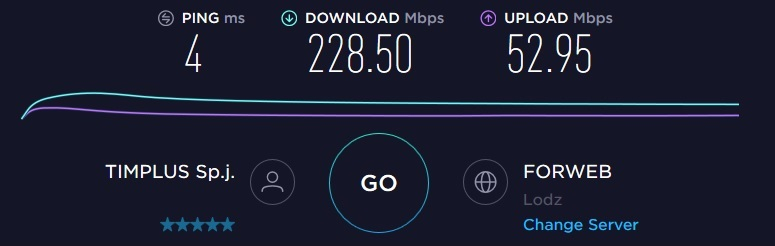
    So far, such a transfer is enough for me.
    Attachments:
    • What "internet speed" is enough? 8287879561.png (18.99 KB) You must be logged in to download this attachment.
  • #33 17982370
    tomason2
    Level 17  
    Posts: 249
    Help: 15
    Rate: 162
    For me, I download max 120 Mbit / s and send max 30 Mbit / s.
    Sometimes you want more, to download something already ;-)

    I remember switching from the modem to the first permanent connection and magic transfers of 20-30kB / s.
  • ADVERTISEMENT
  • #34 17983095
    speedy9
    Helpful for users
    Posts: 12019
    Help: 1231
    Rate: 2414
    Inea is going to connect me a house in the country. The minimum I could choose was ... 600/600 Mb / s. Symmetrical optical fiber. It makes no sense, but 300/300 costs only PLN 10 less :P
    Considering that all devices continue to run on WiFi, it is impossible to really use such a band. Nice router for ~ 150 PLN really "extracts" max 100Mb / s after WiFi. And I'm afraid that most unknowing users are sitting on weaker hardware anyway. Fortunately, there are already relatively affordable routers (~ PLN 500) that can approach 1Gb / s, for example TP-LINK Archer C2300. But it's still close to the router anyway.
    I admit that the 60 Mb / s I had in my apartment earlier was enough for everything. After all, even Netflix 4k only requires 25Mbps ;)
    After moving I am sitting on mobile (LTE) and this is a disaster. It's not even about medium speed anymore. The problem that irritates me the most is that when I have one a week, maybe it's time to watch something in streaming, this streaming usually gets cut.
  • ADVERTISEMENT
  • #35 17983117
    Anonymous
    Level 1  
  • #36 17983214
    conrad9210
    Level 26  
    Posts: 904
    Help: 83
    Rate: 209
    Welcome. I'm not that old, but the gate to the Internet was opened by entering the number 0202122 and the password ppp :) Who remembers the speed? And currently at home 120Mb / s. Enough for a TV, consoles, 2 computers and smartphones. best regards
  • #37 17983226
    sanfran
    Network and Internet specialist
    Posts: 9806
    Help: 953
    Rate: 2951
    And this advanced operator technology to support dial-up internet:


  • #38 17983239
    kaczakat
    Level 34  
    Posts: 1748
    Help: 317
    Rate: 229
    conrad9210 wrote:
    number 0202122 and password ppp
    After graduation, I switched from 100Mbit in the dormitory to a telephone connection, after the first package bill. It was painful. I've been waiting for optical fiber for 15 years.
    Helpful post? Buy me a coffee.
  • #39 17983246
    conrad9210
    Level 26  
    Posts: 904
    Help: 83
    Rate: 209
    My friend switched from the modem to the link in the dormitory and when he told me that by clicking he did not know if he was downloading mp3 or mp4, I did not believe him :) These were the times.
  • #40 17983363
    Tomek_Krecik
    Level 29  
    Posts: 1571
    Help: 114
    Rate: 224
    The Internet I have with T-Mobile is great, 110 Mbit in peak 130mbit after 20:00
    160mbit after 22:00 (probably depends on the bts load)
  • #41 17983452
    TechEkspert
    Editor
    Posts: 7062
    Help: 16
    Rate: 5462
    You touched on dial-up, distant times,
    if 0202122 still working?

    Years later, I even checked what the next phases of the modem connection are:


  • #42 17984348
    error105
    Level 14  
    Posts: 479
    Help: 1
    Rate: 145
    Bandwidth is not only Upload and Download and LTE / 3G users know it very well ......
    So what if in theory I can download slightly with LTE 150Mbit, at the same time I can basically no longer browse the internet, so only the file is downloaded.
    Where, with Neostrada 20Mbit, and downloading the file, the Internet is still conveniently useful.

    Hence, stupid answers that someone Mbit alone is enough :)
  • #43 17984644
    waxman
    Level 21  
    Posts: 534
    Help: 36
    Rate: 64
    30/10 Mbps per head is enough - depending on your needs, of course. Heavy users are around 1.5% to 2%, the rest do not use the potential of their link or cannot :)
  • #44 17985039
    Tomek_Krecik
    Level 29  
    Posts: 1571
    Help: 114
    Rate: 224
    As I look at the download, 70-80mbit corresponds to 6.5mbsec.
    110-130 = 12.5-13mb / sec
  • #45 17988315
    Wszechelektronik
    Level 13  
    Posts: 100
    Help: 1
    Rate: 157
    In general, the development of the Internet is moving towards working in the cloud. In the future, you probably won't be installing the system at all. It may even come to the point that you only buy access to computing power. There will be no better and better computers at home, because there will be no home computers at all.
    Mountains of electro-waste will disappear ... Eventually, the entire picture can be transmitted with sound and control signals. And that can consume even more than 10Gb / s, depending on the resolution and smoothness of the image.
    18 years ago my modem pulled out 14kb ha ha and what will it be in 18 years? As anyone knows. it probably doesn't know anything. ;)
  • ADVERTISEMENT
  • #46 17988488
    sanfran
    Network and Internet specialist
    Posts: 9806
    Help: 953
    Rate: 2951
    Wszechelektronik wrote:
    Mountains of electro-waste will disappear ...


    Forget it. Companies will not twist a rope around their necks voluntarily.
  • #47 17989138
    pawelr98
    Level 39  
    Posts: 6461
    Help: 413
    Rate: 1152
    Wszechelektronik wrote:
    In general, the development of the Internet is moving towards working in the cloud. In the future, you probably won't be installing the system at all. It may even come to the point that you only buy access to computing power. There will be no better and better computers at home, because there will be no home computers at all.
    Mountains of electro-waste will disappear ... Eventually, the entire picture can be transmitted with sound and control signals. And that can consume even more than 10Gb / s, depending on the resolution and smoothness of the image.
    18 years ago my modem pulled out 14kb ha ha and what will it be in 18 years? As anyone knows. it probably doesn't know anything. ;)


    I will never go for something like this.
    I prefer to have a machine that works independently.
    In Bydgoszcz, it is definitely not profitable for me to use cloud services.
    The connection is so slow that it is faster for me to go to Gdansk with the hard drive to download. And I generally do this almost every week because I drive regularly anyway.

    After that, there are limits to how many people can use the link.
    If people switch entirely to data from the cloud, it may turn out that the current infrastructure will not be able to withstand it. In addition, large areas in many countries (including developed countries such as the USA or Western Europe) still do not have a broadband connection.

    The disappearance of electro-waste is utopia. Limited space in server rooms and profitability (performance / current) will require periodic replacement of the equipment with a more efficient one.

    Apparently, the use of equipment will be better because computers will practically never stand "out of work" but this translates into accelerated wear. Especially hard drives and high-performance GPUs.

    It is not without reason that some companies considered introducing a clause into the guarantee that the cards may not be used in cryptocurrency mines.
    Cards with such intensive use sometimes did not last until the end of the warranty and companies had to replace them for free.
  • #48 17989474
    barondary
    Level 20  
    Posts: 272
    Help: 31
    Rate: 71
    50Mbit is enough for me to work freely, I upload little, download a lot.
    I don't use the cloud because I don't want my documents to be read and everyone knows what I'm doing. After all, securing the cloud with passwords by the average user is a delusion.
  • #49 17990498
    Anonymous
    Level 1  
  • #50 17991589
    Tomek_Krecik
    Level 29  
    Posts: 1571
    Help: 114
    Rate: 224
    Sucking 80gb of data is about 120 minutes on a 110mbps link.

    If time matters, these 2 hours are a long time, thus the connection from the machine is too slow :)
  • #51 18004206
    pablolinda
    Level 15  
    Posts: 438
    Rate: 120
    I currently have a vectra 50/5 Mbps link and I think that it is enough for one person, although UP could be at least as much larger as sometimes you want to send a movie.
    I recommend that you install the NetWorx program and set it on the system bar to show the current transfer and then you really know how much, what, what transfer reserve you need and how much free space is left.
    What "internet speed" is enough?


    I am annoyed with offers where you force more speeds to people for more money, like most people, and they will not use half of it.
    I am laughing at the conversations when you call me with the offer and tell me that now I have 50 Mbs, and if I would switch to 100 Mbps, the pages would open faster for me, which translators say that the pages will not open faster because on average, at least those on which I am looking at loads the connection in the range of 3-4 Mbps, the exception is the Play page, which can be consumed with 7 before it is fully loaded.
    The rest of my use is yt, which even in full HD in the post office accelerates to 40 for a while and then drops to 12 -15.
    Up to 4K, this link would probably also be enough for even 2 people.
    In addition, most people have weak computers, laptops from the market, the processors of which do not allow you to speed up to the maximum speed they got from the operator and use the built-in wi-fi card, often at 2.4 GHz, where the network blocks on these frequencies interfere with each other and then my brother-in-law calls me and asks why he has only 30 Mbps in the sped test, as he was driving 200 Mbps internet and even changing the channel did not help him much. fast connections make sense for a large number of households with good equipment after 5 GHz, or cable and having good data download sources, so what if I have 200 as a server only 100 uplaud.
  • #52 18004232
    E8600
    Level 41  
    Posts: 8869
    Help: 525
    Rate: 2475
    That's the truth. The purpose of the seller is to sell and you need to be aware of how something works and where the weak point is in order not to pay wasted.
    You have to be aware of your real needs and not those created by marketing.
    Unfortunately, there is not only a small percentage of conscious users not only of the Internet.

    The offers are dominated by a significant asymmetry of the link, e.g. 200/20 mb / s. The problem is that today people are uploading more and more (cloud operations) and are forced to take a faster connection just to get a decent upload.
    To sum up, suppliers sell what we are not able to use anyway; for sale deaf violin.
  • #53 18004878
    pablolinda
    Level 15  
    Posts: 438
    Rate: 120
    E8600 wrote:
    You have to be aware of your real needs and not those created by marketing.
    Just told wisely, only people want to know you, and not look for a topic on the Internet, and then I am surprised that I know it all this way and I have it so cheap and they pay subscriptions for PLN 70 and have less than I have for a card, e.g.
    Symmetrical links would be the best, but they are usually expensive if 50/50 Mbps is already available to me calmly. It is a bit better with Lte because the sending speeds are higher there, usually for parents, I made internet with RBM for PLN 40 and in my location it is on average 25/20 Mbps, which is enough for them to use normally, despite the fact that I have a fiber optic outlet at home, but the company is out and they offer the lowest package for PLN 66 20 Mbps and if they put optical fibers, they had 10 for PLN 39, which I was able to take for my parents' needs, so that would be enough.
    But I prefer now mobile on a trellis and without a contract for 2 years than their fiber optic at this price after mimom the speed guarantee.
    And I start the transmitter from Orange for me, I will take a 85 GB package from them for PLN 25 per month, which is enough for parents, since now they do not exceed 60 per month.
  • #54 18058284
    RafalB

    Level 28  
    Posts: 1108
    Help: 91
    Rate: 221
    I am a bit sad because at work I only have 200mbps of upload and at home there is 1gbps and the VPN is working a bit lame between these locations. For me, a symmetrical 1gbps would be optimal :)
    Company Account:
    iFixThis
    Łowmiańskiego 18, Poznań, 60-685 | Tel.: 516XXXXXX (Show) | Company Website: https://www.instagram.com/ifixthis.pl/
📢 Listen (AI):

Topic summary

✨ The discussion revolves around the question of what internet speed is sufficient for typical home use. Participants share their experiences with various bandwidths, highlighting that speeds of 100 Mbps are generally considered the minimum for households with multiple users engaging in activities like streaming and online gaming. Many users report that speeds between 30 Mbps and 600 Mbps are adequate for their needs, depending on the number of devices and the type of activities performed. The importance of symmetrical upload and download speeds is also noted, especially for tasks like cloud storage and video conferencing. Some users express skepticism about the necessity of extremely high speeds, suggesting that many consumers do not fully utilize the potential of their connections. The conversation also touches on the evolution of internet speeds over the years and the impact of Wi-Fi limitations on actual performance.
Generated by the language model.

FAQ

TL;DR: 25 Mbps per 4 K Netflix stream is the official requirement [Netflix Help], yet “speed as needed” notes andrzejek23 [Elektroda, 17979133]; Poland’s median home download is 113 Mbps (Ookla 2023). Most homes run smoothly on 50–300 Mbps with at least 10 Mbps upload.

Why it matters: Choosing the right tier avoids overpaying while keeping every device responsive.

Quick Facts

• 25 Mbps – Netflix Ultra-HD minimum per stream [Netflix Help]. • 10–15 Mbps – typical 1080 p cloud-gaming requirement [NVIDIA 2022]. • 113 Mbps / 24 Mbps – Poland median fixed down/up (May 2023) [Ookla 2023]. • ≈100 Mbps – real single-device Wi-Fi 5 throughput one room away [SmallNetBuilder 2021]. • PLN 60 ≈ monthly cost of 300/30 Mbps fibre tier [Elektroda, lechoo, post #17979731]

How much bandwidth is enough for basic browsing and e-mail?

Light tasks peak under 2 Mbps; even a 10 Mbps ADSL line keeps pages snappy [Elektroda, Grzegorz_madera, post #17980396] Add a safety margin: 20 Mbps covers updates and two phones syncing simultaneously.

Is 50 Mbps sufficient for one or two 4 K streams and casual gaming?

Yes. A single 4 K Netflix stream needs 25 Mbps, leaving 25 Mbps spare for a game download or video call [Netflix Help; Elektrode, szymon122, #17979122]. Many posters with 30–50 Mbps report stutter-free 4 K playback [Elektroda, andrzejek23, post #17979133]

When should I upgrade to a 300 Mbps or faster plan?

Consider upgrading if you 1) run three or more simultaneous 4 K streams, 2) move 100 GB+ files often, or 3) back up terabytes to cloud storage overnight. Users sharing fibre with five devices saw congestion disappear after moving from 100 to 300 Mbps [Elektroda, Sas_AS, post #17981305]

Why does upload speed matter at home?

Uploads affect cloud backups, CCTV, live streaming and large e-mail attachments. lechoo chose 300/30 Mbps over 100/10 Mbps because 10 Mbps “is misery” for NAS and cameras [Elektroda, 17979731] Aim for at least 10 Mbps up; power users may want ≥50 Mbps.

What bandwidth do cloud-gaming services require?

GeForce NOW lists 15 Mbps for 1080 p and 25 Mbps for 1440 p [NVIDIA 2022]. Forum estimates match: 25 Mbps per full-HD stream [Elektroda, szymon122, post #17979122] Keep latency below 40 ms for responsive play.

How many devices can comfortably share a 100 Mbps connection?

Rough rule: divide usable speed by 25 Mbps per HD/4 K stream or 5 Mbps per light user. Thus, 100 Mbps supports one 4 K TV plus four browsers. Families on 100/30 rarely see slowdowns unless someone uploads large files [Elektroda, kaczakat, post #17979934]

Does Wi-Fi limit my real internet speed?

Often. bravo37 measured only 5.5 MB/s (≈44 Mbps) over an older laptop radio despite a 600 Mbps line [Elektroda, 17979334] Wi-Fi 5 averages ~100 Mbps at one-room range [SmallNetBuilder 2021]. Use wired Gigabit or Wi-Fi 6 to exploit gigabit tariffs.

What latency should gamers look for?

In shooters, ping under 30 ms feels snappy; 50 ms is already “a bit too much” [Elektroda, Anonymous, post #17979409] Fibre links usually stay below 20 ms, while LTE can spike above 100 ms during congestion.

Are symmetrical fibre plans worth paying extra?

If you run VPNs, upload RAW photos, or host a server, yes. SP5IT says high-download offers make sense "when they start to give symmetrical" speeds [Elektroda, 17979169] For pure streaming, asymmetric 300/30 Mbps is more cost-efficient.

What can I do if I’m stuck with under 10 Mbps?

1) Schedule big downloads overnight like sanfran with a 40/10 line [Elektroda, 17980222] 2) Lower Netflix to 720 p (needs 3 Mbps). 3) Bond two LTE or DSL lines where available. 4) Lobby local ISP; pawelr98 doubled speed after hardware fixes [Elektroda, post #17979334]

How do I measure my real bandwidth accurately?

  1. Disconnect or pause all other devices.
  2. Run a wired Speedtest to the nearest server (beta.speedtest.net was suggested) [Elektroda, pidar, post #17980283]
  3. Repeat three times at peak and off-peak; record the lowest result for planning.

Why can LTE feel fast in tests yet slow in everyday use?

LTE schedulers prioritise bulk traffic; heavy downloads can starve web requests. error105 saw 150 Mbps downloads yet webpages froze until the transfer finished [Elektroda, 17984348] This edge case shows bandwidth alone doesn’t guarantee responsiveness.

Will satellite constellations like Starlink replace fibre?

Low-Earth-Orbit systems promise ~1 Gbps per user and sub-40 ms latency, but need dish hardware and clear sky. Forum users doubt mass adoption until costs drop and upload proves adequate [Elektroda, bravo37 & And!, #17980338 #17980358]. Fibre remains faster and immune to weather.

How long will a big download take on my current link?

Rough guide: divide file size (GB) by speed (Mbps) × 0.12. Example: 80 GB ÷ 110 Mbps × 0.12 ≈ 1.8 hours; mirroring Tomek_Krecik’s 2-hour real-world figure [Elektroda, 17991589]
Generated by the language model.
ADVERTISEMENT