logo elektroda
logo elektroda
X
logo elektroda

Query: Tuya Led Controller DC5-12v Compatibility with Cloudcutter Flash BK7321 and OBK Drivers

MnM1 10503 136
Best answers

Can I flash this Tuya LED controller with Cloudcutter on BK7231N/BK7231T and get the needed OpenBK drivers and GPIO settings working?

Yes — the device in the thread was ultimately identified as a BK7231N TuyaMCU-based controller, and Cloudcutter was used successfully to detach it from Tuya and flash OpenBK [#20661998][#20684927][#20685629] The important catch is that it is not a simple direct SM16703 LED-output device; the attempted SM16703 driver path did not work because the LEDs are driven through TuyaMCU, so the right approach is the OpenBK TuyaMCU driver rather than raw GPIO mapping [#20685629][#20685646] Once the fnIDs/DPs were captured, it became controllable with `startDriver TuyaMCU`, `tuyaMcu_defWiFiState 4`, `tuyaMcu_setBaudRate 115200`, and `tuyaMCU_setupLED 24 1`, plus scripts/buttons for the different modes and scenes [#20720196][#20720438] The device was later described as fully supported in OpenBK, with power, scenes, color picking, brightness, and music mode working, although warm/cold white handling was still not working and does not seem to be present in the original Tuya app either [#20713971][#20721021][#20817640] If you want to check Cloudcutter compatibility first, the advice was to use the cloudcut-only option and select the matching N/T profile based on the Tuya firmware prefix [#20661998]
Generated by the language model.
ADVERTISEMENT
  • #91 20736143
    MnM1
    Level 10  
    Posts: 175
    Help: 4
    Rate: 13

    Hi @DeDaMrAz, did you have a chance to make more progress with this device?

  • ADVERTISEMENT
  • #92 20753223
    MnM1
    Level 10  
    Posts: 175
    Help: 4
    Rate: 13

    Hi @DeDaMrAz and @p.kaczmarek2 - any more progress with this device?
    If you could get the warm/cool white going, that will be great. Let me know if you want me to do more testing or anything.
  • ADVERTISEMENT
  • #93 20755739
    MnM1
    Level 10  
    Posts: 175
    Help: 4
    Rate: 13
    Don't feel the love anymore :( Hopefully was not something I said or done :)
  • #94 20755752
    DeDaMrAz
    Level 22  
    Posts: 603
    Help: 34
    Rate: 129
    @MnM1

    Life and job in the way mainly. Have faith and patience we will get to it soon, there is a lot to do in the background as the TuyaMCU driver has to be rewritten.
  • #95 20755795
    MnM1
    Level 10  
    Posts: 175
    Help: 4
    Rate: 13
    Thanks for the update!! :)
  • #96 20766031
    DeDaMrAz
    Level 22  
    Posts: 603
    Help: 34
    Rate: 129

    @mnm11

    Small update, there is a new flag created (flag 43 - [TuyaMCU] Use queue) in settings, can you use the build from the link below and confirm that you can change colors every time??

    https://github.com/openshwprojects/OpenBK7231T_App/suites/17084255605/artifacts/975871212

    So go to Config/Configure General/Flags and activate flag 43, then submit - and test if the colors from the color wheel are changing every time.

    Thanks.

    P.S. Extract just OpenBK7231N_938_merge_1ca2873690e8.rbl file and use it as OTA file.
  • #97 20766269
    MnM1
    Level 10  
    Posts: 175
    Help: 4
    Rate: 13

    Hi @DeDaMrAz,

    Thanks for the update.
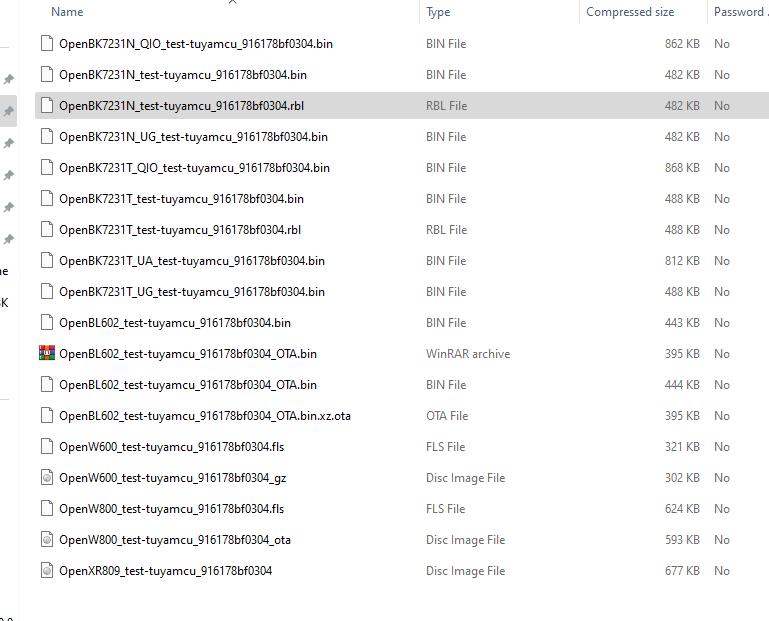
    I looked for the file you mentioned (OpenBK7231N_938_merge_1ca2873690e8.rbl) but it is not there:

    Screenshot showing a list of files in a folder with various extensions and sizes.
  • #98 20766300
    p.kaczmarek2
    Moderator Smart Home
    Posts: 14615
    Help: 655
    Rate: 12632
    I think OpenBK7231N_test-tuyamcu_916178bf0304.rbl should be correct
    Helpful post? Buy me a coffee.
  • ADVERTISEMENT
  • #99 20766304
    MnM1
    Level 10  
    Posts: 175
    Help: 4
    Rate: 13
    OK I will use that file
  • #100 20766369
    p.kaczmarek2
    Moderator Smart Home
    Posts: 14615
    Help: 655
    Rate: 12632
    This build should fix the following issue:
    DeDaMrAz wrote:

    @mnm11

    We need a bigger sample of tests, can you update your device to build 1.17.237 and add it to HA to test if color change will work for you? The issue that I am facing is that I can change color only a certain number of times (let's say 7 or 8 times) and then the device will become unresponsive to color change until I power cycle the light by on/off switch. Can you test that maybe?


    Keep in mind that no other changes are in place. Of course, you need to enable TuyaMCU queue flag first.
    Helpful post? Buy me a coffee.
  • #101 20766386
    MnM1
    Level 10  
    Posts: 175
    Help: 4
    Rate: 13

    Did a quick test from the device page and from HA. They both worked OK - colors changed every time. Dimming the colors works too.

    As mentioned before, my colors are not RGB but they are BGR (as in red and blue are swapped).
    Because of this, I have seen different colors than what was on the color wheel - especially as I moved further away from the edges (in HA). But I think that's expected if red and blue are swapped.

    The warm white and cold white temperature slider still does not work. If used, it just switches all the LEDs off. I get them back by selecting a color on the color wheel.
    Is there any way I can make my colors RGB (in software) instead of BGR?
  • ADVERTISEMENT
  • #102 20777196
    p.kaczmarek2
    Moderator Smart Home
    Posts: 14615
    Help: 655
    Rate: 12632
    MnM1 wrote:

    Is there any way I can make my colors RGB (in software) instead of BGR?

    Isn't it configurable on remote? I can consider adding that option to OBK but I am not sure if it would be practical
    Helpful post? Buy me a coffee.
  • #103 20777414
    MnM1
    Level 10  
    Posts: 175
    Help: 4
    Rate: 13

    Yes, I have since pulled out the manual and gone through some settings and managed to get the colors correct.
  • #104 20777534
    p.kaczmarek2
    Moderator Smart Home
    Posts: 14615
    Help: 655
    Rate: 12632
    MnM1 wrote:

    The warm white and cold white temperature slider still does not work. If used, it just switches all the LEDs off. I get them back by selecting a color on the color wheel.

    Was warm/cold slider present in original Tuya app? We have went through the topic with @DeDaMrAz and now we are not sure...
    Helpful post? Buy me a coffee.
  • #105 20777571
    MnM1
    Level 10  
    Posts: 175
    Help: 4
    Rate: 13
    I just checked on the device that I have on Tuya - no it does not have warm/cold white slider at all. Only the color picker:

    >>20713970

    Added after 8 [minutes]:

    Trying to "decode" the "English" manual..it seems to indicate that white colors are made by mixing the RGB colors? What do you think - is that what they are trying to say?

    "Color ring: In color mode, press or slide the color ring to
    switch colors, and switch color temperature in white mode;
    Lighting mode:
    1, short button function: press the button to enter the
    lighting mode, and each short press will switch between cold
    light, warm light and neutral light; Non-independent heating
    and cooling lamp products, only energy mixed color RGB white
    light;"
  • #106 20817459
    MnM1
    Level 10  
    Posts: 175
    Help: 4
    Rate: 13

    Hi @DeDaMrAz and @p.kaczmarek2 - any more progress with this device?
  • #107 20817640
    p.kaczmarek2
    Moderator Smart Home
    Posts: 14615
    Help: 655
    Rate: 12632
    Hello @mnm11 , we may be wrong, but we looked into that about a week ago and concluded that CW mode is not present on original Tuya firmware, so most of the work is done already. Are we incorrect? What else is there to support?

    I think I've already posted a guide for this device, but it's not yet translated:
    https://www.elektroda.pl/rtvforum/topic4014389.html
    Helpful post? Buy me a coffee.
  • #108 20817946
    MnM1
    Level 10  
    Posts: 175
    Help: 4
    Rate: 13

    @p.kaczmarek2 - great write up!! I used Google Translate.

    "...and can be controlled from Home Assistant, although at the moment the animation trigger must be written manually in YAML by sending the appropriate command to MQTT."

    I think I will need some help with this part.
    Will it be possible for you to do one animation (as an example) as I have no idea how to do it? I can then replicate it for the rest of the animations.

    I am starting up my device now and upgrading to the latest firmware. latest autoexec from your article and will give it a good test.

    "...This means that we will soon be running the WS2812B driver on the BK, most likely based on SPI, but more about that another time" - also looking forward to this one too :)

    Added after 8 [minutes]:

    Edit: one thing that I think might be beneficial to add to the Polish article is a complete autoexec. It has the contents throughout the article but not in one single place.
  • #109 20818136
    p.kaczmarek2
    Moderator Smart Home
    Posts: 14615
    Help: 655
    Rate: 12632
    It's good idea, I will add it.

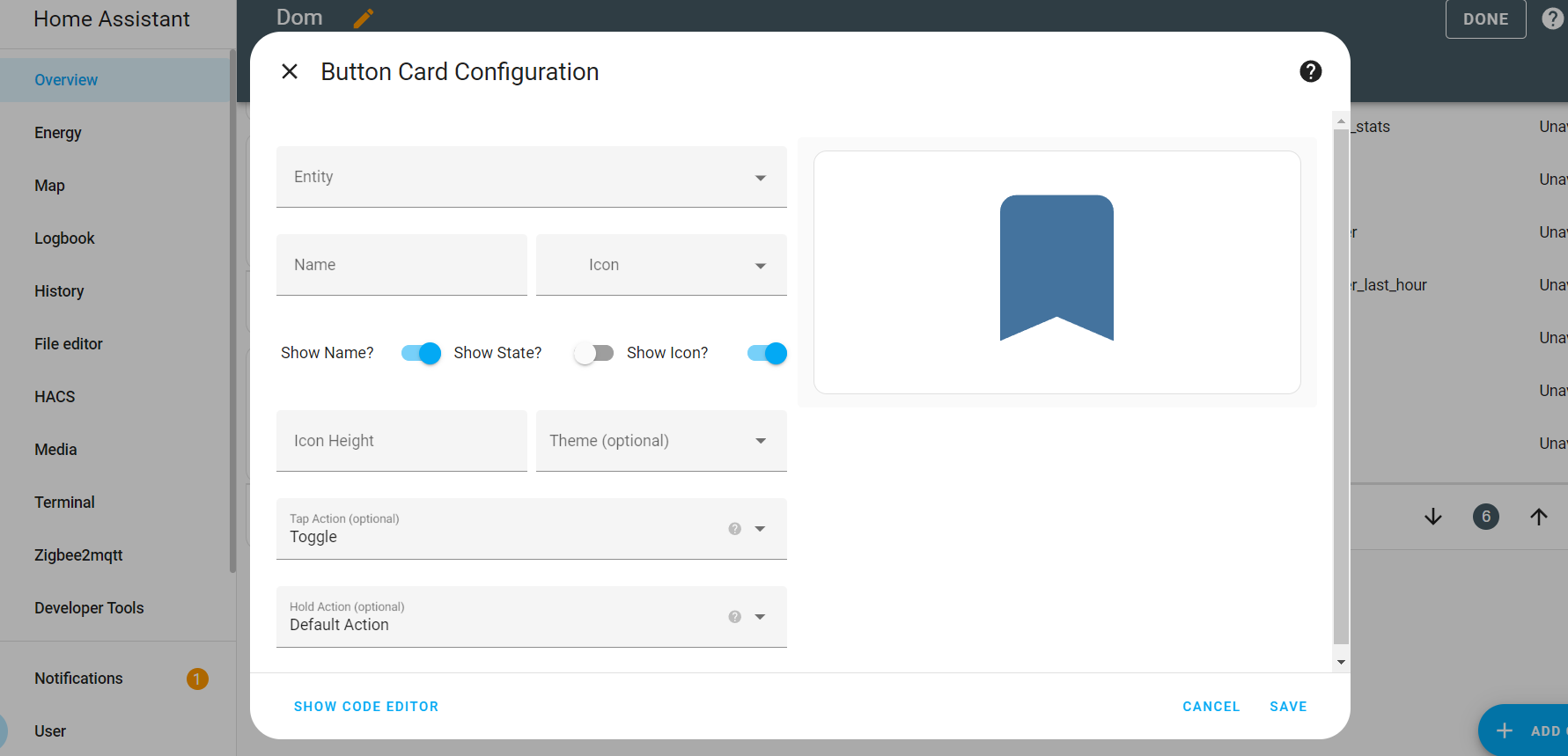
    Regarding buttons - do you know how to add them in HA? Via dashboard editor?
    Button card configuration in Home Assistant with settings options.
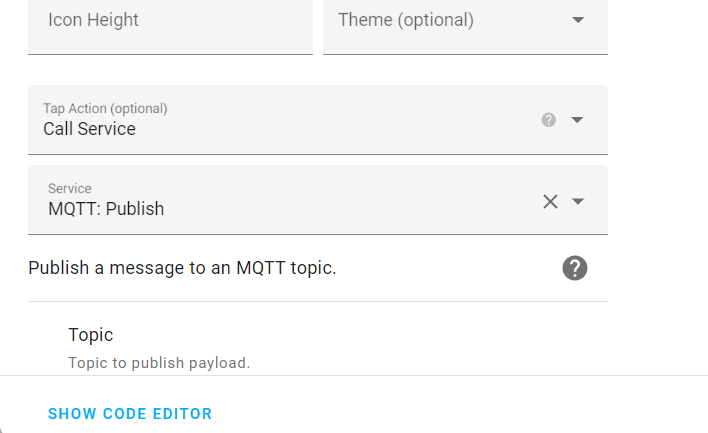
    You can set a service action for them with MQTT publish:
    Screenshot of Home Assistant dashboard editor with MQTT service action settings.
    I may create a tutorial for that later.
    Helpful post? Buy me a coffee.
  • #110 20818148
    MnM1
    Level 10  
    Posts: 175
    Help: 4
    Rate: 13
    Thanks - I will try in HA and see how I go.

    Added after 11 [hours] 54 [minutes]:

    I have some feedback with the temperature sensor for this device.

    I have enabled it in autoexec and rebooted:

    startDriver MCP9808 7 8 1
    MCP9808_Adr 0x30
    MCP9808_Cycle 1

    After the reboot I see a strange value instead of the expected temp:

    MCP9808 Temperature=-0.062500

    Screenshot showing MCP9808 sensor temperature reading as -0.062500.

    Let me know if you want any logs or testing form me
  • #111 20820173
    p.kaczmarek2
    Moderator Smart Home
    Posts: 14615
    Help: 655
    Rate: 12632
    MnM1 wrote:
    Thanks - I will try in HA and see how I go.

    I have published polish tutorial for HA buttons, but screenshots are in english. English version will be published shortly:
    https://www.elektroda.pl/rtvforum/topic4015423.html


    MnM1 wrote:

    I have some feedback with the temperature sensor for this device.

    (...)

    MCP9808 Temperature=-0.062500

    Excuse me, does that mean that you actually bought the same temperature sensor we had with @DeDaMrAz and soldered it to the device? You know, the device in question does not have any temperature sensors in the factory state. We have just added MCP9808 ourselves, as a demonstration of possible modification that users can do to add more functionality to this device.
    Helpful post? Buy me a coffee.
  • #112 20820528
    MnM1
    Level 10  
    Posts: 175
    Help: 4
    Rate: 13

    Ahhh I see - I might have missed that through Google Translate. I thought it was built-in. Now that explains why I am getting this wrong value.

    Cheers.
  • #113 20825641
    MnM1
    Level 10  
    Posts: 175
    Help: 4
    Rate: 13
    >>20820173

    Apologies - I just noticed your post about the tutorial.
    Thank you for it. I am reading it now.
  • #114 20835539
    MnM1
    Level 10  
    Posts: 175
    Help: 4
    Rate: 13

    @DeDaMrAz and @p.kaczmarek2 - guys, I have tested the device.

    I am very happy with the way it turned out. It has all the features found in the Tuya app. It performs really well.
    Next, I will "free from cloud" the devices that I have and install them at the front of the house.

    Thank you very much for working on it and putting up with my limited experience and questions.

    Great job!!!

    Edit: a donation was made via PayPal. Hope it helps :)
  • #115 21083379
    MnM1
    Level 10  
    Posts: 175
    Help: 4
    Rate: 13
    Hi @p.kaczmarek2 and @DeDaMrAz

    Hope you guys are doing well.

    I am resurrecting this thread as after using the lights for a while I have identified a fault which I am hoping you guys can fix.

    Basically this s what is happening (all through OBK GUI not HA):

    1. Turn on the lights from switch (so, no toggle - the switch when on provides current to the light)

    2. Select Curtain Mode for example (it works, the same for any other modes)

    3. Select Light Mode (so the device goes back to the white light that it has as the default when it is turned on) - this is where it breaks. It does not go back to the white lights at all. The device is on but no lights are displayed anymore. The only way to get the white lights back is to go to the LED RGB Color and select the white light (R=255, G=255, B=255). Only then the light turns on. If I reboot the device without doing the R=255, G=255, B=255 step white light is not displayed at all anymore until I do that step.

    4. After the above steps, and the white light is back, any mode can be used and can switch between white light and modes with out any issues until the power to the device is turned off. Then it starts again with the issue described in 1, 2 and 3 above.

    This is the autoexec I have:

    startDriver TuyaMCU
    tuyaMcu_defWiFiState 4
    tuyaMcu_setBaudRate 115200
    
    tuyaMCU_setupLED 24 1
    
    startDriver httpButtons
    
    setButtonEnabled 0 1
    setButtonLabel 0 "Light Mode"
    setButtonCommand 0 "startScript autoexec.bat do_whitelight"
    alias do_whitelight startScript autoexec.bat do_whitelight
    
    setButtonEnabled 1 1
    setButtonLabel 1 "Music Mode"
    setButtonCommand 1 "startScript autoexec.bat do_music"
    alias do_music startScript autoexec.bat do_music
    
    setButtonEnabled 2 1
    setButtonLabel 2 "Curtain"
    setButtonCommand 2 "startScript autoexec.bat do_cur"
    alias do_cur startScript autoexec.bat do_cur
     
    setButtonEnabled 3 1
    setButtonLabel 3 "Collision"
    setButtonCommand 3 "startScript autoexec.bat do_col"
    alias do_col startScript autoexec.bat do_col
     
    setButtonEnabled 4 1
    setButtonLabel 4 "Rainbow"
    setButtonCommand 4 "startScript autoexec.bat do_rai"
    alias do_rai startScript autoexec.bat do_rai
     
    setButtonEnabled 5 1
    setButtonLabel 5 "Pile"
    setButtonCommand 5 "startScript autoexec.bat do_pil"
    alias do_pil startScript autoexec.bat do_pil
     
    setButtonEnabled 6 1
    setButtonLabel 6 "Firework"
    setButtonCommand 6 "startScript autoexec.bat do_fir"
    alias do_fir startScript autoexec.bat do_fir
     
    setButtonEnabled 7 1
    setButtonLabel 7 "Chase"
    setButtonCommand 7 "startScript autoexec.bat do_chase"
    alias do_chase startScript autoexec.bat do_chase
     
     
    // stop execution
    return
    
    do_whitelight:
    tuyaMcu_sendState 21 4 1
    delay_s 0.1
    return
    
    do_music:
    tuyaMcu_sendState 21 4 3
    delay_s 0.1
    return
     
    do_chase:
    tuyaMcu_sendState 21 4 2
    delay_s 0.1
    tuyaMcu_sendState 25 3 020e0d00001403e803e800000000
    return
     
    do_cur:
    tuyaMcu_sendState 21 4 2
    delay_s 0.1
    tuyaMcu_sendState 25 3 000e0d00002e03e802cc00000000
    return
     
    do_col:
    tuyaMcu_sendState 21 4 2
    delay_s 0.1
    tuyaMcu_sendState 25 3 07464602000003e803e800000000464602007803e803e80000000046460200f003e803e800000000464602003d03e803e80000000046460200ae03e803e800000000464602011303e803e800000000
    return
     
    do_rai:
    tuyaMcu_sendState 21 4 2
    delay_s 0.1
    tuyaMcu_sendState 25 3 06464601000003e803e800000000464601007803e803e80000000046460100f003e803e800000000
    return
     
    do_pil:
    tuyaMcu_sendState 21 4 2
    delay_s 0.1
    tuyaMcu_sendState 25 3 010e0d000084000003e800000000
    return
     
    do_fir:
    tuyaMcu_sendState 21 4 2
    delay_s 0.1
    tuyaMcu_sendState 25 3 05464601000003e803e800000000464601007803e803e80000000046460100f003e803e800000000464601003d03e803e80000000046460100ae03e803e800000000464601011303e803e800000000
    return
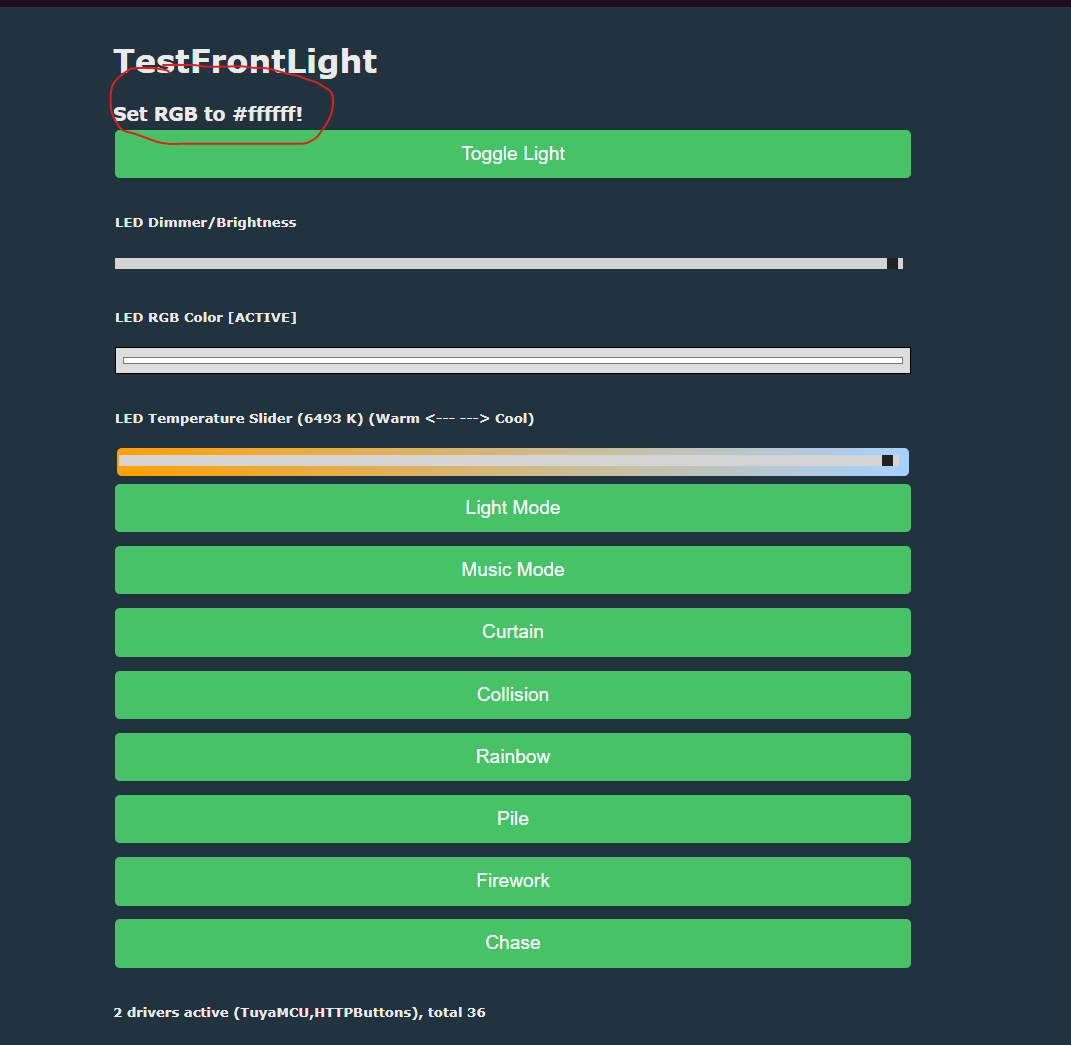

    Hope it can be fixed.

    Thanks.

    Added after 8 [hours] 59 [minutes]:

    I guess the fix is to add a line to the do_whitelight section that will send the command as if it was picked from the LED RGB Color section (R=255, G=255, B=255) before the rest of the script runs.
    I noticed that when I pick the white color from the color picker in LED RGB Color in the GUI at the top I see this - Send #ffffff command.

    Screenshot of the TestFrontLight app with various LED light settings options.

    Not sure how to add that to the do_whitelight section (or even if possible)

    do_whitelight:
    tuyaMcu_sendState 21 4 1
    delay_s 0.1
    return
  • #117 21084278
    p.kaczmarek2
    Moderator Smart Home
    Posts: 14615
    Help: 655
    Rate: 12632
    The delays may be much shorter (or maybe none, who knows) if you enable TuyaMCU queue
    Helpful post? Buy me a coffee.
  • #118 21085291
    MnM1
    Level 10  
    Posts: 175
    Help: 4
    Rate: 13
    I have given it a test on my test device and it seems that it works well.
    I have Flag 43 enabled - I have made the timings 0.1 for both and I can see that it still works pretty well. The delays are insignificant this way.

    I will change the config on the actual lights I have installed at the house and see.

    @DeDaMrAz - can you please let me know what the 3 tuyaMCU_sendColor lines do? Wanting to learn more :)

    Thanks both for your quick assitanrce.
  • #119 21085519
    p.kaczmarek2
    Moderator Smart Home
    Posts: 14615
    Help: 655
    Rate: 12632
    Helpful post? Buy me a coffee.
  • #120 21100770
    MnM1
    Level 10  
    Posts: 175
    Help: 4
    Rate: 13
    Hi @p.kaczmarek2 and @DeDaMrAz ,

    I have another issue with the lights.

    When I toggle the lights from HomeAssistant they turn ON for 1 second and then the light goes off immediately.
    If I toggle the light ON from the OBK web interface it work as it should (light stays on and doesn't turn off unless toggled to turn OFF).

    I think this is something recent as I did not see this kind of behavior before - running HA 2024.5.5
    I hope you might have some solution for this issue.

    Many thanks.

Topic summary

✨ The discussion centers on the compatibility and firmware flashing of a Tuya waterproof LED light purchased from AliExpress, featuring BK7231N chipset and controlled via a TuyaMCU with an SM16703 LED driver. The main focus is on using Cloudcutter to flash OpenBK (OBK) firmware, determining whether the device uses the N or T version, and verifying driver support and GPIO configurations. Initial attempts to use the SM16703P driver in OBK showed limited success due to the device employing a TuyaMCU protocol rather than direct LED driver control. The device supports multiple DPIDs for functions such as power toggle, mode selection, color, scenes, timer, and music sync via microphone. Users successfully detached the device from the Tuya cloud using Cloudcutter, retaining full local functionality controlled through LocalTuya in Home Assistant (HA). Color control commands were developed and tested, revealing color channel mismatches (BGR vs RGB) adjustable via remote settings. Warm/cold white temperature control is not supported in the original firmware and remains unimplemented in OBK. Firmware backups were made to facilitate analysis. Advanced users explored hardware modifications to bypass TuyaMCU for direct SM16703 or WS2812B LED control, but this requires complex soldering due to unavailable SPI pins on the CB2S/CB3S modules. A comprehensive autoexec.bat script was shared to enable LED control, scene selection, and music mode via OBK commands. Issues such as LED blinking during pairing, color inversion, and device behavior after mode changes were addressed with command sequences and flag settings (e.g., TuyaMCU queue flag 43). Integration with HA was improved with MQTT commands and button configurations. The community continues to refine support, with ongoing development to rewrite the TuyaMCU driver and enhance device functionality, including animation triggers and improved color temperature handling. The device's IR remote has advanced features that can alter button functions and color mappings, which may cause unexpected behavior if misconfigured. Overall, the device is now operable with OBK firmware, supporting most Tuya app features locally, though some advanced functions like color temperature remain under development.
Generated by the language model.

FAQ

TL;DR: For owners of sealed DC 5–12 V Tuya dreamlight controllers, the safest path is: verify Cloudcutter first, then treat the device as TuyaMCU-based, not direct SM16703. As one developer put it, "The SM driver will not work for this device"; working control came from dpIDs, scene scripts, and Flag 43 queue support. [#20685629]

Why it matters: This thread shows how to free a waterproof Tuya light from the cloud without opening it, while avoiding the biggest failure mode: flashing a device that still lacks the right driver path.

Option What the thread found Practical result
BK7231N + TuyaMCU path Working support arrived first; test device reported BK7231N and later got scenes, color, brightness, and music mode working Best current route for this light
BK7231T + direct SM16703 tests Early SM16703 builds for T were missing or not ported; 202 T even returned 404 for one file Not the safe first choice
Direct SM16703 control Promised more customization, but this device turned out to use TuyaMCU in front of the LEDs Not the right control path for this product
Tuya app / LocalTuya only Full original behavior stays after cloud detachment, but you still rely on TuyaMCU datapoints Useful for testing before flashing

Key insight: The breakthrough was identifying the controller as a TuyaMCU light with dpIDs and 115200 baud, not a simple BK-to-LED direct driver design. Once the project switched from SM16703 experiments to TuyaMCU scripting, core functions started working. [#20685629]

Quick Facts

  • The Tuya IoT dump exposed 11 functional dpIDs on this device, including 20, 21, 24, 25, 26, 27, 28, 42, 51, 52, and 53, which made reverse-mapping possible in OpenBeken. [#20685592]
  • The pixel-count datapoint reported dpID 53 = 300, giving a concrete strip-length parameter for scene logic and timing tests. [#20685592]
  • The working TuyaMCU setup used 115200 baud and required tuyaMcu_defWiFiState 4 to stop the power-up blinking that looked like pairing mode. [#20720438]
  • A tested product variant was the RGB, 30 cm, 9 W, waterproof model from AliExpress, used as the sacrificial device for reverse-engineering. [#20686151]
  • Early queue-related instability showed up after roughly 7–8 color changes in Home Assistant on one tester’s setup, which is why Flag 43 became important. [#20722415]

1. How can I tell whether a Tuya LED controller on firmware 1.1.12 is compatible with Tuya Cloudcutter, and how do I choose between the BK7231N and BK7231T profile?

Use Cloudcutter in detection mode first, not full flashing. 1. Select the Cloudcutter-only option. 2. Try both the T and N profile for that exact firmware. 3. If one profile shows an “A-xx” prefix, use that platform for flashing. The thread’s practical rule was to avoid guessing before detection, because picking the wrong platform can strand a sealed device with no easy recovery path. [#20661998]

2. What is OpenBeken (OBK), and how does it work with TuyaMCU-based LED controllers like BK7231N or BK7231T devices?

OpenBeken is replacement firmware that runs on Beken Wi‑Fi chips and can control a separate TuyaMCU over serial. "TuyaMCU is a serial control MCU that handles device features through dpIDs, while the BK chip provides Wi‑Fi, scripting, and UI logic." In this thread, OBK worked by starting the TuyaMCU driver, setting Wi‑Fi state, mapping dpIDs, and sending scene or color commands instead of talking to LEDs directly. [#20720438]

3. What is an individually addressable LED driver such as SM16703P, and how is it different from simple RGB or CCT LED control?

An individually addressable LED driver such as SM16703P lets one strip show multiple colors on different LEDs at the same time. "SM16703P is an addressable LED driver that controls per-pixel color data, unlike simple RGB or CCT control where the whole strip changes together." The thread used a simple test: if one device can display several colors at once, it is addressable; if it only changes as a whole, it behaves like basic RGB/CCT lighting. [#20685681]

4. Why did the SM16703P test commands fail on some OpenBK builds, and which builds added working support for BK7231N versus BK7231T?

They failed because support landed unevenly across platforms and some builds missed the latest commit. One tester got SM16703P_Init NOT found, then found 1.17.202 T unavailable with a 404, while the maintainer confirmed the contributor had only provided a working version for N at that point. Later, a tester on BK7231N flashed 1.17.206 and could at least load the driver, while T support still needed porting. [#20669569]

5. How do I safely test a sealed waterproof Tuya light with Cloudcutter and OpenBeken without opening the device or risking permanent loss of functionality?

Test cloud detachment first and keep original behavior available as long as possible. 1. Verify Cloudcutter compatibility without flashing. 2. Add the light to Tuya and, if needed, LocalTuya first so you can inspect dpIDs. 3. Do not flash experimental direct LED drivers unless you have a backup or a cheap sacrificial unit. The maintainers explicitly recommended a 2 MB firmware backup before risky tests because support was incomplete early on. [#20662154]

6. Why do the LEDs start blinking blue immediately after power-up on this Tuya light, and how does the tuyaMcu_defWiFiState 4 command stop the pairing-style blinking?

They blink because the TuyaMCU thinks the device is still in Wi‑Fi pairing mode. The fix is to tell the MCU it is already paired and cloud-connected by sending tuyaMcu_defWiFiState 4. In the thread, the maintainer identified the blue blinking as MCU-side status behavior, not LED driver failure, and said the blinking would stop as soon as that command was applied. [#20685629]

7. How can I determine from Tuya Config data and dpIDs whether a light uses direct SM16703 control or a separate TuyaMCU controlling the LEDs?

Look for Tuya serial metadata and stateful dpIDs instead of raw LED pin control. In this case, the Tuya Config partition exposed a baud rate, and the live device reported dpIDs such as 20, 21, 24, 25, 51, 52, and 53, which confirmed a TuyaMCU path. The maintainer concluded that direct SM16703 commands would not work here because the LEDs were not being driven straight from the BK chip. [#20685629]

8. What do the Tuya dpIDs 20, 21, 24, 25, 27, 28, 51, 52, and 53 do on this dreamlight-style TuyaMCU LED controller?

They map the device’s main functions. 20 is power, 21 is mode, 24 is color/brightness data for light mode, 25 is scene data, 27 is phone-microphone music data, 28 is color-wheel control data, 51 is dreamlight scene mode, 52 is dreamlight music data, and 53 is pixel-number or timing-related control. The reverse-engineering notes also tied 21 values to 1 = light, 2 = scenes, and 3 = music. [#20720196]

9. How do I create a working autoexec.bat for this TuyaMCU RGB light in OpenBeken with Light mode, Music mode, and custom scene buttons like Curtain, Rainbow, and Firework?

Start with TuyaMCU, set Wi‑Fi state and baud, then bind HTTP buttons to mode and scene scripts. The working template used startDriver TuyaMCU, tuyaMcu_defWiFiState 4, tuyaMcu_setBaudRate 115200, tuyaMCU_setupLED 24 1, then scene buttons that first sent tuyaMcu_sendState 21 4 2 and next pushed scene payloads on dpID 25. A published example already included Music mode, Light mode, Curtain, Collision, Rainbow, Pile, Firework, and Chase buttons. [#20721021]

10. Why does the warm white and cool white temperature slider turn the LEDs off in OBK or Home Assistant on this device, and what does that imply about native Tuya support?

It turns the LEDs off because this device does not expose a real warm/cool white channel in its native Tuya behavior. After reviewing the original app, the developers concluded there was no CW slider at all there, only a color picker and preset modes. That means OBK or Home Assistant may show a white-temperature control, but on this product it is not backed by a valid Tuya datapoint and should not be treated as supported. [#20777571]

11. How can I fix swapped colors such as red showing as blue and blue showing as yellow on a TuyaMCU light, and when is the remote's RGB order setting involved?

Fix the RGB order in the remote’s hidden configuration, not in OBK first. One tester proved the mismatch was local to the lamp because tuyaMCU_sendColor 24 1 0 0 1 produced blue, 0 1 0 1 produced green, and 0 0 1 1 produced red. Later, the same user corrected the order by revisiting the remote/manual settings and confirmed the colors became correct without a firmware rewrite. [#20721099]

12. What is the difference between LocalTuya and TuyaLocal in Home Assistant, and which one fits a cloud-detached Tuya light after using Cloudcutter?

LocalTuya was the path discussed for a cloud-detached light in this thread. After detaching from the cloud, a contributor said the device would keep full functionality, but you would need LocalTuya to control it because it would no longer connect to the Tuya cloud. The thread mentions confusion with TuyaLocal, but the only concrete recommendation here was LocalTuya plus the device ID and dpIDs discovered during setup. [#20663292]

13. How do I use Home Assistant and MQTT to trigger TuyaMCU animations from OBK, including scene commands that need manual YAML or dashboard buttons?

Use MQTT publish actions from Home Assistant buttons and send the same OBK commands that work in the web UI. The maintainer said animation triggering still needed manual YAML or dashboard-button service actions, and later showed Home Assistant buttons sending MQTT commands. For example, scene buttons can publish a mode change to dpID 21 = 2 and then the required dpID 25 scene payload for Curtain, Rainbow, or Firework. [#20818136]

14. Why would color changes stop working after several tries in Home Assistant, and how does enabling OpenBeken flag 43 'TuyaMCU Use queue' affect reliability?

They can stop because back-to-back TuyaMCU writes collide or arrive in the wrong order. One tester reported color changes failing after about 7 or 8 tries until the lamp was power-cycled, which led to a test build and the new Flag 43: TuyaMCU Use queue. After enabling that queue flag, another tester reported that color changes and dimming worked every time from both the device page and Home Assistant. [#20766386]

15. What can I do if a TuyaMCU light powers back on after a reboot or power cut even with startup settings changed, and how can autoexec or SetStartValue be used as a workaround?

Use autoexec to force an OFF command after boot, because SetStartValue did not solve this TuyaMCU case. The reported workaround was: query state, wait about 1 second, then send tuyaMcu_sendState 20 1 0. The maintainer called it a temporary fix and noted the lamp may flash on briefly before turning off again, but it reliably restored the desired post-reboot OFF state until a firmware-side fix could be worked on. [#21275570]
Generated by the language model.
ADVERTISEMENT