logo elektroda
logo elektroda
X
logo elektroda

Santa Claus - Christmas decoration with LED "neons".

Andrzej_Tomaszewski 3333 3

TL;DR

  • A Santa Claus Christmas decoration uses 12V LED "neons" and a waving-hand animation.
  • A simple CD4093-based generator circuit controls the hand-wave motion, with a potentiometer setting the swing speed.
  • The main structure is a circle about 114 cm in diameter, cut from 30 mm thick Styrodur, with an aluminum frame mounted on the back.
  • The decoration is adapted for outdoor conditions and places the power supply on a horizontal aluminum beam.
  • Building the decoration itself is very time-consuming and requires a lot of patience, even though the electrical part is straightforward.
Generated by the language model.
ADVERTISEMENT
Treść została przetłumaczona polish » english Zobacz oryginalną wersję tematu
📢 Listen (AI):
  • Hello :)

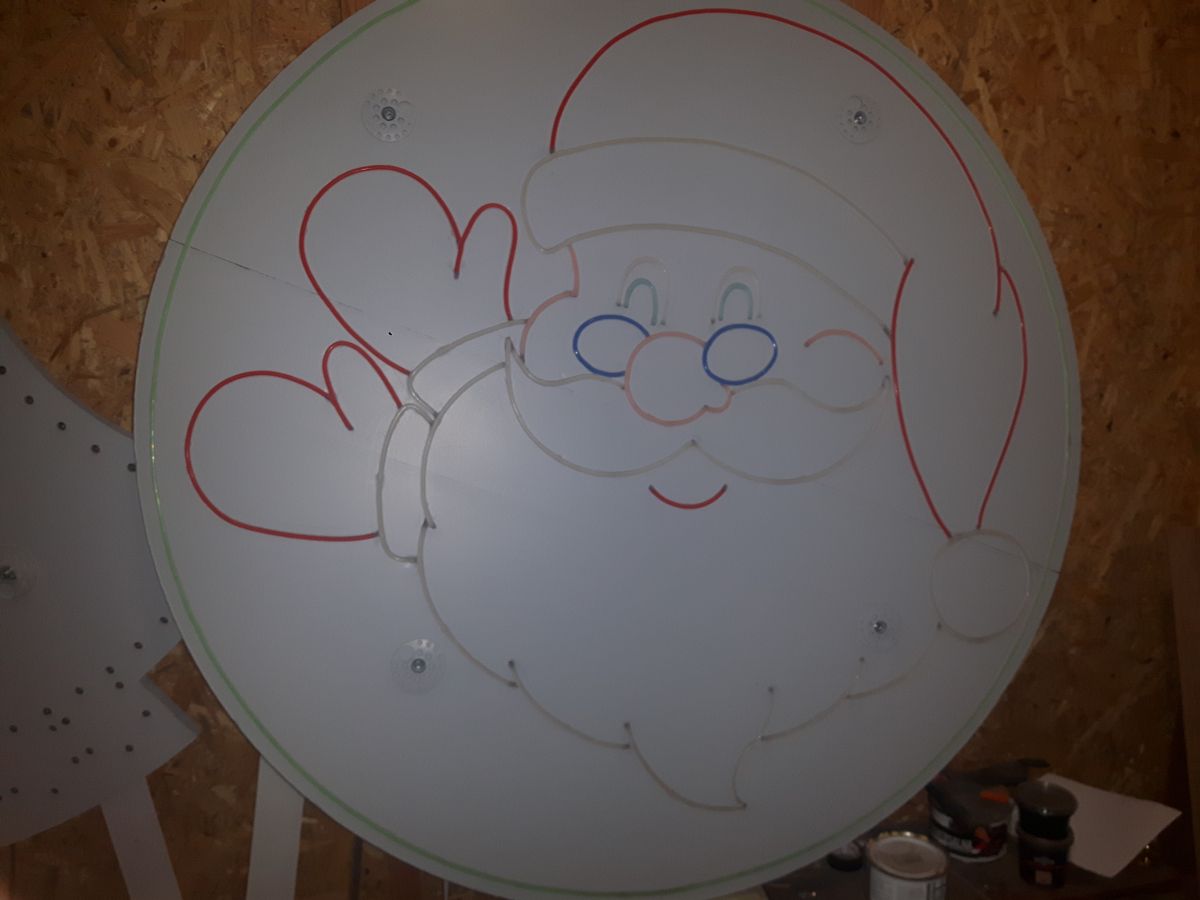
    I present to you another implementation of a Christmas decoration. The project was created for Christmas 2021. I used 12V LED "neons" for construction. The animation (hand waving) is controlled by a simple generator circuit based on CD4093. The main structure is a circle with a diameter of approx. 114 cm, cut from 30 mm thick Styrodur. There is an aluminum frame mounted on the back for mounting on the wall. In terms of electricity, there is nothing groundbreaking here, but making the decoration itself is very time-consuming and requires a lot of patience. This decoration is adapted to work in outdoor conditions.

    This is what the decoration looks like on the front
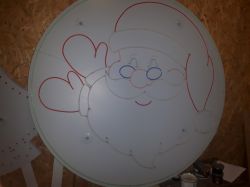
    Christmas decoration depicting Santa Claus with LED neon lights.

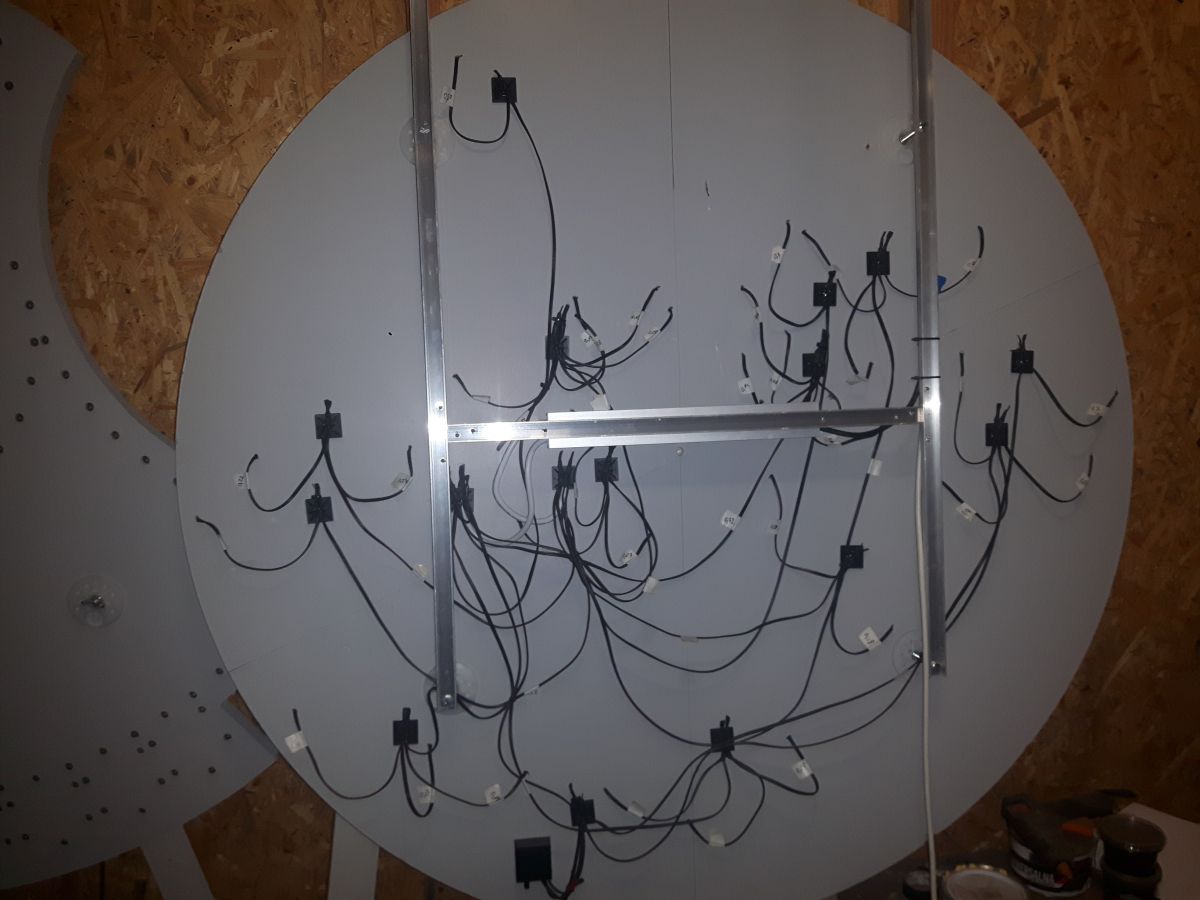
    And so at the back
    Back of a Christmas decoration with visible wires and aluminum frame.

    In the lower left part, in this small plastic housing, there is a system responsible for waving the hand. You can see the protruding potentiometer knob for setting the swing speed. The power supply is mounted on a horizontal aluminum beam.

    Below is a video showing how the system works. The film does not reflect the colors of the light well, in fact they are much better.


    Regards :)

    Cool? Ranking DIY
    About Author
    Andrzej_Tomaszewski
    Level 13  
    Offline 
    Andrzej_Tomaszewski wrote 270 posts with rating 332, helped 2 times. Been with us since 2005 year.
  • ADVERTISEMENT
  • ADVERTISEMENT
  • #3 20784627
    Andrzej_Tomaszewski
    Level 13  
    Posts: 270
    Help: 2
    Rate: 332
    Board Language: polish
    Thank you for this comment and for the gift you sent earlier :) Regards!
  • #4 20787278
    WX3V
    Level 18  
    Posts: 250
    Help: 28
    Rate: 95
    Board Language: polish
    Congratulations on your brilliant idea and I sincerely envy you.
    Regards.
📢 Listen (AI):

FAQ

TL;DR: A 114 cm Styrodur circle hosts 12 V LED-neon strips driven by a CD4093 flasher; “Unique and cannot be purchased!” [Elektroda, gulson, post #20784509] Builder shows outdoor-ready Santa that waves via a simple RC oscillator [Elektroda, Andrzej_Tomaszewski, post #20783967]

Why it matters: DIYers can replicate a large, weather-proof light display for a fraction of retail costs.

Quick Facts

• Diameter: 114 cm circular panel [Elektroda, Andrzej_Tomaszewski, post #20783967] • Core material: 30 mm Styrodur (extruded polystyrene) [Elektroda, Andrzej_Tomaszewski, post #20783967] • LED-neon input: 12 V DC, ≈0.65 A m⁻¹ typical [LED Neon Flex Datasheet] • Controller IC: CD4093 CMOS quad NAND gate, <1 µA static current [TI, 2023] • Approx. project cost: €80–120 in parts, labour excluded [MakerBudget, 2022]

What materials form the structure of the Santa decoration?

The builder cut a 30 mm thick Styrodur sheet into a 114 cm circle and glued 12 V LED-neon strips onto it. A bent aluminium frame on the rear adds stiffness and provides mounting holes [Elektroda, Andrzej_Tomaszewski, post #20783967]

How is the display fixed to a wall or façade?

The aluminium frame on the backside acts as a bracket. Screws or expansion anchors pass through the frame into the wall, spreading the 2.8 kg load over several points for wind safety [Elektroda, Andrzej_Tomaszewski, post #20783967]

Why were LED-neon strips chosen over standard LED tape?

LED-neon has a continuous diffused glow, bends in two planes, and offers IP65 moulded silicone jackets. Standard LED tape shows dotting and needs extra diffusion. The neon strip’s 120° viewing angle improves visibility outdoors [LED Neon Flex Datasheet].

What drives the animated hand-waving effect?

A CD4093 NAND gate oscillator creates a square wave. That signal toggles a MOSFET which powers the arm segment. Changing the RC pair via a potentiometer alters flash frequency between about 0.2 Hz and 2 Hz [Elektroda, Andrzej_Tomaszewski, post #20783967]

Is the project safe for outdoor winter use?

The enclosure is plastic and sealed; the LED-neon is rated IP65. Use silicone grommets and dielectric grease on DC connectors. At −20 °C, silicone remains flexible, unlike PVC [Outdoor LED Guide].

How much power does the whole decoration draw?

The finished piece uses roughly 42 W: 6.5 m of neon × 6.5 W m⁻¹. That is about the same as a small incandescent string but eight times brighter [LED Neon Flex Datasheet].

What is the most common failure outdoors?

Water ingress at cut ends corrodes copper tracks and can kill an entire segment within a week. Seal every cut with neutral-cure silicone and end caps [Flexible Strip Failure Analysis].

Can the same CD4093 circuit run a larger display?

Yes. The logic gate only supplies a few milliamps, so scaling means choosing a MOSFET or relay rated for the higher strip current. Keep total gate capacitance below 200 nF to retain stable timing [TI, 2023].

How do I cut and bend LED-neon without damage?

  1. Unplug power and locate the printed scissor icon.
  2. Use a sharp flush cutter to make a straight, perpendicular cut.
  3. Slide a pre-sized silicone end cap over the cut and fill with sealant. This method keeps the internal copper bus centred and waterproof [LED Neon Flex Datasheet].

How long did the builder spend on assembly?

The author notes that the electrical part is simple but “making the decoration itself is very time-consuming and requires a lot of patience.” Expect 10–15 hours for cutting, gluing, and sealing [Elektroda, Andrzej_Tomaszewski, post #20783967]
Generated by the language model.
ADVERTISEMENT