logo elektroda
logo elektroda
X
logo elektroda

[BK7231N] New LSC Smart Mood light 3204432

snakesrules94 9552 23
ADVERTISEMENT
  • Helpful post
    #1 20943154
    snakesrules94
    Level 8  
    Posts: 37
    Help: 3
    Rate: 4

    Hi all,
    here is a copy of my post on OBK github.

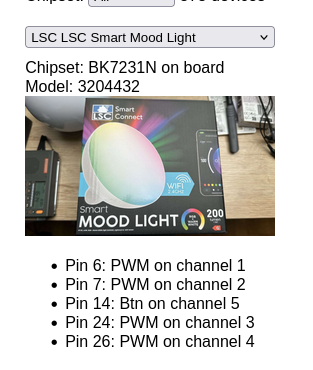
    I bought today some new smart light from action which afaik is not yet seen on the database :
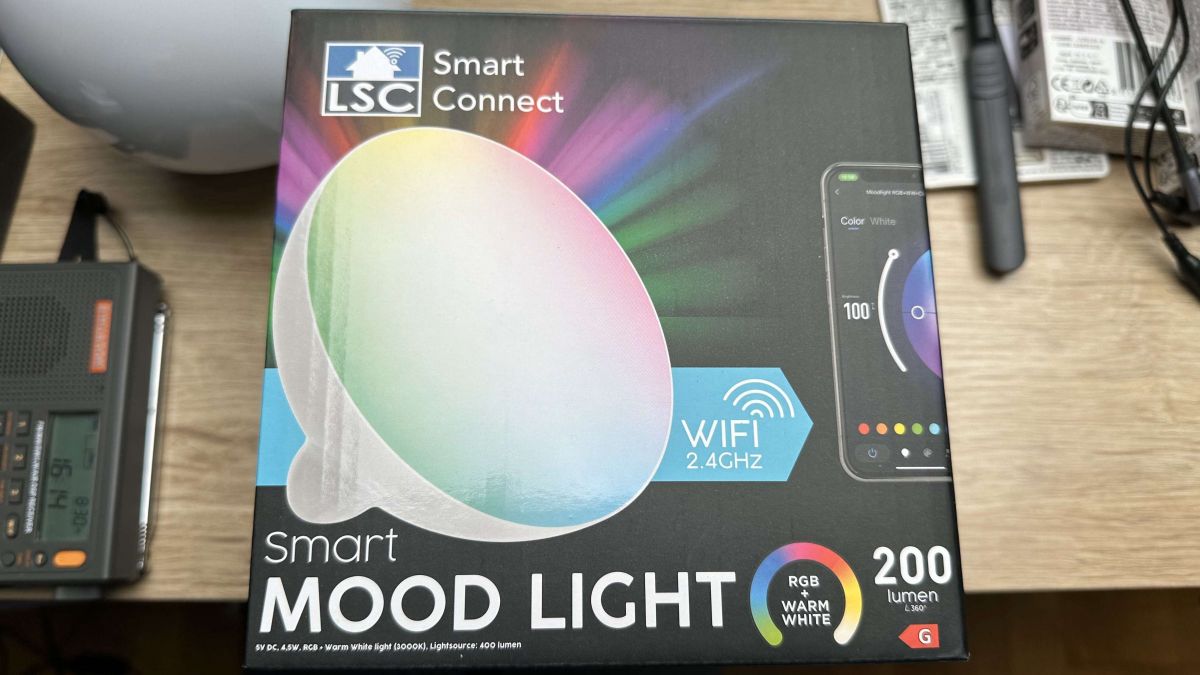
    Box of LSC Smart Mood Light with visible feature information.
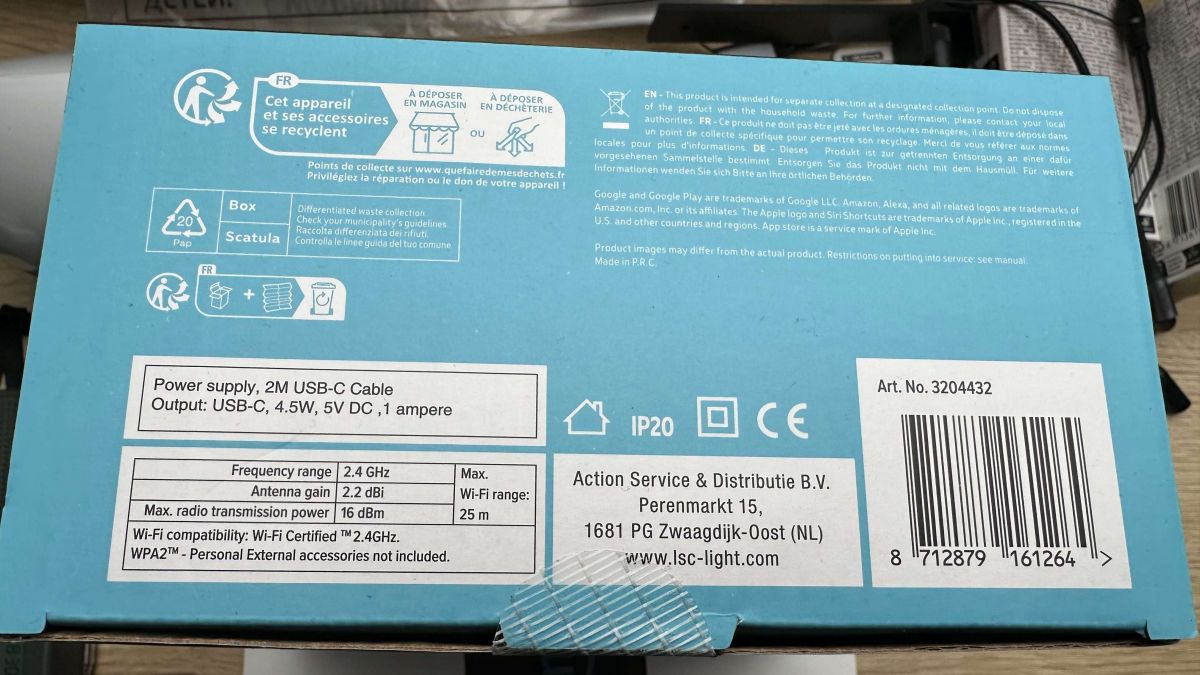
    Back side of LSC smart lamp packaging with product information.

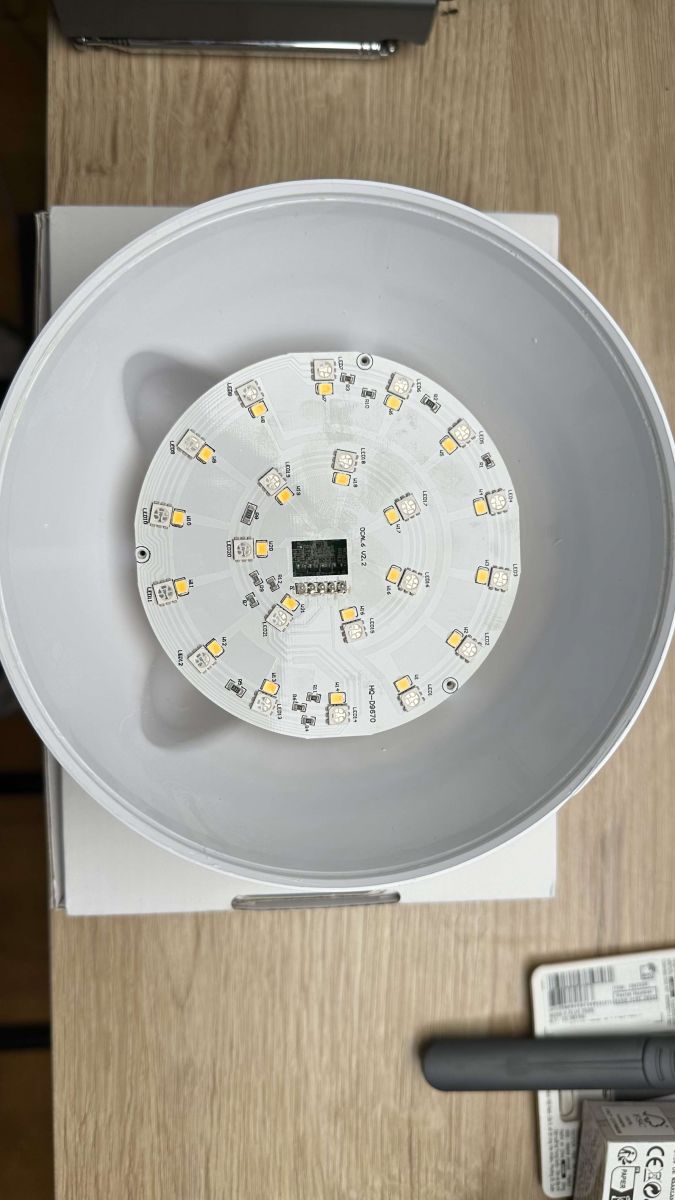
    opening is quite easy by gently cutting the glue around the edge of the refractor and then it comes :
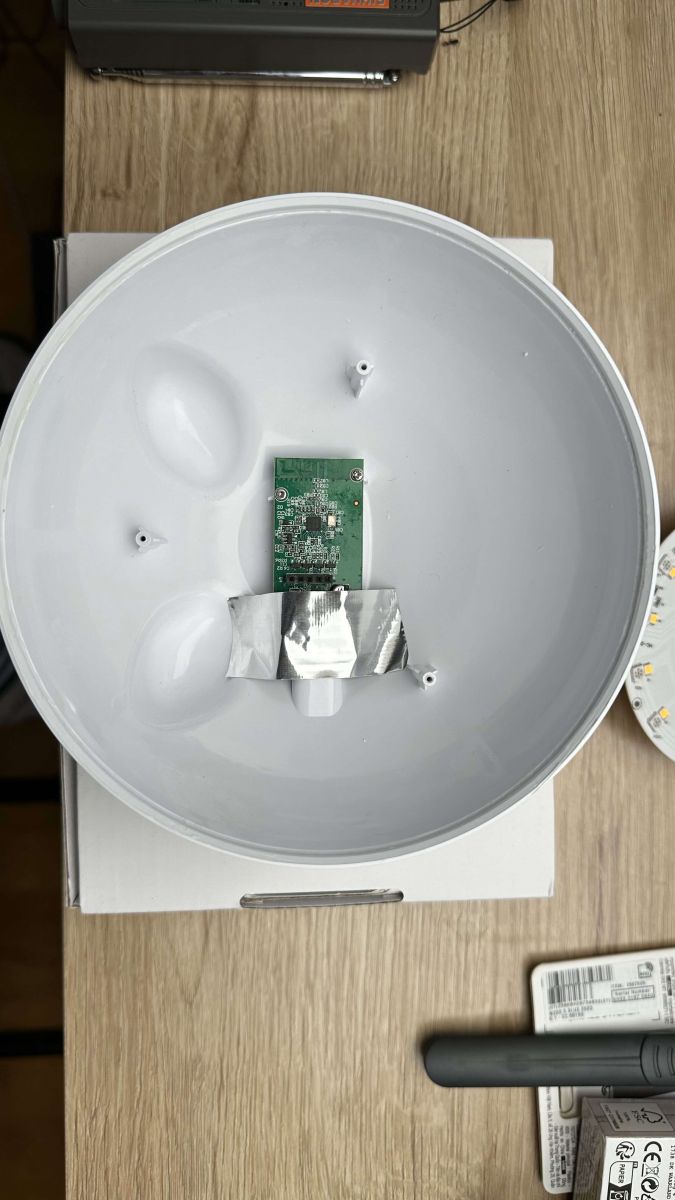
    Interior of a smart lamp with a visible circuit board and wires.
    Interior of a smart light with a visible circular circuit board featuring LED diodes.

    This time, the BK7231N is soldered directly :
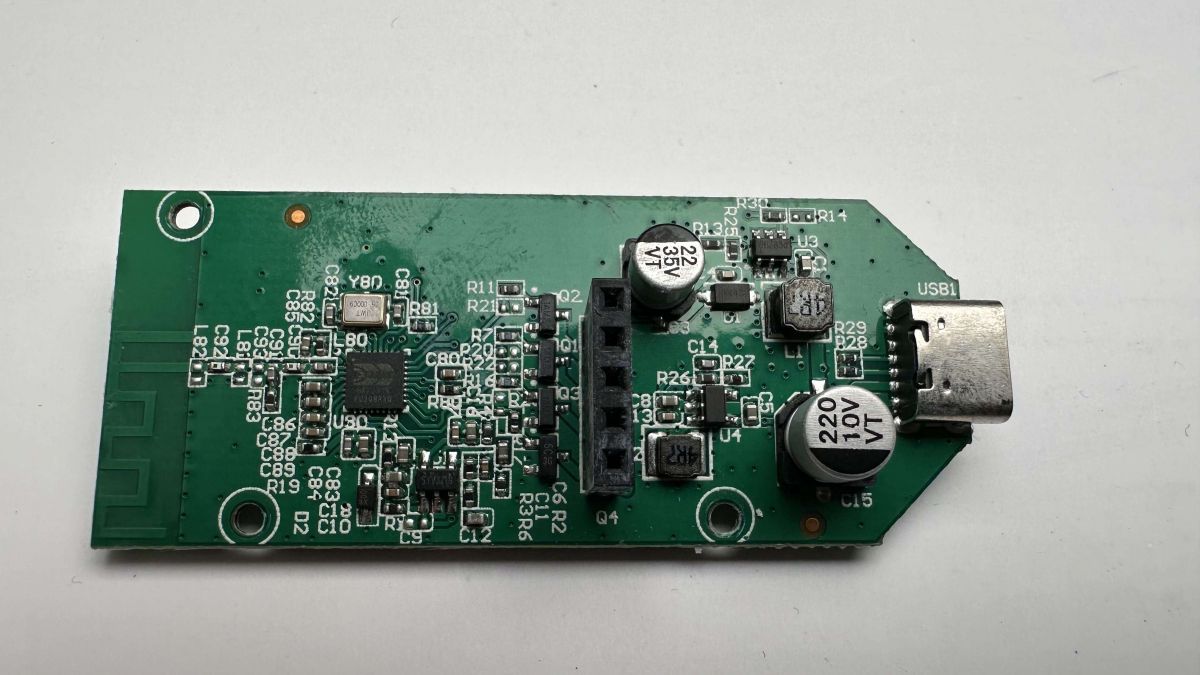
    The image shows a printed circuit board with electronic components and a USB connector on the right.
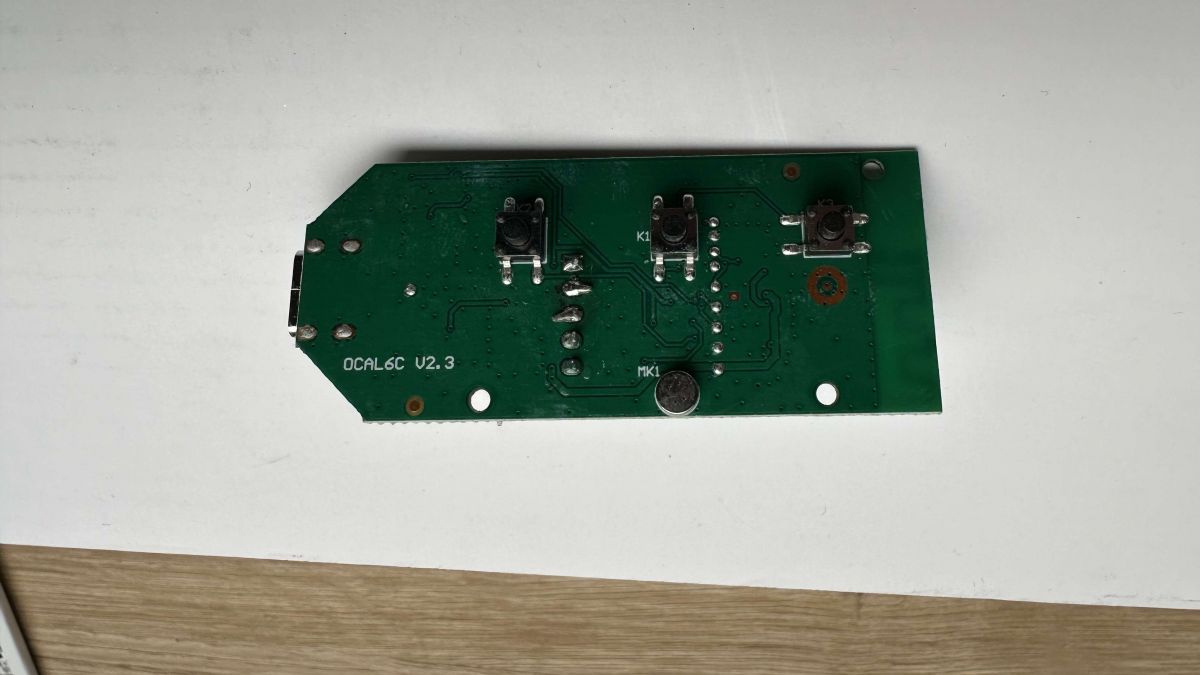
    Circuit board with three visible buttons and the marking OCAL6C V2.3.

    The light is recognized in tuya app with fw 2.0.0.

    I've dumped the FW and submitted a profile for TCC so now this lamp can be flashed directly.

    Working profile (except mic/music functions):

    {
      "vendor": "Tuya",
      "bDetailed": "0",
      "name": "Lsc Smart Mood Light",
      "model": "3204432",
      "chip": "BK7231N",
      "board": "on board",
      "flags": "1024",
      "keywords": [
        "TODO",
        "TODO",
        "TODO"
      ],
      "pins": {
        "6": "PWM;1",
        "7": "PWM;2",
        "14": "Btn;5",
        "24": "PWM;3",
        "26": "PWM;4"
      },
      "command": "",
      "image": "https://obrazki.elektroda.pl/1414285900_1706982172.jpg",
      "wiki": "https://www.elektroda.com/rtvforum/topic4033331.html"
    }
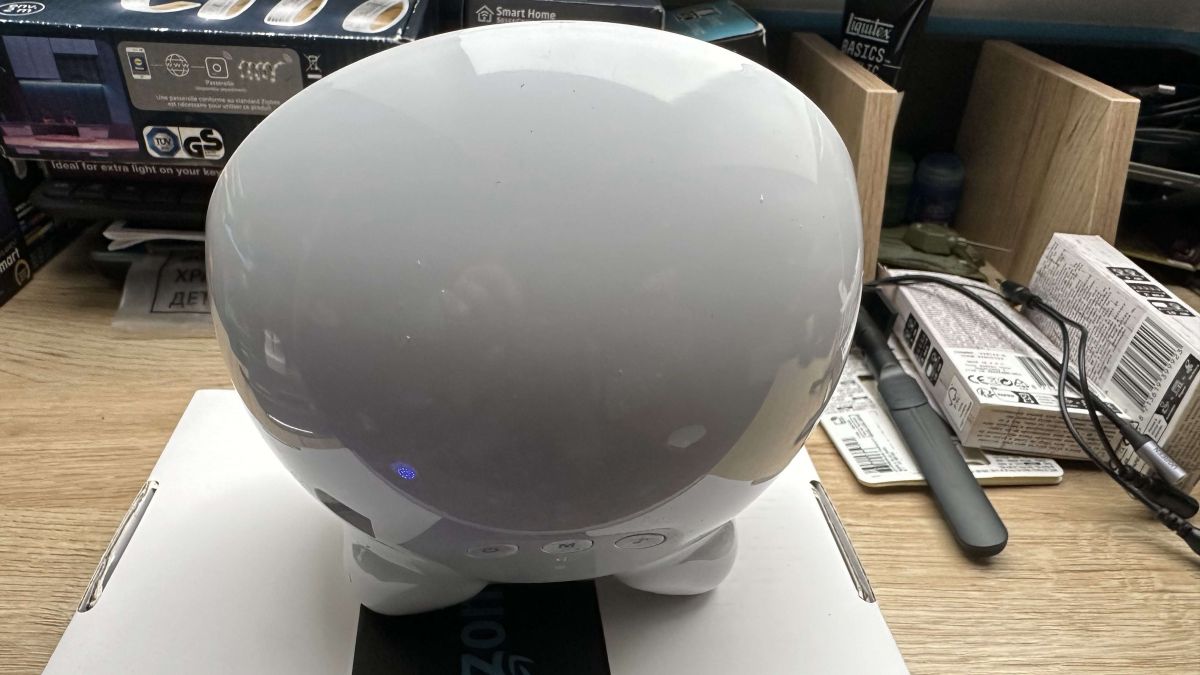
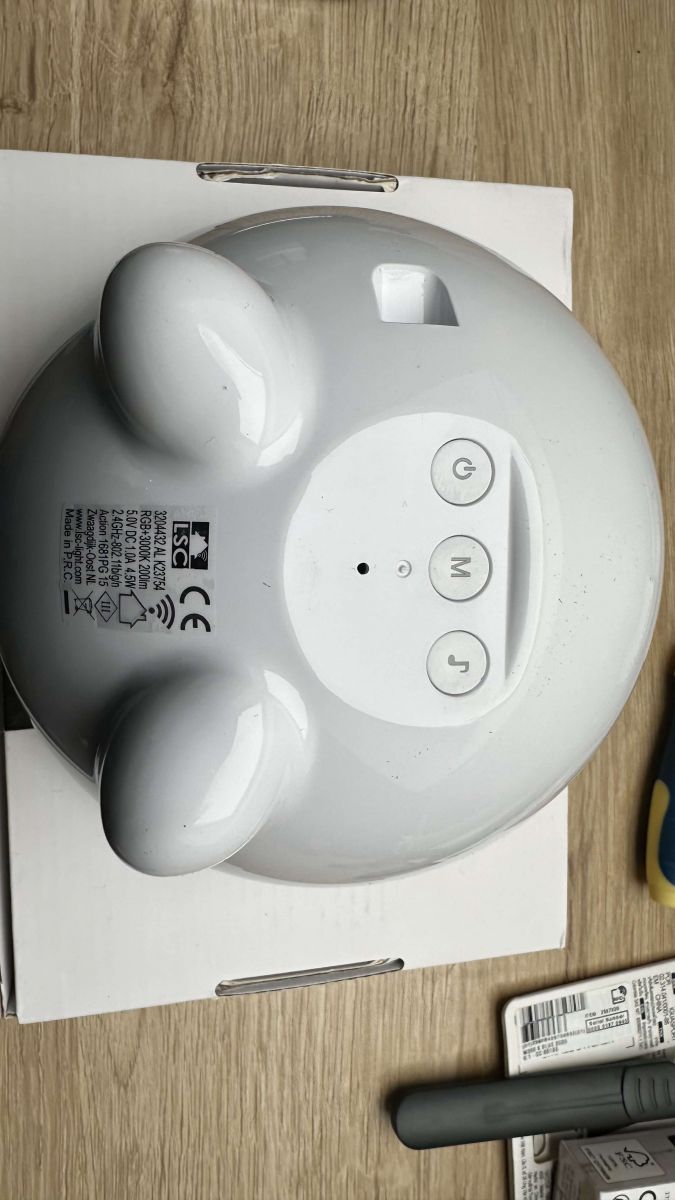

    White, smart lamp with a rounded shape on a desk surrounded by boxes and cables.
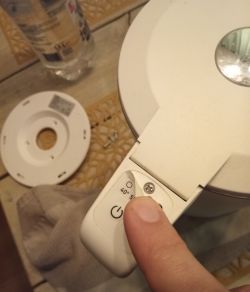
    Back of the smart mood lamp with three buttons and a sticker with CE markings.

    Regards.
  • ADVERTISEMENT
  • #2 20943190
    p.kaczmarek2
    Moderator Smart Home
    Posts: 14440
    Help: 650
    Rate: 12411
    Helpful post? Buy me a coffee.
  • #3 20943209
    snakesrules94
    Level 8  
    Posts: 37
    Help: 3
    Rate: 4

    p.kaczmarek2 wrote:

    btw, how bright is this light in practice?


    Honestly speaking, I'm using it in my living room along with some other Philips HUE devices to make a colored ambient to watch TV and the result is not bad at all. Especially when you compare the price of this lamp to a Philips ... :-)
  • ADVERTISEMENT
  • #4 20958525
    Rockking81
    Level 3  
    Posts: 5

    Hi, maybe a stupid question, but which pins do I use for my TTL to USB converter.
  • #5 20958579
    p.kaczmarek2
    Moderator Smart Home
    Posts: 14440
    Help: 650
    Rate: 12411
    I think you should consult our flasher readme:
    https://github.com/openshwprojects/BK7231GUIFlashTool
    or/and check out our flashing tutorials for BK7231:
    https://www.youtube.com/@elektrodacom
    you can also check BK7231 datasheet topics if you have a non-standard board and search for QFN case pinout:
    https://www.elektroda.com/rtvforum/topic3951016.html
    Helpful post? Buy me a coffee.
  • ADVERTISEMENT
  • #6 20959172
    snakesrules94
    Level 8  
    Posts: 37
    Help: 3
    Rate: 4

    Rockking81 wrote:

    Hi, maybe a stupid question, but which pins do I use for my TTL to USB converter.


    Hello, if you want to flash this particular model, I didn't identify pins directly on the board to flash the 7231N. The simplest way is with tuyacloudcutter as there is now a profile for this lamp.

    Regards.
  • #7 20959324
    Rockking81
    Level 3  
    Posts: 5

    Hi, thanks for that pointer. So I dismantled this lamp, and it was not necessary. :)
  • #8 20960730
    p.kaczmarek2
    Moderator Smart Home
    Posts: 14440
    Help: 650
    Rate: 12411
    The search for SPI DMA bug continues:
    https://github.com/openshwprojects/OpenBK7231T_App/pull/1055#issuecomment-1942166659
    There is still something slightly wrong and sometimes wrong colors are set. If anyone wants to join us and help, feel free to do so. We need to figure out what is wrong in
    https://github.com/openshwprojects/OpenBK7231...9b32a6383c9444b65ea/src/driver/drv_sm16703P.c
    Helpful post? Buy me a coffee.
  • #9 20965781
    alexandrethenard
    Level 1  
    Posts: 1

    Hi there,

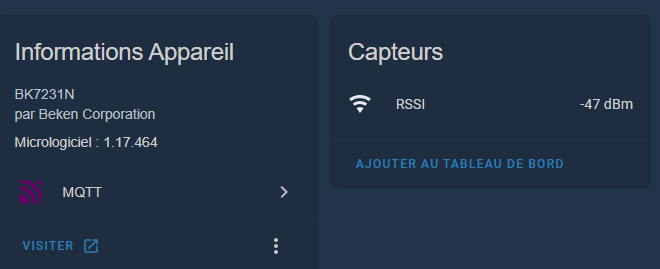
    I've just flashed my device with tuyacloudcutter, working like a charm on its web interface, however I'm struggling to make it work with Home Assistant, I'm only getting RSSI info on MQTT, nothing else. Screenshot of the BK7231N device web interface showing device information and RSSI.

    Do you have an idea of what could be the issue? Thanks!
  • #10 21014582
    p.kaczmarek2
    Moderator Smart Home
    Posts: 14440
    Help: 650
    Rate: 12411
    Hello @alexandrethenard , sorry for the late reply.
    The following may indicate that you haven't configured PWMs, or, to be more precise, that you did HASS Discovery before configuring the PWMs.
    You need to first configure PWMs (the GPIO, the template as shown in the first post), and then do again Home Assistant Discovery.

    Please refer to the video below for HASS Discovery procedure:


    If you have a different device and don't know which GPIOs are used, don't have a template, you can try doing Tuya config extraction:


    Let me know if the issue persists after repeating Home Assistant Discovery and I will try to help you futher in such case.
    Helpful post? Buy me a coffee.
  • #11 21091216
    igfotfrank
    Level 7  
    Posts: 17

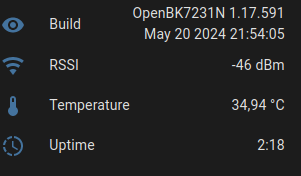
    I have a similar problem. I just see the values for: Screenshot showing system data of OpenBK7231N.

    But no Lights. I selected as template the model: 3204432
  • #12 21091240
    p.kaczmarek2
    Moderator Smart Home
    Posts: 14440
    Help: 650
    Rate: 12411
    What is your config? From what I can see, the 4-PWM discovery is missing?
    Helpful post? Buy me a coffee.
  • #13 21091257
    igfotfrank
    Level 7  
    Posts: 17
    Code: JSON
    Log in, to see the code


    LSC Smart Mood Light product packaging with BK7231N chipset and pin specifications.
  • #14 21091301
    p.kaczmarek2
    Moderator Smart Home
    Posts: 14440
    Help: 650
    Rate: 12411
    I see. And are you using it in RGB + W mode, or in RGBCW mode (emulated cool)?
    Helpful post? Buy me a coffee.
  • #15 21091317
    igfotfrank
    Level 7  
    Posts: 17
    Ahh my bad. I had both modi set.
    Now i have the flags: 0,1,2,10 and 24.
    And now it works.
    Thanks for the tip
  • #16 21091340
    p.kaczmarek2
    Moderator Smart Home
    Posts: 14440
    Help: 650
    Rate: 12411
    So you're saying it works with "emulated cool" but not in the pure RGB+W? Well, that's still something we need to add, i guess.
    Helpful post? Buy me a coffee.
  • Helpful post
    #17 21171840
    ElektroTechnikus
    Level 8  
    Posts: 22
    Help: 2
    Rate: 5
    Somehow I didn't particularly like the Mood Light. So now I've had another look at it and suggest the following changes:

    First make flag 24 work correctly:
    P6 = PWM, 0
    P7 = PWM, 1
    P24 = PWM, 2
    P26 = PWM, 4
    (not 1 - 2 - 3 - 4)

    You may also activate all buttons:
    P8 = Btn_NextColor (M button)
    P9 = Btn_NextTemperature (musical note button - to be held)
    P14 = Btn_SmartLED, 0 (on/off button - to be held to work as dimmer)
    Set flag 23 (for convenience)

    BTW: It would be nice if the first action of a button would only change the mode (RGB vs. C/W) when the mode needs to be changed - i. e. do not move the slider, do not change the color, but only change the mode and initially leave the last temperature or the last color. (If flag 23 is set switch on and force that mode only.)
  • #18 21177071
    p.kaczmarek2
    Moderator Smart Home
    Posts: 14440
    Help: 650
    Rate: 12411
    If you want custom button interactions, you can easily script them in autoexec.bat:
    https://www.youtube.com/watch?v=kXi8S12tmC8
    Check out our scripting samples here:
    https://github.com/openshwprojects/OpenBK7231T_App/blob/main/docs/autoexecExamples.md
    You should set the role Btn_ScriptOnly and then manually script button events. Here is some random sample:
    
    // channels 1 to 5 are used
    setChannelType 1 toggle
    setChannelType 2 toggle
    setChannelType 3 toggle
    setChannelType 4 toggle
    setChannelType 5 toggle
    // Btn_ScriptOnly is set on P26
    addEventHandler OnClick 26 ToggleChannel 1
    addEventHandler OnDblClick 26 ToggleChannel 2
    addEventHandler On3Click 26 ToggleChannel 3
    addEventHandler On4Click 26 ToggleChannel 4
    addEventHandler On5Click 26 ToggleChannel 5
    
    Helpful post? Buy me a coffee.
  • #19 21261780
    nielspiersma
    Level 9  
    Posts: 60
    Help: 3
    Rate: 20
    >>21091340
    I can confirm this is working as expected.
    Maybe we can update the template and have the flags enabled by default.
    Niels>>21014582
  • #20 21318230
    thordals
    Level 1  
    Posts: 1
    >>20959172 I'm old school, I like the smell of tin ;)
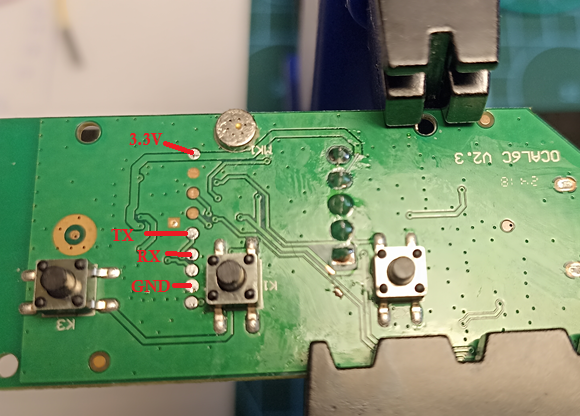
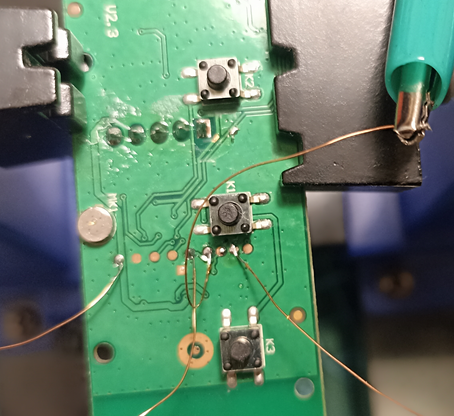
    I flashed today by soldering 0.2mm wire to access the UART pins
    UART pins :
    Close-up of a circuit board with wires connected to UART pins labeled 3.3V, TX, RX, and GND. Circuit board with wires soldered to UART pins.
  • ADVERTISEMENT
  • #21 21411879
    Maximilian0017
    Level 7  
    Posts: 12
    Help: 1
    Rate: 1
    Is there a way to get the music button to work?
    Ik is quite a nice feature for the kids.
  • #22 21411890
    p.kaczmarek2
    Moderator Smart Home
    Posts: 14440
    Help: 650
    Rate: 12411
    Music button or do you mean the mic? We would need to check what kind of available open source implementations are there for this kind of feature.
    Helpful post? Buy me a coffee.
  • #23 21413100
    Maximilian0017
    Level 7  
    Posts: 12
    Help: 1
    Rate: 1
    Yes, I did mean the Mic.
  • #24 21629231
    mtb1007
    Level 3  
    Posts: 3
    Rate: 10
    >>21318230

    Thanks for figuring out the UART wiring, I've flashed it that way too. In addition to these pins, I also needed the reset pin to initiate the transfers: the CEN pin is routed to the pad just above Tx (in your first image), so the 3rd pad from the mic.

    With the pin settings from post #17 above, and flags 0, 1, 10, 23 and 24 set, the device functions quite well. Although even at full power, the brightness of the RGB LEDs is rather poor (especially R), but the warm-white LEDs are a bit better. You get what you pay for, I guess..

Topic summary

✨ The discussion centers on the LSC Smart Mood Light model 3204432, which uses the BK7231N chip soldered directly on the PCB. The device is recognized by the Tuya app with firmware version 2.0.0. A firmware dump and device profile have been submitted to enable flashing via TCC and tuyacloudcutter tools. Users report successful flashing and operation, including web interface control, but some experience issues integrating the device with Home Assistant, primarily due to missing or misconfigured PWM channels and flags. Correct PWM pin assignments (GPIO 6, 7, 24, 26) and flag settings (including flag 23 for button convenience) are crucial for full functionality, including RGB and color temperature modes. Button roles can be customized via scripting in autoexec.bat for advanced control. UART pins for flashing can be accessed by soldering fine wires. The music/mic button functionality remains unsupported and requires further investigation. Ongoing development addresses minor bugs such as SPI DMA color setting errors. The device offers good ambient lighting comparable to higher-priced brands like Philips Hue, making it a cost-effective smart lighting option.
Generated by the language model.

FAQ

TL;DR: The working OpenBeken setup uses 4 PWM channels, and one expert called Tuya CloudCutter flashing "the simplest way" for this lamp. This FAQ helps BK7231N owners of the LSC Smart Mood Light 3204432 open it safely, flash it, fix Home Assistant discovery, and choose between CloudCutter and UART methods. [#20959172]

Why it matters: This thread turns a cheap ambient lamp into a documented OpenBeken device with known GPIOs, flashing paths, and Home Assistant fixes.

Method Opening required Soldering required What the thread says
Tuya CloudCutter No No Described as the simplest path because a profile exists for this lamp
UART flashing Yes Yes Works with thin wires on UART pads and a reset/CEN connection

Key insight: Apply the correct 4-PWM template first, then rerun Home Assistant discovery. Most "RSSI only" reports came from discovery being done before the lamp was fully configured. [#21014582]

Quick Facts

  • The lamp identifies in the Tuya app as firmware 2.0.0 and uses a BK7231N chip soldered directly on the board. [#20943154]
  • The first working OpenBeken template mapped GPIO6, GPIO7, GPIO24, and GPIO26 as PWM outputs, with GPIO14 as the button input. [#20943154]
  • A later hardware report confirmed UART flashing by soldering 0.2 mm wire to the exposed pads. [#21318230]
  • For reliable Home Assistant light discovery, users reported success with flags 0, 1, 10, 23, and 24 enabled. [#21629231]
  • Real-world brightness is acceptable for TV ambient use, but one later report said RGB output is weak at full power, especially red, while warm white is better. [#21629231]

How do I open the LSC Smart Mood Light 3204432 without damaging the diffuser or board?

Open it by gently cutting the glue around the edge of the refractor, then lift the diffuser off carefully. The original teardown said opening was "quite easy" with that method, and no board-side desoldering was needed just to inspect the BK7231N. Use light pressure and work around the full perimeter instead of prying one side hard. [#20943154]

What GPIO and PWM pin mapping works for the BK7231N-based LSC Smart Mood Light 3204432 in OpenBeken?

The confirmed working mapping is GPIO6 = PWM1, GPIO7 = PWM2, GPIO24 = PWM3, GPIO26 = PWM4, and GPIO14 = Btn5. A later refinement suggested flag 24 works better when channels are treated as P6=PWM0, P7=PWM1, P24=PWM2, and P26=PWM4. If colors look odd, use the later flag and channel guidance. [#21171840]

Why does Home Assistant MQTT discovery only show RSSI and no light entities after flashing the LSC 3204432 with Tuya CloudCutter?

This usually happens because discovery ran before the PWM template was configured correctly. The fix is simple: 1. Apply the lamp template and correct PWM roles. 2. Save the mode and flags. 3. Run Home Assistant discovery again. The maintainer explicitly said RSSI-only reports can mean PWMs were not configured before discovery. [#21014582]

What is Tuya CloudCutter, and how does it let you flash the LSC Smart Mood Light 3204432 without soldering to UART pins?

Tuya CloudCutter lets you flash this lamp without soldering because a device profile for model 3204432 was submitted and reported working. "Tuya CloudCutter" is a software flashing method that replaces Tuya firmware over the device workflow, its key advantage here being no UART wire access on the lamp PCB. In this thread, it was called the simplest method for this exact model. [#20959172]

How bright is the LSC Smart Mood Light 3204432 in real use compared with Philips Hue for ambient TV lighting?

It is bright enough for colored ambient TV lighting, but it is not presented as a Philips Hue equivalent. One owner used it in a living room beside Philips Hue devices and said the result was "not bad at all," especially considering the lower price. A later user added that RGB brightness, especially red, is poor at full power, while warm white performs better. [#21629231]

Which UART pads should I use to flash the BK7231N on the LSC Smart Mood Light 3204432 with a TTL-to-USB adapter?

Use the UART pads shown in the later hardware follow-up, where the lamp was flashed by soldering thin wires directly to the exposed pads. The thread does not publish pad names in text for TX and RX, but it confirms the UART pad set in the posted photos works for BK7231N flashing. One user specifically succeeded with 0.2 mm wire. [#21318230]

Where is the reset or CEN pin on the LSC Smart Mood Light 3204432, and why is it needed for UART flashing?

The CEN reset point is routed to the pad just above TX, described as the third pad from the microphone in the first UART photo. A later flasher said that pad was needed to initiate transfers, in addition to the UART pins. If flashing does not start over TTL, missing the CEN connection is a concrete failure point. [#21629231]

What is the difference between RGB+W mode and RGBCW with emulated cool in OpenBeken, and which one works better on this lamp?

RGBCW with emulated cool worked better in this thread. One user initially had both modes enabled and saw no light entities, then changed the setup so it used flags 0, 1, 2, 10, and 24, after which discovery worked. The maintainer then noted the lamp worked with "emulated cool" but not yet in pure RGB+W mode. [#21091340]

How should I set the OpenBeken flags for the LSC Smart Mood Light 3204432 so Home Assistant discovers the 4-PWM light correctly?

Use the flags that match the working 4-PWM configuration, not mixed light modes. One user fixed discovery by setting flags 0, 1, 2, 10, and 24, then reported that Home Assistant worked. A later user reported good operation with 0, 1, 10, 23, and 24. The shared pattern is that flag 24 is important and mixed mode settings can break discovery. [#21629231]

Why can the LSC Smart Mood Light 3204432 show wrong colors sometimes, and what does the SPI DMA bug mean in this context?

Wrong colors can appear because the maintainer reported an unresolved SPI DMA bug in the driver path used for this lamp. "SPI DMA bug" is a firmware driver issue that transfers LED data by hardware DMA, its key symptom here being occasional incorrect color output even when the lamp otherwise works. The thread states colors were sometimes set incorrectly while the investigation continued. [#20960730]

Can I use the physical buttons on the LSC Mood Light for next color, temperature, and dimming, and how do I configure them in OpenBeken?

Yes, the later thread mapping shows all three buttons can be used. The suggested setup was P8 = Btn_NextColor for the M button, P9 = Btn_NextTemperature for the musical-note button, and P14 = Btn_SmartLED for on/off and dimming when held. The same post also recommended enabling flag 23 for convenience. [#21171840]

How do I script custom button actions for the LSC Smart Mood Light in autoexec.bat using Btn_ScriptOnly and event handlers?

Set the button role to Btn_ScriptOnly, then bind events in autoexec.bat. The maintainer gave a working pattern: define channels 1 to 5 as toggles, then add event handlers such as OnClick, OnDblClick, On3Click, On4Click, and On5Click for one GPIO. That lets one physical button trigger up to five separate actions. [#21177071]

What is OpenBeken Home Assistant discovery, and when should I run it after applying a device template?

Run Home Assistant discovery only after the template, PWM roles, and light mode are already correct. "Home Assistant discovery" is an OpenBeken integration step that publishes device entities to MQTT, its key requirement being that channels and roles must be configured first or only partial entities may appear. In this lamp thread, rerunning discovery after PWM setup fixed missing lights. [#21014582]

Tuya CloudCutter vs UART flashing with soldered wires on the BK7231N — which method is better for the LSC Smart Mood Light 3204432?

Tuya CloudCutter is better if you want the quickest path and your goal is only to flash this known model. The original owner said CloudCutter was the simplest method because a profile already existed for the lamp. UART remains useful if you prefer direct access, want manual recovery, or enjoy hardware work; one later user flashed successfully with soldered 0.2 mm wires and a CEN reset lead. [#21318230]

How can I get the music or microphone feature working on the LSC Smart Mood Light 3204432 after flashing it with OpenBeken?

You cannot enable the microphone feature from this thread alone because no working OpenBeken implementation was provided. In January 2025, the maintainer replied that the mic would require checking what open-source implementations exist for that kind of feature. The original template also stated that mic or music functions were the known exception. [#21411890]
Generated by the language model.
ADVERTISEMENT