logo elektroda
logo elektroda
X
logo elektroda
ADVERTISEMENT
Treść została przetłumaczona polish » english Zobacz oryginalną wersję tematu
📢 Listen (AI):
  • #31 21633503
    dktr
    Level 25  
    Two weeks have passed and the sensors are still sending data without problems.
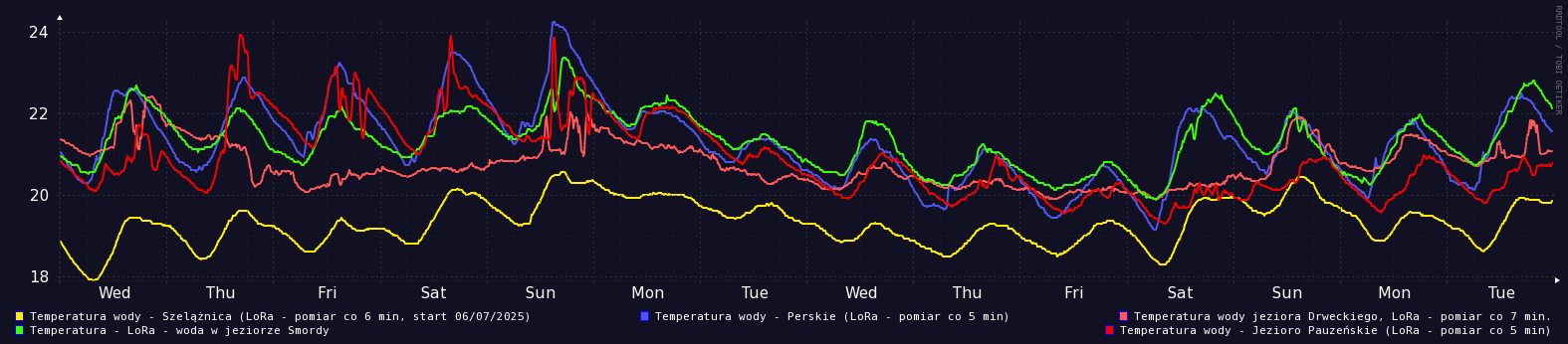
    On the graph, the water temperature in several lakes.
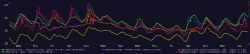
    Graph showing water temperature changes in five lakes measured every few minutes .

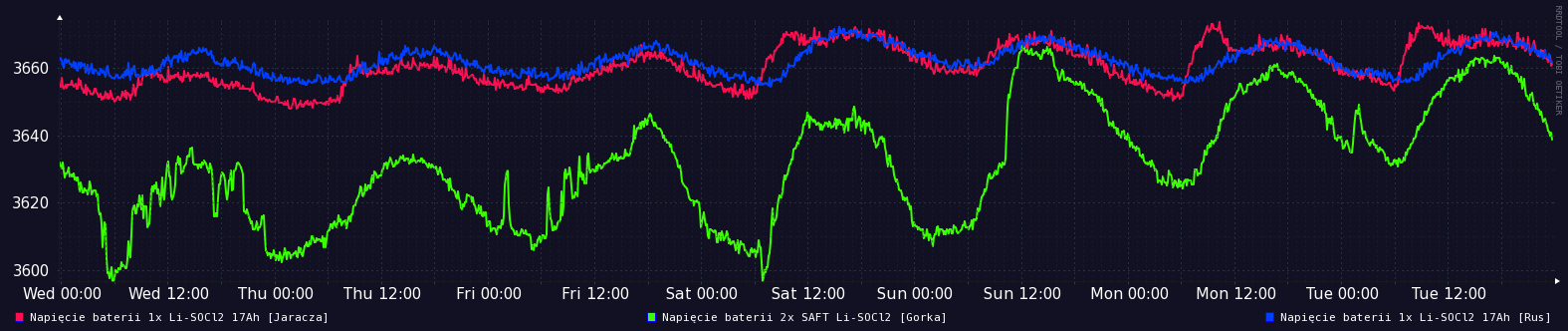
    It's also cool to see where I used a lithium battery from a different company in one unit and the voltage fluctuates differently.
    Graph of voltage for three lithium batteries in measurement devices over 7 days
  • ADVERTISEMENT
  • #32 21633519
    jarekgol
    Level 40  
    Why does the red have such sharp pins and the yellow is so smooth? Some depth of immersion or access to sunlight?
  • ADVERTISEMENT
  • #33 21633953
    dktr
    Level 25  
    >>21633519 Sensors at a depth of about 1m, it varies sometimes 2m from the shore sometimes 10m, access to the sun is at this depth but that's not it. There are quite a lot of different vessels floating on this lake, I have a PTZ camera there and I have already observed that when something passes close by it just makes such temperature fluctuations.

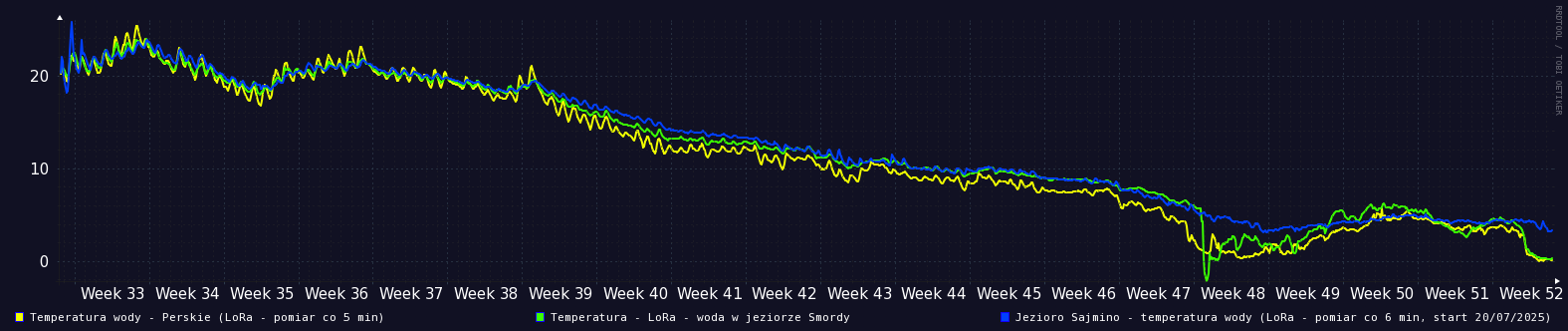
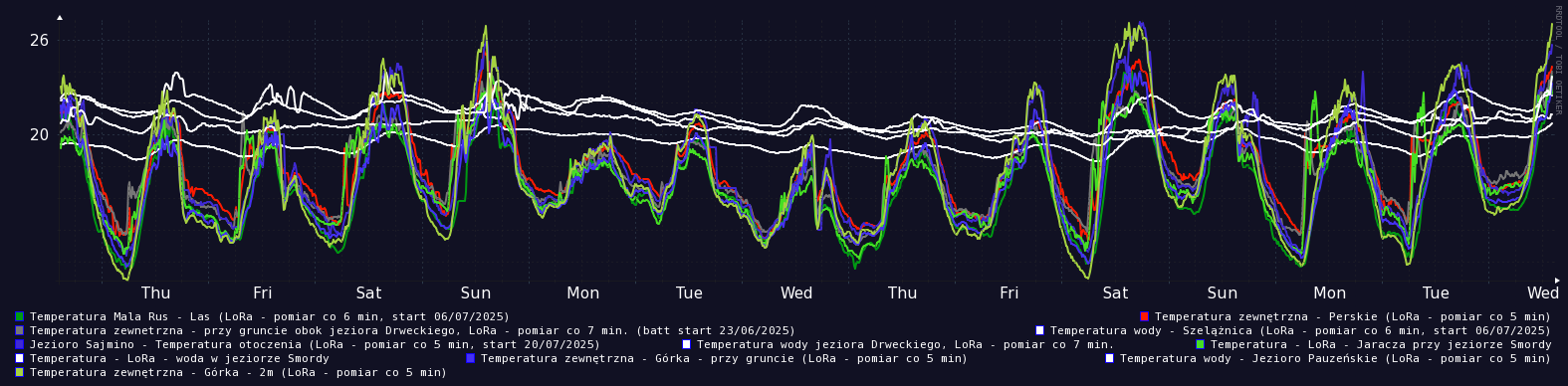
    In the graph the white colour is the water temperature and the coloured ones are the outside temperature next to the lakes.

    Water and ambient temperature graph around lakes over 14 days .
  • #34 21742010
    waldem67
    Level 13  
    There is a noticeable difference in transmitter range between the stick and the built-in "spring" antenna on the SX1276 ?
  • #35 21742628
    dktr
    Level 25  
    >>21742010 No. A stick antenna is also a spring only on a piece of wire which introduces loss, but the gain is due to being able to place the antenna in a more convenient location - away from metal parts or anything that will jitter it. My 'network' already has several gateways and 9 transmitters within a 15km radius. I've set myself a page where I can keep track of what is being received and how - http://meteo.lipowa.net/lora_log/
  • ADVERTISEMENT
  • #36 21742825
    jarekgol
    Level 40  
    Fridge_TP :) nice diagrams.
  • ADVERTISEMENT
  • #37 21742985
    waldem67
    Level 13  
    I see on the charts that the average RRSI over -100 and no problem with reception, I have a problem receiving all the packets from the basement to the fifth floor of the same block, at my place RRSI between -102 and -107, SNR -20. Out of 3 short packets sent 1-2 arrive.
  • #38 21743697
    dktr
    Level 25  
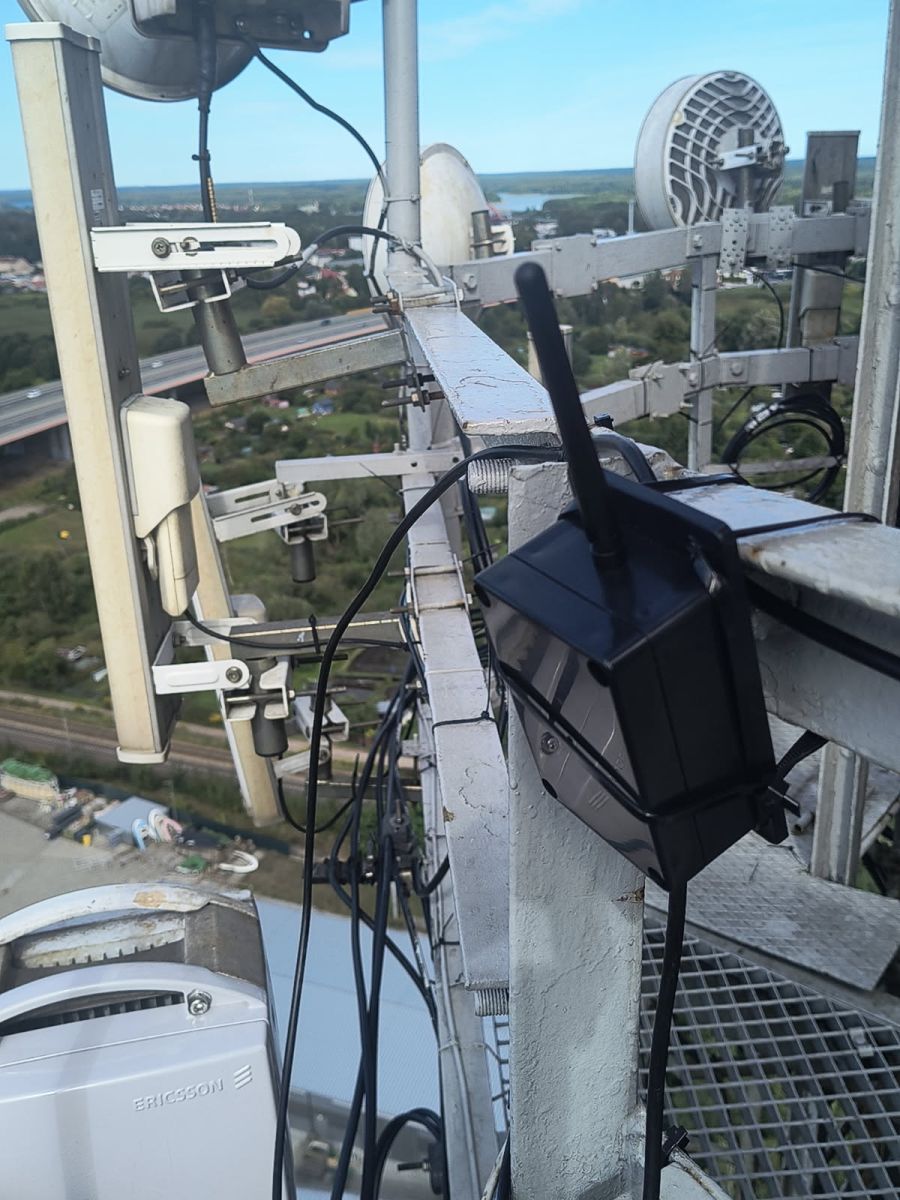
    >>21742985 I already have a total of 6 gateways with different antennas in different locations, from observation the most important thing is the background/noise level, with a shorted antenna input the SX1278 indicates -137 dBm with a 125 kHz channel width set, the worst radio conditions I have are on the chimney of a heating plant, even though it is very high there - about 100 m, in a very short distance there is a whole bunch of different devices, radio links, sector antennas of probably all operators, a few of my sectors at 5 GHz, a few radio links at 60 GHz, and a tangle of twisted-pair cat7 causes that on a small antenna the background does not go below -100 dBm and despite the fact that this gateway is the highest it receives the worst and the fewest packets compared to the rest. The gateway works best on a 50m pole where there is no mobile operator and only my toys at 5/60 GHz.

    View of antennas and radio equipment mounted on a high industrial mast
📢 Listen (AI):

Topic summary

The discussion revolves around experiments with LoRa technology using SX1276 radio modules in the 70 cm band. The author built multiple devices, including two gateways and several transmitters, to evaluate the range and capabilities of these modules. Key points include the importance of bandwidth occupancy for long-range transmission, the use of lithium batteries for power efficiency, and the challenges of signal transmission delays. Participants also discussed the modulation methods, potential interference with other devices, and the use of GPS for synchronization in experiments. The author shared insights on battery performance in low temperatures and the advantages of using non-rechargeable batteries over rechargeable ones.
Summary generated by the language model.
ADVERTISEMENT