


logo elektroda
logo elektroda
X
logo elektroda

How to Integrate TAC4300-CT and KWS-303L Meters via ET69C02 LAN/RS-485 in Home Assistant

kmarkot  2 1053 Cool? (+1)
📢 Listen (AI):

TL;DR

  • Integrates TAC4300-CT three-phase meter and KWS-303L counter with Home Assistant through an ET69C02 LAN/RS-485 converter.
  • The ET69C02 ships with DHCP disabled and factory IP 192.168.3.7; Home Assistant uses modbus tcp on host 192.168.50.65, port 502.
  • Set KWS-303L and TAC4300-CT Modbus addresses to 101 and 255, then map register addresses such as 14, 18, 26, 55, 0x0400, and 0x0402.
  • The sample YAML defines voltage, current, power, and energy sensors, including TAC4300-CT active power in kW and total import/export energy in kWh.
  • Use Developer tools → Check configuration, then open the Modbus domain; restart Home Assistant if that option does not appear.
Generated by the language model.
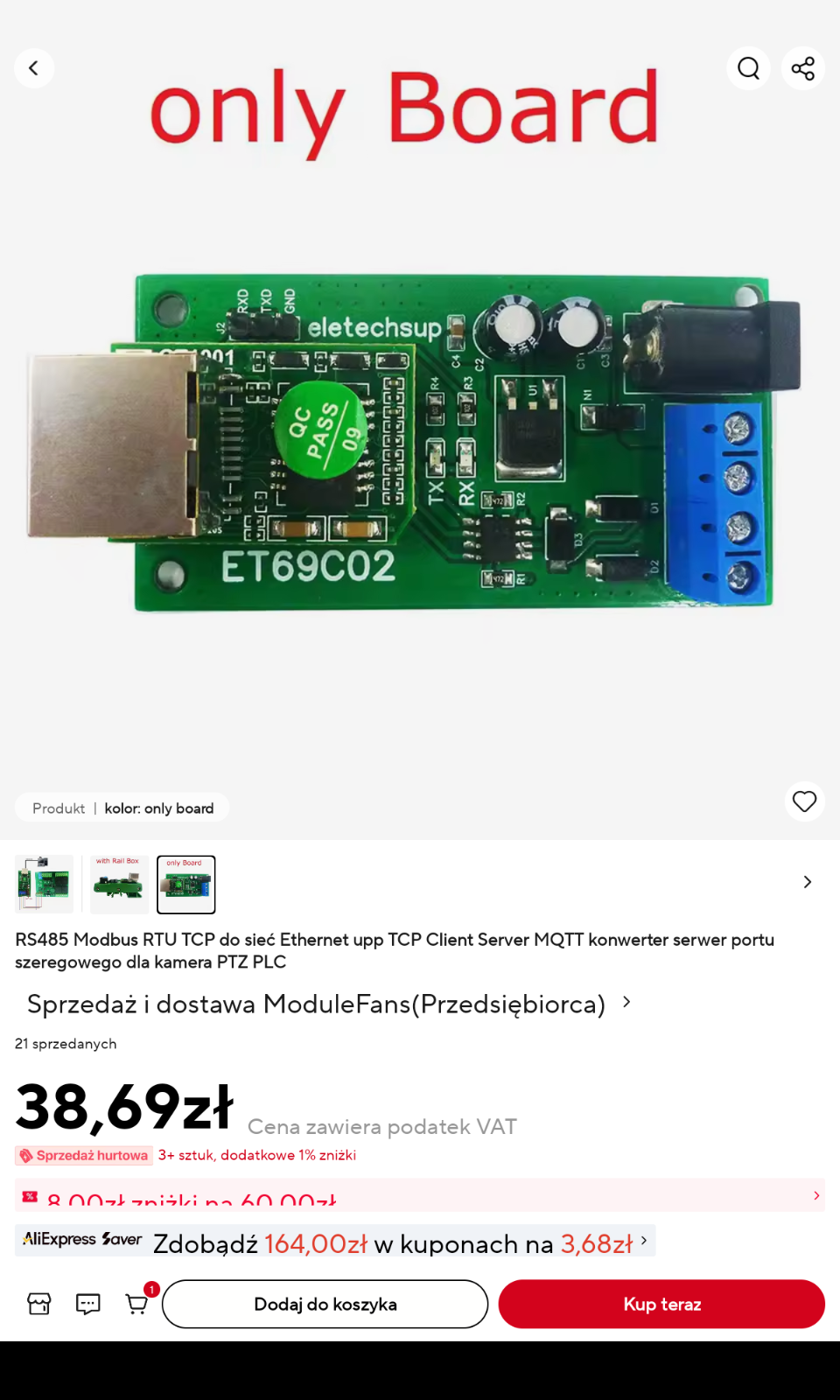
LAN/RS-485 converter ET69C02

ET69C02 converter board with Ethernet port and RS-485 terminal connectors

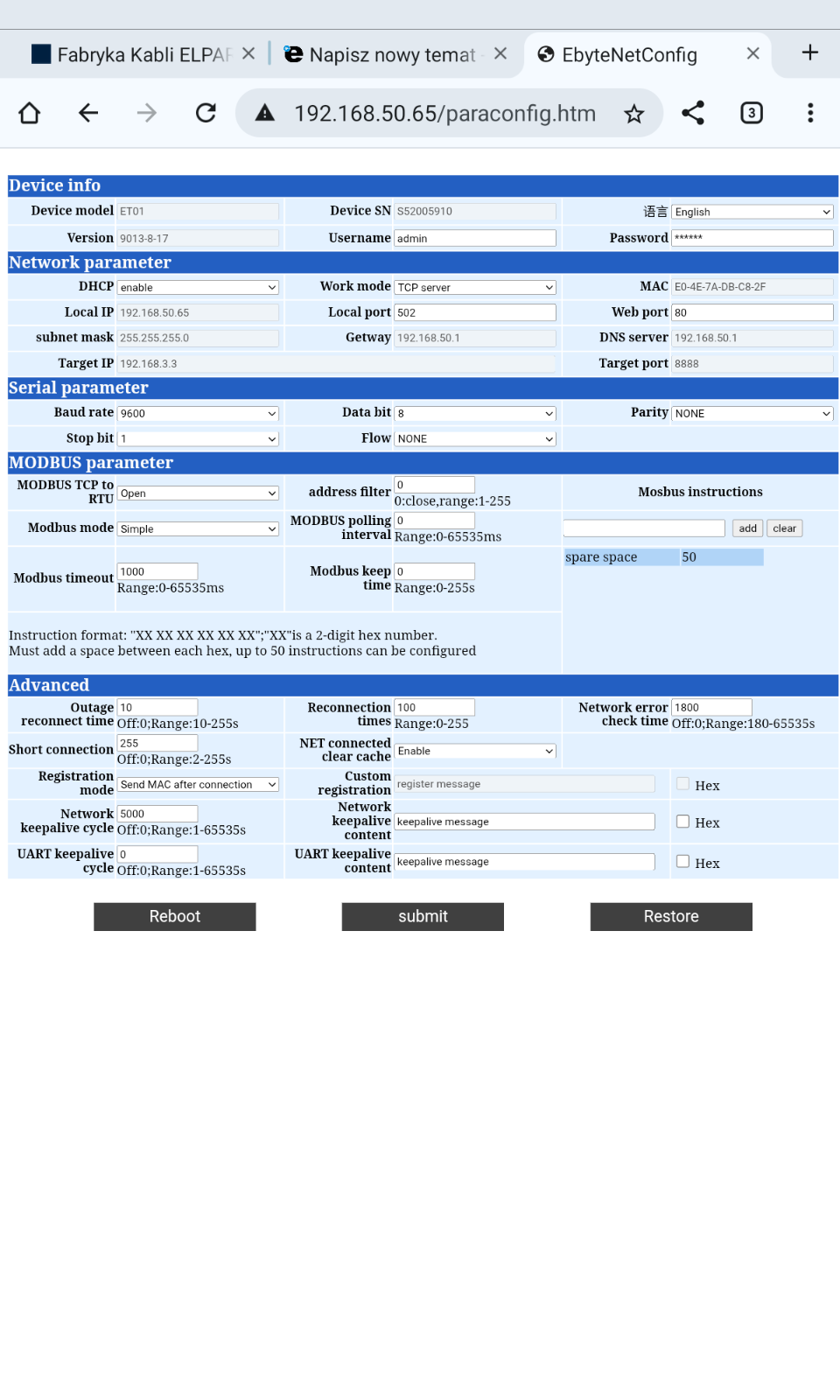
DHCP in this converter is disabled it can be enabled the factory set IP is 192.168.3.7
https://youtu.be/QN_S2Ff1y04?si=EZ2IKUe2BmcGF-h4
Configuration
Screenshot of LAN/RS-485 converter configuration at IP 192.168.50.65

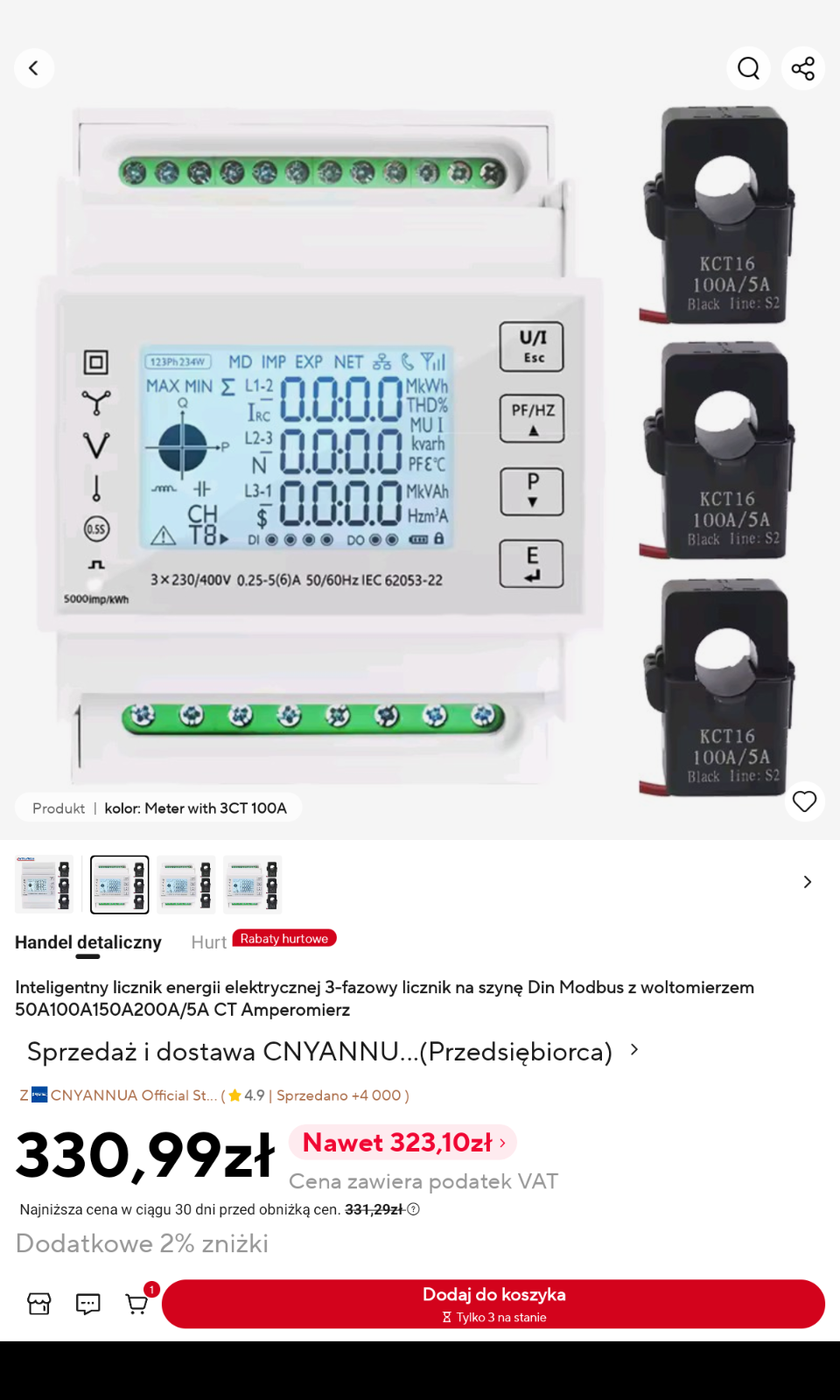
TAC4300-CT bidirectional three-phase meter

Three-phase energy meter with LCD display and three KCT16 100A/5A current transformers.

https://github.com/esphome/feature-requests/issues/2727
https://yizhantongimage.oss-accelerate.aliyuncs.com/UploadFiles/20221202134151415143.pdf
You need to set the communication address according to instruction(2. Setting the modbus communication address) 255 in the configuration.yaml slave file: 255


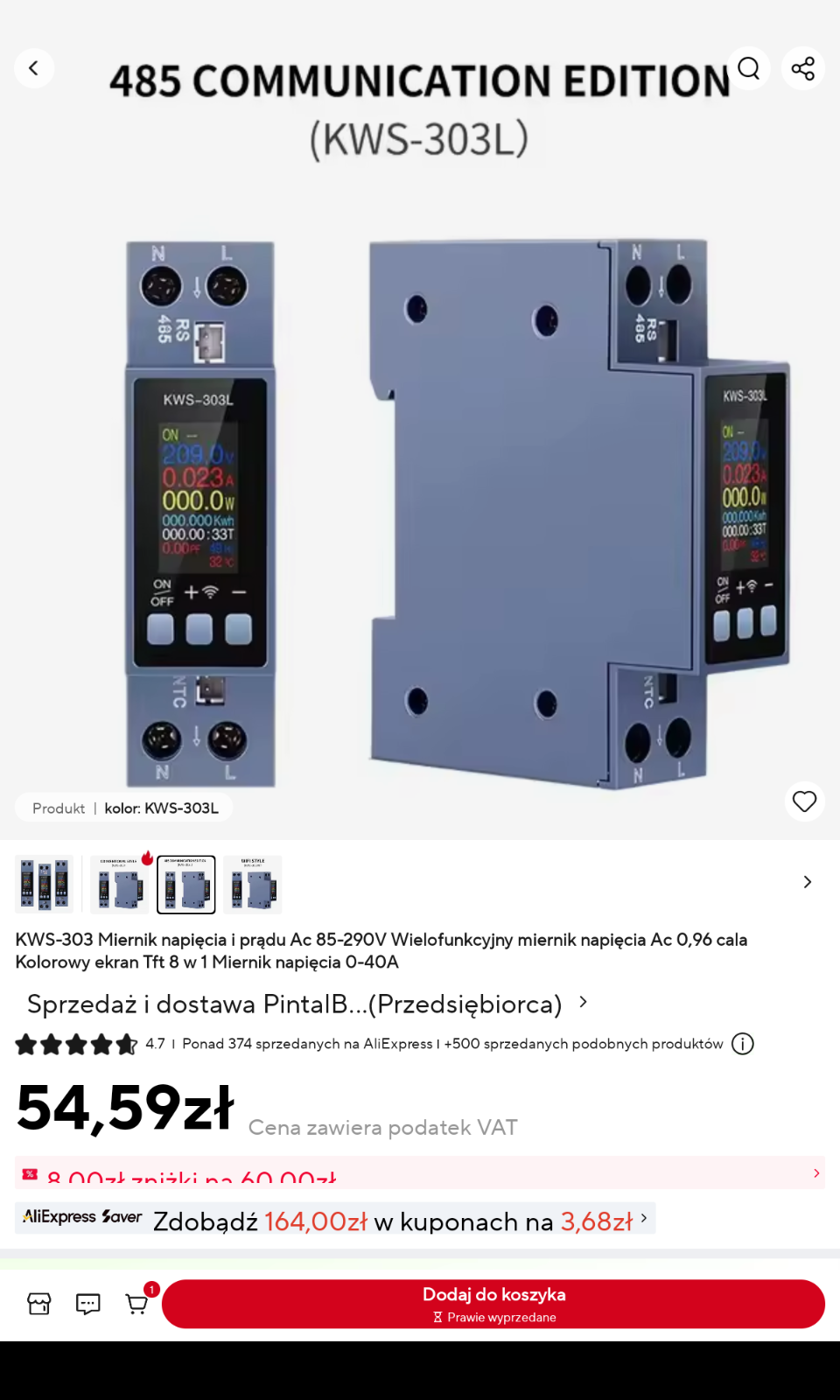
Counter KWS-303L

KWS-303L meter with TFT screen and RS-485 port, front and side view

https://github.com/baldale/kws-303l

https://www.nikom.biz/pic_info/A578019/KWS-30...CeZheOBComuL-5NjpN3FJNHneP4HM9k-fqnb3LWdVLkDk
change language from Chinese to English there are some bushes with EN ending
Set modbus address the same as in configuration.yaml slave: 101


Configuration Home assistant https://www.home-assistant.io/integrations/modbus/
configuration.yaml


modbus:
  - name: Modbus
    type: tcp #rtuovertcp
    host: 192.168.50.65
    port: 502
    switches:
      - name: Switch on/off
        slave: 255
        address: 63
        command_on: 1
        command_off: 0
        verify:
            input_type: holding
            address: 63
            state_on: 1
            state_off: 0
    sensors:
      - name: KWS-303L Napięcie sieci
        unit_of_measurement: V
        scale: 0.01
        precision: 1
        slave: 255
        address: 14
      - name: KWS-303L Prąd
        unit_of_measurement: A
        scale: 0.001
        precision: 2
        slave: 255
        address: 18      
      - name: KWS-303L Moc
        unit_of_measurement: W
        scale: 0.1
        precision: 1
        slave: 255
        address: 26
      - name: KWS-303L Energia pobrana
        unit_of_measurement: kWh
        scale: 0.001
        precision: 2
        slave: 255
        address: 55    
#
      - name: tac4300ct UL1
        data_type: uint32
        unit_of_measurement: V
        scale: 0.01
        precision: 1
        slave: 101
        address: 0
      - name: tac4300ct UL2
        data_type: uint32    
        unit_of_measurement: V
        scale: 0.01
        precision: 1
        slave: 101
        address: 2
      - name: tac4300ct UL3
        data_type: uint32      
        unit_of_measurement: V
        scale: 0.01
        precision: 1
        slave: 101
        address: 4        
      - name: tac4300ct Moc  L1 active
        data_type: int32
        unit_of_measurement: kW
        scale: 0.001
        precision: 3
        slave: 101
        address: 12
        device_class: power
        state_class: measurement            
      - name: tac4300ct Moc  L2 active
        data_type: int32
        unit_of_measurement: kW
        scale: 0.001
        precision: 3
        slave: 101
        address: 14
        device_class: power
        state_class: measurement
      - name: tac4300ct Moc  L3 active
        data_type: int32
        unit_of_measurement: kW
        scale: 0.001
        precision: 3
        slave: 101
        address: 16
        device_class: power
        state_class: measurement                 
      - name: tac4300ct Total import active energy.
        data_type: int32
        unit_of_measurement: kWh
        scale: 0.01
        precision: 3
        slave: 101
        address: 0x0400
        device_class: energy
        state_class: total_increasing
      - name: tac4300ct Total export active energy
        data_type: int32
        unit_of_measurement: kWh
        scale: 0.01
        precision: 3
        slave: 101
        address: 0x0402
        device_class: energy
        state_class: total_increasing 


Developer tools -> Check configuration

Then click on "Modbus domain" ( if this option is not there then you need to restart HA)

About Author
kmarkot wrote 1364 posts with rating 354 , helped 126 times. Live in city Białystok. Been with us since 2009 year.

Comments

kmarkot 12 Oct 2025 17:42

KWS-306L With RS485 https://obrazki.elektroda.pl/5883539800_1760283639_thumb.jpg Configuration of this and the above mentioned energy meters modbus: - name: Modbus type:... [Read more]

jix0934 22 Oct 2025 05:55

The TOP249YN (https://www.weylan-d.com/ is a high-performance off-line PWM switch for low-power applications. Packaged in a TO-220-7C, the device has a 700 V breakdown voltage and offers a wide input... [Read more]

FAQ

TL;DR: Set ET69C02 as your Modbus TCP bridge, use slave IDs 255 (KWS‑303L) and 101 (TAC4300‑CT); “DHCP is disabled; you can enable it.” Add sensors for key registers like 0x0400/0x0402 to Home Assistant. [Elektroda, kmarkot, post #21691159]

Why it matters: This FAQ shows home energy tinkerers exactly how to get bidirectional three‑phase and single/three‑phase meters talking to Home Assistant over RS‑485/LAN without guesswork.

Quick Facts

How do I connect the ET69C02 LAN/RS‑485 converter to my meters and Home Assistant?

Wire RS‑485 A→A and B→B from your meter(s) to the ET69C02. Enable DHCP if needed, or assign a fixed IP. In Home Assistant, configure a Modbus hub pointing to the converter’s IP and port 502. Then add sensors/switches referencing each meter’s slave ID. [Elektroda, kmarkot, post #21691159]

What slave IDs should I use for TAC4300‑CT and KWS‑303L?

Use the example mapping from the working setup: TAC4300‑CT at slave 101 and KWS‑303L at slave 255. Match these on the meters and in configuration.yaml. “Set the communication address according to instruction.” [Elektroda, kmarkot, post #21691159]

How do I add the meters to Home Assistant’s configuration.yaml?

Create a Modbus hub with type: tcp, host: , port: 502. Under sensors, add entries for each register (address, data_type, scale, precision, slave). Under switches, map the control register with verify. Then Check configuration and restart if needed. [Elektroda, kmarkot, post #21691159]

Which TAC4300‑CT registers give total import and export energy?

Use holding registers 0x0400 for Total import active energy and 0x0402 for Total export active energy. Configure data_type: int32, scale: 0.01, and state_class: total_increasing for energy tracking. [Elektroda, kmarkot, post #21691159]

How do I control the KWS‑303L relay over Modbus?

Map a switch to address 63 with command_on: 1 and command_off: 0. Add verify with input_type: holding at address 63, state_on: 1, state_off: 0. Set the slave to the meter’s Modbus ID, e.g., 255 in the example. [Elektroda, kmarkot, post #21691159]

What’s the configuration for KWS‑306L three‑phase readings?

Example: slave 122. Voltages at addresses 14, 15, 16 (scale 0.01 V). Active power L1/L2/L3 at 0x0019/0x001B/0x001D (int32, W, scale 0.1). Total import energy at address 52 (int32, kWh, scale 0.01). A combined L1_L2_L3 active power is at address 23. [Elektroda, kmarkot, post #21718096]

I don’t see “Modbus domain” in Developer Tools → Check configuration. What now?

If the Modbus domain isn’t listed after validating configuration, restart Home Assistant. This refreshes integrations so Modbus entities load correctly on the next boot. [Elektroda, kmarkot, post #21691159]

Should I use type: tcp or type: rtuovertcp in Home Assistant?

Use type: tcp for devices that speak Modbus TCP. Use type: rtuovertcp when bridging RS‑485 via a TCP forwarder. Both use port 502. “Swap” options and data types must match your meter or values will look wrong. [“Modbus - Home Assistant”]

How do I set the TAC4300‑CT communication address on the meter?

Follow the meter manual’s “Setting the Modbus communication address,” then mirror that address in configuration.yaml (example uses slave 101). After changing the meter’s address, power‑cycle if the display requires it. [Elektroda, kmarkot, post #21691159]

How can I switch the ET69C02 from Chinese to English menus and set KWS‑303L language?

On KWS‑303L, change language to English; menu items with EN suffix help navigation. Ensure the meter’s Modbus address matches configuration.yaml (example uses 255). The shared thread shows screenshots guiding both steps. [Elektroda, kmarkot, post #21691159]

Give me a 3‑step how‑to for adding TAC4300‑CT and KWS‑303L in HA.

  1. Set meter addresses: TAC4300‑CT → 101; KWS‑303L → 255.
  2. Configure Modbus hub (type: tcp, host: ET69C02 IP, port: 502).
  3. Add sensors/switches: TAC energy at 0x0400/0x0402; KWS values at 14/18/26/55; validate then restart HA. [Elektroda, kmarkot, post #21691159]

What is Tuya?

Tuya is a China‑based IoT PaaS provider behind many Wi‑Fi smart‑home devices. It offers cloud, app, and module ecosystems for brands and developers worldwide. Tuya listed on the NYSE in March 2021 and serves global markets. [Tuya Inc.]

What is an Arduino Nano?

Arduino Nano is a 5 V, ATmega328‑based microcontroller board with 16 MHz clock, 32 KB flash, 2 KB SRAM, and 22 digital I/O. It supports UART, I2C, SPI, and is programmed via USB. Size is 18×45 mm and typical current is about 19 mA. [Arduino Nano — Arduino Online Shop]

What is OpenBeken?

OpenBeken is open‑source firmware that replaces Tuya module firmware (e.g., BK7231), offering Tasmota‑like setup, MQTT, and Home Assistant compatibility. It supports multiple chips and provides OTA updates and scripting. “Tasmota/ESPHome replacement” summarizes its goal. [OpenBK7231T_App]

What is a CAN bus?

CAN bus is a differential, multi‑master serial network designed by Bosch for robust controller communication. Classic CAN supports up to 1 Mbit/s, while CAN FD increases payload rates. It prioritizes messages via arbitration for reliability. [CAN bus]

Any failure modes or gotchas when reading registers?

Wrong data_type or byte/word order yields garbage values. If readings look 10× or 100× off, adjust scale or swap options. Also, after editing configuration.yaml, you may need a full HA restart for entities to appear. [“Modbus - Home Assistant”]
Generated by the language model.
%}