logo elektroda
logo elektroda
X
logo elektroda

DIY Weller WMRP and WMRT soldering station

hacker_ice 21177 35

TL;DR

  • A DIY soldering station for Weller WMRP and WMRT handles uses a PIC16F1788 controller and one-knob operation.
  • The design relies on an Alps EC12E2424407 encoder, Lite-On LTC-4627JR or Youngsun ATA3492BR-1 display, and the microcontroller’s internal reference voltage.
  • It supports WMRP-only tips, fast heating, original Weller holder sensing, setback, standby, offset temperature, °C/°F switching, and thermocouple diagnostics.
  • The build fits in a 180mm x 150mm x 90mm case and uses a cheap 12V/5A LED-strip power supply.
  • Estimated costs are about PLN 11 per PCB, PLN 200–250 for parts and fabrication, and around PLN 100 per WMRP tip.
Generated by the language model.
ADVERTISEMENT
Treść została przetłumaczona polish » english Zobacz oryginalną wersję tematu
📢 Listen (AI):
  • ADVERTISEMENT
  • #32 19004269
    Asedio
    Level 13  
    Posts: 56
    Rate: 13
    Eh... I've already ordered almost everything :(

    Added after 8 [hours] 5 [minutes]:

    It's been over 1.5 years since your last entry, so I didn't expect you had anything else in stock.
    I ordered the display and the rest along with the tips from RS-Components.
    This is a very interesting topic and I'm surprised it's so little popular.
    It turned out that Dirty rejected it because the size didn't match. I wrote to you privately.
    You didn't respond, so I ordered a PCB from PCBWAY version 1.1, which has programming pins/pins.
    They are already in Poland, I will receive them any day now.
    I got :)
    Updated for today..
    I've got it ready. It works and it seems to be OK, but if the mini-drive socket is bad, the contacts are weak or something else, I don't know, you will burn the tip. This happened to me twice. I managed to save the third one. Everything works, heats and regulates nicely, temperatures are consistent. I have a KTY82 in my stock and everything else. Today I was soldering for an hour, everything was fine, until at some point the display started going blank and the tip started turning red. I took it out in time. I know, it's my fault because I used an arbitrary socket (in a hurry), but in my opinion the design should provide for all possible options that may occur when inserting, removing or even damaging the mini jack socket.
  • ADVERTISEMENT
  • #33 19038709
    Asedio
    Level 13  
    Posts: 56
    Rate: 13
    I ordered new branded 3.5mm sockets with thread. Additionally, I will mill the bushings from aluminum PA9 (I have a CNC). I will screw a 3.5mm socket from the bottom. A tip will be inserted into the hole of this 9mm sleeve, so that it will be stiffened on the entire outer metal surface and not only on the 3.5 socket. There will be no forces acting on the plug and socket resulting from pressing the tip during soldering. I will also add that there is newer firmware 9.1 on the author's website.
  • ADVERTISEMENT
  • #34 21051627
    legwion
    Level 2  
    Posts: 2
    Rate: 2
    Hello everyone,

    I'm new to this forum and to the world of PIC. I have only made a few small programs using MPLAB X and XC8.
    My problem: I got a new WMRP and I made the subject board. When I connect the WMRP to the PCB it is not recognised: "nc" on the display. However, it heats up non-stop (I limit the current for tests by using a laboratory power supply).
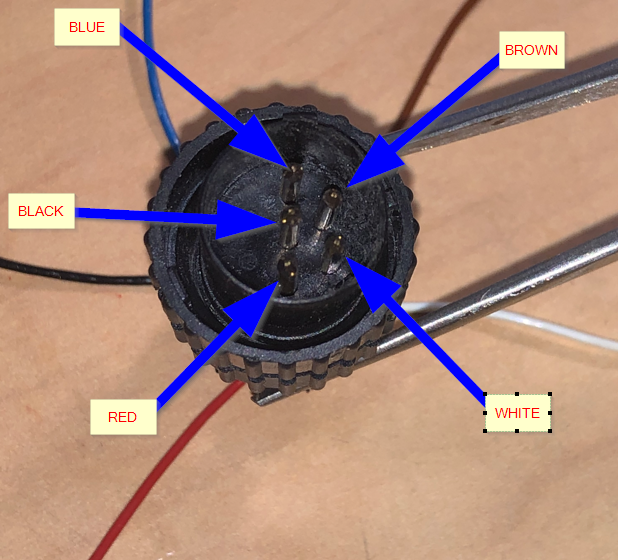
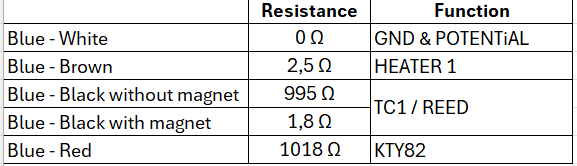
    Strangely enough, my connector doesn't match, but multimeter measurements have enabled me to validate the layout.
    Here's what I found:

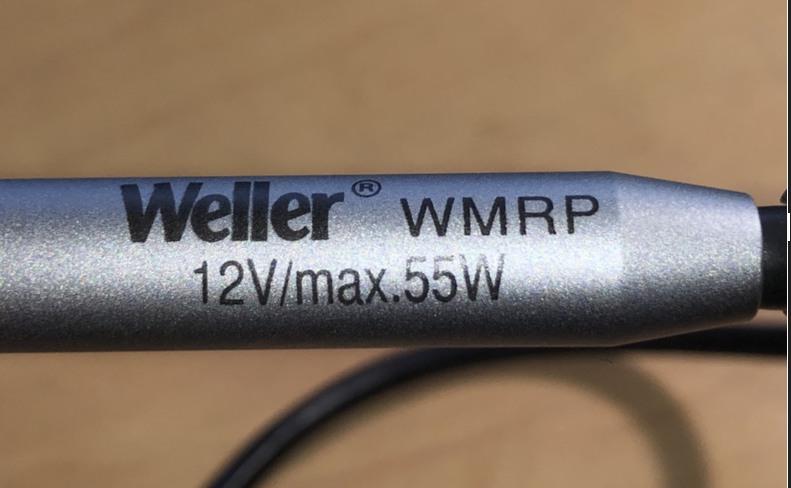
    Weller WMRP soldering iron tip labeled 12V/max. 55W

    Close-up of a connector with five pins and attached wires of different colors: blue, brown, black, red, and white.

    Table showing resistance values and functions for different wire color combinations.

    So it looks like there are different pin-outs?

    I've also noticed that at the TP1 test point I'm not getting the 2.048V I was expecting but 0.75V.

    Can you help me understand why the tool is not detected and why the reference voltage is not present because the programme is a complex one for me, especially as I don't know the CCS environment at all.

    The +5 at the output of the regulator is OK, the components come from RS or FARNELL (no Chinese fakes), PCB manufactured by JLCPCB.

    I have an oscilloscope.

    Thanks for your help.
  • ADVERTISEMENT
  • #35 21053257
    legwion
    Level 2  
    Posts: 2
    Rate: 2
    I've found the problem, the system works :)
  • #36 21326007
    warmemberkill
    Level 1  
    Posts: 1
    >>21053257
    Hello, I have the same problem as you at my station, the VREF (TP1) voltage is not right and my tip is glowing red, can you please tell me how you solved the problem
📢 Listen (AI):

Topic summary

✨ A DIY soldering station compatible with Weller WMRP and WMRT handles was developed using a PIC16F1788 microcontroller, controlling temperature via a single Alps EC12E2424407 rotary encoder and displaying data on a Lite-On LTC-4627JR or Youngsun ATA3492BR-1 display. The station supports original Weller tips with 3.5mm jack connections, enabling fast heating and features such as PTC thermocouple cold junction compensation, flask presence detection via a magnetic sensor, temperature setback, standby modes, offset adjustments, and selectable temperature units (°C/°F). The design samples plug presence to prevent short circuits during tip insertion/removal. Thermotweezers (WMRT) require original holders connected to standard sockets, while WMRP tips use the mini jack socket without original handles. Temperature stability tests showed a typical 9°C difference between station reading and external thermocouple, with oscillations of 1-2°C. Calibration adjustments were made using multi-turn potentiometers in the amplifier feedback loop. The station uses D-type thermocouples, with firmware updates available (version 9.1). Mechanical improvements include using threaded 3.5mm sockets with aluminum bushings for better tip stability. Community members shared resources such as pinout modifications, thermocouple voltage tables, and 3D printable handle designs. Some users reported issues with tip recognition ("NC" message) and incorrect reference voltage (VREF), which were resolved by verifying connector pinouts and system calibration. The project emphasizes compatibility with Weller components while offering cost-effective alternatives and modular design for soldering and thermotweezers applications.
Generated by the language model.

FAQ

TL;DR: 9 °C max tip deviation, “Very fast heating” [Elektroda, hacker_ice, post #16992158], confirmed in a 1-hour run with ±2 °C drift. Cost per fully-built controller ≈ PLN 400 (~€90) [Elektroda, hacker_ice, post #16975843] Why it matters: you can match pro-grade Weller WMRP/WMRT tools for a hobby budget.

Quick Facts

• MCU: PIC16F1788, 1.024 / 2.048 V FVR used for sensing [Microchip DS41685]. • PSU: 12 V ±5%, ≥5 A LED-strip SMPS works [Elektroda, hacker_ice, post #16975843] • Heating time: <5 s to 350 °C with RT1 tip [Elektroda, hacker_ice, post #16975843] • Typical accuracy: ±9 °C; stability ±2 °C [Elektroda, hacker_ice, post #16992158] • Latest firmware: v9.1 (2020) [Elektroda, Asedio, post #19038709]

What tools does the DIY controller support?

It drives Weller WMRP single-tip irons via 3.5 mm jack and WMRT thermo-tweezers through the Amphenol T 3437-000 connector [Elektroda, hacker_ice, post #16975843]

How accurate and stable is the temperature?

A direct test showed the display reading 9 °C higher than an external thermocouple; observed drift stayed within ±2 °C during use [Elektroda, hacker_ice, post #16992158]

Can I run only the WMRP tip without the original handle?

Yes. Enable the “poor” option in the menu. The station then samples the jack to detect presence and prevents heating if the tip is absent [Elektroda, hacker_ice, post #16976847]

How do I avoid short circuits when inserting the 3.5 mm plug?

The firmware polls the tip between power bursts, so transient shorts do not energise the heater. Users report no damage even with half-inserted plugs [Elektroda, Kajox, post #16977014]

How do I program the PIC16F1788?

  1. Solder the 6-pin ICSP header (X1).
  2. Connect a PICkit 3/3.5 clone and tick “Power target” in MPLAB IDE.
  3. Flash the HEX; verify VDD at 5 V to avoid the common “no VREF” error [Elektroda, hacker_ice, post #16975843]

Which displays are pin-compatible?

Lite-On LTC-4627JR and Youngsun ATA3492BR-1 match the PCB. TDCR1050M also works when L3 is tied to pins 10 and 9 [Elektroda, michal82, post #17001455]

What are the key menu functions?

Setback temperature (SETB), delay timer (DELA), standby timer (POFF), °C/°F switch (UNIT), 1 / 5 °C step, diagnostic read-outs for two thermocouples, cold-junction sensor, reed switch status, and line frequency [Elektroda, hacker_ice, post #16975843]

How do I modify an Amphenol T 3437-000 to fit Weller plugs?

Slide the central pin block out, rotate 180°, and reseat it so the keyway aligns with Weller moulding [Elektroda, michal82, post #16996066]

Any edge cases or failure modes?

A loose or low-quality 3.5 mm socket can cause continuous heating and a glowing red tip; branded threaded jacks fixed in an aluminium sleeve solved the issue [Elektroda, Asedio, post #19004269]

How do I update to firmware 9.1?

Download the HEX from kair.us, connect the PICkit, erase, then program. Confirm TP1 shows 2.048 V after flashing; otherwise check FVR config bits [Elektroda, Asedio, post #19038709]
Generated by the language model.
ADVERTISEMENT