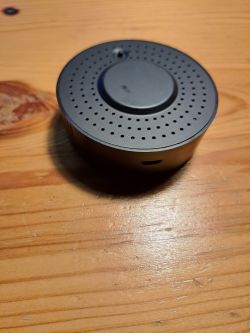
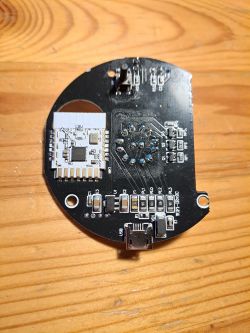
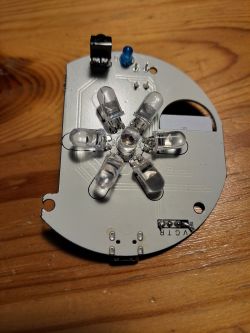
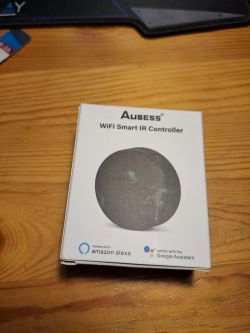
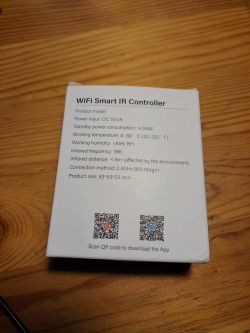
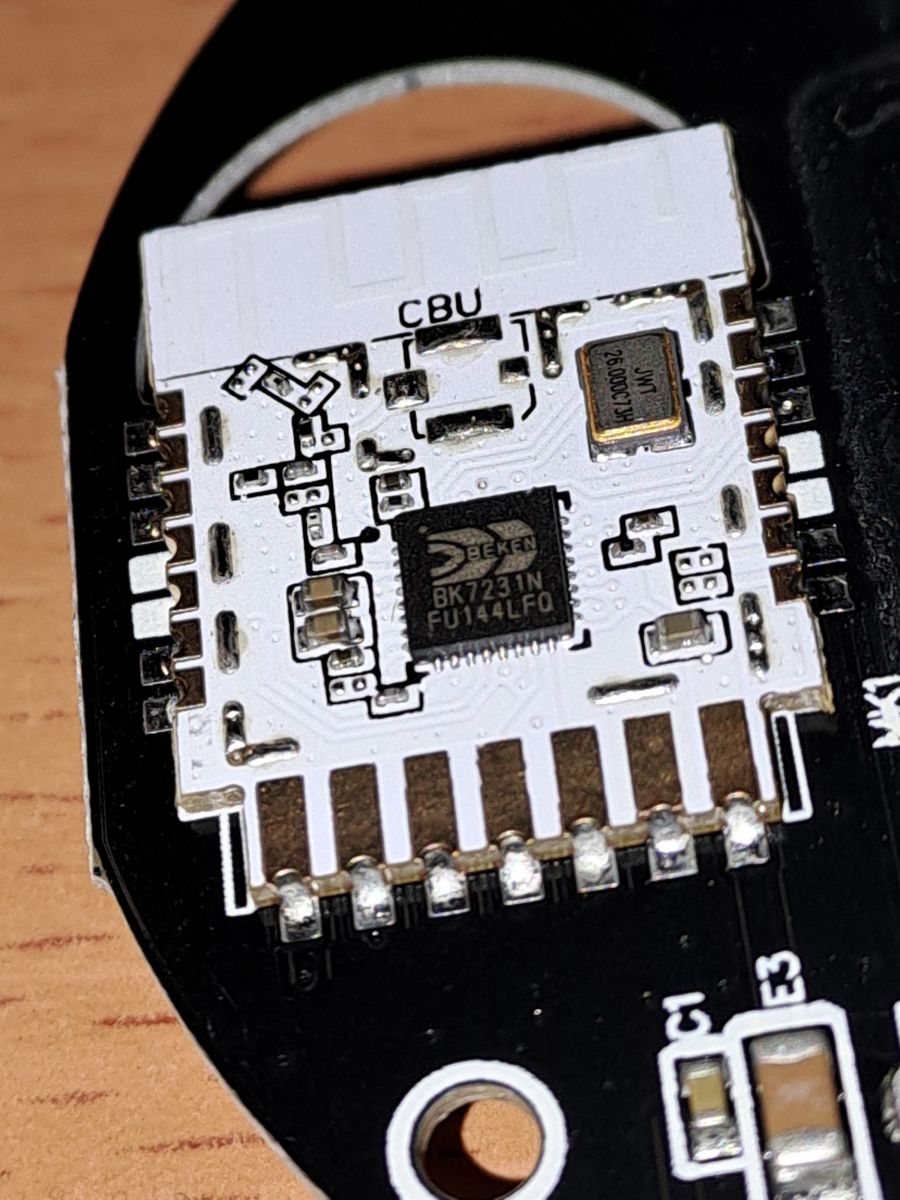
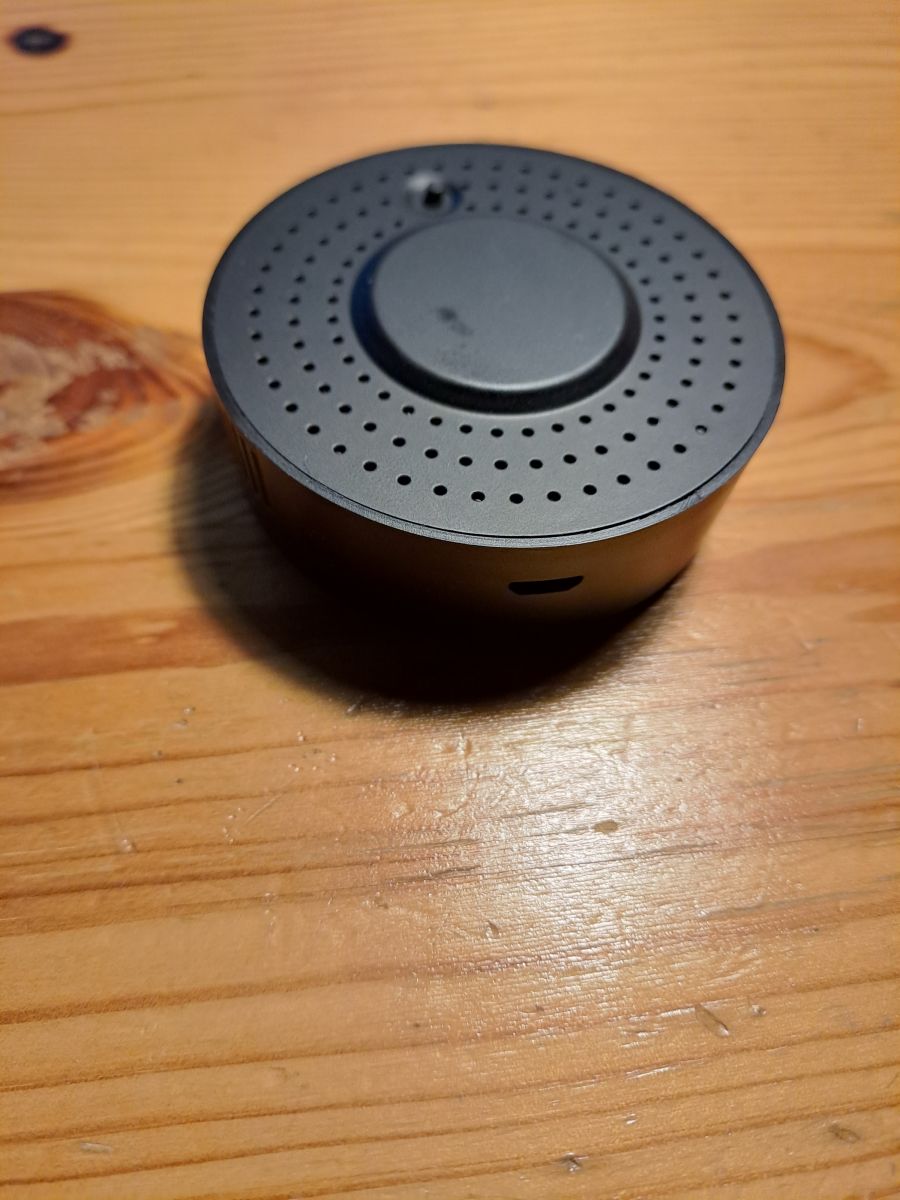
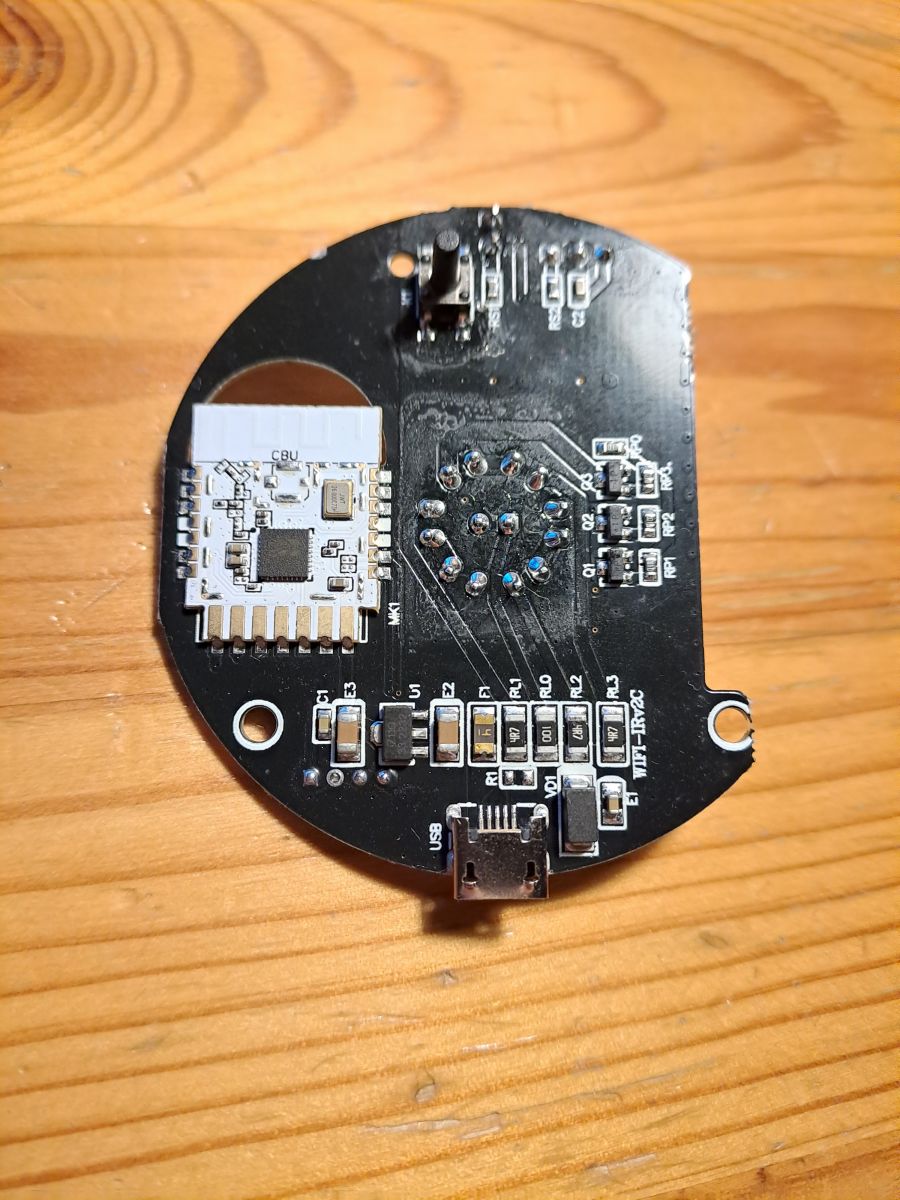
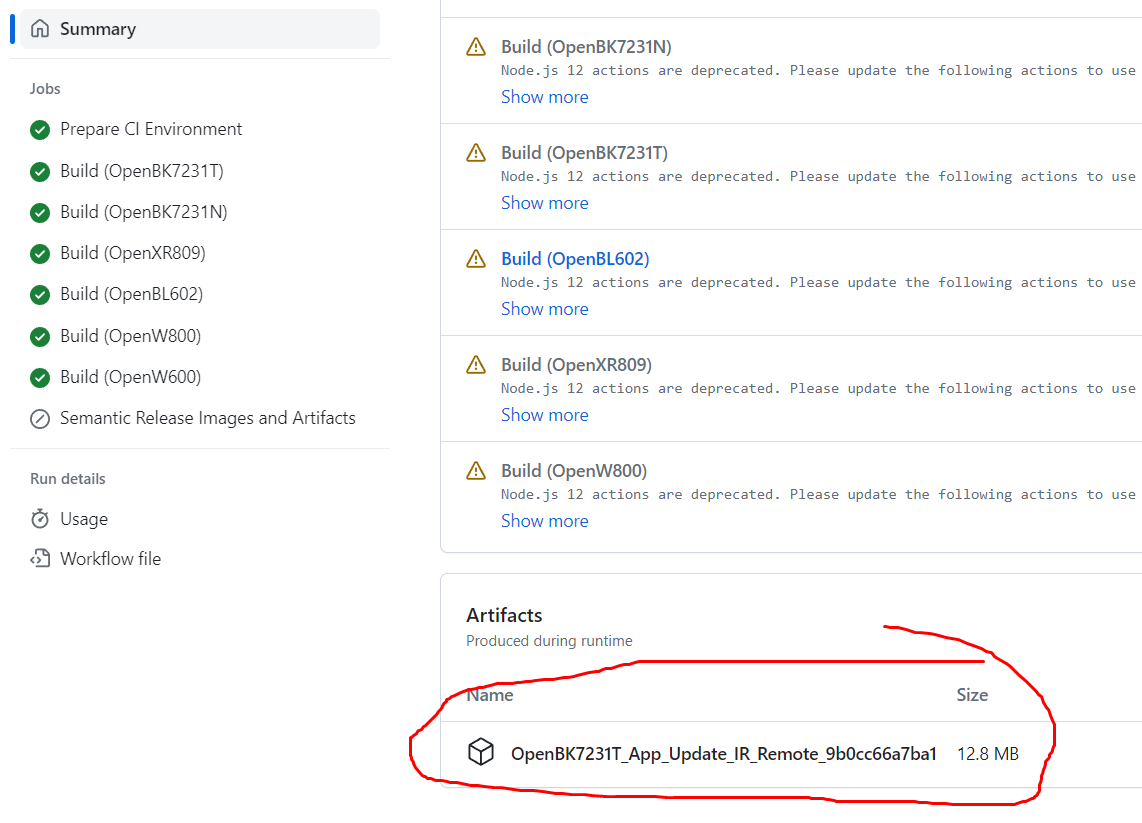
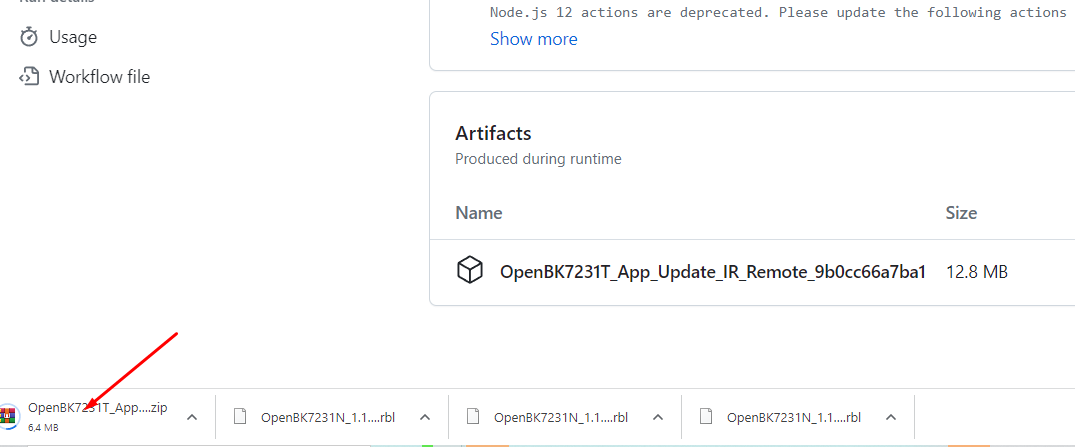
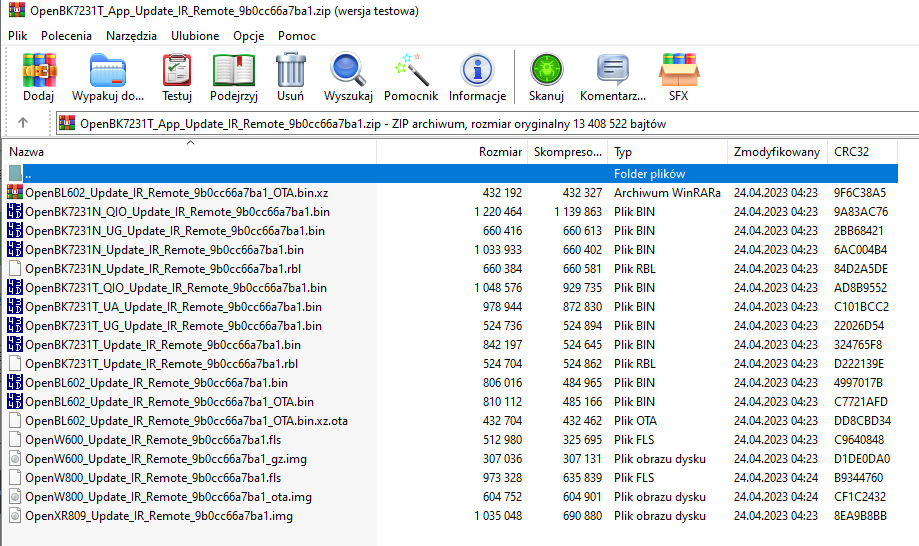
Flashing:
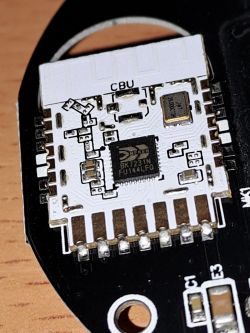
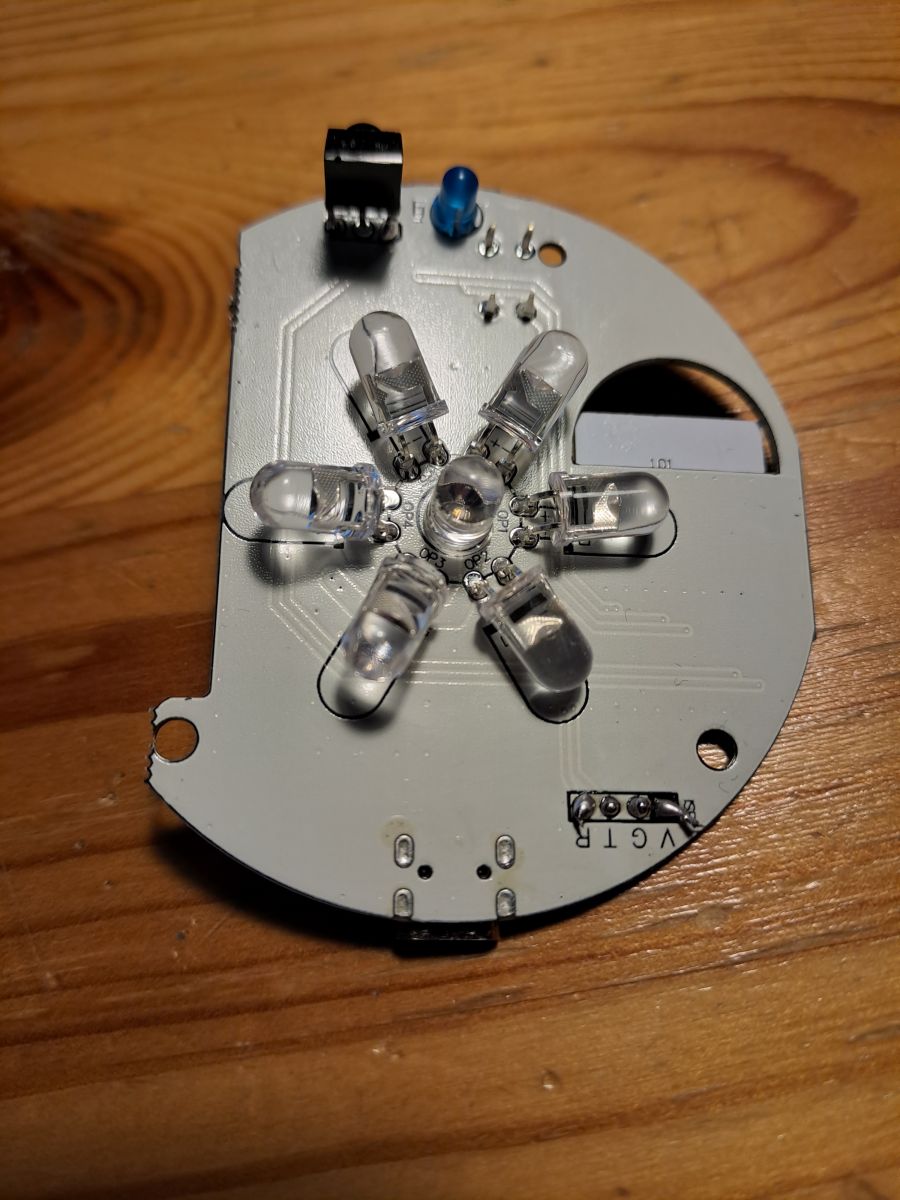
I flashed with the hid_download_py tool (uartprogram, same as described HERE ), using the UART testpoints located on the board. PIN 18 (CEN) needed to be shorted to GND to reset.
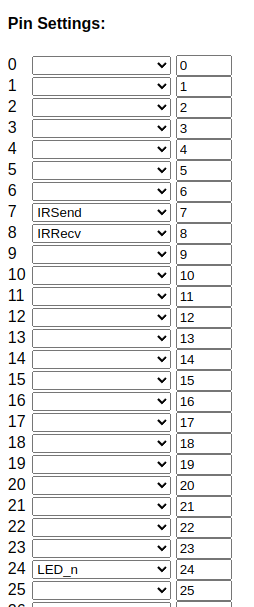
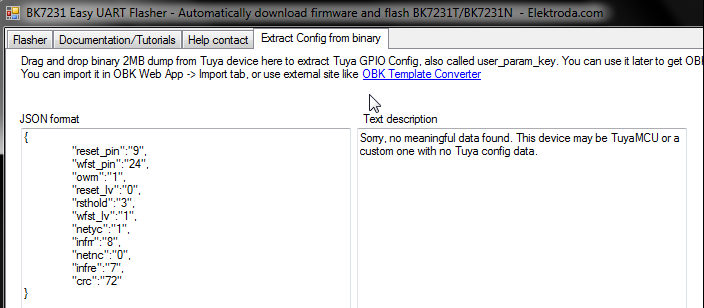
I was then able to use the device with this pin configuration:
Hey there. I have one of these, i flashed it.. But i have no idea how to use.
Could you give me any short info on how to teach it an ON and OFF button from my AC remote? It does not respond to my old AC remote.. However it does respond to Samsung TV remote.. Also once we figure, if we do, why i get no command from AC remote, which i could teach in tuya app, how do i use that data to make automation in HA based on temperature sensor to turn it ON and OFF.. So far only that, no changing in temperature.
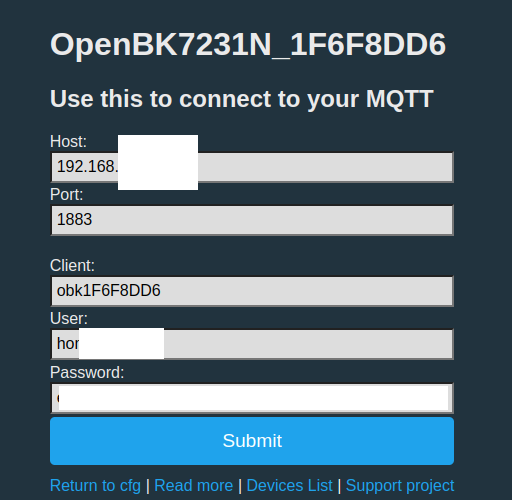
and mosquitto on HA side.
After that I opened the webapp on the device and configured the pins like this:
After that I went to the Logs tab, and enabled IR and MQTT log feature and pointed my xiaomi lightbulb remote to the device and pushed the on-off button. The following messages appeared:
Info:MQTT:Publishing val IR_NEC 0xE384 0x24 0 to obk1F6F8DD6/ir/get retain=0
Info:IR:IR MQTT publish IR_NEC 0xE384 0x24 0 took 2ms
Info:MQTT:Publishing val IR_NEC 0xE384 0x24 1 to obk1F6F8DD6/ir/get retain=0
Info:IR:IR MQTT publish IR_NEC 0xE384 0x24 1 took 1ms
Info:MQTT:Publishing val IR_NEC 0xE384 0x24 0 to obk1F6F8DD6/ir/get retain=0
Info:IR:IR MQTT publish IR_NEC 0xE384 0x24 0 took 2ms
Info:MQTT:Publishing val IR_NEC 0xE384 0x24 1 to obk1F6F8DD6/ir/get retain=0
Info:IR:IR MQTT publish IR_NEC 0xE384 0x24 1 took 1ms
From this I learned that the code to turn the lightbulb on/off I need to send the "NEC 0xE384 0x24 0" payload via MQTT. The topic to send to is: "cmnd/<Client ID>/IRSend" where the <Client ID> is the client ID of the device from the MQTT configuration tab. For me it is obk1F6F8DD6 so the MQTT topic is: "cmnd/obk1F6F8DD6/IRSend"
With this information I added the following to HA's configuration.yaml:
And with this I was able to control the lightbulb from HA. You should be able to do something similar with your AC, your IR codes will be different ofc.
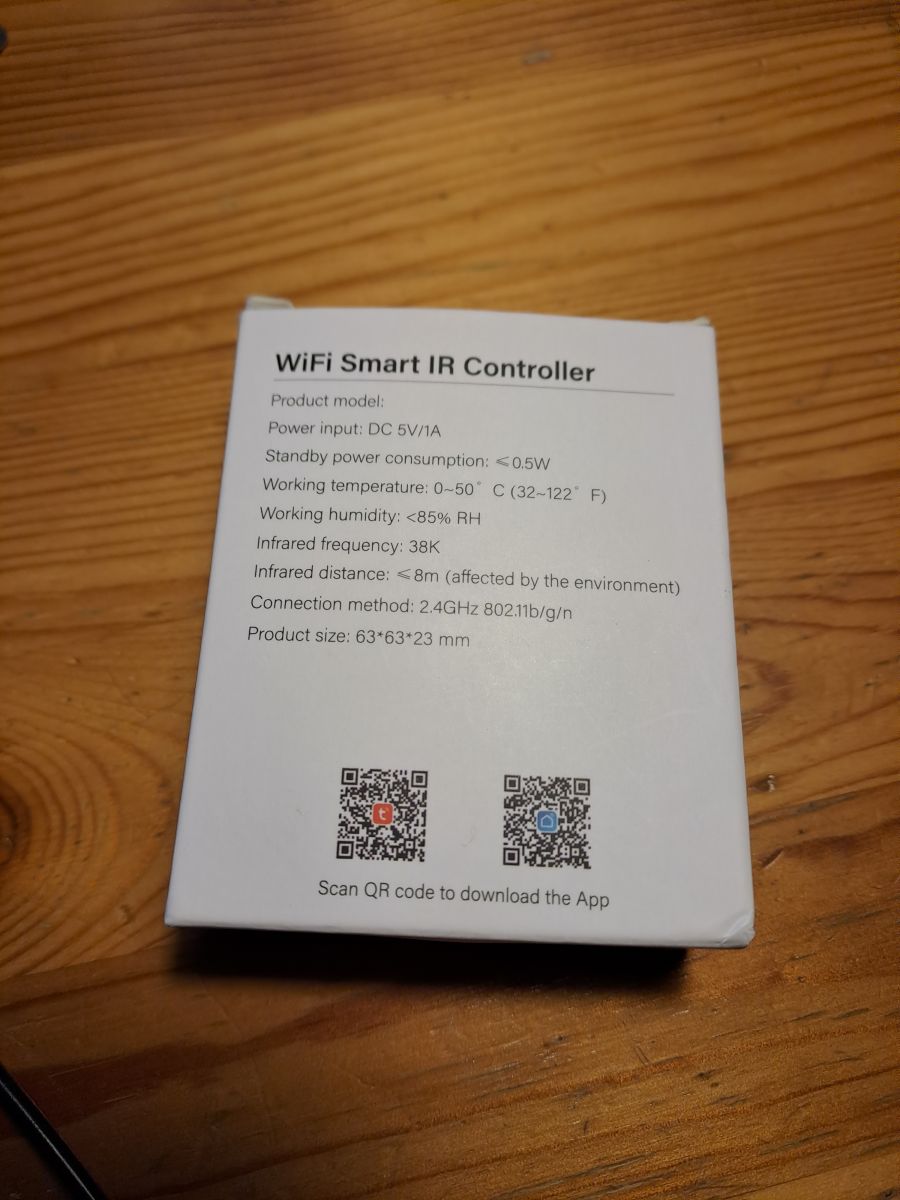
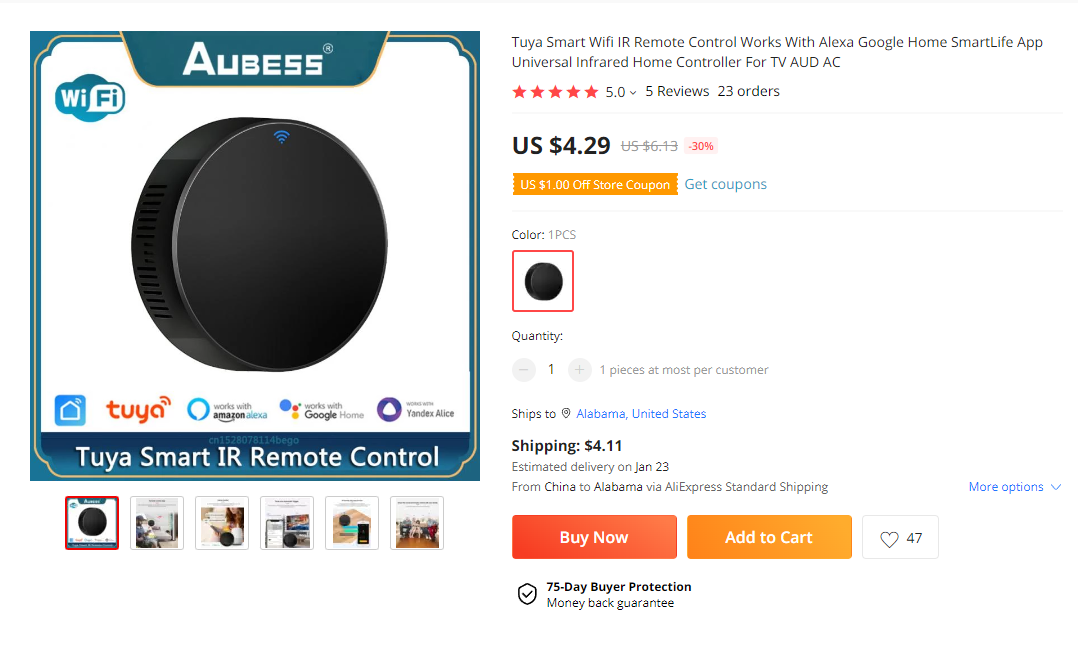
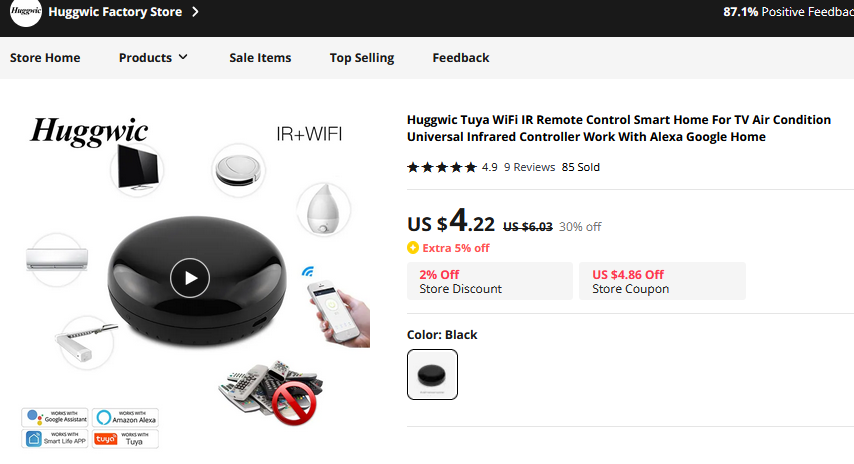
Here's the screenshot from the link, just in case, because links tends to expire rather quickly on Ali:
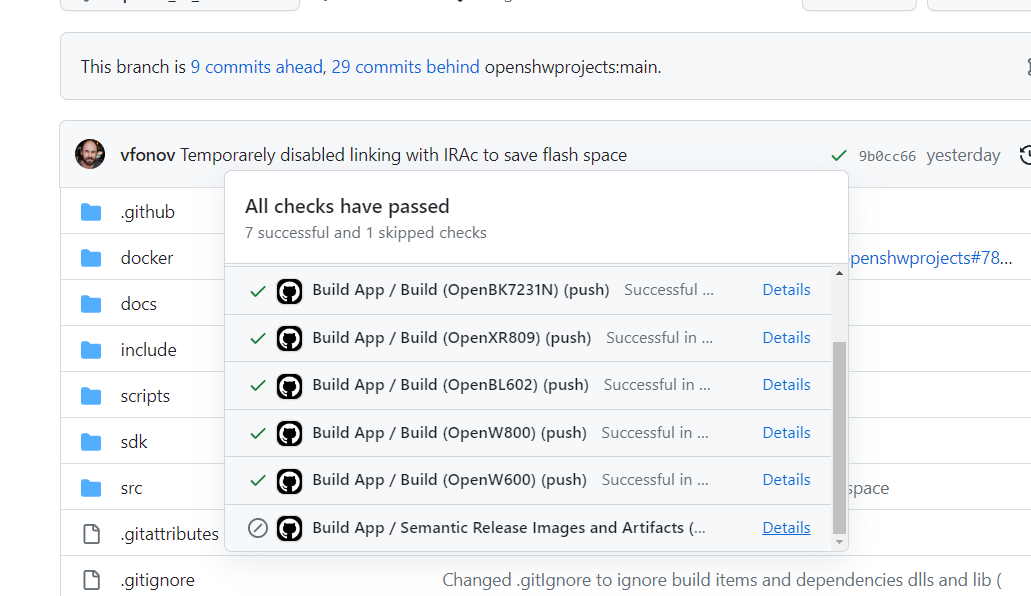
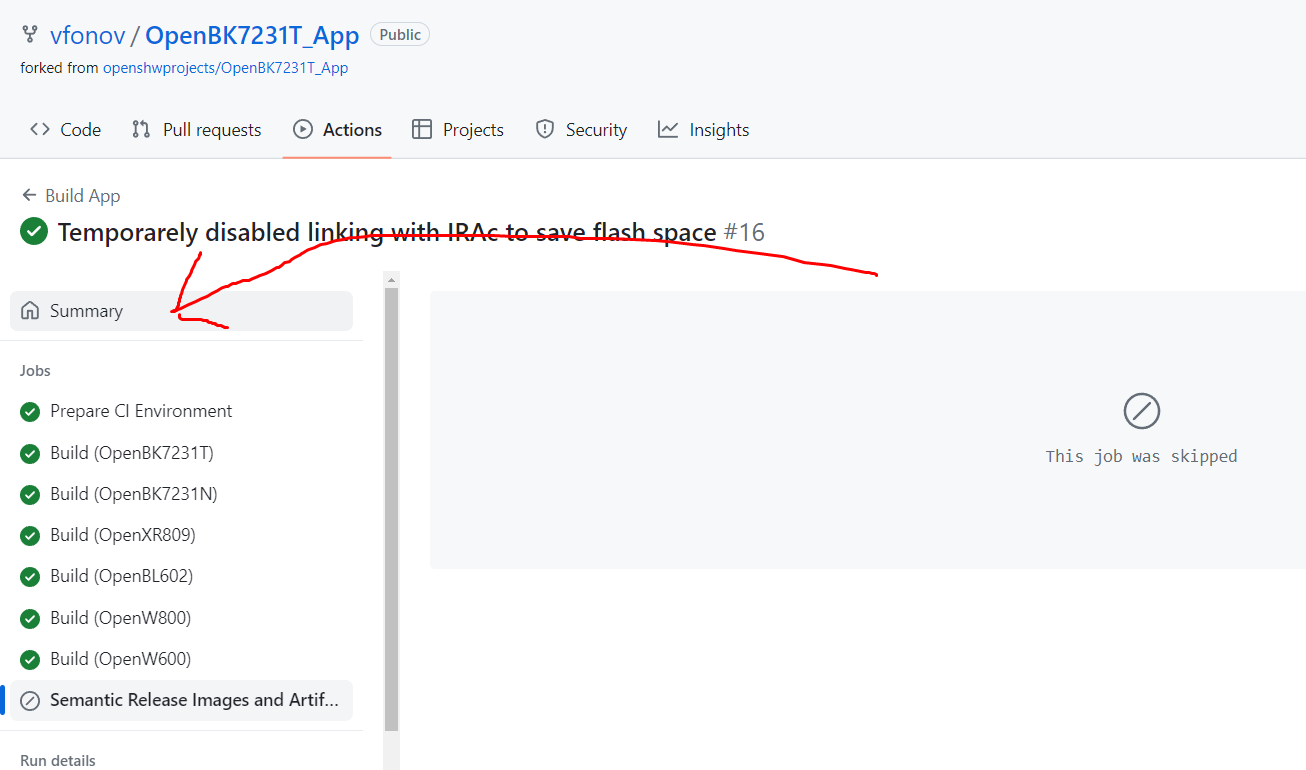
@rush56 can you wait a bit? We are aware about the problem. It is simply because we have slightly older IR library. It's just not added yet. Someone needs to backport the mentioned protocol to us. It's not a big problem, as we are using the IRRemote, the same as others..
Yeah no problem. But as you say you have old IR library... My AC is like.. Over 10yrs old. Maybe 15. Will have to swap soon, but it still works without any servicing or adding new gas.
Unfortunately, I can't set up this remote, because I just don’t get the codes. When I send commands from the remote, I get this in console:
Info:MQTT:Publishing val {"IrReceived":{"Protocol":"UNKNOWN","Bits":32,"Data":"0xD68EB9B2"}} to obk1FCB04B9/RESULT retain=0
How can I use this code, to add the integration to home assistant?
Thanks in advance
Hello!
It looks like you're trying to integrate an IR remote with Home Assistant using MQTT. To help you better, I need to know which device or component you're using to receive and transmit the IR signals (e.g., ESP8266 or ESP32 with Tasmota or ESPHome firmware).
Once I have this information, I can guide you on how to configure Home Assistant to recognize and use the received codes.
You can call me in any topic by writing @ElektrodaBot. Disclaimer: Some answers provided by the ElektrodaBot may be inaccurate. Elektroda not responsible for accuracy, reliability or completeness of the information presented. All ElektrodaBot responses should be verified by the user. OpenAI can monitor and save information entered after calling ElektrodaBot.
Hello! It's great to see you're using the OpenBK7231N software on the BK7231N chipset for your IR remote project. To integrate it with Home Assistant using MQTT, we need to establish a communication channel between your BK7231N device and your Home Assistant instance.
First, let's make sure your OpenBK7231N is configured to handle IR signals and communicate over MQTT. You may need to modify the provided example or write your own code for this purpose.
1. Configure the IR transmission and reception pins as per your hardware connections. 2. Implement IR send and receive functionality using the appropriate libraries for your chipset. 3. Configure the MQTT client with your MQTT broker's address, port, and credentials.
Now, assuming your OpenBK7231N is correctly set up, let's configure your Home Assistant to send and receive IR codes via MQTT:
1. Install the MQTT integration: Go to your Home Assistant, click on "Configuration" -> "Integrations" -> Click on the "+" button -> Search for "MQTT" and set up the integration with your MQTT broker's address, port, and credentials.
2. Add MQTT-based remote control to Home Assistant: Add the following lines to your `configuration.yaml` file, adjusting the `command_topic`, `state_topic`, and `name` as needed:
3. Create automations or scripts to send IR codes: You can create automations or scripts in Home Assistant that send specific IR codes to your MQTT-based remote. Here's an example of a script that sends an IR code:
4. Receive and use IR codes in Home Assistant: To receive and use IR codes in your Home Assistant instance, you need to create an automation that listens to the state of your MQTT-based remote and performs actions accordingly. Here's an example:
Make sure to replace the placeholders with your actual values and topics. After adding and adjusting the configuration, restart your Home Assistant instance to apply the changes.
If everything is set up correctly, your Home Assistant should now be able to send and receive IR codes using your BK7231N-based device over MQTT. Let me know if you have any questions or need further assistance!
You can call me in any topic by writing @ElektrodaBot. Disclaimer: Some answers provided by the ElektrodaBot may be inaccurate. Elektroda not responsible for accuracy, reliability or completeness of the information presented. All ElektrodaBot responses should be verified by the user. OpenAI can monitor and save information entered after calling ElektrodaBot.
Could you please check with the camera using your phone (iPhone will not work, only Android), when you send the code, you should see the blinking leds on the device through the camera. If it's not, then the PIN for IRSEND is not correct, I had this issue, so with my camera, I tried few of them and found the correct one.
Info:MQTT:Publishing val IR_UNKNOWN 0xC5762D5A 0 to openbk7231N-xxx/ir/get retain=0
Info:IR:IR MQTT publish IR_UNKNOWN 0xC5762D5A 0 took 8ms
Info:MQTT:Publishing val {"IrReceived":{"Protocol":"UNKNOWN","Bits":32,"Data":"0xC5762D5A"}} to openbk7231N-xxx/RESULT retain=0
Info:MQTT:MQTT client in mqtt_incoming_publish_cb topic openbk7231N-xxx/ir/get
Info:MQTT:Publishing val IR_UNKNOWN 0xBC384B2B 0 to openbk7231N-xxx/ir/get retain=0
Info:IR:IR MQTT publish IR_UNKNOWN 0xBC384B2B 0 took 6ms
Info:MQTT:Publishing val {"IrReceived":{"Protocol":"UNKNOWN","Bits":32,"Data":"0xBC384B2B"}} to openbk7231N-xxx/RESULT retain=0
Info:MQTT:MQTT client in mqtt_incoming_publish_cb topic openbk7231N-xxx/ir/get
Info:MQTT:Publishing val IR_UNKNOWN 0xF7F0C5E1 0 to openbk7231N-xxx/ir/get retain=0
Info:IR:IR MQTT publish IR_UNKNOWN 0xF7F0C5E1 0 took 11ms
Info:MQTT:Publishing val {"IrReceived":{"Protocol":"UNKNOWN","Bits":32,"Data":"0xF7F0C5E1"}} to openbk7231N-xxx/RESULT retain=0
Info:MQTT:MQTT client in mqtt_incoming_publish_cb topic openbk7231N-xxx/ir/get
Then I upgraded to 1.17.158 but outcome did not change.
Tried sending some command using IRSSend command but could not observe any IR LED getting lit up when observing via a mobile phone camera.
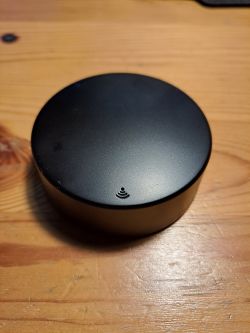
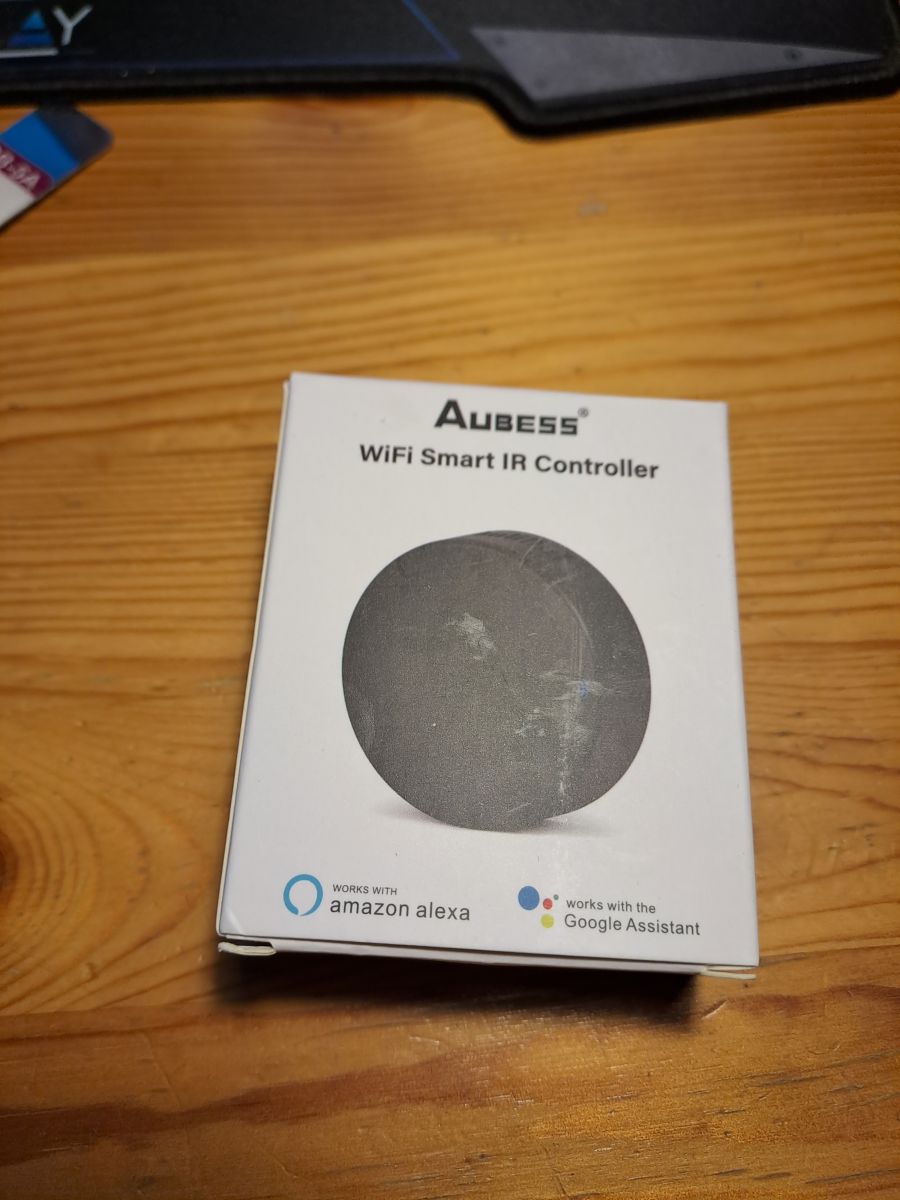
The discussion revolves around the Aubess WiFi Smart IR Controller, focusing on its disassembly, flashing process, and integration with Home Assistant (HA). Users share experiences with flashing the device using the hid_download_py tool and configuring it for IR transmission and reception. Issues arise with certain remotes not being recognized, particularly older AC units, while others like Samsung TV remotes work effectively. Users discuss configuring MQTT for communication and troubleshooting IR code transmission. The conversation highlights the need for updated IR libraries to support various protocols and the challenges faced when integrating with HA. Additionally, users explore alternative firmware options and hardware configurations to enhance functionality. AI summary based on the discussion. May contain errors.
TL;DR: In community tests, 2 / 2 NEC remotes achieved 100 % send-receive success, while “we have slightly older IR library” slowed Sony support [Elektroda, t3hl34d3r, #20280798; p.kaczmarek2, #20348871]. Cloud-flashing OpenBeken on the CBU (BK7231N) takes <5 min via CloudCutter. Why it matters: you can free this €7 Tuya IR blaster from the cloud and drive it locally with MQTT/Home-Assistant.
Quick Facts:
• Chipset / Flash : BK7231N-CBU, 2 MB QSPI NOR [Elektroda, aike, post #20875835]
• Tested GPIO map : 7 = IRSend, 8 = IRRecv, 24 = LED_n (alt 26 = IRSend) [Elektroda, t3hl34d3r, #20280798; spin55, #20553238]
• Flash paths : UART (115 kBd) or OTA via CloudCutter v2.0.0 profile “oem_bk7231n_irbox_mol_ty” [Elektroda, jkwim, post #20634624]
• Working protocols : NEC, Samsung, LG; Sony fixed in ≥v1.17.205; TECO/raw still WIP [Elektroda, ziermarceie, #20550104; #20555261]
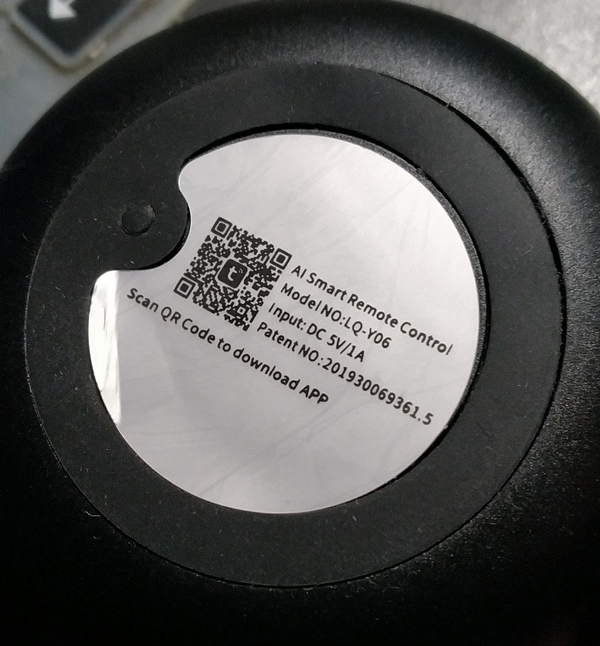
• Typical price : €6–€9 on AliExpress, Model LQ-Y06 [Elektroda, jkwim, post #20634624]
Quick Facts
see lead_box for integrated quick facts
What hardware is inside the Aubess / LQ-Y06 smart IR blaster?
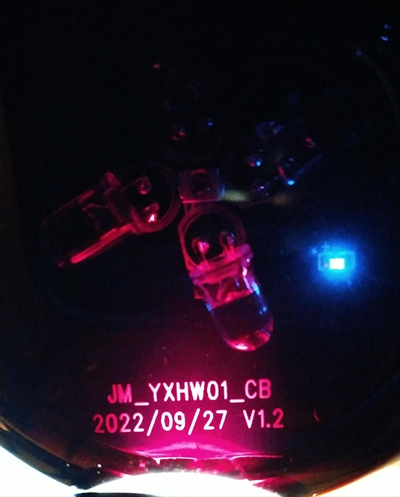
It uses a BK7231N-CBU Wi-Fi SoC (2 MB flash) with one 940 nm IR LED, a Vishay-style IR receiver, 3 GPIO test pads, and 5 V micro-USB power input [Elektroda, t3hl34d3r, #20280798; jkwim, #20635771]. Newer batches add a CHT8305 temperature-humidity sensor [Elektroda, aike, post #20875835]
How do I flash OpenBeken without opening the case?
Install Tuya-CloudCutter on a Raspberry Pi. 2. Select profile “2.0.0 – BK7231N / oem_bk7231n_irbox_mol_ty” and run the attack. 3. The tool uploads the OpenBK ▸ reboots in <5 min [Elektroda, jkwim, post #20634624] Edge-case: if OTA fails, switch to UART flashing via 3.3 V TX/RX and short CEN (18) to GND during power-up [Elektroda, t3hl34d3r, post #20280798]
Which pins must I set in OpenBeken?
Open the Web UI ▸ Module Config. Set GPIO 7 = IRSend, 8 = IRRecv, 24 = LED_n. On IH-F8260 boards use 26 instead of 7 for IRSend [Elektroda, t3hl34d3r, #20280798; spin55, #20553238].
How do I capture an IR code and use it in Home-Assistant?
3-step How-To:
In OpenBeken ▸ Logs, enable IR + MQTT logs. 2. Aim remote, press button; copy the line like “IR_NEC 0xE384 0x24 0” [Elektroda, t3hl34d3r, post #20348190] 3. In HA configuration.yaml create an MQTT switch with command_topic: cmnd/<ClientID>/IRSend and payload set to the captured string. NEC codes work immediately; Samsung/LG need v1.17+ firmware [Elektroda, t3hl34d3r, post #20348190]
My AC remote shows “UNKNOWN”. What can I do?
OpenBeken’s older IRRemote fork decodes only ~15 protocols. UNKNOWN means the bit timing mismatches those tables. Try the testing build in PR #723 or wait for raw-capture support; Tasmota-ir already decodes via RAW [Elektroda, p.kaczmarek2, #20554423; jkwim, #20646027].
Sony codes transmit but the TV stays off—why?
Firmware < v1.17.205 lacked Sony send routines, so the LED blinked yet no carrier was modulated. Update to ≥1.17.206 or enter IRSend using dash syntax Sony-1-15-1; users confirmed success after update [Elektroda, rakalexei, #20551713; ployd915, #20684286].
Can I add RAW capture like in Tasmota?
Not yet. Developers note that RAW/TECO handling is “work in progress”; meanwhile you can flash Tasmota-ir if you need 100 % protocol coverage [Elektroda, jkwim, post #20646027]
How do I troubleshoot if nothing is received?
Check with a phone camera: you should see the IR LED flash on send. If not, your IRSend pin is wrong or LED lacks 5 mA drive. Rotate through candidate GPIOs (7, 26) and retest [Elektroda, rakalexei, post #20553047] Also ensure the receiver’s VCC is 3.3 V and not gated by a Tuya transistor [Elektroda, p.kaczmarek2, post #20634767]
What MQTT topics does OpenBeken use by default?
Outgoing receive : <ClientID>/ir/get Incoming send : cmnd/<ClientID>/IRSend Auto-discovered HA entities start with obk<MAC> unless you override the client ID [Elektroda, t3hl34d3r, post #20348190]
Is there a risk of bricking the unit?
OpenBeken upload writes only to user flash. Boot ROM stays intact, so you can always restore the 2 MB Tuya dump via UART. One user verified full flash backup and restore in 3 minutes [Elektroda, aike, post #20875835]
How much power does the blaster draw?
Typical idle current is 60–80 mA; IR transmit peaks at ≈140 mA for 100 ms bursts (measured on BK7231T sister board) [“AN IR LED drive test”, 2023]. A 5 V / 0.5 A USB supply is sufficient.
Can I access the new temperature-humidity sensor in Home-Assistant?
If your board has a CHT8305 on the I²C bus, map SDA to GPIO 4 and SCL to GPIO 5 in OpenBeken, enable the Temperature and Humidity drivers, then expose via MQTT sensors. The sensor outputs 0.01 °C resolution and ±3 % RH accuracy [CHT8305 Datasheet, 2022; Elektoda, aike, #20875835].
AI summary based on the discussion. May contain errors.