logo elektroda
logo elektroda
X
logo elektroda
Dostępna jest polska wersja

Czy wolisz polską wersję strony elektroda?

Nie, dziękuję Przekieruj mnie tam

Flashing Open-Source Firmware on X5 Mini Camera (TXW817-810 SOC): UART & Logic Analyzer Help

tsisaris 7287 21
Best answers

How can I flash open-source firmware onto a TXW817-810 X5 mini camera, and which debug/UART connections are needed?

You can flash the camera with the TXW81X open-source replacement firmware, but the thread says the practical path is to use an STM32F103 with 64 KB flash (C8T6 or CBT6) plus an ST-Link for the backup/flash process [#21692954][#21738979] It is not a full factory-equivalent port: SD, battery, sleep, app pairing, buttons, and LED behavior are not all supported, and the firmware is mainly for RTSP video/audio streaming [#21692954][#21738979] For this X5 variant, users identified the sensor as a GC0329 640×480 camera, and the thread says the chip uses MJPEG with no hardware H.264 encoder, so the advertised 1080p30 H.264 spec is not realistic [#21693274][#21695439][#21692954][#21693175] Taixin datasheets and SDKs are available from the manufacturer’s product pages, with a GitHub mirror of some documents for reference [#21693037] For board connections, the discussion only confirms that TXW817 backups follow the same process as other TXW817 boards, that the silkscreened RST pad is actually PA10, and that the relevant debug pads are labeled P10 (DebugCLK), P9 (DebugIO), and P8 (HDA), so you should trace the pads visually before wiring a debugger [#21695336][#21695342][#21695378]
ADVERTISEMENT
  • #1 21692368
    tsisaris
    Level 3  
    I recently purchased the X5 mini camera from AliExpress, which uses the TXW817-810 SOC. The camera is connected to a proprietary app, and I'm concerned about potential privacy issues and Chinese spyware, as the video feed likely goes through servers in China.

    I am looking for a way to flash this device with open-source firmware to eliminate these privacy risks. I am not an expert, and I need a step-by-step guide to accomplish this.

    Here is what I've determined so far:

    The SOC is a TXW817-810. I've been unable to find a datasheet or a verified working open-source firmware for this specific chip.

    The PCB appears to have no external flash memory, suggesting the firmware is stored directly on the SOC itself.

    I want to retain the ability to stream 1080p at 30fps with H.264 video encoding.

    I have the following tools and need guidance on how to use them:

    EZ-USB FX2LP CY7C68013A USB Core Board (USB Logic Analyzer): I want to use this to monitor the microSD card on boot-up. Could someone provide a diagram or instructions on which GPIO pins on the logic analyzer should connect to the corresponding pins on a microSD card sniffer to check for boot-up access?

    USB to 4-way TTL serial port (FT4232HL chip): I need to connect this to the UART on the camera's PCB. Can you help me identify the correct UART pins on the board and provide instructions on how to connect the TTL serial port to them?

    I've looked at similar forum posts, but haven't found a directly applicable guide for the TXW817-810 SOC. Any guidance or assistance in "baby steps" would be greatly appreciated.

    Thank you in advance for your help!
  • ADVERTISEMENT
  • #2 21692954
    insmod
    Level 31  
    >>21692368
    Guide specifically for TXW817-810 cameras - https://www.elektroda.com/rtvforum/topic4123724.html
    At minimum, you would need STM32F103 with 64kb flash (C8T6 or CBT6) and ST-Link to program it.

    In current open source firmware, there is no support for SD, battery and sleep.
    The chip uses MJPEG, not H.264. You would have to transcode via ffmpeg or something similar (in HA, go2rtc is an excellent choice).
    And there is no 1080p, even stock firmware uses 4:3 480p resolution.
  • ADVERTISEMENT
  • #3 21693037
    divadiow
    Level 38  
    tsisaris wrote:
    The SOC is a TXW817-810. I've been unable to find a datasheet or a verified working open-source firmware for this specific chip.

    datasheets and SDKs can be had from https://www.taixin-semi.com/Product?prouctSubClass=58 and https://www.taixin-semi.com/Product?prouctSubClass=67

    registration required to download.

    some resources here too: https://github.com/divadiow/DataSheets/tree/main/Taixin

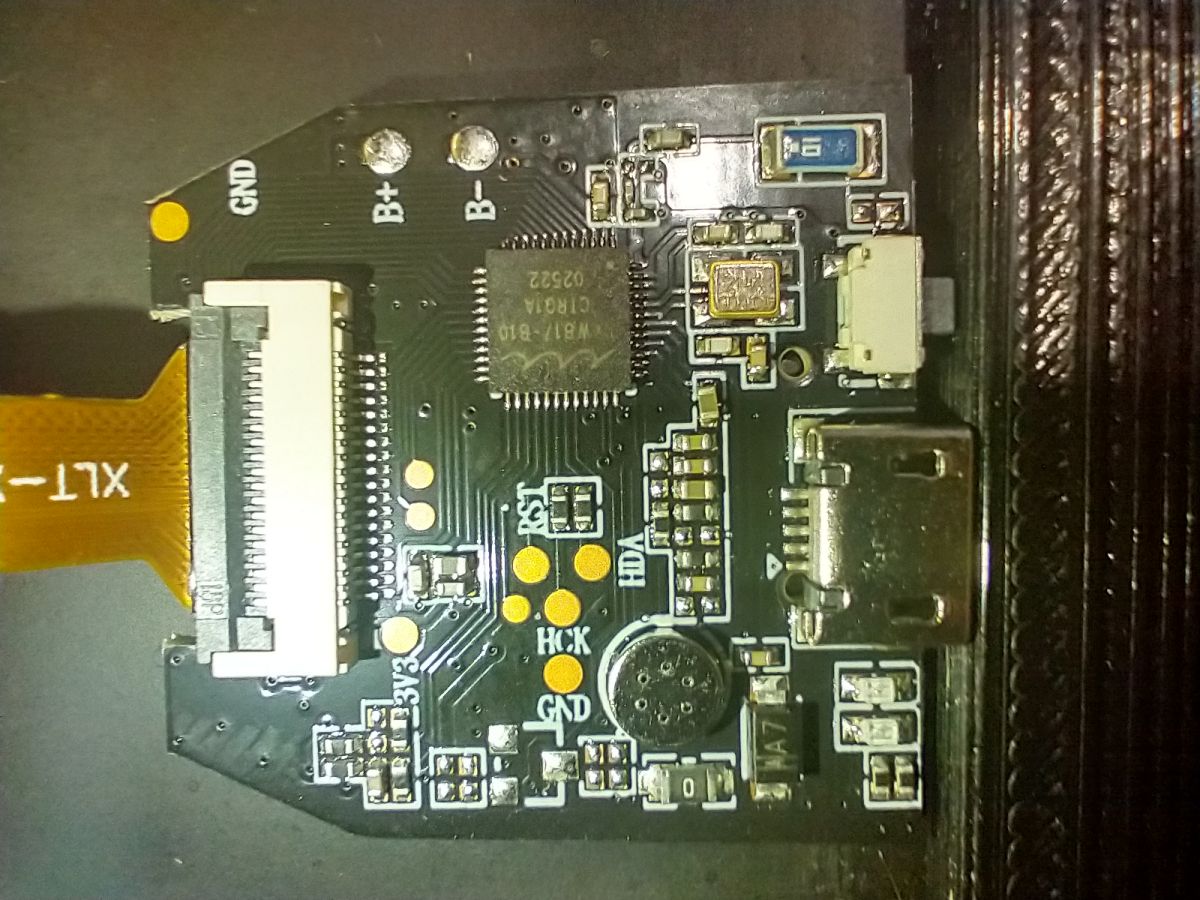
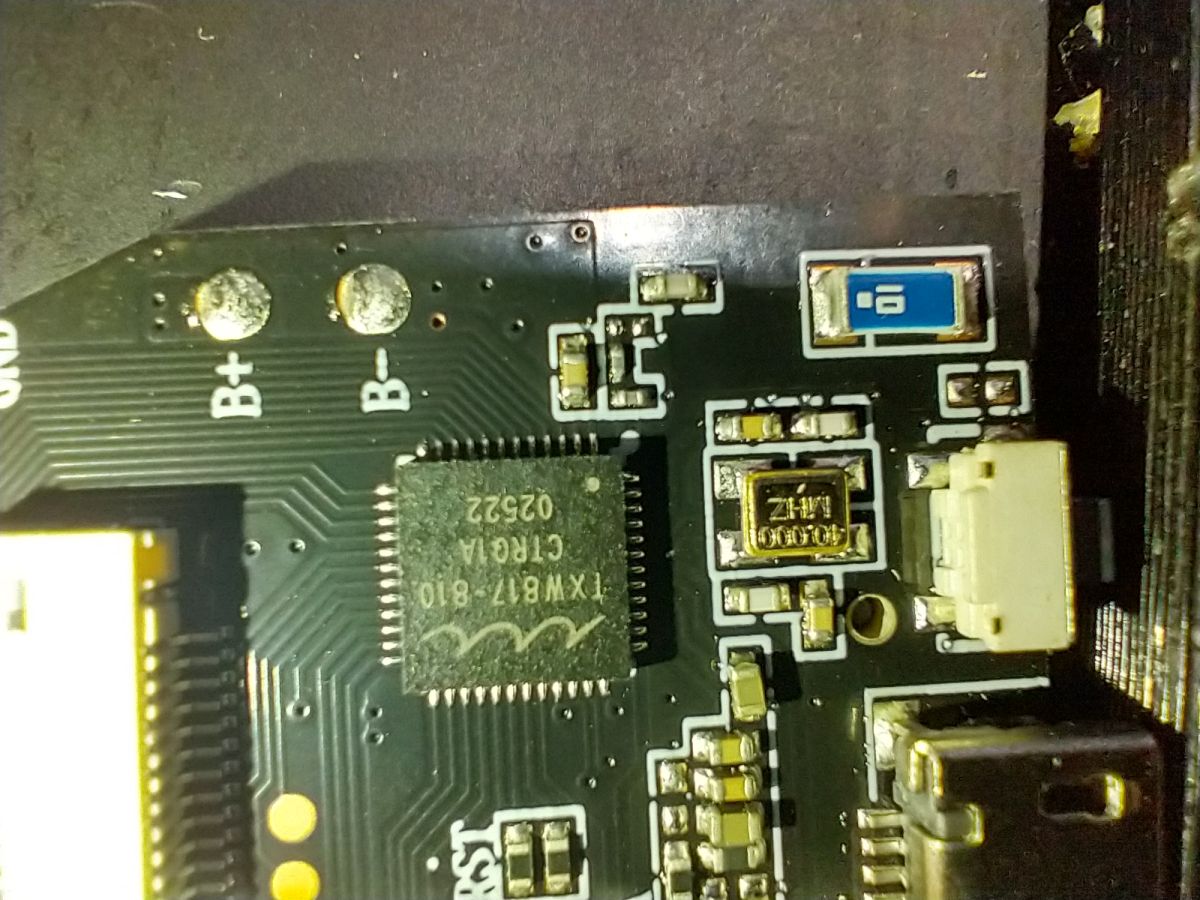
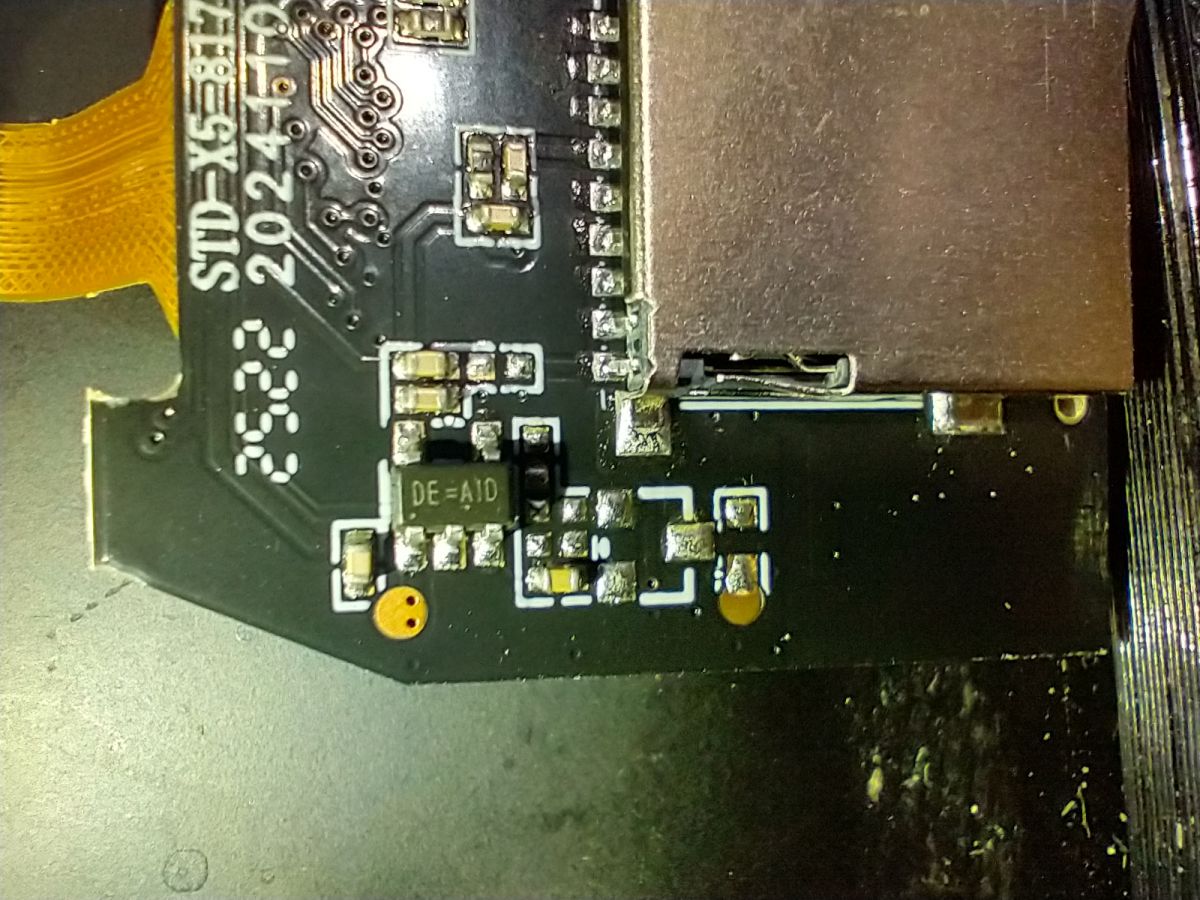
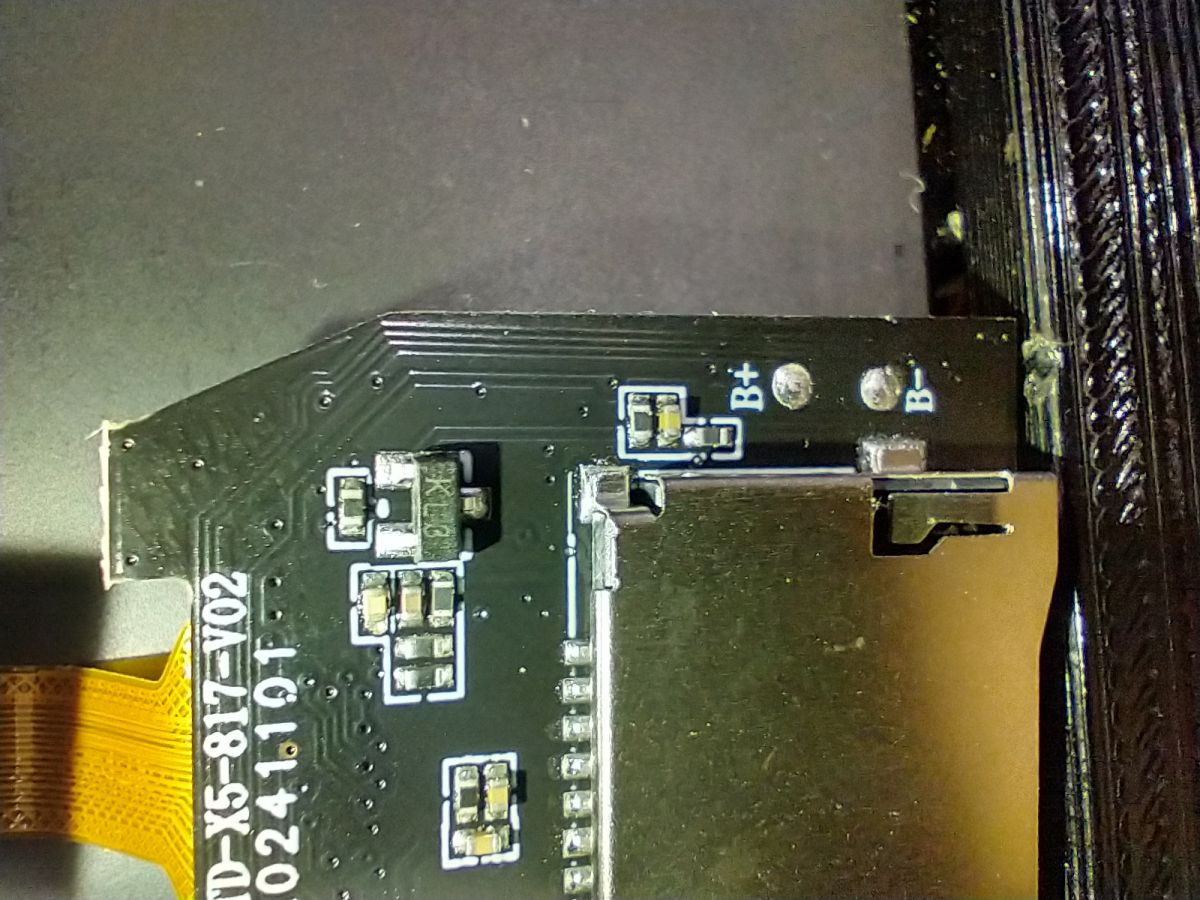
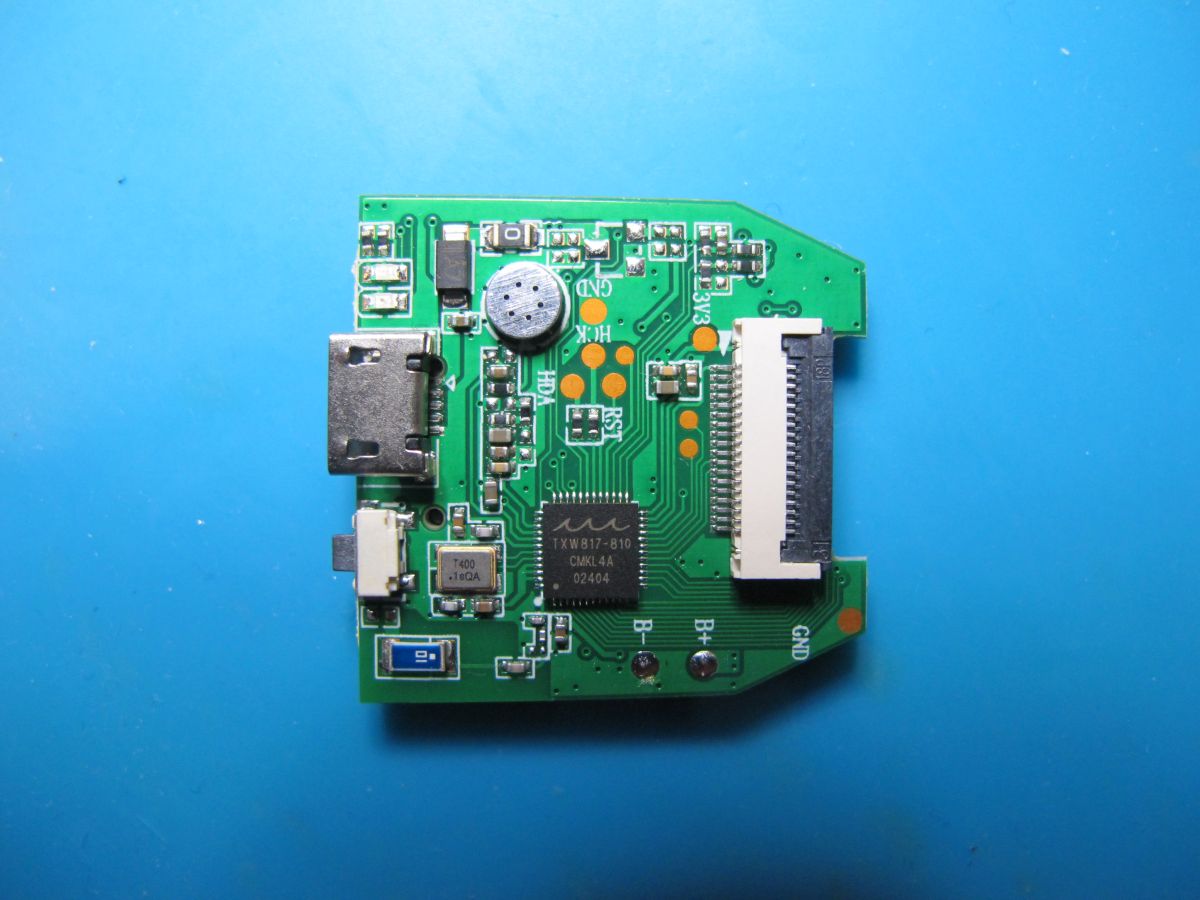
    out of interest, what does your X5 PCB look like?
  • #5 21693151
    divadiow
    Level 38  
    cool. looks familiar. don't think I've posted about mine anywhere yet. definitely not tried OpenTXW81X on it

    backup was same process as other TXW817s

    Flashing Open-Source Firmware on X5 Mini Camera (TXW817-810 SOC): UART & Logic Analyzer Help

    Green PCB with USB ports and a large ribbon connector on a blue background
  • #6 21693159
    tsisaris
    Level 3  
    The camera was advertised as 1080p30fps h.264? It was also advertised as night vision but I can't find any IR LEDs on it. I guess that's just AliExpress propaganda? Should I just return them? I don't mind going through the work but 480p is junk... I want a long high quality video loop on the micro SD card MJPEG is much less memory efficient. What are the cheapest options that will fit my project and hopefully not require a difficult flash process? It would be nice to have AV1 hardware encoding and stream? I'm sure that's more than the $2 per camera that I paid. I wouldn't mind going through and doing the work if this will make it really easy for other people to network a bunch of $2 cameras, but at 480p without night vision. The cable on the camera says XLT-X5-0329-V1.0, I also can't find any hardware details on the camera itself.
    Thank you in advance for your help.
  • #7 21693175
    insmod
    Level 31  
    >>21693159
    Chip itself can't handle 1080p. There is simply not enough RAM. And there is no hardware H.264 encoder.
    It's all fake of course, just like those "Xiaomi" mini 4K cameras, which are 480p MJPEG too.

    Among open source i can only think of OpenIPC and ESP32-P4 cameras.

    Or XMEye/ICsee cameras. I use one of those with 1080p24fps h.264 with IR and SD slot for $10. Mine is quite buggy though, IR turns on and off when rotating (PTZ) and off and on during the day. That is with latest firmware. On previous one there were no such things, but wifi was unstable instead.
    Just block any cloud it tries to connect to on router.
  • #9 21693916
    tsisaris
    Level 3  
    I have rethought things and I think it would be better to go with the LuckFox Pico Mini B and the SC3336 camera. They are $9 each on the LuckFox website. The LuckFox Pico Mini B has h.265 hardware encoding. I will need to connect an ESP32S3 WROOM-1U with 8MB PSRAM and 16MB FLASH over QSPI to the LuckFox Pico Mini B to transmit over WiFi. I can connect a MEMS microphone like the INMP441 to the ESP32 S3 module with I2S and have the ESP32 S3 control tiny servo motors for tracking. Way more than $2 but I can run YOLOv8 large quantized to int4 on the LuckFox Pico Mini B and send hits to the central server for even better inference. Does this sound doable?
  • #10 21693932
    insmod
    Level 31  
    >>21693916
    You will probably have to connect microphone and servos to luckfox, not esp.
    AFAIK module with esp-hosted firmware is just a co-processor, so it's a no go for additional tasks. I could be wrong though.
    And it's not necessary to use ESP32-S3, a cheaper C3 would work too. Or C6 for AX. C5 is not yet supported, so no 5ghz for now.
    And not via QSPI, just regular SPI (and UART if BLE is needed).
  • #11 21695041
    tsisaris
    Level 3  
    I just want to make sure that I get the gist of all of this. The cameras I have for $2 from AliExpress are actually 480p 30fps with MJPEG compression which kind of sucks but they can be easily jail broken with a workflow exactly described in one of these project threads? I can have multiple devices look at the same stream and if I want use a more powerful computer on the network to take the video and compress it down with AV1 and store the video in a rolling loop. The micro sd cards in the cameras themselves will fill up and loop pretty quickly. I can have an esp32s3 wroom poll each camera at 3fps for a jpeg image so I get a total of 9 jpeg images every second streaming through the esp32 and it decompresses them and feeds them directly to the Maix Bit over gpio with qspi protocol. The Maix Bit takes the images and downscales them to 224x224 and feeds them into its kpu for inference with a very tiny int8 model for object recognition person or no person? If it gets a hit then it sends a signal to the esp32 and the esp32 sends an alarm through the network and any devices that have an app installed get a notification and a button to pop up the live feed at full resolution. Something like this?
  • ADVERTISEMENT
  • #12 21695064
    insmod
    Level 31  
    >>21695041
    I don't know, i'm not an expert at configuring such a system.
    It's possible, i guess. Though like i said earlier, ESP would act just like a wifi adapter via SPI. So everything would have to be done on either separate server on directly on luckfox board.

    My camera averages at 22 fps (ffprobe -v error -select_streams v -of default=noprint_wrappers=1:nokey=1 -show_entries stream=r_frame_rate rtsp://192.168.1.20:7070/webcam results in 265/12 -> ~22fps)

    And it's not necessarily easily jailbroken. Some cameras can have sensors that are not supported (yet?). So there would be no video, only audio.
    Plus if you're unlucky - you would have to trace i2c pins for camera to work.
  • #13 21695322
    max4elektroda
    Level 24  
    divadiow wrote:
    backup was same process as other TXW817s

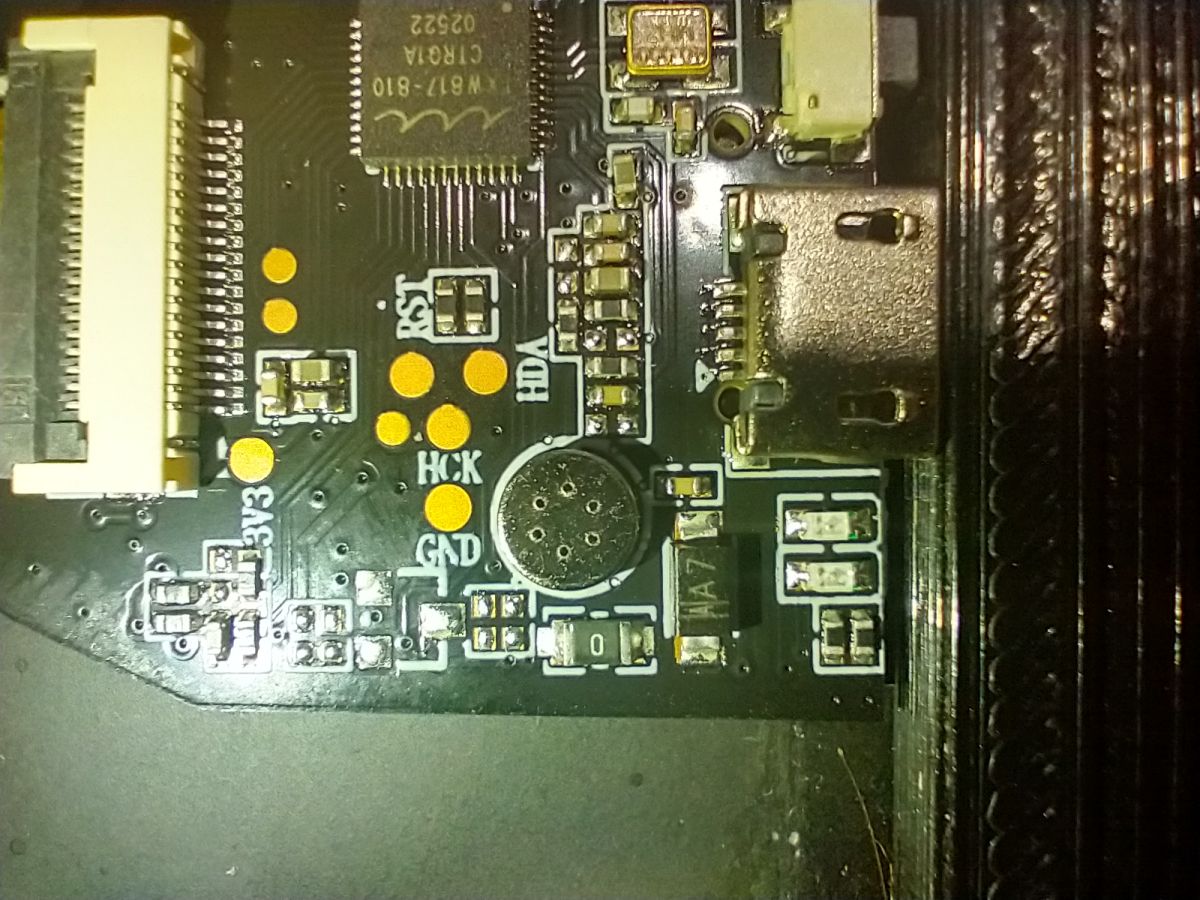
    If you allready made an backup, could you please add labels to the picture?
    Which point is P10 (DebugCLK)?
    I assume P9 (DebugIO) is the HCK point and P8 is HDA as on the other X6 device shown in this post?
    Thanks!
  • #14 21695336
    divadiow
    Level 38  
    sure. this is from November 2024, so I assume it's correct because I would have used it in May when I made the firmware backup. I recall the labelling was a little wrong on this, so it would make sense that the RST pad is indeed actually PA10
    Attachments:
    • Flashing Open-Source Firmware on X5 Mini Camera (TXW817-810 SOC): UART & Logic Analyzer Help dots.jpg (4.05 MB) You must be logged in to download this attachment.
  • ADVERTISEMENT
  • #16 21695378
    max4elektroda
    Level 24  
    divadiow wrote:
    RST pad is indeed actually PA10

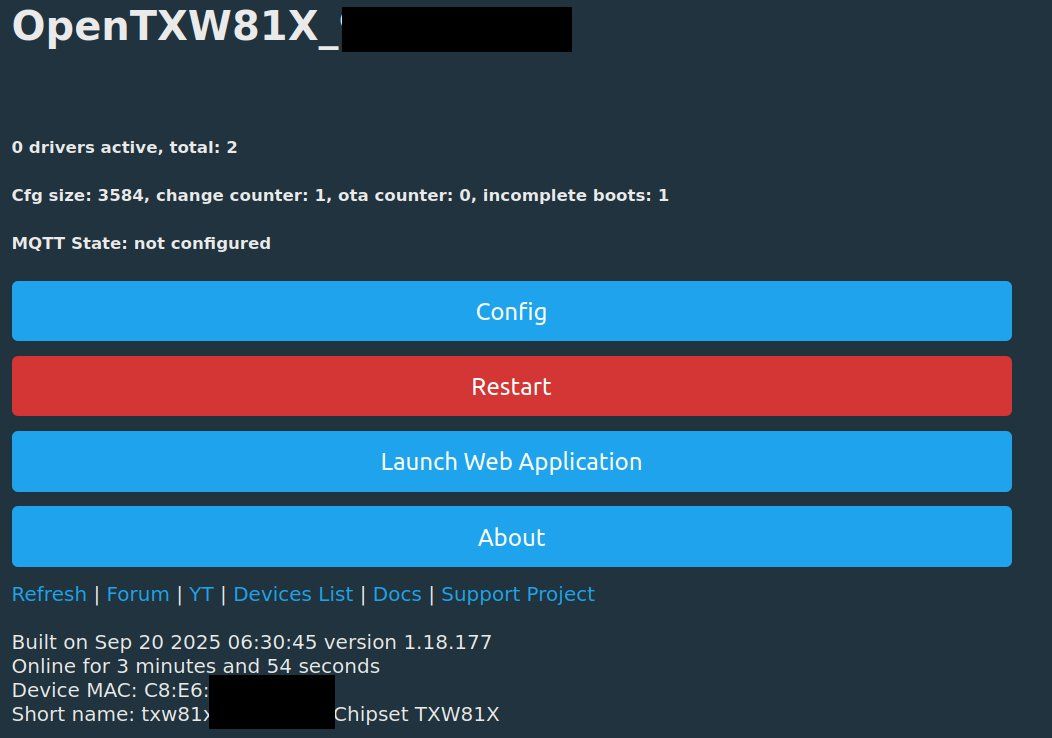
    Indeed, Thanks:

    OpenTXW81X device web interface with configuration and control buttons visible
  • #17 21695391
    divadiow
    Level 38  
    cool. are you finding that board has stuck to SDK defaults re cam/mic or maybe you're yet to get to that point. The TXW adventure does span several threads now.
  • #18 21695407
    max4elektroda
    Level 24  
    I think I didn't understand the question (maybe I need to get to that point?)
    I get an RTSP stream with some (distorted) audio - sounds like there's an engine running, but I can hear sounds ...
  • #19 21695420
    divadiow
    Level 38  
    yet to get that point = at the stage where you know if the cam is using SDK default pin assignments. Sounds like you are ;)

    What cam did yours come with?

    Added after 5 [minutes]:

    max4elektroda wrote:
    sounds like there's an engine running, but I can hear sounds

    at least the mic is default I guess.

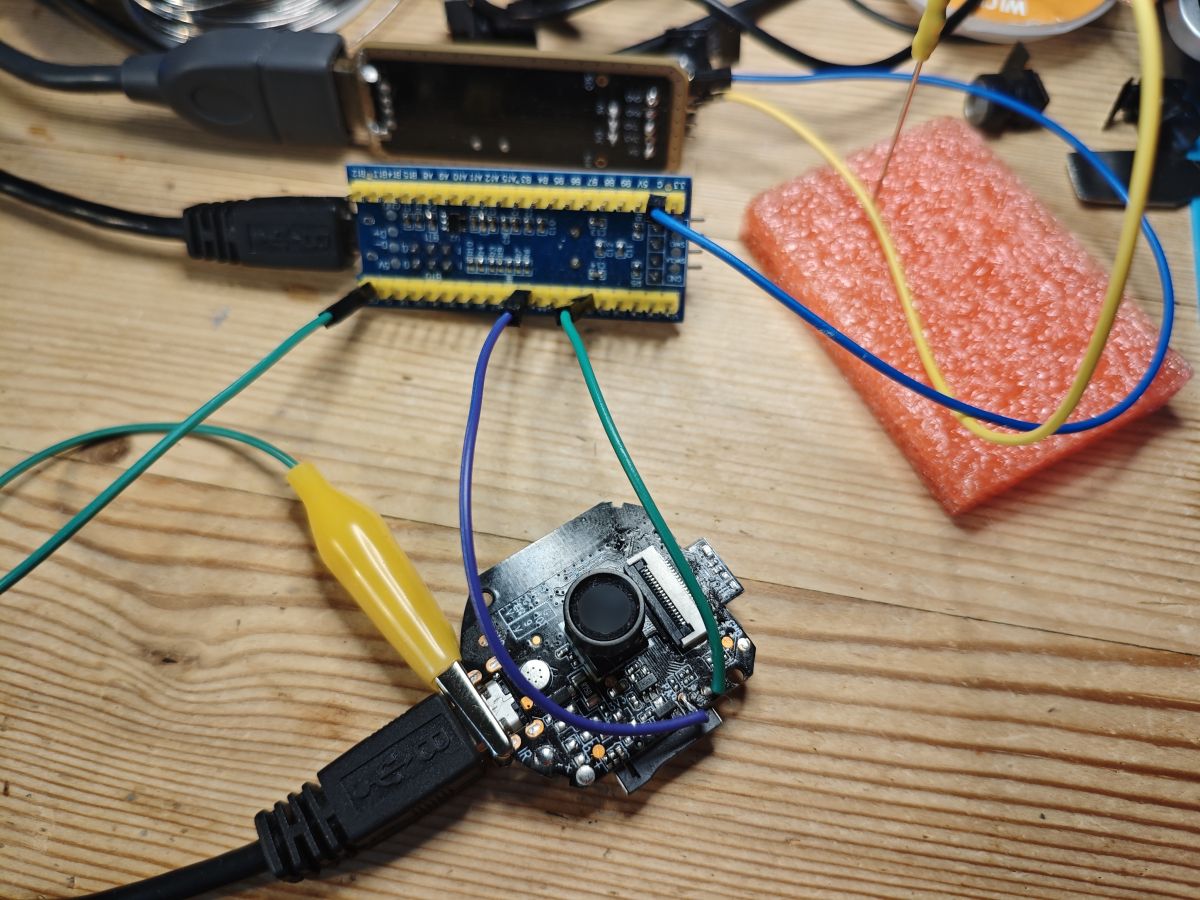
    Mine sounds crap anyway but with grounds connected to usbttl and STM32 it's worse. Not *too* bad though

    Joystick module connected to development board with wires on wooden desk
  • #20 21695439
    max4elektroda
    Level 24  
    Cam is labelled X5-G29-2364V1 (it's allready mentioned in the "Identifying Mini Cam Modules"-thread.)

    Soldered TX line, so I can also give the output from loading the driver:
    [173551]sensor driver match: name=gc0329 id=0xc0 num=5 addr7=0x31 mclk=24000000 pix=640x480
  • #21 21738936
    nevergone
    Level 1  
    Hello,
    I've read this topic, but I don't fully understand it.
    Is there an open source firmware available for this camera that at least supports the factory functions but does not send data to China?
    My son and I build cars out of LEGO, and I bought this cheap camera for that.

    Here is some useful software for it: https://github.com/hardest1/cam-reverse

    Thanks!
  • #22 21738979
    divadiow
    Level 38  
    there is opensource replacement firmware for the Taixin TXW81X-based cameras, yes. It'll offer you the ability to RTSP stream the video and audio to whatever solution you choose to use that's capable.

    What this doesn't provide is a complete factory-like solution where all the buttons, LEDs, power-saving, pairing with app etc are available as a complete alternative package.

Topic summary

✨ The X5 mini camera uses the TXW817-810 SoC, which lacks external flash memory and stores firmware internally. No official datasheet or verified open-source firmware exists for this chip. The device advertised as 1080p30fps H.264 is misleading; the chip supports only 480p MJPEG video without hardware H.264 encoding or IR LEDs for night vision. Open-source firmware options like OpenTXW81X do not support SD card, battery, or sleep functions, and transcoding to H.264 requires external tools such as ffmpeg or go2rtc. The TXW817-810 has insufficient RAM for 1080p and no hardware H.264 encoder, making genuine high-resolution streaming unfeasible. Alternatives suggested include OpenIPC and ESP32-P4 cameras for open-source solutions, or low-cost XMEye/ICsee cameras offering 1080p24fps H.264 with IR and SD card support, albeit with some firmware bugs. Users are advised to block cloud connections to mitigate privacy risks. Tools like the EZ-USB FX2LP CY7C68013A USB Logic Analyzer can assist in monitoring microSD communication during firmware exploration.

FAQ

TL;DR: These X5 mini cams with TXW817-810 output "stock firmware uses 4:3 480p" and MJPEG; not H.264. Expert note: "no 1080p." [Elektroda, insmod, post #21692954] Why it matters: This FAQ helps hobbyists decide whether to flash open firmware, keep stock and block cloud, or pick better-value 1080p options.

Quick Facts

Can my TXW817-810 X5 mini camera do 1080p H.264 like the listing says?

No. Community testing shows TXW817-810 units output MJPEG at 4:3 480p, and the chip lacks a hardware H.264 encoder. Keep expectations at VGA quality, or choose a different platform if you need HD H.264. “There is no 1080p.” [Elektroda, insmod, post #21692954]

Is there open-source firmware that keeps factory-like features but removes the China cloud?

OpenTXW81X-style firmware exists for TXW81X cameras. It provides RTSP audio/video to your own stack. It does not replicate factory pairing, LEDs, buttons, or full power-saving behavior. Use it if you want local streaming control without the vendor app. [Elektroda, divadiow, post #21738979]

What hardware do I need to flash or back up these cameras?

Use an STM32F103 (C8T6/CBT6) board and an ST-Link programmer. Current open builds omit SD, battery, and sleep features, so plan accordingly. Follow the TXW817-specific guide linked in the thread for pinouts and steps. [Elektroda, insmod, post #21692954]

Is jailbreaking always easy on X5/TXW817 cams?

No. Some boards use sensors that community firmware does not support yet, yielding audio-only streams. You may need to trace I2C camera pins to restore video. Treat each PCB revision as a separate bring-up task. Edge-case: unsupported sensors break video. [Elektroda, insmod, post #21695064]

What image sensor is inside the X5 variants referenced here?

Multiple users report GalaxyCore GC0329 sensors labeled on X5 boards, with 640×480 output. This aligns with the stock 4:3 480p video behavior seen on TXW817-810 devices. Check your PCB silkscreen to confirm. [Elektroda, divadiow, post #21693274]

How fast is the RTSP stream on community firmware?

One measurement reports about 22 fps (265/12) from RTSP on a TXW817-based cam. Actual fps can vary with sensor, network, and configuration. Treat 20–22 fps as typical for these low-cost modules. [Elektroda, insmod, post #21695064]

Can I keep stock firmware and block the cloud instead of flashing?

Yes. You can block the domains/IPs the camera calls from your router or firewall. You lose remote app features but preserve local use if your client can access the stream. “Just block any cloud it tries to connect to.” [Elektroda, insmod, post #21693175]

Is there a simple 3‑step workflow to back up/flash TXW817 cams?

Try this: 1. Wire the STM32F103 and ST‑Link to the documented pads. 2. Use the guide’s toolchain to dump the stock firmware. 3. Flash the open build, then verify RTSP. Follow the TXW817-specific guide linked in the thread. [Elektroda, insmod, post #21692954]

Which debug pads matter on the X5 board (RST, P9, P10)?

A contributor corrected the labeling: the RST pad is actually PA10 on that board. Use the community-labeled photo when connecting your programmer, and verify continuity before powering. [Elektroda, divadiow, post #21695336]

Where can I get TXW81X datasheets or SDKs?

Taixin’s site hosts datasheets and SDKs for TXW81X families (account required). One user also mirrored documents on GitHub under a DataSheets/Taixin path. These help identify pins and drivers. [Elektroda, divadiow, post #21693037]

What’s a good budget alternative if I really need 1080p H.264 and IR?

Consider XMEye/ICsee-based cameras around $10. A user reports 1080p at 24 fps with IR and SD slot. Firmware quirks exist, so expect trade-offs like IR control bugs or Wi‑Fi instability. Block cloud for privacy. [Elektroda, insmod, post #21693175]

Can the LuckFox Pico Mini B with SC3336 and an ESP32S3 handle Wi‑Fi, audio, and servos?

Yes, but attach microphone and servos to the LuckFox. The ESP in esp‑hosted mode acts as a co-processor. Use SPI for data and UART if you also need BLE. An ESP32‑C3 or C6 is sufficient. [Elektroda, insmod, post #21693932]

How do I identify the camera module in software logs?

Watch the boot log for the sensor driver match line. Example: gc0329 id 0xc0 at 0x31 with 24 MHz mclk and 640×480 pix. That confirms sensor type and timing. [Elektroda, max4elektroda, post #21695439]

Can I get 1080p recording by transcoding on my server?

You can upscale and encode to H.264/AV1 on a separate machine, but source detail remains VGA. Tools like go2rtc or ffmpeg help centralize recording and re-encode. Expect higher storage use from MJPEG sources. [Elektroda, insmod, post #21692954]

What is UART, and why do I need it here?

UART is a serial interface for logs and boot interaction. On these cams, UART helps observe boot, change settings, and aid backups. Identify TX/RX/GND pads before connecting USB‑TTL adapters. Follow the thread’s pad guidance. [Elektroda, divadiow, post #21695336]

Glossary: What are Tuya, Arduino Nano, OpenBeken, and CAN bus?

Tuya is a smart‑home cloud ecosystem. Arduino Nano is a small MCU board for prototyping. OpenBeken is open firmware for certain Wi‑Fi IoT chips. CAN bus is a robust vehicle/industrial network. These are not native to TXW817 cams but appear in related DIY contexts. [Elektroda, divadiow, post #21738979]
ADVERTISEMENT