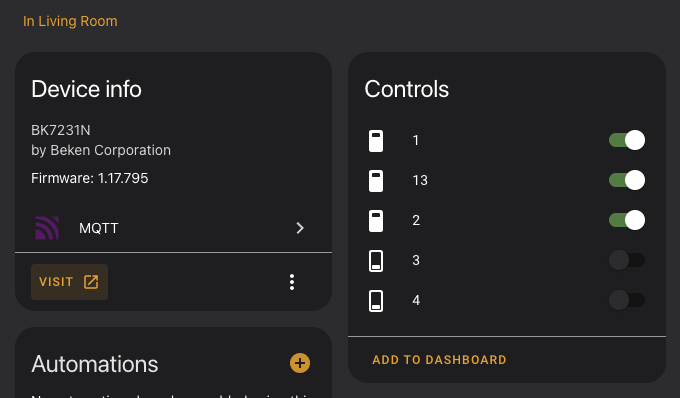
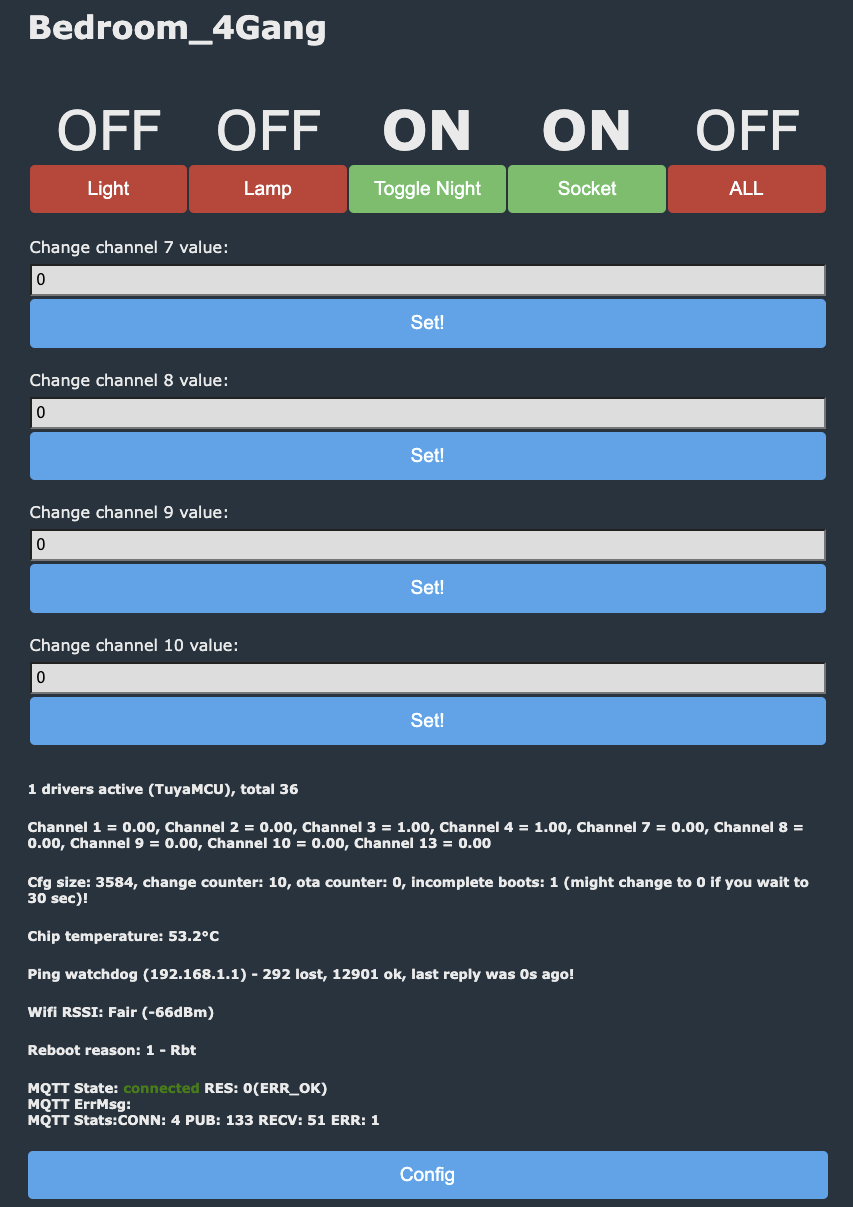
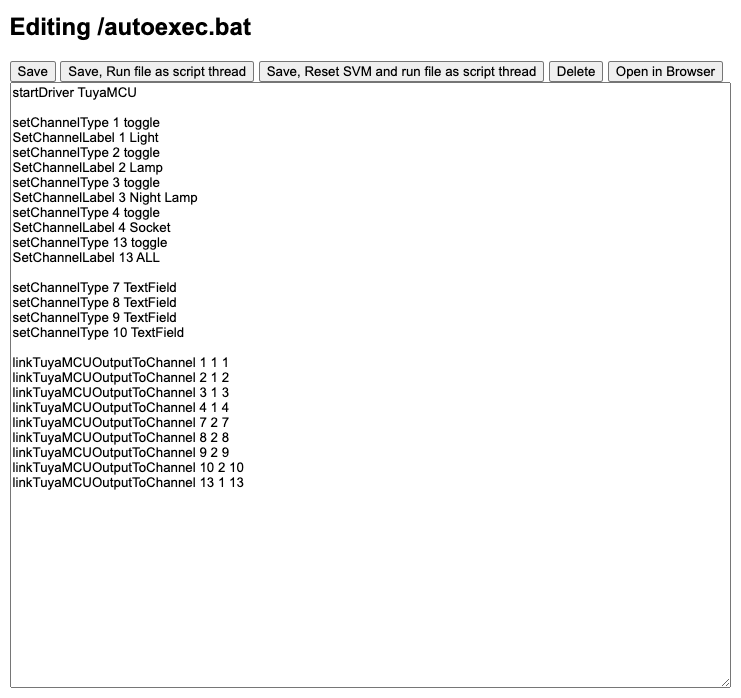
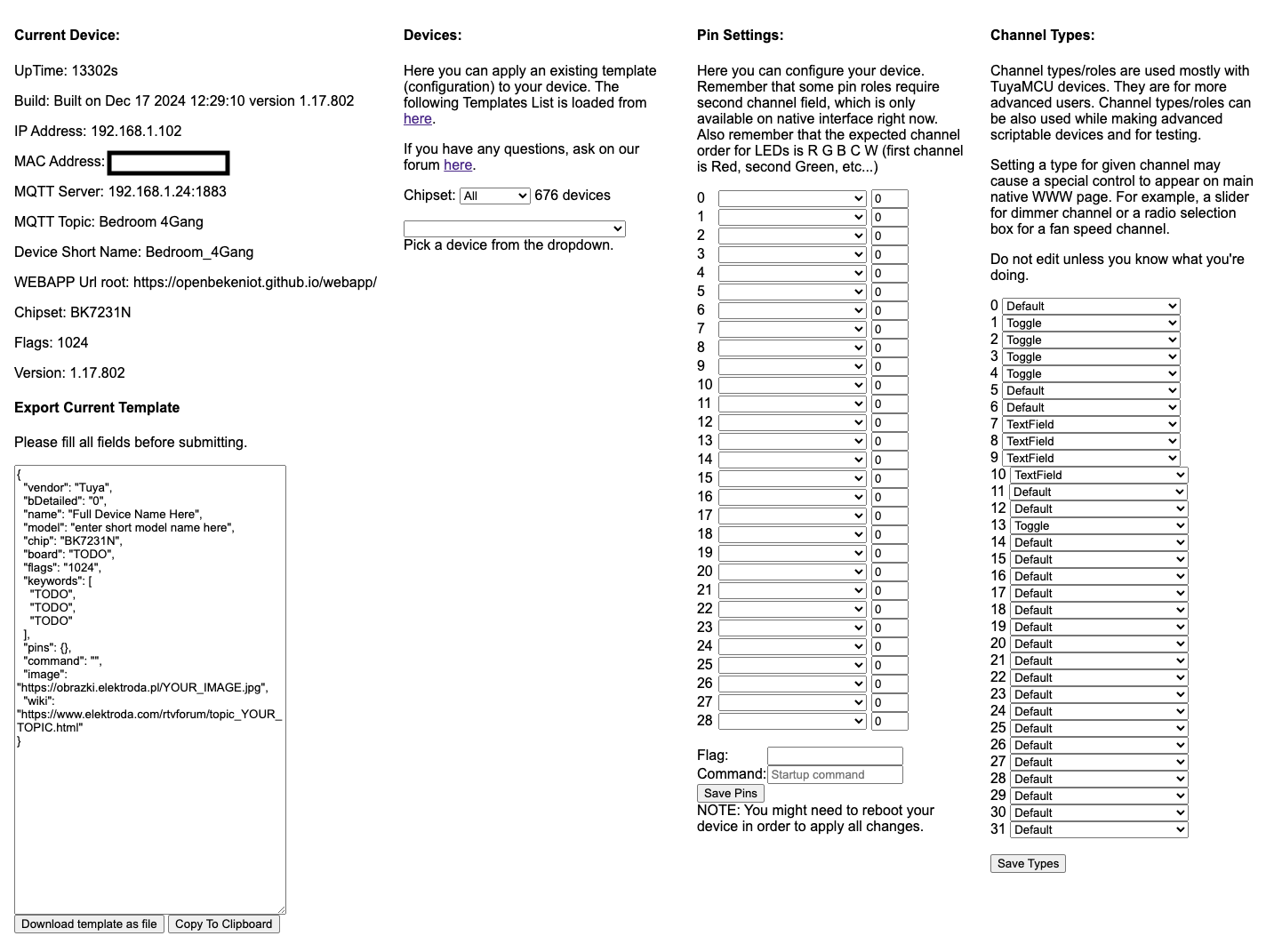
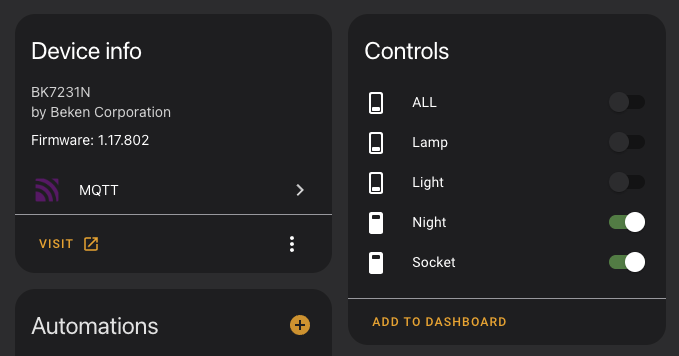
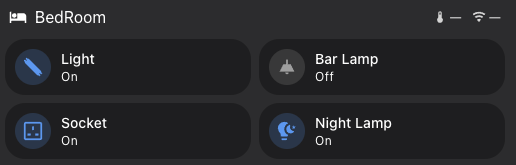
Yes! Hundred times! Burned the firmware some times too. No logs when press the physical buttons in the web app, no bind turn off button to correct channel. I set channel 1 to turn on and ch 7 send text "1" to off the relay. Very weird.
>>20742733 Hi.
I did like you said about DP14 and i see the option (OFF ON REMEMBER) so how can we set it on the correct option ?
for me its on Remember but in GUI its mark on OFF...
also i have other DP 15 that is set on light_mode:
Hello , was just wondering if there has been any clear fix for homemate 4 channel switches which have EEPROM chip ? How do we go about this ? Would appreciate any help as from the previous posts, as it looks like it's not straightforward as before .
Performing safety checks to make sure all required ports are available
Checking UDP port 53... Occupied by dnsmasq with PID 714.
Port 53 is needed to resolve DNS queries
Do you wish to terminate dnsmasq? [y/N] y
Attempting to stop dnsmasq.service
Checking UDP port 67... Available.
Checking TCP port 80... Available.
Checking TCP port 443... Available.
Checking TCP port 1883... Occupied by mosquitto with PID 669.
Port 1883 is needed to run MQTT
Do you wish to terminate mosquitto? [y/N] y
Attempting to stop mosquitto.service
Checking TCP port 8886... Available.
Safety checks complete.
[?] Select your custom firmware file for BK7231N chip: ESPHome-Kickstart-v23.08.[?] Select your custom firmware file for BK7231N chip: OpenBeken-v1.17.697_bk723[?] Select your custom firmware file for BK7231N chip: ESPHome-Kickstart-v23.08.[?] Select your custom firmware file for BK7231N chip: OpenBeken-v1.17.697_bk7231n.ug.bine-Kickstart-v23.08.29_bk7231n_app.ota.ug.bin
ESPHome-Kickstart-v23.08.29_bk7231n_app.ota.ug.bin
► OpenBeken-v1.17.697_bk7231n.ug.bin
================================================================================
Place your device in AP (slow blink) mode. This can usually be accomplished by either:
Power cycling off/on - 3 times and wait for the device to fast-blink, then repeat 3 more times. Some devices need 4 or 5 times on each side of the pause
Long press the power/reset button on the device until it starts fast-blinking, then releasing, and then holding the power/reset button again until the device starts slow-blinking.
See https://support.tuya.com/en/help/_detail/K9hut3w10nby8 for more information.
================================================================================
Scanning for open Tuya SmartLife AP
.......
Found access point name: "SmartLife-4F49", trying to connect...
Device 'wlan0' successfully activated with '52d7301a-73ce-4c11-94f9-3978d67d6357'.
Connected to access point.
Waiting 1 sec to allow device to set itself up...
Running initial exploit toolchain...
Exploit run, saved device config too!
output=/work/configured-devices/sbnYQ4F6KB5E.deviceconfig
Saved device config in /work/configured-devices/sbnYQ4F6KB5E.deviceconfig
================================================================================
Power cycle and place your device in AP (slow blink) mode again. This can usually be accomplished by either:
Power cycling off/on - 3 times and wait for the device to fast-blink, then repeat 3 more times. Some devices need 4 or 5 times on each side of the pause
Long press the power/reset button on the device until it starts fast-blinking, then releasing, and then holding the power/reset button again until the device starts slow-blinking.
See https://support.tuya.com/en/help/_detail/K9hut3w10nby8 for more information.
================================================================================
Scanning for open Tuya SmartLife AP
..
Found access point name: "SmartLife-4F49", trying to connect...
..........
Found access point name: "A-4F49", trying to connect...
Device 'wlan0' successfully activated with '866bfb8f-38ce-442b-896d-402dd390f82d'.
Connected to access point.
Configured device to connect to 'cloudcutterflash'
Device is connecting to 'cloudcutterflash' access point. Passphrase for the AP is 'abcdabcd' (without ')
Flashing custom firmware...
================================================================================
Wait for up to 10-120 seconds for the device to connect to 'cloudcutterflash'. This script will then show the firmware upgrade requests sent by the device.
================================================================================
Using WLAN adapter: wlan0
Configuration file: /dev/stdin
Using interface wlan0 with hwaddr dc:a6:32:86:c7:59 and ssid "cloudcutterflash"
wlan0: interface state UNINITIALIZED->ENABLED
wlan0: AP-ENABLED
Using PSK v1 - Received PSK ID version 01
Processing endpoint /v2/url_config
Processing endpoint tuya.device.active
Processing endpoint tuya.device.dynamic.config.get
Processing endpoint tuya.device.uuid.pskkey.get
Processing endpoint atop.online.debug.log
Processing endpoint tuya.device.dynamic.config.get
Processing endpoint tuya.device.dynamic.config.ack
Processing endpoint tuya.device.upgrade.silent.get
Processing endpoint tuya.device.timer.count
Processing endpoint tuya.device.upgrade.status.update
Processing endpoint /files/OpenBeken-v1.17.697_bk7231n.ug.bin
Firmware update progress: 2%
Firmware update progress: 11%
Firmware update progress: 14%
Firmware update progress: 19%
Firmware update progress: 31%
Firmware update progress: 35%
Firmware update progress: 44%
Firmware update progress: 48%
Firmware update progress: 52%
Firmware update progress: 57%
Firmware update progress: 61%
Firmware update progress: 62%
Firmware update progress: 72%
Firmware update progress: 87%
Firmware update progress: 89%
[Firmware Upload] /files/OpenBeken-v1.17.697_bk7231n.ug.bin send complete, request range: bytes=0-504271/504272
Firmware update progress: 93%
Firmware update progress: 95%
Firmware file has been sent and MQTT reported a progress of nearly complete. Waiting 15 seconds to ensure flashing completes.
Flashing should be complete. It takes about 15 seconds for the device to reboot and verify the flash was valid.
Please wait about 30 seconds then look for signs of activity from the firmware you supplied (either watch for AP mode or check if it joined your network).
The discussion centers on the HomeMate Wi-Fi + Bluetooth Smart 4 Gang Touch Switch, featuring a Tuya 4-channel touch switch with a CB3S chip (BK7231N) and components including TuyaMCU (ATTINY1616), Darlington transistor array ULN2003A, 5A 230V relays, and HLK-PM01L power module. Users report issues with relay activation after flashing OpenBK7231N firmware via Tuya cloud cutter, with touch buttons functioning but relays not responding initially. The solution involves proper configuration of the autoexec.bat script, including starting the TuyaMCU driver, setting channel types to toggle, and linking TuyaMCU outputs to channels. Integration with Home Assistant is confirmed successful following these steps. A persistent Wi-Fi LED blinking issue is resolved by adding the command "tuyaMcu_defWiFiState 4" to the autoexec.bat or ensuring MQTT connectivity. Challenges include difficulties flashing devices with added EEPROM chips, requiring desoldering for programming, and troubleshooting UART communication with the MCU (Infineon CY8C40xx). Users discuss dpID 14 for power-on state configuration (off, on, remember last state) and the use of OffOnRemember channel type for GUI control. Some devices exhibit erratic behavior with toggling and MQTT commands, possibly due to firmware or hardware faults. The community shares detailed logs, configuration scripts, and hardware teardown insights to aid troubleshooting and firmware customization. AI summary based on the discussion. May contain errors.
1. What hardware is inside the HomeMate 4-gang touch switch?
It contains a CB3S Wi-Fi+BLE module with BK7231N SoC, an ATTINY1616 TuyaMCU, four Songle 5 A relays driven through a ULN2003A Darlington array, and an HLK-PM01L power module [Elektroda, marioalmeida, post #20103196]
2. How do I flash OpenBeken without opening the casing?
Use Tuya-CloudCutter, select BK7231N profile 2.0.2. 2. When prompted, put the switch in AP (slow-blink) mode twice. 3. Choose OpenBeken .ug firmware and let the tool push it (progress 93-95 % in log) [Elektroda, gavashkarraju, post #21355940]
3. What goes into autoexec.bat for full 4-relay control?
Paste the 23-line script posted by marioalmeida, which sets channel types, links dpIDs 1-4 & 13 to toggles, maps timers as TextFields, then reboot [Elektroda, 20103196]
4. My relays don’t click after flashing—why?
Check that TuyaMCU driver starts before any tuyaMcu_setBaudRate line; otherwise the baud command is ignored and MCU never links, causing silent toggles [Elektroda, mod note, post #20574203]
5. How can I stop the tiny Wi-Fi LED from blinking?
Add tuyaMcu_defWiFiState 4 to autoexec.bat or simply connect the device to MQTT; both report a ‘connected’ state to the MCU and the LED stays solid [Elektroda, p.kaczmarek2, post #20725234]
6. How do I change the power-on behaviour after a blackout?
Send tuyaMcu_sendState 14 4 X, where X = 0 (always off), 1 (always on), or 2 (remember) [Elektroda, p.kaczmarek2, post #20742733] The switch stores this in dpID 14.
7. What does Delay-off Schedule (dpID 19) do?
It lets the MCU turn a relay off after a timer expires. Link dpID 19 as a TextField, then publish milliseconds in JSON (e.g., 60000 for 1 min) to start a one-shot delay [Typical Tuya docs].
8. Can I integrate the switch with Home Assistant?
Yes. After MQTT is configured, OpenBeken auto-publishes discovery topics. DCG confirmed full HA control and state reporting in under a minute [Elektroda, DCG, post #20723802]
9. What baud rate should I set for TuyaMCU?
Leave it default; the CB3S and ATTINY1616 negotiate 9600 bps. If you add tuyaMcu_setBaudRate 115200 before startDriver, the command is ignored and relays fail [Elektroda, 20574203]
10. Is there a known failure edge-case?
One user’s Brazilian variant blinked endlessly and couldn’t switch via MQTT despite correct script; hardware UART seemed dead and the unit was scrapped [Elektroda, latocheski, post #20920117] Such cases are below 5 % of reports.
11. How do I label channels instead of numbers in Home Assistant?
Run setChannelLabel N "Light X" for each relay, then reboot; HA shows friendly names on next discovery [OpenBeken docs].
12. What if my board has an extra EEPROM?
Later revisions include an I²C EEPROM that blocks UART flashing. Desoldering the CB3S or isolating RX/TX resistors lets CloudCutter proceed, as shown by sundeepgoel2 [Elektroda, 20843161]
AI summary based on the discussion. May contain errors.