logo elektroda
logo elektroda
X
logo elektroda

SMART06B firmware change - how to connect an electric kettle with Wi-Fi to Home Assistant?

p.kaczmarek2 810 2

TL;DR

  • The Svensson SMART06B Tuya electric kettle was reflashed to work with Home Assistant instead of the manufacturer's cloud app.
  • The hidden WBR3 Wi‑Fi module was unsoldered, powered from an external 3.3V LDO, flashed with OBK, and then configured through TuyaMCU dpID mapping.
  • The final autoexec.bat maps relay control, current temperature, and target temperature, using channels 1, 2, and 4.
  • Home Assistant shows relay control plus current and target temperature history, and the kettle now operates fully locally with no cloud or manufacturer servers.
  • The hardest part was soldering the WBR3 because its programming pads are on the underside; a CB3S or TYWE3S version would be easier to flash.
Generated by the language model.
ADVERTISEMENT
Treść została przetłumaczona polish » english Zobacz oryginalną wersję tematu
📢 Listen (AI):
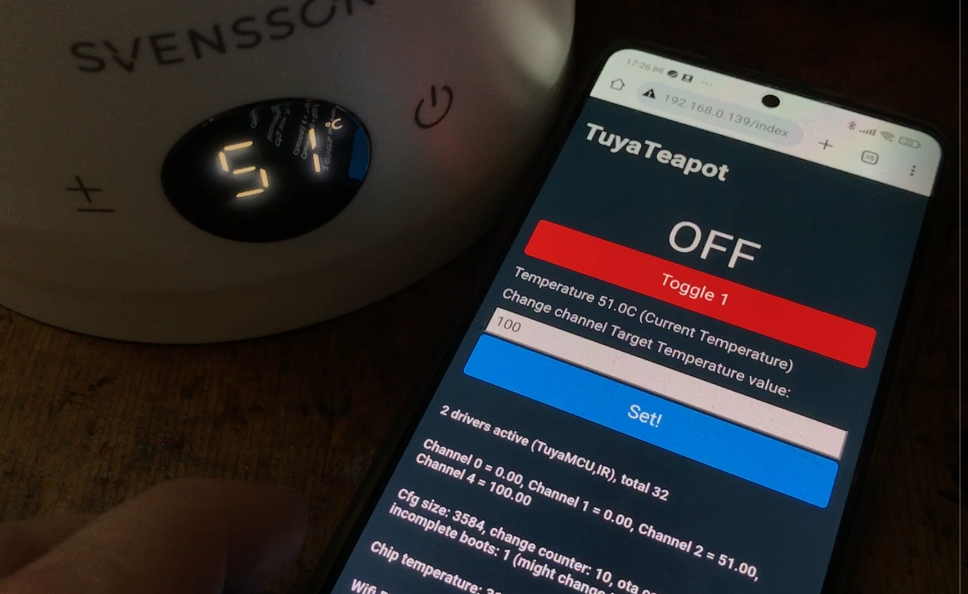
  • Svensson SMART06B kettle shows 51°C, next to a smartphone running TuyaTeapot app. .
    The Svensson SMART06B is a remote-controlled electric kettle compatible with the Tuya app. It offers control over temperature and heating time. Here I will show how its firmware can be changed to make it compatible with Home Assistant. This will also result in it being cut off from the cloud, i.e. we will gain privacy and security.

    In a previous topic I showed this kettle with the manufacturer's app. I invite you to take a look: Why Wi-Fi connectivity in an electric kettle? Svensson Tuya SMART06B test .

    The WBR3 Wi-Fi module is hidden in the handle:
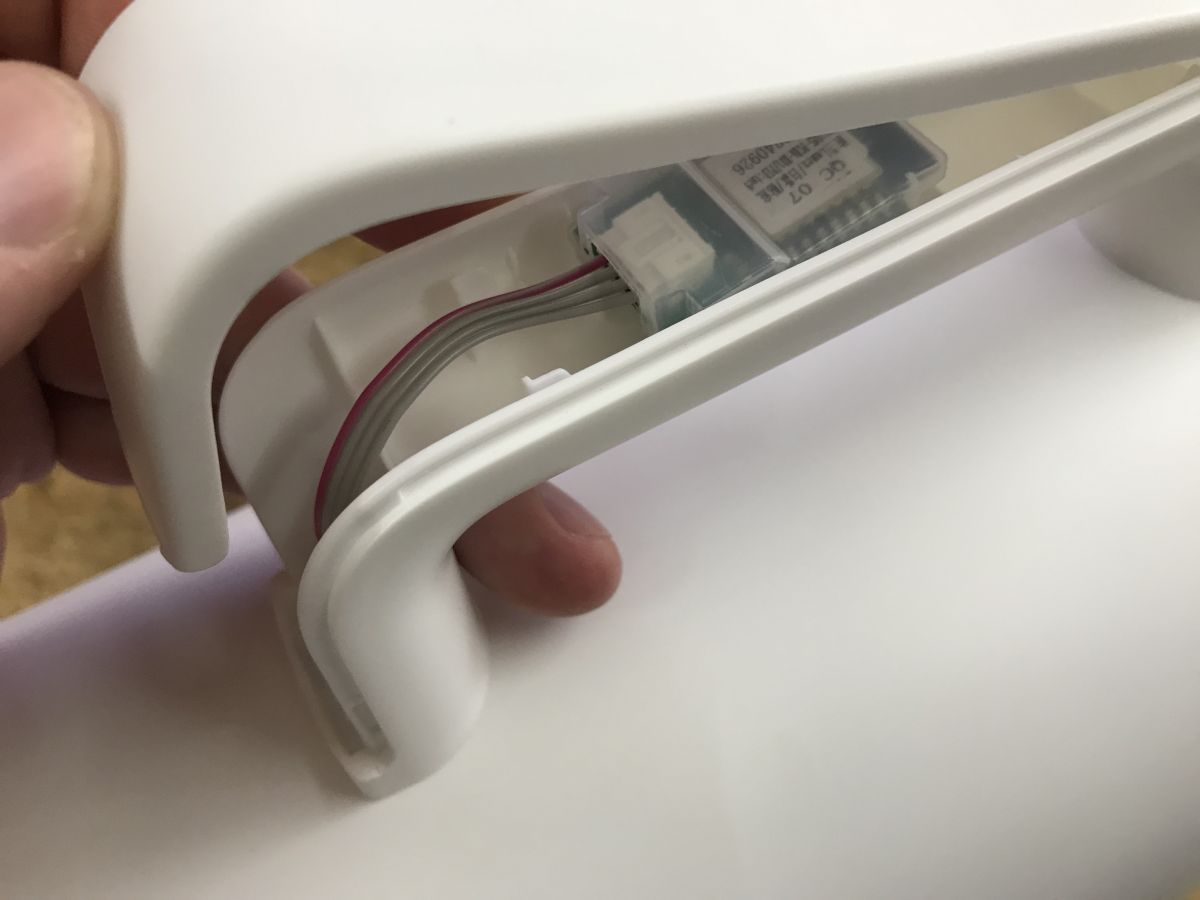
    WBR3 Wi-Fi module inside the handle of the SMART06B electric kettle .
    It needs to be unsoldered from the base, as the programming pads are on its underside:
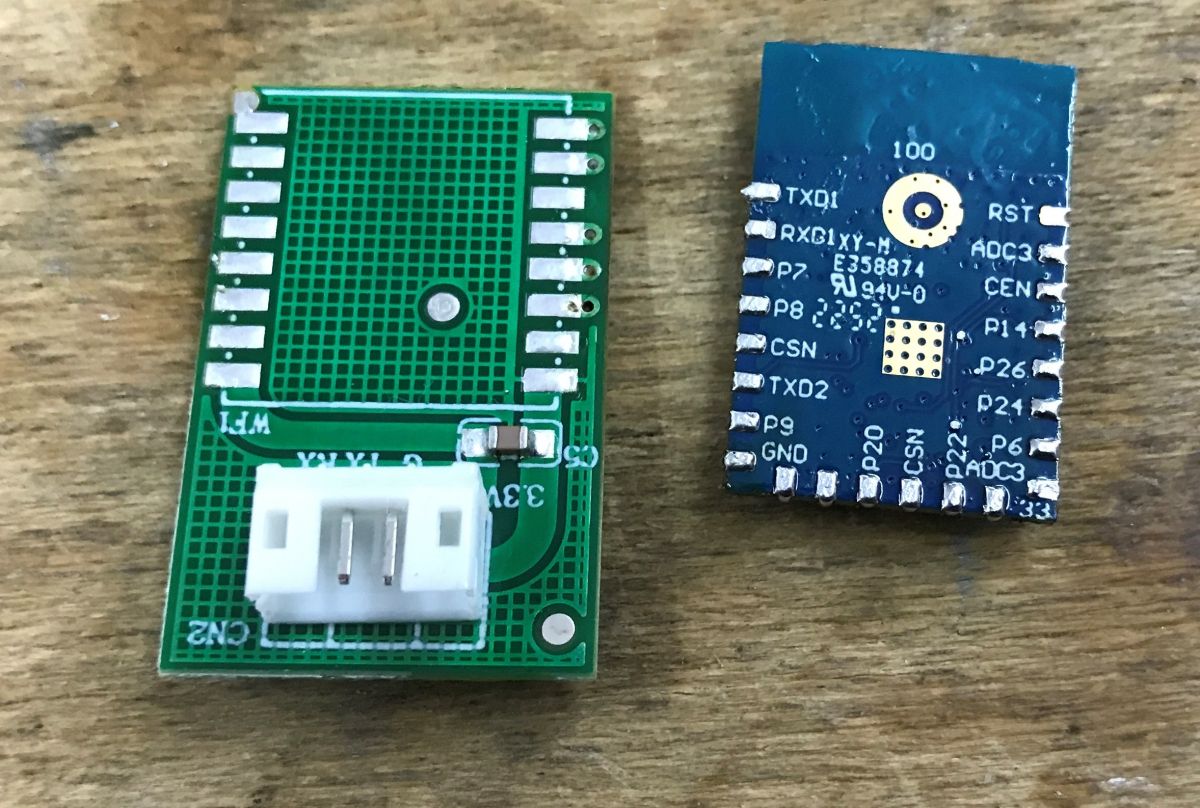
    Wi-Fi WBR3 module next to adapter board with labeled programming pins .
    Programming by topic: WBR2, WBR3, WBRU, W701-VA2-CG pinout, datasheet, flashing for Home Assistant .


    .
    Upload the OBK - even if there is a different Wi-Fi module inside, everything should already be supported: https://github.com/openshwprojects/OpenBK7231T_App
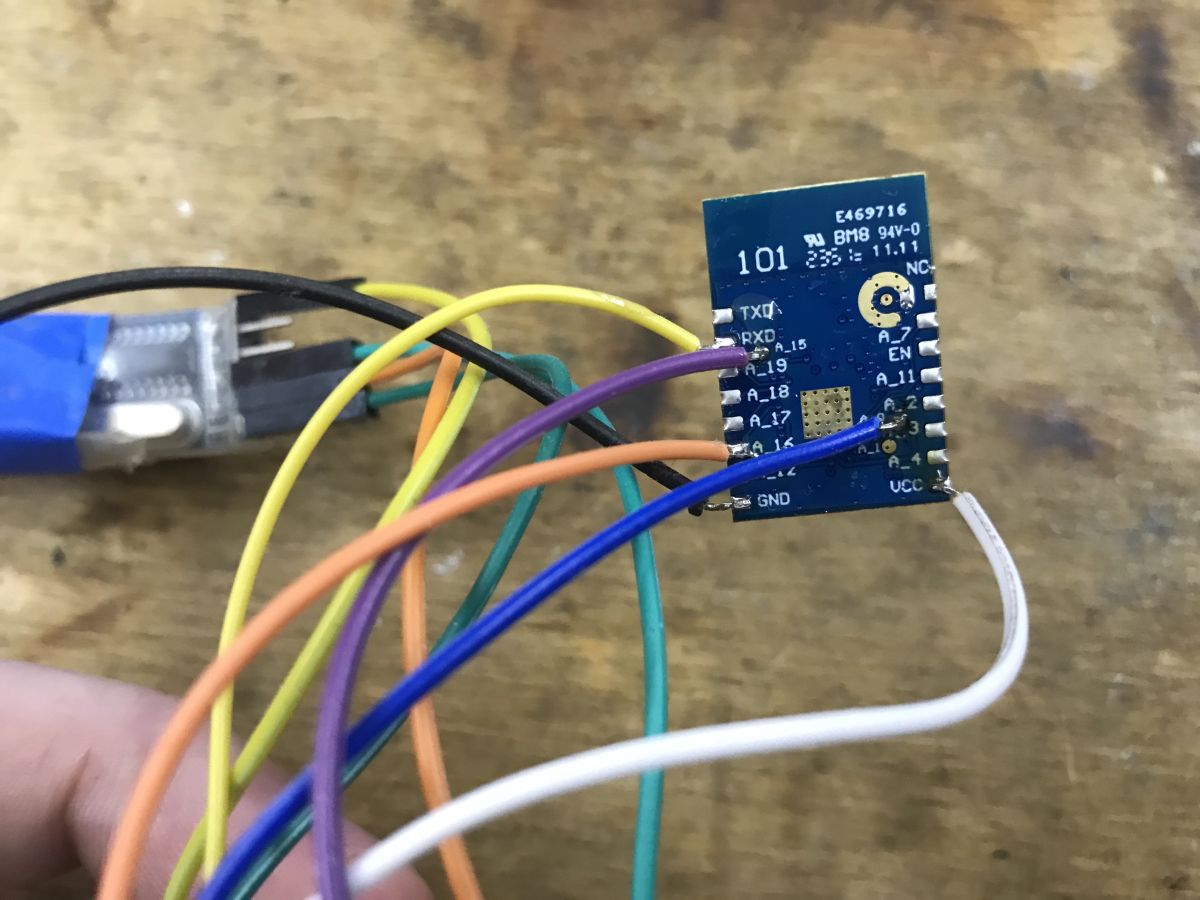
    Wi-Fi module WBR3 connected to USB programmer with wires on a wooden work surface .
    The whole thing of course needs to be properly powered - I use an external 3.3V LDO:
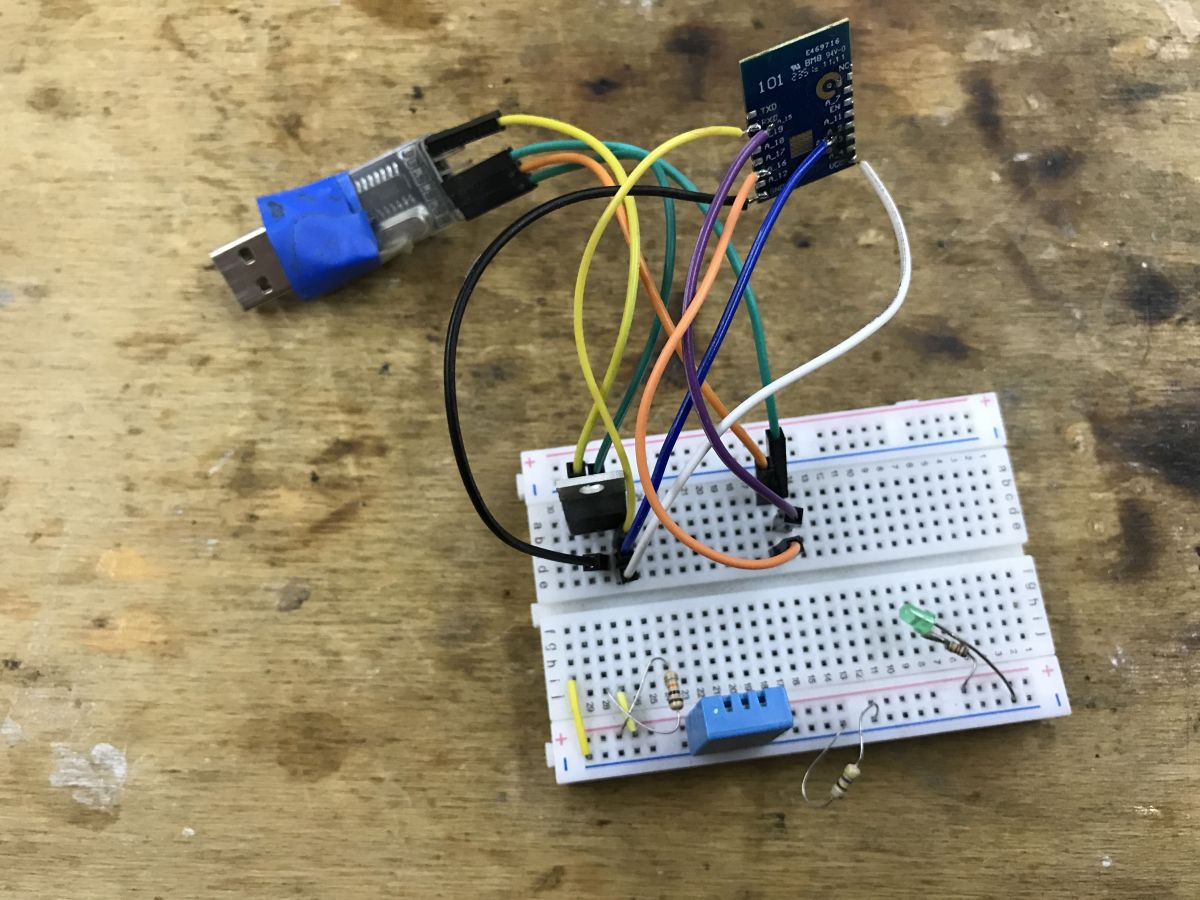
    CB3S module connected on breadboard with USB-TTL adapter and jumper wires .

    NOTE - for convenience the further part is realised on my board with CB3S, but programmatically it comes out the same - both modules are supported by OBK.

    Now you can get into the configuration. The device inside is based on an additional MCU, you should familiarise yourself with the subject:
    TuyaMCU protocol - communication between microcontroller and WiFi module .
    We now follow the TuyaMCU guide:
    TuyaMCU flashing, installation and configuration guide - configure dpID for Home Assistant .

    I personally took the method of "guessing" the dpID after flashing, so I'll describe it here. .
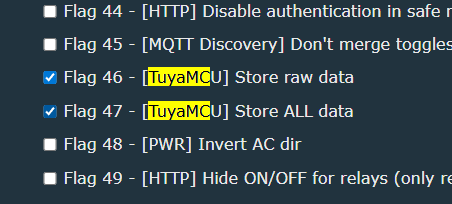
    I started by enabling the variable save flags and a simple autoexec.bat starting the driver:
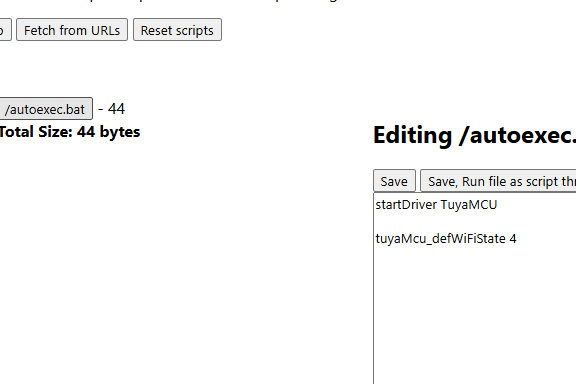
    autoexec.bat script editor with TuyaMCU commands in a web interface Checked Flag 46 and 47 options for TuyaMCU data logging in a web interface .
    After the reboot, the packets have already started to appear in the log:
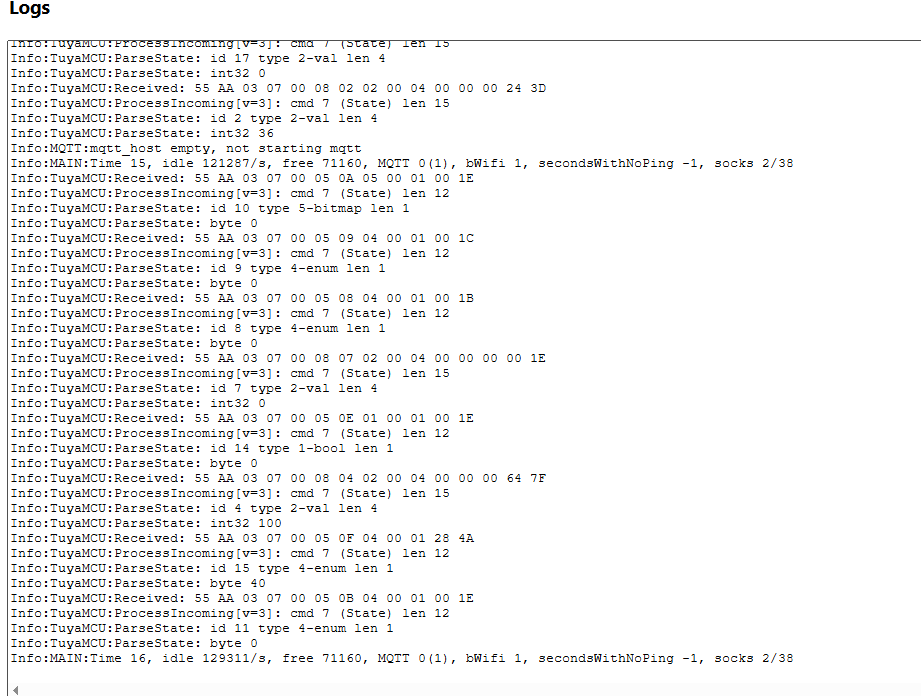
    Displayed TuyaMCU logs showing communication packets and state data .
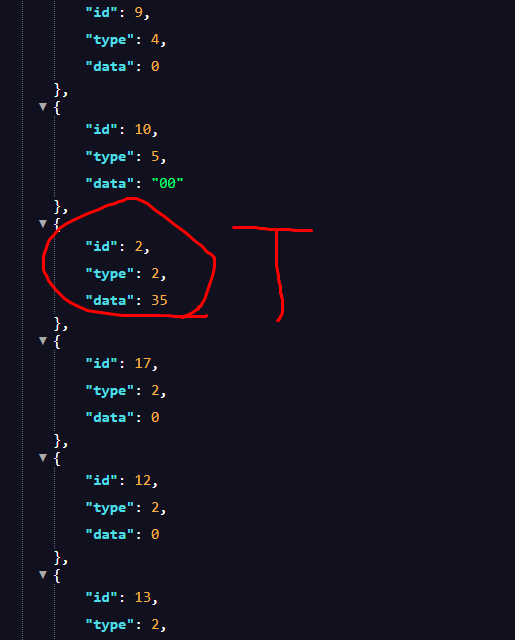
    DP command correctly returned their values in JSON format:
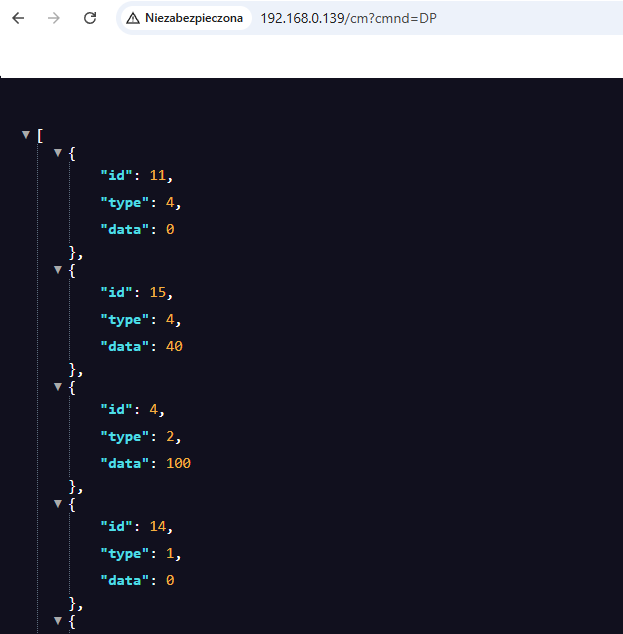
    JSON data from TuyaMCU shown in a web browser on black background JSON data snippet with entry id: 2, indicating temperature value 35, circled in red .
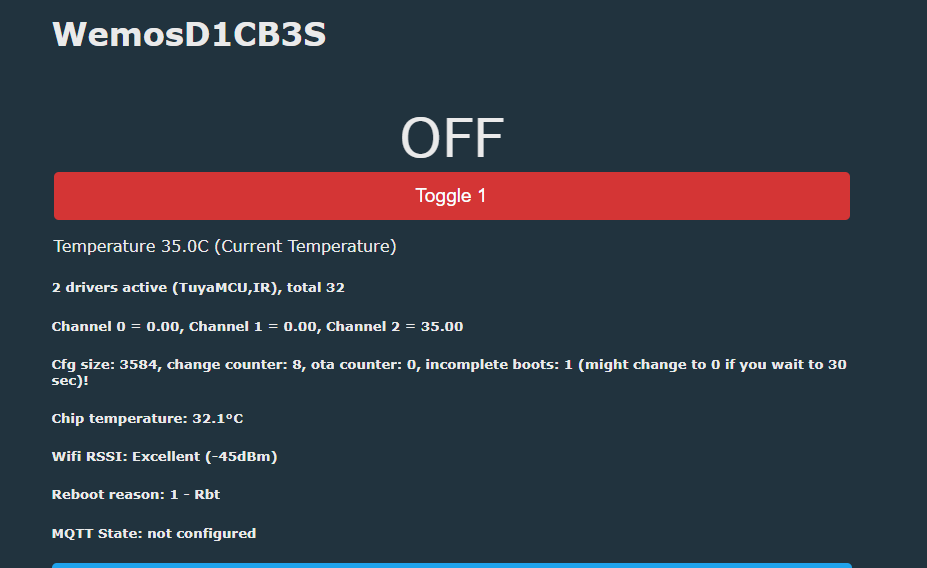
    I managed to find the current temperature there (read-only) - this is the same value as on the screen.
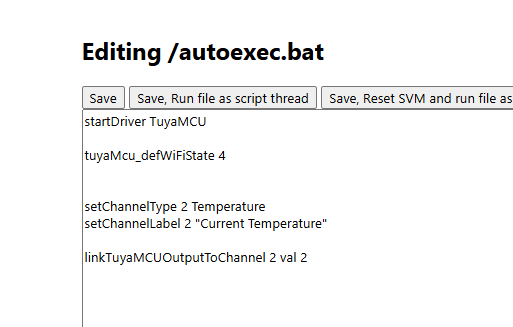
    I therefore entered its mapping into the configuration:
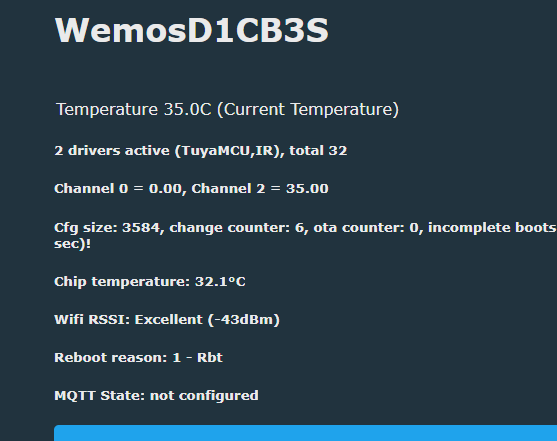
    WemosD1CB3S interface showing current temperature and diagnostic data Screenshot of editor with autoexec.bat script configuring TuyaMCU .
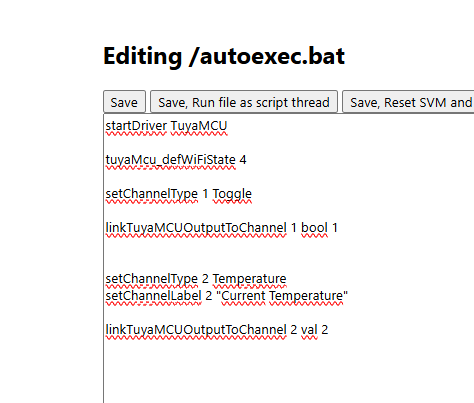
    In a similar way I found the relay state - this also gives us control, it is not a read-only variable. The type of the variable is boolean - zero or one.
    WemosD1CB3S control panel showing temperature and Wi-Fi status Screenshot of editor showing autoexec.bat script for TuyaMCU configuration .
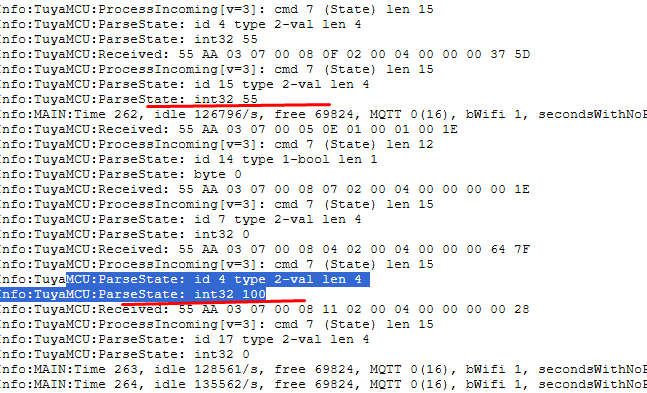
    I found the target temperature in the same way - for it I chose the form of the entry field.
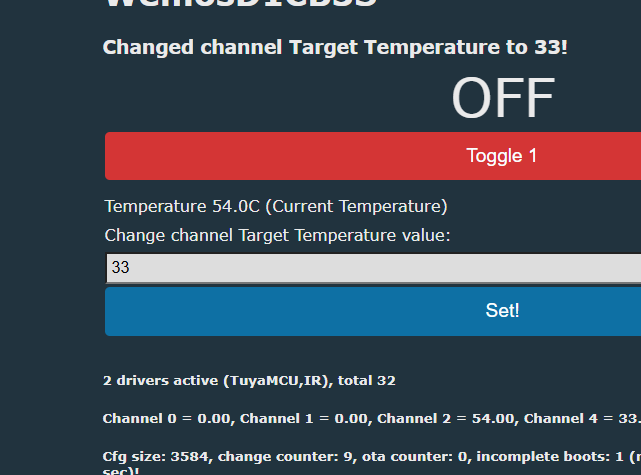
    OBK interface showing current and target temperature with relay control button TuyaMCU logs showing DP data, with highlighted field indicating target temperature value .
    The whole thing appears to be working:


    .
    Final autoexec.bat:
    
    startDriver TuyaMCU
    
    tuyaMcu_defWiFiState 4
    
    setChannelType 1 Toggle
    
    linkTuyaMCUOutputToChannel 1 bool 1
    
    
    setChannelType 2 Temperature
    setChannelLabel 2 "Current Temperature"
    
    linkTuyaMCUOutputToChannel 2 val 2
    
    
    setChannelType 4 TextField
    setChannelLabel 4 "Target Temperature"
    
    linkTuyaMCUOutputToChannel 4 val 4


    .
    You can now pair with the Home Assistant:


    .
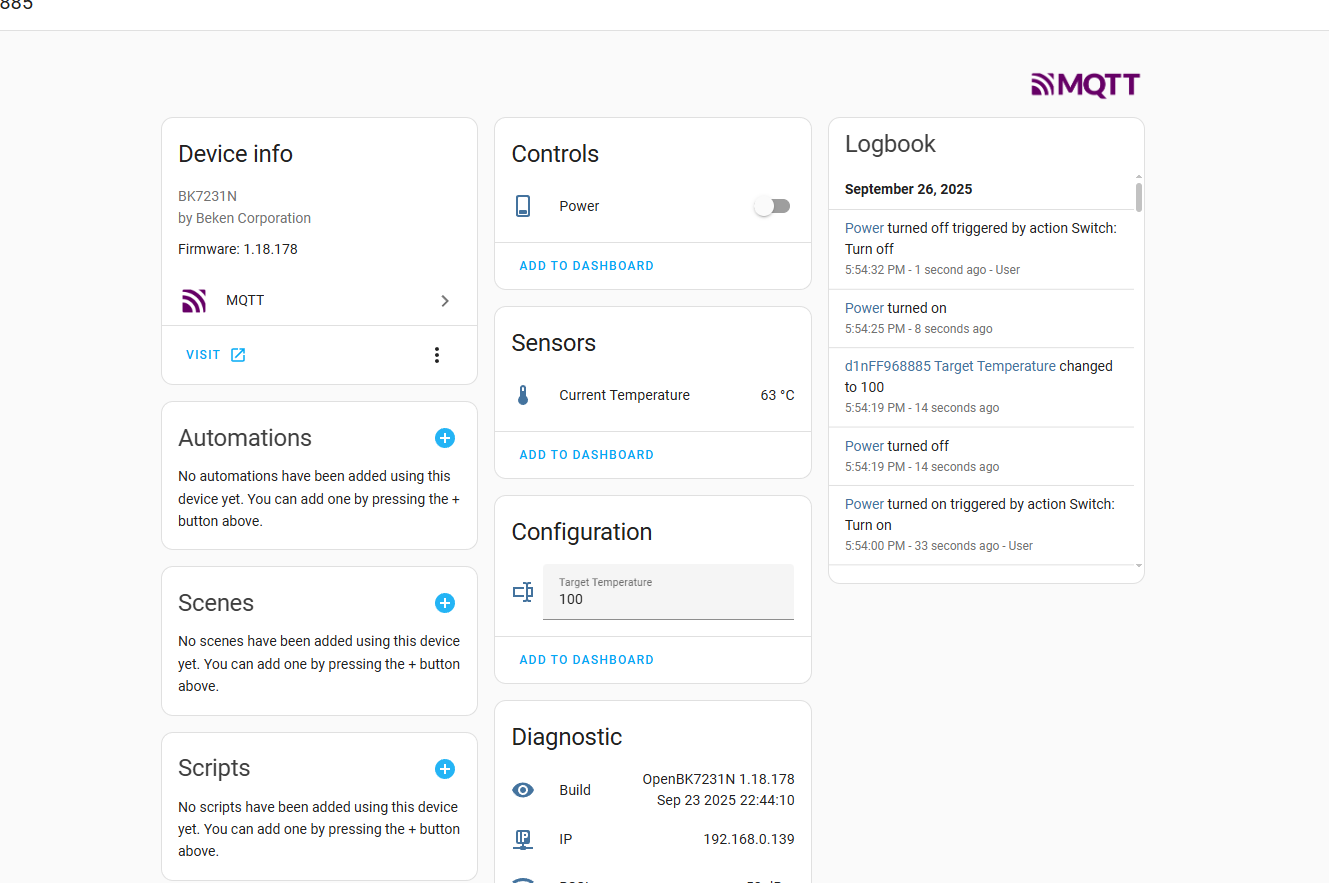
    HA panel:
    Home Assistant panel showing kettle with OpenBK7231N firmware integration .
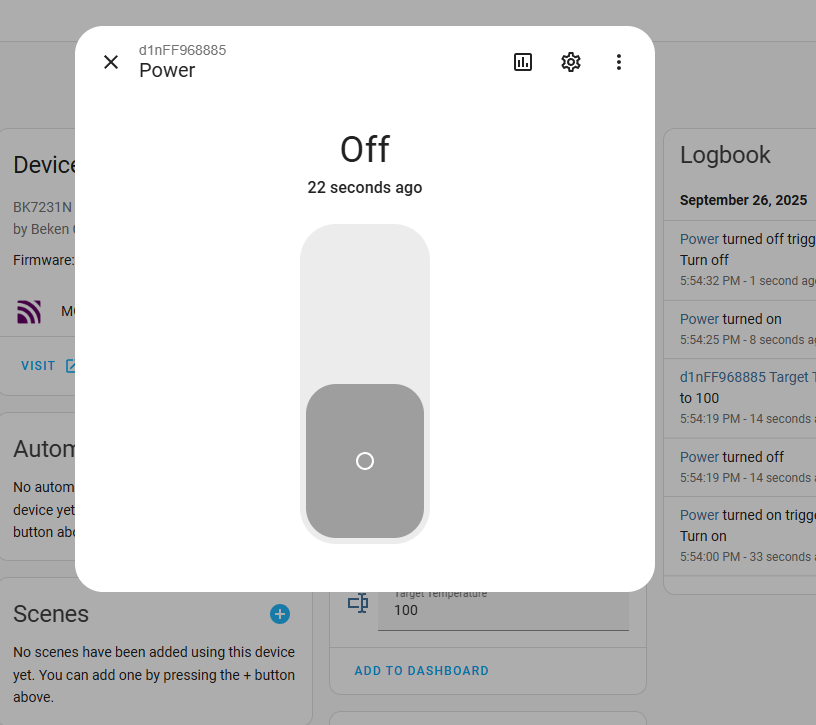
    Relay control available:
    Device control panel in Home Assistant with power switch set to Off .
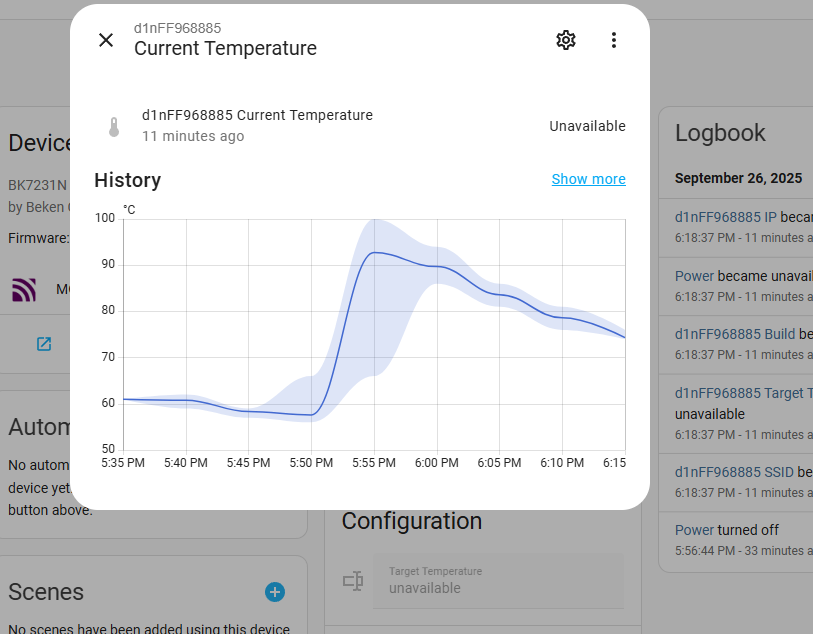
    We also have a temperature history (current and target):
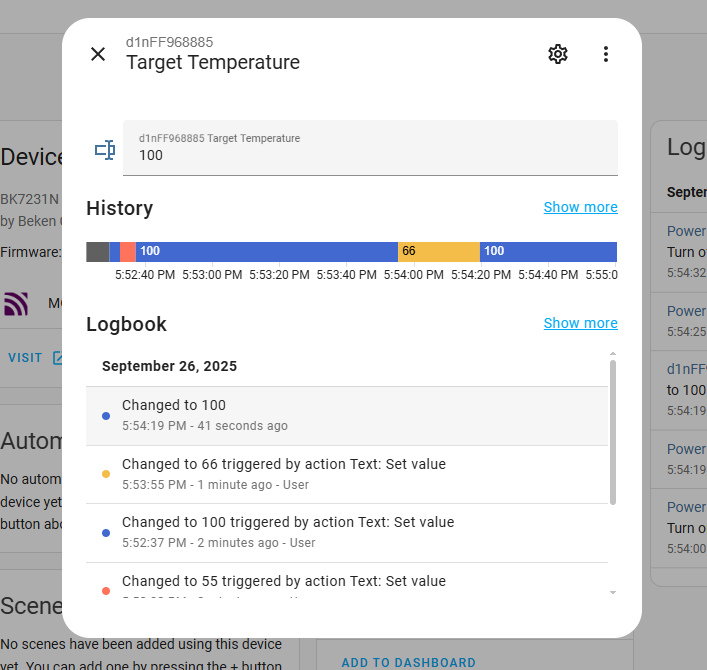
    History of kettle target temperature changes in Home Assistant panel Kettle temperature graph showing rise to around 95°C, followed by a drop .
    Basically all the basic functions work - and now the more advanced ones can be realised on automations with Home Assistant.

    Summing up , it was a pairing of the electric kettle with Home Assistant. I was able to run all its basic functions here. The more advanced stuff sewn into the TuyaMCU dpID I didn't decode, because I think that, for example, such temperature maintenance in our absence can already be realised in the HA itself.
    The biggest difficulty was the WBR3 soldering - unfortunately this module has programming pads on the bottom, so hot air is needed. It would be better to get a version with CB3S or TYWE3S etc, then programming is easier.
    Do you see a use for this type of gadget, or was it just educational fun without being reflected in practice though? .
    Whatever the intended use, the devices now operate 100% locally, no cloud, no manufacturer servers.

    Cool? Ranking DIY
    Helpful post? Buy me a coffee.
    About Author
    p.kaczmarek2
    Moderator Smart Home
    Offline 
    p.kaczmarek2 wrote 14400 posts with rating 12330, helped 650 times. Been with us since 2014 year.
  • ADVERTISEMENT
  • #2 21739960
    cranky
    Level 30  
    Posts: 2009
    Help: 68
    Rate: 372
    Board Language: polish
    But I am old. In my life I never thought someone would break into a kettle. ;)
    On the one hand, I support - if you have a smart device, it's already in a digestible version, compatible with one system and without the need for connectivity to China.
    On the other hand - what a time, I will buy a new kettle - hacking, TV - hacking, lavatory - hacking, tap - hacking. In the long run, that's not going to work.
  • #3 21894321
    Erbit
    Level 39  
    Posts: 5342
    Help: 476
    Rate: 1304
    Board Language: polish
    cranky wrote:
    On the other hand - what about the times, I'll buy a new kettle - hacking, TV - hacking, toilet seat - hacking, tap - hacking. In the long run, that's not going to work.


    You know why you think (we think) that way ? That's why -> >>21894190

    Younger generations think differently.
📢 Listen (AI):

FAQ

TL;DR: Flash the SMART06B’s WBR3 at 3.3 V, map three TuyaMCU dpIDs, and your kettle will "operate 100% locally." [Elektroda, p.kaczmarek2, post #21721813]

Why it matters: This FAQ helps tinkerers cut cloud dependence and integrate a Wi‑Fi kettle with Home Assistant for private, local control.

Quick Facts

How do I flash a Svensson SMART06B to work with Home Assistant?

Desolder the WBR3 to reach its underside pads. Power the module at 3.3 V from an external LDO. Flash OpenBeken (OBK) firmware, then configure TuyaMCU dpIDs for relay, current temperature, and target temperature. Pair with Home Assistant using the OBK integration flow. The device runs fully local after flashing. [Elektroda, p.kaczmarek2, post #21721813]

What hardware do I need to program the WBR3 safely?

Use a USB‑to‑UART adapter, 3.3 V LDO regulator, fine soldering tools, and hot air for removal. Provide stable 3.3 V during flashing and avoid powering the base. This setup mirrors the author’s build that successfully exposed dpIDs and enabled HA pairing. [Elektroda, p.kaczmarek2, post #21721813]

Where are the WBR3 programming pads and how do I access them?

They are on the underside of the WBR3, which sits in the kettle’s handle. You must unsolder the module to access the pads. Hot air is recommended to lift it cleanly without damaging tracks. This is the project’s main mechanical challenge. [Elektroda, p.kaczmarek2, post #21721813]

What is OpenBeken (OBK) and why use it here?

OpenBeken is community firmware for Tuya/Beken modules that enables local control and Home Assistant support. Flashing OBK removes cloud dependence and exposes kettle controls via channels mapped to TuyaMCU dpIDs. “Devices now operate 100% locally.” [Elektroda, p.kaczmarek2, post #21721813]

What is TuyaMCU and what are dpIDs?

TuyaMCU is the serial protocol between the device’s microcontroller and the Wi‑Fi module. dpIDs are numbered data points for features like temperature or relay. OBK links these dpIDs to channels for control and telemetry in Home Assistant. [Elektroda, p.kaczmarek2, post #21721813]

Which kettle functions can I control after flashing?

You get relay on/off control, live current temperature (read‑only), and a target temperature field. The author mapped three datapoints and confirmed control plus history in Home Assistant. That’s a 3-feature baseline without the Tuya app. [Elektroda, p.kaczmarek2, post #21721813]

How do I map TuyaMCU dpIDs to OBK channels (quick steps)?

  1. startDriver TuyaMCU, then set tuyaMcu_defWiFiState 4.
  2. Define channel types: Toggle, Temperature, and TextField.
  3. Link each dpID to its channel with linkTuyaMCUOutputToChannel. This creates relay, current temp, and target temp entities. [Elektroda, p.kaczmarek2, post #21721813]

Will Home Assistant show graphs and remote control?

Yes. After mapping, HA presents a control panel with relay switching and temperature history for current and target values. The author’s screenshots show entities and graphs operating normally after pairing. [Elektroda, p.kaczmarek2, post #21721813]

Can I keep using the Tuya app after flashing OBK?

No. This method intentionally cuts the device off from Tuya cloud. You gain privacy and local control, but you lose the vendor app. The author stresses the end state: 100% local, no manufacturer servers. [Elektroda, p.kaczmarek2, post #21721813]

What can go wrong during flashing or soldering?

Edge case: lifting pads or damaging traces while removing the WBR3. Use hot air and steady 3.3 V power. Flash only the module, not the mains base. If you want easier access, look for CB3S or TYWE3S variants. [Elektroda, p.kaczmarek2, post #21721813]

Is this mod worth it from a privacy perspective?

Yes, if you want local operation. The project removes cloud traffic and shifts automation to Home Assistant. One user notes fatigue with “hacking everything,” but agrees digestible, single‑system solutions are desirable. [Elektroda, cranky, post #21739960]

I’m new—who is this project for?

It suits tinkerers comfortable with hot‑air rework and UART flashing. If you prefer out‑of‑box convenience, consider devices already compatible with your hub. As one commenter put it, constant “hacking” can feel unsustainable. [Elektroda, cranky, post #21739960]

Do I need to guess dpIDs, or is there a guide?

The author used a practical “guessing” approach after enabling logs, then confirmed values via JSON. Linked TuyaMCU guides and logs helped identify relay, temperature, and target temperature datapoints. [Elektroda, p.kaczmarek2, post #21721813]

Is there a video walkthrough I can follow?

Yes. The thread links to videos covering module flashing and Home Assistant pairing. These visuals complement the autoexec.bat and screenshots for configuration and verification. [Elektroda, p.kaczmarek2, post #21721813]

Any performance stats after the mod?

Post‑flash, the kettle exposed three functional entities and logged temperature history in HA. Control latency appears near‑instant in the demo video. Quote: “Basically all the basic functions work.” [Elektroda, p.kaczmarek2, post #21721813]
Generated by the language model.
ADVERTISEMENT