logo elektroda
logo elektroda
X
logo elektroda

[CB3S/BK7231N] Heckermann Wifi Door Window Sensor, Model: PB69 - teardown, chang

nihildiximus 5094 13

TL;DR

  • Teardown a Heckermann Wifi Door Window Sensor PB69 and shows how to flash it with OpenBK7231T firmware.
  • Identifies the device as a CB3S (BK7231N) unit on PCB PB-69W VER 1.3 20211112 and notes the minimum firmware release as 1.17.10.
  • Helps anyone repurposing a Tuya door/window sensor, because it gives the pin mapping and setup steps needed for Wi‑Fi, MQTT, and Home Assistant use.
  • Shows that a CH340 adapter with 3.3V, GND, TX, RX, and the CEN button is enough to back up and upload firmware.
  • Warns that Home Assistant Discovery can swap the sensor values by default, so manual HA setup and a door entity class change may be needed.
ADVERTISEMENT
Treść została przetłumaczona polish » english Zobacz oryginalną wersję tematu
📢 Listen (AI):

  • Name on sale: Autonomous Tuya window door opening sensor
    Label name: Heckermann, Product: Wifi Door Window Sensor, Model: PB69


    Device photos:

    [CB3S/BK7231N] Heckermann Wifi Door Window Sensor, Model: PB69 - teardown, chang [CB3S/BK7231N] Heckermann Wifi Door Window Sensor, Model: PB69 - teardown, chang

    Disassembly photos:
    [CB3S/BK7231N] Heckermann Wifi Door Window Sensor, Model: PB69 - teardown, chang

    Microcontroller: CB3S (BK7231N)
    PCB: PB-69W VER 1.3 20211112


    [CB3S/BK7231N] Heckermann Wifi Door Window Sensor, Model: PB69 - teardown, chang [CB3S/BK7231N] Heckermann Wifi Door Window Sensor, Model: PB69 - teardown, chang

    Pin description:

    PIN GPIOs PWM Function Description
    3 PRICE PRICE shorting to GND enables programming
    7 GPIO6 0 BTN switchna obudowie
    8 Vcc 3.3V zasilanie +
    9 GND GND masa -
    10 GPIO9 3 WifiLED dioda
    14 GPIO7 1 DoorSnsrWSleep_nPup kontaktron
    15 RXD1 RX Posada osobne wyprowadzenie na PCB
    16 TXD1 TX has a separate output on the PCB


    Firmware change:

    CH340 converter is enough to change FW. We connect Vcc 3.3V, GND and TX and RX interchangeably. I didn't need an additional power source during development. A switch should be connected to the CEN and GND pins, which, when pressed, will enable downloading or uploading the FW.

    [CB3S/BK7231N] Heckermann Wifi Door Window Sensor, Model: PB69 - teardown, chang


    Download the firmware from the address: https://github.com/openshwprojects/OpenBK7231T_App/releases
    Minimum version required. 1.17.10

    I had problems with BK7231GUIFlashTool under linux via mono so I took advantage of hid_downloader_py .

    1. To make a firmware backup :
    Code: Bash
    Log in, to see the code


    ADVERTISEMENT


    2. To upload new firmware :
    Code: Bash
    Log in, to see the code


    After running the command, you need to briefly press the button connected to the CEN to start programming. After all, just unplug the device, insert the batteries, connect to the new Wifi AP and start configuration via www.


    Necessary settings:


    We connect to the Access Point of the device via Wifi and enter the configuration page: http://192.168.4.1

    We set in turn:

    1. Wi-Fi → Configure WiFi ( after confirming, we need to reconnect via the address taken from DHCP )

    2. Static IP address to speed up connection → Configure IP

    3. Sensors → Configure module :
    P6 Btn
    P7 DoorSnsrWSleep_nPup
    P9 LED

    4. Flags → Configure general/flags :
    x 35 [HASS] Deactivate avty_t flag for sensor when publishing to HASS (permit to keep value). You must restart HASS discovery for change to take effect.
    x 37 [WiFi] Quick connect to WiFi on reboot (TODO: check if it works for you and report on github)

    5. Start commands → Change startup command text : (we set the same wake-up state for each position and shorten the time to fall asleep)
    backlog DSEdge 0; DSTime 15;

    6. Device name → Configure names

    7. Connection to MQTT → Configure MQTT

    8. Home Assistant settings→ Home Assistant Configuration


    [CB3S/BK7231N] Heckermann Wifi Door Window Sensor, Model: PB69 - teardown, chang


    You can use Home Assistant Discovery to automatically add a sensor to the MQTT service, but by default the sensor values are swapped:
    Code: YAML
    Log in, to see the code


    Instead, we create a file with the sensor ourselves and add it manually to the HA configuration:

    Code: YAML
    Log in, to see the code


    And in HA itself, we change the entity class to "door" to improve the way it is displayed.

    Cool? Ranking DIY
    About Author
    nihildiximus
    Level 9  
    Offline 
    nihildiximus wrote 32 posts with rating 23, helped 1 times. Live in city Wrocław. Been with us since 2018 year.
  • ADVERTISEMENT
  • #2 20546826
    p.kaczmarek2
    Moderator Smart Home
    Very good material, at the beginning I will only add that disabling the addition availability can also be implemented through a flag, according to:
    https://github.com/openshwprojects/OpenBK7231T_App/blob/main/docs/flags.md
    Quote:

    35 [HASS] Deactivate avty_t flag for sensor when publishing to HASS (permit to keep value). You must restart HASS discovery for change to take effect.

    In addition, it will come in handy:
    Quote:

    37 [WiFi] Quick connect to WiFi on reboot (TODO: check if it works for you and report on github)

    (but flag number 37 will be enabled by default soon).
    Helpful post? Buy me a coffee.
  • ADVERTISEMENT
  • #3 20546971
    gulson
    System Administrator
    Great, thanks for the presentations, if you write me a PM with a parcel locker, I'll send a gift :)
  • ADVERTISEMENT
  • #4 20548376
    nihildiximus
    Level 9  
    >>20546826
    Entry completed :)
  • #5 20593817
    kasa
    Level 13  
    Hello ,
    I was able to successfully change the software, unfortunately I entered the MQTT data incorrectly and I can't change it, I still have old data, re-uploading does not help, it does not open a new WLAN network, but everything is the same as the old one, what is the recipe to clear it?
    it's about USER and PASSWORD
  • ADVERTISEMENT
  • #6 20593887
    p.kaczmarek2
    Moderator Smart Home
    Turning the power on and off five times will force open the configuration AP, where you can change the settings, according to the FAQ: https://github.com/openshwprojects/OpenBK7231T_App/blob/main/docs/faq.md
    [CB3S/BK7231N] Heckermann Wifi Door Window Sensor, Model: PB69 - teardown, chang
    In addition, the latest flasher also allows you to load/edit/save the OBK config from the UART:
    https://github.com/openshwprojects/BK7231GUIFlashTool
    Helpful post? Buy me a coffee.
  • #7 20594426
    kasa
    Level 13  
    Thanks, it helped

    Ultimately, I would like to have it in IOBROKER, maybe some other config?
  • #9 20594546
    kasa
    Level 13  
    I'm all about that PB69,
    I admit it's my first contact with OBeken, I work with various "sonofs" and Tasmota all the time, Iobroker is running on Proxmox in a "container"
    I have different door sensors but at 433 mHz and they would be useful for WLAN. Should the LED on the PB69 flash?
  • #10 20628197
    Jagis
    Level 10  
    Hi,
    I have a problem with the door/window open/close sensor. The manufacturer is Melink, on the PCB I found only such information as MC400D-A002 and the production date 20210910. The sensor has a CB3S module, I installed OpenBK7231N_QIO_1.17.152 on it and configured it according to dumb matched with tuya, it also has a hall sensor.
    I have a problem with waking up the sensor, if it goes into deepsleep when it is open, the wakeup works properly, but if it goes into deepsleep when it was closed then it does not wake up after applying the magnet. Only waking up open/closed with a physical button works correctly.
    Sensor photo:
    [CB3S/BK7231N] Heckermann Wifi Door Window Sensor, Model: PB69 - teardown, chang
    Template:
    {
      "vendor": "Tuya",
      "bDetailed": "0",
      "name": "Full Device Name Here",
      "model": "enter short model name here",
      "chip": "BK7231N",
      "board": "TODO",
      "flags": "1024",
      "keywords": [
        "TODO",
        "TODO",
        "TODO"
      ],
      "pins": {
        "7": "Btn;1",
        "8": "DoorSnsrWSleep;2",
        "14": "BAT_Relay;4",
        "23": "BAT_ADC;5",
        "26": "WifiLED_n;3"
      },
      "command": "backlog DSEdge 0; DSTime 15;",
      "image": "https://obrazki.elektroda.pl/YOUR_IMAGE.jpg",
      "wiki": "https://www.elektroda.com/rtvforum/topic_YOUR_TOPIC.html"
    }


    I put dumb tuya in the attachment. readResult...-08-38.bin (2 MB)You must be logged in to download this attachment.
  • #11 20628332
    p.kaczmarek2
    Moderator Smart Home
    Hello @Jagis, this issue was discussed with @nihildiximus in this thread:
    https://www.elektroda.pl/rtvforum/topic3971140-0.html
    But in short, you just probably need to change the DSEdge setting to something else. While you actually have DSEdge 0 at the moment, you'll have to try to see if DSEdge 1 or DSEdge 2 works better.

    Just remember that the startup command, as the name suggests, is executed at device startup. So if you change it and don't do Restart, then in this session (before reboot) setting won't run. So after changing the commands I recommend to reboot.

    PS: It's very good that you also set the Button role, because without it, in case of problems with DSEdge, you wouldn't be able to wake up the device and you would have to remove the batteries.
    Helpful post? Buy me a coffee.
  • #12 20748384
    andrewishy2
    Level 2  
    I have the same device, this is what I did to make the purple board work...

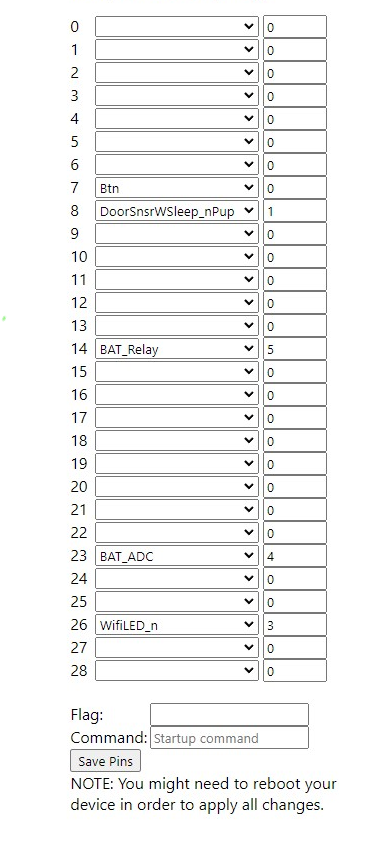
    Set the I/O to the following
    Screenshot showing the configuration of device input/output settings with various values assigned to each field.

    And the following in the autoexec.bat
    DSTime 5
    DSEdge 1
    addEventHandler OnHold 7 DSTime 600

    Edit 1 - I got it working
    Edit 2 - Added reduced the wait time in autoexec.bat to 5 seconds and added a handler so if you press the button it stays up for 600 seconds
  • #13 20753721
    jnoam
    Level 3  
    Hi,
    I have what seems to be the same board (purple one). I configured as suggested by @andrewishy2 and want to ask if you see the same behavior (which might be OK for you?):
    1. The module wakes up both from the open or closed positions (this is good)
    2. Update delay in MQTT (probably due to wakeup/boot process) takes about 9-10 seconds
    3. This time delay, which may by itself not be problematic for an alarm detection, creates this problem: the window can be opened and closed during this period and then I do not get any notification on the event
    4. My use case (a "welcome" message displayed when opening the door) requires shorter delay. Does that mean I cannot use deep sleep? what is the energy penalty if anyone knows?
    5. I am not getting the battery status on the MQTT though the device log shows it - channel 5 is always 0.
    6. pushing the button does wake up the device but it does not stay on for 600 seconds as I thought it should (am I missing the point?)
  • #14 20754824
    andrewishy2
    Level 2  
    2. Mine has some delay while it gets on the wifi network. However, I have set a static IP address so that it should not be waiting for DHCP.

    4. I have some zigbee door sensors, they are more expensive but work much quicker with a local home assistant running

    5. The battery numbers didn't work until I powered the device with a battery, when I was powering it from the USB serial device it didnt show the power or voltage.
    6. Did you put the following in the autoexec.bat file? "addEventHandler OnHold 7 DSTime 600" This is what makes it stay up for 600 seconds
📢 Listen (AI):

Topic summary

✨ The discussion revolves around the Heckermann Wifi Door Window Sensor, Model PB69, which utilizes the CB3S (BK7231N) microcontroller. Users share experiences related to software modifications, including issues with MQTT configuration and deep sleep functionality. Solutions include resetting the device by cycling power and using specific commands in the autoexec.bat file to manage wake-up behavior and event handling. Users also discuss integration with IOBROKER and the performance of similar devices, highlighting delays in notifications and battery status reporting. Various troubleshooting tips and configuration settings are provided to enhance device functionality.

FAQ

TL;DR: Deep-sleep current is only 6 µA [BK7231N Datasheet, 2022]. "Turning the power on and off five times will force open the configuration AP" [Elektroda, p.kaczmarek2, post #20593887] Flash OpenBK7231 ≥1.17.10, set pins P6/P7/P9, and use DSEdge to fine-tune wake-up.

Why it matters: These tweaks cut setup time, save battery life, and keep the €8 sensor fully local.

Quick Facts

• MCU: Beken BK7231N @ 120 MHz (CB3S module) [Elektroda, nihildiximus, post #20546781] • Flash voltage: 3.3 V only; no extra PSU needed [Elektroda, nihildiximus, post #20546781] • Minimum firmware: OpenBK7231T 1.17.10 [Elektroda, nihildiximus, post #20546781] • Reset: 5 power cycles reopen setup AP [Elektroda, p.kaczmarek2, post #20593887] • Typical online price: €8–€10 [Amazon.de listing, 2024]

What hardware sits inside the Heckermann PB69 door/window sensor?

The board carries a CB3S module with a 32-bit BK7231N Wi-Fi SoC, on-board PCB antenna, a magnetic-hall door sensor, tactile push-button on GPIO6, red status LED on GPIO9, and a 3 V battery holder [Elektroda, nihildiximus, post #20546781]

How do I flash OpenBK7231 firmware onto the CB3S?

  1. Wire Vcc 3.3 V, GND, TXD1↔RX, RXD1↔TX, and short CEN to GND.
  2. Run ./uartprogram -d /dev/ttyUSB0 -b 128000 -u -w OpenBK7231T_UA_1.17.10.bin.
  3. Tap the CEN switch once to start flashing; unplug after success [Elektroda, nihildiximus, post #20546781]

Which exact pins must I connect for UART flashing?

Pin 8 (Vcc 3.3 V), Pin 9 (GND), Pin 15 (RXD1), Pin 16 (TXD1); keep Pin 3 shorted to GND while flashing to enter bootloader mode [Elektroda, nihildiximus, post #20546781]

How can I back up the original Tuya firmware before modding?

Use the same UART link and execute ./uartprogram -d /dev/ttyUSB0 -b 115200 -s 0x00 -u -r backup-fw.bin to read out the full flash image [Elektroda, nihildiximus, post #20546781]

The sensor sleeps closed and never wakes—what fixes it?

Adjust the wake edge: set DSEdge 1 or DSEdge 2 in autoexec.bat, then reboot. Users report restored wake-ups from both open and closed states after the change [Elektroda, p.kaczmarek2, post #20628332]

Battery voltage always reads 0—what am I missing?

BAT_ADC only reports with a real battery connected. Insert the cell and map GPIO23 (or 14 on some boards) to BAT_ADC; the value then appears on MQTT channel 5 [Elektroda, andrewishy2, post #20754824]

Should the LED flash on door activity?

Yes. Assign GPIO9 to LED or WifiLED_n; the diode blinks during Wi-Fi join and on state changes. No flash indicates a wrong role or damaged LED [Elektroda, nihildiximus, post #20546781]

Can I use the PB69 with ioBroker instead of Home Assistant?

Absolutely. Expose the same MQTT topics (doors_front/0/get, etc.) and add a state object in ioBroker’s MQTT adapter. No firmware change is required; only topic mapping differs [ioBroker Docs, 2024].

What power draw should I expect?

OpenBK deep-sleep averages 6 µA; active Wi-Fi peaks near 40 mA [BK7231N Datasheet, 2022]. At two events per hour, a 1000 mAh cell can last over one year.

What can go wrong during flashing and how do I recover?

Edge-case: feeding 5 V to Vcc can permanently damage the MCU. Mis-swapped TX/RX or forgetting to ground CEN only blocks flashing; the bootloader remains intact—rewire and retry at 3.3 V [Elektroda, nihildiximus, post #20546781]
ADVERTISEMENT