FAQ 
TL;DR: TR6260 flashing works locally with OpenBeken: the chip has 1 MB flash, and one contributor confirmed, "TR6260 can now be flashed via UART" using UTP, boot_nocrc.bin, a partition file at 0x6000, and OpenTR6260 at 0x7000. This FAQ is for repairers and Home Assistant users who need the real boot procedure, pinout, backup method, and OTA caveats. [#21351236]
Why it matters: This thread turns TR6260 from a poorly documented Tuya module into a repeatable, cloud-free platform for local automation.
| Topic |
TR6260 / TR6260S1 |
ECR6600 / AXY family |
| Main flashing path discussed |
UTP over UART with boot_nocrc.bin |
SDK mentioned, but no equivalent flashing guide completed |
| Confirmed OpenBeken work |
Yes, with OpenTR6260 builds |
Related SDK mentions exist, but support is less mature in-thread |
| Typical modules named |
HLK-M20, XY-WE2S-A V1.1 |
AXY3L, AXY2S, WG236 |
| OTA discussion depth |
Extensive, including FotaPKG v1/v3 and diff tooling |
Mostly tooling comparison and SDK relation |
Key insight: The critical step is choosing the right boot strap and file layout. Grounding the correct boot pin before power-on decides whether TR6260 enters normal SPI boot, UART flashing mode, SDIO mode, or an unsupported state. [#21405320]
Quick Facts
- TR6260 is described as a 32-bit, 2.4 GHz Wi‑Fi SoC with 6 PWM, 1 ADC, and 1 MB flash, which sets the practical backup size and OpenBeken image layout. [#21351236]
- A valid full factory dump is exactly 1,048,576 bytes; the read operation was reported to take about 2–3 minutes in UTP. [#21351236]
- The proven OpenTR6260 write layout is:
boot_nocrc.bin at 0x0000, partition binary at 0x6000, and firmware at 0x7000. [#21351236]
- On one real XY-WE2S-A module, boot logs were readable at about 58,000–59,000 baud rather than standard 57,600, which helped confirm the selected boot mode. [#21405320]
- One module showed a reported RSSI drop from about -56/-57 dBm on original firmware to -71 dBm on OpenTR6260 at 1.5 m from the router. [#21421792]
1. How do I flash a TR6260 or TR6260S1 device with OpenBeken using the UTP flash tool and a USB-to-UART adapter?
Use UTP with a 3.3 V USB-to-UART adapter and the TR6260 boot pin grounded at power-on. 1. Solder TX, RX, GND, 3.3 V, and the boot pin connection. 2. Power on with GPIO14/TOUT2 grounded, then load
boot_nocrc.bin, the partition file, and
OpenTR6260_xxxx.bin into UTP. 3. Flash, remove the boot strap, reboot, join the new AP, and open
192.168.4.1. The thread says TR6260 can be flashed fully locally and paired with Home Assistant without Tuya cloud access.
[#21351236]
2. What is the correct boot mode procedure for TR6260, and how do GPIO14/TOUT2, BT0, and BT1 affect spi-flash, UART, SDIO, and unsupported boot modes?
TR6260 enters different boot modes solely from the boot strap pins at startup. On HLK-M20, grounding GPIO14/TOUT2 before power-on was used for the documented flashing workflow. On XY-WE2S-A, BT0 low gave UART boot, both pins floating gave SPI-flash boot, BT1 low gave SDIO boot, and BT0+BT1 low produced
unsupported boot mode with
bootrom startup err. The same post also notes readable boot logs around 59,000 baud when checking these states.
[#21405320]
3. Where can I download the TR6260 UTP flash tool, boot_nocrc.bin, and the partition files needed for OpenTR6260 flashing?
Download them from the FlashTools package linked in the thread. The UTP utility is not
esptool, because TR6260 is not an ESP chip. The post points to the TransaSemi-ESWIN FlashTools repository and an alternate TR6260 resource pack, and it states that
boot_nocrc.bin comes from the same zip as UTP. That same package also includes the partition binaries used at address
0x6000.
[#21351236]
4. Which files and flash addresses should I use in UTP for TR6260 flashing, including boot_nocrc.bin, the partition binary at 0x6000, and the OpenTR6260 firmware at 0x7000?
Use three files in UTP:
boot_nocrc.bin at
0x0000, the partition binary at
0x6000, and
OpenTR6260_xxxx.bin at
0x7000. The flashing guide originally named
new_partition_0x6000.bin, and a later thread update says a new partition filename was added to each FlashTools zip for the same
0x6000 slot. Do not rely on an old extra File_4 entry; the thread later says that advice needs revision.
[#21725879]
5. How can I make a full 1MB factory backup dump from a TR6260 before flashing OpenBeken, and how do I verify the dump is valid?
Make the dump in UTP with the device in the documented boot state and set the read length to
0x100000. 1. Ground GPIO14/TOUT2 before power-on. 2. In UTP, select
boot_nocrc.bin, choose a PC save path, and read the full flash. 3. Verify that the resulting file is exactly
1,048,576 bytes. The guide states the flash is 1 MB, and the read may appear stalled for 2–3 minutes before finishing.
[#21351236]
6. Why does restoring a full TR6260 backup fail unless boot_nocrc.bin is also selected first at address 0x0000 in UTP?
It fails because UTP first needs the RAM-loaded boot helper before it can write the rest of the image. A later confirmation showed you can restore the whole 1 MB backup from
0x0000, but only if
boot_nocrc.bin is also selected first at
0x0000. With only the backup file chosen, UTP returned
RAM Download uboot file fail;. That error explains why whole-image restores looked broken until the boot file was added back into the list.
[#21407688]
7. What is the real pinout of the XY-WE2S-A V1.1 TR6260S1 module, and why does it differ from the published TR6260 and TR6260S1 datasheets?
The real XY-WE2S-A V1.1 pinout was traced from the PCB and does not match the published datasheets. The mapped functions were TX0=
UART0_TXD, RX0=
UART0_RXD, BT1=
TOUT3, BT0=
TOUT2, PWM2=
GPIO22, PWM1=
GPIO4, PWM0=
GPIO13, CEN=
RESETB, PWM5=
GPIO0, PWM4=
GPIO1, ITX=
GPIO3, and IRX=
GPIO2. The author explicitly says the chip pinout on real modules conflicts with both the TR6260 and TR6260S1 documents, and even with earlier forum images.
[#21405320]
8. Can someone find a TR6260S1 datasheet that matches the real pinout seen on HLK-M20 and XY-WE2S-A modules?
No matching TR6260S1 datasheet was found in the thread. One contributor explicitly said they tried and failed to find a datasheet consistent with the traced “real” pinout. Another earlier note says HLK-M20 showed the same mismatch problem. So the practical guidance in this thread is to trust traced module pads and boot logs over the published TR6260 pin tables when flashing real hardware.
[#21405320]
9. What is SSDP in OpenBeken on TR6260, and why did enabling multicast in LWIP fix SSDP and Wemo discovery?
"SSDP is a network discovery protocol that advertises devices over multicast, enabling local services such as Wemo and Alexa discovery on the LAN." On TR6260, SSDP initially failed because
setsockopt IP_ADD_MEMBERSHIP failed, which means multicast join did not work. After enabling multicast in LWIP, the log changed to
Socket created, waiting for packets, and Wemo discovery succeeded, including Alexa finding the device. The thread links that fix directly to the multicast setting change.
[#21367101]
10. What is the FotaPKG v1 versus v3 OTA format on TR6260, and how does ota_tool choose between the different TR6260 and ECR6600 packaging methods?
TR6260 uses two discussed diff OTA containers: FotaPKG
0x01 as “v1” and FotaPKG
0x03 as “v3”. A reverse-engineered summary in the thread says
ota_tool detects the board from the target firmware header, then maps
diff to method
3 by default. That makes TR6260 use
sw_pack_file_trdiff_package_new() and emit FotaPKG v3. Patching one byte changed
diff to method
1, forcing the older TR6260 v1 path instead. ECR6600 uses different packers for AB, CMZ, and diff modes.
[#21842600]
11. TR6260 vs ECR6600/AXY modules: what are the differences in SDK support, module availability, and firmware tooling discussed in the thread?
TR6260 had a working OpenBeken flashing path in-thread, while ECR6600 discussion stayed closer to SDKs and module sourcing. The thread names ECR6600-based AXY modules such as AXY3L and AXY2S and mentions Skylab WG236 hardware. It also says an SDK readme mentioned TR6260 support, but that support seemed removed later. Price comments show ECR6600 modules were harder to justify, with examples around
$14.5 + ~$8 shipping,
$18 + $10 shipping, and
$26 shipped.
[#21358543]
12. Why does Wi-Fi RSSI look much weaker on OpenTR6260 than on the original Tuya firmware, even when the device is close to the router?
The thread reports the issue, but it does not give a confirmed root cause. One tested switch showed about
-71 dBm on OpenTR6260 versus
-56 to
-57 dBm on original firmware at only
1.5 meters from the router. Reflashing the original full 1 MB backup and then OpenTR6260 again did not fix the lower reported RSSI. The open question was whether RF calibration data, measurement reporting, or another firmware setting caused the difference.
[#21421792]
13. How do I configure DHT11, BME280/BMP280, DS18B20, or SHT3X sensors on OpenTR6260, and what should I check if a driver is missing from the build?
DHT11 and BME280/BMP280 were shown working, while DS18B20 was noted as unchanged and SHT3X prompted build-option discussion. For BME280/BMP280, the thread gives
startdriver bmpi2c 0 1 2 3 4 in
autoexec.bat. If a sensor driver is missing, check whether it is enabled in
obk_config.h; that was stated directly for BMPI2C. A later post also asks why SHT3X was not exposed as
ENABLE_DRIVER_SHT3X, linking it to a pull request.
[#21367101]
14. What's going on with GPIO13, GPIO16, and GPIO17 on TR6260, including the relay fix PR and the SDK limitation that says some pins cannot be used as normal GPIO?
GPIO13 needed a relay-output fix, and that pull request was later merged, after which the affected switch worked correctly on official builds. GPIO16 and GPIO17 are different: the SDK code says they cannot be used as normal GPIO, and one contributor confirmed there is no general initialization path for them. The thread also notes special functions exist such as
gpio16_write,
gpio17_write, and
gpio17_read, which suggests limited, nonstandard handling rather than full GPIO support.
[#21419965]
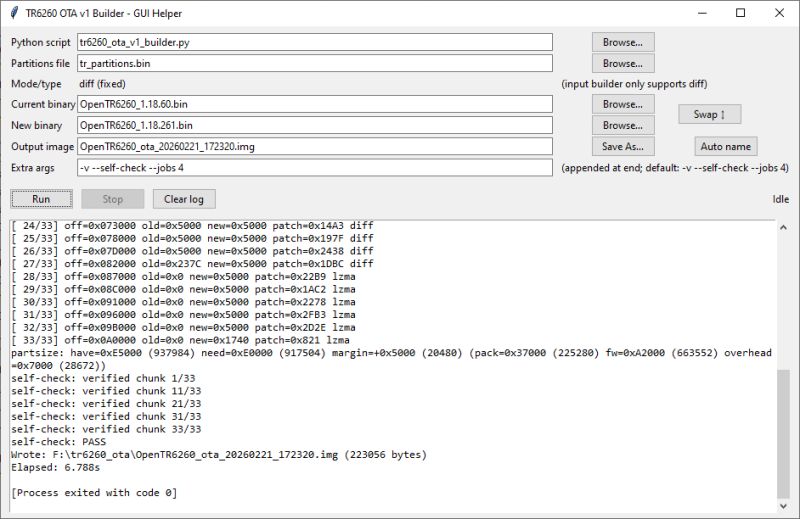
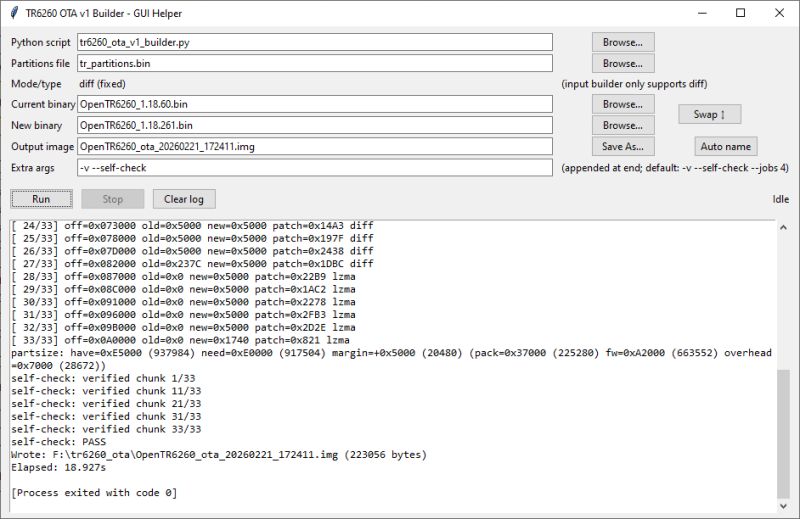
15. How can I build and apply OTA updates for TR6260 with Python or ota_tool, and why do some OTA patches fail around 81% or produce an unbootable device?
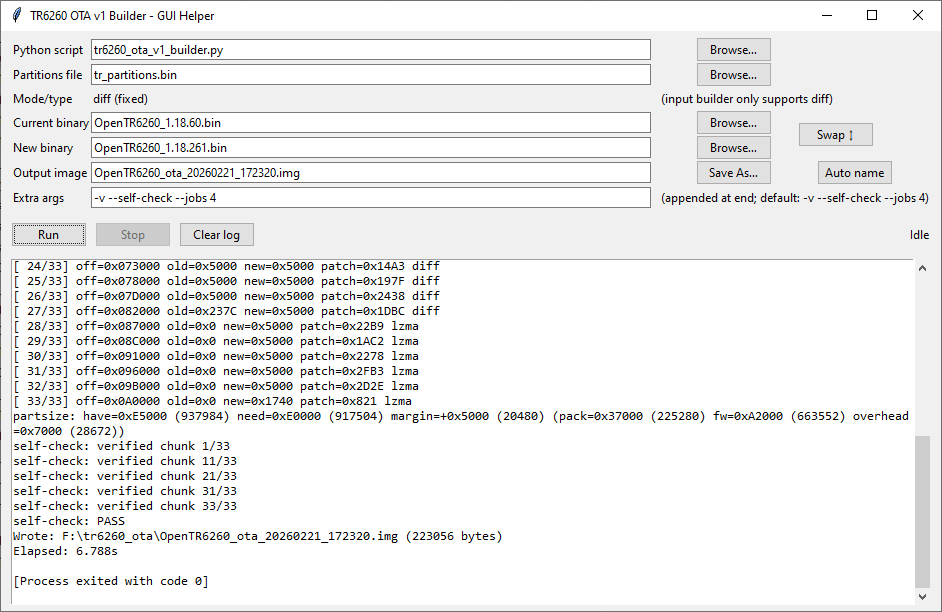
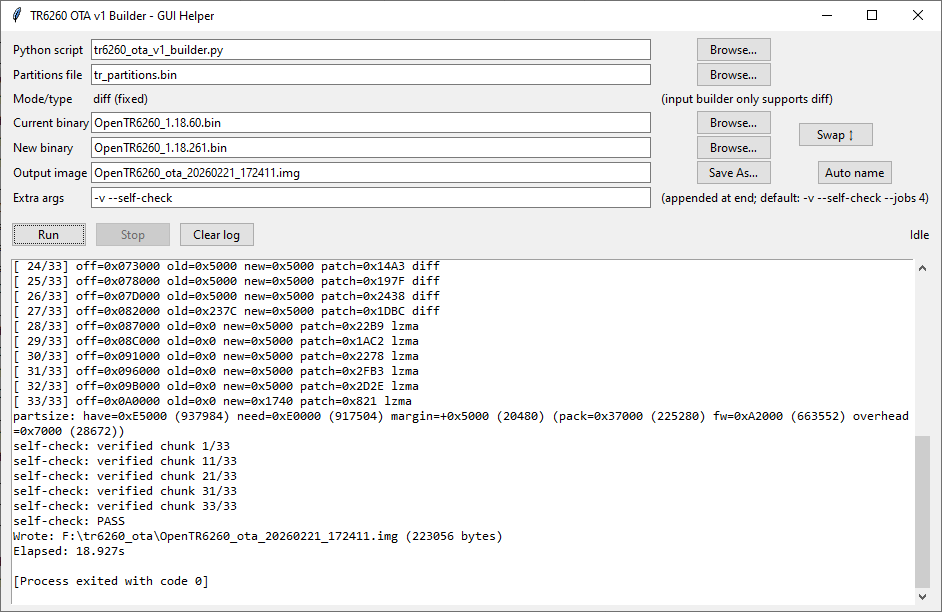
You can build TR6260 OTA diffs with either patched
ota_tool or later Python builders, but large version jumps remained fragile. One contributor reported successful Python-generated packages as small as
40,544 bytes, while another saw failures around
81% during updates such as
1.18.80 -> 1.18.261. The thread also records cases where a generated patch passed self-check yet left the device unbootable. The likely cause is package-format or compression edge cases, since the original tool produced a working patch only
2,464 bytes lighter than the failing Python one.
[#21844134]
AI summary based on the discussion. May contain errors.