logo elektroda
logo elektroda
X
logo elektroda

OpenBeken configuration for WiFi universal IR remotes from aliexpress (S06, S18, IRC02) with BK7231

Lexcis 16704 50

TL;DR

  • OpenBeken configurations target AliExpress WiFi universal IR remotes: TUYA Home Smart Life Mini Universal IR Remote S06, S18, and Intelligent WiFi IR Remote Control IRC02.
  • The main value is board-specific pinout guidance for button, WiFi LED, IR RX, and IR TX wiring.
  • S06 uses BK7231T [WB3S] with GPIOP_6 button, GPIOP_8 IR RX, GPIOP_9 WiFi LED, and GPIOP_26 IR TX.
  • S18 uses BK7231N [CB3S] with GPIOP_6 button, GPIOP_7 IR RX, GPIOP_8 WiFi LED, and GPIOP_26 IR TX.
  • IRC02 uses BK7231N [CB3S] with GPIOP_6 button, GPIOP_7 WiFi LED, GPIOP_24 IR RX, and GPIOP_26 IR TX, but the PCB mixed up the Rx and Tx labels.
Generated by the language model.
ADVERTISEMENT
📢 Listen (AI):

  • I ordered some WiFi universal IR remotes on AliExpress and want to share my experiences from flashing OpenBeken on them.
    Here are some pinouts for configuration and other hints:


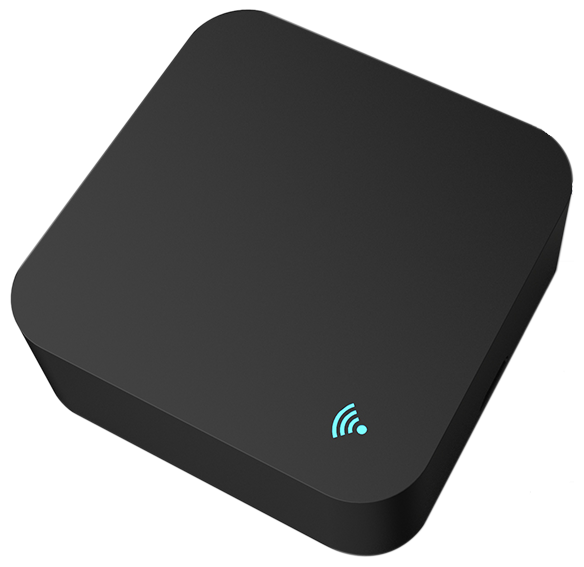
    TUYA Home Smart Life Mini Universal IR Remote S06 (BK7231T) [WB3S]
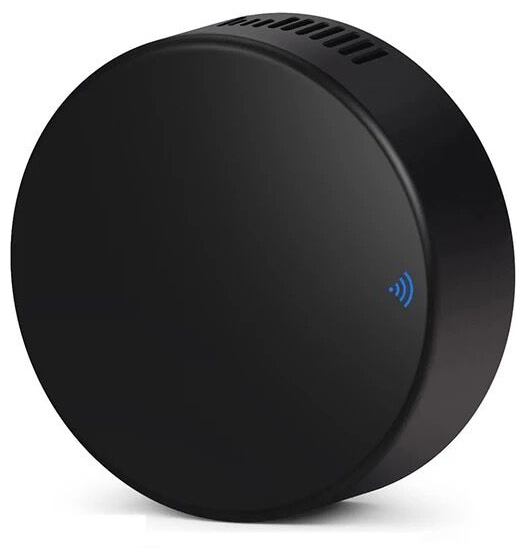
    Black square IR WiFi remote with illuminated blue WiFi symbol.
    Button: GPIOP_6
    IR RX: GPIOP_8
    WiFi LED: GPIOP_9
    IR TX: GPIOP_26


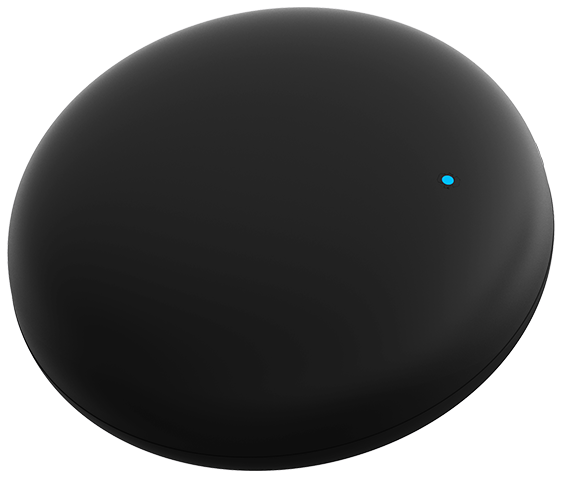
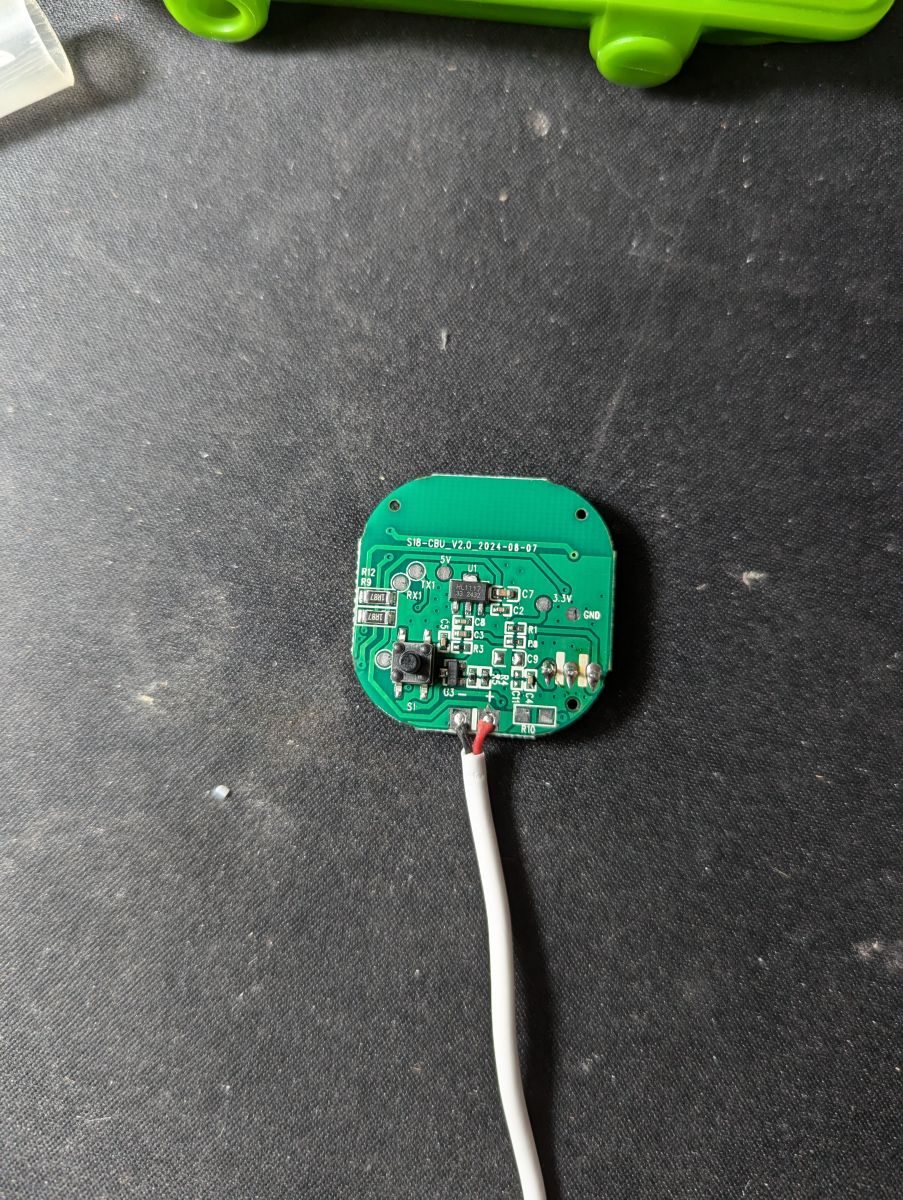
    TUYA Home Smart Life Mini Universal IR Remote S18 (BK7231N) [CB3S]
    Black, round universal IR remote with a blue LED.
    Button: GPIOP_6
    IR RX: GPIOP_7
    WiFi LED: GPIOP_8
    IR TX: GPIOP_26
    Important notice for flashing: In my case labeling of Rx and Tx was mixed up on PCB


    TUYA Home Smart Life Intelligent WiFi IR Remote Control IRC02 (BK7231N) [CB3S]
    Black, round universal IR remote with a blue LED indicator.
    Button: GPIOP_6
    WiFi LED: GPIOP_7
    IR RX: GPIOP_24
    IR TX: GPIOP_26
    Attachments:
    • irc02.json.txt (499 Bytes) You must be logged in to download this attachment.
    • s18.json..txt (484 Bytes) You must be logged in to download this attachment.
    • s06.json.txt (484 Bytes) You must be logged in to download this attachment.

    Cool? Ranking DIY
    About Author
    Lexcis
    Level 2  
    Offline 
    Lexcis wrote 2 posts with rating 3. Been with us since 2023 year.
  • ADVERTISEMENT
  • #2 20717191
    p.kaczmarek2
    Moderator Smart Home
    Posts: 14615
    Help: 655
    Rate: 12632
    Thank you, can you also post JSON configs from Web App so I can just copy-paste them to our devices list?

    Futhermore, are you sure that you got BK7231N in a WB3S form? Usually WB3S i BK7231T, and CB3S is BK7231N.
    Helpful post? Buy me a coffee.
  • #3 20717271
    Lexcis
    Level 2  
    Posts: 2
    Rate: 3

    Sorry, checked it again and you are right: Both of them are BK7231T. I have corrected my post.
    Sure, I will add the JSON code shortly.
  • #4 20717335
    p.kaczmarek2
    Moderator Smart Home
    Posts: 14615
    Help: 655
    Rate: 12632
    Okay, no problem, I was just asking because we really already had a batch of devices that were using CB2S with BK7231T inside, which was very, very strange and confusing for our users, because you have to choose the correct platform at the time of the flashing. So far I haven't seen any other swaps like that.
    Helpful post? Buy me a coffee.
  • #5 20760495
    p.kaczmarek2
    Moderator Smart Home
    Posts: 14615
    Help: 655
    Rate: 12632
    JSONs were added to our teardowns list. Thank you! Now we have more than 400 devices in our Elektroda database!
    Helpful post? Buy me a coffee.
  • ADVERTISEMENT
  • #6 20765817
    morgan_flint
    Level 14  
    Posts: 251
    Help: 4
    Rate: 59
    In case you have a TH06 but the JSON posted in this thread doesn't work for you, maybe it's because you have the same PCB but a different Wi-Fi module. See here for more details.
  • #7 20782871
    sergeyhatunzev
    Level 2  
    Posts: 2
    Please send the original firmware here I need any version except 2.0.0 . I write through a translator so there may be errors, thank you in advance. S06CB3S
  • #8 20783326
    morgan_flint
    Level 14  
    Posts: 251
    Help: 4
    Rate: 59
    sergeyhatunzev wrote:
    Please send the original firmware here I need any version except 2.0.0 . I write through a translator so there may be errors, thank you in advance. S06CB3S

    Hello, in case it's suitable for you (or anybody else), I've added the original FW of my device to my other post about it.

    Anyway, take into account that my device has a WB3S module instead of the CB3S, although the PCB's silkscreen is "S06-CB3S-V1.1", check if yours have the same module as my photos in the other post before flashing.

    P.S: My edit adding the FW to the other post is awaiting moderation, so just now you can't see the FW. I don't know how much it will delay
  • #9 20858490
    sterium
    Level 2  
    Posts: 4
    >>20717083
    Sorry I am new from openbk the configuration file "s18.json.txt" where do you put?
  • #10 20858630
    p.kaczmarek2
    Moderator Smart Home
    Posts: 14615
    Help: 655
    Rate: 12632
    You can import pins that way:


    Or here is standalone converter:
    https://openbekeniot.github.io/webapp/templateImporter.html
    Helpful post? Buy me a coffee.
  • ADVERTISEMENT
  • #12 20892177
    SteIta
    Level 6  
    Posts: 8
    Rate: 1
    Hello, i flash s18 via ota CloudCutter, using firmware 2.0.
    Purchased for 1.80 euros on Aliexpress from Spain to Italy
    I use this for test, i am new from openbk and flashing.
    Thanks Lexcis
  • #13 20892227
    p.kaczmarek2
    Moderator Smart Home
    Posts: 14615
    Help: 655
    Rate: 12632
    Hello @steltad , can I help you somehow? Have you seen our IR tutorial?


    Helpful post? Buy me a coffee.
  • #14 20982644
    nacxoffw
    Level 5  
    Posts: 13
    Rate: 1
    Hi!

    I have one tuya IR Remote working with config like this post and embembed in HomeAssistant.

    Working!!!

    My question... How to send as mqtt topic the irCode getted by the sensor? Instead of check device logs... Send the data to a topic.

    IR pinouts not allow define Channel so...
  • #15 20997557
    baudneo
    Level 6  
    Posts: 17
    Help: 1
    Rate: 5
    nacxoffw wrote:
    Hi!

    I have one tuya IR Remote working with config like this post and embembed in HomeAssistant.

    Working!!!

    My question... How to send as mqtt topic the irCode getted by the sensor? Instead of check device logs... Send the data to a topic.

    IR pinouts not allow define Channel so...


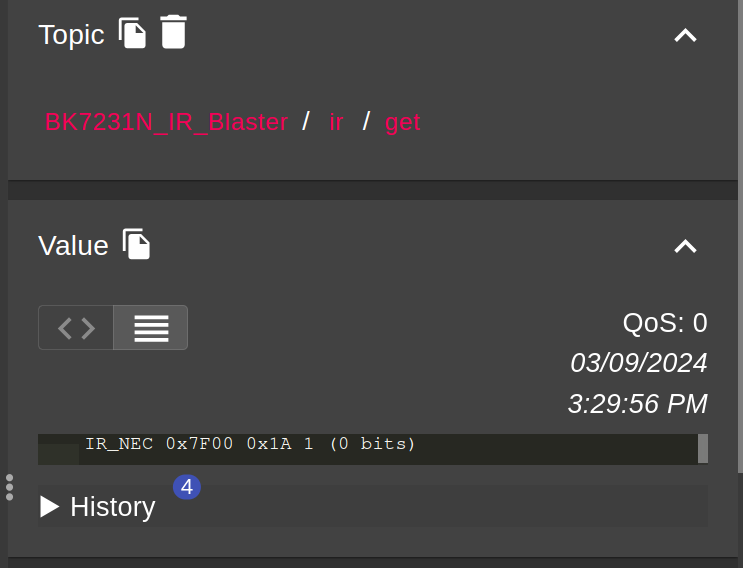
    You need to set Flag 14 in the config>Configure General/Flags and then it will publish IR codes to <dev id>/ir/get

    User interface displaying IR code reading for BK7231N_IR_Blaster.
  • #16 21156018
    carlig833
    Level 7  
    Posts: 23
    Help: 1
    Rate: 5
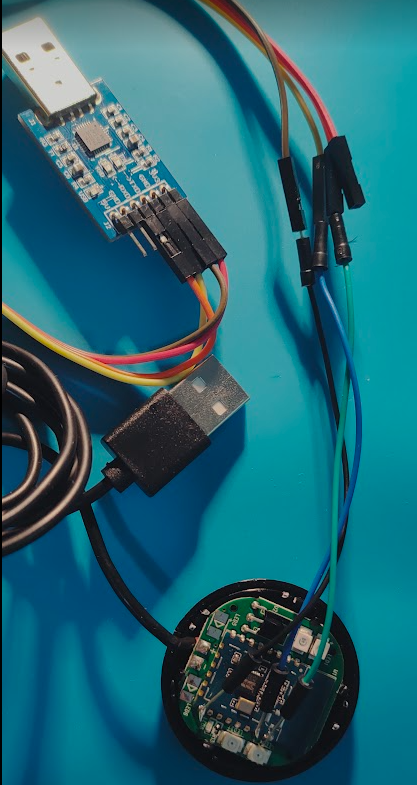
    I have one of these devices (CB3S, BK7231N), but I am confused about how this is supposed to be flashed.
    According to the second youtube video in this thread I should connect TX1, RX1 and GROUND pin to USB-to-UART converter. I did this.
    Then I should power on, off and then on again the device using its own USB cable. I did this.
    However the BK7231 Easy UART Flasher continues to output the following messages:

      Getting bus failed, will try again - 91/100!
      Getting bus failed, will try again - 92/100!


    I had some experience with smoke sensors, based on the same chip and in that case it was necessary to connect the CEN line and breafily connect it to the ground, but this is not mentioned in this guide and I am pretty confused right now. May I get any help?

    [img] Module connected to a USB to UART converter with wires. [/img]
  • #17 21156029
    baudneo
    Level 6  
    Posts: 17
    Help: 1
    Rate: 5
    If it's not entering bootloader mode on its own, then try the CEN to ground method.
  • #18 21156054
    carlig833
    Level 7  
    Posts: 23
    Help: 1
    Rate: 5
    Thanks for answer. Unfortunatly the CEN to GROUND trick does not work either.
    What is nonsense to me is having the device powered separately via its own USB cable, but also connected via USB-to-UART.
    Would not be more straightforward to power it via the USB-to-UART device as we do for smoke and water sensor?
    In that case on which CB3S PIN should I provide the 3.3V coming from USB-to-UART?
  • #19 21156073
    baudneo
    Level 6  
    Posts: 17
    Help: 1
    Rate: 5
    Yes, you can power it from the usb to TTL converter. The usb power is just for convenience.

    I haven't had any issues flashing obk to several devices now, sounds like maybe there's a hardware issue or something.
  • #20 21156442
    p.kaczmarek2
    Moderator Smart Home
    Posts: 14615
    Help: 655
    Rate: 12632
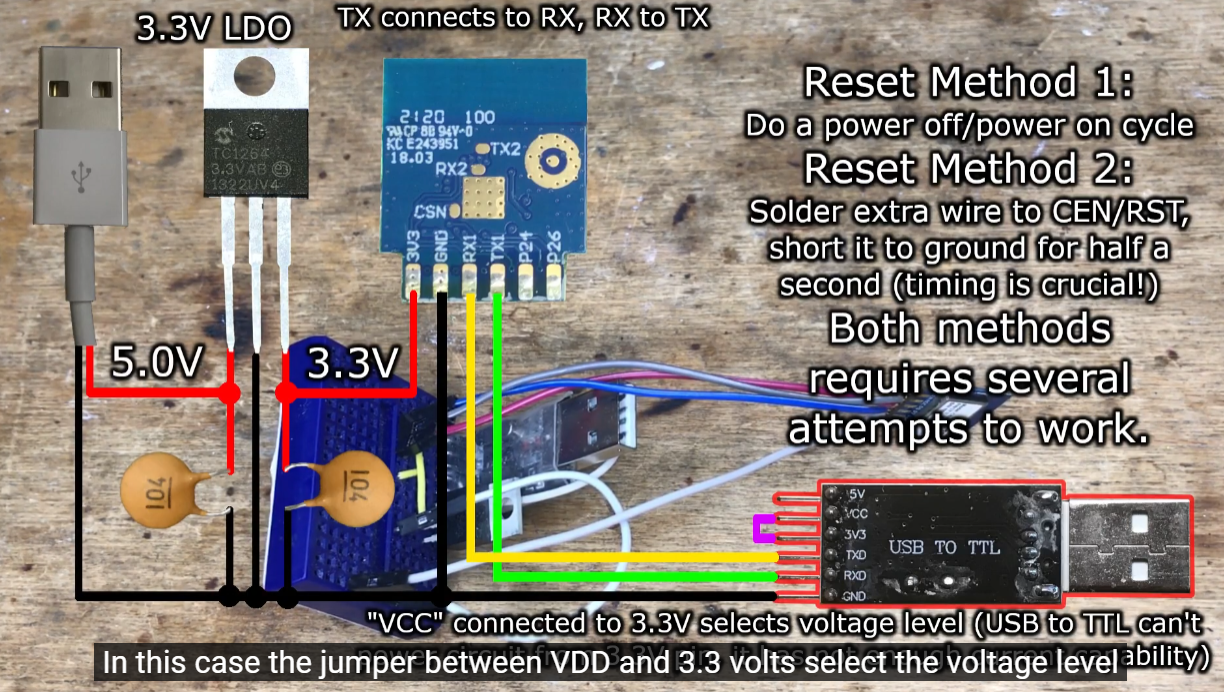
    I'm afraid that you actually can't reliably power it from USB to UART converter. It does not have enough current capability. In our videos, we always use external 3.3V supply:
    https://www.youtube.com/watch?v=L6d42IMGhHw&list=PLzbXEc2ebpH0CZDbczAXT94BuSGrd_GoM
    Diagram of USB to UART converter connection with an external 3.3 V power supply and reset methods.
    Helpful post? Buy me a coffee.
  • #21 21160214
    carlig833
    Level 7  
    Posts: 23
    Help: 1
    Rate: 5
    I fixed a bad soldering on TX/RX pins and I flashed firmware BK7231N version 1.17.645 of my S18 IR receiver.

    Tested with Remote A it works fine and I can see lines printed in logs:

    Info:IR:IR IR_Sony 0x1 0x15 1 (12 bits)


    Tested with Remote B I cannot see any line printed. Remote B seems not compatible.
    Reverted to Tuya firmware and tested the IR learning mode with Remote B it works!

    How can I troubleshoot why OBK firmware is not receiving IR events sent by Remote B?
  • #22 21160223
    divadiow
    Level 38  
    Posts: 5062
    Help: 438
    Rate: 893
    if you check this flag then try again do you see any entries in the logs?

    Screenshot showing an option labeled Flag 15 - [IR] Allow 'unknown' protocol with a checkbox.
  • #23 21161550
    carlig833
    Level 7  
    Posts: 23
    Help: 1
    Rate: 5
    Yes, I can now see a log line printed. Whatever button I press the line looks always the same:

    Info:IR:IR IR_UNKNOWN 0x0 0


    There is something that I can actively do on my side to have this remote supported?
    It is a very old remote for a TECO Air Conditioning system, so there are low chances that it will be added by someone else in the future.
  • ADVERTISEMENT
  • #24 21279517
    agudelotmateo
    Level 2  
    Posts: 2
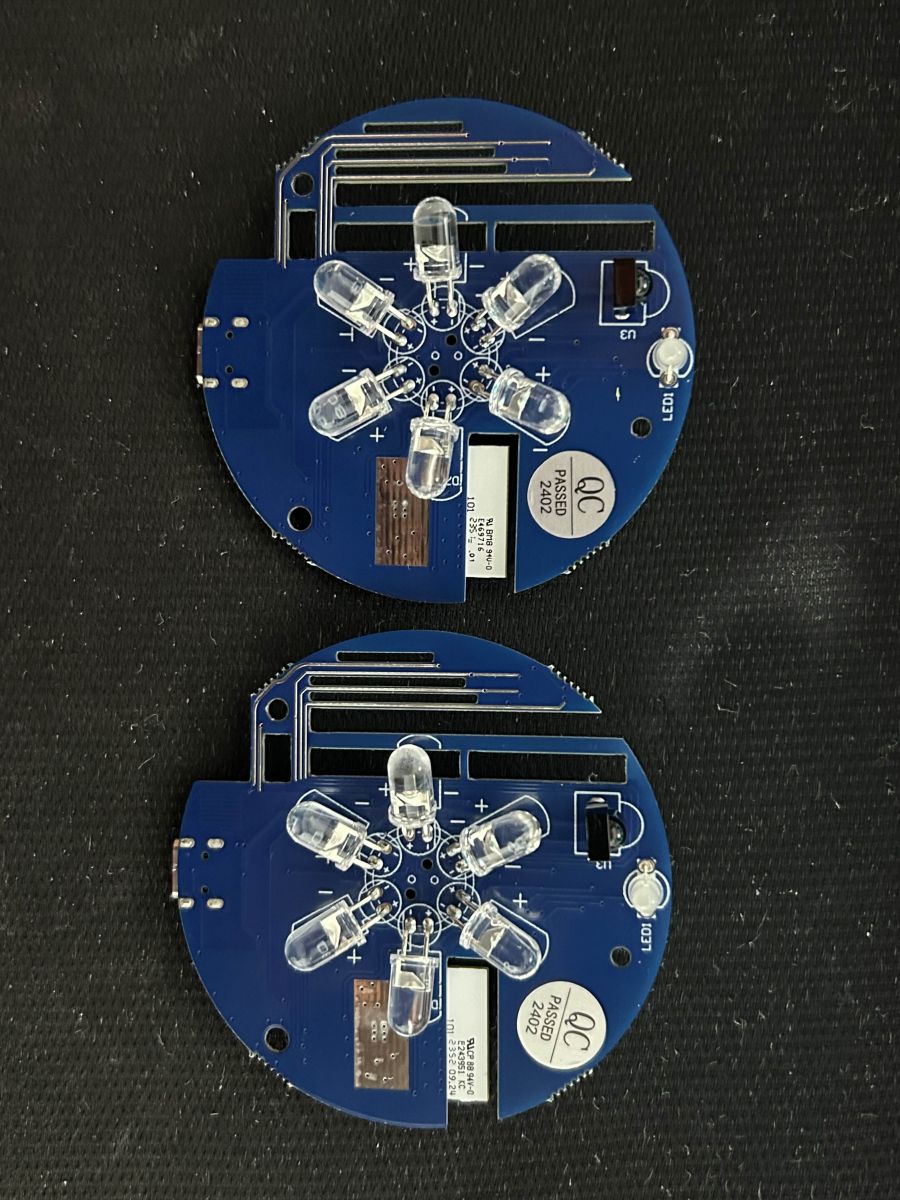
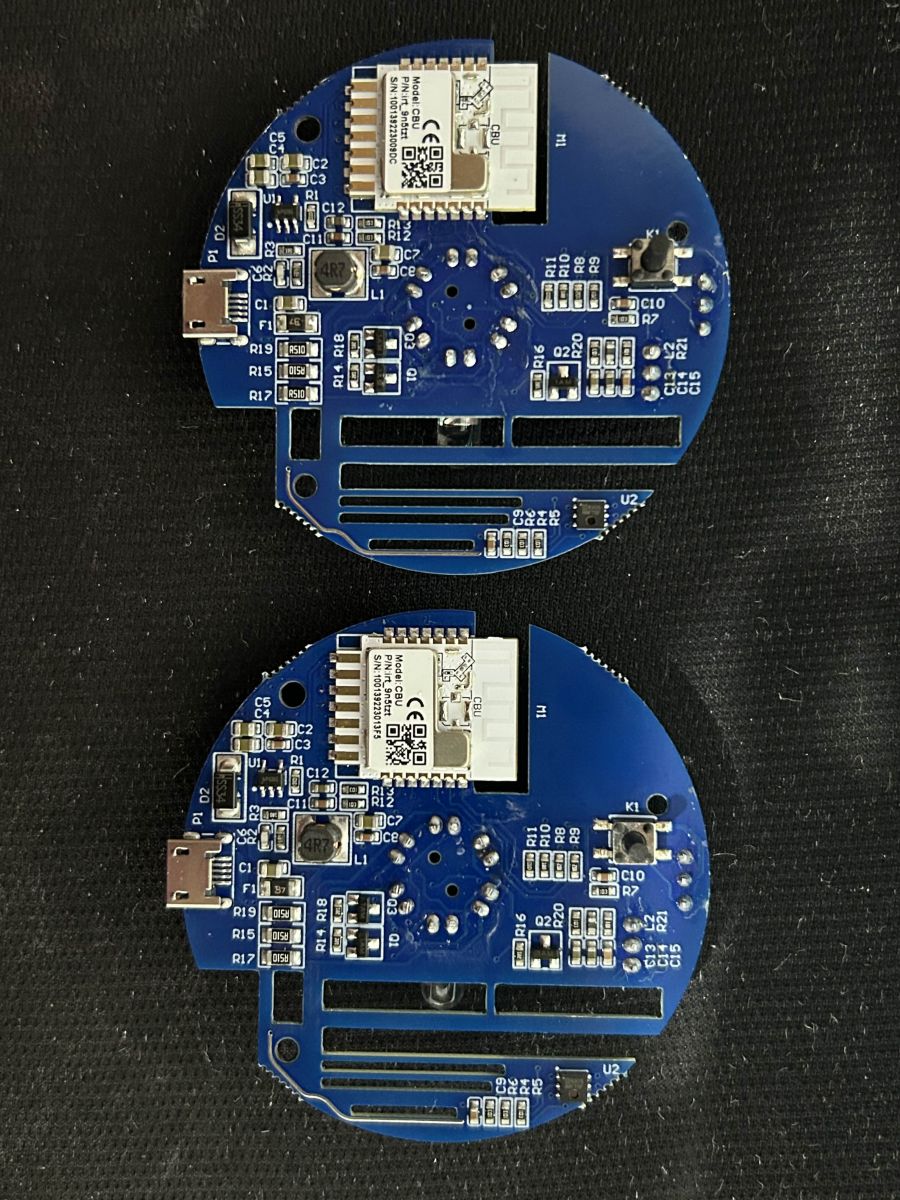
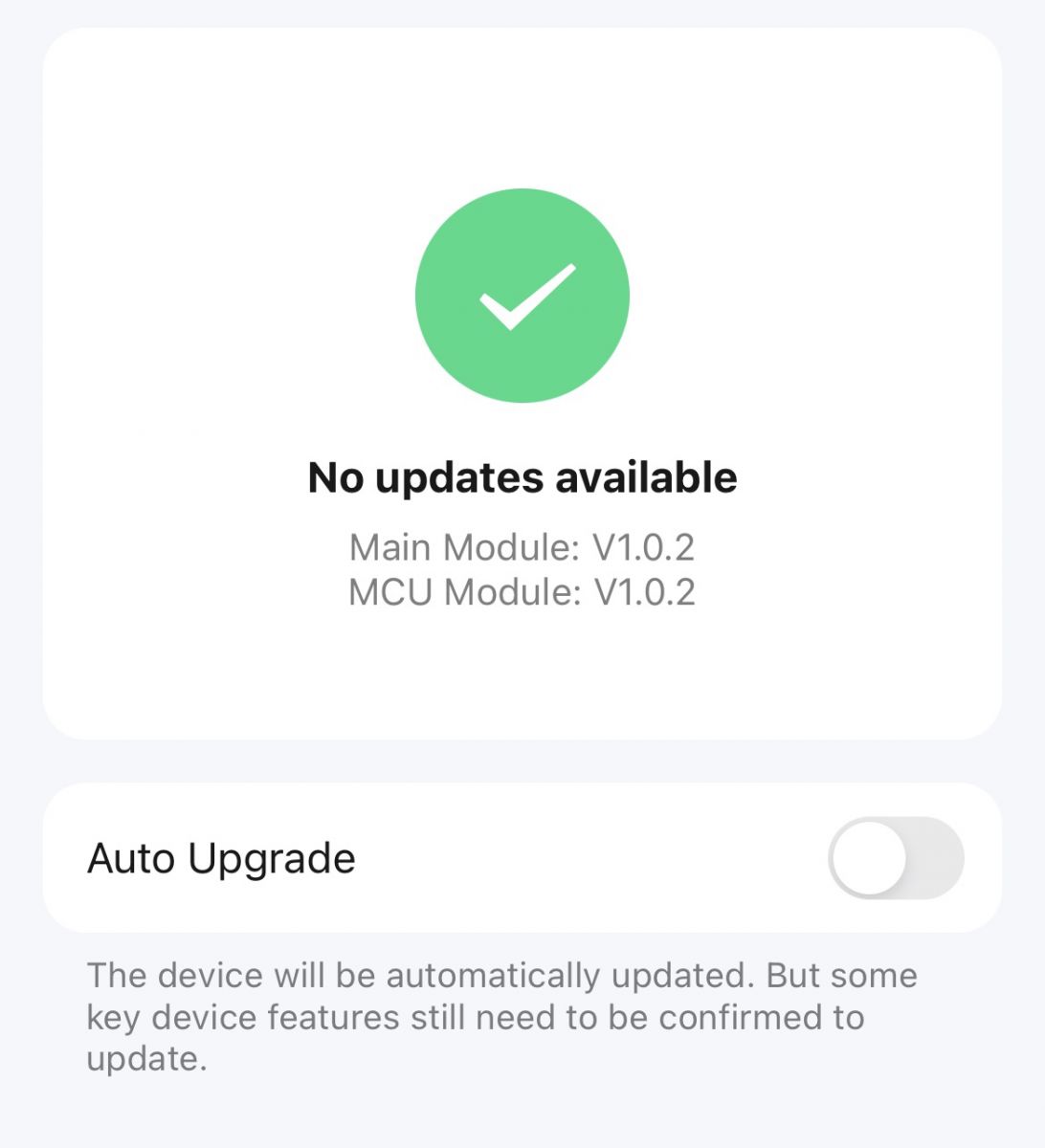
    Hey everyone, I just got myself two units that seems to match the "TUYA Home Smart Life Intelligent WiFi IR Remote Control IRC02 (BK7231N) [CB3S]" but I have no idea how to flash them. I've flashed "S06 Pro"s in the past using the Avatto profile on Tuya CloudCutter, but even though these (the IRC02 ones) are running 1.0.2 from the factory, after trying a bunch of profiles none of them worked.

    I also removed the case and I have no idea where I could solder, I can't seem to find any VCC, UAT, GND, RX or TX labeled connections.

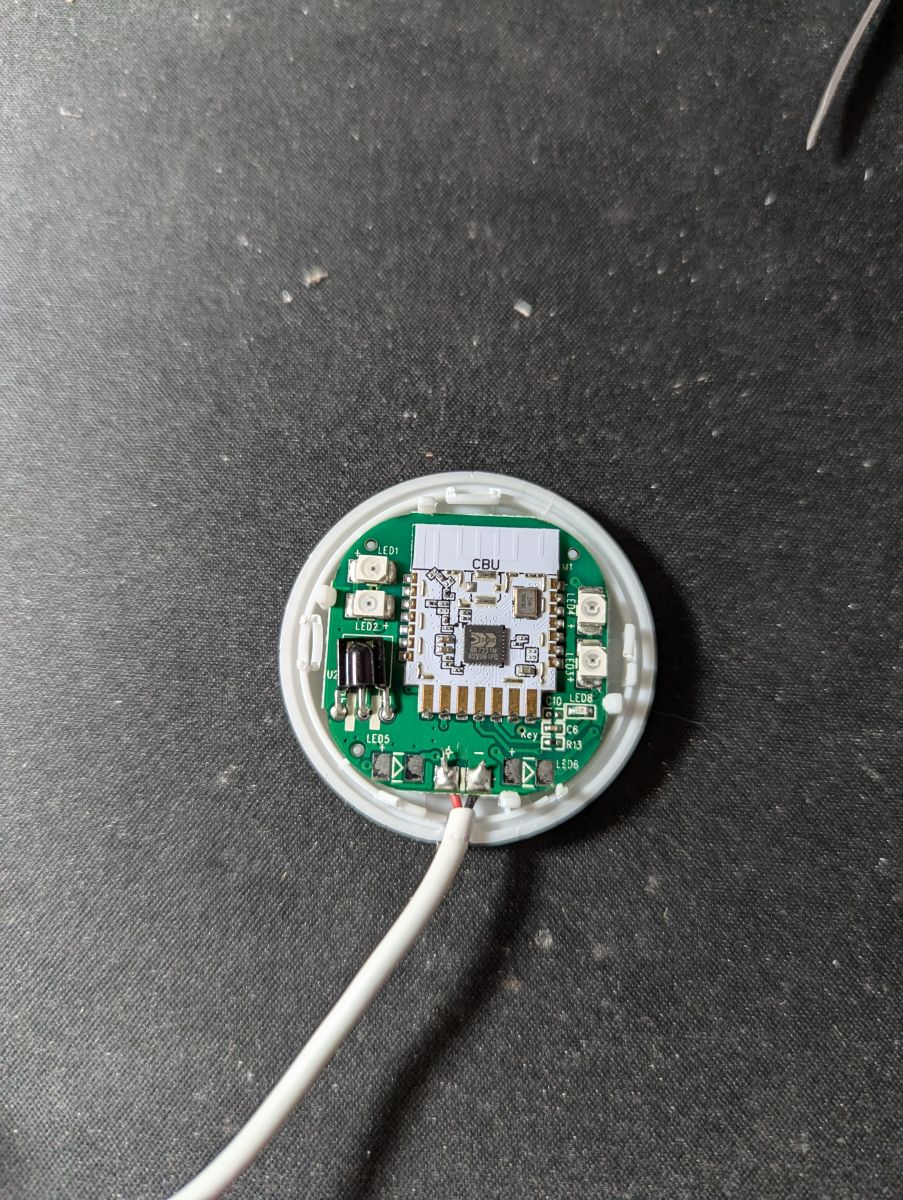
    Any ideas? I'm not very experieced but I could probably solder my cables directly to the CBU (?) chip after finding the proper pinout, but isn't that kind of scary? I know that development pins or connectors ase essentially the same thing but I'm worried about messing up the chip. Two round, blue circuit boards with mounted LED diodes. Two circuit boards with a WiFi module on a black background. Screen displaying device software update information.
  • #25 21282250
    p.kaczmarek2
    Moderator Smart Home
    Posts: 14615
    Help: 655
    Rate: 12632
    I can't see any solder pads that could be a flashing port. You can still try probing with multimeter to find some, but maybe it would be worth to solder directly to CBU...

    You don't have much wires to solder, you will only need to solder RX and TX to CBU pads.

    Ground can be soldered elsewhere, for example, this large pad is most likely connected to ground - just check it first with multimeter.

    Then, power, it can be supplied via USB connector, from the same machine that you have USB to UART converter connected to.
    Helpful post? Buy me a coffee.
  • #26 21299443
    agudelotmateo
    Level 2  
    Posts: 2
    p.kaczmarek2 wrote:
    I can't see any solder pads that could be a flashing port. You can still try probing with multimeter to find some, but maybe it would be worth to solder directly to CBU...

    You don't have much wires to solder, you will only need to solder RX and TX to CBU pads.

    Ground can be soldered elsewhere, for example, this large pad is most likely connected to ground - just check it first with multimeter.

    Then, power, it can be supplied via USB connector, from the same machine that you have USB to UART converter connected to.


    OK I was able to dump the stock firmware using ltchiptool but UPK2ESPHome was unable to get anything out of it. I flashed ESPHome and at this point I'm able to flash wirelessly, but the device isn't working, really, because I don't know how to get the IR to work of read the data from the sensors.

    This is a CBU device and based on my research (I'm new at this) it doesn't have a TuyaMCU. I have no idea how to configure this device. I have a similar device (S06 Pro) but that one uses a TuyaMCU (temperature and humidity are read from the TuyaMCU, Pin 26 is the IR Transmitter and Pin 8 the IR Receiver so pretty easy under generic-bk7231t-qfn32-tuya with RX1 and TX1 for the UART bus at 9600 baud rate) and this one apparently does not.

    Any idea on how to figure out the pins and stuff for this device? I attached the stock firmware dump in case that's useful

    EDIT: Looks like the device I have is exactly like the one shown in this post: https://www.elektroda.com/rtvforum/topic3974946.html#20560227, but the pinout specified there does not work for me (Pin 8 for the IR Transmitter and Pin 24 for the IR Receiver). This is the relevant part of my ESPHome YAML file:

    
    bk72xx:
      board: generic-bk7231n-qfn32-tuya
    
    remote_transmitter:
      pin: GPIO8
      carrier_duty_percent: 50%
    
    remote_receiver:
      id: receiver
      pin:
        number: GPIO24
        inverted: true
        mode:
          input: true
          pullup: true
      tolerance: 55%
      dump: all
    
    Attachments:
    • ltchiptool_bk72xx_2024-11-12_00-33-24.bin (2 MB) You must be logged in to download this attachment.
  • #27 21315300
    psyko_chewbacca
    Level 7  
    Posts: 9
    Rate: 2
    Hi,

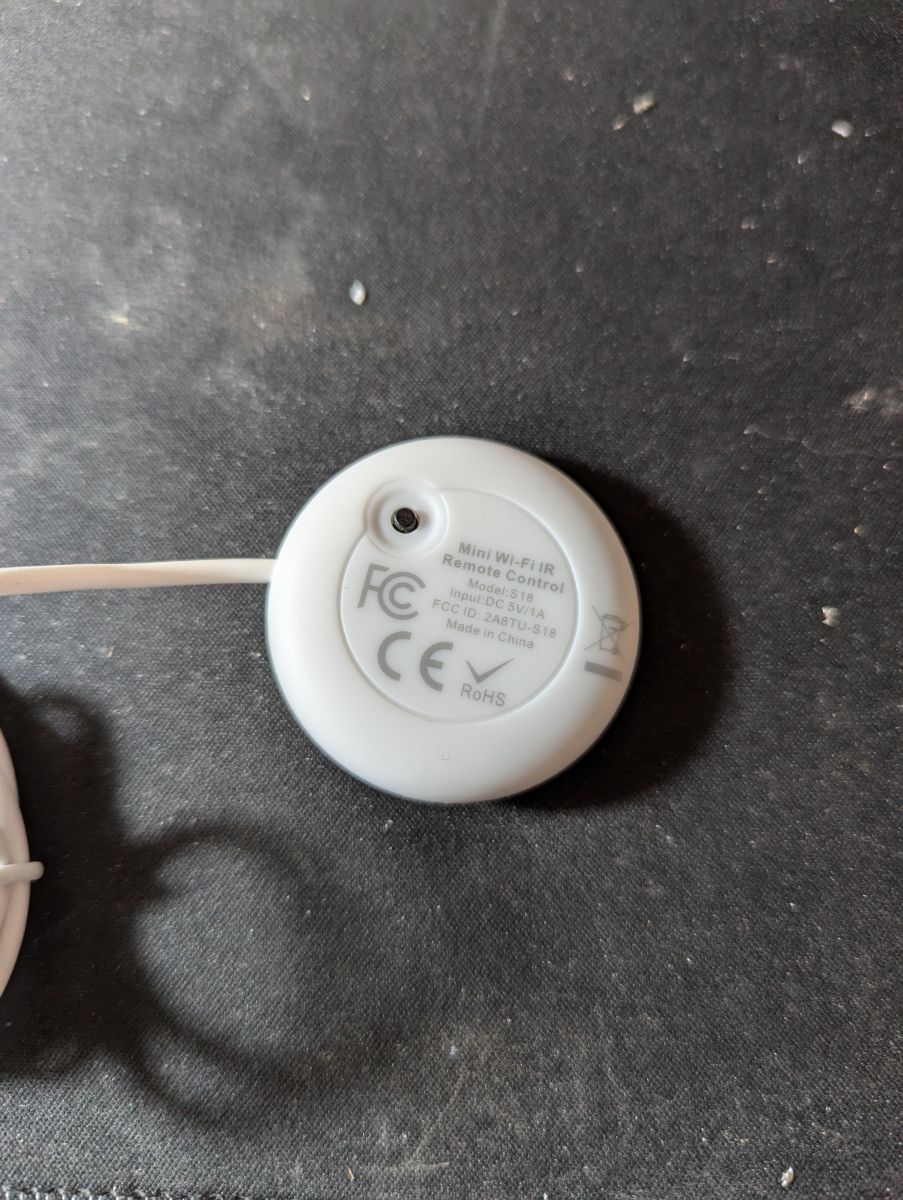
    I recently bought 2 units labeled as model S18. They are white, small and come with a soldered-on USB-A lead.
    They do not have the same IO mappings as the S18 unit described in the very first post of this thread.

    In fact, they are equipped with a CBU module rather than a CB3S.

    My units came programmed with Tuya firmware version 2.0.0 and could be flashed through Cloudcutter. It's a good thing because opening up these suckers will surely break all retention clips. You will need to use glue to put it back together.

    Here's the mapping info pulled from BK7231Flasher

    
    {
    	"reset_pin":"26",
    	"wfst_pin":"24",
    	"owm":"1",
    	"reset_lv":"0",
    	"rsthold":"3",
    	"wfst_lv":"1",
    	"netyc":"1",
    	"infrr":"8",
    	"netnc":"0",
    	"infre":"7",
    	"crc":"32"
    }


    Device configuration, as extracted from Tuya: 
    - Button is on P26
    - WiFi LED on P24
    - IR Receiver is on P8
    - IR Transmitter is on P7
    No module information found.
    And the Tuya section starts, as usual, at 2023424


    Pictures:
    Back of a white device labeled Mini Wi-Fi IR Remote Control with technical specifications. Circuit board of S18 model with a soldered USB-A cable. Interior of an electronic device with a visible CBU module and a soldered USB-A cable.
  • #28 21315480
    divadiow
    Level 38  
    Posts: 5062
    Help: 438
    Rate: 893
    even though you used Cloudcutter, did you happen to take a factory firmware backup anyway or was that config extraction from the 73kb Tuya config download from within OpenBeken webapp?
  • #29 21315828
    p.kaczmarek2
    Moderator Smart Home
    Posts: 14615
    Help: 655
    Rate: 12632
    CBU has P16 easily available, I'd use this device to attach WS2812B strip as a nice addition to basic functionality.
    OpenBeken WS2812B animations - new HTTP panel integration, PixelAnim driver
    Helpful post? Buy me a coffee.
  • #30 21320663
    psyko_chewbacca
    Level 7  
    Posts: 9
    Rate: 2
    divadiow wrote:
    even though you used Cloudcutter, did you happen to take a factory firmware backup anyway or was that config extraction from the 73kb Tuya config download from within OpenBeken webapp?


    As I couldn't figure out the IO mapping, I disassembled the second unit and while at it, I decided to go through serial flashing rather than cloudcutter.
    So lucky you!

    Attached binary dump

    EDIT: Here's the product page I bought it from: https://www.aliexpress.com/item/1005006871030126.html
    It was $5.50 USD at the time, for 2 units.
    Attachments:
    • readResult_BK7231N_QIO_s18_cbu_1_2024-23-11-02-02-33.bin (2 MB) You must be logged in to download this attachment.
📢 Listen (AI):

Topic summary

✨ The discussion centers on configuring and flashing OpenBeken firmware on WiFi universal IR remotes purchased from AliExpress, specifically models S06, S18, and IRC02 equipped with BK7231 series chips (BK7231T and BK7231N). Pinout mappings for buttons, IR RX/TX, and WiFi LEDs were shared for these devices, with clarifications on module types (WB3S vs CB3S) and corrections on chip identification. Users exchanged JSON configuration files for easy import into OpenBeken, contributing to a growing device database. Flashing challenges were addressed, including bootloader entry issues requiring CEN pin grounding and power supply considerations (external 3.3V recommended over USB-to-UART power). Troubleshooting IR reception revealed that some remotes, especially older or AC-specific ones, show IR_UNKNOWN codes or fail to capture signals, prompting suggestions to use a forked OpenBeken firmware with enhanced IR library support for air conditioner remotes. Discussions also covered difficulties in locating solder pads for flashing on certain models with CBU modules, and the need to probe chip pins directly. Users reported successful flashing and integration with HomeAssistant, with some noting limited IR transmission range possibly due to hardware or configuration issues. Links to firmware dumps, flashing tools, and updated OpenBeken releases with IR improvements were shared to aid the community.
Generated by the language model.

FAQ

TL;DR: For owners of Tuya WiFi IR remotes, this thread gives 3 proven GPIO maps and one blunt rule: “choose the correct platform.” It solves the main OpenBeken problems for S06, S18, and IRC02 units: wrong module ID, failed UART flashing, and AC remotes that decode as unknown instead of usable IR data. [#20717335]

Why it matters: These remotes ship with different modules, pin maps, and firmware versions, so the same AliExpress model name does not guarantee the same OpenBeken setup.

Model / variant Module / chip reported in thread Confirmed core pins Flashing notes
S06 WB3S, BK7231T Btn P6, IR RX P8, LED P9, IR TX P26 Standard mapping from teardown
S18 CB3S, BK7231N Btn P6, IR RX P7, LED P8, IR TX P26 One board had swapped RX/TX labels
IRC02 CB3S, BK7231N Btn P6, LED P7, IR RX P24, IR TX P26 Some boards lack labeled flash pads
Newer S18 variant CBU / BK7231N Btn P26, LED P24, IR RX P8, IR TX P7 Different from original S18 mapping
Later S18 variant T1-3S / BK7238 IRSend P6, input P9, LED P24, IRRecv P26 Needs BK7238 path, not BK7231

Key insight: Do not trust the product name or PCB silkscreen alone. Verify the actual Wi-Fi module and extracted Tuya pin map before flashing or importing a template.

Quick Facts

  • The thread started with 3 usable pinouts, then later added at least 2 more hardware variants, including a CBU-based S18 and a T1-3S BK7238 S18. [#21713105]
  • One user bought an S18 for 1.80 euros and flashed it over OTA with Tuya firmware 2.0, showing that some low-cost batches still accept CloudCutter-style workflows. [#20892177]
  • OpenBeken’s device database passed 400 devices after the JSON templates from this teardown were added, which makes these mappings reusable beyond a single post. [#20760495]
  • A practical serial-flashing constraint appears repeatedly: use an external 3.3V supply, because a USB-to-UART adapter may not provide enough current for reliable flashing. [#21156442]
  • One OpenBeken user referenced a 73 kB Tuya config download from the web app for extracting mapping data on a CBU variant, which helps verify pins before full reconfiguration. [#21315480]

How do I configure OpenBeken GPIO pins for the Tuya S06, S18, and IRC02 WiFi IR remotes with BK7231 modules?

Use the model-specific mapping, not a generic IR profile. S06 uses Btn P6, IR RX P8, LED P9, IR TX P26. The original S18 uses Btn P6, IR RX P7, LED P8, IR TX P26. IRC02 uses Btn P6, LED P7, IR RX P24, IR TX P26. One S18 board also had RX and TX silkscreen labels swapped, so verify with the board or extracted config before flashing. [#20717083]

Where do I import the OpenBeken JSON template file like s18.json.txt, and how do I use the template importer web app?

Import the JSON through the OpenBeken web interface or paste it into the standalone template importer. 1. Open the device web app and use the pin-import function. 2. If needed, open the standalone template importer page mentioned in the thread. 3. Paste the JSON from files like s18.json.txt and apply the generated pin setup to the device. A video and the web importer were both linked for this exact task. [#20858630]

Why does BK7231 Easy UART Flasher keep showing "Getting bus failed" when flashing a CB3S or CBU IR remote, and how can I fix it?

That error usually means the device did not enter bootloader mode or the serial wiring is bad. In the thread, one case was fixed by correcting bad TX/RX soldering. Another reply suggested trying CEN-to-GND if auto-entry fails. Also avoid relying on the USB-to-UART adapter for power alone; an external 3.3V supply is the recommended setup for stable flashing on these IR remotes. [#21160214]

What is Tuya CloudCutter, and how does it differ from serial flashing for S06, S18, and IRC02 IR remotes?

CloudCutter is an OTA exploit method that flashes supported Tuya firmware builds without opening the device, while serial flashing uses RX, TX, GND, and power over UART. "CloudCutter" is an OTA flashing method that targets specific Tuya firmware builds, avoids soldering, and depends on a matching exploit profile for the exact device firmware. In this thread, CloudCutter worked on some S18 units with firmware 2.0 or 2.0.0, but failed on others running 1.0.2. [#21813801]

What is the difference between WB3S, CB3S, CBU, and T1-3S modules in Tuya IR blasters, and why does it matter for OpenBeken flashing?

They are different Tuya Wi-Fi modules, and the module determines the chip family, platform choice, and sometimes the GPIO map. The thread corrected an early WB3S/CB3S mix-up because WB3S usually means BK7231T, while CB3S means BK7231N. Later posts also showed CBU-based S18 units and a T1-3S unit that needed BK7238 firmware. If you pick the wrong platform at flash time, the process and pin template can both fail. [#20717191]

Which is more reliable for these Tuya IR remotes: CloudCutter OTA or UART solder flashing?

UART solder flashing is more reliable. The thread states that CloudCutter needs a per-build exploit, and success is not guaranteed because devices ship with different firmware versions and builds. By contrast, serial access works across more hardware revisions if you can reach RX and TX. Even users who preferred OTA ended up opening the case when profiles failed on MCU 1.0.2 devices. [#21813801]

How can I publish received IR codes from OpenBeken to MQTT instead of only seeing them in the device logs?

Enable Flag 14 in OpenBeken. After that, received IR codes publish to the MQTT topic <device id>/ir/get instead of staying only in logs. This was given as the direct fix for a Home Assistant user who already had the Tuya IR remote working and wanted incoming codes over MQTT for automation, not just live log viewing. [#20997557]

Why does OpenBeken detect some remotes correctly but show only IR_UNKNOWN 0x0 0 or random unknown values for AC remotes?

Because some AC remotes use protocols the current build does not decode correctly. In the thread, one remote produced valid Sony logs, while an old TECO AC remote showed only IR_UNKNOWN 0x0 0. Later users reported Samsung AC remotes producing changing unknown values around 173 to 175 bits. Tuya learning mode could still recognize some of those remotes, which shows the hardware may receive the signal even when OpenBeken cannot decode it cleanly. [#21905896]

What can I do to troubleshoot an air conditioner remote that works in Tuya learning mode but is not decoded properly by OpenBeken?

Switch to the irRemoteESP build and inspect raw or alternate decode output. The thread first pointed to a fork with AC support, then reported that this IR variant was added to official builds. If OpenBeken logs only IR_UNKNOWN, compare behavior across versions, because one later discussion said 1.18.98 worked better than 1.18.214 or master for irRemoteESP decoding. That gives you a concrete A/B test path before replacing hardware. [#21758950]

How do I find RX, TX, GND, and power points on an IRC02 or S18 board when there are no labeled flashing pads?

Probe the board and use the module pins if the PCB exposes no clear header. On one IRC02-style board, the advice was to solder RX and TX directly to the CBU pads, use a large verified ground pad for GND, and power the board through its USB connector from the same machine as the USB-to-UART adapter. That avoids guessing unlabeled pads and limits soldering to only the essential serial lines. [#21282250]

Why might an S18 or S06 have a different Wi-Fi module or pin mapping than the one shown in the original teardown, and how can I verify the real mapping?

Because Tuya remotes ship in multiple hardware batches under the same retail name. The thread shows an S06 with PCB silkscreen S06-CB3S-V1.1 that actually had a WB3S module, plus a newer S18 with CBU whose pins changed to Btn P26, LED P24, IR RX P8, and IR TX P7. Verify the real mapping by checking the installed module, reading the Tuya config, or extracting mapping data with BK7231Flasher before applying any template. [#21315300]

How can I back up the original Tuya firmware from an S06, S18, or CBU-based IR remote before flashing OpenBeken?

Dump the factory firmware before reflash, either from serial tools or from a backup someone posted for the same hardware. In the thread, one user dumped stock firmware from a CBU-based unit with ltchiptool, and another shared original firmware from an S06-class device in a related post. If the board has several variants, confirm the module first, because firmware from WB3S and CB3S hardware is not interchangeable just because the shell looks identical. [#21299443]

What is the irRemoteESP OpenBeken build, and when should I use it instead of the standard firmware for AC remote support?

Use irRemoteESP when the standard build receives basic remotes but fails on AC protocols. "irRemoteESP" is an OpenBeken firmware variant that integrates an alternate IR library, adds broader air-conditioner protocol support, and can improve decode results for remotes that appear as unknown in standard builds. The thread first referenced it as a forked build, then confirmed it was added to OpenBeken releases in May 2025. [#21539309]

How do I create an OpenBeken event so one IR remote button triggers an IRSend command to control another device?

Create an event handler that matches the received protocol and code, then calls IRSend. One working example in the thread used startDriver IR, setFlag 1 1, and addEventHandler2 IR_NEC 0xC7EA 0x17 IRSend NEC 0x0 0xA8. The trigger side logged a Roku NEC code, and the destination device accepted IRSend NEC 0x0 0xA8 manually. If the event fires but the target device does not react, test repeat bits or the exact pressed/released variant. [#21714593]

Why does IR transmission range become very short after flashing an S18 mini remote, and what settings or pin states should I check?

Short range can mean the transmit hardware is not being fully enabled, not just weak firmware. The thread’s most concrete advice was to inspect the extracted Tuya config and check whether an extra GPIO must be driven high to enable sending. That matters because one user reported an S18 that could read and send IR codes, yet only over a very short distance after flashing. [#21539309]
Generated by the language model.
ADVERTISEMENT