logo elektroda
logo elektroda
X
logo elektroda

Flash NAND Lite Memory Programmer! TSOP48

funak 407655 558

TL;DR

  • Built a low-cost Flash NAND Lite programmer for TSOP48 NAND chips, aimed at reading and programming memory from sticks, routers, televisions, modems, and navigation devices.
  • The board runs from USB 5.0V, generates 3.3V with a TPS781330220 LDO, and uses an XMEGA-A4U plus FT245 USB converter with a parallel data bus.
  • The design exposes four CE lines and four RB lines, while the LDO’s 150mA overcurrent protection helps prevent damage if a chip is inserted backwards.
  • Measured throughput reached 980kB/s from FT245 to XMEGA and 2.7MB/s from NAND to XMEGA, showing much faster direct NAND communication.
  • The main limitation is cost-cutting simplicity: only one permanently soldered TSOP48 socket is included.
Generated by the language model.
ADVERTISEMENT
Treść została przetłumaczona polish » english Zobacz oryginalną wersję tematu
📢 Listen (AI):
  • ADVERTISEMENT
  • #212 17885410
    Vit2
    Level 11  
    Posts: 12
    Rate: 3
    Hello Funai!
    on the first image of the selection automatically.
    on the other hand as it is okay, the record happens normally.
    in the third photo with validation errors.
    new chips. It's worth it
    help, uezhe tv 6 months. Flash NAND Lite Memory Programmer! TSOP48 Flash NAND Lite Memory Programmer! TSOP48 Flash NAND Lite Memory Programmer! TSOP48
  • #213 17885496
    fachura
    Level 17  
    Posts: 187
    Help: 11
    Rate: 111
    Board Language: polish
    First program the memory and then use verify.
  • #214 17885531
    Vit2
    Level 11  
    Posts: 12
    Rate: 3
    I programmed my memory all over again, then clicked on the check
  • #215 17889721
    Reider
    Level 9  
    Posts: 18
    Rate: 5
    When will the English or Russian version of the software ??
  • ADVERTISEMENT
  • #216 17899867
    iwian
    Level 1  
    Posts: 1
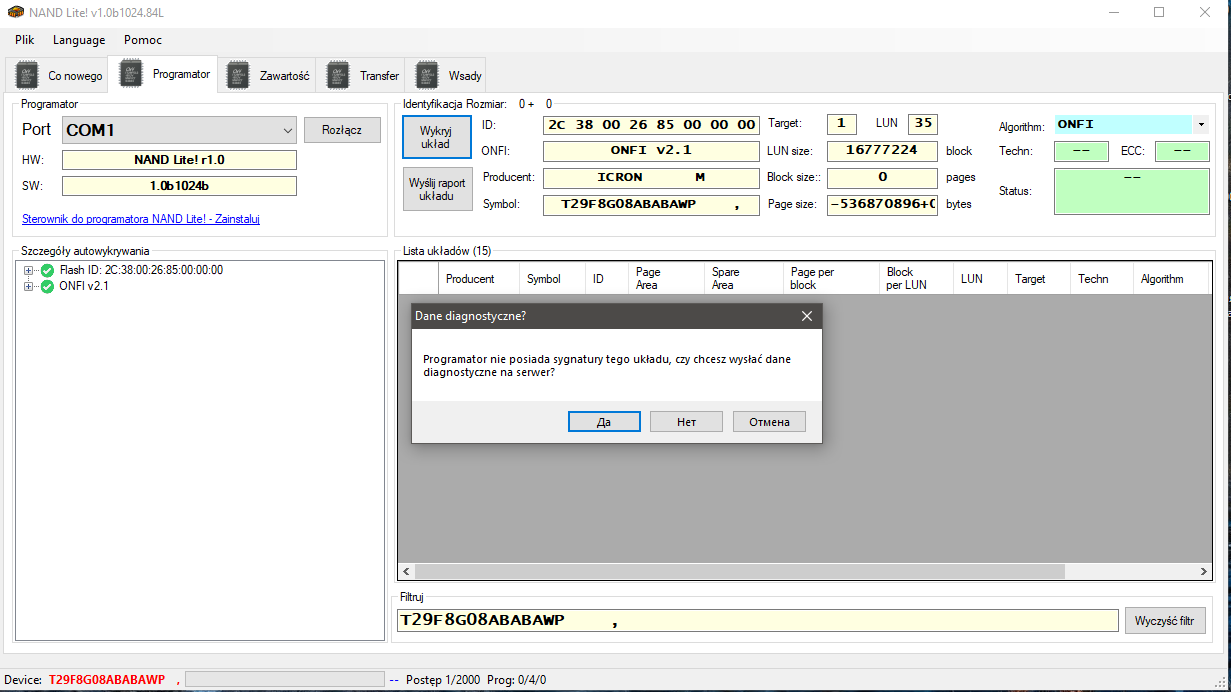
    Does it support or not have MT29F8GO8ABABAWP?
    Well, the new MT29F8GO8ABABAWP does not pass as identification.
  • ADVERTISEMENT
  • #217 17900467
    funak
    Level 27  
    Posts: 1074
    Help: 98
    Rate: 455
    Board Language: polish
    This memory is programmer serviceable.
    It also has ONFI registers, so there is 100% support.

    Type SLC, therefore a good chance to be programmed with full success.
  • #218 17900611
    Vit2
    Level 11  
    Posts: 12
    Rate: 3
    So why are you checking for errors?
  • #219 17900619
    funak
    Level 27  
    Posts: 1074
    Help: 98
    Rate: 455
    Board Language: polish
    In the case of SLC?

    For two reasons, according to the manufacturer:
    - not all blocks are operational when they leave the factory memory
    - in the case of SLC, the manufacturer allows 1-4 bits of corrupted bits, hence SpareArea is used to check if the number of corrupted bits is greater than allowed by the memory manufacturer.
  • #221 17900734
    funak
    Level 27  
    Posts: 1074
    Help: 98
    Rate: 455
    Board Language: polish
    The current version of the FW software of the NANDLite programmer! v1.0
    Attachments:
    • NANDLite!_r1.0v1.0b1024a.zip (7.97 KB) You must be logged in to download this attachment.
  • #222 17908781
    funak
    Level 27  
    Posts: 1074
    Help: 98
    Rate: 455
    Board Language: polish
    I will update the software soon.

    Planned changes:
    + removal of an error related to the content tab
    + generating graphs with write / read / erase time
    + generation of memory verification graph - number of erroneous bits
    + write LOG together with the operation of writing / reading / erasing the memory
    + saving charts to a PNG file
    + reduction of memory detection time

    If there is enough time, it is still generating a map of the memory contents.
  • #223 17982967
    bolvan
    Level 8  
    Posts: 5
    Rate: 1
    Board Language: german
    Hi funak,
    You are a genius!
    Thank you, a very good product!
    I have tested and it works great!

    Dodano po 2 [godziny] 33 [minuty]:

    How can I add this Nand Flash Samsung K9F4G08U0B-PCB0 to the list?
    I want to edit this part with your device.
    Thank you in advance!

    I have adapted config file for K9F4G08U0B-PCB0 now.
    Flash is recognized and read correctly.
    Attachments:
    • device.zip (2.27 KB) You must be logged in to download this attachment.
    • K9F4G08U0B-IIB0.pdf (984.31 KB) You must be logged in to download this attachment.
  • #224 17991319
    Vit2
    Level 11  
    Posts: 12
    Rate: 3
    Thank you Funak! TV has been working for 3 days 29F8G08ABABA
  • #225 18004129
    kirejan
    Level 9  
    Posts: 3
    Board Language: german
    Hello,
    How to Order only empty circuit board ?


    Hallo,
    Wie kann ich eine Leere Platine Kaufen?
    Danke
  • #226 18005981
    funak
    Level 27  
    Posts: 1074
    Help: 98
    Rate: 455
    Board Language: polish
    PayPal: funak @ interia.pl


    Cost: PLN 60 - 1 x PCB
    Shipping: PLN 21
  • #227 18005989
    tomasz wojcicki
    Level 23  
    Posts: 848
    Help: 26
    Rate: 346
    Board Language: polish
    Such a question in connection with nandlite: would it be difficult to add a function that would check whether all the pins of a given system are in contact in the socket?
  • #228 18006558
    funak
    Level 27  
    Posts: 1074
    Help: 98
    Rate: 455
    Board Language: polish
    Short circuits with each other can be tested, and whether they contact, a bit worse with the current hardware system. Perhaps only programmatically by periodically reading the memory ID every few blocks.
  • #229 18006888
    fachura
    Level 17  
    Posts: 187
    Help: 11
    Rate: 111
    Board Language: polish
    Hello buddy funak when you can expect the latest NAND lite update.
  • #230 18020439
    acsz
    Level 16  
    Posts: 326
    Help: 10
    Rate: 81
    Board Language: polish
    tomasz wojcicki wrote:
    Such a question in connection with nandlite: would it be difficult to add a function that would check whether all the pins of a given system are in contact in the socket?

    After reading, I use read verification and if there are errors, sometimes it helps to fix the memory in the socket and the verification is correct.
    If it were possible to introduce the option of verification, while reading the memory, after reading each page, it would be some additional information.
    The reading time will be longer, but the total time will be saved with repeated reading and verification.
    Or, in the event of a verification error, the failed page reading could be programmatically repeated to select a reading that is compatible with the verification.
  • #231 18046104
    acsz
    Level 16  
    Posts: 326
    Help: 10
    Rate: 81
    Board Language: polish
    Is it possible to read and program the S29AL016D memory?
  • #232 18050815
    tik-tak
    Level 1  
    Posts: 1
    Board Language: german
    S29AL016D NAND Flash?))))
  • #233 18050834
    funak
    Level 27  
    Posts: 1074
    Help: 98
    Rate: 455
    Board Language: polish
    Only in version 2.0.
  • #234 18056719
    Hetii
    Level 17  
    Posts: 518
    Help: 4
    Rate: 420
    Board Language: polish
    Would it be possible with this programmer to change the series into nand bones from ipad 3? I bought two to get retina screens, but as there are also motherboards, you can have fun trying to unlock. :
  • #235 18056891
    funak
    Level 27  
    Posts: 1074
    Help: 98
    Rate: 455
    Board Language: polish
    Will be hard :)

    What model of NAND memory is there?

    The procedure would be as follows:
    1. Read the NAND
    2. Analyze the content in terms of correction data and find the position where they are stored, for which area they are responsible, and adjust the data determination algorithm.
    3. Analyze the batch where serial numbers can be written and change their value
    4. Recalculate the correction data.
    5. Enter the data into the memory.
    6. Test on device.

    The described procedure will work if the serial number is written explicitly and its number is not additionally checked elsewhere. File checksum type, or any other validation method.
  • #236 18056937
    Świr
    Level 34  
    Posts: 3971
    Help: 114
    Rate: 247
    Board Language: polish
    Does the programmer support tc58fvm6b5btg65 memory?
  • ADVERTISEMENT
  • #237 18056943
    funak
    Level 27  
    Posts: 1074
    Help: 98
    Rate: 455
    Board Language: polish
    NOR type memory.
    NandLite v1.0 will not handle.
  • #238 18056948
    Świr
    Level 34  
    Posts: 3971
    Help: 114
    Rate: 247
    Board Language: polish
    Thank you for the information. And is there a programmer that will handle it? I've already done five pieces and none of them want to get along: /
  • #239 18057044
    funak
    Level 27  
    Posts: 1074
    Help: 98
    Rate: 455
    Board Language: polish
    Can you agree, read or write in your sense?

    Added after 11 [minutes]:

    Documentation attached.

    From what I can see, the memory only communicates in 16bit mode, so there may be a problem with that. Not every programmer has this feature.

    Second thing, the documentation mentions the password. I am not fluent in English, I need to study if the password is only for a special block or for the entire memory. Perhaps the memory is disrupted, then it cannot be read or written.
    Attachments:
    • TC58FVM6B5BTG65.pdf (698.47 KB) You must be logged in to download this attachment.
  • #240 18057097
    Świr
    Level 34  
    Posts: 3971
    Help: 114
    Rate: 247
    Board Language: polish
    Read on one and write on the other.
    https://www.elektroda.pl/rtvforum/topic3502788.html

    I have been struggling with these memories for a while, because they are used in older digital mixers and they are slowly starting to rain. I was stuck at the stage of trying to read the source memory.
📢 Listen (AI):

Topic summary

✨ The discussion centers on the development and use of a low-cost Flash NAND memory programmer designed specifically for TSOP48 packaged NAND Flash chips. The programmer targets applications such as reading and programming NAND Flash from devices like flash drives, TVs, routers, and modems, offering an affordable alternative to expensive professional tools. The design includes a permanently soldered TSOP48 socket and uses an FT245 USB interface combined with an Atmel XMEGA microcontroller for flexible control and hardware timing measurements. Software development focuses on supporting various NAND Flash memory types, including multi-die ("4 die") memories, and implementing error correction algorithms such as BCH capable of correcting multiple bit errors per 512-byte sector. The NANDLite application supports reading, writing, erasing, and batch uploading of NAND dumps for analysis and algorithm improvement, including handling bad block tables (BBT) and ECC data correction. Specific NAND Flash models like Samsung K9GAG08U0E and Toshiba TC58NVG6T2FTA00 are extensively tested, especially in relation to Samsung D5500 series TVs. Challenges discussed include addressing discontinuous memory spaces, bad block management, different addressing schemes (e.g., Toshiba's additional page addressing commands), and the complexity of NAND file systems like UBIFS. The project is evolving with plans for faster data transfer rates (up to 50MB/s in future versions), improved software interface, multilingual support, and expanded memory support including eMMC in the future. Comparisons with commercial programmers such as RT809H and Lens-Men highlight differences in speed, functionality, and openness of software. The community contributes NAND dumps for analysis to enhance error correction and bad block handling algorithms. The discussion also touches on hardware considerations like the quality of Chinese TSOP48 sockets, USB driver compatibility (including Windows XP support), and the limitations of TSOP48 packaging as industry shifts toward BGA and FBGA packages, suggesting ISP programming as a future direction.
Generated by the language model.

FAQ

TL;DR: NANDLite v1 erases 512-MBit chips at 4.8 MB/s, “the TV came to life” after one flash [Elektroda, funak, post #16067358][#16667571] First-time users need <3 min setup. Why it matters: hobbyists get pro-level NAND support without €900 lab gear.

Quick Facts

• Firmware: NANDLite! _R1.0v1.0b1024a [Elektroda, funak, post #18353353] • Max measured write speed: 2.7 MB/s NAND→XMEGA, 980 kB/s PC link [Elektroda, funak, post #15973950] • Auto-erase rate: 4.8 MB/s on 69 MB ST NAND512W3A [Elektroda, funak, post #16067358] • Supported IC signatures: 70 + (SLC, MLC, ONFI) [Elektroda, funak, post #16449394] • Kit price: approx. PLN 450; worldwide shipping PLN 21 [Elektroda, mailo, post #17314701][#17949208]

Which Windows versions run the current NANDLite software?

The online release 1.0.1014.89 runs on Windows XP, 7, 8, 10 (32 / 64-bit). SmartScreen blocks can be bypassed via “More info → Run anyway” [Elektroda, funak, post #18359665]

How fast can I dump a 2 GB K9GAG08U0E?

With v1 hardware set to 750 kB/s link speed, a full 2 GB read finishes in about 45 minutes; v2.0 (USB 3.0 + FPGA) targets 40 MB/s, cutting time to ≈55 s [Elektroda, funak, post #18250769]

What error level is acceptable during verify?

SLC devices allow 1-4 bit errors per 2 kB page; MLC K9GAG08U0E tolerates up to 24 bit flips—verify will flag but ECC corrects them in-device [Elektroda, funak, post #17878605][#16649962]

Can I add an unsupported NAND ID myself?

Yes. Pick a chip with matching geometry from the list, edit LUN-, block- and page-sizes, then save as a custom XML entry. Example: TC58BVG0S3HTA00 added by user in 5 min [Elektroda, bolvan, post #18061891]

How do I prepare a Samsung D5500 dump?

  1. Detect K9GAG08U0E.
  2. Press “Prepare file D5500”; select source dump and output file.
  3. Click “Erase”, then “Write”. The wizard remaps all bad blocks and recreates the BBT automatically [Elektroda, funak, post #16649962]

Does NANDLite handle eMMC or SPI NOR?

v1.0: only parallel NAND. v1.2 will add SPI/I²C via EXT header; v2.0 will add eMMC and NOR through USB 3.0/FPGA adapter [Elektroda, funak, post #18223831]

What is the largest page size validated?

16 384 + 1 280 B pages (Hynix H27UCG8T2BTR-BC, 64 Gbit). Verify reports <130 flipped bits per page—well within the 640-bit ECC budget [Elektroda, funak, post #16876251]

How do I flash chips that need 1.8 V I/O?

Use NANDLite v2.0 or v1.0 with the dual-voltage adapter; set supply to 1.8 V and leave VCC at 3.0 V as per ONFI [Elektroda, funak, post #17298560]

Where can I buy genuine TSOP48 sockets?

Original Yamaichi TSOP48 cost ≈PLN 180 at Semicon; tested Chinese clones work but lose spring tension after ~100 insertions [Elektroda, tplewa, post #15976786][funak, #15979863].

Statistic: how many bad blocks are typical on a blank 8 GB MLC?

Four bad blocks (0.2 %) per die is typical; sample K9GAG08U0E showed 8 bad blocks right after erase [Elektroda, funak, post #16656035]

Failure fact: what causes endless verify loops?

If geometry is unset (page = 0), the app enters an infinite verify loop—select a matching chip definition first [Elektroda, funak, post #18400138]
Generated by the language model.
ADVERTISEMENT