logo elektroda
logo elektroda
X
logo elektroda

Woox R6132 Smart WiFi Multi Power Socket Configuration and Internal Overview

nielspiersma 2157 9

TL;DR

  • Woox R6132 SMART WIFI MULTI POWER SOCKETS provide three mains outlets plus two USB-C ports and two classic USB ports.
  • Inside, a WB3S board with BK7231T controls four relays and the BL0937 power-meter circuit, and the unit ran Tuya v1.3.5.
  • Recovery mode is entered by holding the button until the LED blinks slowly, releasing, then pressing again until it turns off.
  • CloudCutter and BK7231t 1.3.5 firmware cutter flash the module, then calibration uses a 60-watt bulb, 231 volts, and CurretSet 0.261.
  • Flattened screw heads made the case difficult to open, so one unit was sacrificed for the teardown.
Generated by the language model.
ADVERTISEMENT
📢 Listen (AI):
  • Hi All,

    Today, I received my two Woox R6132 SMART WIFI MULTI POWER SOCKETS.

    They were reasonably priced, and buying two saved me on shipping costs.

    The device consists of 4 relays. Three of them control the power sockets, and one controls the power to the USB ports for charging your favorite devices.
    Total charging power is 3A@5Volt. The device comes with 2 USB-C ports and 2 Classic USB ports.

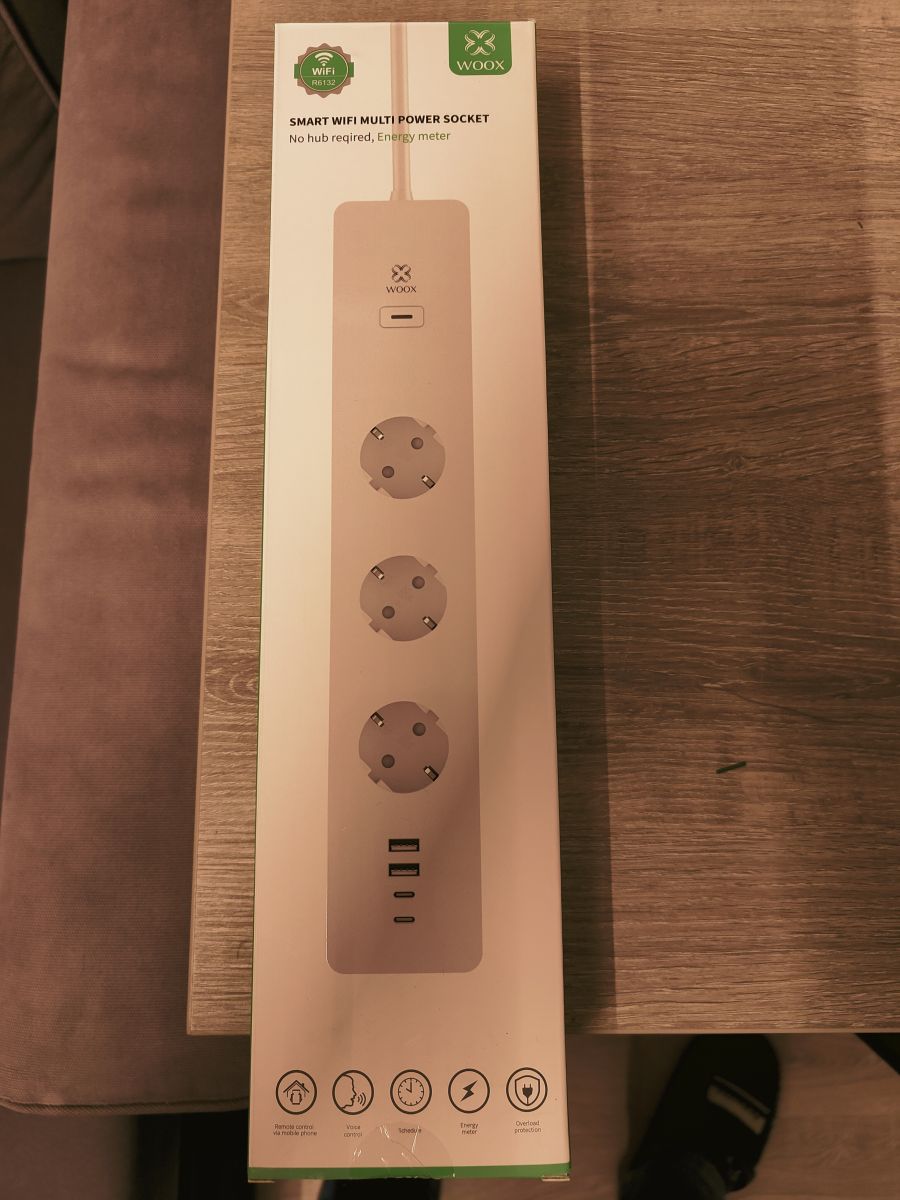
    Some pictures to start with:
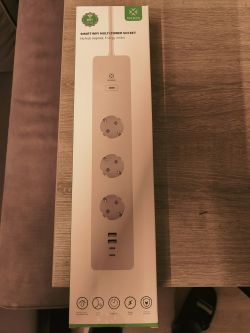
    Packaging of Woox R6132 SMART WIFI MULTI POWER SOCKET.

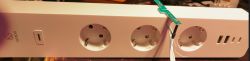
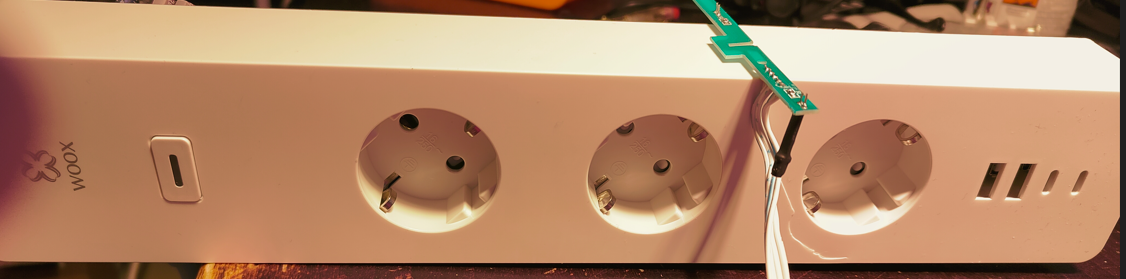
    Close-up of Woox R6132 power strip with three sockets and USB ports.

    Well, usually, I am okay with just configuring the device, preferably without cracking the case. However, Once I finished configuring the relays, I noticed it should come with a power meter. And that means looking for the chip that does the monitoring thing.

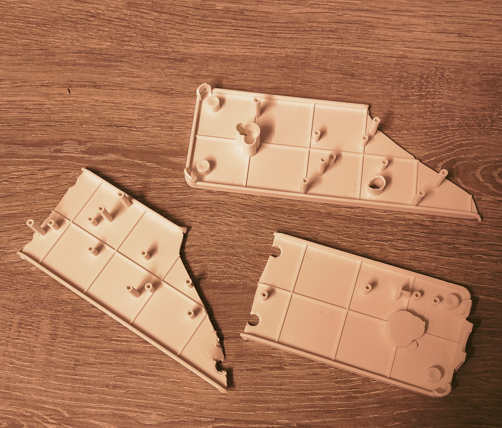
    In this case, the screw heads were flattened, and there was no way for me to open the casing. So, I sacrificed one unit.

    bottom plate ;(
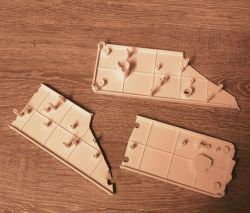
    Three pieces of white plastic casing on a wooden table.
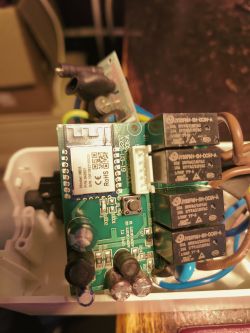
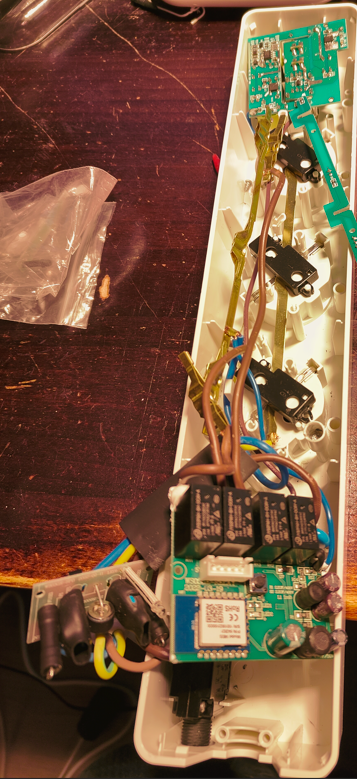
    After opening the unit, the inside looks like this.
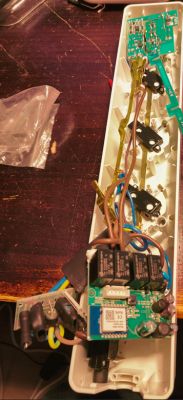
    Interior of a disassembled Woox R6132 power socket.

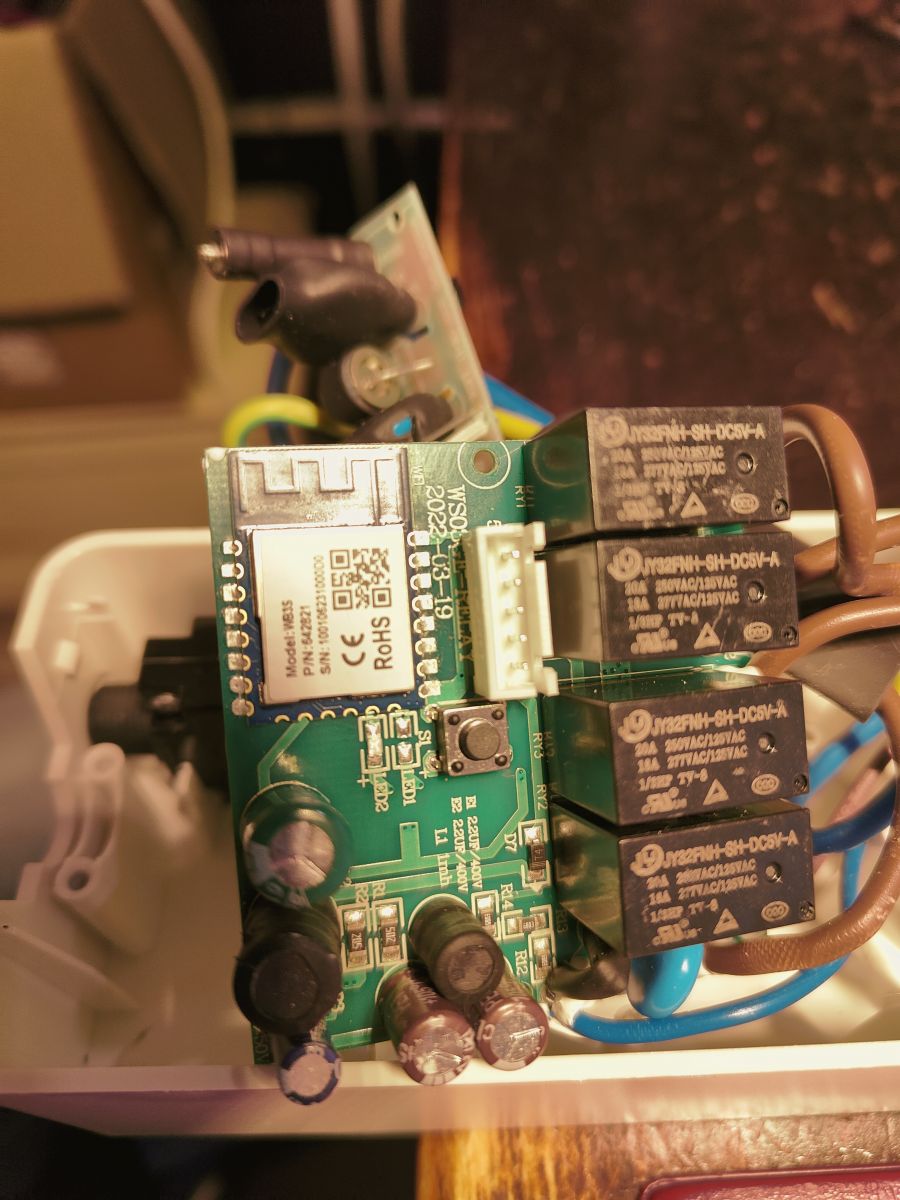
    Main circuit
    Inside of the socket with circuit board and relays.

    So, the technical details:

    The unit comes with a WB3S (https://developer.tuya.com/en/docs/iot/wb3s-module-datasheet?id=K9dx20n6hz5n4) labeled board soldered on the main circuit board. Our trustful BK7231T module is doing its job.

    The WB3S controls the four relays, the power meter circuit (BL0937), and mine ran Tuya v1.3.5.

    Getting it into recovery mode is straightforward. Power it on. Push the button until the led starts blinking slowly. Release the bottom and press it again until it goes off. Bang. You're in recovery mode.

    Run cloudcutter and flash it with BK7231t 1.3.5 firmware cutter and flash it the flavor of your choice.

    Here is the template:
    Code: JSON
    Log in, to see the code


    Once you have applied it, please remember to calibrate the power using a 60-watt light bulb and a multimeter.
    PowerSet 60 (for the wattage of the bulb)
    VoltageSet 231 (set your voltage from the multimeter)
    CurretSet 0.261 (calculated 1000*(60/231)

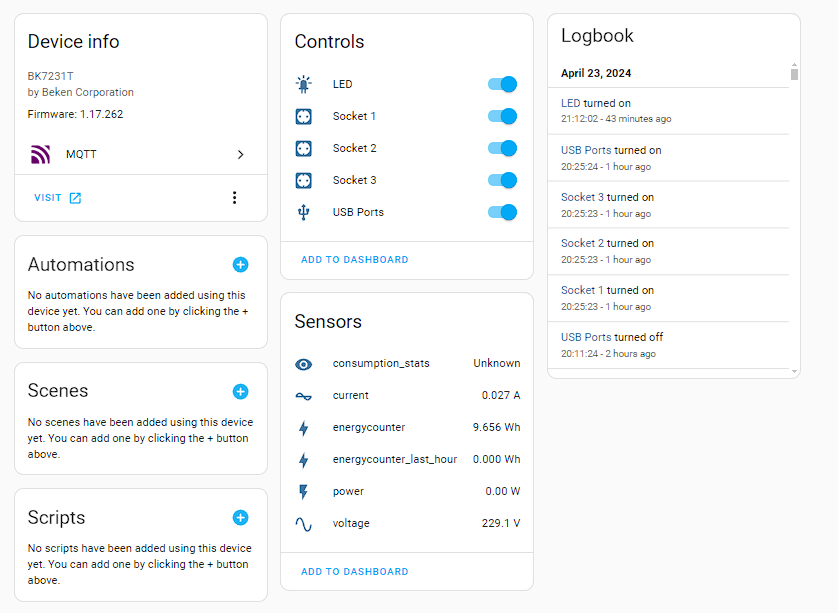
    Configure HomeAssistant, and it will nicely show up
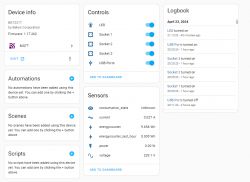
    Control panel and log of Woox R6132 socket

    I played around with it, and it works like a charm.

    I hope you enjoyed it, and if you have a device you want me to purchase and investigate, happy to do so!

    Cheers

    Cool? Ranking DIY
    About Author
    nielspiersma
    Level 9  
    Offline 
    nielspiersma wrote 60 posts with rating 20, helped 3 times. Been with us since 2022 year.
  • ADVERTISEMENT
  • #2 21057895
    p.kaczmarek2
    Moderator Smart Home
    Posts: 14440
    Help: 650
    Rate: 12411
    I flashed a Woox power strip once, but it was easier to open. Futhermore, it had ESP8266 inside:
    https://www.elektroda.com/rtvforum/topic4036447.html#20964495
    https://www.elektroda.pl/rtvforum/topic4036447.html#20964495
    I am really interested in seeing more teardowns, what kind of devices do you have available for purchase?
    Helpful post? Buy me a coffee.
  • ADVERTISEMENT
  • #3 21058186
    nielspiersma
    Level 9  
    Posts: 60
    Help: 3
    Rate: 20
    Hi,
    I don't have any devices for sale :). But I like purchasing Smart devices, hoping they contain BK chips, and adding them to my HomeAssistant.
    So, every two months, I spend about 25 euros on a new device and see if I can integrate it.
    I have a load of BT-enabled devices that I don't use, such as several smart switches and ceiling lights.
    For me, "de-china-nizing" smart home devices is a hobby, something I do just for fun.

    So if you have a link to a device I can try, I'm happy to purchase it and give it a shot.

    Cheers
  • ADVERTISEMENT
  • #4 21058197
    p.kaczmarek2
    Moderator Smart Home
    Posts: 14440
    Help: 650
    Rate: 12411
    That's what I meant, I asked which devices are available for purchase for you.
    In general, anything that is not yet on our list here:
    https://openbekeniot.github.io/webapp/devicesList.html
    should be interesting for us
    Helpful post? Buy me a coffee.
  • ADVERTISEMENT
  • #5 21058231
    nielspiersma
    Level 9  
    Posts: 60
    Help: 3
    Rate: 20
    Just volunteering :)
  • #6 21058283
    p.kaczmarek2
    Moderator Smart Home
    Posts: 14440
    Help: 650
    Rate: 12411
    Would you like to free from the cloud some simple device? Or would you rather try something harder, maybe TuyaMCU based? I can guide you step by step in case of more advanced devices.
    Helpful post? Buy me a coffee.
  • #7 21058295
    nielspiersma
    Level 9  
    Posts: 60
    Help: 3
    Rate: 20

    I have already tinkered with about 20 devices, ranging from simple relays to impulse counters to TuyaMCU electricity meters.
    I'm looking around for new devices to break down and add to the list.
    As I don't mind sacrificing one or two devices, I am merely looking for a device someone wants to have processed before buying.
    Niels

    Added after 2 [minutes]:

    This would be something I would be happy looking into:)
    https://www.amazon.nl/wifi-schakelaar-afstand...g-schakelaar-energiemeting-16A/dp/B0B7MYYT2V/
    https://www.amazon.nl/Happlignly-Energy-Afsta...ening-Digitale-Frequentiefactor/dp/B0BNT98ND8
  • #8 21058451
    p.kaczmarek2
    Moderator Smart Home
    Posts: 14440
    Help: 650
    Rate: 12411
    I am also doing lots of teardowns, here you can see my latest ones:
    https://www.elektroda.com/rtvforum/topic4049884.html
    https://www.elektroda.com/rtvforum/topic4048894.html
    https://www.elektroda.com/rtvforum/topic4047343.html
    https://www.elektroda.com/rtvforum/topic4046607.html
    I think you can try ordering those devices, however, I may have seen something similiar on forum, maybe branded as atorch? It may be worth checking. Still, even if you order the same device, you may get different revision, so the teardown will be still helpful.
    Helpful post? Buy me a coffee.
  • #9 21058538
    nielspiersma
    Level 9  
    Posts: 60
    Help: 3
    Rate: 20
    Check. Keep you posted
📢 Listen (AI):

Topic summary

✨ The discussion revolves around the configuration and internal overview of the Woox R6132 Smart WiFi Multi Power Socket, which features four relays—three for power sockets and one for USB ports, providing a total charging power of 3A at 5V. Users express interest in the device's internal components, particularly the power meter chip, leading to discussions about device teardowns and modifications. One user mentions their experience with flashing similar devices, specifically those containing ESP8266 chips, and expresses a hobbyist interest in integrating smart devices into HomeAssistant. The conversation includes links to various teardowns and suggestions for other devices to explore, emphasizing the community's focus on "de-china-nizing" smart home products.
Generated by the language model.

FAQ

TL;DR: With 4 relays and a 3A @ 5V USB section, the Woox R6132 is a strong OpenBeken target for users who want local control and power monitoring. As the teardown shows, "Bang. You're in recovery mode." Flashing works with Cloudcutter on Tuya v1.3.5 and a WB3S/BK7231T template for Home Assistant-ready setup. [#21057584]

Why it matters: This FAQ helps smart-home tinkerers replace Tuya cloud dependence with a repeatable local flashing and calibration workflow for the Woox R6132.

Variant discussed Main Wi-Fi module/chip Opening difficulty What matters for setup
Woox R6132 in this thread WB3S / BK7231T High; one unit was sacrificed Use BK7231T profile, map 4 relays, calibrate BL0937
Earlier Woox strip mentioned in replies ESP8266 Easier to open Different internal platform, so flashing method and template differ

Key insight: External branding does not guarantee identical internals. Two Woox power strips can require different flashing paths because the chip family and board revision may change between models or production runs.

Quick Facts

  • The Woox R6132 has 4 relays: 3 switch AC outlets, and 1 switches power to the USB charging section. [#21057584]
  • The USB charging block provides 3A @ 5V total and includes 2 USB-C ports plus 2 classic USB ports. [#21057584]
  • The teardown identified a WB3S module with a BK7231T and a BL0937 power-monitoring chip, running Tuya firmware v1.3.5 before reflashing. [#21057584]
  • Calibration values shown in the thread used a 60 W lamp, 231 V measured mains, and 0.261 A calculated current for OpenBeken setup. [#21057584]

How do I put the Woox R6132 Smart WiFi Multi Power Socket into recovery mode for flashing?

Put it into recovery mode with a two-press sequence on the single button. 1. Power on the strip. 2. Hold the button until the LED blinks slowly, then release. 3. Press the button again until the LED turns off. The thread describes that final state as recovery mode, ready for Cloudcutter on the Tuya v1.3.5 unit. [#21057584]

What pin template should I use to configure the Woox R6132 with a WB3S BK7231T module in OpenBeken?

Use the posted OpenBeken JSON template for the Woox R6132 with WB3S and BK7231T. It maps relay outputs to pins 6, 8, 9, and 14; the LED to pin 10; the button to pin 11; and BL0937 signals to pins 1, 24, and 26. The command field is backlog scheduleHADiscovery 10;, which helps Home Assistant discovery after applying the template. [#21057584]

How do I flash a Woox R6132 running Tuya firmware v1.3.5 with Cloudcutter and BK7231T firmware?

Flash it by using Cloudcutter with the BK7231T 1.3.5 profile after entering recovery mode. The thread states the unit ran Tuya v1.3.5 and says to "flash it with BK7231T 1.3.5 firmware cutter" and then install the firmware flavor you prefer. Apply the template afterward so the 4 relays, button, LED, and BL0937 power meter all map correctly. [#21057584]

What is the BL0937 chip in the Woox R6132, and how does it handle power monitoring?

"BL0937 is a power-monitoring chip that measures electrical load data, using dedicated signal lines for metering functions in smart plugs and strips." In this R6132, the WB3S controls the BL0937 and exposes its signals through pin assignments BL0937SEL, BL0937CF1, and BL0937CF. That is why the author opened the unit after relay setup: the strip appeared to support energy measurement. [#21057584]

How do I calibrate power, voltage, and current on the Woox R6132 using a 60 W bulb and a multimeter?

Calibrate it with the exact values shown in the thread. Set PowerSet 60 for the lamp wattage, VoltageSet 231 for the multimeter reading, and CurretSet 0.261, calculated as 1000*(60/231). Use a 60 W bulb as the known load and your own measured mains voltage, not a guessed value. That keeps BL0937 readings aligned with real consumption in Home Assistant. [#21057584]

Why would a Woox R6132 need to be opened physically even after the relays are already configured?

You may still need to open it to identify the energy-monitoring hardware. The author had already configured the relays, then noticed the strip should include a power meter and wanted to locate the metering chip. Opening confirmed the WB3S module, BK7231T, and BL0937. That internal check mattered because relay control alone would not reveal how power measurement was wired. [#21057584]

What is a WB3S module, and how is it related to the BK7231T in Tuya-based smart plugs?

"WB3S is a Tuya Wi-Fi module that carries the main control chip, providing wireless connectivity and GPIO control for relays, LEDs, buttons, and sensors." In this Woox R6132, the board is labeled WB3S and the installed chip platform is BK7231T. That pairing is the reason the posted OpenBeken template targets a BK7231T-based WB3S design. [#21057584]

ESP8266 vs BK7231T in Woox power strips — what differences matter for flashing and Home Assistant integration?

The main difference is that the chip family determines the flashing path and configuration template. In this thread, the R6132 used a WB3S with BK7231T, while another Woox strip mentioned in the replies had an ESP8266 and was easier to open. For Home Assistant, both can expose entities after setup, but you must match the firmware and GPIO mapping to the actual internal platform. [#21057895]

What should I do if the screw heads on a smart power strip are flattened and the case will not open?

First try a non-destructive approach, because flattened screws can force a destructive teardown. In this case, the screw heads were flattened enough that the case could not be opened normally, so one unit was sacrificed to inspect the board. The practical lesson is simple: buy two if the price is low and you want one working sample plus one teardown candidate. [#21057584]

How does the Woox R6132 expose its four relays in Home Assistant, including the USB charging ports relay?

It exposes four controllable outputs after you flash it and apply the template. Three relays control the three AC sockets, and the fourth relay switches power to the USB charging section with 2 USB-C and 2 classic USB ports. The thread shows that, once configured, the device appears cleanly in Home Assistant, with relay control and calibrated energy data. [#21057584]

What kinds of smart devices are still worth buying and tearing down if they are not yet listed in the OpenBeken supported devices database?

Devices not yet listed in the OpenBeken database are the best teardown candidates. One reply says that, in general, anything absent from the public device list should be interesting for the project. That makes unlisted plugs, switches, meters, and lights valuable even when they look ordinary, because a new teardown can add board details, pin maps, and firmware guidance for others. [#21058197]

How do TuyaMCU-based electricity meters differ from simple relay-based WiFi devices when integrating them with OpenBeken?

TuyaMCU electricity meters are the harder class because they add a secondary control layer beyond basic relay switching. The poster says he has already worked with about 20 devices, ranging from simple relays and impulse counters to TuyaMCU electricity meters, and another reply offers step-by-step guidance specifically for more advanced devices. Simple relay hardware usually maps directly; TuyaMCU devices often need deeper protocol handling. [#21058295]

Why might two visually similar Tuya smart devices have different internal revisions or chips after purchase?

Because the same-looking product can ship with different internal revisions over time. One reply warns that even if you order what seems to be the same device, you may receive a different revision, which still makes a teardown useful. That means case design, seller photos, or branding do not guarantee the same Wi-Fi module, metering chip, or flashing method. [#21058451]

What does 'de-china-nizing' a smart home device usually mean in practice for Tuya and Woox products?

Here it means removing cloud dependence and integrating devices into a local smart-home stack. The poster says he buys smart devices that hopefully contain BK chips, flashes them, and adds them to Home Assistant. He describes "de-china-nizing" as a hobby, done for fun, but the practical result is clear: local control instead of relying on the original Tuya cloud workflow. [#21058186]

Which smart devices available in the Netherlands or on Amazon are good candidates for OpenBeken teardown and cloud-free flashing?

Two Amazon Netherlands energy-related Wi-Fi switches linked in the thread are good candidates because they were explicitly flagged for teardown testing. The poster says he would be happy to look into those models and usually spends about 25 euros every two months on a new device to integrate. A strong candidate is any locally sold Tuya-style product not yet present in the OpenBeken list. [#21058295]
Generated by the language model.
ADVERTISEMENT