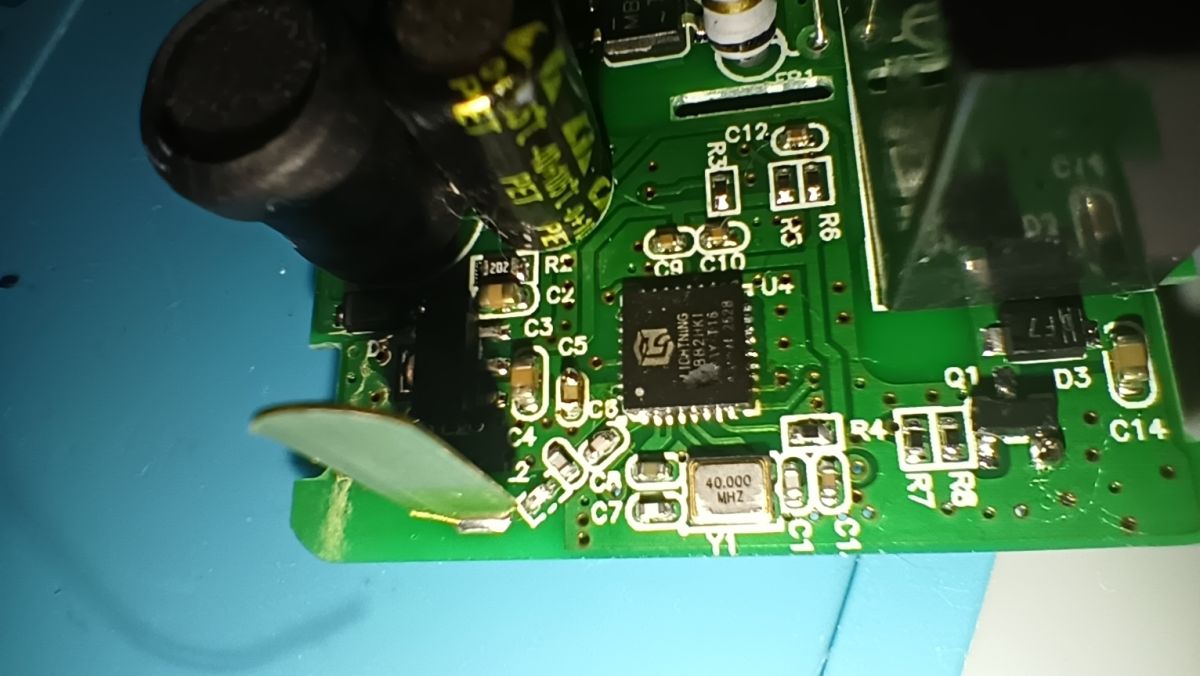
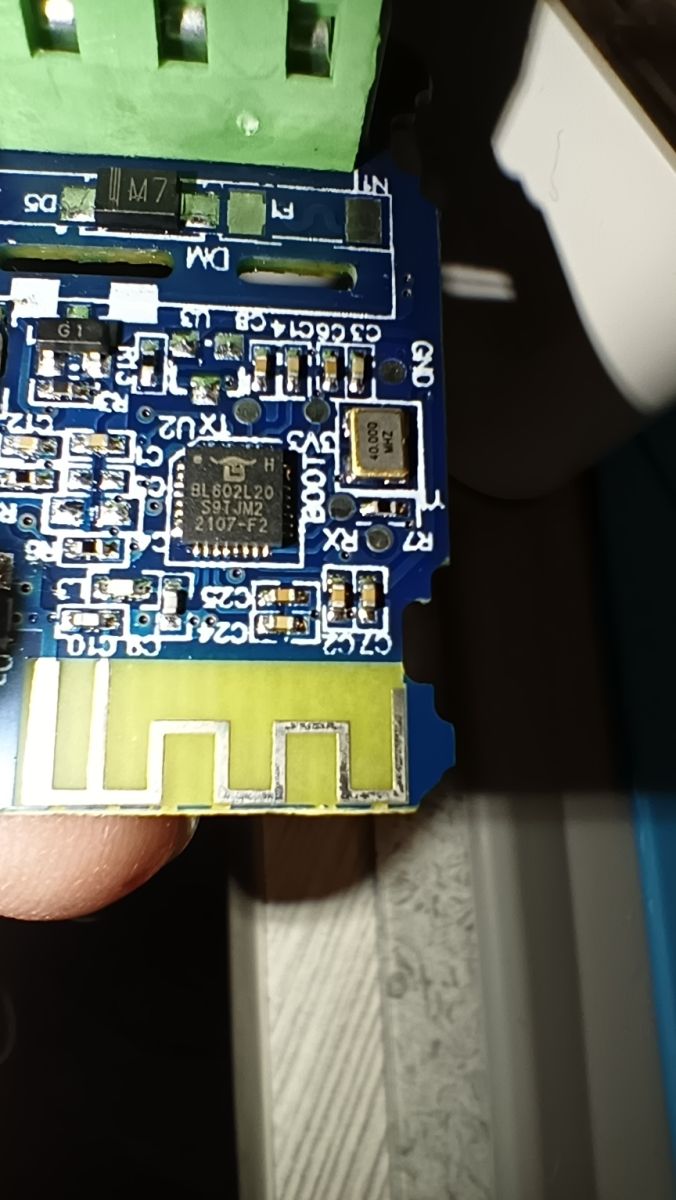
A step-by-step video shows how to flash the LN882HKI/LN882H module and set it up for cloud-free OpenBeken use.
The process uses soldered wires, grounds one BOOT pin, and then flashes new firmware over UART, much like ESP8266 recovery.
As of 2026, read/write support also works with BK7231GUIFlashTool, replacing the legacy flashing tool for the same wiring setup.
After flashing, the firmware can pair with Home Assistant and later enable features such as DHT11 support, SSDP discovery, and Tasmota Control via OBK scripting.
AI summary based on the discussion. May contain errors.
>>21811084 The hole in the controller can't be fixed, and you can't buy a separate microchip on AliExpress. I also have a BL602 relay that I also burned out with my experiments, and they don't sell microchips for it either.
I think DR means "Dual Role" (wifi + bt), in which case it can be removed. Added it just for testing, and forgot to remove it.
0x40012034 is unknown, but it's also in RF_P0_BASE range.
With it, i've had no packet drops for 10 minutes (but there were some duplicates).
But i didn't test without it.
https://github.com/openshwprojects/OpenBK7231T_App/pull/1963 LN882H/LN8825 ADC, H UART (with configurable pins), H changing log port.
Disabled berry for now, added tuyamcu driver for testing. Plus i remember there was a request for BL0942 for H.
Fixed 8266 crash (https://github.com/NonPIayerCharacter/OpenBK7231T_App/blob/95316e3bf42fc9efae36a355138f15714977b51b/src/mqtt/new_mqtt.c#L2450)
Possibly https://github.com/openshwprojects/OpenBK7231T_App/pull/1969 Flash vars on BK and W600 in easyflash.
With this, every platform would support KV storage.
Moved fast connect data from config to EF.
Disabled log and asserts in EF so that it would be more compact.
Removed __FILE__ macro (would return empty string).
Disconnect from wifi on reboot/short sleep (possibly make it bk only). As it is now, first connect attempt after reboot/wake would fail with psk option.
All in all, + about 500 bytes to .rbl on 7238.
Very cool, certain merge, but just let me know - maybe we could easily use some kind of "create dropdown helper" to make it more DRY? We already have one for a button. Don't we have a dropdown helper somewhere?
However... it seems you're using fx_ syntax, not a generic dropdown?
>>21828358 Will survive, but only on new installs.
Plus, currently there is no way to disable them (via DISABLE_FLASH_VARS_VARS)
It might even be possible to enable HLW8112 together with BL09xx in the same build (flash vars conflict before?)
Would be good to test it on real 8112 device.
Easyflash holding flashvars on W600 would also allow enlarging config over the actual flashvars area so config V4+ would be possible without moving own flashvar structure.
Downgrade will loose data, since it's not aware of the changes.
But that was always the case (CRC over the whole V4 range will be different to the CRC over V3 config.)
The only thing i've noticed is that first boot is slower, probably because it's erasing env area.
What i tested: T, N, N_ALT and 8. If they work, then the rest will work too.
Plus new sdk always logs when it's switching flash protect on/off.
P.S i put flash vars at 0x1E5000, because on T1 there is some encrypted data at 0x1E4000, that looks similar to tuya config.
I tested the 1969 PR on N just now, all I have to say is - I can't figure out how to measure reboot time, it is that fast, will try to monitor the uart output to figure out what is going on....
as @p.kaczmarek2 said it feels like reboot is broken
>>21830400 Updated my N plug to 1.18.255. Works fine (at least for now).
But it started spamming Button_OnLongPressHold. It didn't on 1.18.247_ALT (at least i don't think so, i've had logging disabled).
Why would buttons behaviour change? Wasn't it untouched?
insmod wrote:
Disconnect from wifi on reboot/short sleep (possibly make it bk only). As it is now, first connect attempt after reboot/wake would fail with psk option.
.
@DeDaMrAz maybe that's what you mean by quick reboot? You mean... quick reconnect?
maybe that's what you mean by quick reboot? You mean... quick reconnect?
Not what I have seen, both reboot and reconnect worked and are quick, haven't seen failed WiFi reconnects... maybe I am wrong as my tests were short and I haven't observed the TX2 output I was more focused on other aspects, LFS, startup commands, last state.....
just playing with LN RF calibration source boot logging + donor nvds transplants from those dumps that do contain rf info in flash. I wanted to know if OpenLN882H would use the rf values in nvds if present.
boot log with build to blank flash on MQ-12F dev board - ie no rf data
Code: Text
Log in, to see the code
transplant GHome/Cuco dump RF 0x1C2000/0x3000 bytes -> 0x1DD000 and this is the boot log
Code: Text
Log in, to see the code
Code: Text
Log in, to see the code
-The WiFi blob asked for RF/TX compensation.
-OpenLN accepted the transplanted NVDS because ATE='S'.
-OpenLN returned b=-7 and gn=-21 to the WiFi blob.
-LMH/channel compensation was read from NVDS but is blank.
TLDR, transplanting to rf data from a dump that does have it present appears to mean it's used to calibrate OBK.
But, only these 5 dumps have RF data in their nvds
Dump
CopySourceOffset
ActiveSector
XtalComp
BComp
GNComp
RFScalarValues
Tuya_GHome_SW5...Cuco_1.0.5.bin
0x1C2000
sector1
+9
-7
-21
xtal +9, b -7, gn -21
Tuya_GHome_SW5...Cuco_1.1.3.bin
0x1C2000
sector1
+9
-7
-21
xtal +9, b -7, gn -21
Tuya_W505Z2_E14_Candle_Bulb...1.0.0.bin
0x1C2000
sector2
-4
-19
blank
xtal -4, b -19, gn blank
Tuya_W505Z2_GU10_BULB...1.0.0.bin
0x1C2000
sector2
-7
-12
blank
xtal -7, b -12, gn blank
Tuya_BSD34_EU_PLUG...WL2S_1.0.4.bin
0x1C2000
sector1
-2
+3
0
xtal -2, b +3, gn 0
dunno if this means it's worth having a BK7238 kind of transplant option.
thought it interesting whatever the case
The discussion focuses on flashing, backing up, and reverse-engineering the LN882H/LN882HKI Wi‑Fi module used in smart switches and bulbs. A Linux flashing tool and later a Windows/C# flasher were developed around a reverse-engineered UART boot protocol, initially assumed to be similar to ESP8266 but later identified as YMODEM-based with ASCII boot commands such as fdump, flash_read, flash_otp_read, and ferase_all. Users shared pinout findings for LN882H boards, including boot/download mode wiring, TX/RX locations, and the need to ground the BOOT pin. The thread also covers OpenBeken/OpenLN882H support, SSDP/Wemo discovery, GPIO limitations on QSPI-reserved pins, and troubleshooting of flashing failures caused by UART adapters, COM port issues, power supply quality, and baud-rate limits. Later posts document successful flash dump and write operations, faster custom ramcode-based dumping, and ongoing work to expose terminal commands and improve read speed and firmware support. AI summary based on the discussion. May contain errors.
TL;DR: Backing up 2MB from LN882H went from about 14 minutes to 12.5–24.8 seconds, and one tester confirmed, "SmartLife AP seen and pairs in Tuya app." This FAQ is for people flashing LN882H/LN882HKI modules with OpenBeken, restoring Tuya backups, and fixing UART, Wi‑Fi, GPIO, and SSDP issues. [#21609499]
Why it matters: LN882H devices often look simple to flash, but real success depends on correct boot wiring, stable 3.3V power, the right RAM loader, and avoiding reserved GPIOs.
Tool
Best use
OS
Read/backup speed reported
Notes
SharpLN882HTool
Flash, erase, backup, restore
Windows
24.77s at 921600; 47.52s at 460800
Later builds restored full Tuya dumps successfully
LN882Loader
Linux flashing and backup
Linux
Earlier full 2MB dumps around 10–14 min
Reverse-engineered, YMODEM-based
Tuya flasher / tyutool_cli
Vendor flashing
Windows / Linux extraction
Read not supported in tyutool_cli
One user saw: "Don't support read."
Key insight: The biggest breakthrough was not the firmware itself but the RAMCODE path: once the custom dumper switched to raw binary reads with CRC and stable UART polling, LN882H backup and restore became fast enough to be practical for everyday recovery and migration. [#21608266]
Quick Facts
Full-flash backup size is 2MB, and one successful custom dumper run finished in 12.5 seconds at 921600 baud after RAMCODE improvements. [#21608190]
Earlier dump methods were much slower: 2MB in ~14 min 20 s with LN882H_RAM_BIN.bin, and about 9 min 50 s after changing baud and stub choices. [#21605883]
A validated speed comparison for SharpLN882HTool v22 showed 184.05 s at 115200, 47.52 s at 460800, and 24.77 s at 921600, with identical SHA-256 hashes across those dumps. [#21609499]
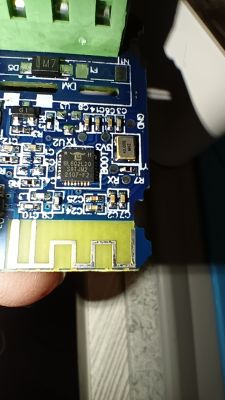
Safe UART access points identified on a bare LN882HK1-on-PCB board were A2 = TX0, A3 = RX0, A9 = pull low for UART download mode, and B9 = TX1 boot log, often at 921600 baud. [#21593199]
One reproducible GPIO failure on LN882H was P13 crashing on “Set Output High” in firmware 1.18.42, later linked to flash/QSPI-reserved pins that should not be driven as normal outputs. [#21446468]
1. How do I flash an LN882H or LN882HKI module with OpenBeken step by step using UART and the BOOT pin?
You flash LN882H over UART by grounding one BOOT pin, powering the board at 3.3V, and sending a RAM loader before the firmware. 1. Solder GND, 3.3V, TX, RX, and the BOOT pin. 2. Hold BOOT low, power up, then connect with a flasher tool. 3. Upload the RAM loader, then write OpenBeken to flash at 0x0. The original guide says LN882H flashing is “very similiar to ESP8266,” with BOOT grounded to enter flashing mode. [#21372895]
2. Where are TX, RX, and boot-mode pins on an LN882HK1 chip mounted directly on the PCB, and how do I identify them safely?
On one directly mounted LN882HK1 board, the reported pins were A2 for TX0, A3 for RX0, A9 for boot-mode entry, and B9 for TX1 boot logs. Safest identification uses labeled pads, board photos, and UART observation before soldering to tiny chip legs. 1. Find GND, 3.3V, and EN first. 2. Check nearby pads against known LN882H pin maps. 3. Confirm with a logic analyzer or boot log on B9 before forcing boot mode. [#21593199]
3. Why does LN882H flashing fail with a USB-to-UART adapter even when it has a 3.3V output, and how can I troubleshoot power and COM port issues?
LN882H flashing often fails because the adapter is not actually transmitting, the COM port is wrong or busy, or the 3.3V rail is unstable under load. One user fixed repeated failures by replacing a faulty FTDI232 adapter with a CH340G unit; another was told to verify COM6 and check for port-hogging software like Cura. A separate report also found that an AMS1117-based 3.3V source improved flashing stability. [#21443865]
4. What is YMODEM, and how is it used by LN882H flashing tools and RAM loaders?
“YMODEM” is a serial file-transfer protocol that sends block-based data with acknowledgements and CRC checks, enabling reliable firmware or RAM loader transfer over UART. LN882H tools use YMODEM to upload the temporary RAM loader first, then often use it again to write the actual firmware image. Reverse-engineering in the thread identified YMODEM as the protocol behind the loader flow, and later tool logs showed ACK, EOT, CRC, and packet counters exactly matching that process. [#21376683]
5. What is SSDP discovery, and why did Alexa or Wemo emulation not work on LN882H until SSDP support was enabled?
Alexa and Wemo emulation did not work because LN882H lacked SSDP support in earlier builds. “SSDP discovery” is a local-network service discovery protocol that advertises devices over multicast, letting controllers like Alexa find compatible endpoints automatically. In the thread, Wemo emulation showed up in setup.xml, but Alexa still could not discover it until SSDP and the related networking support were enabled on LN882H. A later post said SSDP had been enabled the previous week. [#21430384]
6. LN882Loader vs SharpLN882HTool vs Tuya's LN882H flasher — which tool is best for flashing, backup, and restore on Windows or Linux?
SharpLN882HTool became the best all-around choice for Windows once fast dump, erase, and restore worked; LN882Loader stayed strong for Linux; Tuya’s tools were useful for reference but weaker for backup. A tester confirmed SharpLN882HTool erased flash, wrote OpenLN882H, restored a full Tuya dump, and then saw the “SmartLife AP” pair in the Tuya app. Another user also reported tyutool_cli could communicate with the chip but ended with “Don't support read.” [#21609499]
7. Why is dumping LN882H flash so slow with flash_read or fdump, and how did the custom RAMCODE speed it up?
The old dump path was slow because it read tiny chunks as ASCII hex over UART instead of sending raw bytes. One developer explained that flash_otp_read 0x0 0x100 returned text like AE BE 4F 2D 5A, meaning roughly 3 characters per stored byte. The custom RAMCODE changed the method to raw binary blocks plus CRC, which removed the ASCII overhead and made full 2MB reads practical in seconds instead of minutes. [#21607145]
8. How can I back up the full 2MB flash from an LN882H module and restore that backup later without losing Tuya or OpenBeken data?
You can back up the full 2MB flash, erase the chip, and later restore that exact image to recover Tuya or OpenBeken. 1. Use a tool that reads the full 0x200000 flash range to a file. 2. Save that dump before experimenting. 3. If needed, erase flash and write the saved file back at 0x0. A tester erased an LN882H, reflashed a Tuya dump with SharpLN882HTool, and confirmed the SmartLife AP appeared and paired in the Tuya app. [#21609499]
9. Which LN882H GPIOs are unsafe to drive as outputs, and why do some pins cause WDT resets or crashes in GPIO Doctor?
Some LN882H pins mapped to the internal flash/QSPI area are unsafe as normal outputs and can trigger crashes or WDT resets. One contributor stated that pins from A13 to B2 should not be used because they are reserved for QSPI, likely internal flash. Real testing also showed repeatable crashes, including P13 on “Set Output High” in version 1.18.42, and later fixes focused on disabling those dangerous pins in HAL. [#21446533]
10. How do I use GPIO Doctor or manual testing to find the relay, button, LED, and PWM pins on an unknown LN882H device?
Use GPIO Doctor carefully, starting with inputs and low-risk checks, then test outputs one at a time while watching for crashes. 1. Back up flash first. 2. Probe candidate pins as digital input or input-pullup before driving outputs. 3. Map relay, LED, button, and PWM by changing one pin at a time and noting physical responses. This matters on LN882H because some pins can crash the device, yet the same method still helped users identify working relay and PWM pins on unknown boards. [#21446543]
11. What Wi-Fi settings are actually available in OpenBeken for LN882H besides Power Save, and what else can cause random disconnects on one network but not another?
Beyond Power Save, the thread only names Quick Connect as another practical LN882H Wi‑Fi option in OpenBeken. A developer added that Wi‑Fi behavior mainly comes from the LN882H SDK, not shared OBK code, so stability can change by platform. In the reported disconnect case, likely causes included local RF noise, supply quality, MQTT load, and possibly flash state or calibration, especially because the same device stayed stable for 3 days on a different network. [#21579867]
12. Why did WPA3 or WPA2/WPA3 connections fail on older LN882H SDK builds, and what changed in the newer Wi-Fi library versions?
Older LN882H builds failed on WPA3 because the Wi‑Fi library rejected association, including repeated reason code 43 errors. That changed after the SDK moved to newer Wi‑Fi libraries, including WiFi Lib 1.5.0, where one tester successfully joined a WPA‑SAE (CCMP) access point and verified fast reconnection after the AP returned. The same tester also said WPA2-only and mixed WPA2/WPA3 then behaved correctly. [#21615134]
13. How does the faster custom LN882H RAM dumper work, including baud rate, CRC checks, and polling vs interrupt-based UART TX?
The faster dumper uploads a custom RAMCODE, reads flash in fixed binary blocks, appends a 2-byte CRC16 to each block, and transmits over a high UART baud rate. One implementation used 512-byte flash blocks plus CRC and achieved stable dumps at 921600 baud after switching UART TX from interrupt mode to polling mode. The author said polling was not faster by itself, but it was more stable and fixed CRC failures seen at higher baud rates. [#21610067]
14. What does LN882H RAMCODE do during flashing, and how is it different from the normal bootloader or secondary boot stage?
RAMCODE is a temporary program sent over UART into RAM so the chip can erase, write, dump, and inspect flash using richer commands than the ROM alone provides. “RAMCODE” is a RAM-resident helper program that runs after UART boot, adds flash commands, and then hands control back or resets after the task finishes. The SDK description in the thread distinguishes it from the normal bootload stage, which is the secondary boot path from flash to app during standard startup. [#21605903]
15. How can I build a custom OpenBeken OTA firmware for LN882H with extra drivers like SHT3X enabled, either locally or through GitHub Actions?
You can build it locally or through GitHub Actions by enabling the driver macro for LN882H. The thread’s build steps say to add #define ENABLE_DRIVER_SHT3X 1 under #elif PLATFORM_LN882H in src/obk_config.h, then run make OpenLN882H locally. If you do not have the toolchain, fork the repository, enable Actions on the fork, commit the config change, and download the finished firmware artifact from the workflow summary. [#21709798]
AI summary based on the discussion. May contain errors.